

Ed.Note July 2012: This post was composed in February of 2010 in response to The Grammys during a time when I was a serious Lady Gaga fanatic. I remain a Gaga fan but am honestly kinda embarrassed by the unbridled Gaga fanaticism expressed in this post. In lieu of retro-editing the post, I encourage you to see the few statements about Gaga contained herein in the context of that time and not let those statements distract you from the rest of the post. Obviously Taylor Swift herself has changed since then and will continue to, so just you know, appreciate this for the little time capsule it is.
 Yesterday, looking for Daily Fix links, I came upon an MTV news piece by James Montgomery titled “Why You Shouldn’t Hate On Taylor Swift.” Fair enough — the hype cycle moves quickly these days and now is probably the opportune moment for someone to step up and captain the “backlash-to-the-backlash” train. But his argument is so off point I wondered if he’d picked this topic or if the unprovable thesis had been assigned to him. Because it’s a difficult point to prove.
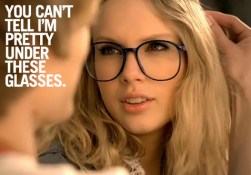
For starters, no one has been “hating on Taylor” — as I understand it, they’ve been hating on Taylor Swift the Product and, as of late, her accumulation of Important Awards. See, there’s nothing to hate about Taylor Swift the human. She’s nice and honest, she’s pumped much-needed cash into the music industry, she looks cute in glasses and she’s friends with Our Heroine Ellen DeGeneres.
There wasn’t even anything to “hate” about Taylor Swift’s twangy addictive pop/country music until she snagged Album of the Year, thus transitioning her from “harmlessly popular teenage pop fad” into the (relatively) Legendary-for-artistic-merit context associated with prior winners like John Lennon, Bob Dylan, Lauryn Hill, U2, Outkast and Eric Clapton.
Furthermore, relative to the oft-criticized oversexed young ladies of pop music, the Great Proverbial Mothers of America agree that they’d like their babies to grow up to be cowgirls, as long as that cowgirl is as effortlessly adorable and endearingly successful as Taylor Swift. And well; from a distance, that idea seemed fine to me too. If you’re one of those mothers who insist on conservative role models who compose girl-bashing boy-crazy rain-soaked anthems and you value a starlette’s “purity” over intelligence or even raw singing talent, then fine; better Taylor than Bristol Palin or G-d forbid, her mother. More on that in a minute.
The article claims this “hating” on Taylor is another nasty result of the internet’s “secure blanket of anonymity” — that people hate on Taylor because they can. That’s silly, ’cause the “hating” he describes comes from identified Facebook users and identified journalists. So, moving on.
His other primary theory for why everyone “suddenly” is “hating” on Taylor is that post-#kanyeshrug, Taylor earned “bona fide mainstream celebrity” status which made her vulnerable to corresponding widespread attack and criticism. That’s untrue as well: most of these so-called “haters” either never liked Taylor or didn’t know of her ’til she won the award that their favorite musician lost. They’re not “hating” on Taylor simply because generalized “celebrity-hating” is a sport.
Where do my negative feelings towards her fit in? I didn’t know much about her ’til the VMAs, when right after learning who That Girl was, she beat Kelly Clarkson, Beyoncé and Lady Gaga for “video of the year” and I yelled [a bit drunk, I admit] “WHAT THE FUCK? GAGA? BEYONCE? ANYONE?” at the teevee, and, as if on cue, Hennessey-shitfaced Kanye popped up on stage to speak my mind and consequently kill his reputation.
Unsurprisingly 75% of the commenters on the MTV piece disagree with Montgomery’s case on all counts, particularly his dismissive “So what if Taylor had an off performance?,” since Taylor always has an off performance. In fact, MTV found the dueling commentary on the article so interesting that they made an article out of the comments before I even finished writing this one.
Yes, this gigantic essay began as a comment for that MTV article. I had feelings. They were getting too long for a blog comment. I decided to take said feelings to a Daily Fix. Then I hesitated.
See, I don’t like dwelling in negativity, nor do I enjoy vilifying anyone besides politicians & Ilene Chaiken. In fact, I prefer writing to endorse redemption of popular villains, such as Tila Tequila and Jenny Schecter.
“…Her entitlement to a blatantly untrue ‘fairy tale’ narrative tastes disingenuous and cheap.”
But I can’t seem to let go of this Taylor Swift thing, and though the comparison is extreme, she irritates me much like John McCain irritated me for most of 2008… or, more accurately, how Avril Lavigne‘s faux-“punk” abstinence anthem “Don’t Tell Me” irritates me or yes, how the Twilight franchise occasionally irritates me (though I’ve seen the first movie now, and I admit it does look cool).
I’ve already shared some of my qualms with you: that I feel her win represents a sinister endorsement of mediocrity/Wonderbread, that it means Digestible beat Daring and I prefer daring, that I’m irked by her consistent inability to recognize more deserving nominees in her acceptance speeches, and that her entitlement to a blatantly untrue ‘fairy tale’ narrative tastes disingenuous and cheap.
But, even after writing that, I felt guilty for having such antagonistic feelings about Taylor Swift the Image when Taylor Swift the Person is, obviously, a good human being.
However, before I brought it up again (especially this late, as the backlash-to-the-backlash part is over and we’re now in the Valley of WhoCares, which is clearly where I “thrive”), I knew I had to do my Taylor Swift due diligence. After reading that MTV article I did it: I listened to her music, read her blog, and watched her videos.
And I finally figured it out.
Taylor Swift is a feminist’s nightmare.
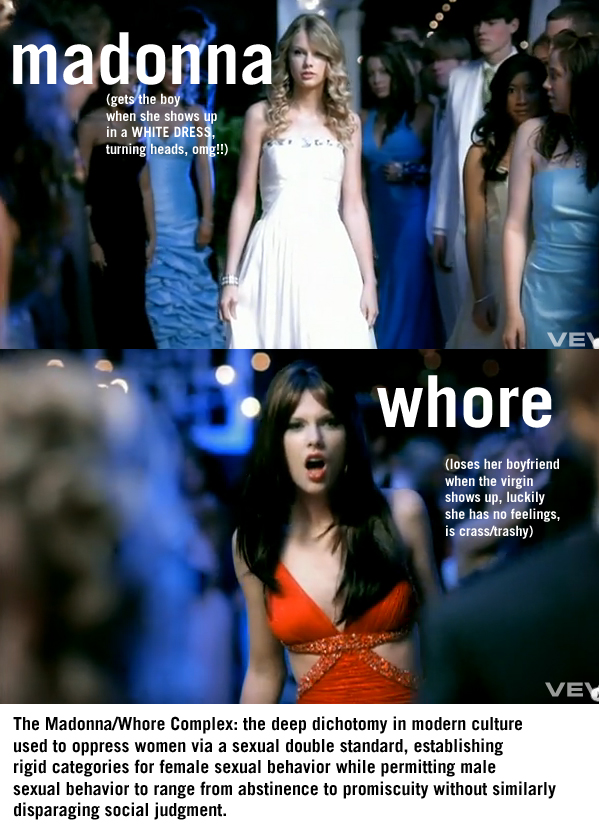
Taylor Swift’s Favorite Storyline
The rush to exalt Swift is (I believe) a desperate attempt to infuse our allegedly apocalypse-bound country with a palatable conservative ideology in the form of a complacent, repressed feminine ideal. It’s working ’cause Swift writes good songs and America is terrified that its children have been scarred by Britney Spears’s psychotic vagina and Miley Cyrus’s obnoxious adolescence.
“The Grammy voters chose someone who, according to her lyrics, has spent her entire life waiting for phone calls and dreaming about horses and sunsets.”
Rather than choosing an established/evolved talent (Beyoncé) or a fresh potential revolutionary (Lady Gaga), the Grammys chose someone who, according to her lyrics, has spent her entire life waiting for phone calls and dreaming about horses and sunsets.
Though the debate over her performance skills is a well-beaten horse at this point, her unequivocal worthiness as a role model for girls has been accepted complacently; at least within my limited purview.
Listen up; if I ever get my life together enough to reproduce other life forms, they will not be joining Taylor Nation — they will be brave, creative, inventive, envelope-pushing little monsters who will find a pretty, skinny white blonde girl in a white peasant shirt strolling through nature-themed screensaver-esque fantasylands singing about how “when you’re fifteen and somebody tells you they love you, you’re gonna believe them” not only sappy, but also insulting to their inevitable brilliance.
I don’t want my unborn grandchildren to listen to the story of how Taylor Swift won a Grammy she hadn’t earned. I want them to set pianos on fire.
+
1. Age is Just a Number
First, let’s address the age issue; as Swift is often celebrated as some kind of child prodigy. Twenty isn’t young and her talent, while exceptional, is not unheard of. Grammys have gone to Adele (21), Christina Aguilera (20 in ’00), LeAnn Rimes (16 in ’97), Mariah Carey (21 in ’90) and Alicia Keys (20 in ’02), among others. Until there’s evidence Swift can sing live, she’s not uniquely qualified as a musician.
Why does Swift seem, at 20, a decade younger than Lady Gaga? ‘Cause Swift’s package is “Purity Sue Ingenue”: eternally childlike, obedient and one-dimensional. Mothers love this package, and teenage girls are hypnotized by her simple songs and pretty hair and propensity for crying on her instruments.
Listen up! When Beyoncè was Swift’s age, she was onstage with Destiny’s Child, proclaiming: “The house I live in / I’ve bought it / The car I’m driving / I’ve bought it / All the women who are independent / Throw your hands up at me!”
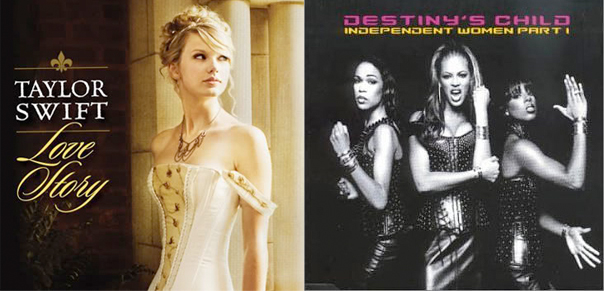
It goes without saying — because, of course, no one wants to say it — that Swift was able to succeed so early ’cause her family was both supportive & wealthy enough to enable her ambitions. Swift had dreams, she chased ’em, and she got ’em; all before puberty! That’s not a Cinderella story, that’s more or less the most awesome childhood of all time.
“Why does Swift seem, at 20, a decade younger than 23-year-old Lady Gaga? ‘Cause Taylor is the ingenue: eternally childlike, obedient and one-dimensional.”
So let’s stop judging her work on children’s terms and excusing that giggly self-absorption as a folly of youth. It’s annoying.
Never was this bunnyrabbitchild persona more exploited than it was after the VMAs. If Kanye had snatched that mike from Lady Gaga, she would’ve snatched it right back, called Kanye an asshole (he is), admitted he was right (he was), and the whole thing would’ve been done and DONE. She certainly wouldn’t have needed — or wanted — the entire country’s fawning faux-sympathy for months afterward.
Taylor had another chance at the VMA’s end to prove her maturity by thanking and honoring Beyoncé for calling her back up to speak. But no, she was just like, “A’ight my turn!”
Role models aren’t suspended children, trapped by projections and unable to grow until affirmed by an idealized male partner. Role models grow and change and challenge themselves and are rewarded for exceptionalism, not potential. Independently.
+
2. Yes, she writes her own songs (sorta). And it Shows.
Swift’s songwriting is as thematically ambitious as a 15-year-old’s LiveJournal, which is to say, like a 15-year-old’s LiveJournal, it never strives for thematic weight or challenges ideas not already covered by Sweet Valley High or The Children’s Illustrated Bible.
If Swift’s work connects with teenage girls, it does so on the most simplistic, reductive territory of all: pining for boys, walking in the rain, kissing in the rain, crying drops of tears on her guitar, driving in trucks with cool boys, wanting boys she can’t have, more rain, more letter-writing, more stalking, more broken hearts, breathing problems as a side-effect of broken hearts, fairytale princess this, white horse that, more pining at the window, more psuedo-stalking, more incomplete hearts yearning for your touch, and one song that misinterprets Shakespeare and The Scarlet Letter so criminally I’m certain she’s never read either.
Swift simply hasn’t had the life experience and doesn’t inherently possess the emotional maturity to create great art. Which is fine — most young pop stars don’t, which is why they don’t win Grammys.
We’ve decided to break this down for you with a special Autostraddle infographic:
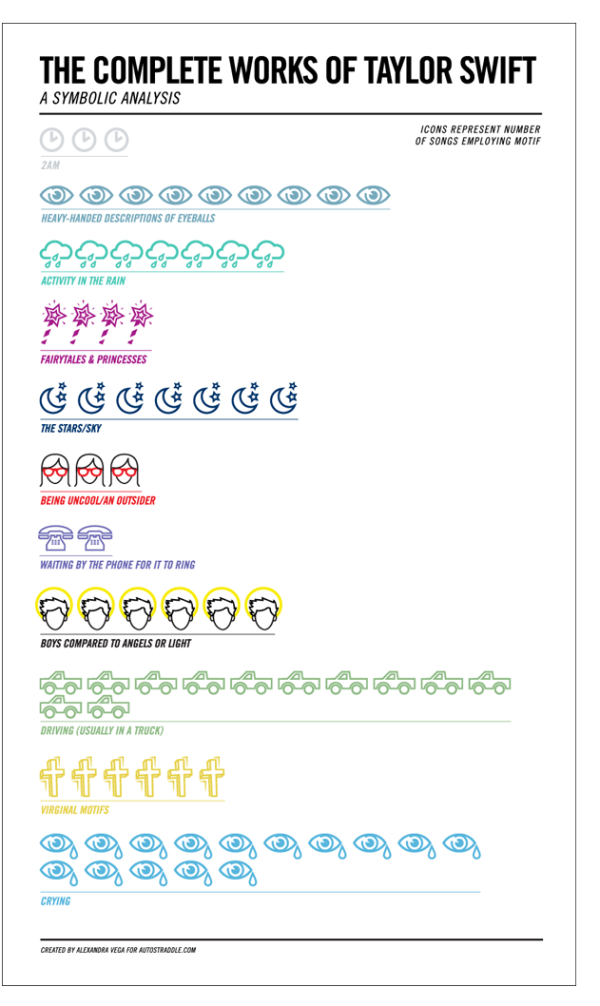
click to enlarge
Next Page:
Not only are her songwriting choices almost mind-numbingly safe, but she also covers territory so familiar, it’s almost a carbon-copy of someone else’s song!
Not only are these songwriting choices almost mind-numbingly safe, but they also cover territory so familiar, it’s almost a carbon-copy of someone else’s song!
In 2006’s “Girl Next Door,” by Saving Jane, the protagonist yearns:
She is the prom queen I’m in the marching band
She is a cheerleader I’m sitting in the stands
This sounds familiar, right?Well, here’s Taylor’s version:
But she wears short skirts, I wear t-shirts
She’s cheer captain and I’m on the bleachers
Interesting. Now check out the music video for “Girl Next Door”:
Just to refresh, here’s Swift’s version:
With almost frame-by-frame precision, Taylor Swift’s most popular music video is not only exactly like dozens of 80s and 90s teen flicks (which are basically remakes of 19th century romantic fiction & Shakespearean allegories), but it’s also exactly like the music video for “Girl Next Door.”
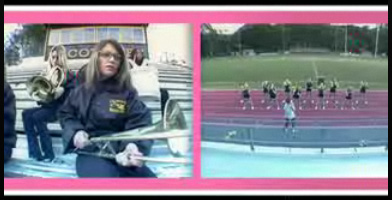
This happens a lot. For example; “A Place in this World” = one part “What It Feels Like For a Girl” (Madonna), one part “Just a Girl” (Gwen Stefani), one part “Not A Girl, Not Yet a Woman” (Britney Spears), and one part Donna Martin poem.
3. Glasses don’t Make You a Freak, Taylor Swift!
Swift’s insistence on casting herself as the outcast or the proverbial “girl in the bleachers” while prettier girls date her crush objects is really silly. Her standard-issue prettiness conforms to a hegemonic Caucasian beauty standard and she’s selling her fans short to claim otherwise; they’ll likely find that the doors that opened for Swift will never open for them, even if they relate to her lyrics.
Perhaps the only legitimately irritating aspect of Taylor the Human is her continually presenting the experience of being teased in middle school for liking country music as a legit tragic impetus. Taylor Fucking Swift! Put on a Rachel Berry smile and get yer sh*t together, we were all bullied in middle school!
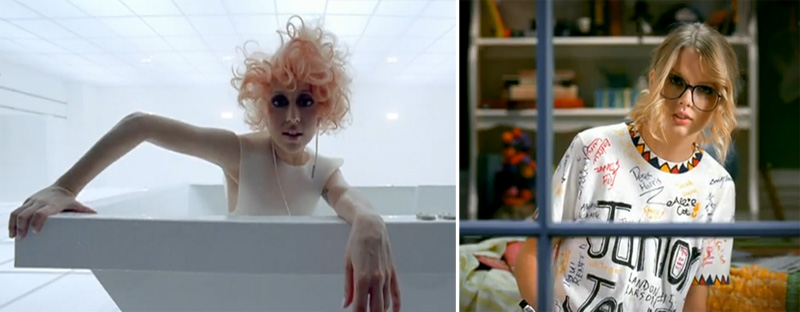
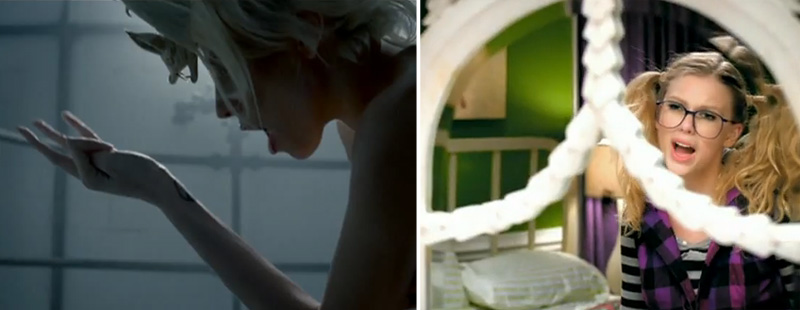
Even when Swift’s songs cast her as the outcast, the freakiest she can get is putting on a pair of glasses and a t-shirt which has apparently been signed by all of her non-existent friends.
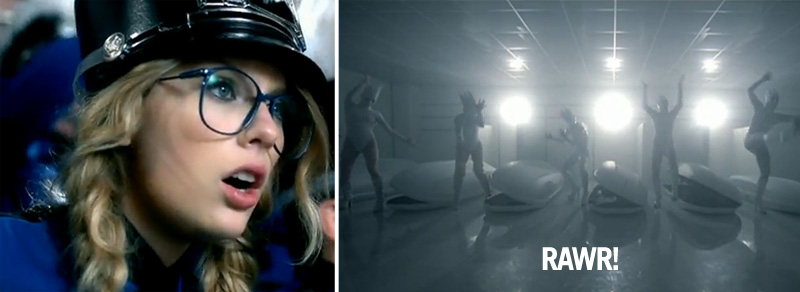
Taylor, look at Lady Gaga in that bathtub and tell me that you’re the one in the bleachers:
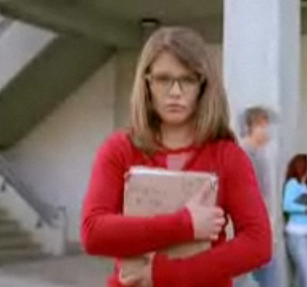
Oh also, they did the glasses trick in “Girl Next Door” video too:
Here’s the rub: actual freaks make really awesome music. It’s edgy and complicated and it comes from a yearning, desperate, mixed-up place where pain and happiness have existed in equal parts for almost entire lifetimes. It’s not safe or sexless — it’s ugly, hopeful danger.
+
4. High School Hop
Her lyrics are praised for authenticity, but to whom? Their flat, archaic view of high school is likely a result of Swift not attending too much high school.
In fact, Swift left regular school at 15 and was then home-schooled via Tennessee-based Christian home-schooling network Aaron Academy. The Academy’s rules are based on The Bible’s rules. The Academy teaches Creationism. Here’s one of their favorite websites: Creation Science.
Aaron Academy parents & teachers are also encouraged to visit the “Family Research Council” for its “excellent articles advocating traditional family values.” Today’s topics include “The Sexualization of our Armed Forces” and “New Study Shows Abstinence Education is Most Effective.”
This survival-of-the-fittest entitlement perhaps explains her lack of humility despite an otherwise charming personality.
5. The Boy-Crazy Girl-Bashing Virgin: My Least Favorite Kind of Person
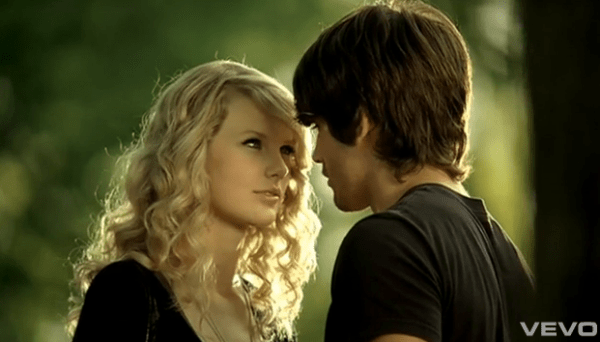
“Taylor wants to help adolescent girls everywhere feel better about themselves”
-Rolling Stone, The Very Pink, Very Perfect Life of Taylor Swift
Furthermore, Swift’s lyrical message to teenage girls is clear: BOYS. That’s it. Just boys. Crying over boys and feeling broken and/or completed by boys.
In fact, Swift loves boys at the exclusion of just about everything else, including other girls. Other girls are obstacles; undeserving enemies who steal Taylor’s soulmates with their bewitching good looks and sexual availability. Unfortunately for these mute yet effortlessly hunky jungle-eyed boys, by choosing the “beautiful” girls over Taylor (who is, suspiciously… also beautiful…), they’re missing out on Taylor’s unique understanding of their heart/inner fireball/angelic rainshower/sweet glory of Jesus. “All those other girls are beautiful,” Taylor pines, “But would they write a song for you?”
This is perhaps her music’s most grating sin: the sex-shaming girl-bashing passed off as outsider insecurity. Boys are angels lit from within with cool hair, fast cars, and eyes that often resemble light sources (stars, sunbeams, etc). These boys never grow beyond metaphor into humanity. If they did, we might have to confront the very idea that Taylor Swift’s entire career is designed to destroy: that teenagers want to have sex. And that wanting is confusing.
Certainly, she’s among a handful of teenage pop stars who truly practices what she preaches. Taylor’s behavior & imagery is just as wholesome as the apple pie her fans dream of baking for their own Jonas Brother-esque boyfriend. She doesn’t peddle paradoxical mixed messages about sex like the previous generation of teenaged pop stars.
I mean, she’s pretty clear in “Fifteen” — really the only song where Taylor has an actual female friend — that “Abigail gave everything she had to a boy, who changed his mind, and we both cried.”
I’ll spare you the time of listening to the song and watching the video and give it to you straight: Abigail had sex with a boy, and later they broke up. That’s right. No marriage. She gave him all she had.
That’s right. All Abigail had was her hymen.
Songs like “Fifteen” dig up the ancient Puritan ideal that girls can only access power by confidently and heterosexually denying access to their pants.
But there’s power in owning desire too, and even more power in owning that responsibly (especially when you’re young). At her age, my friends and I were having safe sex, listening to Ani DiFranco & Destiny’s Child & Lauryn Hill & The Magnetic Fields & George Michael and um *cough* Britney Spears and so far it seems none of us lost “all we had.”
See, teenagers do think about sex and that’s part of what makes adolescence so fucking wretched but also hopelessly authentic. Revisiting that paradox as an adult can make great art. It’s not about slut shaming, exalting resistance, extending childhood or demonizing desire — it’s about powerfully wanting things that are REAL.
[ETA: I’m not saying all teenagers should have sex, or that being sexually active is better for kids than abstinence. That’s ridiculous. I’m just saying the wanting is real. Acting on the wanting is a whole different story — but Taylor is promoting denial of both, whereas I suggest if there is any denial at all, it should be in your actions, not in your desires.]
And I think that mature female-empowered desire has never been so present in pop music as it is right now, and many of those women were there on Sunday. [Sidenote: I could write a whole new essay about what Adam Lambert is bringing to the table right now for male sexuality, but I already have/this is already too long.]
The ironic thing is, I think pop music is past the stuff Taylor Swift is a reaction to. We’re not really being subjected to the hypocritical virgin/madonna antics of Britney Spears, Lindsay Lohan, Christina Aguilera, Jessica Simpson, Paris Hilton, Mandy Moore, and their ilk peddling Lolita-Sex for sex’s sake but disguised in pastels.
Instead, awards shows this year featured gifted, evolving pop performers like Pink, Lady Gaga, Beyoncé, Rihanna and Janet Jackson; women who are more than hymens or fairy tales. Women for whom sex isn’t something you just throw into the crowd like candy — it’s something strong and eternal and tenacious and often quite inspiring.
Let’s bring it back to the lady I think should’ve won: Lady Gaga is vicious hungry sex in hellfire. She’s more theatrical than Broadway and every night she sings in romantic open fists. Lady Gaga opens her dress, extracts her gut, assembles it in shapes splashed in sinister glitter and then shatters her dangerous violent diamonds onto the piano and screams FIRE and it sounds like bad romance. She wants your ugly, she wants your disease, and she’s everything Taylor Swift will never be. Punks don’t win awards, they eat awards.
And so that’s what I hope for my hypothetical unborn children, whether it’s from Gaga or another powerhouse female who owns it on stage: pop music that shuns tired Dawson Leary cliché in favor of your drama, disease, love, revenge, and (when you’re ready) your dangerous ambisexual kiss in the motherfucking sand.

Pages: 1 2See entire article on one page


I really, seriously enjoyed this.
thanks, fit!
This is a very thorough analysis. You have obviously spent a great deal of time on this subject, and most of it IS clever, humorous, and right-on. I can’t help perhaps thinking that this kind of detailed criticism belongs on more worthwhile topics? Such as issues that affect people and the world far more than engaging tunes. I know music is amazing and life would not be life without music, but seriously, analyzing music stars/starlets to this extent is just not IMHO worthwhile.
1) No little girl/teenager/adult who is in love with Taylor Swift and her songs will take it seriously. No amount of criticism will cause a true fan to suddenly dislike her based off a blog or any number of articles on the internet.
2) You talk about how Taylor Swift’s ideas are unoriginal…however, I would say that most songs are talking about, implying, or tip-toeing around the same thing…sex/romantic relationships…nothing wrong with that at all…but you shouldn’t call Taylor Swift unoriginal if you are going to call Beyonce, Rihanna, Janet Jackson, Lady Gaga original…they each come up with different approaches to similar (if not the same) subject but in creative ways, as Taylor Swift has done. So, I’m not quite convinced about Swift’s lack of originality compared to these other so-called “original” singers……..
3) I don’t see anything wrong with being “conservative” or “promoting abstinence”…I don’t think it takes a rocket scientist to realize the message behind her songs…I don’t believe her songs need to be analyzed to death…they ARE pretty simple…I would say that’s the beauty of her songs…that people CAN relate easily, BECAUSE they are common experiences, doesn’t MATTER if she hasn’t experienced it herself, someone HAS…and doesn’t MATTER if the outcome is unlikely to happen as it has in her music videos…it is just some form of child-like faith (like with Santa Claus, the Easter Bunny, etc.) that the future is bright and people have reason to think optimistically…plus it’s FANTASY, what many people love, take for example the popularity of Harry Potter, Twilight, Lord of the Rings, etc. NOTHING wrong with fantasy…just a means of entertainment, getting away from the pressure (or lack thereof in many cases) of the real world…
4) There’s nothing funny or acceptable about what Kanye did…it was just bad form…I know it’s a great thought to imagine people you don’t like much (for whatever reason) getting humiliated…but actually putting it into action against something as meaningless as winning an award is just bad form and isn’t as cool as you would think…(this is also in response to your comment about grandchildren)
5) Finally, the media is going to present celebrities in any way they want…in good light or bad…false light or true…can’t really do much about that (Freedom of the Press), so Taylor Swift’s response to success is not really relevant…so what, her parents/family got her where she is today…she was lucky to get there, and being jealous that she could reach success, is your own business, of course, but IMHO, not worthwhile.
Just thought I would give some of my reasons for distaste of the article as a whole (not you as a person, hahaha) but just to the overall impression I got from it…
Good job, very thorough analysis, but perhaps you should put your analytical talents to greater good…like solving world peace or improving the economy…something lasting and will impact everyone…not just pop music lovers =)
you hit the nail on the head:)
More importantly…..
Hey Valerie! Thanks for assuming that this is the only thing I’ve ever written and the only subject I’ve ever analyzed! You are SO RIGHT. Why did I waste the only 3,000 words I’ve ever written on Taylor Swift? God. I waited ALL MY LIFE to come up with more than one word to say about something, and I went and wasted it. Shit, I’m gonna go cut myself, or starve myself, or sleep with a bunch of people, or do sketchy shit for money… no wait, I’ve already done that. I think I wrote about it… it’s so hard to remember, what with my one-track mind and all.
I should expand! Perhaps you would enjoy some of my other work, like my analysis of the gay community’s divided response to Obama’s HRC speech? Did you like that one? I dunno, I also wrote a piece about Maine repealing gay marriage, and how even at her 22-year-old cousin’s funeral my girlfriend’s family found a way to make us feel bad about being gay … did you catch that one? No? DANG! Actually, I run this website! Almost every day I write about a LOT of things — coming out, gay families, DADT, transphobia, hate crimes, eating disorders, and so forth. If you read my bio… wait for it… this isn’t even the only place I’ve written words! Yup, that’s right! I’ve written for other magazines, websites, and even IN BOOKS! I also went to college, which was awesome. So much writing there.
And if you check out my personal blog, I spent three years writing about subjects including mental illness, agoraphobia, drug abuse, racism, how to deal with the death of a parent when you’re really young, abusive relationships, this business of art, city life, boarding school, having a lesbo Mom, self-esteem, confidence … (The L Word obvi) … and you know, other stuff, like FRIENDSHIP! AND LOVE! AND HOPE! and the future!
I’d link you to all that stuff, but surely you’ve read it before spending all this time reading my article and responding to it all detailed in numbers and stuff, right? I mean, that would be SO ignorant, to just come on here, because you were actually led to my work by some link that linked here because for some reason, this subject caught on? and people seem to care about it A WHOLE LOT, and have feelings about it? Surely you would’ve checked to see what else I’d written before making a comment about what I take the time to write. I mean, you did do that, right? You wouldn’t just condescend without looking into it? Would you, Valerie?
Why do you bother recapping tv shows? That is a waste of your time and talent, IMHO.
Don’t listen to it, Riese! Dinosaurs are extinct for a reason!
lol, nice comeback.
But seriously, Valerie has a point, not about this article but about choosing what is important to devote time and webspace to. Like after ellen has gotten shitty because its now ALL recaps of dollhouse and lame-ass vlogs. Don’t want autostraddle to go the same way, is all.
please don’t presume that we’re selling out before we’ve even made money. we’re working our asses off here to do something radically different from anything else out there — and investing thousands and thousands of our own money to do so when to be honest we could just post top 10 hot lesbian elections every week and probs make money a lot quicker.
afterellen is an entertainment & pop culture website, so i think they continue to cover the material they have always covered.
we are a VERY different website! they do what they do and we do what we do and we have nothing in common besides sexual orientation. we’re not competing with them in any way, they’re great at what they do and we’re friends with many of their writers and link to them every day.
Our scope is more magazine-style, we aim to cover a breadth of politics and social issues and we always have and we always will.
please show your support for serious topics by commenting when we discuss social and political issues.
thanks!
Come on Dinosaur, the new Julie webseries is not gonna be someone talking nonsense into a computer camera for 30mins. I think it happens to be smart and funny, IMHO, and not a sign of the demise of Autostraddle. Laughter and light-heartedness is important!
We balance things out here.
So if you’re not into the recaps or Julie’s hilar vlog, then probs don’t read or watch it. But we will always continue to have things like this article here — thought-provoking conversation and debate. Always. We promise.
‘Laughter and lightheartedness are important’
Couldn’t agree more. Seriously the only reason I was defensive is because i dig the content here, its salty, informative and pro-gaga…
I DO think afterellen cut its own throat with the vlogs, it descended into this weird ass documentation of the wreckage of a narcissistic friendship group, at the expense of the good articles, but hey thats just me. :)
Sorry if you’re pissed…
bright eyes says, it’s cool we can still be friends. anyhow I never watched any of those vlogs so I dunno, I go to AE for the articles! Well, different strokes for different folks.
Julie is my favorite comedian, I love everything she does and I’m really honored to be working with her. Trust me we’ve had a TON of ppl come to us with other concepts and we’ve said no, this project is something that means a lot to us — and the movie they are working to get made is also something we believe in — Women in Hollywood YAY!
We do all our editing in-house and work with the talent on crafting the story and concept and jokes and the whole package… I think with our attention to detail I don’t think we’ll ever have more than three or four vlogs at a time.
But we also want to bring new eyes over to the site and get them involved in all of our conversations here and bring in numbers we need to have the resources to do more on-site reporting for political and social issues.
I’ve been doing vlogs for like several years now, and I enjoy editing (tho i hate being on camera), and it’s good for my brain to do more than just write all day cuz my brain starts to hurt writing so much.
not pissed, we’re cool. watch the show, you might like it!
Taylor Swift likes dark meat
After publicly humiliating Harry Styles at the Brit Awards she was flirting with his black friends Jordan Stephen and Frank Ocean. After whoring with so many white men it’s about time Taylor Swift started whoring with niggers as well. Think about all of the new songs she could write because of the new boyfriends.
Hi,
I don’t think autostraddle is selling out, I just had a bit of a freak out when I saw the new julie goldman vlogs. I’ll bet they’ll be really popular and enjoyed, they’re just not my thing. I think autostraddle is much, much smarter than the other lesbian sites and I’m anxious for it not to change. Sorry if i came off as an asshole. I really appreciate your busting your ass here.
Ahaha, best comeback ever. The article was great, but this reply was AWESOME.
You’re not into transguys are you? Because, while I absolutely fucking loved this article, the wholehearted bitchslap applied to that moron pushed me head over heels in love. :) Absolutely fucking brilliant. I saw mentioned in said reply that you have written about transphobia….I was quite fortunate to have this link sent to me by a friend but haven’t had the opportunity to read any of your other stuff. Would you mind sending links to the transphobia stuff?
It’s really funny now, to read these comments saying this post isn’t important enough to exist. This is the post that brought me to this website in the first place, and now I’ve been a regular reader for over a year & give you my monies because the things posted here, and specifically the things you write, are so well thought-out and insightful and amusing and brilliant and great. There have been comments elsewhere on the site testifying to the fact that I am not the only person for whom this is true. Like, this post is famous a little I think? So in the immortal words of Janis Ian, SUCK ON THAT.
Hmm… Valerie, is it? When was the last time YOU penned a 3000 word essay on anything? Well, I certainly hope that it was about saving the world, recycling, and volunteering because to write about anything else is ridiculous and a waste of your time. This is America, Valerie, and in America we have the right to write about whatever the hell we want. (I will point out that you did write about the Freedom of Speech act in your above comment which is highly ironic.)
BTW, honey, if you’re going to give digs about the article up above, no need to add compliments or points you liked about the article. This isn’t a polite peer-review that’s going to be graded by your Writing 101 teacher in college. If you don’t like it, say so. At least that way we can admire you for having the cajones to say what you mean without resorting to beating around the bush with nice-girl platitudes.
This article was good shit. Loved it, enjoyed it. Learned a little something, too. Thanks.
Valerie, Taylor Swift has not contributed to art or culture in any significant way. Just because she sells and is unoffensive to radio, she does not deserve recognition. She rewrote love songs that are so common a narrative in our society that young women are told their experiences are common/natural. They aren’t, in fact they are a product of the suppression of the dynamic female voice. Instead her one-dimensional image is insulting to women. I do not relate with her, and the changing construction of femininity will begin to look less like her. I shudder to think of a progressed world will have in its history the indication that her songs were original, artistic, or creative.
Well i didn’t read all of what valerie said cause i was pretty exhausted after this huge ass article that started out pretty solid and intelligent and finished on a big whiny feminist Lady Gaga-loving segment. The article made a lot of sense, and I understand that Swift can be a little too much to bear sometimes, and I also agree that she probably did not deserve a Grammy. However, mentioning that she follows geniuses like Lennon, Dylan, Simon, etc. doesn’t really fit with the other nominees as well (yeah, even “Lady Fucking Gaga”). So anyway person who wrote this, I generally agree with you, and I really respected your style for the first half of the first page. Then it got a little too crude and I lost interest. Yeah, she talks about boys and not fucking them. Great. The thing is that I don’t actually think she is a reaction to a lot of pop stars today, but people think she is, and thats why they hate her. Is she the greatest writer? No. Is she the greatest singer. No. But by singing about these tiny little teenage things, she’s actually being much more original than a lot of other people out there right now, mixing together electronic sounds and giving more thought to a fucking costume than a solid melody. I respect Taylor because she just sings a fucking song. Its not an act. She has a feeble voice. But I really cannot tell you how sick I am of hearing either someones damn robot autotune voice, or a Kelly Clarkston-American Idol-I can sing stronger and higher than anyone-voice. Because I don’t buy it. I can stomach Swift because at least she seems real. Come on, people like her because they see the happy, optimistic side of themselves in her. She’s a decent looking white girl with a couple kinda goofy features that became famous. I think people are tired of seeing the Brittany Spears and Lady Gaga’s that put on a disguise and act like a superstar all the time. I don’t like the abstinance, Madonna/Whore thing being presented to kids either, and I think sometimes that it may seem that Swift is presenting that, but I think that’s as conjured up by critics as it is true. I don’t think fifteen is any sort of abstinence anthem–Abigal fucked a dude. Probably was a mistake cause the guy was using her. Learn from your mistakes, that’s what it’s saying. I think most of your point was based around your opinion that women should sing about being strong, not weak. Well we all have weaknesses, and thats probably why pre-teen girls like Swift singing about theirs. But the thing is that rock and roll is based on songs about boys and girls and love and heartbreak. Come on, Roy Orbison talked about being lonely, the Beatles wanted to hold hands, fuck, Eddie Cochran has a song about wanting to see his girl, but the elevators broken and she lives on the 20th floor–and its a great song. Sure, the Stones talk about not getting any satisfaction and having a girl “under my thumb” but they were one of the first and few to have that swagger. And that’s great, but like I said, I don’t buy it from pop stars like Gaga that dress up to disguise the mediocrity underneath, or even Carrie Underwood, who trys to shove emotion into her songs by belting out long sustained notes. Taylor Swift didn’t have the album of the year. But neither did any of those other pop stars. But I think we can agree that any of those aforementioned are the real threat to our youth culture when we have dumb-asses like Miley Cyrus running around. But nevertheless, as The Who said (they didn’t win a Grammy either, Gaga), the kids are alright.
YES! This is exactly what I wanted to say. Thank you.
I Hate Taylor, but Gaga’s no prize either. It’s the same pre-packaged crap, just choose your ribbon to put on top.
Girl Next Door/You Belong With Me
Express Yourself/Born This Way (you KNOW this is true.)
This is just what people like to do, bash other people. Taylor Swift is allowed to write about fairy tales and love, at least she writes her own songs and writes from her experience. At least she isn’t a washed up pop star who has to have people tell her what to sing and do. She’s a nice young lady and she’s just singing what everyone else wants. Taylor writes from her experiences and this article bashes them to the core. When she talks about how a guy she had a crush on was in love with another girl, the article says its some kind of sexual influence and what not. It’s reading WAY too much into her songs when really, this happens all the time to both boys and girls. They keep comparing her to Lady GaGa, which is mindless. Of course she’s no Lady GaGa, she’s her own person. Lady GaGa is amazing in her own way, and now you see all these other pop stars that start trying to be different and creative like her (A.K.A. Miley Cyrus) and thank goodness Taylor isn’t like that, because the world doesn’t need 50 Lady GaGa’s. And of course she may not cover totally new topics. You know why, it’s because she writes about her life and people do go through the same experiences and with different points of view too. Just because “You Belong With Me” and “Girl Next Door” by Saving Jane cover the same topic, doesn’t mean she stole from the song. Yes she can sing, that’s how she got famous. Do you hear her voice being auto-tuned to robotic-ness like Ke$ha? No, she actually does sound much like she does on her cd and she can sing, just not so much when she dances around. http://www.youtube.com/watch?v=in3PtPhFl… <— She's a great country singer and talented artist, despite what this article may say.
This is one of the most bizarre complaints I’ve ever heard. You enjoyed the article and thought it was good while simultaneously feeling that it was a waste of time? Then you thought, wait, I haven’t wasted enough time yet.I need to write a point by point critic or the original critic.
wow u are dumb as shit
Since when do you have the word to tell people what to believe is more talented and right? Writing an article about something that you hate obviously means that you care about it and is a way to show an insecurity that you have for yourself. People can like Taylor Swift, Beyonce, or Gaga; it’s their preference. You have no right to talk and bash about a certain celebrity just due to your opinions against him or her.
Valerie-
It’s really contradictory to both praise the writer’s analytical skills, but suggest that she spend them on more “important” subjects, and to also criticize the points she made, while being, analytical on this subject.
So maybe you should take more time and thought before you give constructive criticism, because contradictory expressions just makes you seem like someone that’s not worth listening to.
Also, you keep adding “IMHO”, but you don’t seem to be humble at all, so again, gives me the impression that you’re not worth paying any attention to.
You’re right, there is nothing wrong with fantasy, and the writer isn’t saying that there is. She’s saying that it’s wrong to be touted as miraculous in every facet of musicianship, winning awards and accolades, when really Taylor Swift is just kind of good at escapism.
Taylor Swift is also fake in her fantasy constructs. Unless she has gone through drastic physical changes, there is no way that someone that looks like her was considered the ugly, outsider, freak girl that no guy wanted to date. It’s insulting to try to pretend optherwise. Yes, she probably didn’t get every guy that she longed for, so others can relate, but I’m quite sure she didn’t have continuously devastating, soul-wrenchingly agonizing heartbreaks from boys that went for other girls instead of her solely because they were prettier than she was/is. It’s also ridiculous to believe (and for her to state) that all those guys had girlfriends that didn’t love them nor appreciate them, so unlike how she did. Vilifying others doesn’t make you the hero, but then, she doesn’t want to be the hero, she wants to be the poor victim that is saved when the heroic (for some reason) boy realizes his folly and saves her by loving her back. It’s so childish. One song like that by someone her age is tolerable, but a whole career of that? Ugh, annoying! Her portrayal as a ‘Juliet’ was mind-numbingly bad with the self-imposed victimhood.
When 17 year old Lindsay Lohan waxed sadly to the media (then acted flippantly) about boyfriend lost, it was understandable; but when 20 + something year old Taylor Swift did it (at least two times that I can think of), it just seems pathetic. Grow up already. But I guess if she did, she would be able to write songs with depth, and that’s not her thing. Emotion is great, but never having any direction for it is juvenile and gets boring quickly.
I love when self-righteous stay at home mom’s like to swing their leg over their high horse and criticize the subject matter of a well-written, thoughtful article.
Dear Valerie,
Taylor Swift IS a mildly important topic. She is in the spot light, meaning she is somewhat of a reflection on our society as a whole. That reflection is a purity pushing, stereotype reinforcing, low quality, self involved cowgirl princess who thinks about nothing more than boys and a fairytale romance. This means that whether or not “our” children are a big fan or not, she is going to have an impression on them.
Another topic I’d like to address is your claim that Gaga, Beyonce, whoever else you mentioned are making music about the same topic over and over again. I think this needs some refuting. Yes, most music is about love, there is no doubting that. But Taylor Swift makes song after song about BOYS who she likes or broke her heart, blah blah blah. I think we can all agree we’ve never heard a song of hers that broke beneath the surface into something deeper. Lady Gaga might not write the most insightful songs, but they do have artistic spins and deeper meanings than just those of “I like a boy, but he likes the popular slutty girl.” Secondly, did you really claim that Beyonce writes similarly to Taylor Swift? Please tell me you didn’t. I actually have a hard time thinking of Beyonce/ Destiny’s child songs that are centered around men/devotion to a man/anything like what Taylor Swift writes. The songs that do pop to mind are “Independent Women”, “Survivor”, “Single Ladies”; I could go on. I am not claiming that these are great songs, but they definitely portray a better scenario for young girls.
Thirdly, and most importantly, there is a huge problem with being conservative and promoting abstinence only. I could get started with my ideas of the social construct of virginity and how it places all of a girl’s value in her body/sexuality, makes her into an object that mustn’t be sullied, and neglects teaching safe self processes, but I wont type that whole essay out. I will point out that states who taught abstinence only health to public school kids are the states with highest teen pregnancy and STI’s. So your claim that there is no harm in an abstinence only view is very wrong.
in conclusion, you are very very wrong and have no authority to criticize the topic of an article written by another, probably more educated person.
Goodnight
Idk I just wanted to reply to this. Sorry, I’m 14 and I was pretty influenced by Taylor at one point. She plays this ‘be innocent, but vicious, be perfect, but insecure’ thing. She did at one point, word for word copy someone elses song, but that stayed on the downlow haha, I used to be a pretty hardcore fan. But she’s petty and childish and has the mindset of Peter Griffin, Homer Simpson and one of the girls from my school. All of this, but not as funny or smart. And can I just say, sure she wrote songs about other people, but at least she wrote them. Now she’s like every other artist. Her music wasnt quality, but backstabbing, when she first came out and now it’s sheep music.
i’m probably the last one to read this article…and i really wanted to leave a comment, but unfortunately there are so many god damn comments already that my computer isn’t smart enough to load all of them, and the page stops right about half way through i think JentheJew’s 8th comment. so yea. finally i decided to just hit reply.
and after ranting all that, i totally lost my opinion on the article in the first place. nerds
As a Spaniard it’s really easy for me to just play certain music in the background without having to pay attention to the lyrics, we’re skilled like that lol. And Taylor Swift offers some catchy tunes -melody wise- that can be tolerated and even hummed. But she’s certainly not an artist worth getting into. At least from my perspective. And I really enjoyed this article, so much I felt like clapping.
I think ‘Britney Spears’ psychotic vagina’ is possibly the best string of words ever put together! It sounds like the name of a progressive jazz album.
Good article, Taylor Swift doesn’t really offend me, I just find her bland and unoriginal. But if people choose to buy her records well that’s their problem. I think most musicians(especially Gaga) wouldn’t care that Swift won awards over them, it’s all about creating the music you love, not winning awards.
agreed
I loved this article. Especially the part about girl having more to give than her hymen. You hit the nail on the head.
Taylor Swift shouldn’t be shunned by feminists
By cathyjwilson
It often makes me grit my teeth when feminists get carried away with categorizing what is and is not feminist. The entire idea of categorizing and labeling people and shoving them into little boxes is sort of anti-feminist, especially when women start being shoved into “what’s good/not good for feminism.”
I love Feministe, but reading Jill (who I usually agree with about pretty much everything) deride Taylor Swift for not being the best thing for feminism rubbed me the wrong way for a few reasons, including the fact that this kind of categorizing is a slippery slope.
What I found most absurd about Jill’s reasoning is her discomfort with Taylor Swift playing the virgin too much, which Jill chalks up to a “problem with her branding.” Where exactly is the line then? Should Swift be more like Miley Cyrus, a 16-year-old girl who takes pictures of herself half-naked and does on-stage performances with a stripper pole? If being hypersexualized isn’t the answer, then that leaves an artist with the choice to be asexual, and really, haven’t women been portrayed as asexual for long enough?
Instead of giving Taylor Swift the benefit of the doubt that maybe her own personal choice and personality is not to be overtly or overly sexual, Jill instead jumps to the conclusion that it’s a role she is playing to sell records. This type of judgment puts women into corners. It’s the kind of dilemma women are caught in all the time, because they are judged if they are virgins or act virgin-like, and they are judged if they are overly sexual. Women are supposed to claim their own sexuality in the eyes of feminism, but how are they supposed to claim it for themselves if feminists are judging them for choosing the wrong level of sexuality to portray? Women should not have to worry they’ll be heckled by men for dressing/acting too sexy, but heckled by feminists for not dressing/acting sexy enough.
And, like Jill, I love Lady Gaga, but she isn’t exactly the holy grail for feminists considering she “worships” men, and I’m pretty sure she denies even being a feminist. And, I agree that Taylor Swift writes most, if not all, her songs about guys, but so does Lady Gaga, and most music artists — a majority of music is about love, that’s pretty standard. John Mayer is always writing about love, Ne-Yo is always writing about love, everyone is always writing about love.
Personally, I think Paramore is good for feminism because Hayley Williams leads a rock band, and rock is a genre where really popular bands are 99.9% male, except maybe The Donnas, and few have just a female lead singer, except maybe No Doubt or Garbage.
It’s your musical preference whether you want to hear someone sing about love over guitar, piano, studio-mixed beats, whatever — but it’s an insanely slippery slope to say it’s OK to write about wanting to ride on someone’s disco stick, but it’s not OK to write about unrequited high school love. I don’t think heartbreak or heterosexual love is the only thing women experience, but I think it’s one of the most influential aspects of songwriting, and it’s hard to decide where to draw the line if you’re trying to label anything as “anti-feminist” if it’s too devoted to men.
This topic opens a whole can of worms about what exactly is good for feminism, which opens a can of worms about sexuality and how heterosexual feminists are supposed to be empowered, independent women while also attracted to men. (See: Naomi Wolf, “Radical Heterosexuality.”)
I still really enjoy your reply.
To the author:
I think that a musical artist should be able to speak to whatever target audience he or she wishes to. If swift wants to target heterosexual “unpopular” boy-crazy teenage girls, I see no problem with it.
Additionally, strange doesn’t equal good. Point: just because gaga (and her music) is weird and sexually charged doesn’t cause it to be good. I think the music itself, the rhythm, and how the words flow are a big part.
Also, I see no reason why swift should not be allowed to act in a way that either completely opposes or furthers feminism. Such is her right. Although, expressing your dislike of such is also your right.
As for why love is one of the commonly written about things: because love is one of our (humanity’s) shared experiences. Almost everyone has either been loved, loved someone else, or known people who have loved (or at least think they might know something about it). So, talking about love is something that people can connect with and that’s not a huge problem. I want to add that far fewer people are connected by teenage sex experiences or wild kinky sex with random strangers or one night stands, or lesbian escapades.
As for the “giving all she had” part:
When a athlete tells their coach, “I gave it all I had, but I still lost,” the athlete isn’t saying that the only important part of him is his sport skills.
What the athlete is saying is that he wasn’t holding anything back, and that he was trying as hard as he could try. And if that isn’t enough, wouldn’t that make you sad?
If you wanted to cook a certain dish and you gave it your best shot, and failed, wouldn’t that make you sad? (Not saying anything about your cooking ability, merely an example).
So, I think what she means is:
her friend tried her best, but it just wasn’t enough. And, whenever someone loses something dear to them (in this case, a relationship) I think its alright if they are sad about it. So, I don’t think that swift is saying that a girl’s virginity is all she has. She just meant that the relationship didn’t end because her friend wasn’t willing to do something.
lol lesbian escapades.
I really want to get this comment that I typed up into the forefront of this article so that if people found this, they would see how big the Taylor “talent” sham really is. So here goes.
The only problem with her her “drive and determination” is that every artist who is struggling to make it has those qualities. It’s what keeps them tied to their instrument, playing out in bars, having a roomful of people watching you every night. That passion is unparalleled in musicians. The Nashvillians have been grumbling about Taylor Swift for quite a while now. On the whole it is, yes, that she can’t sing and can’t hold a damned candle to other country giants who speak their words through true sincerity to hard work and virtue. To country artists who know what LIFE is – good, bad, and ugly. They embrace and sing about all aspects, making them down home and relateable. NOT like Taylor who just blocks out the negative and sings about all things happy. This only brings out frustration at an ideal perfection that just doesn’t exist.
Everyone kept their mouth shut all this time because she brought name and money to country music.
But the truth is people may know Taylor better than she probably knows herself. To Taylor, this may seem “Mean” and shocking, but it’s been a long time coming. The quiet frustrations have been built up over time at the lack of talent and utmost fury at the lies of her upstart.
The truth is, her father Scott Swift, is rich. He has connections to Merrill Lynch, and is a very wealthy stockbroker. Music insiders know the story inside and out. Most kids probably know that their teenage love songs that they write in their bedrooms will never see the light of day and is just self-therapy. They just don’t have the resources. But how would you feel if your dad said your dream will come true and I will do anything to make it happen? That I will move to Nashville for you and make you a STAR?
Apparently, he would rope Taylor into performing in front of his friends, family members, anyone available when she was younger. She grew up in a MANSION in Wyomissing Hills, PA, and later moved by request to her parents to Nashville. There, the whole family was invested in looking for talent agents to represent them. This whole “played in bars, and look! Scott Borchetta found me!” is fabricated to a great extent. Taylor was with a talent agency that once represented Britney Spears (look up Dan Dymtrow) – she once wanted to go into acting or do pop music. Dan told her to keep the Myspace and “online teenage diaries” going. But soon Scott Borchetta contacted Taylor’s dad and said he would make Taylor into a country star, but he needed some funds for his start up label. Scott Swift obliged, and exchanged emails with Borchetta that said statements like “You asked me to break both his legs, wrap him in chains and throw him in the lake. I did.”. He paid for one half of the record deal, and Taylor Swift was the first artist signed to Big Machine Records. And that was the start of the Taylor Machine. About a couple million was spent on Taylor Swift (the album), and about 5 million has gone into pushing her as a star. The return is about 900 million in Taylor Swift (product – albums, tours, side promotion) revenue.
If Taylor Swift’s family hadn’t had the money, that drive to get herself out there might have just died with performing at local fairs at a young age. (She never had the vocal talent to attract the bigwigs at Sony.) Taylor probably would have still come out as a good person, but music would have just been her OWN self therapy that only she would ever play back. But her parents, mainly her dad, pushed her and let his little daughter’s dream come true. A lot of people don’t have that opportunity, so when they see a cute girl who says she just happened to be discovered at a bar perchance, they run away with it.
Don’t EVER run off with the idea that Taylor somehow, must have, been signed by talent alone, that fairytale just doesn’t work in real life. Maybe fairytales work in Taylor’s songs that appeal to the imagination, but never in real life. She is as mainstream product and as lucky as they get. She fooled you once under the cover of a guitar as talent, don’t get fooled again.
So you’re saying that Taylor Swift is different in her privileges from the majority of artists in the pop industry how…?
How? In the way that they DON’T have rich parents paying to start record companies for them to have a label to sing at. That’s how.
Taylor Swift is seriously pathetic… Her celebrity is based off of her being the laughing stock of the music industry. She’s a joke these days.
Riese I gotta hand it to you that was an absolutely amazing essay!
thanks!!
Girls or artists like taylor are so forgettable, if they disappears someday, nobody is gonna notice kinda forgettable,disposable ….but like lady gaga, beyonce kind, they are irreplaceable, classic, unprecednented and unforgettable.
you say taylor swift will be forgotten but NOT beyonce or lady gaga. beyonce is little better, slightly more provocative but just as manufactured. lady gaga…wow the onlt thing she’ll be remembered for is being a weird ugly chick who tried too hard to get attention.
I have to disagree with her being ugly. True, when measured against the extreme beauty that all women famous have, she doesn’t reach up to them, but compared to the “ordinary world” she is crazy hot.
And, while I’m not a fan of her music, or of pop in general, I find her music and the message of her songs and videos quite captivating, and outside of the box. Watching Bad Romance I was both freaked out and enchanted. It’s not about being provocative, it’s about not giving into conformity. You cannot honestly say there is another Lady Gaga out there (that isn’t trying to copy her).
Maybe there isn’t another “Lady Gaga” out there, but there ARE millions of other “totally crazy and unique” artists (and millions more wannabe artists) who stand for the exact same thing she stands for; being crazy and unique for the sake of being crazy and unique. In fact, there’s even a word for these people: Hipster. Yes, Lady Gaga’s fashion sense is cool and provocative and her songs are catchy and maybe something a little more than that. However, she’s not a songwriting genius, and I agree with chillax; she’s just a pop star, and she very likely will be forgotten, just like all the other attention-grabbing hipsters of this generation.
Agreed.
This was really a lose-lose situation.
This generation is growing up on whiny,unoriginal music.
…I’m just going to go ahead and say that Lady Gaga is probably the least hipster thing in the world…besides Taylor Swift.
Agreed. Please, people, stop calling Lady Gaga revolutionary… she’s just the next pop tart wearing the crown bestowed upon her by UMG. Plus, her style is totally derivative of Roisin Murphy’s, only with a better design crew.
If she were really revolutionary, she wouldn’t be on the teevee.
Hah, no. You CANNOT even compare Lady Gaga and Taylor Swift, and I’m not even a Lady Gaga fan. She likes to be weird and put on a show, not everyone’s cup of tea. But that woman is an incredibly talented songwriter and a beautiful singer. She was offered a spot at Julliard when she was 11 years old. While you may not like her act, she is the real deal. Taylor Swift is a carbon copy singer that everyone likes because she doesn’t offend. There is something to be said for thinking outside the box, even if it doesn’t work some of the time… Even if it doesn’t work most of the time! Taylor Swift found a formula to sell records, and that is: be pretty, be pure, be the victim and make girls believe they are just like you because you had “trouble getting boys” too. She slut shames and publicly humiliates her exes and masks it as the normal thing girls do to get over guys. It’s a terrible thing to teach young girls and I, like the author, will not reproduce and raise Taylor Swift fans. I want my children to actually have dreams and personalities and silly things like that.
Before you start criticizing others, maybe you should take a good look at yourself. If all you can see is the surface of someone, the looks, and completely ignore her talent and drive then YOU are the idiot who’ll be forgotten.
This was so well written riese it really makes you take a closer look at taylor swift and what she really stands for.
i agree times 5000000 million%
this is brilliant! perfect! amazing!
(if i could articulate my thoughts it would be like you were reading my mind!!)
“one song that misinterprets Shakespeare and The Scarlet Letter so criminally I’m certain she’s never read either.”
THANK YOU. I have always said that if I met her in a dark alley, I was going to bash her in the skull with both.
Also, for all she talks about being an outsider, she looks suspiciously like all the girls that tripped awkward, big-nosed, bespectacled me as I walked down the hall. GIRL YOU ARE NOT PLAIN AND YOU KNOW IT. It’s just like she’s all that or some shit, glasses don’t make you ugly.
Taylor Swift surprised the hell out of me when I found out how old she was. I thought she was 16. No, really, because her music is eternally trapped in that girl-child world before we realize that we don’t need anyone to MANSPLAIN to us what we want, before we have our own desires instead of the world’s. My Dad’s BFF has a daughter who is 8, and even SHE recognizes how incredibly stupid Tay Swizz is and prefers Joan Baez, Kate Bush, and Lady Gaga.
Father Jew (No really Jenny, bringing up your father again? Go on.) and I were discussing Lady Gaga the other day, and he compared her to people like Freddy Mercury. Just because the public doesn’t know what to do with you doesn’t mean you don’t deserve the award!!
yes! it confuses me so much. i was such a fucking insecure adolescent outsider weirdo, and girls like taylor made me feel so much worse, but i didn’t really know that then. i just knew that i was unhappy and felt somehow limited by my physical appearance because it wasn’t like the girls on tv but couldn’t really make the connections. i guess it’s hard to explain in retrospect. and my mom really tried hard to never let me see girls on tv; so. i just think it would be sweet if her songs owned up to it!
and yeah, i mean lady gaga doesn’t care if she wins or not. it’s more about like, what our world is endorsing as an acceptable narrative these days, and what it’s still afraid of. it’s predictable, but still unfortunate.
Girls like taylor made me believe that if I took off my glasses, wore a dress, and curled my hair, I would be beautiful. That was pretty damaging for someone as insecure as me, and I spent a lot of time and energy trying to BE Tay Swift. I dyed my hair blonde. I am olive-skinned, big nosed, and dark eyed. It looked awful on me. I threw a fit with my Dad because I wanted colored contacts. I wanted a nose job. I am so glad my Papa said no to all, but at the time, I hated him for it, and was convinced he didn’t understand me. Gaga, with her big ol nose, makes me go “Hell yeah!”
I WANTED VIOLET CONTACTS SO BAD I SAW THEM ADVERTISED IN TEEN MAGAZINE
instead i wrote stories about girls with violet contacts
I AM GLAD IT WASN”T JUST ME.
Seriously, I was yelling at my dad about my need like I was the little mermaid or some shit.
i really related to the little mermaid except that i wasn’t pretty and i can’t sing. but i defo wanted to be a part of that world etc
Riese, I feel like you must have read Francesca Lia Block, you sound like you did.
I want to scream “OHMYGOD GLASSES ARE SEXY!” at TaySwift’s video producers. Stop using them as the symbol of being “uncool”.
I was the exact opposite. I still have 20/20 (thank God, ’cause I can’t afford an eye doctor), but when I was little I broke the lenses out of plastic sunglasses and wore the frames around. Until my mother tried to make me put them on to show my cousins and I realized they were laughing at me and refused to wear them again.
A good friend of mine recently gave me a hard time by asking “What do you think it says, that all the girls you’ve been with are vision-impaired?” “It says specs=sex, asshole.”
Srsly. My gf has glasses and I think glasses are very attractive.
I wrote a whole thing about Tay Swift and looks, but it was way too long to put here, so I put it on my blag, if anyone really needs to hear it.
http://flyfreebabybee.blogspot.com/2010/02/taylor-swift-and-my-own-body-image.html
A friend told me about this essay this morning, and I’ve already fallen in love with it and brought it up in all 3 of my classes today (one of them was physics…)
Anyway, aside from being very well written, I really liked your analysis of how we have, as a society, changed what we ‘endorse as an acceptable narrative’. The first CD I ever bought with my own money was Destiny’s Child’s Survivor, and I remember the thrill of singing along outloud, shouting that I was my own woman, and not at the will of a man or some other agent of society. Of course, I was about 10 or something, so it didn’t really resonate with me that this was not a message young women had always heard, and it didn’t occur to me until reading this article, that this isn’t the sort of CD that a 10 year old today is going to buy.
I sing along to Taylor Swift on the radio in the same ironic way that I started singing along to Lady Gaga, but while the Lady continues to engross me, in the tiny details hidden within her songs or her lyrics and the creative spirit of her videos, Taylor’s continue to sound the same, and twang me slowly into boredom. But beyond musically, I agree so much with your analysis of what “our” (American) music tastes say about our society at large.
I’d say miley cyrus looks older than taylor swift. she certainly acts that way. Well yes, i’m referring to the way she dresses and questionable pole dancing but taylor swift does look and sound like she’s trapped in high school, forever stuck there daydreaming about boys. GROW UP TAYLOR!
And like was said earlier…taylor supposedly didn’t even go to highschool, was homeschooled after 15yrs old! So that means if she is writing about things that happened to her in school, then she was in middle school, getting dumped all the time! So she isn’t all that innocent! Some say she lost her virginity at “15” which is when she went to homeschooled.And it has been one guy after another, recently her fling with John Mayer! did she honestly think he would be interested in her after all the beautiful women he goes out with? She sounds terrible when she sings live without the benefit of auto-tune..listen to her when she sang with Stevie Nicks!Stevie was looking at her like WTF! What is that noise coming out of your mouth!!!She wins the awards that are fan voted where all the preteens vote and vote which is fine but it takes away awards from real singers who deserve them,Last year was her year, this years awards will be a different story.She isn’t nominated near as many times and the ones she does, she most likely win.
opps I meant the ones she is nominated for she most likely won’t win..
JentheJew said: “Also, for all she talks about being an outsider, she looks suspiciously like all the girls that tripped awkward, big-nosed, bespectacled me as I walked down the hall. GIRL YOU ARE NOT PLAIN AND YOU KNOW IT. It’s just like she’s all that or some shit, glasses don’t make you ugly.”
Better check out Taylor Swift’s middle school yearbook photo:
http://glambamm.com/249/taylor-swift-in-middle-school/
Everyone feels like an outsider in high school! Not just pseudo-intellectual-lesbian-femminists like yourself and pretty much everyone commenting on this.
Just because you all are, according yourselves, cursed with an big nose and a less-than-attractive face, didn’t make you anymore of a social outcast in high school than someone who has been blessed with good looks.
Being a teenager is tough on everyone, regardless of how ‘pretty’ they look.
Well, Catarinaaa, everyone feels like an outsider even when they’re not. But some of us are TRULY on the outside during high school for whatever reason. Obviously, YOU were not one of these outsiders since you’ve fallen on that same old bullshit – “tough on everyone.” I hate hearing that from anyone; it says “your feelings don’t merit my notice, much less my concern.”
Hate to tell ya, honey, but it’s tougher for some than others. And those ‘some’ are the bullied ones who speed walk with their heads down hoping to escape notice; the mercilessly teased because their hair is curly red or because they’re smarter than the bully or because they have a sibling of a different race and it’s “wierd”; the friendless ones who eat lunch alone in the corner day after day. We’ve already established that adolescence is a very emotional time, and it IS harder for these true outsiders because they don’t even have someone to talk to about what they’re feeling.
Now, before you post something stupid, please not that I did NOT say that it’s easy for anyone. It’s not. But I’m sick of people saying it’s just as difficult on a pretty blonde girl whose Daddy bought her a brand new car, sends her to the salon every week, pays for new clothes every month and hands over his credit card as it is on a plain-looking brunette driving a beater she saved for since she was twelve wearing clothes from Goodwill and wishing she owned a blowdrier.
The blonde bitch doesn’t even know what tough is yet, but you think I should have sympathy for her because “it’s tough on everyone?” I don’t think so. Looks and brains aren’t equally distributed; hardships and “tough” situations aren’t either.
Geez. I was bullied in high school, so I’d know. I’m just saying that, no matter who you are, high school is tough. Everyone complains about how bad high school was.
I wasn’t asking you (or anyone else) to sympathize with her because most people have better things to do.
No need to hate on someone else who claims to have suffered as well just because she’s pretty. xD That’s basically the point I was trying to make.
And I doubt she was THAT rich.
I understand what you’re saying; the problem is that in her songs, Taylor is constantly harping on the fact that it is being pretty that makes other girls popular while she is not. So she’s the one who established that hierarchy using those terms, not the listener. Does that make sense?
Wow, please take blonde out of your list of superficial traits. I have been blonde from birth, and I know as a fact it did not in itself make me one friend in high school. My hair didn’t buy my car (my shitty job did), I shopped at Goodwill (and was well dressed, still shop there), and have never been to a salon (not really my style anyway).
Truth be told, I hated my hair. It was frizzy and wavy. I longed for the silky brown and red manageable manes my sisters had. THEY were the ones with the attention. THEY were the attractive ones. And you know what? They got the attention despite their second hand clothing and clunking automobiles because they let their infectious personalities shine through.
I don’t understand the blonde hate. Why do people think we have it easy? We’re joked at, considered less intelligent. Based on a physical trait? That’s discrimination. I guess I could just die my hair/(bleach my dark skin/stay in the closet/) right? No! Because I say it once and for all- BLONDE IS BEAUTIFUL, DAMN IT! Just like any other physical trait, it is complex and mysterious. Mostly though, it is inconsequential. It doesn’t matter. So what. Devin=Devin, through and through. Oh by the way Devin was born with blonde hair. So what?
To quote the goddess “I am not my hair. I am not this skin. I am not your expectations”
India Arie
I don’t think she was implying blonde is automatically superficial. (Except maybe if she went to an All Girls School like me whee literally everyone had t dye their hair blond or at least had streaks (for fuck’s sake even I had bleached tips) or at the very minimum act like they did lol)
Rather blonde hair is a trait that is supposed to be universally desirable, like blue eyes and caucasian traits, as vehiculed by the media. Even by many people’s personal, conscious standards who do not necessarily deify these, we are still affected by it on some subcoscious level.
Do not forget that blond is a trait like blue eyes that propagated with sexual selecetion. It offers no direct evolutionary advantage (except in terms of sexual competition) and in the case of blue eyes may even offer disadvantages. Of course just because you are blond will not automatically make you beautiful or successful, a lot of it depends on what you are like as a person as well as your other traits, but it is generally a “bonus” or a “plus” :)
Studies have shown several things in linking blond hair with attractiveness and/or success. Sadly it has also linked it with prevailing stereotypes about blonds.
An again there’s also the relativeness of the term “blond” depednig on where you are in the world. I for example am rather picky as to what is light enough, naturally (I insist) to qualify as blond. My lover for example calls herself a blond. She is not blond in y eyes, she is a light brunette and at the peak of the summer a sandy blond with highlights but not a blond proper. Of course where she grew up, in Southern Romania, people have pretty dark brown to black hair on average. In contrast she is light-haired and in some cultures that equals blond. I on the other hand have standards for blondness shaped by a much more Northern European derived society. You wil not be considere blond unless your hair is pure gold or platinum and makes me want to say as countless human beings (well the heterosexual cavemen who are responsible for the propagation of the trait) have before me “OH, gold hair of wheat and Sun, burnt grass and belgian tobacco, will you not allow me to walk yu home?”
Not just pseudo-intellectual-lesbian-femminists
That line alone tells everyone everything about you that is needed to know.
Highschool is “tough” for most people yeah, and maybe you were even bullied a little.
And yet, you still had it easy. You prove it with your words. That is, unless you were bullied for always spouting idiotic nonsense. In which case you kinda got what you deserved.
Wow. Y’all are really bitter.
So you were bullied in high school. Get over yourself, now you have a shitty job and a relationship with someone you can’t marry. :P
And how would you know that I had it easy? ahahah.
How can you even tell me that I had it easy based on a few comments I left on what seems to be a lesbian blog a couple of weeks ago?
what crawled up your ass and died? the fuck is your problem? and why is lesbian some kind of an insult to you?
go fuck yourself, you cunt.
I understand this was written like 6 years ago and though I agree with you point by point I feel that u are highly flawed in your argument of establishing lady gags as a strong female pop star she is anything but.lets start shall we? She went to an expensive private school in New York no less she then began singing on the piano ala Alicia keys which was nice. realizing she wasn’t getting enough dough she took the craziest persona and used that to reach out to weirdos.the thing is she takes about her music as art when it hardly is.it is just gibberish noise and doesn’t in any way correlate to how she speaks of it.she talks about how she has this genious vision for her music and all I heard was riding on someone’s disco stick or gaga oh lala.just because u say u are great media automatically assume u r.u haven’t even released a second album and have people writing books yes books on u titled queen of pop (thereby discrediting all other female pop stars before her who have worked their butt of to establish a place for women like her) now let’s continue shall we after being manufactured in every sense of the word she later went on to have more autonomy in born this way which wasn’t clearly the success it was intended to be. It was heavily influenced to the point of “redundancy” (yes I went. There) don’t get me wrong it has some of the best gaga anthems but was not the revolutionary art her team continued to push it to be. She then had the audacity to use the name of her album as a publicity stunt for the born this way foundation which proved to have done nothing.after that she went all over her head and made art pop and we know what happened with that disaster. After all was said and done she went back to being the piano playing musician she was on tony Bennett album which was the only honest effort I have seen from her.she was way too ambitious and mishandled herself by creating a legend status rather than building it. As far as her fashion is concerned it is just audacious attention grabbing garbage. There is nothing wrong as marketing yourself as a legend but u must have it to prove it.so while Taylor is overrated your respect for gaga exceeds it.
For you information, she has read both Romeo and Juliet and The Scarlet Letter, so stop jumping to conclusions. And saying that she wasn’t an outsider was totally not your right to say because you didn’t know her when she was in school. She was bullied and had no friends until high school. On another note, I would also like to say that most of her songs were written while she was a teenager, so they would include subjects such as crushes relationships. But Taylor has also written songs about bulimia, forgiveness, bulling, and growing up. Do some research.
For your information, Taylor did read Romeo and Juliet and The Scarlet Letter. In fact, they’re one of her favorite stories. And saying that she wasn’t an outsider is totally not your place to say. I’ll have you know that Taylor was constantly bullied and made fun of for her curly hair and dreams. She didn’t have any friends until high school, which she only attended for a year before becoming home schooled. One more thing, Taylor wrote most of her songs when she was a teenager, so it would make sense for her to have songs about crushes and relationships. But she also has songs from the same time period about bulimia, bullying, forgiveness, her parents, how things can change for the better, growing up, and many more topics that don’t involve romantic love.
True dat @sarah Gonzalez she made a song about a four year boy who died of cancer to raise money. I don’t understand why people would hate her so much.
You are the biggest idiot of a writer that I have ever read and I can’t beleive there is a freedom of the press that lets you write this crap. So what if Taylor is the girl next door. Do you not think there are other girls out there in this world that are like her. I understand that Gaga is a great creative performer but Taylor Swift is a creative in her own way. I don’t think she would have sold millions of albums (way more than Beyonce and Gaga’s grammy nominated albums) if people in the world did not like her. There are a lot of girls who still beleive in fairytales and love her music. So take your ugly disease ra ra blah blah whatever and shut up!!
P.S. You are still an idiot and will always be one!
Freedom of the press is idiotic isn’t it sketch? Not everyone should be entitled to impart their opinions without interference should they?
I don’t know you but I hate you and you can go fuck yourself.
your avatar is fat
Your avatar is fat.
Oh man i actually woke up my girlfriend cuz I laughed so hard.
i have to admit, i’m just quoting riese from another post.
You just made me laugh so fucking hard!! I love you.
lot of girls who still beleive in fairytales
We call them ‘kindergartners’
i laughed out loud.
ditto.
hahaha loves it!
Lot of girls who couldn’t get a boyfriend …
We call them lesbians. :P
funny story: this is a lesbian website! :-p
It’s true. This site is totally into other girl websites. I’ve seen it hitting on shewired before and I know she’s always got an eye on afterellen.
“This site is totally into other girl websites” – I always thought this website was skanky. :P
“You are the biggest idiot of a writer that I have ever read and I can’t beleive there is a freedom of the press that lets you write this crap.”
You just made me LOL. But not with you, sadly.
you know what we need? Stalinism. This freedom of the press thing is getting out of hand. Before long, people are going to start hating on cats. And bunnies. And then probably also kittens (children of cats).
sketch = Taylor Swift’s mother cruising lesbian sites. Btw, sketch, the writers at AE and Shewired are much worse.
“sketch= Taylor Swift’s mother cruising lesbian sites” …. no shit!
I haven’t seen you in a while, Lilo’s cooch! Staying out of the press these days, eh?
HAH!
You are so way out of your league kid.
Hi! Are you the same Sketch who was in the second season of Skins? The girl who stalks the gay dancer before seducing his best friend (the guy from Slumdog) and dying his hair blond?
Ugh, no, that Sketch did nasty things in Maxxie’s bedroom!
Wonder if you’re the same pro-Stalinist on another comm who keeps advocating that too much freedom is a bad bad thing for artists. Well, at least I HOPE you’re the same person because I’d hate to think there are more of you out there advocating repression.
This was an absolutely SUBLIME read. Amazing, introspective and fucking intelligent as all hell.
And I feel pity for all the people posting pro rainbow/pony/fairy tale comments. They are obviously stunted. Being proud of holding ever so tightly to unattainable and ultra saccharine ideals is sad.
” fucking intelligent as all hell ”
Why did she use big words that you pretended to understand? :P
LOOOL. Come on, fairy tales aren’t that bad.
“LOOOL” – nuff said.
Thank you sketch. This woman is an idiot. Although I have to disagree with you on one point, she’s not a writer. Leave it to feminists not to do their homework. Beyonce reinforces sexual stereotypes that “feminists” tend to attack. Put a ring on that finger? What about, put some pants on those legs? Taylor has busted her ass in the music industry and is wholesome, good clean fun. Beyonce? She dresses like a prostitute and make teenage girls feel bad about themselves. As if an artist who oppresses her own people deserves an award. FYI, this is a blog, not a real venue to proliferation poorly argued, lesbian rants. What next? Going to blame Barbie for your eating disorder?
No, I’m going to blame you for my eating disorder.
Re: Sydney
I’m sorry but how does Beyonce make girls feel bad about themselves? Put some pants on? Are you implying that wearing a leotard makes girls feel bad about themselves? The majority of Beyonce’s music are women anthems.
Taylor busted her ass in the music industry? How so? You know what, I’m not going to touch that one, but I’m willing to bet Beyonce work ethic is far superior than Swift ever has done, as well as her other peers.
Thank you, Sketch and sydney prescott. It’s not a crime to be good role model. Taylor Swift writes about boys and love because it’s what she’s experiencing right now. Say all you want about her, but like it or not she still has millions of fans.
Yes, it’s a horrible thing to enforce the message of abstinence, isn’t it? That makes perfect sense.
Please, spare us and try to grow some brains before you write an article like this.
See, that’s what’s known as a false syllogism. Calling someone a good role model doesn’t make them one. Nor does calling them brainless actually make them brainless. That only works on very suggestible people who haven’t yet learned to trust their own critical thinking.
And yes, “enforced” abstinence–controlling women’s sexuality through shame, threats, and emotional manipulation–is indeed a horrible thing. Verbally abusing the people who say so won’t change their minds about that. It will, however, convince them that you don’t deserve influence or credibility. (Presumably the opposite of what you were hoping to achieve here, unless you just like the power rush of hurting people on purpose. Which is completely not ok.)
You either didn’t read or didn’t understand the article. You point out that people like Taylor and that there are lots of girls like her, as if that disputed rather than supported the point of the article. Yes, obviously, Taylor is popular. She is likeable because she’s nice, tame, boring, repressed, “normal” – exactly the way that many actual girls next door are, exactly the way some people raise their daughters to be. Some of us – the freaks, feminists, and little monsters referred to in the article’s title – object to that model of femininity. We exalt artists who are actually creative: the ones who disrupt rather than conforming to social norms; the ones that make us think differently; the ones who inspire a multitude of dangerous feelings within us (bliss, despair, rage, distance, connection, ambition, hope, rebellion) rather than just one trite dichotomy of feelings (sad over breakup/happy over being in a relationship); who deal with human sexuality in liberatory or at least realistic ways; the independent, one-of-a-kind souls who produce creations that only could have been made by someone with the vision to see past today’s mundane reality. Go ahead and like T-Swift; we will continue to dislike her (probably for the same reasons you like her).
Hahahahahahahaha!!!! You are like seriously adorable! Let me guess, you’re 13 years old and Taylor Swift is your role model? I’m close? I don’t know, Taylor doesn’t bother me that much but then I haven’t exactly sought her music out either. I figure live and let live. The haters gonna hate hate hate just like that 1 song says.
Taylor is the pseudo-girl next door type. She and her marketing people try to project that image, but she gives off a mean girl vibe to many. When I picture the girl-next-door, I do not picture a girl on stage singing to another girl that she should go stand in the corner because she is about to dish the ultimate revenge by outing her as a slut to the entire world.
Riese, I love you, I do. Because you make stances I can completely agree with, and then to reinforce them you go do your research. You can say you listened to her music and really looked into it all. Then you come back and present it to us in the world-class way only you can.
I want to vomit on Taylor Swift, even more so after reading this.
Honestly, I stopped liking her the moment she hopped in that T-Pain video prancing around like a little white Sambo. I have a hard enough time dealing with the way most rappers portray themselves these days, and the whole baggy jeans, gold-fronts image. I do NOT need her making that shit look cool to her tween demographic. That honestly leads to little suburban girls thinking they can make a mockery of inner-city stereotyped black kids. I can’t deal.
The bitch was HOME SCHOOLED since 15?!
I’m starting to believe none of her inspiration comes from truth.
Oh yeah, we all need boys to complete us, lest not forget.
“That’s right. All Abigail had was her hymen.”
Ha!
She must be a republican, I’m convinced.
I want you to know that “I stopped liking her the moment she hopped in that T-Pain video prancing around like a little white Sambo” made me laugh out loud (alone in my room) for like five minutes probably.
And seriously, I couldn’t even get into that video, but what the fucking fuck! I think, especially to suburban kids who have yet to venture outside their cul-de-sac or summer teen tours think that we’re actually at a point in society where it’s ok to mock the inner-city stereotype as if America is like, post-racism now. There’s a part of me that can’t believe that video actually happened.
And yes! I enjoy a good educated analysis of pop culture, but I guess a lot of other people just want to look at animated gifs of their favorite celebrities blowing kisses into the rainy wind.
SO thank you for your appreciation, DemiArianna.
Well, I’m certainly not going to complain if you give us animated gifs of Gaga blowing kisses.
Despite the freedom of animation permitted me in this country, I don’t even know HOW to make animated gifs. sigh.
Ha! Cul-de-sac is one of my favorite terms for some odd reason.
Greatness.
And I’m glad you laughed, lol.
I think some of you just don’t get Taylor, and that’s fine. Not everyone is going to love her, just as not everyone will love or understand Gaga or others like her. I don’t believe Taylor is really the goody-two-shoes-you-have-to-be-a-virgin-till-marriage that most people believe her to be, nor is she anti-feminist. She just has writtten her life as she knows and sees it up to this point, and millions of girls and grown women and men too have empathized with her; they don’t necessarily believe in a fairytale world, they understand that it is fairytales and dreams as well as real life she sings about. As for the Fifteen song; to me the meaning of that song is “girls, having a hot guy in school who’s a star on the team and having sex thinking it’s going to last forever with that guy and being popular isn’t really as important as it feels. You are going to grow up and your dreams will expand and change, and those things aren’t going to define your life forever” I might be wrong but that’s what I hear when I hear the song.
And the Tpain song/video. That was a joke song she made to make fun of her very pristine and wholesome self. Its what she does in real life and she knows that its not glamorous or outrageous, its just who she is. She really bakes cookies, she really didn’t use to party or get wild. She did live with her parents at the time she did the song. So I don’t know why it was so offensive to some, unless they think she was seriously trying to be a rapper or something.
It’s not my intention to insult this article or the writer or those that do not like Taylor or do not like her music or both. It’s just that I feel there is more to her than the writer and some of her detractors see and believe.
Most of the songs on her debut and on her second CD were written before she was 18, many of them when she was 13-15 years old, but even as a man almost 40 years old I can relate to those songs and the feelings and emotions they portray. I can remember being young and dreaming of life ahead and wanting to fit in and wanting someone that was out of my reach. Have you heard/listend to the song “Tied together with a smile? That song was written about a friend of hers that was bulimic and felt she wasn’t beautiful. http://www.youtube.com/watch?v=lVdc4sxqa7U
Or the song The Best Day about her mother, or the song Change.
She’s not perfect but no one is, and to write her off completely seems to me as wrong as putting her on a pedestal so high that when she falls she’ll be smashed into a million pieces. Isn’t that just as much a bashing of a fellow human as you say she does other girls? I think all the women and girls who are her friends have always had nothing but high praise for her and how she treats them.
Good point, Matt. I think the overall message of Fifteen is a good one- that you are going to make mistakes and have problems and it won’t all matter so much in the long run. But the wording that she gave him “everything” is still uncomfortable to me. It’s not the whole message of the song, agreed. But it’s still not great even in one line to refer to virginity as everything. And it follows a line about her realizing bigger dreams, which sets up an uncomfortable contrast.
I’m sure Taylor has more depth too, but she’s not marketed that way now and it’s certainly my hope that with her next album she’ll be allowed to show her age and growth more as many great women in country music have.
And I think a very important point in this article is that (with the exception of the criticism of her performance) she is talking about the product, the image created to sell the music- the videos, the style choices. It’s not a criticism of her as a person or how she personally treats other women.
And I really want to create a direct link to your comment as an example of how to disagree civilly. Thanks for raising some good points!
The thing about that “everything” line in the song…At that point in Abigails life it was everything to her, not her hymen persay but her heart and everything she dreamed it would be up to that point to be loved and respected and that the boy she first slept with would value the fact that she chose him to be the one she began her experiences in the sexual side of love with. Its not going to be like that for every girl (or boy) but Taylor was talking about her friend who she knew intimately and her friend’s experience, which at the time was obviously very hard for that friend to take, that this boy whom she thought so highly of and loved and thought he valued her in return and would value that first shared moment, so easily changed his affections. As I said I’m almost a 40 year old man and I’ve been through many many heartaches and times where someone I cared about was not at the same place, or even in friendships where a friend didn’t realize how important something was to me. Those times still hurt even at 40 and jaded..how much more at 15 or 12 or 17 or whatever age in your teens you discover a passion and liking and need for someone that you never knew before.
I don’t know if I’m making my point clear, I hope I am to some degree. I think Taylor is just telling the story of herself and her friend, and trying to tell other girls to try to open their minds and see that there are other things than giving their entire attention and devotion to one thing, in Abigail’s case, one boy, because there are other things much bigger and more important and if you put your trust entirely in that boy in your teens and believing that that teenage love will last the rest of your lives, you’re going to get hurt and disillusioned and find out that emotions and commitment are not unchangeable, especially at that age.
Hm, that is a very interesting point and while not my take on the line I can certainly see what you mean and hope that’s how most young listeners interpret it.
I was very much in a place of not letting myself feel anything at 15, so I can easily admit it’s hard for me to take that perspective. But you’ve explained the pov pretty clearly and I can certainly see what you mean.
And the way you interpret it, Abigail’s story can possibly contain a good message. Except that it starkly contrasts other songs (Love Story, for example, “You were everything to me, I was begging you please don’t go”) that portray the “romantic other” as…well…everything, as opposed to something secondary to career aspirations, and other personal goals.
And whether or not Taylor writes about her authentic experiences, she is still a sort of pop culture commodity broadcasting messages to her audience, as are all artists.
Thus, they are all vulnerable to this sort of analysis.
Taylor is just one of the pop artists that anyone interested in the feminist cause finds problematic. I’m one of those not-necessarily-lesbian feminists who is still kind of annoyed that she is expected to clarify her sexual orientation every time she utters the word “feminist”- but ENTIRELY beside the point.
As Riese said, “I don’t want my unborn grandchildren to listen to the story of how Taylor Swift won a Grammy she hadn’t earned. I want them to set pianos on fire.”
I agree to an extent, but it is undeniable that teenagers now-a-days idolize her. The issues that she presents in her songs are not…REAL, they aren’t EARTH MOVING, they don’t make people EMPATHIZE, and they certainly don’t give a view-point that is fresh.
What I hate about Taylor Swift is not that she chooses to write songs that revolve around her self, but that so many young people feel that she is exceptional. She is NORMAL. Every teenager goes through what she is going through. Every teenager worries about boys and heart aches.
She just appeals to the masses, and this shouldn’t be something that is worthy of a Grammy. It should be a one-hit wonder.
What is deserving of a Grammy is something that shifts paradigms, empowers and moves people to empathize. Taylor Swift, though she writes lyrics that significant to herself, does not accomplish this.
Now to unleash the feminist in me: REAL LIFE is not about SIMPERING ABOUT BOYS, IT’S ABOUT ACCOMPLISHING SOMETHING GREATER THAN YOURSELF (and usually, that involves boys simpering around you).
yeahhh i’m not going to lie, i judged YOU a little bit for interpreting “everything” as virginity. i hadn’t picked that meaning up from the line, so it’s striking to me to hear someone point it out.
it’s in the video; watch it!
FUCK! THANK YOU MATT! I’m not even going to elaborate on what you just said because you just said it all PERFECTLY.
I was homoschooled (that typo-ed itself, no lie) since 13, and I’m pretty sure that the creepy Christian-owned company that once hired me thought that homeschooling = brainwashed wholesome goodness. Sorry to disappoint — thanks for the ca$h suckaz!
In conclusion, Taylor Swift definitely had ample opportunity to be way cooler.
The “hey, your Freudian slip is showing” award goes to Lola.
I know this comment is really late so it will probably never be read, but just to clarify a few things…
Taylor Swift was homeschooled for the last two years of high school. so from 17-18 I guess? I live in Australia so I don’t really know much about the American school system, but I know she attended freshman and sophomore year at school and then because she was on the road so much it was more practical to continue with homeschooling.
And no, she’s apparently not a Republican. I would link the article to you if I could remember where it came from, but I read that she admitted that she voted for Obama in the last election.
But she performed at the Republican National Convention!
And last I read she wasn’t sharing who got her vote.
wow. at first this was entertaining. then it got pathetic. you certainly spent a WHOLE lot of time thinking, pondering, and writing about someone who doesn’t mean much to you.
*sigh*
That’s what good journalism is about, Riese could have said ‘I just plain don’t like her’ without valid reason, but before she went on to continue passing judgement with little info she did her research. Her job, essentially, is to delve deep and report her findings and observations on topics that are hot to her demographic. And a lot of us are still pissed/perplexed/in shock about this, period.
I agree. Well informed opinions are teh dumb. I would appreciate it if your next article was a little less thought out and brilliant.
I just had a really good idea to write an article about how my heart breaks open, i can’t breathe, and i go walking in the rain, and feel incomplete. thoughts?
Will your hymen be intact when you write the article? THIS IS IMPORTANT.
Wasteunit, I think I love you.
I just realized that this gives me an excuse to link to my favorite thing on the internet ever! http://www.gigimo.com/main/product/Artificial,Virginity,Hymen,2299.php?prod=2299
OMG IS THIS REAL LIFE?
My favorite part is that they’re in boxes (ha!) of two. You could potentially lose your virginity three times to the same guy. The moans and groans will help you pass through undetectable. Don’t worry. And just in case you’re a TOTAL WHORE who needs to not be on many, many occasions, you can purchase them in bulk for a discounted price.
wait…so….what if the guy ends up not f-ing you???
like….you’ll have leave it up there or pop it yourself.
GROSS.
…and they’re ON SALE.
I agree. This is the best thing ever. Thank you.
“If you worry your family still find out about your package, then you have found the solution. Hide the item inside this teddy bear! Can hide small item inside the body.”
THEY STOLE MY INNOCENCE.
THEN SOLD IT BACK TO ME STUFFED INSIDE MY STOLEN INNOCENCE.
AAAAAAAAAAAAAAAAHAHHAHAHAHAHHAHAHHAHAHHAHAHAHHAHAHHAHAHAHHAHAHAHHAHAHAHHAHAHAHHAHAHHHAHAHAH.
Love,
Carmen
And it’s not even a damn bear, it’s a bunny!
Actually, the artificial hymen is an extremely important, revolutionary, even life-saving commodity in many other countries. I am an Anthropologist and I specialize in modern and historical Middle Eastern Cultures. There are still plenty of cultures in which failure to leave blood on the marriage bed is a punishable offense. The artificial hymen is actually a revolutionary and subversive product that is granting increased sexual freedom to a number of young women. For these women, fear of their family finding the hymen is legitimate, in some cases discovery of the product could even lead to honor killings, or the cultural equivalent. The bulk option is for merchants who need to inconspicuously import and sell the items. The artificial hymen has already been made illegal in Egypt, and is available only on the black market.
While using the artificial hymen isn’t exactly a declaration of independence in these areas, it is a way for women to begin to experience some level of sexual freedom, with a somewhat lessened fear of the repercussions, and may lead to an eventual open discussion of female sexual and reproductive rights. While it certainly seems silly to us in the U.S., the artificial hymen is actually saving lives.
And to the person worried about what happens if you don’t immediately engage in intercourse, the material dissolves harmlessly in the vagina, as do any pieces which may remain following the sex act.
In addition – let’s try to remember that Taylor Swift certainly does not present an edgy or original image, but she is not solely in charge of how she is presented to the world. Taylor Swift did not direct her own videos, and very likely has a stylist who keeps her in those ridiculous curls. The article itself points out her limited and nontraditional education, and the huge influence of her parents over her life and career. As another poster pointed out- this has been her life. We may not agree with the hype, but it’s likely that this is an honest and non-contrived account of her experiences. I am a feminist to the core, a female in a male dominated field, have studied the evolution of women’s roles and rights throughout history, and am currently back in school getting my law degree w/ a focus on Family law -specifically reproductive rights. I am all for woman power.
Nevertheless, I won’t pretend that Taylor’s songs don’t still resonate with the unsteady, insecure little girl I used to be, and I appreciate that even now. I spend my days reading divorce and custody and adoption cases, and in the face of all that I actually find it beautiful that this girl believes in fairy tales, and clearly, so do many millions of people. Taylor will grow up, rebel, become jaded, but I don’t have a problem with celebrating her current innocence and naivety. Swift’s worldview is not in any danger of taking over the nation, or the industry.
as for her curls..they have got to be hair extensions cause somertimes her hair is shoulder lenth and kinda frizzy/. I guess she needs them so she can toss her hair up and down while she is prancing around on stage singing very off key, making heart signs with her hands! They say she turns it under and pins it up when it looks this short but there is no way that is true cause it would cause a huge hump on the back of her head! And as far as being country, just because you wear cowboys but does not make you country…she “strums” basic cords on the guitar, have you ever seen her actually “play ‘ a guitar like Keith Urban?
I completely agree Sarah.
Alex — as usual, fucking brilliant infographic.
Riese — I’m trying to comment on this but it’s turning out to be a waste of time because I can’t organize my thoughts maybe I should create an action step
If I turn out to be half the writer you are, I’ll be happy.
RIESE DANGER BERNARDO 2012 you have my symbolic vote from Canada.
I LOVE THE INFOGRAPHIC
just sayin
Thank you, you guys!
Wow are you in high school or something because it sounds that way from your article. You compare lyrics. Um, who does that? If everyone wrote and sang songs like you describe I would not listen to music at all. I like Taylor Swift and I like listening to someone who sings about pinning for the boy and being the loser in highschool. I think Hollywood has made money off of the same idea. Taylor will not be Gaga or Beyonce. Thank goodness. She has her own individual talent and appeals to a very wide audience. She also sells a lot of albums if you didn’t know that already. Go Taylor!!
I don’t know if you know this, but album sales have no correlation to talent. If anything, it only shows the PR agent is talented. How could Riese criticize a music artist without looking at the lyrics? THAT sounds crazy.
Seriously, why does everyone doubt Taylor Swift’s talent?
Yes, she may have evoked a certain sentiment of pity after the VMAs, but there is NO WAY she could’ve won all those grammys without having that much talent.
It is obvious that “album sales have no correlation to talent”, but the grammys are (I don’t know if you know this) the most important awards show in music. I doubt they hand out pity prizes.
You compare lyrics. Um, who does that?
I have several books on musical movements that say: professional authors/writers.
“Taylor will not be Gaga or Beyonce. Thank goodness.”
Gasp! Might you have compared Taylor Swift’s lyrics to those of Gaga and Beyonce to make this judgement?! For shame! Um, who does that?
PINNING! you guys PINNING! like in the 50s like in grease right? like ‘omg i’m wearing his pin, he pinned me.’ that’s so much better than pining. pining takes forever and i cannot live without the love in my heart that fills me with driving in trucks for the sunset like romeo and juliet
actually i find this comment way more complex than a taylor swift lyric. bravo #tayloronewomanarmy!
I read “pinning” and think of the time my really hot friend demonstrated the proper Police way to handcuff a suspect by pinning me against a wall.
Word association is weird like that, huh guys?
but the point is…she didn’t go to highschool! Does anyone know why she dropped out and was homeschooled? I think Abagail in 15 is Taylor…
Taylor Swift was homeschooled because her debut album dropped in 2006, she was constantly on the road opening up for other artists and doing radio tours, and it just wasn’t practical for her to attend high school anymore. She didn’t have time for it anymore. There is no other reason.
Her fans will grow up more quickly than she ever will.
Awesome comment.
I love Taylor Swift. Thank goodness there is someone in the music world who is some crazy booty shaking freak!! GO Taylor. Go all the girls out there who love fairytales and are the girl next door.
The image of Taylor Swift doing some crazy booty shakin is now eternally burned into my mind.
is the music world lacking crazy booty shaking freaks, or was that a typo. i can’t decide which would be better, you know?
i thought that “Go all the girls out there who love fairytales and are the girl next door.” was a joke, because then this person would be really funny.
I concur
I think the world would be a happier place if it had an hour of every day designated to crazy booty shaking freaks. People would be required to set an alarm that played Booty booty booty booty rockin everywhere.
I’m In
Lets do it!
Hi, I’m the girl next door.
I grew up poor with an alcoholic father and didn’t care about boys for a long time, all I cared about was writing was getting out of my little town. The girl who lived next door to me had two good parents who weren’t on drugs or booze and who stayed together. She was a little boy-crazy and grade-deficient, but went to college on a swimming scholarship.
What am I saying?
That I’m sick of this “girl next door” BS. There is more variety than that, and it’s insulting to say that just because someone is blond, white, and affluent, hey, they’re just like you or the girl that lives next door.
When I was stuck in my little town, a boy wasn’t my ticket out, he was a cement block tied to my leg.
This is just one of the many problems with Talor Swift’s “love is everything, let’s get married message.” Just. One.
Taylor Swift forever!! Long live horses and sunsets!! I love her music and I am proud to be a fan. Haters just need to shut up!
I think if you read the article you would know that Riese doesn’t hate Taylor Swift. Here, I’ll help you out: in the second paragraph on the first page it says:
For starters, no one has been “hating on Taylor” — as I understand it, they’ve been hating on Taylor Swift the Product and, as of late, her accumulation of Important Awards. See, there’s nothing to hate about Taylor Swift the human. She’s nice & honest, she’s pumped much-needed cash into the music industry, she looks cute in glasses and she’s friends with Our Heroine Ellen DeGeneres.
I mean obvs this person who posted 4 comments under different names didn’t read the article. Although I can def get behind “long live horses and sunsets” — I agree!
long live horses and sunsets and people whose existance and idiocy alone make me feel like a genius.
but mostly, long live riese.
and also alex for the infographic.
is this the same gd person commenting over and over again?
yes it is, they’re all coming from the same exact IP address.
You suck!
how’s the snowstorm?
It’s the simple things that crack me up.
I was just about to say, okay, thanks for the spam.
Clearly you’ve never heard of an IP address.
Ahahahah trolls
Ok so Taylor Swift won. Beyonce won. Gaga won. Woo hoo!! Great. Awesome. Fabulous. Can we just move on. I like Taylor Swift and I am so ticked that this has happened. I liked all the artist that were nominated. Yes Taylor had an off night but that doens’t mean she should not have won. It was album not performance that won. She had the best year out of any artist nominated. No one could touch her record sells. Her concerts sell out and in minutes and in case you have see on youtube, a lot of other artist have covered her music. Think positive, Gaga will always have 2011.
I’m a little puzzled how you can list all of these qualities about Taylor and ignore that they all apply to Gaga as well. Gaga is more original, more courageous, and more talented. Simple as that.
And her album was full of number one hits, in case you missed it.
NO I refuse to move on!
I remember when fucking Steely Dan beat out Radiohead for best album. OBVIOUSLY NOT BASED ON RECORD SALES! But whatevs, at least Steely Dan are reputable old dudes.
Kid A rocks! Am I 10 years ago?
I can say this essay is possibly one of the greatest things ive read. Not only was it thought provoking, deep and funny, it represents completely what ive come to love about this site. i go to high school, and everyday witness the atrocity of girls only seeing worth in themselves because of how the boys and men react to them. Its a struggle to watch my friends, the people i see value in, diminish themselves by doing so. As a young out gay woman living in a very republican community, where being Jewish is considered a minority, i have enough problems feeling proud of myself and who i am. This glorification of everything that wishes to suppress and hold me back hurts in a place so deep, i never knew it was there before. i understand it is clearly NOT taylor’s fault and i wish her the best of luck, but as said above glasses dont make you feel like a freak or an outcast.
so thank you for writing this, and not making me feel so alone out here.
Much Love
Thanks Liz! I’m glad that this essay gave you all these feelings. And props to being an out gay Jew in a Republican community. I’m proud of you and who you are.
I feel like there’s a lot of really daring empowering music out there for girls to listen to, I sort of grew up during the whole riot grrl thing and i think it can really be a source of strength. i remember there being mainstream pop stars but we generally ignored them… god, i can’t even remember who those pop stars may have been. mariah carey? she was alright i guess.
i think taylor’s music is fun and stuff. it’s just weird that it’s being heralded as this like revolution for chaste teenagers when it’s really not. i mean, FAR FROM IT. how did this happen
How did it happen? It’s movement conservatism, plain and simple. You gotta fight it.
WORD.
we all fight it every day, but we have to remember to support each other. thanks for yours :)
Queer Jews represent! *high five*
Pingback: uberVU - social comments
Riese this piece is amazing – you make a lot of brilliant points here that I’ve never considered. And also, I laughed my ass off.
I purchased Taylor’s album after the Grammys to see what the fuss was all about and although it didn’t deserve to win, I think it’s a good album. But then you know I have a huge soft spot for tween pop stars, I don’t think I’ll ever stop defending them and their genre.
I’m glad the distinction was made between Taylor the Product and Taylor the Person. Sometimes I feel like people are picking on Taylor the Person and my heart aches a little.
Honestly it didn’t seem relevant to the piece, but I enjoy listening to her music, like I told Alex if it came on while we were in the car I wouldn’t change the station and she yelled at me for saying that.
It’s really sweet and catchy and makes me want to sing along for realsies. but holy shit i had no idea how fucking popular this person was and how it’s become like a huge thing for teenage girls when her lyrics are really dumb. obvs things can be both dumb and fun, but i didn’t know things could be dumb and fun and really meaningful in an almost spiritual way to so many teenage girls. it makes me sad, they need more tegan & sara in their lives.
Everyone needs more tegan & sara in their lives.
Maybe it’s my sleepy pills kicking in but I liked this comment and think it deserves a hug! :)
“I’m glad the distinction was made between Taylor the Product and Taylor the Person. Sometimes I feel like people are picking on Taylor the Person and my heart aches a little.”
Agreed.
Taylor Swift’s songs are super contagious but so are STDs. Like, you enjoyed having unprotected sex, A LOT, but then, afterwards, you realize you now have syphilis.
What I obviously mean is that for the young, unprotected minds, her songs are awesome but they don’t realize that they’re also filled with so many retrograde and infectious ideas (STDs). So next time you have sex with an unknown song, consider using dental dams. Or something like that.
bwahahahahaha!
best.comment.ever. (yea this is like a million months late)
Fuck yeah, I’m with you Riese. My thoughts exactly.
Your interpretation of Swift is exponentially more shallow and uninformed of her as you claim she is of the world.
If you did your research, you would know that she voted for Obama. If you followed Grammys, you would know they simply do not vote for conservatives, and certainly NOT conservative country singers. Mainly because most voters are not. So much for politics.
You act as if Swift has sat on her butt and had everything handed to her. She works hard and has since she picked up a guitar at age eleven.
The only thing you got right was what she writes about. Such genius, she repeats it about twice a day, somewhere.
The part you miss is that teens have never had anyone say it the way she does. They like it. It someone had thought of it they would have done it already.
Grammy! Yep…
i think most people who come up with an idea to write songs like that get told to shut the fuck up.
Wait vanyogen, I actually have done my research. Like EXTENSIVELY. And all I’ve read is that she refuses to state political affiliations. She was asked about it in a Rolling Stone interview and said she didn’t want to get into politics, but really liked the mood of the country, which is something she could say to go either way.
So if you could provide me with a link to the research I missed, please do.
riese,
I went back and tried to find the link. I was 90% sure it was Rolling Stones, Feb 09. What they said was probably off the record, they said something to the affect “she later told us she voted for Obama” Obviously if I’m right, Swift probably would have had her take it down. After the Dixie Chicks incident, country folks generally don’t get too political. Most liberals who don’t follow Country and have not for decades, think it’s some kind of blue state genre. It is not. It’s about 60/40 conservative at most. I’ve been following country in all it’s forms off and on since the mid to late 60’s. Is this conservative?
Harper Valley PTA (note the flash bulbs going off from the press)
http://www.youtube.com/watch?v=j6ByJf91jYo
The voters at the Grammy’s have to have artist credentials I believe. I don’t believe “industry” voters exist except in the form of ex artists turned industry.
At any rate, I think if you read the tea leaves, she has all but said by actions or words, she voted for Obama, or would have leaned that way. What young impressionable, singer song writer would have voted for McCain. Look at who she hangs out with.
As far as research, unless you have Lexis Nexis, research on Google, is incomplete. Swifts web activity is so vast, I had to go through several search gyrations just to get back here. I have been following her out of curiosity, consistently for over a year. I can tell you that unless you know what you are looking for, it can be very difficult to find.
I’m not just talking written articles but also videos.
That’s the best I can do.
Interesting site y’all have here.
Respectfully,
vanyogan.
.
okey doke “possible republican affiliation nonwithstanding” has been removed from the sentence where it formally resided.
i am one of those people who think that if you’re in a position of power and influence to change the world that you are morally obligated to do so; by speaking out and etc., but that is defo just my personal opinion and I can see both sides so I won’t go into it.
FOR THE RECORD: i love taylor swift. but in like the way that i enjoy eating ice cream even though i’m vegan and it makes me stomach hurt.
i want to like, love, reblog, and retweet this article.
yes yes yes me too about the ice cream.
But….but….but I learned all the words to ‘Love Story’ so I could serenade you all with it. Did I toil in vain? SAY IT ISN’T SO!!!!!
No TSwizzle it was not in vain, I will consider your serenade from my ivory tower, I will be wearing a gown and a padded bra!
i don’t know about Love Story….but if someone serenaded me with You Belong With Me i would probably do them on the spot.
Agreed, but it would have to be more like this version and less like Taylor’s version…
http://www.youtube.com/watch?v=KOQAjsi0YQA
Miss Kitty Fantastico! I thought Dawn killed you by accident!
(I am so loving all the usernames tonight)
I’ve been hiding from Dawn since the crossbow incident. Please send tuna.
i love you guys.
BEST USER NAME EVER!
I want a version of Love Story that reflects what really happens in the story:
Will you die with me, Juliet/You’ll never have to be alone/I love you and I stabbed Paris you should know/I’ll die first, then stab yourself through that dress/Oh,It’s a love story, baby just say yes.
That’s awesome that you learned how to do that!
“Punks don’t win awards, they eat awards.”
Great article, Riese!
Riese, legendary article per usual. Thank you!
AND THAT INFOGRAPHIC MADE ME REALIZE THAT TWILIGHT AND TAYLOR SWIFT ARE THE SAME THING OMG.
Eh. I’m not a Swift fan at all, but some of us don’t think Gaga is OMGWTFBBQAMAZINGGGG. Sorry, but I fail to see any significance in lyrics like “I wanna take a ride on your disco stick,” and I can’t stand her music. This article looks like it was written by a Glambert.
Man, I miss Veruca Salt.
Outside of my Gaga meh, though, I do agree with some points you raised. Particularly that Madonna/Whore picture.
eh eh eh there’s nothing else i can say
eh eh i wish he never looked at me that way
eh eh there’s nothing else i can say
eh, eh
can’t fight the seether!
I really don’t think we’re going to have to worry about Taylor Swift for a terribly long time. I wish her all the best. But I don’t think it’s going to be easy for her to mature as a singer/songwriter…I mean, if you’re still singing about crying and boys and fairytales when you’re 30, it’s just kind of creepy.
I know, I sorta feel like she needs to take a few years off and go live some life, and then come back and try to write songs again. I read a few interviews where she says she doesn’t usually even write about her own experiences now, just stories from friends! it’s like either these awards are premature, or this might be the last year she had a shot at winning one. i guess we’ll see!
A+ I have to admit, whenever I hear someone talk about You Belong With Me, I think of Saving Jane. I’ve never heard anyone articulate the blatant similarities before, so this was much appreciated!
I am actually really confused why no one has called her out on this!
Thankfully, when going about my day, never once do I stop and think “… Tim McGraw?” and thus, think of Taylor.
ALSO in that song where she decides she DOESN’T LIKE some guy, she uses ‘gay’ pejoratively. And probably doesn’t know what ‘pejoratively’ means. Or what ‘gay’ means. That home school doesn’t do sex-ed.
I’m not sure you can assume Taylor Swift doesn’t know what pejoratively means… Also, that lyric has been changed from “I’ll tell mine that you’re gay” to “You won’t mind if I say” in newer versions of the song. Maybe Taylor rethought how the lyric came across because I do remember seeing an interview where she was asked about it. She claimed she didn’t mean it as a put-down to gays, but rather as a lie you’d tell people so they wouldn’t be interested in dating the guy (the guy tells his guy friends she’s obsessive so they won’t want to date her and she tells her girl friends he’s gay so they won’t even think of him as a possible date). Maybe she was being insincere, but nonetheless, the lyric has been changed.
Oh exactly! She really didn’t know what ‘gay’ means.
I’m mostly joking. Taylor may very well possess an astounding vocabulary she simply chooses not to employ when songwriting.
Katy Perry wrote a song called “Ur So Gay”. :P
I have to admit the graphics are what made me read this article. The title kind of feeds into the whole Taylorgate going on right now. As previous people have mentioned I am glad the Taylor image is separated from Taylor the person.
I work in music so this issue really hit home with me. Though I did find your piece interesting, you can also see that um maybe you are a huge Gaga fan. Personally I love Taylor Swift and not just because she finally became legal but because of what she represents. Not the feminist devil but the young, simple girl that most not all woman used to be. She has this ethereal angelic look that parents love and teenage girls obsessed with romance clamor too. She is the “image” people want to be. The girl with everything, because really as a teenager who the hell wants to be the outsider teenager years are hard enough as it is.
For every point you raised about Taylor someone who dislikes Gaga could argue the same thing. She came from a wealthy family, copies artists who came before her, and writes songs which lack the shall we say songwriting skills an artist at her level should have. It all comes down to how the artists are packaged and their image sold and shoved down the public’s throat.
Corey, if we had an actual office and not a virtual office, I would shoot a koosh ball at your head right now.
me, too.
—-
corey seriously, you’re going to have to elaborate / clarify what you meant by ‘feminist devil’ because like, you work here and i need to know what to buy if i draw your name for secret santa. like, maybe you want a feminist angel doll or something.
Feminist angel doll please preferably one that looks like Taylor Swift.
And I accept my fate for opening my mouth. Either way it was a great article Riese, even if I don’t agree.
“She is the “image” people want to be.”
I don’t think that’s a good thing honestly.
i want to dp alex’s infographic (since it’s not an actual human and i want to protect the sanctity of marriage and all.)
yay riese! i’m totally feeling this article. and i’m with crystal, i’m glad you pointed out the difference between person taylor and product taylor. because human taylor probably has felt the things she sings about and we shouldn’t take that away just because product taylor sucks in a major way.
w/r/t/ innocence, hymens, boys etc. i hate this shit. like for real. how are girls supposed to figure anything out if all they hear is ‘sex. sex sex sex. sex is great. just not now. and also you’ll need boys if you want that and boy’s are just to hard to figure out and will hurt you. and so will sex’? people say society is too sex-saturated but maybe we should be looking at how we respond to kids’ exposure to sex instead of tryig to get all puritannical all over everyone’s asses. is this were the case, maybe i would’ve figured out i was gay earlier/on time.
maybe i eat a snack or something instead of commenting directing after reading my sociology of pop culture articles.
I don’t really have much left to add that hasn’t already been said, except that I did so much agreeing during this article that I’m amazed my head didn’t fall off.
That and.. it’s really wonderful that there are places like Autostraddle where I can visit and feel challenged and empowered, especially in a world that is mostly telling me to be quiet and fit the mould. I always appreciate it, and it always makes my day better, to know that other women notice the very anti-feminist messages we are exposed to in such a widespread and mainstream way.
Thanks Texmez. It makes my day better to know that other women notice and care and come here to say so. I feel like we can all be fierce wierdos together, hymens and all. We’re honored to be described that way. So thank you.
“anti-feminist messages” – Well, unless you’re watching Fox News, the media isn’t exactly that unfair.
Sure, some commercials directed towards men and a few insecure women who think that they can look exactly like the models, could be considered degrading. But there are a LOT of news articles about ‘positive body image’ or ‘being yourself’.
Although you have all those Dove campaigns around to raise ‘self-esteem’ and ‘confidence’ (not anti-feminist) for insecure women who just haven’t gotten around to accepting themselves, I would prefer watching an Axe commercial (blatantly degrading to women) where a crowd of hot chicks attack a man. ;) Either way, they just want you to buy their products. That’s pretty much what the media aims for, I doubt they meant to be ‘anti-femminist’. The female anatomy is just so interesting. :P
What is so wrong about being innocent and pure and writing 2 albums about it? xD And then winning a lot of awards??? ahaha.
I wanna take this post behind the middle school and get it pregnant.
My first reaction to Taylor Swift the Hugely Successful Pop Star was confusion and mild disgust. I have since developed, uh, stronger and better defined feelings. Btw, I agree with everyone who said she won’t be around for long: she already comes across as infantile to the point of mental disability (no offense to the mentally disabled) and I honestly can’t see how her act will live on after she’s past legal drinking age. And in a few more years, I am SO going to enjoy that Where Are They Now VH1 special…
By the way, Adam Lambert complimented Taylor’s Grammy dress and her height (…yeah, reaching a little there, babyboy) and called her a Glamazon. I so wish he were right. Speaking of Adam, who else is excited for his current not-a-shock-rocker-in-fact-totally-likable PR stage to end and the glittery-cultural-revolution-via-gay-anthems(bring-your-own-sex-toys) to begin? When you have some time, Riese, I’d LOVE to read your thoughts on him.
One last thing: someone in the comments was mocking the apparent simplicity/unoriginality of Lady GaGa’s lyrics in LoveGame. To that I feel I should say: 1) disco stick is motherfrakkin’ poetry, 2) it is a glorious declaration of GaGa’s sexual identity as the woman on top, a.k.a. the rider of said disco stick, be it an organic part of the male anatomy or the baton wielded by the female cop in her video (hey – I believe in thorough literary analysis), and 3) despite everything we’ve ever learned from Britney, female desire can actually have agency beyond “I want you so much to want to do things to me” etc. SO THERE.
no_detective i salute you! And your comment made me LOL too.
And I agree about the Gaga lyrics — I mean, for one thing, many of her lyrics are basically satirical; hyperbolic meta-commentary on mainstream pop music. It’s easy for people to take them at face value and criticize them from that angle.
I understand that a lot of people don’t see the glory and power of her lyrics, which is fine; different strokes for different folks — but also, Taylor is a girl who stands on a stage with a guitar. Lyrics are the most important element of her production! For Gaga I think even people who don’t dig her lyrics could still appreciate other elements of her performances and her songs. In some of her songs the lyrics are more like another instrument than words, if that makes sense. So YAR!
I’ve basically been listening to Fame Monster, For Your Entertainment and Sainthood on shuffle for like 2-3 months now so I feel like these people live in my head. We’ve written about Adam a lot here actually! So I am eagerly awaiting the right moment to write about him even more. I wish he would make out with his keyboardist on stage again. Sigh.
Okay, see, I was gonna engage in further discussion re: lyrics and meta-performance and what these things reveal about the current (pop) cultural climate, but then you went and mentioned that AMAs makeout session and now I’m all… distracted. In a happy, tingly way.
Brb, looking up Adam on Autostraddle.
YOU ROCK.
Here’s a few!
Adam Lambert’s ‘For Your Entertainment’ Album Cover is the Most Terrible/AWESOME Thing Ever
Lady Gaga & Adam Lambert on American Music Awards: Performance Art & Dirty Talk
Adam Lambert, as Photographed by Robin, Including “For Your Entertainment” Video Premiere
Team: Good Morning America Can’t Handle Adam Lambert, Cancels His Appearance
OH MY GOD, THIS IS LIKE THE BEST SEARCH FUNCTION EVAH.
Thank you!!! I think I just found my new favorite spot on the internets. *gets comfy*
Don’t forget Britney also taught us about understanding the touch of our hands
ooo I love that song!
You guys! Okay so look what I just found via another website that linked to this essay and then also linked to another essay!
LOOK LOOK LOOK, SOMEONE ELSE FEELS THIS WAY TOO AND IT’S REALLY FUNNY! Taylor Swift Wants To Ban Access To Your Lady-Bits by a woman named Sady Dole. Obviously I missed this article at the time (I subscribe to bitch print and keep up on their website pretty well) ’cause this was before I became interested in Taylor (two days ago), but she says a lot of what I said here, but probs even better. Like this:
“Teen Girls of America, here are your choices: have sex and wind up broken and sad and feeling as if you’ve lost “everything you had,” or wait until your untouched vagina accumulates enough charge to make you rich and famous. Because your sexuality should never be an end in and of itself; it should be something you strategically employ to get what you want. Which isn’t sex, because who ever heard of a girl wanting that? This TOTALLY WHOLESOME MESSAGE comes courtesy of Taylor Swift.”
I feel super empowered by Sady Dole right now and I would’ve just added that to my article, but it’s already too long.
You’re a dick wad!!! you obviously have so many issues of your own that you can sit there and write an entire essay about a girl who has just followed her dreams and been genuine the entire time! taylor Swift is a beautiful person, and society can’t get enough of her because there are not many people in the public eye that are like her. So what if she has an innocent appeal, why is that a bad thing? why can’t everyone just leave her alone? I don’t think she has the best voice of all time, or even a great voice at that but she has never claimed to be something she is not, she is just doing something that she loves and something that makes her happy. She puts on an entertaining show and writes music that people, not just tweens, normal everyday poeple, can relate to. So what if it is simple music, it’s obviously working in her favour!
people just need to lay off. She won the award, there is nothing anyone can do about it and sitting here bitching about whether or not she deserved it is not going to do anything but bring people down. If you’re really concerned about making a difference and having a say, why don’t you put a bit more love out there instead of a critical essay on a 20 year old girl who just happens to get paid for something she loves doing. jeeze!
i answered all of your questions (which may have been rhetorical) in the article. i’m glad that you enjoy taylor’s music and it means something to you. probably reading feminist critiques of pop culture isn’t really your thing, just like taylor swift isn’t many people’s thing and lady gaga isn’t a lot of people’s thing.
*snort* Dickwad? 1999 called. It would like its insult back.
I am sorry to admit that I just called someone a jerkwad yesterday and then promptly roflcopters after letting the full meaning of it sink in.
My number one question for you, Sarah, is did you read this entire article?
also, I think youre wrong here: “but she has never claimed to be something she is not,”
And I think Riese is totally right, probs a feminist critique of the implications of a brand like “Taylor Swift” isn’t your thing.
oh sarah, expecting the world to treat someone (namely that swift girl) fairly because she is good/innocent, is like expecting a bull not to charge because she’s a vegetarian
btw, i dont know what “normal everyday people” relates to thinking they’re repunzle awaiting prince charming, because “normal everyday people” know that it isnt reality and that most “prince charming” are awaiting their own prince charming. while others are either worrying about/paying their bills, or are engaged in sapphic “digital” intercourse.
So grow up sarah, thanks in advance =]
HER SONG IS CALLED GIMME MORE FOR A REASON, CAUSE ALL YOU WANT IS MORE MORE MORE
LEAVE TAYLOR ALONE!
“…it never strives for thematic weight or challenges ideas not already covered by Sweet Valley High or The Children’s Illustrated Bible.”
When I was in first grade, I’d read The Children’s Illustrated Bible one night, and the next day in class my teacher asked me if I’d been reading (we were supposed to do a certain amount each night) I told her I read the whole bible last night, and she thought I was a big liar. I always laugh when I think about that.
—–
BUT I DIGRESS-
Great article I love the Madonna/Whore complex pictre. AMAZING article actually, well thought out. Riese (and Autostraddle) you never fail to lay down the facts and really disect pop-culture, which ends to get dismissed as fluff, but it’s fluff that affects us all.
I knew that Taylor Swift portrays innocence, but now I JUST GET IT.
Seriously, before I stumbled upon Autostraddle, I refused to let myself be seen as a feminist, you know the usual lame reasoning.
BUT NOW I GET IT. YOU CHANGE LIVES.
Your tangent story is funny because that happened to me in 3rd grade! It was the Kid’s Bible and I honest-to-Gaga read it cover to cover and she didn’t believe me at all.
i also read that bible cover to cover!
and then my parents got mad at me cause i stayed up all night reading…
Aw look at us bein’ all smited for readin a holy book and having to read’em in secret in the nighttime and now, little did they(we?) know, for also being of the gay!
Really well done article. Still, I find Lady Gaga more obnoxious than Taylor Swift. And just as cookie cutter incidentally.
Well, it’s 3AM… my thoughts are a kinda disoriented and I shouldn’t be commenting, but I just wanted to say that this is pretty rad! I’m glad I grew up with songs that told me when I’m feeling sad and low, spice girls will take me where I gotta go, smiling dancing everything is free, all I need is positivity. Spice up your life.
Uhg. Some of these commenters make me so angry. If they had actually read the article they would see that you weren’t being a dick at all and in fact made sure to say that Taylor Swift is not a terrible person, but her music didn’t deserve to win all these awards. People are so insulted that their beloved pop star is being insulted that they are being really cruel. You made sure in the article to point out that it wasn’t really anything personal towards Taylor, but rather the fact that she is getting so much notoriety in the music world. I think that her songs are catchy and they do mean a lot to teenage girls, but doesn’t that suggest that maybe they aren’t quite sophisticated enough to win awards? Also as a singer, I recognize that her voice isn’t nearly as strong as some other people’s. I think that she is doing really well because she writes accessible music and has a sweet face, but why does that grant her a Grammy? It is actually kind of inspiring I guess. Anyone can follow their dreams and win awards if they know how to market themselves. I thought it was a well written article and you took time to write it out thoughtfully, even if people don’t see that because they are fueled by defensiveness.
P.S. I still think that was a dick move for Kanye to interrupt her. Nobody deserves that. It was her time, even if people don’t agree with the decision.
YEAH! EVERYONE STOP BEING A DICK! LISTEN TO JULIA YOU GUYS
“Anyone can follow their dreams and win awards if they know how to market themselves.” true ‘dat.
I don’t know why people are being mean, really, i feel like most of the commenters don’t read the second page of the article. mostly i just wanted to talk about how i think that when we think about role models for children, we might do ourselves a favor by considering more revolutionary and inventive role models like the other musicians popular right now. HATERS WANNA HATE obvs.
And yeah, Kanye was a dick. Any role model of mine would’ve stood up to him then & there, but that’s really my personal preference.
I think the people who are posting mean comments (instead of well thought, articulate rebuttals) directed at you are doing so because you crushed their little pony dreams with your logic, and they can no longer function. Send them some sunshine and rainbows, stat.
or ponies and teardrops?
Logic? xD
ahahahaha. Y’all are so funny! I just laugh and laugh when I read this stuff.
I love ponies and rainbows and prince chamning! Send me lots. :P
I think taytay is adorable & I will always enjoy drunkenly singing her songs with my roommate. I honestly just skimmed this cause its 3:35 in the morning, so I have nothing else to add without being misinformed. Well I can add that I would very much like to do lady gaga, and not taylor swift.
I just really want to stick it to whoever picks this stuff. Thanks to them, Taylor’s got this stuff to contend with now, while everyone else got snubbed.
Taylor’s super cute and all but that’s about it. No more no less. She’s definitely not the one who makes me all sell-my-soul crazy up insides. Lady Gaga makes me want to change the religion section on facebook to Haus of Gaga, give up everything I have and join the little monster revolution.
Dear Judger People,
You suck.
No thanks,
Stiney
I love this article, I love this infographic, I love you.
.
I have the same annoyance with Taylor Swift as I have with a lot of hyped mainstream entertainment (like Twilight, the DaVinci Code…). The products themselves might be pleasant and entertaining enough (although I do have individual problems with all of the things mentioned above), and if you like them, no problem, just don’t claim it’s good. Their ability to accumulate ridiculous amounts of money? Excellent. Their actual cultural value? …
i’ve tried to construct a comment several times and failed but i’ll just say I AGREE and thank you for this, i wish the entire media did their job properly, the world would be completely different. by which i mean/ am hoping that autostraddle is changing the world one article at a time.
also i wish people would learn how to read!! is comprehension a lost art? this is probably also the media’s fault.
Thank you guys so much, you rock. As a young Gen Y woman, I get so sick of the argument by conservative parents that listening to Britney, Lady Gaga and loving my little dyke Lindsay (despite all the craziness) would make me turn out to be a whore. It’s the same with all generations really but it’s an argument I am so bored of. I loved Britney as a kid, danced to her, bought all her albums and my brother called me a tart when I tied my shirt the way she did in the Baby One More Time video..I didn’t find out what that meant til I was older haha. And I’m not scarred by any of it. I know that they are performers and performers…well they just dress crazy onstage or off because well…to me they’re kind of entitled to, as they are, after all, entertainers. Swift is just another example of how Disney/the industry went for an image overhaul after the public downward spirals of some of their most loved (and successful) stars by bringing out heaps of self-proclaimed virgin/non-threatening/Conservative Christian/generic/cookie cutter etc singer-actresses to once again claim back a wholesome family image. I’m not that ‘out there’ myself but I like my entertainers to be brash, have kinda husky voices (I have one myself), rebellious, crazy and raw. I can live out that inner freak in me through them. Thus, my 4 favourite entertainers are Lady Gaga, Lezzy, opps I mean Lindsay Lohan, P!nk and Amy Winehouse. I also adore Ellen Page but I’m not sure where she fits into the equation right there lol.
I loved Britney too, ha. But I knew she was like, bubblegum pop or whatever and that although she sold well, it wasn’t like real ‘art’ or whatever. But I loved it anyhow, and I still listen to her stuff and anticipate her new albums eagerly.
I think Ellen Page is a bit of a gender warrior. She seems to want to go against the grain. And she has a sexy voice. and is cute.
“I loved Britney too, ha. But I knew she was like, bubblegum pop or whatever and that although she sold well, it wasn’t like real ‘art’ or whatever. But I loved it anyhow, and I still listen to her stuff and anticipate her new albums eagerly. ”
And this right here is the crux of my biggest issue with this article. Who are we to assume that Taylor’s teenage fans don’t see her in the same way? I spent my teenage years reading Seventeen and listening to terrible pop music, but also read Ms. and listened to Ani DiFranco. I was able to critically look at what I liked and to realize that it wasn’t all to be taken seriously. Maybe I’m an optimist but I think there are a hell of a lot of teenage girls in the world these days who can do the same things. Let’s give them the credit they deserve and also, room to come to those conclusions on their own.
(I also really agree with Mike and his reading of the song “Fifteen” and am glad that comment started a good conversation.)
(And it’s a small-ish thing, but it bums me out when people put Mandy Moore into the “Britney, Paris, Jessica” category. She’s matured beautifully as a songwriter and singer, and I wish she was given more credit for that.)
Anyway, you do make a lot of great points, and I really enjoyed reading this – it is so rare to read something this cogent and well-thought-out on the internets, so brava. I want my nieces and cousins and currently-hypothetical daughters to set pianos on fire as well. But! I also want them to be able to enjoy the silly things in pop culture without feeling bad about it, and I want them to be able to make decisions about which *are* the silly things on their own. And since they’ll be being raised by me and my equally-awesome feminist husband, I trust them to be able to see those differences.
oh god, if i start getting quoted from comments to defend my points this is going to be a shitshow. whatever i say in a comment, which i write in about 14 seconds without too much concern for how it fits into a more nuanced and thought-out argument, should never be used to back up anything I wrote in the piece or held up as an issue with the essay. i could go further into the britney thing, but if i had included that point in the essay i would’ve expressed my thoughts more clearly.
in any event the answer to “Who are we to assume that Taylor’s teenage fans don’t see her in the same way?” is the exact impetus for writing this essay — because she just won a fucking grammy for album of the motherfrackin year. prior to that moment, i assumed that she wasn’t actually serious, just a teen fad. i think i say that in one of the first grafs of the article. britney was nominated for a few smaller awards (best pop vocalis, etc) and won for best dance album or something of that sort in 2005, but she never won an award that John Lennon and Bob Dylan and Outkast had also won.
On the subject of comments, I wanted to say there are some brilliant/hilarious ones here and I almost feel like it needs its own HDYSTC. Who knew Tay Swift made us have so many feelings?
THE INFOGRAPHIC ROCKS
Riese, I am so glad that you not only made a point of separating your criticism of the product from the person (in bold, at that). I think the most important point here is the more subtle messages the Taylor Product delivers. And the majority of the songs (which is where Taylor the person has the most direct control) are fine- no girl bashing, no judgement in the lyrics. But you’ve pointed out some of the problems with the Taylor Product as a whole and a couple of songs in particular that are certainly worth considering. Thank you.
First, I definitely agree with you on the Madonna/Whore motif. Sexuality should be a personal choice and every individual’s decisions respected. Instead (there was a great article you all linked to a while back, I think on Jezebel about this), young people are constantly being fed two opposing narratives: 1) having sex makes you a dirty whore or 2) not having sex makes you a prudish freak. And then we are taught to judge the actions of others along these same lines.
The main offender here is, as you’ve pointed out, You Belong With Me. The boy is being seduced by heels and short skirts, but we are assured that what the boy *really* wants is the virginal sneakers and t-shirts Swift. It reinforces the idea that boys will run around with the “loose” girls (with little or no judgement on him) to get his kicks, but won’t want to really settle down with such a woman. If you want to win the man in the long-term you better keep those ankles crossed and knees covered. Same problem with referring to virginity as “everything”. The song pretty much states that if you want to have bigger dreams, you can’t have sex. Instead of reinforcing high school stereotypes and painting the “cool kids” as sexual and the “nerds bound for great success” as pure, wouldn’t it be great if a song suggested that we’re all the same and our choices are our own and we could all just show some compassion and get along?
Because what a lot of this comes down to for me is compassion. There is room in this world for weirdos and punks and band geeks and cheerleaders and girls who want to shatter every gender role and girls who want to get married and work full-time as mothers. If you spent your childhood dreaming Swift-like fairy tales about boys in pick up trucks, great! The problem is when someone says “I’m doing what I’m doing because what that guy over there is doing is bad.” Or worse, when we tell others “You have to be like this because everything else is NOT OKAY.”
Yes, we’ve all had bitter experiences in school and yes we can all relate to a song singing about how we are more deserving of getting what we want than that “other girl” who seems to have it so easy because she is prettier (and the end of the YBWM vid pretty much sends the message that if you want attention you’d best doll up as well). And this is exactly why I find the song’s theme so tired. Now write a song about how, looking back, you never really knew who that “other girl” was at all and should have just realized that you were both your own kind of cool and it doesn’t matter and maybe that song will stand out. Or at least be something I’d want my kids to listen to.
Kids need to be taught to celebrate themselves because they have value as all people do and not to find self-esteem by criticizing others. If my (hypothetical and unlikely to ever exist) kids decide they want to be Taylor Swift when they grow up, they will at least have known that Lady Gaga was an option too.
So while I find no problem with Taylor the person and only a few particular problems with her lyrics (which is true of many many artists), the Taylor Product packaging you’ve described does pain my inner feminist.
Loose ladies in short skirts and high heels: When you are rejected by Tay Swift’s man-child boyfriend, please know that someone with an actual sex drive is waiting in the wings to appreciate your legs. namely me.
Or me. Especially if you have short skirts, high heels and glasses. :)
While that comment is already ridiculously long (sorry!), I do have to add:
As far as the Grammy goes, I find the theme of Taylor’s songs pretty bland and I think that is a fair part of a Why she shouldn’t have won argument. Saying the themes are simple doesn’t mean you shouldn’t love listening to it. Quite the opposite- we’ve all pinned for someone at some point so it’s no surprise that an album about that is largely unrequited love is wildly successful. But does it really stand out? (This question is why the lyric comparisons Riese gave are relevant.) Does its artistic value merit an award, or is the award about likability? Music doesn’t have to be a huge stage production or even address sexuality to be great. But it does have to have something about it, something that stands out and I’m not convinced this album does. These questions could be debated, but just saying “I hate you Riese, I love listening to Taylor” does not move the discussion forward. Tell me why you consider Taylor deserving of recognition along with the country greats and maybe you’l change my mind about the Grammy.
Absolutely stunning. Kudos, Riese.
Riese, although I don’t agree with everything you’ve said in this article, you said it with honesty and from your perspective and it is interesting to read your points and think of why I agree or disagree with them.
I would be interested in seeing if you could look at Taylor from the other side of the coin. Imagine yourself as one of those that love and respect her and admire her and try to see the reasons why they do, and why those reasons might be valid. I wonder if it’s possible to argue for something you completely disagree with and make it believable. It’s easy to argue passionately for or against something when you are arguing with your heart and mind, and especially easy when you argue against or for something or someone that is suddenly being attacked from everywhere, or supported from everywhere.
Another point I want to make..has every Album of the Year Grammy winning album been deserving over every other album that year? It’s subjective, and I think if you went back and examined them all you’d find a number of them that could be debated. Were the lyrics of Beyonce’s Single Ladies really so wonderful and amazing that that song should have own against the songs it was up against?
It’s kind of sad to me that Taylor is taking so much heat just for being herself, writing the songs about her life that she writes and being loved for herself and her music by those that love her when there are so many other things that deserve people’s outrage and hate. Is it really such a horrible thing, her winning album, to deserve such a concentrated attack on her value in society and music by so many media outlets and blogs and newswriters, when there are music artists that glorify crudity and killing and other things and no one cares or thinks twice about it? And that’s just in music, it doesnt encompass realities of crime and famine and wars and politicians and all the other tragedies going on today.
Hi Matt, thanks for your input and for reading!
1. people do think twice about artists that glorify cruelty and killing and blogs and newspapers are written about it. all the time. people absolutely think twice about it. twice, three times… wow. and those things are really black and white. this is a different type of article that seeks shades of gray in something else.
2. there is no outrage or hatred here, just nuanced analysis.
3. the issue with taylor swift is that her image and lyrics seem so good on the surface and that people accept it at face value (as I believe you have) because they don’t want to consider what other messages it might send to women. I believe that your perspective is a perfect example of this! Which is fine, you can totally love and enjoy her music — as I said in another comment, I like listening to it too — but what I want to do in this piece is point out that beneath the catchy tunes and sweet teenagey lyrics, there are other things going on. and that’s all. it’s not mutually exclusive to your perspective, in fact it can coexist with your perspective.
4. Absolutely every album of the year winner could be debated. But that’s not what this piece is about. In general however the album of the year award specifically has gone to significantly more exceptional work than Taylor’s — actually it often leans quite old — and I’m curious in what the choice to award Taylor (valid or not) says about our society right now.
5. If you’re a 40-year-old man (as you say in another comment) then the issues I raise really don’t apply directly to you — there is no damaging subtext in those songs for you, aside from I suppose what you might say to endorse these messages to younger women. furthermore i don’t know if you can really accurately gauge what it feels like to be a teenage girl from that vantage point — particularly if you imagine it feels like Talyor Swift says it does. And the testimonies of other teenage girls who say it feels that way don’t really count, that’s just the surface and this piece isn’t about the surface it’s about the subtext.
I don’t mean this in a combative way — but I do believe that that is the reality of this situation, just as I only have limited understanding of what it feels like to be John Mayer.
Which is why I actually believe that I am doing exactly what you ask me to do — I am looking at it from the perspective of a girl who did once absorb messages like Taylor’s without thinking. I do like listening to Taylor’s music, and I do think she’s a sweet girl. All I’m saying here is that there’s more to those songs than meets the eye. And I think that point can coexist with your point, and neither would be wrong.
Riese, Thanks for your clear and reasoned response. I’m not a writer,so I’m afraid my own dialogue won’t be as clear or concise. I’d like to respond to your points; not necessarily disagreeing entirely with each and every one but to try to state my own perspective in a more accurate way.
#1 I know there is outrage at those things that are blatantly wrong and negative in music and other aspects of society; I was just saying I think the outrage at Taylor’s winning this grammy for this album is disproportionate to her perceived offense, i.e. making her own music her own way. She could not give herself that award ,it was voted for her by industry members and musicians and performers and critics, so there had to be enough people that see her music in this album and it’s influence on music as being worthy of this award, so to say she does not deserve it is a debateable opinion.
#2 I obviously wasn’t clear in my comments on outrage and hatred. I never thought for a minute you yourself were guilty of either of those towards Taylor (well maybe you felt a bit outraged at her win) I meant the outrage and hatred that is coming from all different areas of the internet, from forums and blogs and even news writers. Some outright say that they hate Taylor Swift and find every reason to diminish what she has done and accomplished, others just make snarky, belittling jokes and comments that in their own way are more cruel. Would all those same people if they actually knew and talked with her be able to say such hurtful and degrading things to her in person? I know I would not attack even someone I disliked as I’ve seen her be attacked in a number of places and ways.
#3 No, it may seem as if I completely endorse everything Taylor does and her music. I do not. She has flaws, one of which is she does not have the strongest voice and that is the first place most go when they want to demean what she does. Some of her songs are fluffy yes, but the same is true of any other musical artist out there. Some of Taylor’s songs that are released to singles are not her best in terms of depth of meaning and impact, but that’s always been true in music. The puclic likes a catchy tune and catchy rhyme and most of the time anything deeper has less success on the charts. I have heard a number of Taylor’s unreleased songs that show incredible maturity and depth especially for the time she wrote them. People critisize her for writing mainly about boys and love. I’d venture to say 95% of the music of any artist out there, especially the popular ones, is about love and lack of it and about someone you want to be with or can’t get, or about sex. So I think that criticism of her is a bit overused and unfounded.
#4 Its true I’m a man, and nearly middle-aged so I can’t look at love or relationships or boys from a teenage girl’s perspective. I can only look at how love and need and desire affect me as a human being, and that reaction is basically universal at it’s core in all humans of either sex, in my own opinion. I believe that desire/passion/need for another and the attaining of that other person or rejection or loss of them create identical emotions in everyone at any age and any sex. This connection with others is not everything in a human being’s life, but it’s a huge part of it. These emotions and reactions and feelings are at the core of what our surface reactions and behaviours are in my opinion, and if that premise is correct then songs that express these “surface” emotions have a very important part in any person’s life. At different points in a person’s life they need ways (songs or other means) to express and release emotions from loss to euphoria and exultation. Aside from all of this, I think there is actual depth to some of Taylor’s songs that goes beyond what many people hear that are just casual listeners, the same as most people that hear “Poker Face” just hear the catchy rhythm and lyrics, and other Gaga and Beyonce songs. If you are a fan of their’s of course you would know every lyric and see the nuances that others don’t, the same way I listen to Mozart and Beethoven and hear why they used violin or cello or piano for a particular passage; those instruments create the sound and the connection in the way the composer wished his listener to hear. Taylor does the same thing with her lyrics and her music, and so do many other artists and writers.
Don’t get me started on John Mayer, I’ve never been a fan, I find him gross and crude, tho a great musician. And its funny you mention him, I believe he and Taylor are actually involved in more than friendship and I don’t think that’s a good thing for her at all. I could be wrong but I expect it to all be made public in the next couple months. It will be interesting to see what feminists and those that see her as a fairytale-believing princess type have to say about that.
Regarding your statement that there is more than meets the eye in her lyrics, I agree, its just we disaggree on what is below the surface of her lyrics. I don’t think there is anti-feminism or bashing of other women or holding up a relationship with a guy as the ultimate goal. I get the feeling that you perhaps do. I apologize if I’m wrong and am misreading what you have been saying.
I guess what I was trying to say by asking if you could look at it from a perspective was assume for just a while that Taylor’s lyrics are deeper than they appear (in some songs, not all) and that they have a positive message of empowerment. I suppose that is asking an awful lot of anyone, since I would find it hard to adopt the opposite view i.e. the view that her lyrics and the messages beneath them are bad for young women and society. It intrigues me though so I believe I will try to do just that.
My apologies to anyone that finds what I’ve written tedious or offensive, as I said I’m not a writer so I find it hard to express myself in this way.
Just butting in a second, kanye-style, to say that I was just linked over to this article and decided to be brave and read the comments. “Brave” because on most blogs and articles posted on the internet, I find that the comments end up being back and forth insult matches or political rants, neither having anything to do with the original article. It’s been refreshing – and affirming of my faith in humanity – to read the comments on this article, especially those that have been a discussion back and forth between Matt and riese. Thank you to both of you for being (*gasp*) respectful human beings having a civil discussion of your opposing views on the internet.
I really really agree. I was very hesitant to read the comments – and there are SO MANY of them! – but I’ve done nothing else this morning besides read comments and compose my own. I was linked here too, and it is so nice to end up in a corner of the internets where people are smart, literate, thoughtful and articulate.
thank you bk broiler (love your sandwich!) and roxy throatpunch (love everything about you really!)
b/c this is an important point i would like to make w/r/t anything i have ever said or done on the internet:
Would all those same people if they actually knew and talked with her be able to say such hurtful and degrading things to her in person? I know I would not attack even someone I disliked as I’ve seen her be attacked in a number of places and ways.
I know you weren’t talking about me here, but LET THE RECORD SHOW that I would LOVE to sit down with T-Swift and ask her these questions to her face. That’s why we interviewed Tila Tequila, I was like, “let’s stop speculating and just call that girl and ask her ourselves!” and so Lola did!
I’ve never said anything about anyone that I wouldn’t say or ask to their face on this website. 100%. I mean, I’ve always been the girl who volunteers to go confront whomever it is that all our friends are having issues with; whenever possible I go to the source.
…I’m at a loss for words.
I’m in love with this article.
I needed this article more than a big cup of coffee this afternoon.
I’ve never commented before but this article is so necessary/freaking awesome that I feel the need to. I was on a university soccer team and was made to listen to her music all the time when we travelled everywhere and I wanted to jam a screwdriver in my ear drum to make it stop. I heard she won a Grammy and was absolutely appalled. There is nothing progressive/original/intelligent about her songs and trust me I heard pretty much all of them. I never had much respect for award shows anyway but now I have zero appreciation for them. Swift winning the grammy was like a celebration of gender-role enforcing mediocrity. I’m really worried for the younger generation when they have role models like this.
I agree with this: “Swift winning the grammy was like a celebration of gender-role enforcing mediocrity.”! YES!
Whether or not someone thinks Gaga has succeeded or made good art, I just think that it’s more important for women to value women artists who are attempting to do something complicated and forward-thinking. Why award someone who’s doing good for her age, or who puts music to sort of tired cliches about boys. I think we should have more ambitious, progressive (as you said) role models than that.
So thank yOU!
I always check the alt tags on your images. They’re fun.
#nerdalert.
There are not enough expletives to do justice to the perfection that is this article!
SUPERBLY stated! I’ve never even paid any attention to Swift, and WOW! now I’m so glad I haven’t. I thank the universe that my daughter has never embraced this puritanical pablum. She can crank up the volume on My Chem any time she wants. =)
I like Taylor Swift. She has feel good music that’s fun and carefree and at times sincere. She probably is aware that her music is as shallow as a puddle but she’s at least not trying to be anything that she’s not. I believe most of her music is relatable. As for comparing her to Lady Gaga… I’m not quite sure if there is even much of a difference between the two artists. Lady Gaga sings about “just dancing”, paparazzi (and if this song isn’t completely boy/girl/whatever obsessive, I don’t know what is), and Bad Romance is a series of grunts half the time! I can understand that Taylor Swift shouldn’t have won Best Album as her predecessors had actual talent, but I don’t think Swift can be completely discredited for whatever talent she does have.
She may portray men as angels or godly, but she also shows them as deceitful (eg You Should’ve Said No, Picture To Burn, You’re Not Sorry). Yes, she’s boy-obsessive and this does limit her range of linguistic style but, in the end, she puts out a good product.
What I’m trying to say is that while you’re article brings up some good points, it is pretty dismissive about the quality of Taylor Swift. And as for how she projects gender stereotypes… It is taken too literal. Taylor Swift is nothing but a symbol for all girls feeling insecure or geeky and although she puts on specs and puts up her hair, that is not a literal show of how a traditional geek is. It is merely a symbol that represents girls who are in that situation whether it be a geek competing with someone who is prettier than they are or a random shy loner who competes with someone more outgoing. In that respect, it’s pretty identifiable.
An excellant read, but judging by some comments, the original point I feel you were making has gotten pushed slightly aside. Firstly I love Gaga and yes both Cd’s of the Fame Monster have been in my player since I bought it and THEY’RE STAYING THERE!! That’s not to say I hate or dislike Taylor, she’s ok,if people love her stuff then good for her/them…But getting back to the point, personally I can’t wait for the Brit Awards because Lady Gaga is up for 3,Best International Female, International Album and is ONLY pitched against Swift in the International Breakthrough Act, but wait for it…that one is voted for by MTV viewers, which kinda unerves me because of ‘Kanye-gate’…so it should be interesting how our British industry votes on the other 2 categories, but I like to think that are music industry is a bit more open minded, than some countries,hint, hint Brit Award voting panel (I have faith in you, so please do not fail me)…please though, if Swift wins can I call on Autostraddle for therapy?!!
For the record, I like Taylor’s music. Like Riese, I wouldn’t change the radio station if she came on. I even have a couple songs on my iPod. But I feel the same way about Taylor as I do about Katy Perry: those songs are damn catchy but sooooo shallow. I think Taylor’s message & its larger implications, not the musical quality of her work, is what this article is criticizing. So it seems to me that all the comments arguing that Taylor is talented are a bit off point. Of course she is; the issue at hand is bigger than her talent.
Either way, I agree totally with the points made here. Her themes are so regressive and repetitive. I’m sure some high school girls have those feelings, but 1) Taylor wasn’t one of those girls and 2) that’s probably just a product of girls being exposed to fairy tales their entire lives. I’d much rather celebrate music that forces young girls to realize there is a bigger world beyond high school and boys, rather than music that induces navel gazing and a loop of the same immature feelings.
YES SARAH YES!
…and I would add 3) that this does have real world implications. when girls are convinced that their sexual feelings are shameful or boy-like, those feelings get pushed into the realm of secrecy and privacy. This is the realm where (like abstinence-only education) the effects on women include: teenagers being too ashamed or confused to talk to adults about being sexually active (and therefore not getting the birth control and STD protection information), girls being mean to other girls who do have sex (slut-shaming) and furthermore feeling such behavior towards other women is acceptable b/c taylor sings sweet songs about it and everyone loves taylor (even mom! even the grammys!), and lastly not feeling entitled to sexual pleasure. the consequences of that range from women who just never feel pleasure or ask for reciprocal attention from their boyfrends to women who — WHAT’S UP QUEERS — don’t even know that they’re lesbians until they’re 27, cuz no one ever told them sex could be fun so they never though anything of the fact that their boyfriends wanted something that they didn’t want. I know that’s obviously a “stretch” so I should stress I’m not suggesting a one-to-one correlation here, but simply adding another consequence to the big barrel of consequences that sex-shaming has for young women.
i realize this is sticky territory, and I think when writing this i assumed people would make the next logical step towards what the consequences of sex-shaming and slut-shaming are. but um, yeah, like you said it seems like people seem to be missing the point.
Love love LOVE this!
“That’s right. All Abigail had was her hymen.” – this was my favorite out of the entire article.
Also, perhaps if teenage girls stopped listening to taylor swift and read a book the challenged them once in a while, then just may be they may stop treating themselves and each other the way they do. Perhaps, they would take control of their lives and sexualities instead of allowing someone else to control them. this may be asking too much.
THIS.
I don’t think Taylor Swift is the reason Teenage girls don’t read books and don’t challenge or think for themselves. I think both boys and girls since time began have struggled with finding themselves and their sexuality and adolescence. 15 years or so ago the babysitter’s club books were huge along with many other questionable influences and I venture to say that it’s been that way throughout history.
The same is true for the other side of the equation too..the beatles and Elvis were condemned as being terrible influences on society and youth because what they did changed society. I’m not equating Taylor with either of those, though her influence and impact on music and society is definately real; but like them there is a big debate on whether what she does is positive or negative on those that admire her. The view that seems to be most vocally and passionatly expressed right now seem to see that influence as negative.
wow, talk about late to the party…
first of all, riese: bra-fuckin’-vo on the article
secondly, matt: you kinda rock for being so passionate but respectful in your opposition to / cautious consideration of this article
if i may just add: Matt’s comparison to the Beatles/Elvis/etc is pretty interesting for a few reasons. and i think a lot of it comes down to our culture RIGHT NOW. the beatles and elvis were artists during revolutionary times. i think it’s safe to say, with such a hotly debated president and the same-sex marriage issue at the forefront of our political landscape, that these are times of comparative change for America. but here’s the thing… and the reason, perhaps, that AS and Riese are in Gaga’s corner: Elvis (with his snarl and gyrating hips) and the Beatles (with their rakish looks, drug-induced lyrics and “noise”) were the sound of the REVOLUTION. Taylor Swift is not. her lyrics are sweet. i’ll sing along to her music and acknowledge that she makes broadly appealing pop-country music, but she is certainly not ground-breaking in the way the Elvis or the Beatles moved music (and youth) forward. and that’s not to say Taylor Swift is a bad person or even a bad entertainer; but it probably helps explain why people are so divided over her work. that inexplicable passion over, OF ALL PEOPLE, Taylor Swift comes down to either conservative OR progressive sentiments. that’s why TS can’t vote for Obama AND have the adoration of her Middle-America fanbase. or why TS adheres so closely to well-tread gender-roles and constructs of “family”. and it’s also why Gaga has become the champion of this website’s writers/designers and lots of other marginalized readers.
reflecting for a sec… all those sentences at the end of my last post were written very definitively and are somewhat presumptuous. they are meant more as theoretical statements. AS probs loves Gaga for way more reasons than b/c this is a progressive website. i mean, her music is rad. she’s entertaining and, freakishly, hot. plus, on the flip-side, i know lots of life-long republicans that will listen to (and admit liking) Gaga in the same way lots of people on this site will admit to liking Swift’s music. so – like Riese said a gazillion comments ago – the two entertainers and trains of thought are not mutually exclusive. it’s the trend we’re all concerned about. ;)
mere84 i like what you said and if my brain was bigger i would have more to say than that.
Also, for me, in Gaga’s favor, I do think she can be seriously dissected. Especially if you look at her videos. I am not wise in these ways, but my stepmom is an editor/reader for a few indie poetry/writing mags, was a lit major, etc. And we were listening to Paparazzi and she managed to take it apart lyric by lyric and decided that it was a warning against sleeping with fans, lest ye be stalked. When we saw the video, that was pretty much decided. Bad Romance is about the music industry. The whole monster motif is about what fame does to people. So if you are wise in the way of lyrics/images, I think it would be possible to talk about what she’s really talking about. I’m not sure that’s possible with Tay Swift. At least, said stepmom never brought anything up with Love Story that way she did Paparazzi.
Thanks for the compliment. I think I understand what you are saying as far as Taylor not being the voice of the revolution in during these current societal changes. On the other hand, I don’t think that’s what she tries for; she tries only to be her own voice, and that voice just happens to resonate with millions of girls (and others) She is the voice of millions who have experienced hurt and hope and dreams, and I think there is a need for someone to be that voice as well as a need for the kind of confrontation and ability to disrupt complacency that people like Gaga and Kanye and others provide. I saw several comments that some people don’t get what this article is saying, I hope I’m not one of them. I realize that Riese isn’t arguing Taylor has no talent, just the validity and content and purpose of her songs and lyrics. My own belief and arguement is that there is a need and a place for lyrics and examples like Taylor. During any revolution militant or pacifisitic, there are the exponents of complete change with no regard to any existing norms or established traditions, but that sort of totalistic abolishment of everything a society is founded on is dangerous not only to the existing society but also to those orchestrating the changes, and to the people they want to affect. There is need for both those carrying brand new ideas and for those that maintain a stability and normalcy in society and government while new ideas are being tested and implemented. Otherwise you have the Soviet Union, or post-reign of terror France. Granted some would argue with me on both points, but I believe good and perhaps better results could have been achieved if less violent and less total chaotic means had been used.
Also I find it kind of ironic that people view Taylor as a fundamental repressed puritan type of victorian princess. I’ve followed her career since before she had a record deal and neither she nor her parents fit that mold. Taylor is very openly accepting of both the gay community and of liberal thinking, she sings along to Gaga and Jayz and Drake, she watches the Tudors and True Blood on a regular basis (and if you know those shows, you know she’s no retiring mouse when it comes to sexual awareness) People assume because she left public school at 16 and finished her courses from a christian school that that shaped her into a little puritan, but she did her school work on the road, with her band of people in their 30s and 40s who were all weathered Nashville musicians. If you havn’t before, I suggest you listen to her quote Stevie Wonder’s speech the night Obama was elected president. She remembered it word for word and quoted it on the Ryan Seacrest show the next day. I think it shows without a doubt that she supported and voted for Obama. you can listen to it here http://www.youtube.com/watch?v=f9fCog5V2GI
Matt, I’m fairly certain I misspoke in my earlier comment – referring to you as “Mike.” Apologies. You’re awesome and your comments have been a highlight of this discussion for me. Rock on.
The book just shouldn’t be Twilight
I think it’s interesting that topic of young women not finding out early enough that they are gay. Afterellen wrote a blog about Taylor’s SNL sketch Roomies, and the author of that blog indicated that any young woman that wasn’t sure if she was gay should watch that clip, because it answers those questions.
http://www.afterellen.com/blog/stuntdouble/taylor-swift-goes-subtly-gay-on-an-snl-sketch
And another interesting thing, someone in the comments there claimed that they knew her and she was actually a pillow lesbian in high school. I seriously doubt that claim myself, but then who knows. If she was she definately has more experience and scope than some give her credit for.
THIS IS IT. RIGHT HERE:
“Here’s the rub: actual freaks make really awesome music. It’s edgy and complicated and it comes from a yearning, desperate, mixed-up place where pain & happiness have existed in equal parts for almost entire lifetimes. It’s not safe or sexless — it’s ugly, hopeful danger.”
This is what I’m aspiring to, always…
Where my little monsters @ —
http://www.havilandstillwell.com/raise-the-funds
Love this article riese, i read it like twice already. It’s ABSOLUTE BRILLIANCE.
It’s exactly what i thought except with better grammar, less foul words, and awesome graphics!
I <3 the way autostraddle captures and filters my thoughts & enable others to write their awesome and witty comments like this one
My head is so full of everyone else’s comments that I don’t even know what to say.
All I will add is that I read this article and the comment feed while I was in the library on campus. I didn’t realize how many stares I was receiving from all the laughing and “yes!” ‘s I was doing. I actually clapped at one point. I mean I didn’t stand up and clap (that would have been better) but it was like a laugh/clap thing. Does anyone else do that? Oh, I’m also alone. Hahaha.
Love this article. It is everything I have been trying to tell everyone else, except a million times better.
Great Piece Riese. Who knew Taylor Swift was such a lightning rod of controversy among the non-hetero tween set? But Lilo’s Cooch, why was I dragged into this dialectic? I was just sitting home drinking coffee and enjoying my Google Alert that led to Riese’s thoughtful and hilarious piece and lo and behold you’re offering up me up to Sketch as a sacrifice. I do not need her on my ass. I’ve never written a negative thing about Taylor except that someone like Pink would have snatched Kanye’s Hennessy bottle, taken a swig and told him to fuck off. And that’s the kind of girl I believe should be a role model to all young women!
Haha, I’ve always said I would love to see what would have happened if he’d tried that with someone like Gaga.
security had to stop Pink from going right up to him after he did that!
You know, to be honest, I’m the kind of person who would have stood there and cried, because I am a lameass. This is why I’m not an example for the youth. This is why I fall MADLY IN LOVE with badass women like Gaga and Pink, who probably would have popped him.
I’ll preface this comment by saying I don’t really know an awful lot about Taylor Swift; I’m not sure she’s had much impact beyond that of any other imported North American pop ingenue, here in the UK. But then we are slightly country-music-phobic as a nation, and her high-school pinings seem a tad anachronistic when we have Lily Allen complaining about lying in cum stains after unfulfilling sex.
However, I would be terribly abashed to make an uninformed comment, so I thought I’d do a little research. It only took a few bursts of her back catalogue on spotify for me to realise that her music sits plum in the middle of the kind of music I really don’t like (I do have quite specific criteria that needs to be fulfilled for this, I wasn’t just dimissing out of hand). So, realising I could learn nothing of her appeal from her music, I needed to ask the only person I knew in the world that actually liked Taylor Swift, an ex. Here is our text convo:
Me: “Who is better: lady gaga or taylor swift, and why!”
Ex: “Uhm, tough one! Taylor, emotional lyrics!”
Me: “I think it’s just because you want to imagine you are in dawson’s creek! Admit it!”
Ex: “Yeah, either that or one tree hill”
It started to dawn on me what this article was about, or at least what it meant to me. People have mentioned the fairy-tale qualities of Taylor’s stuff, boy meets girl, happy ever after etc. which sits sort of symbiotically alongside the common notion that every little girl dreams of her wedding day.
I remember a close friend at school that said she did indeed dream of that, and that for her marriage was the ultimate goal; she didn’t long for a career. My school was full of very intelligent and independent girls (gogo English grammar schools!), and when she said that, it was rather unexpected. For reasons that are now obvious, I had never dreamed of marriage, and in a cloud of teenage solipsism, I actually thought that the whole concept of marriage idealism was a myth, because if I didn’t think it, who else would, right? (this is only one of many naive disbeliefs I have had in my life. For many years I truly didn’t believe that people could have ginger pubic hair, and my god, it was quite the trauma when I witnessed first-hand that they could)
What I’m trying to get at here, is that there is a whole ideology built around the concepts that Taylor espouses, and she has, perhaps unwittingly, become the figurehead of it in our minds. This is an ideology which I can notionally understand, but feels completely alien to me, as alien as when I walk into a room of middle-class, centre-right straight folks and all that is going through my head is “you are not my people.”
Conversely, for the first time I can think of, there is someone out there in the public eye that is representing the aspects of myself that I never dared think anyone would give credence: queerness, freakishness, violent passion and, er, monster claws. And she’s not just some figurehead, she has the popularity and record sales to back it up.
So when the supremely talented queen of subculture gets beaten by the safe and saccharine princess of mainstream, it’s not a trivial award loss. It’s fucking heartbreaking. It’s saying that no matter how successful you queer weirdos are, we’ll never let you pierce through this thick safety blanket (or straight jacket) of fairy tale lies we have wrapped around the youth of the land.
Your article was fantastic. I didn’t agree with everything you said, and thought that despite differentiating between Taylor the product and person, it did occasionally veer too much towards the personal. But I got incalculable pleasure from the intensity of passion tempered by reason. Please, write more.
Awards, schmawards. Winning Album of the Year and winning American Idol are nothing but rubber stamps of approval during a snapshot in time. Maybe Taylor Swift and Kris Allen will sell a few million more records and fill a couple of stadiums as a result of winning their respective awards / competitions, but no one is going to remember their cultural impact in ten or fifteen years.
But for provocateurs who are able to marry underground aesthetics to the mainstream, such as Lady Gaga and Adam Lambert, there is still hope – not just to win awards and sell records but to actually make a cultural impact. For people like Taylor Swift and Kris Allen, I’m afraid that this is as good as it’s going to get.
In 2001, Steely Dan beat Beck, Eminem, Radiohead and Paul Simon for Record of the Year. No one knows who the hell Steely Dan is nowadays, but people still think Radiohead’s Kid A is a groundbreaking album and Eminem’s The Marshall Mathers LP (despite its questionable lyrical content) is a hip-hop masterpiece. So yippee for Steely Dan, but it is the others who really won – their music withstood the test of time.
(O hai, I registered!)
Taylor Swift was never on american idol. she would have never even made the first cut. Simon would have ripped her apart telling her that her singing is awfull and go be a model somewhere that you don’t have to sing or talk..
i have a few close friends who throughout their professional training and even now in the formative years of successful careers have always said that if only they could find the right guy they would give up their significant scholarly investment and be happy to stay at home learning ikebana. needless to say they are aware of my ever-rolling eyeballs. oh also one of them listens to taylor swift, uhh so there’s that.
I’m going to go off topic, but the “highly educated woman with a successful launch of her high powered career turning into a housewife after ten years in the workforce” isn’t as rare as you think. Why? The corporate world just kind of sucks. Being tied to your Blackberry and not having a personal life sucks. Dealing with office politics, irritating bosses, incompetent underlings and backstabbing support staff sucks sucks sucks. Being treated like a machine and not a person, no matter what your title is, is again… teh suck. And when you work long hours in that environment so that you never see the people who actually give a rat’s ass about you… sucketh!
Everyone hates the rat race and are only generally in it to run away with a pile of money or for approval from others. Otherwise, it’s completely and utterly miserable. Society still lets women quit the workforce and not get looked at disapprovingly (except from other women who brand them as “quitters.”) So women have this escape hatch, and men don’t. Men wish they did, however!
I’ve been out of college a little over ten years. Recently, a few of my female friends have opted to use the escape hatch. One, the most A-type feminist “I can have it all” type I know, who I thought would become the CEO of a bank or head up a hedge fund, recently told me she stays home with her son and is much happier. So do I judge them? Ten years ago I would have ripped them a new asshole, but now a part of me – and a part which seems to get stronger each year – is secretly jealous. Also, who am I to rain on their happy parade?
All I know is that if I win the lottery and get these horrible student loans paid off, I’m quitting the law racket, except to do some side work for artists and musicians, which is what I wanted to do all along. And I’ll travel. And write full time.
Having financial security without actually having to grind myself to the bone – AND so I can pursue interests that are actually *interesting* – AND possibly spawn and actually get to see my hypothetical spawn grow up instead of being stuck on the 34th floor in a glass building in midtown Manhattan surrounded by reams of shitpaper (and shitheads)… that’s quickly becoming my personal fairy tale. Every moment you live shortens the time you have left – why not make the rest of your life easier?
Anyway, society still allows women to quit the workforce to stay home while it punishes men that do. (Some) heterosexual women are aware of this and use it to their advantage. Me? I’m a homo and this option isn’t available so hi ho, hi ho, off to work I go…
Let the flames, toilet papering and general haterade begin. ;)
ok i can definitely see where you’re coming from, and i don’t blame those women who choose a life away from their career. i will admit to generalising.
however, the problem with my specific situation and friends is that we don’t work in the corporate world, i didn’t really want to get into details but we generally agree that out of all the careers that we could have gone into, ours is the most generous, flexible, no working for ‘the man’, we really truly help people, etc. for us it IS possible to work part-time and have a very comfortable lifestyle. these are options that are available and yet some of my friends would give it all up, after beating out other people who would gladly have taken their place at university, for something anyone can have if they only find the right guy? (again, slightly generalising.) maybe i’m idealistic but i can’t help but think it’s a waste.
yeah, that makes no sense to me either, but i suppose to each her own. i think it’s easy to look at them and say “wow, they have really been duped by the conservative ideal, yadda yadda” or “why do they want A when B is available to them?” but i suppose finding the right guy is simply what is appealing to them, and in a society where being an independent career woman is now a choice, “finding a right guy” is no longer something women are forced to do. instead, it is just another alternative – something women can choose out of their own free will. it’s just something you and i would not choose.
“…All I know is that if I win the lottery and get these horrible student loans paid off, I’m quitting the law racket, except to do some side work for artists and musicians, which is what I wanted to do all along. And I’ll travel. And write full time…”
…and there would be no risk of the lottery jackpot cheating on you, bringing home HIV, and offering a divorce if you don’t keep sleeping with it.
Yes, the rat race sucks, but depending on a sex partner for a living can have a down side too:
http://www.washingtonpost.com/wp-dyn/articles/A34022-2004Dec3.html
http://news.bbc.co.uk/2/hi/asia-pacific/3872773.stm
…which is why women should be encouraged to get an education and learn marketable skills. because if the shit hits the fan, you aren’t shit outta luck. :) the women i’m talking about above all have marketable skills and a high powered network. should they ever decide to return to the workforce, they have a very good chance of doing just fine. not exceptionally well as defined by those in charge of the rat race, but enough to stay afloat and then some.
Right on! :)
Sally — there are so many beautiful parts of your comment, it gave me real feelings! Thank you for commenting, I really enjoyed what you wrote about Lady Gaga.
I loved this article so much that I decided to read every single comment on it as well. 183 of them. And now I can’t really form a coherent sentence because my head is going to explode. But it was amazing.
@Sarah (member)- Ah, you put that so much better than I did, I didn’t quite know how to put into words about the articles point being slightly pushed aside, by some of the comments made.
Plus I just have to add…After commenting on here I went and had tea and flicked through the newspapers and there in front of me was a brief write up about Taylors new release, how uncanny is this..! I won’t quote it totally but basically said that she seems to exist in a fantasy world in which the code of life isn’t DNA but a string of greetings cards messages and that probably works great for her record label who can pay her in magic beans, but doesn’t say much for the fans who so willingly immerse themselves in Taylors World of Nice…ok, so I did pretty much quote the whole thing, but it made me chuckle and obvs they’re on our wavelength too!! ;)
To me though, music has a multitude of meanings,it can be just something to hum the day away to, or it can provide a soundtrack to a particular point in life,whether in a happy way or sad etc…but its lyrics that you yourself find that you can relate to that can have the biggest impact/impression on our lives, I know I don’t speak for everyone, but when you actually take the time to stop and really ‘listen’ to the music/words you see it in a different light, it’s true meaning.
So yes Gaga is flamboyant, but behind all that, more importantly she’s an artist who’s true to herself and isn’t afraid to wear it on her sleeve (quite literally!) which makes her songs real and with so much more depth and certainly character too(which she should be commended and awarded for). Discovering songwriters whose songs/lyrics I can dentify with has helped me personally so much recently,but its the fact that I know that they have experienced what it is they are singing about that strikes the chord. I guess what I’m trying to say is..who do you respect more? Someone who has actual experience (been there, done that or doing it) or someone who has just read/dreamt or been told about it?
Whoa, sorry I think I got carried away, wow I didn’t realise I had so much to say, please feel free to delete my ramblings.
P.s, I love the fact that I have found a website that discuss matters such as these, and that we too can join in too!!
Perhaps Taylor Swift is really a performance artist mocking the vapidity of such messages and pointing out how prevalent they are in society – hence the near-exact matches.
I feel very schizophrenic right now because less than a week ago I was the #1 fan of team “STFU t-swift” and now I’m about to try and defend her actions. After reading way more about her this week than I care to admit I’ve developed more of an understanding of why she is the way she is. I even kind of sympathize with the girl (hold on let me explain!!!) I think it is very difficult, if not impossible, for anyone to understand Taylor Swift’s actions unless they’ve been raised in a similar environment to Swift.
I can understand why Taylor Swift is the way she is because until about 3-4ish years ago I was just like her. She was raised in an extremely conservative, Evangelical, Christian home. Evidenced by the fact, among other things, that her parents chose to home-school her under the guidance of Aaron Academy (a school whose statement of purpose includes this: “We also believe that our students will be “a chosen generation, a royal priesthood” to the world they will live in, the future standard bearers for the Lord”). I was also raised in a crazypants conservative household with parents that sent me to a school that can only be described as something out of “Jesus Camp.” See, Taylor and I were taught that yes we could be whatever we wanted to be just as long as a fit into the confines of a traditional Biblical worldview. We weren’t given powerful female role models to look up to. We were given the Bible and were expected to adhere to its archaic standards of what a woman should be. These teachings absolutely destroy the self-worth of a young girl and skew her perception of the world. I think keeping those things in mind when you look at Taylor Swift make her actions/music more understandable. She’s writing about what she knows and what she knows is that a girl is only worth as much as the boy she marries.
The only reason I’m not still like Taylor Swift, ignorantly going along with everything I was taught, is because something forced me to question those teachings. When you start to think you might be gay the whole literal interpretation of the Bible doesn’t work so well for you anymore. Very few people stray drastically from the things they are taught as a child though (Sociology 101 or something). That is why the traditional Evangelical Christian religion lives and breathes Proverbs 22:6 (SEE! even now I can spit out random Bible verses). What I’m saying is Taylor hasn’t had a reason to question any of the dogma that has been heaved on her and so she’s just throwing it recklessly back into the world through her music (thankfully minus any heavy-handed Jesus references…so far). Yes she absolutely is a feminist’s nightmare. But I think it’s kind of unfair to expect her to be any other way. She’s obviously been wrapped in a cocoon of ignorance by her parents. According to that Rolling Stone article her mother is basically with her at all times! I get the feeling that Taylor hasn’t been exposed to any kind of diversity in her life that would make her even begin to question what she’s been taught.
The more that I think about it the more I’m confused as to why any of this is even about Taylor Swift. I feel like Taylor is just being who she was raised to be and those around her realized that it is incredibly marketable. I say blame her parents, blame the Country music industry, and blame whoever the fuck is voting t-swift for all these awards because they are the ones that are glorifying this ignorant woman-child.
Lady Gaga, Beyonce, and Kanye West will all be just fine in life…they’re all confident, independent women. Taylor Swift, at the age of 20, is neither confident nor independent and will probably never be.
ps. I probably projected my own religion/parent/life issues onto
t-swizz more than I should have and I’ll def just print this comment off and take it with me the next time I see my therapist. It’ll save me at least 5 sessions.
Good point about a religious upbringing. I mos def did not have one; Dad’s a reform Jew, Mom was sort of ‘Christian’ secular nothing, she did Christmas and Easter and believed in God and all that, but I never went to church. Hell, we only started attending temple regularly a few years ago. I can only imagine if I had, I would still be closeted and probably married. I just don’t honestly have a very tough personality, so kudos to you for coming out of it.
Also, is it strange that I am a little offended but the use of Aaron Academy and priestly and Christians? I SEE WHAT YOU DID THERE, CHRISTIANS.
@Kristina, yes I agree completely. I actually chatted to Laneia about this a bit while I was writing; I didn’t want to blame Christianity because I know there are a lot of really positive things that people learn through the church and I didn’t want that to be misinterpreted. Clearly most people who read and disagree don’t even read the whole thing, but religion is particularly tricky so I didn’t want to take that risk or end up in a weird debate.
But yes, everything you said is how I feel. That’s part of what concerns me — it might sound odd, but it’s like I think there’s secretly a separation of church and popular-music situation happening here, but no one knows it, they just think “this is how teenage girls feel and act,” and they don’t realize what they’re subscribing to is something that really isn’t right for all girls, it’s right for a certain belief system that is ascribed to by many girls.
Again, Taylor seems like a sweet person, I don’t know her; none of us do. It’s the apparent impact she’s having on society in general that gives me pause, ’cause the more popular and lauded she becomes, the more people assume there’s nothing political or religious driving the message. we should all just be aware of what we’re listening to, i guess, or believing in.
“Lady Gaga, Beyonce, and Kanye West will all be just fine in life…they’re all confident, independent women.”
hah!
So you’ve spent some time complaining that Taylor doesn’t recognize the other nominees in her speeches. Well, lets take a look at 2 of Gaga’s thank-yous:
best new artist vma’s 2009:
“It’s my first moon-man! i just want to say a big thank you to my family, Troy Carter, and Vincent Herbert. Jimmy Ivy and Don lawrence. Can you hold this for a sec? I love you guys! This is for my fans, your the best fans in the whole world, I love you. And it’s for God and the gays!”
Her twitter account after the Grammy’s:
“We won big tonight little monsters, i am so proud to make music 4 you. i hope i continue to inspire u the way u inspire me. you’re everything.”
I see nothing about nominees in there. Uh oh!
You should also know that not all music comes from “yearning, desperate, mixed-up places.” Yes, believe it or not, there are other motivational emotions that are used to write music and lyrics. Notice there how I separated music from lyrics, because they’re not the same. Get it? And not all artists grow up with a troubled life. Some do grow up in wealthy or comfortable homes. (omgz reallyz??!)
You also spent some time complaining about how the only way Taylor can make herself look like an outcast is by putting on glasses. Lets keep in mind the audience she is writing for… children and teens! What is a common nightmare for young kids in school? glasses! why? because they think they’ll be labeled as a geek. Childish reasoning? of course, but this is the audience that she chooses to write for. Gaga’s on the other hand writes for a far more mature and explicit group of listeners.
And then you go on to ridicule Taylors music because when you were her age you and your friends were sexually active. Well thats lovely for you but is there a rule that states she must follow this lifestyle? She has chosen a conservative, abstaining lifestyle, not everyone lives the same way. So let her sing about the life that she knows and you can go on and sing along to Gaga’s stories instead.
Finally lets looks at Taylor’s most popular or well-known stanza of poetry:
“You’re on the phone with your girlfriend she’s upset/shes going off about something that you said/cause she doesn’t get your humor like I do.”
Maybe not the best but it seems genuine and high schoolish… which I believe is what she’s going for.
Lets compare Gaga’s latest popular stanza that people love to quote:
“Ra ra ah ah ah/roma ro ma ma/Ga Ga oh la la/want your bad romance.”
Well both examples have one thing in common, they both suck! But, as childish as they may be, only one of them makes sense.
So it’s time to stop crying (a week after the show) because your team lost the award. Hey, maybe next year! In the end though, when you can write better lyrics & music, or when you’re a member of the Recording Academy, then maybe your opinion will matter. Until then, accept it for what it is and move on.
But for real, just enjoy the music you like without spending days attacking the artists you don’t just because your love didn’t win.
This coming from someone who actually likes Gaga’s music better, by the way.
This (along with a complete lack of talent) is why I could never be a journalist. It makes me so angry when people miss the point entirely.
“So it’s time to stop crying (a week after the show) because your team lost the award”
Who is crying?? No one is crying here. This is a cultural impact analysis not an attack. Don’t see any sobs or sighs nor passive aggressive feelings.
“when you can write better lyrics & music, or when you’re a member of the Recording Academy, then maybe your opinion will matter”.
Hey who the **** you think you are? Everyone’s opinion matters here, we are not under Stalinism or a sultanate.
Crying was used sarcastically to point out that you come off as sore losers. Especially by saying things like:
“There wasn’t even anything to hate about Taylor Swift’s twangy addictive pop/country music until she snagged Album of the Year”
or
“Following the announcement of Taylor’s win we shut off the teevee.”
-from the “Why Taylor Won and Lady Gaga Didn’t” article.
Interesting sidenote: Why are so many men popping up to defend Taylor here, when we’re a lesbian site that usually gets like one guy a week?
Actually two guys a week — we have foist and john luna. a few others. sometimes we get male adam lambert fans too. i love them a lot.
My own reason for defending her and debating her merits as a musician and what I see as her positive cultural presence is I have always admired her as a person and as a lyricist and performer. She’s young enough to be my daughter and while I believe she is beautiful I’ve never seen her as a sex object, although I’m sure she is that to many men and some women out there. I also always feel a need to stand up for anyone that is experiencing criticism that I feel is not fully justified. I have defended Gaga as well, tho not online, and various other people famous as politicians and celebrities.
I just wish I was more eloquent so I could provide more thoughtful and more convincing arguements.
But how did you even find it? Like, did you wake up and go “I need to see if the lesbians are picking on Taylor Swift?”
It’s cool that you like her and all, but I think she represents a very white, Christian, straight, passive ideal of womanliness and normality that needs to be challenged.
I wasn’t even aware that this was a lesbian site to be honest and the article was retweeted I think by someone on twitter is how I found it. I can’t even remember for sure. I am always very interested in perspectives by all races/sexes/orientations of people on anything that interests me, and while sometimes I don’t agree with those perspectives I try to see why those opinions differ from mine; even though I fail sometimes to step aside from my own opinion enough to grasp what others are saying and seeing I still try. I often read the afterellen site because although I am a straight man, I find seeing the world from their point of view helps me not to be as narrow in my own as I would otherwise. It seems to me that the ladies at afterellen have a different perception of Taylor than the majority do here, or else they just don’t discuss her as much.
I find the statement that you think “she represents a very white, Christian, straight, passive ideal of womanliness and normality that needs to be challenged”
very interesting. I realize you are voicing your own opinion and should voice it, but the reasoning behind that statment bothers me a little.
Is the image that she maintains and presents to the world and that millions of people accept and appreciate and applaud any less valid or acceptable to those that disaggree with or oppose that image just because they hold a different image as what is acceptable and praiseworthy? Why should she be expected to be different or to present a different less “pristine” image if you will, just because not everyone is going to have her persona or her looks or her background and life? Should she be forced to be more like Gaga if that is not her nature and should those that admire her be reprimanded or mocked because they have the same personal views and dreams and feelings that she sings about and presents? Just as Gaga speaks for all those that support and admire her and see her as a figurehead of their culture, there seems to be just as many that feel that Taylor represents their own individual psyche. Neither should Gaga or her fans be mocked or belittled because they look up to her as representing their views and lifestyle and aspirations.
I think this is the reason I find all the articles and criticisms and bashing (not on this site) of Taylor offensive to me. Those people that say she is undeserving of what she has achieved and the awards others have voted her worthy of seem just as guilty as those in the past have been of devaluing and dehumanizing the those that came from Africa and the American Indian and yes, gays and lesbians. The scale and magnitude of the offense is less but the basic premise is still the same. If Taylor is true to herself, then to try to take away her worth as that person and her value and right to sing about it and project it in her behaviour and talk, is the same as undermining her value as a person in being who she is by nature. To carry it further, then to say that all those that love her music and see her as someone to be admired are wrong for doing so, when she echoes what they feel and believe and aspire to, is to say they should not follow their basic natures either.
I think that she never would have gotten this far if she didn’t embody those values, because she is a package made up to espouse those values. That’s the portrayal of appropriate womanhood we’ve been given for years and years, and it tells teenage girls that this is the way to be, this is how you are meant to be, and anything else is wrong. Hell, those ideals are why I was practically engaged to a man and in the closet until I was 20!
Who wins the Grammys says nothing about talent. I would say that even if Gaga won, because what the Grammys say is what marketing and the media wants to push on us. Not the sexuality of beyonce, not the bizarreness of Gaga, but the purity and submissive womanliness of T Swift. I mean, look at Kanyegate. She stood there and took it from a man, like a good woman does, until someone had to rescue her. She’s a grown woman who acts like a 16 year old, and I don’t think that’s something to hold up. I just don’t. You can like something while recognizing it has little social value. Hell, I own a Pussycat Dolls album, and I’m not saying they are good for women, because i don’t think they are. For a lot of the same reasons, honestly.
It wasn’t what Kanye said that made her speechless and caused her not to be able to respond, and she did try to start speaking again in a few seconds after he was done but MTV cut her off. I think that is allowable for anyone in that situation to be momentarily stunned at such an interruption. She said at the time and later that what stunned and rendered her speechless was she could not tell if the crowd was booing her or if they were booing Kanye. Can you tell me in all seriousness that if you were in the position of receiving what was an uprecedented award in front of not only all your peers and heroes but also live tv cameras that were broadcasting to the world, and were interrupted and told that you were undeserving of that award, and then to hear boos and think perhaps the crowd of your peers was in aggreement that you would immediately react with bravado and assertiveness? Especially when you went from the high and euphoric elation of winning and being applauded to feeling as if and being told that you were unworthy by someone you respected and admired? (because she had said several times in the past that she admired Kanye and hoped to work with him someday) I don’t think many people even ones more jaded and worldy would have reacted much faster or in a better manner.
While her ideals may not be right for everyone or even many people, they do reflect the ideals and the realities of many others, so condemning her for those ideals because not everyone fits that mold is erroneous in my opinion, just as condemning Gaga or Beyonce or Kanye or any other artist because their music does not reflect the life or the thoughts or the ideals of some would be wrong. Thats all I am sayinh; her music and her lyrics have their place and their validity just as other artists have theirs and it is wrong to completely dismiss the value and worth of any of those artists, Taylor included. She may not represent you or your friend or your neighbor, but she represents herself, and while that should be enough to validate her, she also represents millions of others and gives them a voice for the emotions and experiences they live every day.
matt, the problem is that the people who she represents are not lacking for other similar role models, she is the status quo when it comes to conservative ‘normal’. so why should ticking all the privileged boxes be deserving of an award?
typical.
I saw a link posted of the graphic; I clicked through approx 20 billion times to get too a version where I could actually read the labels, and when I did, there was an article attached. I was going to post my comments, then got a little peeved at the comment that I then replied to.
I’m one of the “Taylor’s not amazing. Gaga isn’t amazing either” crowd, though, so I’m also not really one of the “guys popping up to defend Taylor.”
THANK YOU.
P.S. Riese, please re-use this article. Only, tweak it a little bit, and rewrite the name “Bella Swann” where Taylor’s name currently resides. Twilight is a much more dangerous, far more widespread piece of anti-feminist pop culture.
YES.
Ok so I have to admit that I am a pretty big Taylor Swift fan. I can’t tell you her birthday or what her Mom’s name is, but when her songs come on the radio, I sing my heart out (and by radio, I mean the CD I play in my car everyday). That being said, I have never really thought about “taylor the product” and I would like to say a big thank you to Riese for what she brought to light. I don’t necessarily agree with everything in this article, but it has definitely challenged my thinking, and I really appreciate this. When I read the first couple of paragraphs I thought to myself “why is autostraddle wasting their time on this when there are real conservative douchebags that deserve these two pages on them” (Glenn Beck, I’m looking at you). However, it is also so important to look at the seemingly harmless representations of the conservative spectrum that infect our culture and media. Now, whether Taylor wants to or doesn’t want to be, she still represents that part of our country, and because she has their undivided attention, her message is important. If the future Sarah Palin’s of the world are 12 year old girls sitting at home right now listening to Taylor, I want Taylor telling them something significant. I hope for starters that as she matures, her lyrics do as well, and the girl-bashing, boy-obsessed verses will stop. I am also hopeful that Taylor will grow-up and maybe teach her fans a thing or two. Riese, thanks so much for this, it was simply fantastic.
riese, just want to join with others here in thanking you for a really great essay. Thank you!
Great essay! I don’t hate Swift but what I do hate is the type of music she represents…the manufactured illusion of a singer using the handy recording magic in the studio. I also believe her song writing is as simple minded as many of her fans. She is one dimensional & I guess for the teenies,she represents them in their one dimensional world but to think that the music industry seems to be ignoring music fans out of their teens, almost is insulting. I think the Grammy voters are simply fearful of Gaga because she is unique like no other at this time and she really can sing live. The same for P!nk! The same will happen to Adam Lambert. They will be fearful of his real talent, his uniqueness outside the usual pablum the music industry wants to feed us & of course, the fact that he’s gay. I honestly don’t see anything changing as long as people like to buy the “faux” anything that is served to them.
I love this. Is she really 20? I can’t believe that. I felt so bad for her because Kanye was mean to her, and she can’t sing live and so many things because I thought she was just a little girl. WTF?! That “Fifteen” song makes me feel like the most Jaded person in the world. Can anyone relate to that? Is this a giant run on sentence? Why did she win any Grammys? Did anyone notice that she gave the same “this is the story we’ll be telling blahblahrockingchair” speech twice? Anyone?
I feel embarrassed and awkward for feeling sorry for a grown woman because someone was mean to her?
i thought she was like sixteen or something. and felt so bad when that happened. like, i just wanted to give her a big hug or stroke her hair.
i mean, i still want to do that. but now in an awkward way…
yes, this. I’m 20 too and thought she was just an immature 17 year old.
So…. this article is basically the bees’ knees. it effectively gives voice to the feelings inside my chest piece about this whole situation.
As Riese systematically broke down all the reasons why Swizzle Stick didn’t deserve the win, i felt like i was in high school again (the place Tay Swizz needs to constantly revert to if she wants to continue having a lucrative career), watching someone get told the f*ck off. :)
Nothing about the article was mean, it was just truthful, and let’s be honest: the truth hurts sometimes.
I know J. Simps kinda started out her career being all “pure” and “virginal”, but even she had to give up that ghost. They all have to; it’s apart of life. I just wonder what’s gonna happen when Swift turns 21 and can’t legitimately be seen/taken seriously as a pure-hearted, innocent thought-ed, naive teenage girl, with more emotions than an all-queer/all-closeted slumber party.
…Shit is gonna get serious. Oh well, she won’t have to cry on her guitar anymore, she can just do it on her grammy.
I think Jen’s blog http://flyfreebabybee.blogspot.com/2010/02/taylor-swift-and-my-own-body-image.html#comments summed up better than I could the problem of the Taylor Product (whatever talent Taylor the person may have being irrelevant to the point).
Thank you.
So, I was at the gay bar last night, as we do, watching the drag show.
LO AND BEHOLD. A Justin Bieber drag king performance.
Which automatically made me think of this GLORIOUS article I have forced all of my friends to read.
I screamed like a little fan girl when I heard that damn “One Time” song come on and a little Justin Bieber baby clone come out in a hoodie and jeans. And point at every lesbian during the “Me plus you” line. I SCREAMED. I could not contain myself.
And I tried to think about Taylor Swift winning her grammy for her musical melodies and think about a Bieber grammy. I tried to compare them in my head. Do I just not like her as a person? Or is this a legitimate distaste I have for her music and an undying belief that she received an undue award? Would I defend Justin Bieber?
And the answer I arrived at was NO. As adorable as the Bieb is, no matter how popular his songs get, no matter how freaking adorable he is, he’s not grammy worthy. If you look at the total package, and not just numbers, Justin Bieber and Taylor Swift are both unworthy of artistic praise. I think the only difference is that JB can legitimately actually sing.
I can’t say anything that hasn’t been said before. Summing it up, they’re both completely unoriginal in every way. I think that the irritation is that boring mediocrity is being lauded…especially when there are other artists that are going outside the box (and artists that can sing in key.)
We need some cortisone for this Taylor Swift rash.*
*and that cortisone is….Lady Gaga.
yes i asked myself the same question about some other musicians who i like but who i would not defend winning a grammy, such as britney spears. and came to the same conclusion.
This is pretty much the best takedown ever. Gaga4ever. (It helps that she loves the gays.)
I love this article SO MUCH.
I find it amusing that so many of the people defending Taylor are men, too. She’s “pure” so stop beating off to her or you’re going to hell, guys. :P
I don’t know about any other guys that have defended her, but I suspect you are right and some do think she is pure and get themselves off to her. However, I don’t believe she is pure or even a virgin, and I’ve never gotten myself off to her nor even wanted to. I just don’t think she is as detrimental an influence to her audience of teen girls as some seem to, and I think her music has merit and has it’s own place in society, and is deserving of the awards she has won, regardless of her purity or lack thereof and regardless of the image she projects as an average young woman. It’s sad that men are regarded (rightfully in most cases) as being incapable of seeing beauty and value in a female without seeing her as a sexual object, but there are men who are capable of doing so.
I love the assumption and close-mindedness of this comment. Just cause we’re men defending a young, beautiful girl, must mean we’re beating off to her. Yeah!
To be honest, I think it’s kind of irrelevant whether the defenders of TS are men or women. As long as they are providing some sort of intelligent counterpoint to the arguments presented (ie Matt’s earlier comments) and are willing to engage in reasonable debate, I think they should be welcomed, regardless of gender. Isn’t that what this whole equality shebang is all about?
Here’s the thing: most of these articles discussing, defending, and attacking Taylor Swift are not written by the people who buy her cds. The majority of the people who buy her cds, and constitute her biggest fanbase, are teenage girls and younger. I can’t speak for everybody, but I can speak for myself as a teenage girl myself with friends who did (and didn’t) like Taylor Swift.
My friends and I liked Taylor Swift’s music, her lyrics, her music videos. We liked belting out her songs in the car and going to her lavish but reasonably priced concerts. Taylor Swift spoke to us a new generation of girls, a generation of girls who still wanted dreams but not to be doormats. We wanted romance, and love, and all of those things, but we also wanted to be able to take a role in that for ourselves, by writing a song for the boy in “Hey Stephen” instead of the boy writing songs for us as might be traditional, or by taking revenge on an ex-boyfriend like in “Forever and Always.” Taylor Swift represented the meld of modern romanticism and feminism, and she looked good doing it. It’s tough to be a teenage girl these days, as we are constantly told what we should and shouldn’t look like, what activities we should and shouldn’t do, and who should and shouldn’t be our role models–and that’s just by our parents, not to mention the media (see: this article). Taylor Swift affirmed our self-worth no matter how we looked or what clique we fell into in school, empowered us to stand up for ourselves with boys, but also told us it was okay to dream sometimes. Taylor Swift also spoke to us as individuals and served as a role model on that level. For example, she recession-priced concert tickets in an age of Hannah Montana, so that nobody would have to pay more than $50 to go to her huge, arena concerts and most people only paid $20. That is a member of the mainstream media who understands the problems in a teenage girl’s budget, as opposed to all those sections in Seventeen that tell us to “splurge” on a big-ticket item like a fancy Ralph Lauren bracelet.
This all being said, I’m not necessarily going to weigh in on whether Taylor Swift determined a Grammy for her efforts. More experienced and knowledgeable music critics have already weighed in on that front, and have generally found her less innovative and musically talented than the other nominees. That’s okay, I don’t dispute that. I do dispute that somehow Beyonce is a better feminist role model than Taylor Swift, a woman who made a wildly successful music video all about the continuing pressure for girls to buy into the traditional marriage institution and value a ring on their finger more than love and companionship. I have always disputed the mainstream media telling teenage girls like me who we should like and value as role models. I know that there are plenty of teenage girls who like Taylor Swift, and plenty that don’t. That’s fine. What bothers me are demeaning, condescending articles like this one.
For example, she recession-priced concert tickets in an age of Hannah Montana, so that nobody would have to pay more than $50 to go to her huge, arena concerts and most people only paid $20.
This, even though I do not like her, makes me appreciate herthinking about her fans. My father is in music, and is of the opinion that concert tickets should rarely, if ever go above 30 bucks. So am I.
First of all, this is very very well written. Thanks for that, I’m a teenaged girl as well and it’s hard to negate the stereotype that we all talk like illiterate shallow idiots (“Uhmmm like, I like taylor are u shud 2”)
However, as I appreciate your point of view, as I said above I am a teenaged girl as well, and Taylor Swift’s lyrics don’t speak to me. You and I are part of the same generation of girls, except I’m part of a different breed. I’m gay, and I’m not afraid to say it, and I think there is more to high school than boys with cars (or girls for that matter) and I resent how juvenile and innocent Taylor says we are in “fifteen”
While I agree with you that you can be a feminist enjoy Taylor’s music, and I’m glad you have found an artist that speaks to you.
I respect your opinion of her, please respect mine. This article is hardy condescending, what’s condescending is assuming that all teen aged girls have the same experiences.
As a girl who also identifies as queer, I can assure you that I didn’t mean it in a sense that “all girls should like boys” or anything like that. In addition, I am fully aware that teenage girls have different experiences. My point was not meant to insult teenage girls (or others) who don’t like T-Swift, as I have many friends who do not. I apologize if you felt that I was implying that all girls had the same experiences or that I did not respect your opinion.
However, I disagree on your final point. This article is extremely condescending. Just look at the title: “Why Taylor Swift Offends Little Monsters, Feminists, and Weirdos.” Catchy it may be, but fair to little monsters, feminists, and weirdos it is not. I am a huge Lady Gaga fan and a pretty big feminist. Telling me that Taylor Swift is fundamentally incompatible with the values I “should” be having as a Lady Gaga fan and a feminist is pretty insulting and condescending.
Late to the game, but wanted to add, Michelle Branch’s single “Sooner or Later” was about her experience in high school of being a guy’s best friend. But instead of thinking, “one day he’ll realize his mistake and we can be happy together,” her message was, “one day he’ll realize his mistake and whoops! I’ve moved on suckah!”
http://www.youtube.com/watch?v=nJph1G3dhEY
This is magnificent!!! These graphics were SPOT-ON!!! OMG the weeping eye for crying was just SO PERFECT!!!
Like you, I was resistant to my own Taylor-hating. I think she’s sooo cute and reminds me of a lot of sweet, Christian small-town kids I went to school with.
However, some young friends of mine love Taylor, and this makes me want to encourage them to rethink many of her messages. I will pass on yr article!
I think the vanity in so many of Taylor’s songs must also be addressed. In her first album she is always singing about how blue her eyes are and how pretty her dress / jeans are. The unexamined grandiosity of the child. The message is that all Abigail has is her hymen, yet the blueness of Taylor’s eyes (combined with the patriarchal approval of the omniscent, omnipotent Daddy) will get here anywhere. I’m not sure that she should be giving lyrical advice to 15-year olds when she herself is a rawther immature 20-year old.
i was actually really scared of her dad after listening to all those songs, he is like sitting there with a chainsaw waiting for a boy to hurt her feelings
OKay in this music she picks an under-ripe cherry off a tree in a white dress, just saying.
http://www.youtube.com/watch?v=8xg3vE8Ie_E (2:37)
REALLY PAPI?
Pperhaps someone can point out to me where the proof is that these songs of Taylor’s are true life stories. Plenty of musicians have written hit songs about stories they’ve never even experienced in their life. For the purpose of creating music that fans can relate to. But I’d need to do more research then I’d care to do, to actually continue with this.
But more importantly, I keep reading these comments and it still comes back to lady gaga. always about lady gaga. I think Matt made a good point here by says that just as Gaga speaks for the people that support and admire her, Taylor is trying to do the same for young girls and teens.
He also made a good point with this whole selection:
“Those people that say she is undeserving of what she has achieved and the awards others have voted her worthy of seem just as guilty as those in the past have been of devaluing and dehumanizing the those that came from Africa and the American Indian and yes, gays and lesbians. The scale and magnitude of the offense is less but the basic premise is still the same. If Taylor is true to herself, then to try to take away her worth as that person and her value and right to sing about it and project it in her behaviour and talk, is the same as undermining her value as a person in being who she is by nature. To carry it further, then to say that all those that love her music and see her as someone to be admired are wrong for doing so, when she echoes what they feel and believe and aspire to, is to say they should not follow their basic natures either.”
But I suppose what is going to happen is that, no one will read or acknowledge any worthy point I’ve made (just like what happened with my last post) and instead, proceed to make comments on how I’m a guy defending Taylor and how I spend my free time jerking off to her.
TYPICAL. RESPONSE.
By the way, I’m not a straight guy so instead of dismissing everything I say, why do you start acknowledging the other side of this story.
I mean I’d still like to see a Gaga acceptance speech where she thanks the other nominees. I’ve searched all over for one but can’t find it anywhere. I even quoted the 2 thank you’s that I could find and no one seems to have anything to say…
I’ll take that to mean that I’m right!
I come bearing Google
From Time’s interview:
“Love Story” is actually about a guy that I almost dated. But when I introduced him to my family and my friends, they all said they didn’t like him. All of them! For the first time, I could relate to that Romeo-and-Juliet situation where the only people who wanted them to be together were them. That’s the most romantic song I’ve written, and it’s not even about a person I really dated.
When I sit down, I say to myself, “O.K., who is this about? What would I say to him right now if I could?”
From Wiki:
During the same interview with Ellen DeGeneres, Swift revealed that the heartbreak song “Forever & Always” on her album Fearless, recorded in late September/early October 2008, was inspired by Jonas.[113]
From a radio show interview:
“I’ve written about [the split], and I like to write about my life … that’s just how I deal with things,”
Whether she lived these feelings or not isn’t the issue, but dude, that took me all of five minutes to find.
steve; your first comment totally missed the point, so it seemed pointless to engage further in debating points that although related to the topic of the article, were not related to the article itself. it would exhaust me to address your feelings about gaga’s lyrics, for example. you asked questions that (as jen pointed out) are pretty easy to find answers to; so that suggests that we might be arguing on speculative grounds here. saying that we’re crying over our team losing is missing the point. there’s so many debates happening here that we have to pick the ones that seem most likely to remain civil and productive.
i think sometimes it’s better just to agree to disagree.
Also though, touchè! Re: this – “By the way, I’m not a straight guy so instead of dismissing everything I say, why do you start acknowledging the other side of this story”
and we have been acknowledging the other side!!
mon (member)
February 6, 2010
11:20 pm
matt, the problem is that the people who she represents are not lacking for other similar role models, she is the status quo when it comes to conservative ‘normal’. so why should ticking all the privileged boxes be deserving of an award?
Mon, I couldnt find a way to directly respond to your comment so I copied and pasted it here. You say she is the status quo for the conservative normal and seem to indicate that is the reason she does not deserve awards. You also say that the people she represents are not lacking for similar role models. The problem with this is that the people she represents choose her because she speaks most clearly and most directly to and about who they are and what they feel. That is why she deserves her awards, beacause she has a way of speaking her own life and feelings so that it gives voice to the same in all of her audience; and I know some here have made comments and probably feel that it is inappropriate for grown men to speak up for a 20 year old woman, but I speak up for anyone whom I think is being unfairly judged and criticized. Judge me for that if you wish, but that won’t stop me from giving my support whenever and wherever I find people that I think need it.
Saying she does not desever her awards because some people feel another artist was more deserving is faulty reasoning in my opinion. And it seems to me that instead of being status quo and being the popular choice, she is actually the unpopular choice judging by all the media and news articles that have been written in the past week decrying her being awarded Album of the year. The popular choice and the status quo seems to me to be you have to be outrageous and be perceived as “edgy” and “daring” and “breaking boundaries” like Lady Gaga or Adam Lambert. They are no longer against the norm, the consensus seems to be that they are the people’s choice, since all the outrage has been directed at Swift for “taking away Gaga’s award”
I would have been fine with Gaga or someone else winning, it would not have bothered me in the least, and I wold not have felt compelled to attack them or their fans because I like Gaga and think she is a unique and powerful performer and voice in today’s music and would have deserved the win as well. Adam Lambert hasn’t done enough to really judge what his impact will be, it will be interesting to see in the future.
And whether you feel Swift’s music is status quo or represents the “conservative norm,” that in itself is no reason to say she doesnt deserve what she’s won. She won on the basis of the people she’s influence with her music, from every age and race and sex, and on the strength of the reviews of her album and by vote of the recording academy of her peers and by those with active interest in the music industry.
why should she be less deserving to have the vote box clicked next to her name just because she represents a portion of society which has different lifestyles than those here, or those on other blogs and forums, that’s my question. That would be like me saying a black man doesnt deserve my vote in an election because he’s black and I’m white and he can’t understand life from my white perspective. It would be wrong and narrow-minded and ill-informed of me. Or to say a woman doesnt deserve my vote because she will only speak and support causes for women, and will ignore the male part of her constituency.
“deserve” is a tricky word. one could argue that she deserves to win, obviously, because she DID win. in this case, the winner defines the contest.
all we’re saying is that in our perfect world, big contests like the grammys would award women who pushed the envelope a little more and brought something newer and fresher to music.
also all i was saying — and i said it using the pronoun “I,” meaning it’s just MY opinion — is that I think someone who is more daring and inventive is a better role model for MY hypothetical children than the more traditional idea of role model as embodied by taylor swift. basically that the idea that a “role model” is a very black-and-white issue where a girl who is ‘good’ is automatically considered to be the better role model is not so black and white as it seems and I think we need to question the messages we are letting slip in when we fail to question the validity of these role model positions.
But that’s just how I feel — and how clearly a lot of other people feel too. That’s all it is. You feel differently. For that reason and many others you and I will probs not get married and make babies. But that’s ok. Basically the world is going to end in 2012 anyhow, i saw it on the teevee. so i mean what can we do.
thank you riese
“That’s all it is. You feel differently. For that reason and many others you and I will probs not get married and make babies. But that’s ok. Basically the world is going to end in 2012 anyhow, i saw it on the teevee. so i mean what can we do.”
Ahahahah Riese you are crazy I love you – btw I hope you shipped my tshirt (just sayin’)
omg YES YES i was just informed of this and we will do it tomorrow. we hadn’t been doing the t-shirt promotion since a few months ago so I didn’t notice the “M” at first glance. TOMRROW PROMISE.
also i just wanted to say to everyone that none of this would’ve happened if i hadn’t been forced to watch the VMAs and the Grammys and a whole bunch of other nonsense this year so that we could talk about it with all the lesbians of the world.
also “touch of my hand’ by britney just came on alex;’s computer, i feel like that’s a sign from goddess
Hey, I’ve been reading for a while but don’t think I ever worked up the nerve to comment before.
This is a great analysis of all the things that make Taylor Swift irritate a lot of people without us being able to identify why. Until now!
Um, one teeny little thing, though? Creationists and Christian Scientists =/= the same thing. Sorry, but that one statement bothered me, even if it was supposed to be funny… (if it was, cool), but I just don’t want my religion misrepresented. (Evolution-supporting Christian Scientist right here).
Anyways, great article!
thanks you! and thank you for working up the nerve and yes yes i totally know they are not the same thing. i did that sentence imply that i thought they were? i will go edit it or something. i just meant “another relgious body endorsing taylor on religious terms (per the article)
THANK. GOD. I thought I was the only one in the ENTIRE WORLD who noticed that “You Belong With Me” was a total ripoff of “Girl Next Door.”
Of course, this is kind of an unpopular opinion — Taylor Swift is something of an untouchable figure these days in music, it seems.
yes it would appear some people do not enjoy having her questioned. but criticism is part of MAKING ART PEOPLE.
thanks overlord. since you’re in charge of stuff, please give us blessings (b/c ur name is overlord etc)
@overlord
I noticed that too! Once a friend posted that quote on her AIM profile and i thought to myself “is that just some rehashing of that old pop song?”
I listen to alot of punk rock/older/angry music, while much of my generation listens to taylor and the like. I’ve always enjoyed unconventional, “weird” music, such as PJ harvey, sleater-kinney, etc. rather than the typical mainstream fare. I never found it interesting.
Lady gaga is great too!
this article’s point is immediately invalid as soon as the writer uses Beyonce & Lady Gaga as the measuring sticks used to determine the talent level of current outstanding performers. what are you, 17? great music doesn’t get nominated for Grammy’s and everyone knows that.
WHO DO YOU THINK I AM , GOD? I CANNOT GIVE YOU EIGHT MINUTES OF YOUR LIFE BACK. I DO NOT HAVE THESE POWERS. G-D YOU PEOPLE YOU STRESS ME OUT WHY DON’T YOU GO INVENT A TIME MACHINE OR SOMETHING GAWWWWDDDD
I would totally be down with you being god. I just wanna throw that out there.
don’t feel too bad, i didn’t actually read the whole article anyway because your writing style is so juvenile, so i didn’t really waste 8 mins reading that. i was just trying to make you feel better since you wasted much more time actually writing this shit.
8minz, I’m going to have to call bullshit on that, it is my strange suspicion that none of your statements or comments have been presented here to make me “feel better.”
who is lady gaga? someone told me she has a penis.
OMG FOR SIRIUS??? This totally affects my opinion of her and her music! The status of a person’s genitalia has always been the deciding factor in the way I judge a person, you see.
I really love this joke, you know? It just shows that no matter how ‘equal’ society is today, a woman will never be able to adopt traditionally male traits such as sexual dominance and assertiveness, and still retain her vagina.
Penis or no, I’d totes ride her disco stick.
Wow, reading this article makes me feel revolutinonary!!!!! Incidentally, I was the one who introduced Taylor Swift to my friends, and to my surprise (more like horror), they love her!! I didn’t hold much grudge against Swift, and never had until the Grammy’s. Her songs were okay to listen to, but the on-going lyrics and themes about boys are very nauseating and her songs never made me feel connected. Taylor Swift is very popular in my country and all, but I don’t think she should get the Grammy’s IMO.
I really agree about the part about her being a feminist’s greatest nightmare. Her songs are highschool-y and I have never liked how she portrayed women in her songs and MV. This also brings up Avril Lavigne’s Girlfriend MV, which I dislike too. LOL
Right on. Idealizing boys is one thing, bashing other girls is another!
I agree everything concerning Taylor Swift, but I don’t believe Gaga is the better alternative. Regarding the award, probably, but when it comes to positive female role-models, there is so much more out there than just Lady Gaga.
yeah really. i wish we were more like england in that way. like….can they look beyond top 40 plz?
fuck top 40.
Even within the mainstream we’ve got better examples than Lady Gaga. For example, Regina Spektor. She’s an excellent, empowering female with smart lyrics. Her song-writing is filled with literary references and empowering messages. I’d take her over Gaga as role-model any day.
Regina Spektor is like, my dream-wife. We both are Russian Jewish even. Regina, why can’t you seeeeee, you belong with meeeeeeee.
yeah surely that is the case; lady gaga was used as an example here because people have claimed that TS deserved the grammy and recognition over Lady Gaga specifically b/c she is a good role model and people like Lady Gaga are not.
You all are just jealous of her success. Admit it.
i am jealous of taylor swift’s success.
barf.
that’s so weird. why would i be jealous of a singer/songwriter? i can’t sing or write songs, so that would be a very delusional thing for me to aspire towards. if i was criticizing another writer (since “a writer” is what i want to be successful at), then you’d probs be right, i would probs be doing it out of jealousy.
i am so jealous though b/c i wish my name was felix, like the cat. v.popular cat
this article was fucking brilliant, and so on point. i can’t even elaborate, because it was just about perfect, and with the added humor–even better than perfect.
and where can i find your article on adam lambert? (you said you wrote one already?) i’m interested in that one too.
I agree with the top 40 comment. Our community should worry about more promising and inspiring artists, stop obsessing over Lady Gaga and Taylor Swift. Talk about artists that will bring me back to this site…
“stop obsessing over Lady Gaga…”
Whaaaat?! you do a disservice to our name! jk.jk.
Riese, another amazing article, girl! If your detractors had actually read the article objectively they would have seen that your article wasn’t unfair in any respect. There is a difference between a thorough criticism and “being a hater.”
What I find quite interesting about all the arguments, pro and con, is that so little of it seems to concern the actual music that’s being produced. Some believe she deserves the awards because she’s sold so many albums or her image speaks to a certain demographic (you shouldn’t win a music award just cause you’re pretty). Others believe she doesn’t deserve the awards because she’s sold so many albums and her image speaks to a certain demographic (you shouldn’t lose just cause you’re pretty). My favorite argument though is the Lady Gaga one… as if Riese being a fan of Gaga somehow negates any validity her criticisms may bring up… If they had bothered to understand the article, they would have seen that Riese’s objections to Taylor Swift have more to do with Taylor Swift, herself, than Lady Gaga.
My personal opinion? All her awards do feel premature. Her songs are catchy and easy to digest, but lyrically, as well as musically, she lacks sophistication and real mastery over her skill. All her insight seems to have been culled from a difficult eighth grade year. Yes, she may tackle difficult issues, i.e. bulimia, but there’s no complexity, no deeper insight. And yes, she’s young, but so is Adele, and artistically, Adele is light years away. You may be able to relate to the music and she may speak to you, but in terms of musical skill, she needs more years to grow and develop. Do I think she has talent as a songwriter? Yes, I do, but where she is right now, I don’t think she deserves Album of the Year.
On a side note, am I the only one who feels like all the awards she’s been winning lately is more of a “Sorry, Kanye was such an ass,” than a “your music will last the test of time?”
Indie let me level with you here: if one more person says that me being a fan of Lady Gaga prevents me from making a rational analysis of Taylor Swift’s music then I am going to go Tank Girl on everyone and chop their heads off. So thank you, Indie, for saying what I have been wanting to say but get too angry to write.
Because if fans of Lady Gaga aren’t allowed to comment on Lady Gaga, Then who is? You know? And the THING IS, I also do enjoy Taylor Swift’s music! Like, I do like listening to it. But I listen to it like I listen to Britney Spears.
If I had written this as a fan of Gaga, it would’ve been a very different article. But there are plenty of places on this website to read about our fandom, and like you said, I honestly feel from most of these detractors that they obviously missed the point, or didn’t read the entire essay. I just want someone to challenge me on the grounds I lay out. Seems like picking one point (that they don’t like Lady Gaga) to contend with and using that to discredit the whole is as unfair as if i were to take one element of Talyor’s performance — like that she can’t sing live — and use that to discredit the whole. And I was careful not to do that.
Thank you for listening to my feelings indie. I feel better now.
This is seriously amazing writing. I agree so much with everything said here. Hopefully our children’s generation will see things this way.
I loved the article and the points brought up by all the commenters.
All of this just makes me want to scream feminism and pop in The L Word, watch Bette and Tina have the world’s hottest sex, and perhaps contact Jennifer Beals and Laurel Holloman to see if we can arrange a threesome.
Oh, and what happens when Taylor Swift loses her virginity? For her sake (because we all know how damaging the public-eye can be) I certainly hope she waits until marriage, otherwise this angelic virgin innocence thing is going to be all for nothing and people are going to be so up in arms we’re going to have to open a live thread! And if she has sex, all the 14 year-olds will have sex, it’ll be anarchy!
Oh goodness Riese this piece is so incredibly awesome I feel bad I’m so late in the game! I’ve been trying to read it forevs but I haven’t had total silence in a while and I wanted that to make sure I concentrated fully on your words.
Taylor Swift is living the life that my 10 year old self scrupulously detailed into a spice girl journal…so I’m a bit bitter to begin with. Granted my dream involved less fairy tales motifs and more belly dancing with Shakira but WHATEVER.
I generally have the utmost respect for someone who can write a catchy pop song and get famous, it’s a whole game that is a lot harder than it seems. However, something about Taylor has always rubbed me the wrong way which is one of the many reasons why this piece resonated so well with me. You totally captured all my feelings and articulated them in a way that I doubt I ever could have done.
I love love love it!!
Country music has become synonymous with patriotism and conservative politics but it wasn’t always that way. I grew up on Johnny Cash, Waylon Jennings, Willie Nelson and Patsy Cline. They were anything but poster children for the straight and narrow. Country music was about hardship and addiction and violence and loss. It spoke to the people that I grew up with who were hard-working, flawed people. The music has been taken over by conservatives (as have most things) and it barely resembles the kick-ass/stick it to the man anthems of my childhood. There is no longer any room for dissent (ask the Dixie Chicks about that). You are so right – we must separate Taylor Swift the person from Taylor Swift the musician. I’m sure she is a nice girl. That said, she is not a country “artist” and would never be able to hold her own with the truly great women of country music.
The other point (that I forgot in my nostalgic rambling) I wanted to make is that I have a great deal of respect for the classic country artists who wrote songs about real life and struggle in its beauty and ugliness. A song about cheerleaders pales in comparison.
this is a really interesting point Vikki. I read earlier today a piece in the washington city paper that compares “You Belong With Me” to similar songs including Dolly Parton’s “Jolene.” I think there has been a lot of criticism from the country crowd that she’s not really a country singer, but I didn’t really know enough about that to comment on it. However I did go to Nashville once and become briefly obsessed, went to like 10 museums, bought the playing cards, and therefore I still know nothing, but I can’t really understand how Taylor fits in to that tradition.
You’re just as polarized as taylor swift is which in itself take credibility away from your points. You failed to provide a discussion. Now ill be the first to admit her music is pretty lame. But sometimes, when I’ve had enough of miss powers, or norah, or the perishers etc I want to listen to a cutsie song that doesnt make my eyes bleed. You fail to recognize that Taylor provides that relief. Its fantastical and wonderful for that. Jeesh.
HA this is awesome! All of the ugly girls here to “hate” on Taylor Swift. Not that I’m a member of the fan club, but I have to admit all of the “I’m ugly and I’ll never be pretty so Taylor Swift sucks” is really great. Whatever you need for validation ladies.
Just because you don’t like or don’t get or are not like … etc someone else doesn’t give you the right to degrade them or their successes. The Irony of that is so thick here it’s amazing. And yes it is ok for people to have a fairy tale. Even if YOU are so cynical and nasty that you’ll never have anything decent happy to you. Way to go.
Thanks for making my day just a little brighter.
Thank you , Justin. Before reading this comment I was unaware that my sole motivating factor for criticizing another woman’s music was my physical appearance. I should’ve known that already, I have been listening to a lot of Taylor Swift! But you’ve really made me face, as the great Michael Jackson once said, the (wo)man in the mirror. It’s me, Justin. And when I look in the mirror I see a sad, ugly girl who needs veneers, a chin job, and a tan. Also my nails are chipping but I think I’m going to fix that later, as soon as I can peel myself off the ground, where I will be spending the afternoon making love to a Klondike Bar, crying and ripping up pages of my diary, screaming “curse you taylor! you man-stealer!”
Holyf*ckingsh*t. This comment reminds me of that Italian moron journalist who said that women who criticize current Italian Equal Opportunity Minister, and former model, Mara Carfagna (also former lover of current president Berlusconi and Faithful Servant of the Catholic Church) do so on the grounds of the personal envy of her looks. Yeah, sure. It has nothing to do with her incompetence, it’s just that we envy the blowjob seeking audience attention.
Watevs man, I’m a f*cking sexbomb. No sh*t. I exploded last night and everything.
No, but for serious, how did you know?? I’m secretly deathly afraid that my boyfriend finds Taylor Swift more attractive than me, so I take my revenge by writing comments that unfairly detract from her brilliance on random internet articles. In fact, I’d never realized that all of my university discussion and lectures on the significance of popular media in reinforcing harmful gender expectations was all just a reaction to my crazy ugly-woman envy of Taylor Swift!
Thank you so much for pointing that out to me, I better go to the beauty salon and work on being a better person.
Some commenters talked about how unlike Taylor Swift, Lady Gaga is breaking boundaries and defining things with her music. But really? Her lyrics, although more mature in a sense, are not really groundbreaking. The only thing about Lady Gaga that is breaking boundaries is her views on gay culture/feminism and her fashion. Other than that…
Don’t you think breaking boundaries w/r/t feminism and gay culture and fashion is enough? Or, at least, more than Taylor Swift is doing?
Yes I do, in a way. For the topic of feminism absolutely! But i don’t think Taylor is trying to make a name for herself as an advocate of feminism. I just boiled it down to the music since the topic at hand is the grammy’s.
yes, i definitely agree that Taylor isn’t trying to do that. Which is why i personally feel that her winning this award despite being unqualified musically (she can’t sing live, that’s been an established fact) or presenting anything “new” to music might have more to do with our culture liking her overall package as a conservatively-presented woman. I could be wrong, obvs, but I went into explaining why I don’t think her lyrics are particularly award-worthy to debunk that as a potential explanation for her winning. So I think it’s the conservative ideaology combined with obvs, money; she sold a lot of records.
Great article, really well written and I totally respect your opinion (along with the fact that no one will prob ever read this but I’ll ramble on nevertheless)
But I disagree on many levels. Though I understand why many agree.
Taylor stated in numerous interviews that her first album was a diary of her childhood until she was 16. Her second was from 16 to 18. And she said her third will be from 18 to 20. In that respect I don’t think you should criticize her lyrics for being “simple”. They’re what many girls her age would write about, have concerns about. She puts her feelings and emotions into lyrics that can be felt by many. So far, 5.5 million have bought her album, she’s outsold beyonce, lady gaga etc 2:1 in the USA. This doesn’t mean she’s better but it clearly means people are identifying with her. Should we fault her for writing about boys and love? I don’t think so. As you said she seems like a good person. If you see her in any interview she’s funny, nice, well spoken, intelligent (i do not think she’s a product of Nashville ‘marketing machine’. They would’ve picked any American Idol wannabe, someone who can sing well live, maybe someone prettier-she wasn’t exactly ‘beyonce-lookswise’ or ‘gaga-voicewise’ as an adolescent when they first found her. In any interview she comes off exceedingly intelligent and anyone whose met her agrees she’s smart, but that’s just my two sense).
She doesn’t appear to be some sort of needy girl except in her lyrics.
For my own personal opinion, I’d dance to Gaga and Beyonce at the parties. But when I’m at home I don’t listen to ‘bluffin’ with my muffin’ or ‘leave my hips, move my thighs, swing my hair, square my eyes, Lookin hott(ah), Smellin good(sss)’. I cannot relate to that. But you look at Taylor Swift’s photos as a kid and teen and she was not the prettiest-it seems to be a total case of the ugly duckling. She clearly has insecurities. I think writing her songs she is that insecure girl. In public she’s not-how could she be with all of her success? But alone, maybe she feels that way. So I listen to ‘Fifteen’ and that line “when all you wanted was to be wanted” may not be original but it shakes me, because I didn’t have friends from when I was 13 to 16. When she sings about her mother being there for her in The Best Day I am moved because I too have been whisked away by my mother on a random drive to forget some horrible day at school. And when she sings of her best friend Abigail losing her virginity at 15 and the boy changed his mind I am moved, because, though I was 2 years older when I lost mine, I also lost it with someone who I later found out just wanted someone to lose it with. I shrugged it off and tried to act like it’s no big deal. And to some people maybe it isn’t. And I’m what you’d called a “Fallen Catholic”-as Kathy Griffin says, i fell so far I landed in Bejing. But I hear Fifteen and it’s one of the few songs I have ever actually cried to.
I’m not old enough yet to have lived Beyonce’s Irreplaceable through (as in i’ve not yet been in that situation)
I do feel like a freak and I do feel like an outcast but Gaga’s music makes me want to dance, not reflect, which is awesome but not emotional, at least for me(I don’t know why I’m writing such personal stuff but thank god for computer anonymity)
With all that bs off my chest I just wanted to say that I get the arguments against her. I know she’s not the best singer, I know her music is juvenile. But I guess I’m juvenile. She’s not my type–once upon a time I would only listen to rock/punk/alternative (I’ll admit it, i was an ignorant music snob). Off the computer I’m the world’s biggest cynic. But if someone can make me cry by the strength of their lyrics alone, they deserve their effing grammys!
But really good article, valid points which I totally respect, yet totally disagree with.
Great article indeed. I’m glad someone is on their right mind about Swift.
BUT, the thing I do not like it, it’s how you’re using Madonna as an example for the “pure” side. Honestly, of all the singers you listed, she’s the one who’s more far away from being pure. I mean, Erotica and the ‘Sex’ book for God’s sake! How can you relate Madonna and Taylor like that? Madonna was one of the firsts, if not THE first, woman to talk openly about sexuality in pop music!
Erm, I think she’s referring to that other Madonna. You know the one that gave birth to some dude without having sex, in that other fairytale book.
haha yeah, um. the mother of jesus madonna. not the like a virgin touched for the very first time madonna. if we were referring to the latter, that madonna/whore complex thing would be slightly more complicated.
This one, not this one.
You’re on Jez! YAY!
The fact that I just fist pumped when I saw a collision of my two fav sites is slightly embarrasing.
I know right! I was delighted too.
This is fantastic. Everything that has frustrated me and offended me about Taylor Swift that I couldn’t articulate, because I also wanted to be her best friend and bake cookies with her. But this is incredible and so, so true.
I don’t mind hearing songs about fairy tales, happy endings, and ever afters. Most songs are about them anyway, it’s just that the songwriter phrases them in a way that isn’t catchy. And that’s the thing that irritates me the most about Taylor Swift. All of her songs (including the slow ones) are catchy. They get stuck in my head and I can’t get them out. Annoying as hell. As a person, she ain’t that bad. But as an artist/songwriter, I am waiting for her to grow up to her age. Her writing included. But I am also irritated that other artists in music (all genres) don’t get the credit they deserve, because she’s snatching up awards left and right. Including Entertainer of the Year, that is wrong on so many levels!
I know, I have basically had You Belong With Me in my head for a week now. I almost think that perhaps we’re being brainwashed it’s like this Orwellian thing. I dunno
thanks, riese! i looooove you!
This is an incredibly smart and well-articulated analysis (and funny! I just adore humor). Thank you!
Pingback: "Taylor Swift Is A Feminist’s Nightmare" | Blog SDN
I’d like to thank everyone who has been supportive or who has raised good points. Especially I’d like to thank all ye who have come here to say how much you love it or to respectfully disagree. You have warmed my hearts!
I’d like to encourage everyone who wishes to discredit the entire piece to ACTUALLY READ IT, and then if you could please point out a specific point i make that you are discrediting, that would make it easier for me to respond. Perhaps with a quote.
For example, before telling me that Lady Gaga’s lyrics are just as simplistic as Taylor’s, please do us both a favor and find a piece of the article where I say that Lady Gaga’s lyrics are better than Taylor Swift’s lyircs or really where I say anything about Lady Gaga’s lyrics at all. Taking her lyrics out of context is a worthless exercise, though it would be less worthless if, like Taylor, Gaga was a girl who stood on stage with a guitar and sang songs.
In fact, before you say anything at all about Lady Gaga, I would like you to consider arguing the actual points I attempted to make, including that I personally think Lady Gaga (or anyone with more daring or inventiveness in their artistic presentation) is a better role model than Taylor Swift, and one of those reasons is that I feel Taylor’s music denies female sexual agency. There’s nothing wrong with abstinence, it’s a great idea, and I never say that abstinence is bad in this piece. Obvs it’s preferred, who wants sperm stuck in their bellybutton ring (an unexplored consequence of the pull-out method, FYI), that gets old fast (and crusty). What IS bad is encouraging silence around sexual topics because girls don’t hear from popular culture that they are allowed to want and desire things, and only hear that sex is something bad girls want, which then leads to these girls not wanting to talk about sex to adults or doctors because they feel it is bad, and this leads to things like unprotected sex which has real-world consequences like babies and STDs.
It’s really interesting to me that basically, the entire second half of page 2 of this article is completely ignored by people who argue against me. In it, I reach the crux of my point; which is that I think we should aspire to be artists, not simply entertainers churning out run-of-the-mill messages, and that I feel the national preference of TS might suggest a move towards conservatism and traditional roles for women.
If you think that promoting Taylor the Product’s value system is the most important musical goal of the year, I’d be interested to hear why.
Also, this article is not about Lady Gaga, but because she was up against Taylor for the Grammys and a critical favorite, she is the person compared to Taylor. IN MY OPINION , Gaga is someone who strives to be artistic and daring (whether you agree that she succeeds or not) and therefore is a more important person musically than someone who does not. That’s all.
saying that you don’t like Lady Gaga, or that you like Taylor’s music, or that Taylor seems really nice in interviews, or that I am ugly, is actually not mutually exclusive to my points. Within the world of my opinion, there is plenty of room for anyone who wants to to love or relate to her work. There is room for people who don’t get Lady Gaga. There is room for people who don’t care about T-Swift’s subtext or can contextualize it in a productive way. There’s really room for the opinions of almost every single one of you who’s offended by this piece for you to be right and for me to also be right.
These other conversations are interesting and all, but you’re sort of driving me crazy, because when I go back and read the article I wrote, I feel most of your questions are answered, and I’m really not entirely sure how anyone thinks that finding one point of contention unrelated to the main point and using that to discredit the entire piece isn’t just as unfair as if I had used the song “Fifteen” and nothing else to argue against Taylor Swift. As I suspect many of you didn’t make it past that part of the essay (it is on page one), it’s unsurprising that you feel how you feel. If you don’t agree with me, I understand it can be trying to read the entire thing, it is quite long. But if you don’t have the time to do that, then I don’t really see why I should make time to argue with you.
To refresh, these are the things that contradict my opinion which you could potentially argue if you wish to argue:
1. Taylor Swift’s material is fresh and original.
2. Taylor Swift’s material strives for thematic weight and artistic impact.
3. Taylor Swift’s overall persona is not passive womanhood, but actually serious feminist.
4. Taylor’s popularity and winning awards is unrelated to a our culture’s present feelings about womanhood.
<3
It speaks volumes that for every comment blindly attacking your article you are able to deftly counter it by referring back to what you’ve already written above.
I’m glad that many people have provided really thoughtful counter-arguments, because those are the ones that stimulate the useful discussion, and stop things descending into warring hater-ing.
Also, I seriously sympathise with anyone that gets into an argument with you.
Lastly, encrusted navel-spunk EUW.
In that case, may I suggest that you go change some HTML so that the form reads “Leave a Counter-Argument”? Because I wish to COMMENT that Lady Gaga’s lyrics are no better than Taylor Swift’s and that a large chunk of her popularity is due to people who can’t see beyond “OMG edgy” to actually look at quality. I don’t claim that this makes anything you said in the article wrong. I do claim that this is my natural response to someone talking negatively about Taylor Swift’s lyrics and lack of striving for artistic impact, then talking about they like Lady Gaga (who also has bad lyrics, and who strives not for artistic impact, but for shock impact).
ok fair enough
Pingback: Taylor Swift = Feminist Nightmare? « Fatemeh Fakhraie
Okay, I cannot express how happy this made me. I like Taylor, she’s very very meh. My friends and I sing along and laugh and gossip (I’m 17 btw) but honestly, if she’s the “ugly, outcast weirdo” then what the fuck am I? Another thing that may have been mentioned, if you look at her “You Belong with Me” video she basically tells us that if we show up to the dance (And by we I mean teenage girls feeling like they’re in the same position) all “prettied” up, we’ll catch the eye of the boy who, let’s be honest, probably will never notice you. Granted, we live in different times, but the high school social hierarchy still remains: Those “on top” will stay with those “on top”. I also love you for the amount of Gaga Hype you’ve done. Gaga deserved/s to win her awards just for the simple fact that she IS the weirdo who sits at the back of the class reading books that would make Taylor cry.
thank you hillary ! i lol’ed thinking about taylor sitting there reading romeo & juliet finding out they both die in the end and no one got to kiss in the rain
Woah! I don’t know when this party started but I don’t have time to go back and read 334 comments…
Just wanted to say – Riese, you rock! Love you long time & keep on straddling that way you do. Awesomeness.
thank you rockets!
Um, you’re saying that you don’t like her because she’s bland (agreed), sings about 15 year old crushes (agreed), and has no life experience (agreed) but mostly because her attitude is towards NOT having sex?
Why are you so insecure in your need TO have sex? There’s nothing WRONG with not having it, if you choose to. I know many people who chose not to and they’re all normal, well rounded people with no issues.
please see paragraph four of this comment and most of this comment for the answer to your first question. as for the second paragraph of your comment, I am sure you will be very happy to know (as I am sure you are very concerned about my well-being and sexual health) that I am not in fact, insecure in my need to have sex. Furthermore, I think there is also nothing wrong with not having it. There’s plenty of sex I wish I hadn’t had, beginning with an unfortunate trip to the Oasis Hot Tub Gardens in 2001 and more recently, in 2005, a person who later told me he hated the movie “Grey Gardens” which is a dealbreaker I wish I’d known about ahead of time.
I have seen the comments here and on Jezebel and I’ve got two things to say. For all youse that say, “…shouldn’t criticize” — it’s called music critcism or appreciation. And putting Taylor on the same level as John Lennon? Come on.
And for all youse that say “…don’t pit Gaga against Taylor…” it’s called an Awards ceremony. It is a contest. They did compete. And Gaga was better. Pink was great, which people don’t mention enough.
Beyonce…well…she’s done some good stuff, but I think she should get a penalty for “Single Ladies.” “Put a ring on it…???” Come on. And all the sucky You Tube videos and terrible versions danced out at awful Weddings? We’ll be suffering for years and she should get a penalty for putting that out.
Yeah I have issues with the Single Ladies lyrics, though when you actually read them the story isn’t so anti-feminist as that line sounds when repeated over & over in my head. basically she’s at a club and her ex-boyfriend is getting all jealous that she’s with another guy and she’s like whatever, you should’ve gotten married (which she clearly did want from him) to me if you wanted to keep me, and that he used to buy her presents but all she wanted was his love. but honestly I don’t think i have the brainpower left right now to dissect the feminist implications of those lyrics vs. this vs. whatever b/c my head hurts
I think there’s a big difference here between pop music and whatever genre Taylor claims to be writing in (pop-country?) — for most pop musicians nominated in that category — Black-Eyed Peas, Lady Gaga, Beyoncè — it’s not just about the words, it’s about the way the song sounds and feels, and also the way it is performed (and re-performed). as a singer/songwriter w/guitar, taylor’s lyrics are the most important element of her production. ditto for dave matthews band who was also nominated WHERE ARE ALL THE DAVE MATTHEWS BAND FANS I SWEAR I SMOKED POT WITH YOU IN COLLEGE
Pingback: "Taylor Swift Is A Feminist’s Nightmare" | About-Yannis
Pingback: "Taylor Swift Is A Feminist’s Nightmare" | About-Yannis
Before reading this article basically I didn’t know who Taylor Swift was. Now I’m looking for pictures on the Internet because I want to look at her eyes.
She has such devilish eyes. Much like Pope Ratzinger. They’d look good together, I think.
Thank you for writing this :)
you’re welcome thank you for reading it monica
This is so far down no one is going to read this but…
Look, I personally prefer Lady Gaga’s music, over Taylor Swift’s.
But, two points:
Firstly, since when is a Grammy a cutting edge award? I thought it was like the Oscars… isn’t this a bit of a Brokeback Mountain moment?
Secondly, you seem to be focused on her image, thinking that is the only reason she won. Now, I don’t like her music either, but someone must be buying it… And if being a clean-cut type of pop singer was such an easy ticket to success, wouldn’t there be more out there? I think the whole premise is fundamentally flawed.
I think the feminist critique is valid regardless of whether the Grammy has ever been an edgy award. Saying that it hasn’t been only suggests that Taylor Swift’s win fits into a longer history of choosing traditional roles over bolder acts.
And saying that her music is popular doesn’t undermine the argument either. Yes, someone is buying it. Does that mean it’s catchy? Yeah, it is. Does that mean it’s really great art? Not necessarily. I don’t think the premise here is that she is ONLY an image, but that there is an image created that contributes to the success of her artistically mediocre music and there are some issues that can be addressed with that image.
There are other successful, clean-cut types (Jonas Brothers, Beiber come to mind) but it doesn’t change a bit what message the Taylor Swift image sends to say that there are many more successful, edgier acts out there. Maybe Taylor’s isn’t the dominant image in terms of record sales, but that doesn’t mean that what the image represents and what the Grammy endorsement of it means can’t be critiqued.
I would venture to say that every artist out there, including Lady Gaga is partly image. I don’t think Gaga is as outrageous a person in private and inside her own head as her outfits and stage behaviour present. I would also proffer the arguement that she carefully cultivated that image to be more outrageous when she saw a segment of the population appreciated and wanted to see more of that image of her. So in a sense, her act is no more genuine or daring than Swift’s or any other artist, they all know their audience and work to give that audience more of what it wants. It’s basic survival, to get to the top you have to find your demographic, and once on top you have to keep pleasing that demographic. I’m not saying Gaga isnt putting a genuine part of herself into her music and performance, but I am saying that her audience creates the demand and she works to fill it, just like any other audience.
I wrote about her image because, as I state on the first page (third paragraph after the madonna/whore image), the performance aspect has already been covered elsewhere, extensively. i am also not qualified to speak about musical quality. all i know is i can’t get taylor swift’s fucking songs out of my goddamn head, so she must be doing something right, akin to whatever it is that the guy who invented cocaine was doing right.
and yeah, it defo has something to do with record sales. but record sales are supposed to be the reward in and of themselves. if susan boyle wins next year, i’ll take it back maybe.
Lady Gaga isn’t any more real than Taylor Swift. You lil twatz need to listen to some 7 Year Bitch or Bratmobile or something. You’re not punk you losers.
WE KNOW WE’RE NOT PUNK, STOP RUBBING IT IN, WE ARE GOING TO GO CRY ON OUR GUITARS/DISCO STICKS
And you just made me spew vault. Thank you for that.
hahhhaa… are these comments actually just the interns? They are too funny.
Also, can my rap name be Lil Twatz?
yes robin, yes it can
I came over here from Daphne Unfeasible’s blog, and I am SO GLAD I did.
I admit that I listen to, and generally enjoy Swift’s music on a superficial level and I might sing along BUT–and I say this as a 17 year old HOMESCHOOLED girl–I completely agree with you. Out of all the women in the music industry, Lady Gaga is by far my favorite–right up there with Pink and Beyonce and Rihanna. All of them are *strong* women who don’t take crap from anyone.
By the way, your description of Lady Gaga made my jaw drop. That was amazing and I bow down to you for those two paragraphs. Simply amazing.
–Mireyah
Thank you Mireyah! Also, I want you to know that I love your name. I actually used to have like an internet alter-ego by that name, with an email address and all, to comment on my friend’s blog to make her look popular. Anyhoo, thank you!
Pingback: the lyrics of taylor swift « squid is already running
bravo!
Pingback: Lady Gaga is viscous hungry sex in hellfire. « Small Town Wren
I haven’t commented yet mostly because I just don’t even know what I would add. After reading this wonderfully written and insightful feature and all of these thoughtful, exciting and enraged comments, what can I say!!!! I absolutely have to agree with Riese and although I think its just terrific that Taylor is going after her dreams, which are valid and important, I think there is something to be said about the musicality and performance that she lacks. This musical maturity might come, but its just not here yet. Kanye, Simon Cowell and Riese might be called the assholes here, but they aren’t going around kicking kittens. Swift is 20 now, she can handle the truth. By the sound of her acceptance speeches, she already knows.
“Rather than choosing an established/evolved talent (Beyoncé) or a revolutionary (Lady Gaga), the Grammys chose someone who, according to her lyrics, has spent her entire life waiting for phone calls and dreaming about horses and sunsets.”
Lady Gaga is just dancing, riding your disco stick, reading your pokerface, wanting your bad romance. So much more meaningful! I can relate. Revolutionary? Its all shock-value. She is Marilyn Manson with a vag… kind of.
My pique with Taylor Swift began much earlier than this earlier than last year’s VMAs, but it’s relevant to this dialogue about how her songs are the slap in the face of anyone who happens to deviate from the norm she’s cramming down our throats. When I was a high school in ’07, a gay friend and I were in a journalism class together. We were in the process of coming out at the time, and essentially sought refuge in the course because it was a hell of a better option than gym class where homophobia was a given. This was around the time that Taylor’s first album dropped, and consequently was played beginning to end in that class every day. This didn’t really phase me, but each time that her song “Picture to Burn” came on, the other students in that class would sing the “That I’m obsessive and crazy/That’s fine/I’ll tell mine/You’re gay” bit in our direction. The shocking thing was, these weren’t vapid athletes that were mocking us – these were the best and brightest females in our graduating class. Minorities who should’ve known better, but bought into the bullshit that this semi-talented teenage girl was (and still is) marketing.
wow.
THIS HAPPENS YOU GUYS READ THAT COMMENT UP THERE
my first name is blowin’ up in the worst way. sigh.
Taylor makes me think of Jonathan Taylor Thomas. His hair was always nice in the photos on my sister’s wall when we were kids and he voiced Simba. So fear not, the name is still clearly RAD.
Really enjoyed your article. Just one thing… “Just a Girl” is No Doubt (Gwen Stefani) not Madonna.
Opinions are just that…OPINIONS. I am a huge Gaga fan, as I love her songs (great beat, danceable), voice, videos, and performances. I personally hate country music and don’t care if someone’s songs are relatable to teens… I am not trying to listen to music to relate and find meaning…but that’s just me. I am also not easily shocked or offended and am jaded by avant garde fashion (grew up reading Vogue), so Gaga doesn’t bother me in the slightest. I have nothing against Taylor and think she’s talented, but not more so than Beyonce (!) or Pink or Gaga. Just IMO.
I do think this is a funny comment though: “I don’t want my unborn grandchildren to listen to the story of how Taylor Swift won a Grammy she hadn’t earned. I want them to set pianos on fire.”
Ha ha aren’t you clever. Ok, Taylor is a “good person” and an innocent young girl. She is talented. I agree, but I also appreciate the creativity and artistic ability of the artist (s) you are bashing. I am bored to tears by angst-ridden songs directed to teens by a young & immature teenage girl. I find setting pianos on fire to be thoroughly entertaining!!!!
I would like to start out by saying how much I enjoyed your article. However, I find my self compelled to respond to your statement that “Taylor Swift is a Feminist’s Nightmare.” I have always defined feminism as the belief in a woman’s right to choose; The right to all of the advantages and options that men have. I also believe that feminism is rooted in different women being allowed to voice their own beliefs and experiences. So if Taylor Swift’s experience of being female is pining away for boys and dreaming of fairy-tales, then who are we to say that it makes her music antifeminist. Clearly the experiences she describes speak to her millions of female fans. Aren’t many of histories feminists movements rooted in an effort to allow women’s experiences to be heard and valued?
No, her experience will not be shared or respected by every female in existence, but I don’t think there is one female in the world who can speak for the rest of us. As an unmarried, non virgin, I am often annoyed by the traditional story line which villanizes the female strong enough to demand good sex and lots of it. But I also respect that there are females in this country who value saving themselves. As long as they know how to put on a condom (just in case), I say let them save themselves for marriage.
Finally, I think that most mainstream female artists at one point in their careers become “a Feminist’s Nightmare.” Both Lady Gaga and Beyonce have portrayed themselves in ways that could be viewed as antifeminist. You just have to hope that there will always be writers who make us sit back and question the messages sent in their songs and music videos. I want to thank you for making me question, even if just for a moment, my enjoyment of Taylor Swift’s music.
that term “feminist’s nightmare” was sort of hyperbolic. And also more complicated than that but my head hurts.
You make an interesting point though. You might be right. I mean at first I thought you were right for sure; now I will say instead that I personally think it’s not that simple, but you make a really good point that has made me think.
Yes. It is a female’s right to choose the kind of life she wants to live. That that is feminism. But I think if we make the definition broad to that level, doesn’t it apply to every woman who isn’t directly following someone else’s orders? Wouldn’t that mean that if Sarah Palin wants to call herself a feminist, she can?
I do think that, as pointed out by I believe salon.com, Taylor Swift the human is a bit of a feminist role model — she has created an empire and has been a business go-getter, savvy businesswoman even if it’s just picking the right people to be around her, as far as i know. but i don’t think she has embraced that word herself. I suppose perhaps the definition of a feminist is someone who fully understands what it means to ascribe to “the doctrine advocating social, political, and all other rights of women equal to those of men” and identifies themselves as such. so then we would argue, based on taylor’s chosen messages in her work (a form with tremendous import), does she understand what that means?
there’s nothing wrong with people not having sex until after marriage. that probably is the best plan for most humans, i don’t know. but they need to know that it’s an option, not a law. Because people don’t want to talk to other people about breaking a law, and then they don’t have the sexual agency any human needs in order to take care of oneself.
And in Taylor’s song, there is no alternative lifestyle, just the one she endorses — because it is an either/or situation, there’s only two options with sex, you do it or you don’t) — whereas in my world, or Lady Gaga’s world, none of us are saying one is better than the other. We’re just saying that it should be an option — should be an option to have sex, and should be an option not to. I’m actually surprised how many people think we are endorsing “having sex.” I think I say that teenagers want to have sex, but that doesn’t mean that they DO. it just means that some aspect of their biology does desire it.
just curious but where in Taylor’s songs does she exclude sex outside of marriage as an option? I’ve never gotten that message from any of her songs. I think people misinterpret the “fifteen” song, I don’t think she’s talking about virginity persay, I think she’s talking emotion, dedication, infatuation and being all wrapped up in the guy and sex/giving of her best friend’s virginity was just part of that. I think she was saying her friend Abigail was completely “gone” on this guy and thought the guy felt the same, but found out the guy was just using her and changed his mind after he got what he wanted. Is it wrong to caution girls that guys are like that, and be careful who you give your heart/body/soul to? That’s the message I got, not that “girls dont have sex outside of marriage” And the second message in that song was there is more to life than falling for the football jock and more to life than dreaming you are going to marry that football jock; isn’t it a feminist message that she says “back then I swore I was gonna marry him someday but I realized some bigger dreams of mine” bigger dreams than marriage..how is that not feminist and empowering for her to tell girls “there can more than just dreaming you will marry your high school sweetheart”
Maybe I’m missing something but could it be possible that you are missing something also?
Wow. This is the most accurate assesment of Taylor Swift I’ve ever heard.
She definitely does simplify the contradictions and emotions that are highschool, and reaffirms my belief that if I start wearing glasses, no one wil think I’m pretty.
But fuck her. I’m gonna be Gaga when I grow up.
YES YES YES This is an amazing article!!!!!!!!
Pingback: THE COMPLETE WORKS OF TAYLOR SWIFT (A SYMBOLIC ANALYSIS) : D92 – Dubai 92
“…And so that’s what I hope for my hypothetical unborn children, whether it’s from Gaga or another powerhouse female who owns it on stage: pop music that shuns tired Dawson Leary cliché in favor of your drama, disease, love, revenge, and (when you’re ready) your dangerous ambisexual kiss in the motherfucking sand.”
That’s it? Just relationship drama and sexuality? Good stuff, but there’s *even more* too! Add Cassandra Steen to your list, and check out her song “Stadt”:
http://www.youtube.com/watch?v=jG1lujlMMsg
http://lyricstranslate.com/en/stadt-feat-adel-tawil-city.html
“…Ich bau ne Stadt für dich
Aus Glas und Gold und Stein
Und jede Strasse die hinausführt
führt auch wieder rein
ich bau eine Stadt für dich und für mich…”
“…I build a city for you
Made of glass and gold and stone
And every street that leads into it
Will also lead out again
I build a city for you and for me…”
The “you” here isn’t yet another idealized boy. Sure, “dich” is the singular, informal, and accusative case version of “you” in German but her video sure implies building a city good for a whole lotta people. *That* is bad ass. :D
N/M that last comment…I misread the whole damn thing. I just don’t have the patience to read the whole article…probably shouldn’t have commented… I agree with EVERYTHING you said.
just one question, how did you manage to make it through this whole article without referencing the bell jar?
This was really amazing.
YES.
Every now and again, when I have a moment to stop and consider there are things in this world that aren’t complete shit, that SOME people ARE striving to move peopledom forward instead of continually working to push human sexuality back behind the dirty, beaded curtain at the video store while simultaneously violating their own moral code’s first tenet by campaigning to firebomb another third world country’s capital city into the stone age, I thank my lucky motherfucking stars that there are occasionally people out there who intellectualize their beliefs rather than thinking until it’s convenient to stop, and then hitting the rest of us with an argument hammer until we pretend to agree with them. Since some days, it feels like I can count those people on one hand, I try to remember when they demonstrate aforementioned ability.
You just got added to that list. Thanks.
There’s a lot in here I’d love to go off on a rant about how right you are, but it’s twelve-thirty and I’m exhausted enough from having had to explain to three different people earlier WHY implying that all women are micromanaging, freedom-eating shrews is sexist, so I’ll just say the part of this essay that connected most with me was your brilliant recognition that Taylor Swift’s videos are so full of straw men it goes round from not even funny to funny again to absolutely bloody terrifying.
As if pigeonholing relationships as badly as Taylor’s songs do weren’t enough, she goes on to promote this viewpoint that a lot of Christian writers and pundits have been pushing for the past few years: this idea that men are victims of their own penises, that, if they were only given the chance, they would desire only to be with The Right Girl™ who, simply by virtue of NOT wanting to have sex, are also without any explanation that much more devoted, understanding, loving, and capable of carrying out a meaningful relationship. Instead, however, since men ARE victims of their own desires, the minute one of these “sluts” flashes their tits, otherwise Noble and Virtuous young men suddenly become Prince Eric under Ursula’s evil spell.
In A Taylor Swift Joint, it seems, being female and sexually active is enough to cast you as the villain, being a (very physically attractive) BOY is enough to cast you as a damsel in distress, and what’s left of the complexity of human interaction is a couple Ayn Rand-esque extreme EITHER/OR statements with Aristotle standing next to them holding a sign that says “WHAT THE FUCK?”
Again, thanks. Good to know a few people out there who believe in USING their brains as opposed to stuffing them under their mattresses.
thanks for your comment i like it a lot
thanks so much, now I know why she’s a problem instead of just feeling the blind need to roll my eyes as my friends sing along.
Pingback: Taylor Swift, "Fearless" Era
Pingback: Artificial Virginity Hymen « Fishpurse
Let me just say first that I didn’t read this article just to get that out of the way.And I came into this website thinking I was dealing with a real journalist. But now I realize that this is just some wannabe,a nobody who doesn’t matter in the world of journalism. Talk about having too much time on their hands, hating on someone who has done nothing to you. Don’t get me wrong I hate Taylor Swift as much as the next person but that doesn’t mean I spend hours and hours doing research day in and day out just to prove some stupid point. You Lady Gaga fans are the rudest people on the plant, putting down people that arn’t GaGa/or arn’t fans of her. Get a life sheep.
lolz you totally don’t need to read something before passing judgment on it.
Yep. It’s a good thing Annie didn’t read the offending article. Us “Lady Gaga fans” are a terrible bunch. Sheep. All of us!
Oh wait.
I don’t even like Lady Gaga much at all.
That said, I’d prefer my daughter was influenced by her than Taylor Swift.
“You Lady Gaga fans are the rudest people on the plant”
Best typo ever. Unless you meant to say “plant” and by plant you mean marijuana?
Most enjoyable and very well written! Looking forward to the Adam Lambert article :)
No, you don’t hate her at all.
I have to comment on this, seeing how it made my night.
Taylor Swift’s always irritated me ridiculously, and I could never pin down exactly why. This article and JentheJew’s side-note on her counterproductive “geek” image has done it. I’d gone through far more heartache, bad experiences, and journeys of self-discovery than she probably has in her entire life by the time I was seven. I never quite sat in the mould right; I was never like other people my age, and even so young I knew that that fairy-tale ideal just doesn’t hold water. I can’t just put on some makeup and straighten my hair and all of a sudden I’m twenty pounds thinner with perfect skin and everyone will like me. Life doesn’t work like that, and I think showing girls the impossibility of having something like that happen to them is absolutely soul-crushing.
The unfortunate part is she undoubtedly has no idea of the negativity that it produces. Pretty girls never do.
Pingback: A Swift rebuke » St. Eutychus
The only song that gets my best friend’s 17-month-old son more excited that the Baby Beluga song is Bad Romance. As soon as he hears it he starts bobbing his head up and down (it’s how he dances) and laughing. But when Taylor Swift comes on he looks at anyone big enough to change the music and says “baaabeeee bawuga pweas [please] pweas,” which rough translation means “i cannot groove to this at all.”
That has nothing to do with this insanely awesome article that I love so much and have read as many times as I’ve gotten other people to read it (which is lots of times!), but I just wanted to share. He just cannot groove to Taylor Swift at all.
And is it safe to say this article has gone mad VIRAL? It’s comment city all up in here.
i think you’re reading into taylor swift’s music more than what is necessary! she’s not trying to push her views on anyone else. she’s not trying to be an anti-feminist preacher. she is just telling her story, just like lady gaga and beyonce. if she doesn’t want to go around sleeping with every guy she sees, she doesn’t have to. this is a ridiculous article. taylor swift is only successful because girls can relate to her. if girls didnt agree with her or hated her message, then she wouldnt be the star she is today. also, no matter how intelligent a girl may be at 15, she’s still stupid when it comes to boys..i hate to say it. i would also like to say that feminism has done more harm than good in this country. just take a look around.
take a look around at what exactly? please do explain this ‘harm’ feminism has caused our country. I mean…I guess EQUALITY is the kind of batshit crazy idea that would be pretty harmful.
also, everything in your comment I actually agree with when it comes to taylor swift! but that’s not the point of the article. There’s no Taylor bashing, just bashing (or even just commenting on) what her product is and her message to young girls. And why it is that she’s so popular…nobody is arguing that she’s not.
I’m taking a look around, and I’m seeing financially and sexually independent women who can vote and whose security is not dependent on marrying a wealthy landowner by the edge of 27 –THE HORROR!
P.S. I doubt that Beyonce and Lady Gaga are sleeping with every guy they see. That would take a considerable amount of time they’d rather be spending singing well to appreciative audiences.
Nice commentary, but how can you use the phrase “survival of the fittest” when describing Swift’s Creationist anti-science education? Please tell me that was supposed to be ironic.
Brilliant article. I’m glad that someone actually took the time to write this out in a calm and intelligent manner. I worry about analyzing lyrics from artists that haven’t produced very many songs, but I can’t help but agree with your results. A++ will buy again.
This article is fantastic and definitely made me think, and I came to the conclusion that, relatively speaking, I have achieved more than Taylor Swift.
I grew up with supportive parents and sisters, yes, but we did not have a huge supply of money. In my mid-to-late teens, I was diagnosed with severe clinical depression and M.E. (chronic fatigue). I was not well enough to attend school most days between the ages of 16 and 18, and yet here I am at 19, a year younger than Swift, in my first year studying English Literature at the University of Cambridge. This time last year I could not physically get out of bed and was experiencing suicidal intention so extreme that were I able to get out of bed, I think I might have done it. I still suffer from the depression and M.E., but I try to work through it every day. Some days it’s incredibly difficult.
Oh, and Taylor? We have the same style and colour hair, eye colour (I know you like eyes), and are the same height. I’m a size 14 (US 12) though (I have read three different interviews where Taylor really tries to get the point across that she’s a size XS, even when it seems completely superfluous, and it’s pretty annoying), and honey, I’m a feminist and I have a boyfriend of over a year. Oh, and I’m a cheerleader on my university squad to boot (when my M.E. will allow it). And cheerleaders generally wear sneakers and t-shirts, not high heels :P
In short, Taylor, life is not all about boys (and non-girl bashing, feminist, intelligent women get boyfriend too, wow!), and being told you were sang out of tune when you’re surrounded by awards, cash and adoring fans is not adversity.
Sorry if this comes across as very self-congratulating, it just made me think of everything I’ve gone through and achieved. You should too!
It is really quite disconcerting that Swift is 20 and GaGa is 23. Wow.
‘being told you SANG’…’get boyfriendS’…I need caffeine.
Loved the essay, agree with just about everything, but, as a veteran Dad and music lover, I had to learn a few pearls that should be conveyed. My friends and I grew up in the punk, post-punk era, and I have a broad enough musical taste to be rightly called a rock snob. As such, I have done my best to encourage my kids to be open minded and listen critically to everything. Decrying my kids’ forays into the schlock that permeates modern life, however, was always–to coin a phrase–an epic fail. There is a social aspect to this, and it may be hip to view your kid as a rebel and an outsider, but she may feel differently about it. My good friend, a talented rock guitarist, never tried to influence his kids, and it finally dawned on me–expose them to the good stuff, and they’ll find their own way. So my 11-year old daughter listens to Swift, Montana, Rihanna, etc…but lately she’s been requesting The Decemberists, Apples in Stereo and (old reliable) Beatles for our nightly musical accompinament to dishes duty. She still thinks Dylan sucks…but so did my older daughter, who eventually went with me to a show, is now a fan, and we just scored Wilco tix together!
“…Decrying my kids’ forays into the schlock that permeates modern life, however, was always–to coin a phrase–an epic fail. There is a social aspect to this, and it may be hip to view your kid as a rebel and an outsider, but she may feel differently about it. My good friend, a talented rock guitarist, never tried to influence his kids, and it finally dawned on me–expose them to the good stuff, and they’ll find their own way…”
Exactly – you can’t choose your kids’ personalities and musical tastes for them! Besides, who knows what cool music your kids may discover that you’ve never heard of before?
For example, check this out: http://www.youtube.com/watch?v=_npFIonozc8 (and read http://www.sepiamutiny.com/sepia/archives/006052.html which is where I found it!)
What are the odds that in 1950s-60s Finland anyone felt “I want my unborn grandchildren to grow up to sing and dance in a genre of Punjabi folk music that goes great with hip-hop”?
Check this out too: http://www.youtube.com/watch?v=m8_LynHb6kA
I bet the older Finns enjoying bhangra in the video got the idea from the youngsters instead of musical tastes taking a one-way street from older to younger. :)
I found this article through the blog ‘ohnotheydidnt’ and I’m so glad I ignored the ‘too long to read’ comments and followed the link. What a fantastic, eloquent, well thought out article. I’ve always been a little fond of Taylor Swift, seeing her as rather inoffensive and harmless but this article drove home some very interesting points I had not seen before.
I’ve seen the “too long to read” thing a few places. What does that say about our ADD society? Riese, another article is in order! And make it as long as you want because reading is FUNdemental, not scary.
yea!! your conformist article is as predictable as the subject you attempt to deplore. your pop isn’t their pop. yawn.
Yeah, like, they’re so, like, conformist, right? Lets go listen to obscure, out of date punk that we found on an internet search for “obscure, out of date punk” and feel good about ourselves. While we’re at it, why not have a quick circlejerk over our hatred of all the sheep and their fake, plastic, consumerist lives. I’ll meet you at Hot Topic and we’ll go from there.
Your comment is about as deep and edgy as a puddle. “Lets not open up the floor to criticism of mainstream media that affects and reinforces mainstream social attitudes, because mentioning popular artists is, like, sooooo conformist.”
All the congratulations on seperating the “person” and the “product” seem premature.
This was a very well-written article and it did bring up alot of interesting questions, but I do feel that trying to cut a line between Product and Person will not end well here. If we’re going with more Gaga/Taylor comparisims, it’s not as if Taylor has a complex on-stage persona; she seems very much herself (the corn-fed, aw shucks blonde) magnified x10 by the public praising and blaming her. Her songs, like Gaga’s, are written from experience, or nursed idea. It’s just that she is a very different – softer – kind of person.
Admittedly, I do not buy into her “I’m such an outsider woe is me” spiel, but since I firmly believe in relevancy, and remembering that she left High School at fifteen, then I can see how she would’ve felt that and belived it.
In the end she’s just a different kind of person to yourself, or those piano-burning wave making fist pump fierce bitches and I do not see anything wrong with that. I don’t believe she or her music are telling people to sew up their vaginas nor do I see the harm in falling in love with a boy with a light-blub smile.
And while I know that you and other commenters are explaining over and over again that that’s not the message you are sending, I feel like it is. As that kind of girl in highschool; the soft, slightly immature romantic, this whole article seems like it’s outlining what girls like Taylor – like myself – are doing wrong, and that we should be ashamed for having simpler (or boring, I suppose) dreams.
Taylor sums up everything that motivated me in highschool, or made my world. Wishing Boys would notice me, Comparing myself to other girls that seemed to have it handed to them, struggling with a relationship sans parental approval (R&J comparisims included, because it would’ve fueled my angst riddled soul nicely). Realizing that my parents and family are amazing (song: “The Best Day”), realizing that yes, actually, I do have some dreams and goals I’d like to try for before settling (“Fifteen”).
At a time when other girls were picking on me because I was old-fashioned (supposedly), and my drama teacher dismissed me as being “A Nice Little Housewife”, Taylor would’ve fed my soul quite nicely.
I want to agree with your article so much because it is SO important that we question everything around us, but I feel like doing so means that I am being completely unfaithful to myself, and other girls like this (and I guess we all feel like there’s more of “Them” than “Us”), so, yes. End of my life story, haha.
It was a really good article, the issues I have with it aside. :)
First: she may seem pure but for this older guy she is a hottie.
Second: she is too young. A girl becomes a woman (in America) at about 22, the time when she can be a bit more rational.
Third: like her music or not. All the rest is mere female bitching.
Fourth: Don’t worry about your unborn grandchild. Take care of yourself NOW. You may not–probably won’t–have grandchildren. And if you do, how old will Taylor be by then and will your grandbitches give a hoot about some pop star from way back now?
Fifth: go forth and sin no more…and stop tossing rocks at glass houses.
You have some seriously outdated views of gender, Nathan. Are you really going to use the “rational thought” card? Women are just as capable of being rational as men. I can’t believe that’s a thing I have to say to another person.
A girl becomes a woman at 22? I think it’s funny that you clarified in America, because I’m fairly certain that isn’t on the books in America anywhere. Everyone, regardless of gender, is an adult at 18. If you disagree personally, that’s fine, but you probably shouldn’t be calling her hot in that case.
Don’t tell Riese not to worry about her family. You should be the one not worrying about it.
Oh and it’s stones that one tosses at glass houses, not rocks.
Fuck, I have my period.
about time someone wrote this article. we salute you.
This article is offensively reductive. The central “arguments” are little more than ad hominem potshots and assumptions, masquerading under a veil of feminist outrage. Sorry, not buying it.
“Listen up; if I ever get my life together enough to reproduce other life forms, they will not be joining Taylor Nation – they will be brave, creative, inventive, envelope-pushing little monsters who will find a pretty, skinny white blonde girl in a white peasant shirt strolling through nature-themed screensaver-esque fantasylands singing about how “when you’re fifteen and somebody tells you they love you, you’re gonna believe them” not only sappy, but also insulting to their inevitable brilliance.”
HELLZ YEAH!!! And… and..and… they’re gonna be kickass guitar playin’, hella righteous, earth-savin’, tasty tofu barbecuin’, total world consciousness raisin’ RAWKSTARS!!
Seriously, your “I kick like sooo much more ass than Taylor Swift can ever dream of kicking” posturing is the most nauseating aspect of your obsessive-compulsive rant. You may have had good points, but they got lost in your own ego preening. Might want to do some deep breathing exercises before typing.
thank you! i have always thought this about taylor swift ever since the kanye debacle. her songs are pathetic, and i think they do far more damage to young impressionable girls than other oh, so scandalous songs about owning your sexuality.
these girls need to realize that there is life outside of high school, mean girls and popularity and crushes on boys.
“Crying over boys and feeling broken and/or completed by boys.”
“Other girls are obstacles;”
“Waiting by the phone and dreaming of sunsets and horses”
Also, i know feel sorry for every girl in highschool who wears glasses because Taylor’s essentially declared them as the automatic social outcast… like, what?
The glasses seem more like an age-old visual cue to showing the “outcast/nerdy” look than a statement on all those that wear them. :)
And, your statement on “these girls” needing to realize certain truths seems callous. Just because that wasn’t your experience in school, or the things that mattered you, doesn’t mean they don’t matter less/are shallower emotionally than what they’re going through.
“…And, your statement on ‘these girls’ needing to realize certain truths seems callous. Just because that wasn’t your experience in school, or the things that mattered you, doesn’t mean they don’t matter less/are shallower emotionally than what they’re going through…”
Some girls treat other girls as mere obstacles instead of human beings. Beth says these girls need to realize they should knock it off. Why call Beth, instead of the girls treating other girls as subhuman, the callous one?
Because it’s on an emotional level that Taylor is commenting on that?
It would take alot of rational and fair thinking to view someone else who’s interested in the same person as you are, as a whole, fully realized being. Vilifying the Other One is a way – and to me, a seemingly natural one – of coping for anyone in Taylor’s sung position.
“Because it’s on an emotional level that Taylor is commenting on that?…”
Since when are emotional and callous mutually exclusive?
“…It would take alot of rational and fair thinking to view someone else who’s interested in the same person as you are, as a whole, fully realized being…”
Not a lot. Just a little bit of common sense.
“…Vilifying the Other One is a way – and to me, a seemingly natural one – of coping for anyone in Taylor’s sung position.”
Still a callous way for anyone in Taylor’s sung position (the girl slut-shaming other girls) and a callous way for anyone in Avril Lavigne’s sung position in “Girlfriend” (the girl prude-shaming another girl).
Music culture is offended by taylor swift. The overlong article articulates its justifications while ignoring that there is a time in many young girl/women’s lives that they want a little romance in a world that offers very little. You would over-analyze fairy tales while Taylor Swift taps into them. You are in mind mode, Swift is in the heart mode. They never get each other.
Instead of Heart vs. Mind, I think it’s more a clash of personalities -I’m sure all people think with a mixture of both, it just depends on that person’s self on what they feel, believe, dream. What crumbles someone else’s cookie might not touch anothers’, hahaha.
This blog actually brings a lot of points as to why I couldn’t like Taylot Swift, not her person, but her persona. I heard that Teardrops on My Guitar (?) and I may have hated it immediately. I think this comes from an inner hate of weepy girls who pine for guys, as if having a guy defines who she is.
Anyway, I really enjoyed reading this, and while I do think Swift can write some good songs, Lady Gaga is still the better song writer for me, mainly because her lyrics and her sound are so signature Gaga. Lady Gaga’s The Fame Monster EP really caught my attention, the way her songs go, her lyrics are very deep, and dark, sensual in nature, but without saying anything vulgar. I don’t understand how she didn’t win that grammy for album of the year, to be honest. :-/
Before, I wasn’t sure what bothered/irritated me about Taylor Swift the Product, but I think you’ve pretty much explained everything right here. So thanks.
a critical comment I made before was deleted! freedom of the press indeed, Vive la Reine Gaga
I assure you we don’t censor our readers. We don’t delete comments unless they make serious personal attacks or use slurs, per our comment policy. Even then, we usually edit the comment instead of outright deleting it.
There have been no comments deleted on this post, and I can’t find anything from you in our spam filters. Are you sure the comment went through? What was its content?
Pingback: Mostly cold fish « its Chicken!
This is everything I’ve ever felt about Taylor Swift and more, but could never find the right thoughts to define it all. Amen to you. This was brilliantly funny and true.
Personally, I was in the school of thought that Taylor Swift kept winning important awards because everyone still felt sorry for her after the Kanye outburst (which I still think it totes hilarious, by the way.) But then there was one flaw in that logic – why did she WIN the VMA over BEYONCE’S SINGLE FUCKING LADIES (!!!!!!!) video in the first place? And what you said was the answer to all of my confusion:
“The rush to exalt Swift is (I believe) a desperate attempt to infuse our allegedly apocalypse-bound country with a palatable conservative ideology in the form of a complacent, repressed feminine ideal.”
UGH. So. True. I will spread this article around to all my friends. Great work.
Pingback: THE CORNER – music, culture, etc. » Blog Archive » It’s The Real Reminisce Over Kanye
Totally, absolutely and unequivocally brilliant. And that it’s all true makes it just that much better!
Thank you for your intelligent, well-argued writing. Miss Goody Two-Step, as I call Taylor Swift, is a product of her environment. I see her as a pawn in the major label pissing contest that is The Grammys, as well as a pawn for the right wing, who are pushing their agenda through popular culture, not just politics. Letting someone perform live who cannot support her notes, and allowing her on stage with a legend who has built her life around perfection of performance was an insult to many. Subsequently awarding Miss Goody Two-Step is pathetic, but that’s the music business. The Grammys don’t award talent, they award sales and all the record labels battle for the top spot, regardless of who the artist is. As a professional musician who studied music for years (and incidentally wouldn’t think of stepping on stage if I couldn’t hold my notes or play my instrument in time), I don’t see the artistic value in Grammy music. Most Grammy music is for light entertainment, background music at the mall, etc. Unfortunately, this is the only music that many young girls are exposed to, and that is a major problem. Women and girls have a lot more to offer than The Grammys care to promote. Dig deeper, Sisters. They don’t want you to, so now’s your chance to rebel and find great bands who tell real stories. I suggest Siouxsie Sioux, Sinead O’Connor and Kathleen Hannah. Better yet, start your own band and let your voice be heard.
Awesome— I don’t think anyone could have summed up my feelings over the whole thing as perfectly as you did. Your writing sounds like my head. We’d probably get along very well.. haha
I’ll be keeping an eye on this site! Thanks for an unbiased and interesting critique on pop culture.
“I’ll spare you the time of listening to the song and give it to you straight: Abigail had sex with a boy, and later they broke up. That’s right. No marriage. She gave him all she had.
That’s right. All Abigail had was her hymen.”
This bothered me. I’m a big believer in “it’s your opinion and that’s perfectly fine” but there’s having an opinion based on something legitimate and having an opinion to have an opinion.
She gave him all she had isn’t just the physicality of sex. I think you blatantly ignored the message that Abigail did give her all to this boy: body, mind and soul. It has nothing to do with pre-martial sex. It has to do with a girl who had sex with a boy because she loved him, and then he cast her to the side. That’s sad. It’s not just, “Oh, well, she had sex with a boy and then he dumped her.” Sex is more than that to some people.
this is so stupid.
don’t attack Taylor Swift just because you had sex when you were a teenager.
children don’t need to have sex to have fun, and it’s actually nice when you are a teenager to be able to listen to someone as innocent, and gracious as Taylor, instead of listening to a woman who wore a nest on her head to the VMAs.
Lady Gaga’s career is based on stupid outfits.
“don’t attack Taylor Swift just because you had sex when you were a teenager…”
Nope, she’s attacking Swift for attacking the girls who do have sex when they are teenagers. Staying a virgin and attacking non-virgins are *two different things*. For example, I bet I’m even more virginal than Taylor Swift is but I still don’t treat sexually active people as being inferior to me for being sexually active.
“…children don’t need to have sex to have fun, and it’s actually nice when you are a teenager to be able to listen to someone as innocent, and gracious as Taylor…”
There’s more to innocence and grace than avoiding sex. Slut-shaming isn’t innocent or gracious no matter how little sexual experience the person doing it has.
Thank you for this article. It is exactly how I feel.
Only part I take issue with is her honesty – I went to high school with TSwift, who was herself popular, mildly talented, and heinously cutthroat… and I don’t know where the farm was, as she lived in a mansion for 10 years.
Humorous that the same girl who called the day of my sister’s birthday party to say she couldn’t come because she was going to a more popular girl’s party can write such self-pitying, empty lyrics. Middle school, and my sister was the one crying.
If you’re for real, I’m actually not that surprised. Taylor doesn’t seem like she’s ever had to suffer at all in her short 20 years.
Hey Ladies! Heads up, this comment is coming a 16 y/o fan of Gaga AND Swifty. After reading this article, I had a revelation about the media’s influence on teenage girls’ minds. Basically all of the brain-washing exposure to MTV, magazines, music artists, TV Shows, all of it, boils down to one fact. They portray women as unable to be happy without a man. That in fact, to become successful and stable in this society, it’s a PREREQUISITE to be dependent upon a man. Not only is it a prerequisite to have a man to be happy, the only way to have a man is to slide into that cookie-cutter slot: Abercrombie-wearing, blue-eyed, bouncy blonde bitch, cheerleader stereotype. Basically you need to be a specific woman to have a man, which is the only way to truly be anyone who matters.
I think I’m about to throw up. It’s going to be really hard to sing-along when “White Horse” comes on the radio next time. I don’t want to be another girl who waits for her Prince. I want to be the girl that knows who she is enough that she doesn’t feel lost without someone by her side.
Aaah thank you so much for this article! I knew there was something… fishy about Swift but I always had a hard time articulating what exactly put me off. You definitely brought out that stuff here, and I will definitely start linking to this article when I’m asked why she bothers me.
This was a fantastic read! I really appreciate someone explaining why she gets all the “hate” that she does. These are the exact reasons why I’m not a fan of her music, why she doesn’t deserve all these awards, and why she lacks major talent. Great job!
DONT BASH TAYLOR JUST BECAUSE YOU WANNA SUCK GAGAs COCK AND SHE LOST
how did you get inside my head??
Genius. Pure genius. This says it all! People need to start looking at Taylor for what she really is.
This seems irrelevant now, but Taylor Swift is a conservatie. She played at a republican convention in ’08. Not to mention her dad’s a stock broker, she was a millonaire by birth, and he owned some sort of big business. This girl’s dad allegedly bougt her her contract, but I don’t know how much I believe that. Either way, I’m not sure this girl’s worked for much in her life. Props to getting to the point she’s at, but there are millions of girls with WAY more talent, just no rich daddy and endless bank account. Sorry if I’m being blunt, but I’m tired of these trust fund babies who pretend like they know absolutely anything about life, and no, I don’t think she’s any child prodigy.
There are many many rich girls with rich daddies and those rich girls would love to sell records and be famous but they havn’t been able to. It’s not all about money or connections, there has to be something there that people want. Taylor has it. There are thousands of singers on cruise ships and in restaurants and in bars and everywhere else with crystal clear, perfect voices but they don’t have what it takes to inspire feeling or connection with people. Taylor has it.
The old lies that her dad bought her career are just that, lies. She worked from the time she was a child for what she has.
I said I didn’t believe the rumor about her dad buying her her contract, read carefully before you write something next time. And you’re ignorant if you think Taylor Swift got signed based on her voice, it’s clearly evident she can not sing well. In effect, I’m sure it didn’t help that her dad was very influential in that society. I mean, the girl was so wealthy she asked her parents to drop everything behind and completely move across states, and they DID.
*Help should be hurt
hey also whats up with vilifying brunettes? is it just because your blonde, taylor?
Pingback: Links for February 9th, 2010
Awesome. :) So glad to see the “virgin-whore” Madonna complex our society has being touched upon. So true. I also agree with how Swift connects to this “wholesome” part of our American society that people are constantly trying to regain as part of our identity… Really, she’s like the Sarah Palin of the music world.
Pingback: The shoes on my feet – I’ve bought it | 黑眼圈
Just wanted to say that Taylor Swift has a lot of fans and is definitely entitled to the awards that she has earned. If she didn’t have her abundance of fans, then she wouldn’t get those awards–obviously. Oh and guess what… a lot of people love her MUSIC. This is why she is getting so much recognition–because people want to listen to her sing…so stop being so pissy because she’s young and not what you think fits in with “artist of the year.” Secondly JentheJew, im pretty sure she read Shakespeare and Nathaniel Hawthorne–it’s called required HS/Grade School readings. Oh and I love Lady GaGa–and would have been equally happy if she had won…hell I expected her to win. And maybe Swift doesn’t have the most original lyrics, but hey she’s making a lot of young girls happy. God forbid young girls have someone they can relate to, who speaks to them and is not a major slut.
I think you may have epitomised what I worry about with regard to Taylor Swift and her influence in the ‘is not a major slut’ part of your comment. Never, ever call anyone a slut. Please? It’s not a nice thing to say, and it criminalises sex for girls.
Nice article. I agree with certain points and am especially happy with your damnation of the ‘The Boy-Crazy Girl-Bashing Virgin.’ Taylor Swift is unequivocally annoying. Good role model, blah blah blah, she’s exactly the sort of vaguely inoffensive bubblegum Barbie that is responsible for this generation’s fixture of mediocrity and excuses.
Your love for Lady GaGa, however, is incredibly disappointing. She is completely unoriginal, gratuitously “freaky” for pure shock value, and has the nerve to act like she’s something entirely innovative when in reality, she’s like something Madonna and Ziggy Stardust queefed up in the 80’s. Only dumbed down for the MTV generation. She’s redefining nothing: if anything she’s just as manufactured as Katy Perry and Rihanna, only she can get away with it because she was smart enough to target the undertrodden demographic. And as far as her schtick being performance art? BAHAHAHAH. Please, are you kidding? Sticking as much weird shit into a music video as possible before bejeweling the crap out of it does not an artist make. She’s one of those godawful posers that try to pulp out a message from what is really a pile of unrelated garbage – the sort of pseudo intellectual BS that you see in high school classrooms when little Billy forgot to read the assignment and starts talking out of his ass. “I wanna take a ride on your disco stick ?” “Work it move that bitch crazy?” Seriously? Lick my twat Lady GaGa.
Chan Marshall and Jenny Lewis for life.
Also, Taylor Swift should be sending that Kanye West a frigging muffin basket for all the good publicity he’s stirred up for her. And Grammys mean jank shit nowadays, so I don’t know why you’re getting so worked up about it.
Pingback: Swift and Grammy « I Don’t Drink But I Do Bathe In Flowers
It annoys me that conservative right wing fools,can’t appreciate the awesomeness that is Lady Gaga.
She’s amazingly talented, n her message of equality and loving the freak in you,n lettting that weird ass, freak flag fly high is so great. With Gaga its not, oh I want to grow up n be just like Gaga,instead its if she has the balls to go out there and be herself, freak n all,then I can do the exact same thing.If she didn’t conform to what is expected in the industry(music) n still achieved her dreams,then I also don’t have to conform in my life.
“It annoys me that conservative right wing fools,can’t appreciate the awesomeness that is Lady Gaga.”
Yeah, don’t ever speak for me again.
Also, you should think about going back to English class and learning how to write, sweetheart. Your shoddy attempts at logic are laughably inane, and your incredibly shaky grasp of the English language bores me. The special needs kid on the debate team could put together a better argument.
XOXO, Blair
XOXO, Blair?
What is this? Gossip Girl?
…Excuse me? It was a patronizing way of bidding farewell to that brainfart ‘jen’ who made the grossly inaccurate assumption that not liking Lady GaGa = conservative right wing fool.
I don’t watch trash like Gossip Girl, but it’s nice to know people like you still keep it on air!
People bitching about Gaga not being original, well its the 21th century, no one is completely original. Everything has been done before.
With all these musicians is just a matter of recycling whats already been done n adding their own twist to it,and Gaga does just that.
Yeah Gaga might not be original to you, and many others but for majority of today’s generation that did not grow up listening and watching david bowie,freddy, Grace n so on..GAGA is completely original to them,especially compared to the rest of the cookie cutter pops stars. So I say more power to her!!.
riese – THANK YOU for writing this article. It’s brilliant. You’re awesome!!!
But… I think “Girl Next Door” and “You Belong With Me” are based on two different things. Yes, they are similar, but in “You Belong With Me,” isn’t Taylor more about getting the boy than being the popular girl? I feel like in “Girl Next Door,” the protagonist wants to BE that popular girl. There isn’t even mention of any certain boy in GND, other than HER OWN boyfriend.
Yeah, the whole bleachers and cheerleading thing is pretty close, but isn’t that kind of a huge stereotype anyway? What I’m saying is that I don’t think that their similarities were intentional.
Plus, in the GND video, it’s not really a happy ending, is it? I mean, she is with her boyfriend riding home from the prom, but she still is longing to be like the Miss America girl. Taylor ends up snatching the boy at the end, and everything’s *sigh* happily ever after.
While I appreciate your wit in this article — I laughed way too hard at some parts — I think you are taking Taylor’s intentions and making them complicated, like she has some agenda to take over the world or something. I honestly think Taylor sits down with her diary and guitar on her lap in her little pink bedroom and writes a song based off her apparently horrible teenage experiences.
It’s extremely cliche, but come on. I don’t think anyone could call her writing “original.”
Pingback: Taylor Swiftification « Fishpurse
who will have the last laugh when taylor is 28 and still trying really hard to be 15? btw, i don’t know ANY 15 year olds who actually follow her life plan as detailed in her oh-so-original songs. this article gives me hope for the future. thanks!!
Please, please, please, PLEASE find some way to tap into a PA system that will broadcast these words at full volume to the people of our nation. I absolutely could not have agreed with this article more. I have always been so offended by Taylor Swift (especially by “Fifteen”) and until reading this I did not know the reason.
You are amazing and your unborn hypothetical children are incredibly lucky.
Gaga forever, Taylor for maybe another few months (hopefully)!
Wow! I enjoyed reading this :) I agree with just about everything… Oh, and since you mentioned the Saving Jane song being basically copied, I have to say, “You Belong With Me” isn’t the only song of hers that sounds similar to “Girl Next Door”
Check out Taylor’s song “I’d Lie”
The chorus to that song and “Girl Next Door” have the EXACT same tune! :\
who are you riese i love you i want to read everything you’ve ever written
LOL
exactly my thoughts when I read my first Riese L Word recap back in 2008
Riese,
Just thought I’d let you know this article inspired me to throw down some thoughts on “Taylor Swiftication” and teen movies. It’s not as well-written as yours, but I blame the flu/Gravol/Ibuprofin cocktail I had going on today for the somewhat scattered tone. Anyway, you can check it out at http://fishpurse.wordpress.com/2010/02/10/taylor-swiftification/ if you like.
Leah
Bravo
Pingback: E.A.Hanson On Information Overload « E.A.Hanson Blog
I recently read Romeo & Juliet/watched Franco Zeffirelli’s film version. This brought about thoughts of Taylor’s Love Story song (thanks to this article), so I compared them. Actually, I can kind of see where Taylor is coming from. I didn’t realize, until I watched the film, how incredibly naive/young/stupid Romeo & Juliet were. After all, Juliet was only 13 going on 14 and Romeo was somewhere around 16, right? Taylor kind of reminds me of Juliet to be honest; her idea of love is simple and extremely likeable, but kind of naive feeling. Only thing she forgot to mention is their untimely deaths… I don’t know where I was going with this, but it’s an interesting comparison to ponder. So, yeah!
to the writer.. seriously GET over yourself, you sound like a miserable and jealous person
“Swift simply hasn’t had the life experience and doesn’t inherently possess the emotional maturity to create great art. Which is fine — most young pop stars don’t, which is why they don’t win Grammys.”
As a brave creative inventive envelope pushing little monster, I find that insulting to my inevitable brilliance.
Wow..what a great article. Of course, I have not read it lol
Pingback: Links of Great Interest 2/12/10 | The Hathor Legacy
Unfortunately, I just bashed the article on Jezebel linking to this article and came preparing to hate on you too. But this is a really well written, well argued and just damn good article.
Pingback: FREE KANYE WEST! « The BreakBeat Axiom
THANK YOU so much for writting this article. I’ve been wanting to express all of this to people for weeks & you’ve done it for me. :D
When I was done reading all of this I wanted to stand up & cheer.
Oh LAWD thank you for getting the angst out of my head about this odd adoration of Taylor Swift. As a huge Stevie Nicks fan, I have been particularly traumatized by seeing Stevie (1) sing back up for Taylor with (2) lyrics concerning t-shirts, mini skirts and bleachers.
But beyond the blasphemous Grammy duet, the whole Taylor Nation thing went from silly to seriously out of hand with the album of the year win. What a charade of talent and insult to the other nominees.
Some fans, including I believe her label exec, call her song writing spectacular. Please. If those lyrics are what it takes, I have 100 songs waiting to be sung in my high school diaries. Now take nearly any of Stevie Nicks’ songs about boys… talk about boys growing beyond metaphor into humanity…
Taylor almost always references fellow nominees in her acceptance speeches. For example, when she won the most prestigious award given at the CMAs she ended her speech by saying she would be lucky to open for any of the people she was nominated with.
Pingback: Dammit, Taylor Swift « Feminist Music Geek
Cannot agree more !!!!!
Pingback: + & – « My Milk Glass Heart
Finally! I was hoping someone would finally address this issue. Everyone seemed to want to attack Kanye on his part, but in a way, he was right. That still does not excuse him from what he did. Anyways, I agree with the main point of this article, Taylor Swift needs to grow up! Life is not all about boys and the lack of originality with some of these pop artists today has become quite annoying. In the words of Santigold (another unique artist IMO), “We think you’re a joke shove your hope where it don’t shine!” :P (I love that song so much… xD)Now if only people would enforce this idea a bit more by not supporting these vapid “artists”…
Pingback: Taylor Swift Is Not In My Nightmares « Mae's Blog
Can we get married. Please.
Whenever I stop to ask myself why I don’t like Taylor Swift the Image as a person and argue with the “She’s a good role model” card, something about her still doesn’t convince me in that respect. And you nailed it. If I ever have a daughter, I don’t want her turning into a boy-pining, starry-eyed country girl; I want her to be a little monster: fierce, daring and better than anything anyone expected of her.
Bravo!
And yes, I can’t believe GaGa and Tay Swift are only two years apart. It seems unfathomable.
Pingback: Graph of the Week – February 14, 2010 « A Misplaced Boy
Hey, I just want to say I agree with your article. In fact, I wrote something similar last December in my livejournal.
http://deppprived.livejournal.com/9636.html#cutid1
I do like Taylor Swift but yeah her act is getting old. And I do think it’s an act at this point. She probably was more genuine when she really was 16 but now, it’s getting less sincere.
And if anything, I don’t think Taylor Swift is like the Palins. I think she’s more like a music version of Jennifer Aniston. Both have images that are more about looking relatable than actual talent and both clearly live lives that don’t fit their public persona, yet people still eat it up anyway. Weird.
Quite honestly, this is one of the best articles I’ve ever read concerning…well, everything you covered. Even if you don’t like Gaga, or any of the artists that you also brought up in comparison to Swift, there’s so much truth in those comparisons that you can’t DISAGREE, certainly. Well done.
This is a great article. I love Taylor Swift and I still agreed with many of the points you brought up. Her songs are catchy (I played her album on repeat for a very long time), she’s adorable and I can even relate to a lot of her lyrics. It’s just that…she’s not revolutionary. And I think an album that wins the best album Grammy needs to be at least a little revolutionary.
I know that Taylor writes all her songs and is really in control of her image, but I wonder how aware she is that she’s contributing to this virgin/whore dichotomy that’s so pervasive in pop culture. I’m not sure I would’ve been aware at that age.
Pingback: Richard Jeffrey Newman - What I’m Reading
Pingback: Alas, a blog » Blog Archive » What I’m Reading
Riese: I don’t want my unborn grandchildren to listen to the story
of how Taylor Swift won a Grammy she hadn’t earned. I want them to set
pianos on fire.
Speaking of setting pianos on fire, have you SEEN/HEARD/EXPERIENCED
Hannah Herzsprung’s performance and the last four minutes of “Vier Minuten”?!! http://www.imdb.com/title/tt0461694/
I’d put up a link to the various YouTube clips, but they keep taking
them down. If you get NetFlix (in the US – don’t know about overseas), it’s available to stream online.
The movie is dark, but OMG, the music. As one reviewer says: “…it’s
all leading to a final piano performance by Jenny that is shocking in
its genius and in its eccentricity. No one is saved, and no one learns
a damn thing, except that music cannot be restrained.”
http://www.flickfilosopher.com/blog/2008/05/four_minutes_vier_minuten_revi.html
…and to add my 2 cents to the “who is actually a good artist” argument subtext, I humbly submit a clip of Lady Gaga at a University talent show performing two songs:
http://www.huffingtonpost.com/2009/11/19/lady-gaga-performs-at-200_n_364026.html
Even choosing her own “weapon” – perhaps a guitar if she so wishes – let’s see Ms. Swift perform like that. Then I’ll listen to people who go on and on about how good of an artist she is.
I’m off to find a copy of “Electric Kiss” now. Shiny. :)
Pingback: Taylor Swift is ruining all of Madonna’s hard work. « Gynomite!
Pingback: This Is Star » Blog Archive » Carousel 2/12/9
I, along with others, am at a loss for words. Great fucking article.
I don’t know. This argument is stretched. Maybe she doesn’t deserve a grammy, but she’s unequivocally popular with many age groups, and she’s sold millions and millions of copies. She is relating to her audience. Honestly I think Taylor is spunky and confident. She was apparently an exceptional student in high school and won national awards for her writing abilities. SHe is tenacious, moved to Nashville and didn’t stop trying to get her music out there until she was finally noticed and accepted. At 16 or 17 years of age, that takes great independence, courage, and strength. Being a strong and independent (black belt in karate) Varsity Division 1 runner, active feminist at school in my community and a pre-law student, i see nothing wrong with what Taylor Swift is singing about; it’s sweet and poignant. And yea, I’m extremely politically liberal and open, but I think Brittany Spears is a terrible influence, and young girls have terrible role models in the media. All the promiscuous behavior they view daily desensitizes them to sex, and they think they only way they can be accepted and cool is by engaging in promiscuity, and the behavior is rampant. Is this the right way for girls to be expressing their individuality and strength. UM NO. It saddens me that someone would spend any time writing about how Taylor Swift is a feminist’s nightmare. And if you’ve watched the music video, the guy does notice her in glasses and while she’s in the band..she dressed up because she’s at a DANCE. Girls tend to dress up at dances…and he noticed her and liked her when she wore her glasses etc..The person she is hasn’t changed just because she’s dressing nicely at a dance. There are many girls who are nerdy that don’t feel comfortable dressing up and showing their true beauty, and i think this video articulates that every girl deserves to look and is beautiful. Oh yea and this is coming from one of the biggest feminists at Northwestern University.
Um and i don’t think that the girl in the video is just the “whore,”–i didn’t see her having sex with anyone let alone a guy that wasn’t her boyfriend..isn’t that what constitutes a whore? a girl that sleeps around? What are YOU saying? She’s a bitch and on the cheerleading and dramatic so she’s unequivocally a whore? Sounds like the author is making her own pretty narrow minded judgement statements.. I guess i’m over analyzing this, but then again not to the outrageous extent the author of this article did. The other girl in the video is a typical high school BITCH, and I think a lot of girls know how terrible those types of girls can be. SO YEA it’s nice to see the sweet, shy sensitive girl get the guy at the end. Whoever wrote this article clearly can’t remember how bad high school can be.
Hey! This was an interesting and very well-done piece. I agree with a lot of your points, and I’m glad you pointed a lot of this out, but I had a few concerns, which I’ve written up here: http://mollykeran.livejournal.com/627.html.
First of all, opinions on Taylor Swift as a person or musician are set aside in my comments. Anyone could argue all day about talent/no talent/etc.
Keeping in mind, I am female…feminists piss me off for reasons like this article. The moms are not pushing anything on their daughters and making their daughters believe in anything. The girls relate to her music (which, again, my opinion is set aside) and enjoy that kind of thing, I guess. However, just because you see her in white dresses and snagging the guy from the whore, doesn’t make her a feminists worst nightmare. To me, that’s saying you don’t have to be using your body to get the guy…which, forgive me if I’m wrong, doesn’t that empower a young girl more than someone who has to spread her legs?
You brought up an interesting point about Beyonce and her lyrics at the age of 20 vs Taylor’s lyrics…but if you recall interviews with Beyonce at that age, she was the same sweet, innocent girl Taylor is now…also living at home and actually NOT buying houses or any of the things she sang about. Not that it’s wrong she sang those lyrics, because being a teen in those days, I remember thinking that I didn’t need to rely on a man to take care of me. It’s just that at 20 years old, you’re not relating to buying your own house and that sort of thing, you’re relating to spreading your wings and dealing with good guys and d-bag guys. (“you” being general because it sounds like this may not be what the author would relate to, but the majority of girls would.)
Really, in my mind, the best part of being female is choosing how strong I want to be and how vulnerable I want to be. It’s my choice and I certainly don’t feel like anyone is telling me be that way. Girls should never be made to feel like less of a person because they are strong willed, nor should they feel like less of a person because they are over the top girly…but (again, OPINIONS of music/talent/etc aside) that’s what this article feels like.
I’m certainly not telling you you’re wong in your points, I just think it’s something to consider.
Pingback: Cleanse Your Brain of Taylor Swift’s Sissy Mantras | Wiz Kid Reports | celebrity gossip, celebrity news, celebrity hairstyles
I ave to say that I respect your opinion, but Gaga’s lyrics doesn’t make any sense, and Taylor deserved that Grammy as much as the other artists that were nominated, that’s the reason why they wereon that category, isn’t it?
Oh and te ideas for the videos, they don’t really come from the artists, they are pretty obligated to do whatever their companies tell them to do.
I want to commend you on the most insightful and hilarious Taylor Swift piece I’ve yet read (which has been quite a few, since I’m a country music nerd). I say that as someone who sincerely enjoys many of her songs and actually rooted for her to win Album of the Year. While I think Taylor Swift’s music is probably fairly innocuous and does have some significant merit, I also think it’s important that we examine it and its implications critically. I’m very impressed with the ways you’ve done so here, even if I don’t fully agree with all of your conclusions.
The main point I would raise about her winning Album of the Year – and I don’t know if someone else has said this or not, so forgive me if someone has – is that, as much as our feelings toward particular artists may influence how we perceive it, it is an album award. I like Beyonce and Lady Gaga, and agree that they’re pushing boundaries in a way that Swift clearly isn’t. But neither of their nominated albums had the vision or consistency – in my opinion – of Swift’s.
Here’s where I get on my soapbox. I think it’s easy to dismiss her music because of its content, to say it’s inherently less good because it’s immature or not socially progressive. But the thing is, I think she writes about being those things well, with an unusually well-honed ear for musical hooks and eye for telling details. And I admire the way Fearless coheres as sort of a character study of a naive, boy-crazed girl who is slowly (slowly) learning to not be so naive and boy-crazy. It’s almost like a concept album. Lady Gaga and Beyonce both released concept-heavy albums, too, but I just personally don’t think either of theirs had the song-by-song strength/consistency of Swift’s.
Now, I do share your concern that girls will model themselves totally after her example, thinking it’s some kind of gleaming ideal. It is certainly not that, and I hope that there’s enough balance out there in those girls’ lives to introduce them to some more intellectually stimulating, personally empowering ideas. But I don’t resent Swift for writing from the perspective she has, or has chosen, or whatever. It’s just what she does – and based on Fearless, I think she does it well enough to deserve the recognition.
Just one more nitpick: I don’t think the “everything she had” line in “Fifteen” really suggests that a girl’s worth rests exclusively in her sexuality. I understand that reading, because obviously the language allows for it. But I really think the line was just meant to be a euphemism for “she lost her virginity.” The “everything” may sound a bit excessive, but let’s face it: losing your virginity is kind of a big deal. It changes your perspective. And if you rush into it with the wrong person, it’s easy to find yourself wishing you would have had the experience a different way. From that reading, I don’t think the song espouses staying virginal OR ELSE or any of that; it just points out that being young means you sometimes make critical judgments before you’re emotionally ready to. And one thing I think is key about the song is that, although it’s told in second-person, it’s clearly a summary of her own experience, which makes me think it’s really more of an attempt to understand and forgive her younger self than it is an attempt to dispense advice to younger people.
This turned out long. Once again, thanks for the excellent read.
Hello Dan. Although I’m not sure I have the brain capacity to counter (I think I maxed out on “thoughts my brain can have about Taylor Swift” about a week ago), I want to thank you for writing the most considerate & respectful disagreement I’ve read here in a long time!
Although I’m swifted out, I’ll never max out on conversations about the nature of internet discourse. And as we roll towards the 600th comment I’m consistently amazed by the aggressive, insulting, defensive and patronizing language employed by people who claim to be interested in changing or adjusting their perception of my POV based on the points made in this essay. My Mom always told me you catch more bees with honey than with vinegar, and it seems like if everyone was actually interested in expanding my mind, they’d talk to me respectfully. But clearly many people just want to yell into the void. Do I sound bitter? I’m not, I swear!
Anyhow, I do (obviously) have a different perception of her album than you do, but I think that’s okay (and I think that you think that’s okay too, which makes me happy). As for “Fifteen,” I probably should have pointed out that my interpretation is based partially on the story played out in the song’s music video, which read (to me) pretty directly as a virginity reference. And although I imagine losing one’s virginity is a big deal for many women, I’m not sure that it is for most or all women — or if it would inherently feel like such a big deal were it not for the meaning it’s been given by our culture/society. For example when I hang out with lesbians (this is a mostly-queer website), the most important getting-to-know-you love/sex related story is not “when did you lose your virginity?” (as it is with my straight female friends) but “when did you know you were gay?” as that is the moment that carries more weight for gay women — moreso than the first time they had sex with a woman, and even if they’d slept with men in the past. This is all a relative social perception. I’d argue that Taylor’s song plays into that construction, for better or for worse. Again… just my take on it, I definitely can see that there’s another side.
Anyhow thank you, since about comment #450 or the 100th time someone yelled at me without reading the actual essay, I haven’t even been able to read past the first sentence or two of the negative comments, which makes me sad since the conversation is what I enjoy most about web writing, and I do appreciate other people’s perspectives. My mind is hardly made up on anything. I did spend a lot of time talking it out for the first few pages of comments, there is evidence of this!
But I read your whole comment and will think about your POV. So thank you. If I were Taylor Swift perhaps I would compare you to angels or light.
Well, thanks! I’m a pretty big fan of respectful comments myself (I write for a country music blog – take crazy fandom and throw in semi-illiteracy and you’ve got a depressing bulk of our comment base), so I’m glad to hear that I’ve got the craft down all right. I really did enjoy the essay, and just don’t see how our disagreeing somewhat about Taylor Swift means we have to wish ill of each other’s mothers or some shit.
And I find your take on the virginity issue really interesting. It’s not something I would have even had the social experience to consider – more evidence that actually listening to people on the internet ain’t so bad after all. Best of luck with the rest of your hate comments!
This is the GREATEST article I’ve read…possibly ever…about the music industry. A million thanks for this.
I grew up with women like Ani DiFranco, Janet, Beyonce, Alanis (at times, a bit predictable, but real and raw). I’m glad girls going through their teen years have real women and real examples to look to instead of this fairytale joke.
And yes, I’m a litle fucking monster!
LOL Kanye was right, right about what? Single ladies being one of the best videos of all time? LOL that thing one of the best videos of all time? LOL
Funny how the author condems Swift for her songs and her faux femminism but doesn’t have a problem with Beyonce and her equally stupid songs.
If you like it you should’ve put a ring on it…what does that say? Invalid article, I don’t even like Swift but this is just silly.
I apologize if this has been said already – I didn’t read all the comments – however I think you have, as you accuse Swift of doing, oversimplified things. Simple lyrics are not a bad thing – Tom Petty, for one, has had a successful 35 year career writing fairly simple songs, songs about love, loss, growing as a person and so on. Simple songs, just because they are easy to understand are not lazy or conservative, they are just simple songs. Why complicate something that can be said in a few words?
You accuse her of not having enough life experience to write good songs but she writes songs about young girls with broken hearts and driving around with boys and you seem to be ticked at that as well. Led Zeppelin – nay, every rock band in existence – wrote dozens of songs about girls and the Beach Boys wrote tonnes about driving around in cars. I’d love to hear you debate with Page and Plant or Brian Wilson about their lack of lyrical and artistic ambition.
Everyone is free to have their own opinion of course, and, of course, your article is just that. Musical preferences are never anything more, and “good” when it comes to music is a relative term, no doubt. Keep on keepin’ on!
IMO the only ‘revolutionary’ thing about Gaga is the way she dresses. Her lyrics aren’t controversial, there’s way dirtier stuff in mainstream rap, and her music sounds like every other catchy pop song. Also she’s a pretentious cunt who thinks she’s a real artist. She makes everyone believe she’s eccentric and cutting-edge by dressing the part and maybe being a little more candid than most celebrities. Taylor Swift’s music may be severely naive and ignorant but at least she doesn’t act like it’s something it’s not.
MY POINT: Gaga’s music is bad. Taylor’s is worse. Gaga thinks her music is genius. Taylor does not. Taylor wins.
Also I just wanted to point out I’m not trying to start a fight and I respect your opinion. I just don’t think either of them are real musicians, and it’s annoying to me that Gaga hides under the guise of ‘art’. But yes, musically of course she is the lesser of two evils and I do think they’re both ‘catchy’.
Entertainment, this article has it.
I.TOTALLY.AGREE.
i would be scared to have my (future) daughter/s and nieces hear and believe *cringe* in the themes that Taylor Swift’s songs suggest. she has been hailed for being an overtly “polite” teen celebrity, thus elevating her into role model status. but then, people (especially the little girls who are drawn to Swift’s saccharine-sweet tunes) must understand that it takes much more than capitalizing on the crowd’s faux sympathy and blind adherence to UNFAIRLY assigned gender roles to be successful.
the madonna-whore comparison that most of her songs put forward are just so way over the top. i hope she gets over it.
role models for girls of today must have the backbone, to innovate, develop and be their better selves!
(PS: and oh, if she were really polite, she could’ve at least thanked beyonce for giving her a slot. )
I LOVE this article! I think you are an excellent writer and I can’t wait to read the other articles you’ve written. The text is full of wit and intelligence. I am very happy someone else voiced their dislike for Swift’s lyrics and image, and more importantly, because I am sick of reading how important it is, about how losing your virginity shouldn’t be a turning point in a girl’s life. Love, love, love it.
Learn to write less. If you can say more from less your writing will have a greater power and value. I found your article/essay to be repetitive ultimately rambling. Your argument was both intriguing and valid.
When someone asks me why I hate the SINGER part of Taylor Swift, I’ll give them the link to this page.
Thank you for writing this whole thing! It’s all so true.
Let me give you some insight about me:
About to turn 15.
In high school.
Girl.
More mature than most teenagers I know.
Never had a boyfriend, and I really don’t need one right now.
Boy crazy – okay so on the aspect about Taylor being boy crazy, yet she wants girls to be okay with themselves, wtf. I see girls all around me crying about boys, and I just laugh to myself. Let me give you a good example. My best friend went out with a guy from late November through early February. One day, she confided in me he had been pressuring her to have sex with him. I asked her if she knew that he was in it for one reason. She denied he was, when it was obvious he was. Thankfully, I made her realize how he was in it for sex before they did have sex. I knew he was no good. But she felt like she still needed him after they broke up. Which is what Taylor is saying in most of her songs, that you need a guy to feel good. It makes me so f*****g mad when I see girls obsess over guys. Yes, it is nice to have someone to be with, but you shouldn’t be dependent on someone else.
Singing live – …………………… my dad said he was embarrassed for her at the Grammys. Not a lot of artists sound great live, but her songs are so simple, that when she sucks live, that’s really sad. It’s not like they autotune her voice, she shouldn’t suck live. I heard somewhere that she started singing later in life and that’s why she’s not the best? Excuses! Look at Michael Jackson, he had some major vocals as a kid! You’re either born with an amazing voice, or you aren’t. No singing lessons will truly help.
Originality – in “Love Story” or whatever, the one where she wears the glasses, wow. It really does look/sound like she copied “Girl Next Door”. But she lacks originality in everything else too.
Feeling like a freak – glasses in “Love Story” video, really? Taylor, are you saying it’s bad to wear glasses? Also, we all know everyone has been made fun of at some point Taylor, embrace those flaws! Or fix ’em! Don’t linger on to them.
GaGa is my f*****g idol. I have learned to accept myself more by listening to her. She HAS changed the way I feel about myself. She makes it okay be feel like a freak! A lot of people find it weird how I listen to her all the time, but I couldn’t care less. Just by hearing some Taylor songs, I’d probably be in a sad mood. And who wants to be sad?
There’s so much more I could say, but I’m not gonna sit here typing all day.
But thank you so much for posting this! Sorry if I repeated anything another comment said, but I didn’t feel like reading all of them after reading a 2 page article. And like I said, if anyone questions why I don’t like her, I’ll be sure to give them this link. I might even print this page to keep it handy in real life to prove points! Although this won’t make a Taylor fan un-like her, it’ll give them insight as to why I don’t like her.
P.S. I love that last picture of GaGa you put. It’s like saying “kiss my butt”. Haha.
Absolutely brilliant. You’ve put into words everything I’ve felt since I first heard the ever-so-slightly flat wails of Swift’s ‘Teardrops on My Guitar’. She is all the things I can’t bear – sickly sweet, superior, conservative and, as some of the lyrics of her songs occasionally betray, a clingy nightmare.
And how is this not something worth writing about!? Feminism, sexuality, stereotypes – the list goes on..
My disdain for Taylor Swift began the night I was channel surfing and came across a program called “Crossroads” on CMT. The concept is to pair a country artist with a rock artist/band who inspired them. This night they had Taylor Swift with…Def Leppard. The absolutely excruciating part of the show was listening to the segments between songs where they shared experiences and musical insights. To listen to her try to match the world-weary experiences of the Leppard clan was akin to that Chris Farley bit on SNL where he interviewed Paul McCartney.
One nit to pick though. You do realize that if your hypothetical child meets your hopes, then said child will be utterly conformist in complying with your fantasy of how they should behave in the world. More likely, you’ll end up with an Alex Keaton-like rebel…
sounds like taylor swift just needs a good pokin’
Great article, really well thought out. As a mom, I find her songs quaint and simplistic and just very immature. But pretty well written … Also, I recently turned 50 and wrote my own parody of “Fifteen”. You can see it here:
http://www.youtube.com/watch?v=TXKK-8jKADc Thanks for watching!
1. I thoroughly enjoyed this article.
2. I think that all singers should be able to sing live before they are considered talented.
3. I work at a movie theatre and when cleaning up the theatres after shows are over there is a music program that runs on repeat. Taylor Swoft’s song Fifteen is on that track. Each day I work, I have listened to that song at least 35 times and let me tell you I would have had so much more fun if it had been a Lady Gaga song or even one of my favorite bands although they aren’t frequented in the U.S.
4. I totally agree that TSwift needs to take a few years to experience life. I feel like she doesn’t really know who she is right now. From what I have heard her mom seems rather controlling and I think she could use some independence and learn to support herself.
5. To all you haters out there, although I loathe using the term haters, I think you could all benefit from a little something one of my middle school teachers taught us.
She always said “You need to Love everyone, but you don’t necessarily have to like them.”
And finally I don’t enjoy Taylor’s songs but I will admit that sometimes it is fun to imagine that there will be a significant other out there for you and a happily ever after. I think Taylor’s songs are just too focused on this. She needs to have a little bit more variety.
I agree with your central idea that Taylor Swift simply reinforces age-old sterotypes, but I don’t think your article is helped by comparing her to Lady Gaga or Beyonce. Yes, they are stronger than Swift (as if it is difficult) but music should have variety, even if it includes Swift. I understand you seem to agree with it as well, and you only really disliked Swift’s music when she won the Grammy and/or VMA, I just think comparing her to specfic artists doesn’t help your cause.
Holy SHIT that was long. But it was also quite funny. Truth be told, I’m probably one of those “hating on” Taylor Swift simply for the fact of her popularity – or maybe just operating under the assumption that anything teeny pop is automatically garbage. That bite-job music video was the first song of hers I’ve ever heard, and affirmed my preconceptions. So thank you for that. I can now go on hating with sound justification.
This article was really, really well done and I really, really enjoyed it. I just HAD to say that…
I didn’t have time to read thru all 596 comments. So, excuse me if this point was already made, but in response to the beginning dispute of this not being worth-while subject material: As a mother of a baby girl who will grow up into a woman, this is possibly some of the most important subject material there is.
I will of course be giving my daughter valuable literature, newspapers, real news, the “other” opinion on everything, but the rest of the world will be giving her Taylor Swift. Or what ever other teenage icon has been placed on a pedestool for the moment. The more icons like Taylor Swift there are, the harder it will be to encourage my daughter to be bold and daring and….well, more Gaga.
This article isn’t really about Taylor Swift at all. It’s about what she represents, and the danger she represents to feminists and women everywhere. Shame on all of you who weren’t articulate enough to realize that.
By the way, found your article from a youtube parody video on taylor swift which was posted on the Bust magazine blog….well deserved publicity. I love it.
Your little girl is lucky to have a mother like you. She’ll be setting pianos on fire in no time! :)
Wow, this is a great article. I love intelligent takes on pop culture. And as many people before me have mentioned, I’m so glad that you specified that your comments (criticisms?) weren’t directed at her as a person – I’m sure she is really sweet, but that in itself does not a rock star (or country music star, whatever) and grammy-worthy artist make. On that subject, what does make a star? Would she be this famous is she wasn’t thin, white, blond and attractive? I seriously doubt it. I kind of doubt her claims of really being an outsider too, because the girls who are thin and blond generally aren’t the ones on the fringes. Good call on the parent thing, but I think that most young people who are famous/”successful” got to where they are because they had parents who had the resources and the willingness to make it possible.
I’d never watched or heard her before, but I really wanted to comment on this article and I wanted to be able to do it at least slightly informed, so I just watched the video for 15. Sure enough, that song sounds appropriate for a 15-year-old, but not in any way emotionally mature enough for a 19-year-old, or for what I would expect from the rest of the country. Assuming that the rest of her music is this one-dimensional and undeveloped (dangerous, I know), I’m shocked at her success. There was nothing even remotely impressive in that song, no depth whatsoever, and little relevancy or relatability to anyone who’s graduated from high school. Like, they’re SO high school.
I’m also shocked by the message that this seems to send – that maintaining your virginity (and your hymen) is the only way to have control and power over yourself and your sexuality – and thus, the all-important BOYZ. That kind of reminds me of abstinence only as a sex-education method, and Bristol Palin and her kid (what’s his name, twig?) are there every day to show us just how much that doesn’t work. I think a more healthy message for people, especially for teenage girls, would be a more realistic one with a more realistic representation of sex and sexuality, and the recognition that you don’t have to remain chaste to remain healthy and in control. What about the empowerment that comes to women when they take control of their own sexuality? The real message shouldn’t be ‘don’t have sex,’ it should be ‘don’t have sex just because he wants you to.’ (and use protection when you do!) Rather than empowering women, her music plays off the ridiculous double standard, where the boy doesn’t lose any points for getting some with the whores before he turns to the love-of-his-life, good girl, virginal bride. And what about the fact that half the time, especially in high school, the boy DOES end up getting with/staying with the girl who will put out, because it’s high school, for gods sake, and honestly, at that age, most boys probably aren’t really interested in your songs, or your heart. They’re interested in getting laid. This kind of thinking, and this as a role model, furthers the perpetuation of the Madonna/whore dichotomy, which is blatantly and inherently unfair to all girls and women. Anyway, in 15 doesn’t she mention her and Abigail laughing at the other girls, who think they’re so cool? (or something) Seems kind of hypocritical, and also typical of the cattiness and judgmental tendencies of the vast majority of teenage girls, whatever their social standing. Didn’t they teach her in Sunday school that two wrongs don’t make a right?
I think it’s ridiculous how mad people are getting about things that are critical of her, however mildly so. When you’re in the public eye, a lot of people are going to be seeing you, and not everyone will like what they see. That’s life. It happens to everyone, especially celebrities. I mean anyway, if you love jesus and know him in your heart, what these immoral, godless heathens say doesn’t matter, right? I’m not bashing her – I’ve listened to one of her songs one time – but I really, really liked this article and was really impressed and wanted to make some sort of comment. that ended up being very long. Ps I love that chart. I laughed a lot.
Update: now I’ve watched like 4 more videos. Maybe 5 – I have trouble telling them apart. They’re all seem the same to me. Did the same thing – the whole boy-with-a-girlfriend-is-actually-her-soulmate heartbreak thing – happen to her like 12 times, or is she just exceptionally traumatized? And they’re all about boys boys boys. Is this her biggest problem in life? Is there nothing more important?
and as far as the kanye thing goes – it’s not a crime to not be assertive or confrontational (although it is maybe a negative thing sometimes). i mean, shit, if that had happened to me, i don’t think i would have told him off. i’m certainly no taylor swift, but i probs would have reacted like her. some people aren’t good at dealing with confrontations, but i don’t think that’s indicative of their strength as a person, nor should it be taken as a reflection of their character.
Thank you, Thank you, Thank you, Thank you, Thank you, Thank you, Thank you, Thank you, Thank you, Thank you, Thank you, Thank you, Thank you, Thank you, Thank you, Thank you, Thank you a million times!!! I have been preaching this for a couple of years now.
Taylor Swift’s mediocrity is unacceptable. And she’s definitely sending the wrong message to little girls. Now I agree, she does seem like a very sweet girl…but these ongoing acclaimations that she keeps getting is just a slap in the face to anyone that appreciates talent in any form.
I’m just gonna stop there because I could go on forever…
oh god, she clearly has NO clue what the scarlet letter is about. her use of “scarlet letter” in the song makes no sense at all, if it’s supposed to allude to the book. she was a scarlet letter – for romeo, i guess? – in that if she had sex with him, um, everyone would know he was an adulteress? she would bring shame on him? maybe she thinks scarlet letter means like something forbidden, y’know, like a big red letter X.
you’re just a fucking bitch who’s jealous of so leave her the hell alone and get a life
Haha
Wow! I came to this article from a young gf’s link on facebook.
From a 54 year old, white chick with 5 grown kids who is a bluegrass musician: GREAT FUCKING ARTICLE!!
BTW, I homeschooled most of my kids for a few years, during which we explored, discussed and LIVED life.
Thanks, and keep ’em comin’!
Pingback: TRASH MENAGERIE |Taylor Swift, Diva Jams, and Healthy Role Models
I thoroughly enjoyed this article.
Just wanted to say that this is the best article I’ve seen about feminism and pop culture in quite some time and I got a lot out of it- and got a tremendous response from everyone I shared it with. Some college students recently made a same sex crush version of the “You Belong with Me” video and it’s absolutely adorable and I find it sweet instead of obnoxious like the original. Says a lot about how sentiments feel more genuine when removed from cultural expectations about what love looks like.
http://www.youtube.com/watch?v=WxWskedKAVU&feature=player_embedded
i don’t see a problem with promoting no sex, and i also think thing you are seeing means something totally different, for example..
abagale gave everything she had to a boy who changed his mind.
this doesn’t mean her hymenn… my god people..
anyone who has been in a serious relationship would know that you can give everything you have to a person without having sex.. and you can lose everything when they leave, without meaning your virginity.. and i feel sorry that you will never experience this, because your to busy promoting slutty stage performances and stereotypes.
As much as I disagree with the way you presented your case, you have a good point when it comes to the “gave everything she had” line.
It’s pretty clear in the video that Abigail /didn’t/ give her virginity to Mr. Sportscar, hence the reason he changed his mind. So when it said “Abigail gave everything she had,” she was just extremely emotionally invested in a relationship that turned out to be just about sex to the guy.
I haven’t enjoyed a music article this much in a long time, and I’m nerdy enough to read a lot of them.
It’s scary to think that back in the day Spears and her ilk actually garnered a lot of concern from adults while Swift goes by untouched. We were concerned when things seemed too sexual, but we’re happy to let our daughters be inundated by themes which mark them as essentially meaningless without a male’s affection simply because it is wrapped up in a nice, virginal package. Better a young woman have no sense of herself as a strong human being independent of a man than to have any sort of sexual identity.
What’s always bothered me most about Swift is the image she sets for women in country music. In the past artists like Loretta Lynn did a lot for the role of women in both music and society. They had a firm grasp of there sexuality and they were no less beloved for it. Swift is setting a new standard for what it takes to be a successful female in country music for the next generation, and it is setting us back decades.
I’m also glad to see you mentioning her age vs. her image. I think a lot of people, myself included, give her a lot of leeway because we think of her as being much younger than she really is. But she isn’t a child at all, and continuing to portray this little girl image just sends the message to young girls that they don’t need to mature into strong, independent adults to be happy or successful. This is dangerously misleading. She does seem like a genuinely nice girl, but she also seems to have a lot of growing up to do.
Again, awesome job. I can let my roommate know that she isn’t the only one who noticed Swift seemed to completely rip of Saving Jane. You’ll make her day as well as mine.
Pingback: Taylor’s Swift Road to Fame Causing Backlash? A message to Taylor & Kayne and a warning to all the young starlets-to-be « Mindbubble Blog
This article is absolutely brilliant: you were completely on target about Taylor Swift’s sanitised, heteronormative, bunnies-and-unicorns femininity and how damaging it can be to young women who look up to people like her. She just feels so emblematic of a false, censored version of what womanhood is supposed to be, and doesn’t have the presence and self-ownership that Lady Gaga, Beyoncé, M.I.A. and other female artists seem to have.
Awesome essay. I like Taylor Swift the same way I like Twilight-harmless fluff, not to be taken seriously, not as a guidebook to live my life. The problem is that too many girls, with Taylor and with Twilight, think that IS how life is supposed to be lived. And therein lies the problem.
On another note, I think Just a Girl was by No Doubt, not Gwen Stefani by herself. Not a major thing, just thought I’d mention it. (And if someone else already did, my mistake.)
thakyou for that article :)
I”m fifteen and my fifteen is no way close to taylor swift’s, and that goes for most of the girls in my school. We don’t wait for boys to catch us when we fall or dream about fairytales, beacuse we know that’s not what life’s about. Right now I’m studying hard and sticking to reality, and i’m sure I’m not the only one.
First of all,
you’re a bitch. Valerie was simply expressing her opinion.
Second of all,
don’t hate on Taylor. People can relate to her songs. Don’t get me wrong I’m a fan of Lady Gaga and Beyonce but they don’t exactly shy away from lovey dovey shit either. Lady Gaga’s famous for her sexual videos and obscene lyrics and Beyonce often sings about heartbreak too, so you definately can’t say that Taylor’s the only one.
Third of all,
look into her music, like the song “Change”. Do your research next time.
Lastly, don’t waste your time writing about Taylor Swift, I know, you write about world issues and things like that but instead this time you decided to write about an award. Waste of time? I think so.
This article was basically pointless, Taylor Swift fans are going to keep being fans and there’s really nothing you can do about it, sorry. Just deal with it.
First of all, you’re a dumbass.
Lastly, don’t waste your time commenting here. I know you never comment at all, but instead this time you did. Waste of time? I think so. Your comment was basically pointless. Riese is just going to continue being awesome and there’s nothing you can do about it. Sorry. Deal with it.
yeah, I never commented because I just found this bullshit yesterday.
I was just expressing my opinion, no need to get all catty, like honestly chill. Just how your defending Riese, I’m gonna defend Taylor Swift. We all have our opinions, and it’s called freedom of speech. I like Taylor, you like Riese, let’s leave it at that.
HAHAHAHAHAHAHAHAHA
yeah man, don’t get catty! By repeating her words back to her or anything, I mean jeez, thats just harsh!
hahahahahaha
I think I love you after reading this article… I often feel if I ever met Taylor Swift I’d fall asleep in her face when she spoke. She’s possibly the dullest human being on Earth. Either that, or she’s blatantly hiding her true bitch-from-Hell nature. I’m banking on the latter.
I would take this article a lot more seriously if it wasn’t filled with comparisons to Lady Gaga. These two have nothing in common. Your comparison seems to be based purely on your obvious preference to Gaga. But what you’ve failed to cover in your otherwise thorough article is the assumed age target these artists are aimed at. I have seen both Lady Gaga and Taylor Swift in concert and let me break it down very simply for you: Gaga – Teens of 14-19 to young adults 20-35. Swift – Children anywhere from 3-15 and adults (Mothers). So while Taylor’s lyrics might be “stuck” in a high school fairy tale most of the people listening to it have not yet even reached this age. Which makes her promotion of abstinence a justified one. Unlike Lady Gaga who, despite her celibacy, promotes overly sexual themes in her lyrics, music videos and stage show.
“All Abigail had was her hymen.”
100% awesome.
Man, I just discovered this site yesterday and already I want all of you to be my friends. Yeeeeaah internet.
Let’s be real. Taylor Swift, you’re cute and all and I loved when you made fun of yourself on SNL, but in terms of art, girlfriend just doesn’t cut it for me.
TEAM GAGA
http://300mirrorsburning.wordpress.com/2010/02/01/apparently-the-world-has-gone-deaf/
Well, this seems to have been a decidedly controversial topic. I have any number of thoughts on my mind, but the preeminent point I would like to argue is your statement to the effect that “high schoolers think about sex.” Indubitably true, in probably the majority of cases, but not necessarily so.
I, before anyone begins to challenge me, attended public high school (after private school before that, I will admit), and I must say, the number of times I thought of sex while I was in high school, by my own accord and without someone else bringing it up around me, could be counted on one hand. It simply seemed quite unimportant; after all, I shall have the rest of my life in which to discover such things, meanwhile in high school I had better, and ultimately bigger, things to worry about.
Oh, I certainly dreamed of enough princes, on adventurous occasions up to the fairy-tale bridal kiss (after that, I envisioned the splendour of our lives, our whole lives, so much beyond any mere bedroom). But I knew that I had grades, to get into a rigorous college and set myself up to achieve that successful, independent career opportunity so lauded by feminism. I had myself, my own convictions and personal traits and ambitions to figure out, knowing a relationship would be futile while I was still in such early, tender stages of creating and refining myself. I had no need for excess stress and “commitments.” I did, however, know myself in all my forms well enough to know that I WAS my best and strongest without a boy perhaps pressuring me to bend to his carnal desires when mine were so controlled or absent. Of course, not everyone will feel the way that I did, and that is every bit just and acceptable, but I think there exists at least a significant minority who do, in fact, think as I did on this matter.
I was a stable, independent, grade- (and therefore future-career-)focused young woman. Is that not feminist, to the movement’s truest sensibilities?
I will have become myself, individual; I will be perfectly prepared to live, to thrive and to enjoy my life if a prince never comes at all! And I must add, if one day a prince DOES come for me, and touch his hand with mine, I believe I will have the best of both worlds, for I will give him – no, I will match him with every splendour of my own self, not a frail princess but the magnificent queen of a woman, who allowed herself her princess years in high school and did, in sum, grow from them immensely.
HA I read this article a few days ago and I thought it was funny, and well-written. For the most part, however, you were just kind of drawing at straws. The virginal pure propaganda thing is just too far fetched, especially since Taylor plays both the good girl AND the bad girl in the music video for You Belong With Me.
But what I found most ridiculous about all of this is the new Team Swift/Team Gaga shit.
http://new.music.yahoo.com/blogs/ourcountry/37025/taylor-swift-is-lady-gagas-guilty-pleasure/
who says it has to be one or the other? not gaga.
You’re just an internet freak talking shxt about someone who has done so many fcking stuff more than you. What have you done for LIFE? Write your stupid blog where people don’t know how bitter you are?
What have you done, for anyone? You want to know what Taylor Swift has done for MILLIONS of teenagers? She has been there, with her music, supporting us on our heartbreaking moments. We have listened to her music while we were crying ourselves to sleep and we didn’t feel alone, SHE WAS THERE FOR US.
We are teenagers, we don’t need to know any shxt about sex or gun bras, bitch. We want to know about love, about broken dreams, because it’s really what our lives revolve around.
FOR LOTS OF US, TAYLOR SWIFT IS OUR ROLE MODEL, WHO WE LOOK UP TO. SHE’S THE OLDER SISTER WE NEVER HAD. And if you mess with her, you’re fcking with us, and you are therefore annoying for MILLIONS of people in this planet. So yeah, you’re doing exactly the opposite that beautiful Taylor does. Congratulations on being a disgrace.
wtf were you drunk when you wrote this too? your retarded. taylor swift is amazing. and about 99% of the world hated on kanye after that. if beyonce should’ve won, she would have but no. Taylor is better obviously. there’s not a lot of haters against taylor, why? because taylor’s great. your one out of a million that don’t like her. so stfu piece of shit.
ignorant bitch!
what you said doesn’t change anyones opinion on taylor swift. she’s amazing all around. your just a lazy piece of shit that took time to write this article that is completely untrue. 99.9 % of the world love taylor swift, and your that .1% who doesn’t. you have NO reason in the world to hate taylor swift. you say she’s a whore? you don’t know her. get to know someone before you say shit about them. taylor has done wonders for all ages. she is an inspiration. she’s sweet and cares about her fans. she doesn’t party. she writes songs that others can relate too. she’s true to herself. she’s not a bitch. does this sound like a girl you should hate on? NO! taylor was born with taylor and has so many fans in the world to back her up. this article is not going to affect anybody and turn them against her. so what’s the point of this? this article just made you look stupid, see how many you comments you have saying how great and amazing taylor is? yeah. i suggest you don’t say shit. taylor is amazing all around. k bye piece of shit.
I’m a 13 year old Christian girl. I have a purity ring on my left hand. I write songs. I play guitar. And I don’t spend my time hating on people I have never even MET. You (the disturbed writer of this) are probably some lesbian since your hero IS Ellen. I love her but reallY? why can’t she just find a man.
1) ORIGINALITY??? do YOU write your OWN SONGS? have you tried? millions of people do soooooo you can’t be TOTALLY original.
2) And Taylor might have had one or two boys cheat on her. Just because she has a song about a cheater doesn’t mean it’s a different one EVERYTIME! Same thing with other topics.
3) You think Lady Gaga is GOOD? Yeah, she can sing but she is naked when she steps out in public? how in the WORLD are you pleased by that?
4) The video copying thing. Those vides are only similar because they wore glasses. And they were girls. And they wished they were somebody else. Whoop de dooo. That’s not copying.
I don’t even need to post this really.
TAYLOR NATION is WAY better than those “Little Monsters”.
Taylor cares for her fans. Has Gaga ever held a FOURTEEN AND A HALF HOUR MEET AND GREET???? FOR FREEEEEEEE??????? nope.
will she?
ohh yeahhhh(RIGHT)
hey….
LOVELOVELOVE,
ForeverrrrandAlwaysss(:
FEARLESSLY
-Abby(:
PS. I don’t hate you. But I will NEVER like you.
GOD BLESS YOU. you are in my prayers.
yo this is gross.
All this blog did was make me a bigger Taylor Fan. Firstly because I believe feminists suck and they are the ones I really don’t want to listen too unlike Taylor Swift. I believe Taylor is a sweet talented girl, and is a great musician. She has deserved everything she has achieved and I hope she continues to do well in the music industry.
You people need to leave this girl alone, she can sing about whatever the hell she wants to. If everyone sang about things in the same way then you’d be saying the music industry is bland. Lets be honest who ever you like in the charts atm, ain’t no-one james taylor or jonie mitchelle, I think it’s better girls grow up listening to Taylor than shit like 50cent, going on about how amazing he thinks he is in bed, how gangster he thinks he is and how much money he’s got. He’s pathetic. At least Taylor is doing something different. You can’t please everyone all the time, it may seem a little childish but shes deffo one of the better song writers about at the minute, cut the gilr some slack.
Don’t get me wrong… I think Taylor Swift is positively beautiful but the fact is that she has no real life experiences to sing about… she has not had to overcome any life hurdles to get where she is now. I am absolutely not saying that Lady Gaga should have won the Grammy… at least she stands up for empowered women and the gay community but… oh… don’t even get me started on her…..
I started reading this all excited (“mainstream music bashing yay!”) and then realized it would end in Gaga’s praise. Gaga is nothing but mainstream. In fact, she’s even more mainstream than most mainstream performers (calling them “artists” makes me cry inside).
It’s not that I don’t get her, it’s that there’s nothing to get. It’s not art. Art is Aphex Twin, Tricky, PJ Harvey, Thom Yorke (now THAT’s a weirdo), the Cunninlynguists.
Art isn’t a rehash of what you’ve heard before. Art is daring, original, complex. Art has an intent (and not just “let’s do nonsensical stuff to see how far we can go without having our fans go “wait, that’s crap!””).
Gaga, Madonna and friends are just marketing. Effective, sure, but still: just marketing.
My problem with Taylor comes from the fact that SHE CAN”T SING! I’ve always thought the Grammy’s were meant to honor true talent, and that included the ability to sing live. I have three daughters and therefore have watched just about every live performance on television Swift has done this year. Girl can’t sing. She’s just a studio creation…
I read the whole thing, have conflicting opinions about Taylor Swift, agreed with some of this and disagreed with other parts of it, but I really only want to comment to say:
I highly doubt Lady Gaga would have reacted to Kanye in the way supposed in this article. I’ve seen her in quite a few interviews, acceptance speeches, and performances, and it’s only in performances that she’s not reserved, eloquent, and actually, impossibly lady-like.
I’m not sure if this has been said yet. I only read the first few comments, up until you responded so rudely to someone who took the time to politely criticize the article.
I don’t understand your argument because it’s all over the place. You don’t like Taylor Swift because she is one young adult female singing about things that you don’t like. She grew up with money, is white, and writes about cliched and overdone things. Hmm, sounds a lot like Lady Gaga: rich white female who sings about getting trashed in a club and being in shitty relationships. Oh, but she did drugs and wears Madonna-esque outfits, so it’s all cool.
I see both of them as dangerous ideals for young women. They represent some fake polarizing effect that their publicists came up with. Look up older videos of Lady Gaga performing. She would be pretty hard to recognize. Her publicist came up with some cuh-razy image that would suck in the girls who don’t like Taylor Swift music like a black hole. I highly doubt she’s as crazy as she portrays herself as, just as I doubt that Taylor Swift is as pure, virginal sweet young girl that you point out she acts like.
Neither one is what she represents, but you promote Lady Gaga as the greater of the two because she is more real?
thank you so much for writing this!!!! this is exactly how i feel.
taylor teaches girls to be controlled by their man and never, ever stick out. you’re supposed to play things waaay too safe.
but Gaga, she’s fucking inspiring. she inspires you to stick out and make your mark. she dresses so diversely it’s almost revolutionary. sure, she’s risking getting called a whore, being accused of wanting media attention, and even being called a copycat, but that’s the whole point.
taylor is trying to make it look like she’s inspiring girls to be different and not care if girls think they’re nerdy, but how many girls do you know that wear glasses and listen to different music than most other teens? and how many girls do you know who are wearing bubble dresses and covering themselves in fake blood? so who’s more revolutionary here?
cherry cherry boom boom
gaga x
This is the stupiest article i’ve ever read.
Gaga’s songs are all about dancing and boys. Stupid little monsters need to get a life. seriously.
Ok, so, as a lesbian feminist weirdo, I of course liked this article. However, one thing I found odd is this statement:
“This survival-of-the-fittest entitlement perhaps explains her lack of humility despite an otherwise charming personality.”
It seems a bit at odds with the rest of the article which is all about how Taylor is too passive and doesn’t stand up for herself. I understand your point about how she should recognize other talented musicians, but “humility” just seemed a slightly odd/ironic word choice for that.
maybe you don’t like taylor’s music but it doesn’t mean it’s a piece of shit.
taylor as a role-model, which she is and i admire her for that. she isn’t trying to look well-behaved, she is just like that. she said that once in an interview. fuck, why she is getting slammed at being a role-model. she’s just being true to herself (she is fucking nice because she is fucking nice!).
taylor writes about what she is experienced and what the heck is wrong with that????
and i’m tired of people saying she doesn’t understand the ending of romeo and juliet! “love story” isn’t about romeo and juliet, rather she was for the first time can relate to them, bec. her parents doesn’t approve of the relationship. of course she knows that R&J died at the end.
she may be child-like but she certainly isn’t immature! oh let me guess you really didn’t listen to her albums. cause if you do, you will know that she can stand-up for her self. remember “picture to burn” and “shouldn’t said no” (these are just some).
taylor has helped me through her songs overcome life problems.
taylor made me a better person.
taylor taught me that it’s okay to be imperfect.
taylor taught me that simple things are the most important.
taylor inspire me to pursue my dreams.
taylor inspire me to overcome my fears.
taylor gives me hope that everything will be okay.
taylor taught me that being a nice person can get me far ahead in life.
taylor taught me that with hardwork and dedication, you can go further in life.
taylor taught me that education is the key to succeed in life.
taylor taught me that honesty is important.
taylor taught me that i can be whatever i want to be in life and don’t let anyone say otherwise.
this article won’t change that fact that i’ll be forever a fan of hers and her music. and i’m not a fucking teenager. and i know a lot of adults who look up to her as an inspiration.
i’ll forever love and thank her and when someday have a family of my own and have kids, i want them to know one of my heroes who helped shaped who their mom was.
don’t judge her, you didn’t even know her.
taylor is nice and actually a good role-model and getting criticized for it?? what the fuck!!!!!
– if my future children want to look up to her, jesus, i’m fucking grateful!!!! she’s a classy young lady!
taylor writes what she knows and experienced in her 20 years of existence and getting criticized for it???? what the fuucckk!!!!
– i believe that music is supposed to be about real emotions, real stories and real experiences. i’m glad that she knows what real music is about. and i admire her talent in song-writing, she’s fucking brilliant at it.
she isn’t a feminist worst nightmare! i have a friend who is a feminist and she adores taylor. she said to me that her songs are bad ass and her favorite was ‘shouldn’t said no’.
fuck, i’m not even a fan and i think this article is stupid and full of ignorance (research your subject girl, please!).
i admit, after that vma performace… i may or may not be turning to be fan. that performance and that song is fucking beautiful and poignant! i may buy her latest album.
oh what the fuck is this article? research your subject! you’re annoyed of taylor’s music because of what she’s sending to the youth? oh you better be grateful that the youth has a role-model for once in this fucked up world!
she’s changing this country and this industry buy being different! instead of singing how much money she have, having sex, partying in the club, how many cars she have, sex,sex, sex, sex, sex and drugs….she’s singing about love, hope, forgiveness, moving on, inspiration, dreams, change….isn’t that was really music is all about? so instead of moaning, complaining about your little monsters/feminist shit, listen to real music! yes, i think that taylor is fucking brilliant! and she’s the one i’m going to say that i’m proud listening to,,,to my children if i have one!
gather your shit and think and research your shit before you publish it so that you’ll not making yourself look like an ignorant!
you think taylor is unoriginal and recycling her music from other artist? well i think gaga is a wannabe copycat of madonna! so how about that!!!!
you say you’re not a hater, well apparently you are after i read this article who is bias and fucking praising this gaga like a god.
you judge without even knowing the person!
Gaga is a lot like madonna. If you simply saw only praise for the new age madonna, maybe you should go back to grade school and learn how to read the actual lines. I think you might have missed a few
gaga innovative and revolutionary my ass!!!! she’s just like madonna girl. recycling her shit!
The fact that someone apparently felt the need to comment on a thread over seven months old, under five different names, is cracking me up this early in the morning.
And, dear lord, anon commenter, you don’t know Taylor, either.
P.S. You have two shift keys, located conveniently on either side of your keyboard. Please use them.
i was literally just thinking about how anti-feminist taylor swift was when i randomly stumbled across this article from another link. you summed up and expanded on my exact thought. thanks so much for this in-depth analysis.
I’m a 14-year-old girl and I don’t find Taylor’s lyrics ‘relatable’, I find them overly saccharine and cliché. Boys don’t consume my life and girls who wear short skirts or join the cheer squad aren’t sluts. if I lived in the Swiftiverse, my everyday life would be viewed as an extreme oddity and I would have to undergo extreme analysis simply because boys are not on my mind 24/7.
I love you.
I dont have much to say. You said it all. I agree so much with you it hurts. Thank you for writing this. Thank you, thank you, thank you. somebody gets it. please write more now that her new album is coming out, i’d love to hear your thoughts. brilliant!
I’m a little late to way in here, but I found this article by accident and it made me sad. I’ve admired Taylor Swift since the beginning of her career. If the worst that can be said about her is that she doesn’t have a strong live singing voice, all I can say is that at least she has the courage to sing live without going the lip sync route. In our generation, anyone who has an acting career can venture into music, and have their voices engineered to sound decent enough to lay twelve tracks and stick a cd on the shelves. This happens shortly before they release their own perfume and their clothing line. What has set Taylor apart, for me, is that she bears her heart like she’s letting you read her diary.
I’m in my mid-twenties, and well aware of how disappointing love and the baggage that comes with it can be, but when I was Taylor’s age, I was still naive and innocent and dreamed of my prince charming. How then could I fault her for still dwelling in the endless possibilities that come before the jaded reality of adulthood? I envy her for being able to see the world through the eyes of a dreamer, because with each passing year, I feel the dreamer inside me fighting harder and harder to have a voice in my thoughts. I think the real tragedy isn’t that Taylor is as successful as she is, but that we aren’t more appreciative (whether we listen to her music or not) to see something innocent and sweet. Sure it’s cheesy, but that’s what I love… when I’m feeling too old, too grown up, too bitter about relationships, I can jump in my car and blast her music and sing like I’m a teenager again.
The content that saddened me was the comment that Taylor is a feminist’s nightmare. Is Gaga a feminist? I always understood feminism to be women fighting for equality with men, as well as respect in all areas of their lives. The modern feminism that I see all too often is women who look so over-sexualized that men get hard just looking at them. These women are giving men what they’ve wanted all along (a hot near-naked female to ogle), but putting their “I’m my own woman, I’ll do as I please, I am free to show of my sexuality” stamp on it. Men can sit back and let us be feminists if they get to stare at our bodies like they wanted to all along. Obviously, I am aware that there is a lot more to the feminist movement than this, but when I look at Gaga and Beyonce (while I can appreciate their epic talent and success), I don’t think, “Hey, those gals are really helping us women earn respect for more than our looks”.
So Taylor dresses in less than provocative wear, sings about things that are reminiscent of high school, and carries herself with an innocent, giggly girlishness that really offends some of you. So much that you took the time to write an essay about it. She stands apart from the sugar-pop that is spewing out of the Disney cast, and from the brash, overtly-sexy pop of the twenty-somethings, and you still aren’t satisfied. Find me another twenty year old who took advantage of the opportunities life handed her, and worked her ass off to get her chance (they had her signed as a songwriter in Nashville before she ever got her start singing), and takes the time to let her fans into her worlds by making videos of her adventures and posting them on youtube. All while still maintaining her belief that true love and modern day princes still exist.
I only wish I’d achieved that much by the time I was twenty, all in the face of people who are quicker to find flaws and take jabs than they are to see simple, sweet beauty.
Cheers.
wonderful comment sassafrass.
I have a lot of respect on taylor. Her passion, drive and integrity towards her music is just incredible. I’m not a teenager anymore but I can relate to her music. Call her cheesy all they want, but her honesty and venerability really affects me.
I don’t know why people bash her for just being who she is. I’d rather hated for who I am than be loved by not being me. She’s really a intelligent, eloquent, nice, down-to-earth, funny and talented young lady as people say. I met her and I’m surprised on the wisdom and truth she speaks.
When a musician can make me cry like a baby with just their lyrics, well they deserved a fucking grammy!
I agree with you. I don’t understand anyone who can hate her so much. Just because you don’t like happy fairytale endings doesn’t mean you should hate on one of the best role models for girls like they have a plague of some sort.
Great post Sassafrass! I couldn’t agree more. I’m a 33 year-old male and enjoy listening to Taylor’s music. I’ve seen her in concert twice and she puts on a great show, and is an incredible songwriter. I also have 6 young nieces that love Taylor and I’m glad they have such a positive role model to look up to.
Saying the author of this article is jealous pf Taylor’s success would be a dramatic understatement. It’s evident she can’t appreciate anything that others would consider mainstream.
Congratulations and good luck, Taylor, on the new CD! I’m sure it will be a great success (I’m heading to Target tomorrow to get my 7 copies).
~Stay Beautiful!
Thank you. I’ve never liked Taylor Swift, but until stumbling across this article I hadn’t known how to articulate my thoughts on the matter. I find her saccharine, impossibly pure persona absolutely nauseating. Endorsing a woman’s hypersexuality and promoting the idea that virginity is something mystical both come laden with implications that a woman is worth only sex.
I love Taylor Swift. And yet I love, love this essay. I’m not sure hot that’s possible, but I will simply let it be. Sometimes I feel whimsical and Taylor helps articulate that feeling. And while I would love for all girls to have a more well rounded exposure to people’s ideas about growing up/sex/life in general, I can’t help but feel that as a 26 yr old woman, it’s perfectly acceptable to listen to Taylor and get lost in her songs. I’ve taken plenty of women’ studies classes, and I have written many an essay myself and at the end of the day, I can still allow myself to enjoy something candy-coated, all the while knowing that it’s not a perfect message. I’ve earned a little wide-eyed wonderment. Her songs remind me of different times in my life and help me celebrate my current life. But I also listen to Lady Gaga and Beyonce, whose music does the same thing. Perhaps Taylor is simply one side of life and it deserves to be listened to as much the side celebrated by the likes of Fiona, Alanis, or Gaga. It’s one person’s experience and many people relate to it, whether you consider it too “white bread” or not. If you know only one side of an experience, you’ll come up lacking, even if you’re listening to the “punky” version.
One last note: plenty of Tayor’s songs are about leaving the boy who treats you like crap, and I think it’s important for girls of all ages to listen to songs like that.
taylor is like the best person i know she is so awsome.i wont to meet taylor so bad its my dream to meet her.i mite not be able to buy her shirts but i love taylor swift so much she is awsome,so awsome i dont really have any words to explian iti love every song u put out.now i wont to move to nashvile tn.close to where u live.but i geus that will be a wile im only 13.in live in tx.but thats not goin to stop me from meeting u one day.please come to dallas soon.I LOVE U TAYLOR SWIFT!!!!!!!!<3
I am taylor swift’s biggest fan in the whole enyire world!!!!!!!!!!!!!!!!!!!!!!!!!!!!!!!!!!!!!!!!!!!!!!!!!!!!!!!!!!!!!!!!!!!!!!!!!!!!!!!!!!!!!!!!! My name is jennifer and I absoloutly love her music. I have her album fearless in platinum edition for cristmas and this year for my birthday present i want to meet her.
You’re right she is so awsom. Infact she should win every award in the univeres!!!!!!!!!!!!!!!!!!!!!!!!!!!!!!!!!!!!!!!!!!!!!!!!!!!!!!!!!!!!!!!!!!!!!!!!!!!!!!!!!!!!!!!! She is my inspiration to be singing and doing chior!
I’m sure this comment will get buried in the dirt with the other ones, but this essay read like an empowerment anthem for all that I believe in. Sometimes I get told I’m a psycho-feminist, but people need to realize that sex is not something to be afraid of. Virginal ideas perpetuate stereotypes and set feminism back.
And this is why Gaga is my hero. This is way Gaga is the anti-Swift. I especially enjoy the line about how “punks don’t win awards, they eat them.” Because that’s predictably what Gaga’s volatile personality would do with an award.
I actually (painfully) watched all the Swift videos you posted, and they did illustrate your point. I feel bad for the girl, because I’ll admit to being especially inclined to looking down on Christians and people who promote ideals instead of viewing them with a critical eye in general, which is wrong on my part (maybe). Again, as you said, Swift is probably a nice person. But it’s her naivete that makes winning important awards in this day and age inexcusable.
Although, what else can I expect? Long ago I stopped watching award shows, realizing that the Gagas of my universe were never going to win, but that it was okay. And I hope others will come to this conclusion. It’s okay that they don’t win, because they weren’t meant to. Taylor Swift was created to win awards and humbly accept them without challenging the decisions that brought her to that stage, as we all know our beloved Gagas would.
I listen primarily to country music and cant stand Taylor Swift. I agree with some of the things you say, but I do not think she is a “repressive” woman.
Again, I dont like her music (probably because I actually like “real” country music and she does not sing “real” country music but is pushed upon the country crowd like one of us) but I also don’t see whats wrong with her songs overall message. When did it become backwards and repressive for a woman to not put out all the time or be a trashy?
Isn’t the idea of a woman relegating herself to nothing more than a sexual object backwards? It is obvious by the path Miley Cyrus is going on that she is destined to be the next Lindsey Lohan. Within the next two-three years Miley Cyrus will be knocked up, in rehab, or both. Is that really progressive for women? No. Now look at what Taylor Swift is doing and ask yourself, is that really regressive? No.
I appreciate the fact that you’ve put a lot of effort into this, and it’s really thorough, but fuck you! Swift is not comparable to Beyonce or Lady Gaga–everyone’s different. When I say different, I mean her music is much more sincere and much less gimmicky than the music of beyonce or Gaga. I can’t believe you’re saying that she is anti-feminist; she doesn’t resort to sexualizing herself and she can be empowered by her talent and intelligence alone. Let your kids listen to Taylor Swift–it’ll help them grow more than Gaga of Beyonce could ever make them respect themselves and understand the complexity of themselves and others
The Saving Jane song must have really influenced Taylor- if you listen to the song I’d Lie, the chorus is the exactt same tune!
I enjoyed this article immensely. I agreed with…well, everything, really, until the end. I’m not a Gaga fan, mostly because I feel she garners musical praise for her theatrics, but hey! Can’t agree on everything.
I read this article and some of the stuff I can’t agree on. Taylor has begun to contradict herself. If you listen to her latest album, seems like to me she getting a little something-something on with someone. Innuendos and what not litter Speak Now. She has grown with this latest effort. I’m going have to admit it. I am a lesbian. I know about feminism. But yet I enjoy Taylor Swift music immensely. When I begin to get annoyed with her, something just pulls me back in. She’s like freakin’ cocaine. Her music is shallow, but not shallow as Ke$ha’s. She’s not the worst out there. She’s not the best. And the reason she won that Grammy was because she’s one of the artist in a while to capture a mass amount of attention. She opened up country to the masses like Shania Twain. Then she gathered a teen following. That’s a double plus in the Grammy commitee’s eyes. That does irk me though. I love deep, meaningful music, but I can’t listen to it all the time. Because I honestly, at times, feel shallow. I feel like the songs Taylor Swift writes. I feel like “You Belong With Me” and “Enchanted”. And I do replace all the boy situations with girl situations.
Thaaaank you so much. It felt good. :) I wanted to write the same kind of article. You did it so good that i think i wont ;)
Basically everything I feel about the music industry and feminism.
Very, very nice, I enjoyed this a lot.
Pingback: delayed missives » Blog Archive » Why Taylor Swift Offends Little Monsters, Feminists, and Weirdos
About 1.5 years ago, I was in agreement with you about Taylor Swift; however a very unexpected and slightly embarassing source changed my mind: an E! True Hollywood Story. I had it on while exercising and since I normaly hate drivel like that I changed the channel but kept coming back to the show. Because it was unexpected. And because it made me have full respect for Ms Swift.
You bring up other young award winners, but one thing that sets Taylor apart from some of them is that she does write her own songs. And though you refer to Beyonce as established I have to defend Taylor on the inferred counterpoint. One thing I end up taking away and enormously respecting was that she looked at music yes, an an outlet, but also as work, as something that’s a skill that requires crafting. She had been writing and performing, and she and her family had been traveling to Nashville once a month since she was 8 or 9. For her, to know what you want to do at that age, stay focused on it, take it seriously for a possible career later on, and stay with it even when she was rejected for several years just building her skills and networking-I had no idea that there was that level of sacrifice. And they play clips and you can see this girl is talented-raw, but there’s somthing special in the unedited home video footage. Later, she was signed and the major label she was signed to kept delaying her album since she was so young, so at 13-14 she left them, and signed with a guy who’d had previous success but had never run a label before and was his first artist. And THAT was HER choice. At 14. She trusted her instincts and I respect that entirely.
And as for her song content, I think it’s far better to respect somewhat you actually has talent and puts thought and care into what they write even if the outlet isn’t groundbreaking. And I find her best lyrics seem to be little catches of phrases: “I should’ve been there in the back of your mind/I shouldn’t be asking myself why/You shouldn’t be begging for forgiveness at my feet/You should’ve said no, baby, and you might still have me” -Should’ve Said No; “When you’re fifteen and your first kiss makes your head spin ’round/But in your life you’ll do greater things than dating the boy on the football team/But I didn’t know it at fifteen”-Fifteen; “You never did give a damn thing honey but I cried, cried for you/And I know you wouldn’t have told nobody if I died, died for you”-Cold As You. I think there’s more there than she’s given credit for.
Ok, but the only problem with her her “drive and determination” is that every artist who is struggling to make it has those qualities. It’s what keeps them tied to their instrument, playing out in bars, having a roomful of people watching you every night. That passion is unparalleled in musicians. The Nashvillians have been grumbling about Taylor Swift for quite a while now. On the whole it is, yes, that she can’t sing and can’t hold a damned candle to other country giants who speak their words through true sincerity to hard work and virtue. To country artists who know what LIFE is – good, bad, and ugly. They embrace and sing about all aspects, making them down home and relateable. NOT like Taylor who just blocks out the negative and sings about all things happy. This only brings out frustration at an ideal perfection that just doesn’t exist.
Everyone kept their mouth shut all this time because she brought name and money to country music.
But the truth is people may know Taylor better than she probably knows herself. To Taylor, this may seem “Mean” and shocking, but it’s been a long time coming. The quiet frustrations have been built up over time at the lack of talent and utmost fury at the lies of her upstart.
The truth is, her father Scott Swift, is rich. He has connections to Merrill Lynch, and is a very wealthy stockbroker. Music insiders know the story inside and out. Most kids probably know that their teenage love songs that they write in their bedrooms will never see the light of day and is just self-therapy. They just don’t have the resources. But how would you feel if your dad said your dream will come true and I will do anything to make it happen? That I will move to Nashville for you and make you a STAR?
Apparently, he would rope Taylor into performing in front of his friends, family members, anyone available when she was younger. She grew up in a MANSION in Wyomissing Hills, PA, and later moved by request to her parents to Nashville. There, the whole family was invested in looking for talent agents to represent them. This whole “played in bars, and look! Scott Borchetta found me!” is fabricated to a great extent. Taylor was with a talent agency that once represented Britney Spears (look up Dan Dymtrow) – she once wanted to go into acting or do pop music. Dan told her to keep the Myspace and “online teenage diaries” going. But soon Scott Borchetta contacted Taylor’s dad and said he would make Taylor into a country star, but he needed some funds for his start up label. Scott Swift obliged, and exchanged emails with Borchetta that said statements like “You asked me to break both his legs, wrap him in chains and throw him in the lake. I did.”. He paid for one half of the record deal, and Taylor Swift was the first artist signed to Big Machine Records. And that was the start of the Taylor Machine. About a couple million was spent on Taylor Swift (the album), and about 5 million has gone into pushing her as a star. The return is about 900 million in Taylor Swift (product – albums, tours, side promotion) revenue.
If Taylor Swift’s family hadn’t had the money, that drive to get herself out there might have just died with performing at local fairs at a young age. (She never had the vocal talent to attract the bigwigs at Sony.) Taylor probably would have still come out as a good person, but music would have just been her OWN self therapy that only she would ever play back. But her parents, mainly her dad, pushed her and let his little daughter’s dream come true. A lot of people don’t have that opportunity, so when they see a cute girl who says she just happened to be discovered at a bar perchance, they run away with it.
Don’t EVER run off with the idea that Taylor somehow, must have, been signed by talent alone, that fairytale just doesn’t work in real life. Maybe fairytales work in Taylor’s songs that appeal to the imagination, but never in real life. She is as mainstream product and as lucky as they get. She fooled you once under the cover of a guitar as talent, don’t get fooled again.
Speaking as a musician myself (classical, not country, but the point stands), I agree with this wholeheartedly. Maybe it’s because I’m a composer, but I’m so sick of hearing how songwriting ability in people in their teens is so rare. It isn’t. Most teens who can play an instrument competently can figure out how to string together a few notes of their own invention. A lot of the band geeks in my school tried their hand at writing music. I wrote my first work of music when I was 12 – and I’m not some child prodigy, I started playing on the cello when I was 10.
What’s rare in teenagers is the ability to make GREAT music. Most early works are unlistenable. It took me a few years, until I was about 15-16, to get to music that made sense and was stuff people other than me would be interested in hearing. Even Mozart’s childhood pieces weren’t fantastic (most of his “canon” works came from his late teens onward, by which point he had been composing for 10+ years). Taylor Swift has certainly reached the listenable/makes sense point, but she’s far from great. So there is really nothing special about her abilities, and I’m so sick of hearing that there is.
And another thing – I agree about country music. I have never been a huge fan of the genre, but there are a few country musicians and songs I like. (Mainly Johnny Cash.) One thing that has always seemed to be the best thing about country music, at least old country, was how it really did celebrate living life to the fullest. Songs were written by people who had seen it all, or at least pretended they did. It was so raw and honest. You can’t completely blame Taylor Swift for bucking the trend; country has been moving away from honesty and rawness and toward this “family values” bullshit for at least a couple of decades. But it is obnoxious that she is the face of the genre now, when she flies in the face of so much of what used to make it great.
I’m not a Taylor Swift fan in the slightest, but here’s my only case for her:
I teach guitar lessons with local community ed, and it seems like the preteen girls I’ve taught, with few exceptions, REALLY REALLY REALLY WANT TO LEARN HOW TO PLAY TAYLOR SWIFT SONGS.
So, if Taylor Swift is getting young girls to want to play guitar, that’s cool. And who knows, these kids might start out wanting to be T-Swift, and grow up to be Carrie Brownstein. :)
I totally adored this, and it takes me sit through a whole load of writing but I was enthralled. Taylor Swift doesn’t make girls feel better, she makes them feel worse for not living up to this ideal womanhood and all the innocence we should possess. One problem I personally had growing up when I was making out with my best friend at sleepovers was that I felt wrong for not having this ideal virginal hetrosexual sexuality, I felt I should be waiting for boys to call and waiting for sex before marriage and when that didn’t all that didn’t happen I just felt plain disappointed at myself. But now I see Rihanna, Lady Gaga and the likes with their strong sense of sexuality whilst being unmarried and being sexually curiosity (Te amo was so hot) and it makes me feel proud to be a woman and to be gay, I don’t feel disappointment in my choices. I feel strong.
So yeah that’s just my feelings about this but yeah loved it :DDDD
Great article. Perhaps these are also the reasons why she has quite a huge male fanbase. I’ve always thought that her whole package is phoney.
WOW amazing lol
I also do not Taylor bc of the stupid shit she portrays. it is all about being a virgin and just having tea with your boring ass friends. she is annoying. my ex bf used to compare me to her and crap so i got sick of it. YES! i like getting tattos, yes i love my belly piercing and yes I LOVE ANAL sex you dumb bastard!!! If a guy says they want a girl like taylor swift, they cant handle a hot girl who knows how to rock their world in bed. I love my crazy life and no i am not ashamed of it!
For the most part I love this essay and everything it chooses to be. Though I do have to wonder what 15 year old’s live journal you’re on that it “never strives for thematic weight or challenges ideas not already covered by Sweet Valley High or The Children’s Illustrated Bible.” Because in my experience a 15 year olds live journal can be just about the most terrifyingly oversexed thing in the known universe. I mean have you never read fanfiction? Who do you think writes most of it?
Coming from a pretty sheltered teenage existence (I went to a nerdy high school where most people were not having sex, or at least not talking about it), I can tell you that a lot of my friends thought about romance and sex in Taylor-Swift-type terms. Just look at the popularity of Twilight, and that should show you that Taylor Swift’s particular regressive ideal is still incredibly common and favorable to teenage girls. If they were writing Harry/Draco slash for fanfiction.net when no one was around, they certainly wouldn’t admit it. (Eh, a few of them would, but they usually weren’t the same girls who were all CHIVALRY! AND FLOWERS! AND BOYS PAYING FOR DATES! SO ROMANTIC! and they were generally in the minority.)
Even I struggled with it. I knew deep down that I didn’t want a relationship where a guy called all the shots, or where the guy didn’t respect me, but most boys in high school were not that enlightened, and I knew that getting a boyfriend would be a ticket to the social acceptance that as an outcast struggling with social anxiety disorder, I so desperately craved. And society was telling me that that was what I wanted. (I’m actually bisexual, but I was deeply in denial about that in high school – I didn’t actually figure it out until college. I liked being boy-crazy because it made me feel normal, so I clung to it.)
I feel like by saying because Taylor Swift is pretty she couldn’t possibly understand the points she is making is proving the point that she can understand. The movies everything portrays it as being easy to be pretty, and in a lot of cases I assume it is easy. I wouldn’t know I haven’t been considered pretty by a lot of people, but the amount of anger I have seen posted by a lot of people proves she could have been easily discriminated against for well just being her, and just cause she never saw the inside of a high school doesn’t mean she was necessarily shielded from other teenagers. Middle school is just as tough as high school, if my memory serves me correctly. I had a miserable time there too I was excited to go to high school at least there it was big enough for me to be invisible. Which I tried to stay and let me tell you I still got harassed, and made fun of there too. I have a cousin the boys around her considered her very attractive but her life was still hell. I am just saying looks aren’t everything and they don’t make life better necessarily for people. On the sappy Taylor swift songs however I like them not all artists need to have some kind of deep message. If the radio only played artists with a message where would people go to just relax? Why would people ever listen to the Beatles when they first came out if a message was required? By your stance “I want to hold your hand” would never have existed, or “good vibrations” by the beach boys or “afternoon delight” by the mamas and the papas. We have sappy songs because the world has enough disappointment in it already. I think saying she offends little monsters feminists and weirdoes is a bit much. Are you telling me that all of these people have never experienced heart break before? , that they have never had promises broken by someone they trusted and cared for? That they never felt like something in the grand scheme of things that ended up being insignificant was the end of the world for them at the moment? The fifteen song is about how something might seem big now but later it won’t be that big of a deal. About first love and giving something to that one person that you love and trust only to have them betray you. Maybe you didn’t experience that at 15, but that doesn’t mean that other people at some point in their lives haven’t. I think teen girls need someone who will put it in their words. Someone who shows them that a person will understand how they feel. You might not think that is revolutionary, but I do. I think that it is a revolutionary idea to have someone speak to teenage girls with their own experiences. Like my mother did with me and I hope to do with my own kids. And so what if she chooses abstinence why is that such a bad thing? It’s her choice. I am a feminist and I feel that it’s about being who you are and being allowed to make choices without gender and society pressures ,and aren’t little monsters always talking about accepting lady gaga being different, and weirdoes even though on the outside of everything wanting whatever they choose to do to be accepted and not changed. So in short shouldn’t we just accept each other and respect the different routes we all choose to go? So what that in all of the voices telling our girl’s to be sexy and present yourself in a hot way , that there is a singer who says no ( who isn’t Disney manufactured ) I think it’s refreshing .
I think you added a new dimension to the conversation.
IMO, Taylor is gorgeous. The article does make good points, I agree and the comments are very entertaining. Im amused, Im not gonna waste my time making an argument.
I really would have quite enjoyed this article if it hadn’t turned out to be a lady gaga commercial.
I despise Taylor Swift, but this pretentious article generates violent tendencies in me.
“20 is not young”. First off, are you crapping me with this? 20.Is.Not Young. Then what is it, middle-aged? I like how you compare her to numerous pop stars who were NON-songwriters, too (unless you’re still fooled that Beyonce wrote her lyrics, even TWO years since she’s been outed as a thief).
I really, am so sick of feminists preaching that women shouldn’t “girl-bash”. Why is it so important that ALL women like each other? Funny, if that’s the case, then why does it seem current-wave feminists cannot respect a girl like Taylor Swift’s pride in her sexual modesty? When the Pussycat Dolls were singing “Dontcha wish your Girlfriend waz a Freak Like Me”, where were all the feminists to protest that “non-freak” girls were being “shamed”? Why does it not surprise me that they didn’t?
I just cannot believe there aren’t more pressing issues in the realm of “women’s rights” than catfighting, slut-apologism, and disposable kiddie pop stars. Actually, I can believe it, since western feminism is pretty much white and upper middle class.
I still hate Taylor Swift though. Her “artistry” is a joke. It’s a shame no one will write about how overhyped certain pop stars are, but will of course complain that they aren’t measuring up their standards of what a good feminist/leftist/bullcrapist is (it’s POP music ffs).
By bashing Swift for being part of a certain category you are saying that women should avoid acting like this which is directly contradictory to your main idea that women should be able to do what ever they want.
You should actually appreciate Taylor Swift, not because of her music, but because of her accomplishments.
She is an example to younger girls that you can succeed. And I know you will probably say that it is because of her father and his money and that there are thousands of singers just like her, but if there are thousands like her then why isnt one of them the famous one.
I can speak from experience because my daughter uses TS as a goal to work towards, a strong independent woman.
You also assume that because she is pretty she had the easiest life which is not true. Beauty doesnt relieve stress and eliminate problems.
And my last point is minor, but why do you think every little thing is about sex and abstinence?
Abigail was sad because her hymen and virginity were lost,that wasnt what happened. When she says that Abigail gave everything to a boy and he changed his mind, she means that Abigail gave the boy her heart and he broke it.
Dont you remember when you were 15 and a boy broke your heart, not your hymen?
The article shows how little you actually know about music.
Beyonce, original? Except for the fact that what Destiny’s Child did was simply a modern take on what dozens of girl groups did before her. Ever listen to En Vogue? Not only was the music better but so were the vocalists. As for her solo work, it sounds literally the same as every single one of her contemporaries [Ashanti, Ciara, to name a few] and has more in common with her counterparts Brandy and Aaliyah.
Lady Gaga, original? No. Read, the obvious original: Madonna. Read, the Japanese superstar: Ayumi Hamasaki. Ready, the multigenerational legend: Kylie Minogue. Madonna pretty much reinvented the music video and pushed the boundaries when they NEEDED to be pushed, Ayumi created the model for an entire country’s pop market and got worldwide attention that no Japanese artist ever had, and Kylie Minogue has been the sound of not one but THREE generations, selling millions of records worldwide WITHOUT the Internet, and beat cancer while she was out of it. And not to mention, 30 seconds off one Taylor Swift B-side is more entertianing than the entire “Born This Way” record. Better yet, look up Fey [Mexican artist] and listen to her albums Verigo and Dulce Tentacion..come back to me..ands ee how someone on a peso budget with no name producers can lay down tracks Gaga would kill for, all without meat dresses, and she even has a legion of gays praising her too!
Also notice, you barely defended Kelly Clarkson, which probably deserves more acclaim than either Beyonce OR Gaga because the medium she came from has produced no one else on her level. American Idol winner should have meant obscurity and mediocrity, but she charted more than once throughout the past decade, found legitimate respect as a female vocalist, and has done a lot for the media acceptance of slightly less svelte individuals. Something tells me your problem isn’t pop music, that your problem itself is wholesome pop music.
But for that matter, let’s get to the heart of it. Only a blatant liberal would assume that Taylor Swift represents the conservative right or the traditional Christian upbringing. Why? First of all, conservative and/or church raised girls DO NOT HAVE a dozen boyfriends by age 18. They don’t get a number everyday, they don’t make out everyday, mand they don’t break up every month. Also, conservative and/or church raised girls aren’t pointed in the direction of modeling [which Taylor did for several years for ABERCROMBIE AND FITCH, etc] or pop [as they would call it] secular music about love and dating. Not only that, conservative and/or church raised girls don’t tour worldwide twice before they are 21, own several properties, or live happily WITHOUT A MAN [which you completely forget, if Taylor was truly this close minded fundie you believe she is, the first thing she would have done is find a marriage and taken a leave from music]
On the other hand, Taylor Swift represents that the truth, that you can be successful as a woman without SEX or SCANDAL. Taylor Swift represents you can still write a good, fun pop tune and entertain people, without pandering to special interest groups [Gaga] or marrying a producer [Beyonce] There’s no politics, there’s no message, it’s just fun music, slick production values without autotune, and something that can appeal to any age group or gender [because believe it or not, there’s Taylor Swift fans who aren’t 14 year old white females]
It seems that for all the name dropping you do [Dylan, Saving Jane, etc] that you’re not really in it for the music. You’re in for some crazy affirmation of your intelligence or liberation, something that says your choices or beliefs as a leftist are correct, or something that simply validates the stick you have up your ass. Why is Swift considered for awards? Because the panels that run these things are looking at the MUSIC, not how “sexy” she is, not how “revolutionary” she is, and not what group of people she’s trying to milk for all they are worth. You want pianos on fire, vaginas spilling out, and curse words every minute? Fine. That’s the beauty of media, there’s something for everyone, go listen to “Blood on the Dance Floor” and “Insane Clown Posse” and you’ll find just what you’re looking for. Just don’t be disappointed when your choice doesn’t go in the record books and Taylor does.
and for all its worth, Swift with an arm tied behind her back and half asleep can outwrite Gaga any day of the week, especially if Gaga doesn’t have Redone with her. The fact that she brought in Mutt Lange for a track is pretty much proof in the pudding she can’t even write a simple soft rock piece on her own..which —ing Ashlee Simpson can do blindfolded.
Putting down Taylor Swift and declaring the genius of Lady Gaga literally in one breath. Do you even know how ridiculous that sounds? Have you listened to the lyrics of “Born This Way”? Its fucking awful.
haha you mad that Tranny didn’t win and Taylor did. Well let me lay it out for you. Lady Gaga song writing ability is quite terrible. So many loose ideas that never tie together. And when Gaga feeling really creative she repeats the same word or phrase over again Po po po po poker face, ale ale ale ale Alejandro, juda a a a as jua a a a as, rah rah rah. Just because Talent got her record deal off talent and not sucking akon cock doesn’t mean you should be mad at Taylor for having values. Also dressing up in silly little costume is just that it’s nothing more. What was gaga reason for the meat dress. She doesn’t even know. And don’t even get into Taylor copying other artist when that’s all Lady Gaga does. Just Dance is exactly same beat as Darin’s Girl Next Door, or Alejandro sounds like the Ace of Base Don’t turn around, or So Happy I could die sounds like Pocketful of sunshine, or Born This way sounds like Express Yourself. And then her other song just copy each other Pokerface, Bad Romance, and Judas. Too bad she has to sell her album at the dollar tree to get it to sell!
Oh. I see. You would rather America’s children growing up to songs about bondage and sex (Rihanna’s S&M) or Kanye bragging about how he gets ass alot. What did your parents teach you? Just because Lady Gaga — who wears penis shaped shoes to American Idol performances and has no creative talent whatsoever, besides that her music is fun to dance to — didn’t win the awards doesn’t mean you should feel negativity towards Taylor Swift. And I don’t think gyrating all over the stage and making out with other girls like Rihanna and Britney is considered “putting on a good performance”. I would rather watch Taylor put on a decent performance before I watch stage sex. I think you should re-evaluate your morals.
I don’t agree with this piece of writing but I also think its mean for all of these people to make hurtful comments to the author. There is nothing wrong with sharing your opinion, it could do with out all of the cussing and sex talk though. Its dumb for people to be at odds with each other because of small things like movie stars. We are all human, and are completely lost in sin. The only difference is, some of us have a savior. Movie stars fit into this category too. They are regular people that happen to be on tv. Please don’t judge taylor swift and try to shove your opinion on others and the rest of you, don’t judge the author of this piece and assume all of these nasty things about them. They have feelings too.
This is a very interesting analysis and I love when people dissect pop culture like this. However,
Girl Next Door = You Belong with me…?
Born this Way = Express Yourself…?
I remember seeing an ad in which Taylor Swift was speaking against homophobia and bullying. I mean, she’s a celebrity who sings COUNTRY music and got her start in Nashville. That’s saying a lot. To be honest, I see that as a greater push forward than Lady Gaga thrusting with homosexual Nazi figures in her “Alejandro” video and claiming it was a statement for gay rights. That video probably inspired even more hatred against the gay community, unfortunately.
It’s true. This is what I’ve been always trying to express about Taylor Sweetheart Swift but couldn’t find the right words.
I loved this article. I really did. I’ve never been a fan of Swift’s sickening lyricism, but this brings my hatred to the surface. And I found the home schooled christian part hilarious. She doesn’t know what the real world’s like. She’s just stuck seeing old music videos and generalizing teenage experiences. I’m 17 and I knew years ago that a girl is more than her hymen. Can I hear a shout out to feminism??
Well I listened to that awful ‘fifteen’ song and found this lyric:
“In your life you’ll do things greater than dating the boy on the football team.”
That doesn’t seem likely based on your other songs and christian brainwash.
Thanks for the awesome article :3
I’m weird and a fan of Gaga (attended monster ball) but Taylor doesn’t even offend me. Having heard the music of Gaga and Taylor, I must say I can relate to Taylor a lot. And no I’m not a teenager.
I listen to Gaga for fun and in parties but I listen to Taylor when I can’t figure out exactly what I’m feeling. And surprisingly she has a song for it. I’ve just recently realized this. Her songs actually make me think and make me feel. And contrary to some of you, her songs aren’t about unicorns and rainbows. Is not that I’m complaining if her music is like that. Her music is real.
I thought that being a feminist is women having a freedom to express who they want to be. And you bashing Taylor’s values and then praising Gaga’s…it doesn’t make sense at all. So what if she chooses abstinence? is that wrong? NO. I think we should respect each other and their beliefs. If the girl has a different beliefs than yours, it doesn’t mean they’re wrong. Good that you like sex (I mean YEY!)and all but don’t bash somebody who doesn’t feel the same way. IT ALL COMES DOWN TO RESPECT MAN.
About that Fifteen song, to me is not about “losing virginity” it’s about Abigail gave everything in a sense that she gave her time, love, effort and trust into the relationship then suddenly the guy betrayed her and left her. Man, remember when you’re a teenager and you had your heart broken for the first time? It fucking hurts and you pretty much devastated. Come on, don’t tell me that doesn’t hurt.
Taylor is a talented, classy, strong and independent young woman. My sister and nieces love her and that’s exactly what they told me (the description of Taylor) and they want to be like her. I mean, I’m glad to be honest.
Oh god, thanks to your article. I reflected to some things and realized that man Taylor is awesome.
Damn, having time to research her and all…I think I’m a Taylor fan now.
***** SHOUT OUT TO ALEX (post may 25, 2011) & AUQUA MARINE (post april 18, 2011)— your posts are very well written :)
omg u guys taylor swift is so dum cause she doesn’t play up her sexuality. that’s liek totally not feminist and stuff. lady gaga is dah best cause she breaks brave new ground by showing cleavage and dat rools!1! grrrl power!!
o and dat part about swift lookin 10 years younger than gaga is so truuu~ liek if she was a feminist and did a lot of blow liek lady gaga admitted to doing she would totes look older and stuff. that would make her more credible i think. and why does swift always have to seem so “nice” all the time. that’s liek so lame.
ALSO, u r so rite about swift coming from $$. gaga is a tru talent cause she grew up in that very poor section of nyc called the “upper west side”. if you’re ever been there, you know how ghetto it is…with some of the most expensive rents in nyc. so proud of gaga rising up & out of her poor background.
I laughed and fistpumped along to this article.
Apparently people really don’t think feminism is gender equality, when, actually, that’s what it is and should be. Taylor Swift’s unending stereotypical high-school setting makes me sick to my stomach, and her framing of a girl who is “a freak” [not a slut/whore, wears glasses, etc.] pisses me off. For the record, I, and many of my female friends, don’t dress as if we’re allergic to fabric. And I’ve had glasses due to my nearsightedness and astigmatism since I was seven. Am I, or any of my girlfriends, any less pretty because of those? No.
I don’t think it’s acceptable for young girls, already hormonal and trying to make sense of it, to view a girl portrayed as perfectly Jesus-like as a role model. Adolescence SUCKS. And you know what? Not all girls like football players, or guys who go for who’s easy, or even boys at all. I want my kids to grow up in an environment where they aren’t pressured to conform to some sort of ideal, and where they’re free of any guilt that they don’t fit the mold. I felt like I was under that pressure, and it’s impossible for me, personally- My parents are immigrants from two different countries, and it shows in how I look, how I speak, and how I treat people. I could never be a Taylor Swift, and frankly, I don’t want to be.
But hey, I’m a Little Monster and a feminist, so maybe I’m just biased.
I am going to have to disagree with you on this one. If you are able to see all of the faults and issues in the brand that is Taylor Swift, how could you, in good conscious, also praise and hold Lady Gaga above the rest of them?
I think if you all weren’t blinded by LG’s support for the gay community, you would be able see her for all the hypocrisies she is. Oh sure, she didn’t come from an affluent background either, yno growing up on the Upper East Side! I could make a list just as long as you made about TS, but it would be discounted b/c Lady Gaga gets to do whatever she wants b/c she’s “groundbreaking and edgy” ooohhh /not
Also, am I the only one that finds Lady Gaga supremely unattractive? Would anyone like to explain/ try to convince me to the merits of LG?
A thought provoking read, thanks.
I stopped reading this when you indicated you liked Twilight. How can any one take you seriously as any type of music critic when you obviously have absolutly no taste or working knowledge of quality entertainment? You can’t even tell the difference between something good and a steaming pile of crap.
This, certainly made a great argument. However, after attending a concert this summer, I can confirm that Taylor can sing live. And, sure, she may seem slightly immature through her lyrics, but it really is good music. There’s no tangled up analogy about tile on the floor or the extinct dodo bird. She writes down whatever she feels, which, maybe, is what the music industry has been missing. Most music has pretty much turned into a sex based industry. From “Honky Tonk Badonkadonk” to Britney Spears’ I Wanna Go. By writing innocent songs, Taylor is showing that you don’t need to write songs about sex to be successful. It’s no coincidence that Taylor is now the greatest thing since electricity. Over 20,000,000 albums. Sold out Stadiums (MSG in 59 seconds). The End.
I like Taylor Swift, although I have never seen her live in concert. I really like that she keeps here lyrics clean. She seems like a good kid.
I agree with some of your opinions and thats saying a lot for someone who loves Taylor swift. Her songs ARE simple and they are catchy but i love them that way. Why? because after the complexity life brings us its always fun to just sing a taylor swift song. Lady gaga herself said taylor’s “you belong with me” is great and that she sings to it alot. To say swift’s fans are all as simple and one dimensional is untrue. I am 23 and I was sexually molested at 7, pregnant at 20, aborted the child, suffering from bipolar disorder, and I am a law student who strongly supports the rights of women.. I know swift’s songs ARE rather..meh.. but they’re catchy and they’re fun.
Not all of her songs are about men. I did think the same til i actually checked her songs out. anyway, to blame swift for her one dimensional lyrics would be sorta wrong because.. how much can we expect from an attractive privileged caucasian girl?
About you having safe sex at 20. Well…i did too, and I regretted it and it wasnt because of swift’s music but because I am worth a hell lot more than a guy who cheated on me for a whole year. It was after that I realized why waiting isn’t such a bad idea. If I could give sound advice to my kids it would be to wait. No, not because it would make them seem holier but because for some, it can hurt if it doesnt last. Im not saying an intact hymen is what makes me, me. Its more of me, appreciating myself over any man. Isnt female empowerment about that as well?
Your article is well written and some of ur points have proven exactly why i have a love-hate relationship with taylor swift
I love this. You totally gave me something to send to all the people I know who say Taylor Swift is a great role model. ugh.
Pingback: Tay Tay
lol fuck whoever wrote this haha really you’re cool.
Seriously awesome. I’m a 15 year old girl, and yet *gasp* don’t follow magazine/tv type pop culture. Sort of at all. It’s more of an out of the loop thing than a choice. However, when I do happen to peek my head out into this sort of thing, at least half of what turns me off is the constant bashing and blaming and obsession with who said or did what. But this article, aside from being really enjoyably, funnily, and well written, was intelligent. I appreciated not so much the putting down of Taylor Swift (who, personally, doesn’t even show up on my Topics Worth Talking about list. I don’t dislike her, or her songs. I have a perfectly neutral relationship with all ‘o that.) but the promotion of pushing the envelope, doing some actual thinking, of making art in an intelligent way, not a way that makes you and all your fans seem one-dimensional and one-track minded. And about being young, too: Just because and artist is young does not mean she/he should work with simplified ideas and then be boosted up because of age. Yes, you are young, but don’t just use it like an accessory or credentials; if being young is going to be important in your work DO something with it – find the issues in it and work with those. At least if you’re going to win awards. ‘Cause there are a lot more to work with than boys and popularity. And being young does not exempt you from larger issues. It just gives you another angle from which to work with them.
Anyway, awesome.
Gotta love this article, “hater” of Swift or die hard fan. I love her music, I can sing her songs (that’s not exactly a complement to her)and I have tried numerous times to copy her style. But she seems just way to concerned with virginity and true love. I refuse to listen to fifteen after the line “Abigail gave everything she had to a boy . . .” I am not even gonna finish that, doesn’t have to be finished, that line alone was just insulting. Just because I am not a virgin, it means I have nothing. Thanks for that Swift.
This article is so gold that I can’t possibly go on to take notes diligently about the French Revolution after having the inner feminist inside of me so riled up.
An excellent analysis and well thought out. I stumbled across your site by accident as I was searching in vain for a Taylor Swift celebrity doll for my 12 year old daughter (eeek!!! I know). Funny thing is that I taught Women’s Studies courses for years but my daughter buys into the whole princess persona. I don’t particularly like Swift’s music (I’m not a country music person) but my daughter seems to think she is better than Lady Gaga or Nikki Manjai (sp).
Thanks for the great essay.
I actually pulled up autostraddle a few days ago to complete a paper I did on making the everyday dildo legal. Just because I do not own one, does not mean I am anti-dildo. I think states ruling against people’s rights to own them is a destruction of rights. It is sad how the female is represented today or chooses to represent themselves to become a popular pop sensation. Just letting everyone out there know, there are multiple facets to people, so writing this article (an expression and explanation of viewpoint) is not only understandable, it needs to be done. It is a lot like everyday magazine articles, but this one is much more thorough and has more depth. I mean these writers don’t only write about the same topic (over and over again). Thank you for taking the time. I found it entertaining. I have heard some of her songs before, but they have never struck a chord in a time of need with me. I suppose that might not be true to all, but hey…everyone is different. Some people are so simple, they cannot enjoy a good article when they read it and cannot take it for what it is.. they have to take it as a personal attack. Good luck autostraddle writers!! You have my support. :)
I got overwhelmed with the very long list of angry comments in reply to your lovely rant/essay, and by the time I found the “Leave a Reply” box I had almost forgotten the reason I was going to comment.
True, true, true. I have long been annoyed and suffered through my sister’s undying love for Taylor Swift, and for all the reasons you’ve so eloquently highlight in your essay. I was going to send this article to her to read over, but I cannot guarantee she wouldn’t send you a long, hateful, and overly-defensive comment. So, I’ll save you the headache and plan my own intervention.
Sometimes I feel like I am the only one who goes on these rants about the perverted and archaic images of women promoted by pop-culture icons, so it was absolutely lovely to slip into your brain for a moment and find someone more tortured than I was!
I love how you write. If women like you are behind it, no wonder autostraddle is such an awesome site. Keep it up!
By you saying that Taylor represents the Madonna/Whore theme, you are promoting the idea that woman are just one dimensional.
You are saying that women are thickly layered and can’t be labeled to that degree, but by you saying Taylor is a “feminist’s nightmare”, you countering your own argument.
Taylor Swift is not a delicate flower. I think it takes a lot of discipline and hard work to get to where she has been, at the very delicate age of 22 or 23? (Just like it took Beyonce and other artists a lot of dedication and work to get to where they are). Taylor sings about love and men and heartbreak and GUESS WHAT–so do almost all female artists! Does Beyonce sing about car parts? Many of her songs–Naughty Girl, Crazy In Love, Countdown–talks about love to some degree and about how she wants to dedicate herself to her man or how crazy she is about her man, just like how Taylor sings about how she likes a boy.
Singing about love and relationships are not demeaning to women–it defines women. And yes, there are many other subjects and parts in women’s lives besides men (independence, working hard, relationships with family members, societal issues, etc), the overwhelming majority of female artists sing about the things Taylor does, just in a different way.
And also–you countered your own argument again when you said Taylor sings about men the same way, while other artists like Beyonce and Rihanna and Lady Gaga find a different approach. By labeling Taylor as a delicate flower petal, you are saying she is different from other artists and approaches music in a different way.
It’s not the end of the world or independence of women or feminism if a girl has a good head on her shoulders. Society is funny: you may bash Kim Kardashian for having a sex tape and being a bimbo, but when someone like Taylor comes along with her head screwed on right and is a fabulous young classy hardworking lady, then you bash her too. You don’t have to wear a leotard or curse like a sailor to prove you a strong women. Look at Beyonce (someone who, in your eyes, is a better version of what a feminist’s idea of what a woman should be)…yes, she dances sexy and wears provocative stuff and can be labeled as more daring than Taylor, but she has said herself in interviews in magazines that she does not curse and does not really drink that much and doesn’t go out to clubs…she works hard.
I think you need to stow away your burning bra and just relax: just because a 20 something year old girl is singing about boys does not mean the end of feminism is near.
By the way, you analyzed the part in Taylor’s song “Fifteen” when she talked about her friend losing her virginity, but you also failed to mention another part of the song, when she writes:
“In your life you’ll do things greater than dating the boy on the football team.”
That is a feminist statement: it’s saying that women have greater potential than just putting all of their claim to greatness on a man, and Taylor has lived out that statement in her real life: she is a Grammy-winning singer-songwriter who is living her dreams.
I think a lot of older women who maybe made a lot of mistakes in their younger years or got really burnt badly by a guy got an idea into their minds that they needed to be tougher, and being tougher meant having an attitude or cursing or going out and going crazy and dressing sexy. If you want to do that stuff, that’s your prerogative. I’m not judging, to each his own. But again, being a strong young woman is not based on all that, and it’s sad that people who call themselves feminist spend so much time bashing someone who has done so well for herself and is teaching girls to have a little class.
And girls who maybe had a tough childhood or got burnt by a guy or who turned really coldhearted and tough I think are secretly jealous of girls like Taylor. It’s not her fault; girls who have their heads on right don’t need to take shit from girls who are still mean and have all this resentment about their lives.
Not trying to be mean but if you wanna put down classy young girls everywhere, then we will fight back. We only look like delicate flowers, but when we need to fight back, we will :)
If you got an issue with the Grammys, take it up with the Grammys. Most of your argument seems to be more about how Swift didn’t deserve it – that’s kind of out of her power.
And I understand that the article is an explanation for why she shouldn’t have received the award, but for me it doesn’t really come together. You conclude that the Grammy committee must have selected Swift because of the unrealistic, juvenile ideals she expresses. But, as you yourself pointed out, the Grammys aren’t really the type to fuck around when it comes to “Album of the Year.” Bob Dylan, Outkast, U2, Norah Jones – they don’t have a history of pandering to cheap images and corporate sellouts.
Since I don’t personally know anyone on the board, I can only assume that the committee in charge of the Grammys thinks of “Album of the Year” as a distinct opportunity to draw attention to a particular record, for one reason or another. And we know that reason is never quite the same, because of the range of people who have received it.
Maybe the Grammys saw Fearless as a unique instance in which major label teen pop found a lyrical message other than sexual promiscuity. Who knows? But in any case they got millions of people to think about why Fearless should and should not be the album of the year. Any of the nominees that year would have its fair share of supporters and critics.
I thoroughly enjoyed this article. You clearly have SwiftNation frothing at the mouth, inciting terrible person criticisms because you dared to say something less than positive about the fragile woodland fairy creature that is Taylor Swift. Screw them. Anyone who says that the topic of Taylor Swift is not an “important issue” are idiots. The issue of having role models in our culture for young girls that are intelligent, dynamic and independent (or not Taylor Swift) is VERY important. So thank you for saying what you said.
Allow me to correct that sentence before some hack predictably uses it to debase the validity of my entire comment… “Anyone who says that the topic of Taylor Swift is not an “important issue” is an idiot.”
Is not Lady Gaga’s whole schtick to be sex-provocative for the sake of sexual provocation? Her message is to shock mainstream America, but to shock them into thinking about… what? Sex? We already think about sex — just not about sex with Lady Gaga.
This is the most uneducated article as well as not being well thought out that I have read in a long time. The different points in the article are stupid and can’t be backed up by legitimate arguments. To start off with, there are no guarantees in the music business, and when a musician is given an award, it’s not something that is just given up. To say that Lady Gaga would have given up something that big when it would only help her career is just a lie.
Secondly, to say that her songs are simple because of the lyrics is also way off the mark. For example, the Beach Boys, who are considered to be the greatest band that the United States produced wrote a lot of songs that talked mainly of cars, girls, and surfing. Based off of your article, the beach boys were a very mediocre band as well.
Thirdly, a lot of girls are bullied in high school because of being the same type of outcast that she portrays in her videos. Her music isn’t meant to be dark like others, and is geared toward younger girls, which makes it a suitable choice to just have the glasses as well as the t-shirt.
Fourthly, real musicians don’t just write music just because it will sell. They write it for themselves, and it’s real for them. Just because the lyrics don’t fit your standards doesn’t mean that it’s stupid. It fits what she thinks and believes in, which makes it good music.
And about her not proving to be able to perform live, Brian Wilson of the Beach Boys who is perhaps the greatest musical genius this side of Beethoven, was not able to perform live because of the stress. So he quit only a little while into starting into his career. And I have been to many conerts, including: The Beach Boys, the Brian Wilson Band, Styx, Journey, Foreigner, and Night Ranger, and none of them came close to being able to portray as much emotion into their singing as Swift. She wrote something that means something to her, and while she is singing you can really tell she is reliving whatever it is that she is singing about. This was such a bullshit article, and it made me so disgusted that I don’t think I will ever read another one of your articles because of the lack of research or thought.
I don’t think I’ve ever read a more contradictory, unintelligent, and judgmental article. I myself am a proud feminist, and Taylor Swift is a person i consider to be an idol for young women everywhere. Contrary to your close-minded beliefs, she doesn’t just sing about men, she sings about things that people around her age, herself included, and anyone in general has feelings about. Love, anger, friendship, independence, growing up, being unsure, a lack of self confidence are all included in her wide spectrum of songs. As for her “apparent lack of intelligence”, if you would actually take the time to look at her achievements instead of making snap judgements unnecessarily, then you would realize just how talented, ethical, and intelligent she really is. She can write lyrics on her own, she can give a great interview to anyone, and she’s socially conscious of all decisions she makes. How dare you accuse her of being anti-feminist? You are one of the most hypocritical and sexist people based upon this forum. By attacking Swift for repetitive song themes and being too free, your holding a double standard to men and women everywhere. Singers such as Eminem, Kid Rock, and Akon just to name a few have many repetitive themes; sex,money, drugs, disrespect for women, and a general idea of imperialism are all included. So by saying Taylor Swift is anti-feminist and a bad role model in a sense, your holding the age-old double standard for men and women; your absolutely reinforcing the idea of everything for women has to be a double edged sword. As for your comments about any future children not looking up to Swift, why? Honestly, why? Would you rather they look up to a socially responsible, truthful, and overall lovely person, or would you rather they grow up with the idea that the only way they’re going to be successful in life is by sexualizing themselves, just as Rihanna and Beyonce do, every day? The only real problem that you may have with swift is that she is indeed a strong women, and based on this article, you apparently cannot handle that. Get out of the dark ages and realize that being a lovely, wonderful, honest, and respectful woman does not make you a bad role model, and stop trying to color people’s views of her due to a lack of either moral beliefs or intelligence.
^ See that right their shows you aren’t really a true feminist Jill. If anything feminism teaches women not idolize anyone or any form of ideology. I think Taylor Swift is a flawed human being who needs someone to tell her that she has no idea what type of ideology she spews in her songs. Her slut shaming propaganda in her music just makes me shake my head at her and wonder how her fans young, impressionable fans take that to heart.
Also I think girls who insult other girls by calling them slut, whore and the like to be even more degrading and puts us back in evolution. No wonder men still think us women can’t truly rule the world because of our vindicative, catty emotions.
This is the absolute best thing I’ve read in months! I love it.
you people are bunch of morons lol CX
Thank you so much for writing this article because it points out exactly what I’ve wanted to say.
On tumblr, there’s a little satire post running around that makes fun of her song “Fifteen” and a few people have blown it way out of proportion and started claiming that the entire feminist movement is against girls not having sex. Which is, obviously, not true. And then there’s the argument that she doesn’t know what she’s saying, which is honestly even scarier because if you don’t realize that you’re slut-shaming, and think that it’s totally okay, you probably should be told so.
Basically, I agree with everything.
One tiny, very small point about the article at hand…
Lady Gaga and Beyoncé did not need to be brought in by comparison. They can coexist with Taylor Swift, even if one wins awards over the other. People can enjoy music about relationships and feeling upset just as much as independence and being unique (I know I do). When I listen to music, I honestly am not looking so deep for self expression. I mean, obviously I’m not just listening to something just for a catchy beat, but I do not look so deep into music to find “virgin motifs”, etc.
Also- about your point on Alison, her virginity, and the song Fifteen.
I think what Taylor Swift was suggesting here, instead of being about breaking a hymen or simply loosing your virginity, is that she gave the fullest symbol of her love- full unity and compassion- to someone who obviously didn’t return it. I know how it feels- lots of people do, and it hurts. Sex, and more importantly, virginity aren’t throwaway matters. It doesn’t mean that “All Alison had was a hymen”. They’re very important, to be honest, and big events in one’s lifetime.
But I really did like the article- a lot. It was extremely well written, very, very much so (unlike this comment, as I am about to pass out from exhaustion!). I also really liked how you differentiated your dislike for Taylor Swift’s music, and her personality.
Also- I have seen her live, and I thought she was pretty good, but everything I see else where seems to disagree? Maybe I was just happy to be at a concert instead of actually listening to her voice.
I think you have a lot of great points here, but I have a problem with the claim that Lady Gaga is the idol to which we should compare Taylor Swift to prove her inadequacy. Lady Gaga is seen as a “visionary” in the music industry because she is different. But she’s full of mixed messages and even lies (plastic surgery debacle, anyone?) And either you believe she’s a pathological liar, or you believe she spent three days in an egg. Either way, this woman is not who I want my daughters to aspire to be like. If T-Swift blindly follows a wrung-out idea of what women should be, Lady Gaga questions what women should be. But what do her answers mean, and are they positive? She’s also guilty of worn out ideas (just dance, anyone?) and she may dress like a person on a lot of drugs, her upbringing was comfortable and she was no more a freak than Taylor- she went to the same prep school as the Hiltons, for pete’s sake. The message she sends to her fans=it’s ok to be a freak, if you’ve got the cash to foot the bill. God forbid my future daughter idolize either of these women blindly.
Just another cynical.
You say that Taylor is not the great thing about having just 20, please, is the youngest person to win an album of the year. This will have good experience but Beyonce sasha fierce abum just received a punctuation of 62 on Metacritic nothing compared to the 73 of Taylor, so the album was much better not tell me what the critics say many music magazines.
Obviously there will always be in the cynical world, and spend so much to write Taylor, if you must hate her.
get a life
Popular opinion doesn’t affect quality, bud.
I’m a feminist..And I do in fact “suck”..On many, many things..Necks..Earlobes..Lips..Nipples..The list goes on and on..Or should I say down and down..And I’m really quite good at it
That last couple of paragraphs about Lady Gaga… GURL, ILY! Just awesome. I mean, the whole thing, but that especially.
I don’t really have an opinion on Taylor Swift, but I LOVED reading this… which really implies otherwise…
[…]please pay a visit to the web pages we comply with, like this a single, as it represents our picks through the web[…]
I wonder why you mention Beyonce in your list of pro-women artists. I don’t agree with that at all. She is pro-women in the way that P!nk (who you also mention) is pro-women. “Stupid Girls” illustrates a definite hostility towards the ‘ditzy, self-unaware’ and ultimately STUPID girls who “use their bodies” to get attention from guys. I mean just look at the video. Look at the way the girl (P!nk) who “respects” herself dresses. Apparently confidence and a healthy self-esteem come from fashioning the librarian-chic look.
A lot of Beyonce’s songs feature a traditional idea of how women should behave; for example, the lyrics in “Me, myself, and I”; girl group Destiny’s Child’s “Cater to you.” (Though, that song is sweet, there is nothing wrong with showing your partner love.) It’s just the video on YouTube has hundreds of comments ranging anywhere from “See, this is how it should be”, “Women need to realize that this is what men like. We like to be taken care of, too. Womens’ lib really messed things up” to nauseating comments from girls reading, “I’m not feminist, but I don’t believe that women need to be doing these things ALL the time”. (Ridiculous, the amount of shame and repulsion this word has been reduced to.) With regard to pop–Cyndi Lauper, Gaga (Blonde high-heeled feminist enlisting femmes for this. Express your woman-kind. Fight for your right!!), Madonna—THESE are the artists that encompass and welcome EVERY facet of feminism, which is what your article claims P!nk and Beyonce also embrace, and, as I mentioned, that couldn’t be further from the truth. They DO slut-shame, ridicule, and ultimately end up purporting the myth that women can only “respect” themselves if they “respect” their temples, er, bodies. For these women, intellect/self-esteem and sexual discipline are directly correlated. Think “I’m not like all those other girls”. Or in P!nk’s case: “I don’t want to be a stupid girl.”
Just wanted to point that out.
“And not all artists grow up with a troubled life. Some do grow up in wealthy or comfortable homes.” – some dude named Steve on here
Yeah….like Gaga, who’s as equally manufactured as Taylor. Taylor’s teenage view of being the “princess” who wants the boy isn’t anything new. I agree, it’s tiring and women should uplift themselves without the need of a man, but using Gaga & Beyonce as counterpoints makes me laugh. These new mainstream pop stars including Gaga have no real depth. Nothing Gaga does is original or sincere. I’m highly convinced that she’ll do and say anything to shock and be famous. Her performances that surfaced online shortly before she “developed” her Gaga personality showed a very plain Jane playing cover songs in bars. Her look was nothing like the Gaga you see today. She looked like she could’ve been on the Jersey Shore along with Jwoww & crew. How are you gonna go from being that to wearing meat dresses in such a short time? Fake. I’ve seen pre-fame vids of her playing the piano, and I’ll admit that she was pretty good…but her sound reminded me of a jazzier Norah Jones type. She knows that won’t get the huge amount of fans she’s hoping for. So let’s pump out the dance tunes & fake crazy costumes. Gaga knows her current dance music lacks depth, it’s a step above crap like Britney Spears. Only Gaga goes out onstage wearing outfits made of dead baby skin to divert attention away from her lackluster music. I feel that she’s pandering to the Gay community too…like she knows her fanbase so now she’s got to play it up for them. And “girl bashing”? Let’s talk about how Gaga referred to Katy Perry as a bitch in a semi- sly way, while ripping the head off of a doll intended to be Katy Perry. Stimulating Girl on girl violence must get a pass if it’s done by Gaga. Sure, Katy Perry may have started with the insults to Gaga’s “character”, but for someone who claims to be anti-Mean Girl, Gaga sure didn’t handle herself any better that Katy Perry. I’m glad that I didn’t drink the Gaga kool-aid that everyone else seems to be enjoying.
Pingback: Autostraddle — Why Taylor Swift Offends Little Monsters, Feminists, and Weirdos | BOOKMARKS ~* ARCHIVES
Pingback: 5 Min. Music News | Open 'Til Midnight
i used to be the biggest taylor fan, EVER. but then, i listened to a lot of her music, and realized that a LOT of the song lyrics were based off of other people’s, and that she copied a few songs from other bands.(the song, “im only me when im with you” is the same melody of a song by a different band, to a T) i guess she has some singing talent, but her biggest talent is being able to act sweet and get the media to like her. she really let me down, because she used to be my biggest inspiration in the entire world, but then i realized who she really was.
I really dug (digged?) this article. It was super interesting and brought up a lot of good points.
I do think that Taylor Swift has talent, but I hope as she gets older she expands her songs. “We Are Never, Ever, Ever Getting Back Together” is catchy, but it’s the same as like…. every song she’s ever written.
Wanna know what I find funny about this? Taylor Swift is a 22-year-old musical success story, with four consecutive successful albums, multiple Grammy’s and other awards, worth $80 million, and has worldwide fame and not to mention, RESPECT. All while being photographed 24/7 and she has still yet to have a public slip-up or embarassment. Maybe you don’t like country music or even her music, but to bash a young girl who has handled herself with nothing but grace, class, and dignity and has made it big in the world based on SUCCESS and TALENT and HARD WORK (unlike trashy girls like the Kardashians) is someone that young women should look up to.
Maybe you’re mad that you made mistakes as a young girl. Maybe you’re mad your mom or dad didn’t show love all that much towards you. Maybe you’re resentful you didn’t chase after your dreams. Or maybe you resent looking at girls that might have something you don’t. But at the end of the day, I’m sure Taylor Swift will continue to have a happy, fulfilling, and successful life and if girls are looking up to someone like her (and are encouraged to go after their dreams and make a life for their own) instead of worshipping someone like Kim Kardashian, then I think that’s a great thing. Taylor Swift will continue to live her life and probably won’t ever see this petty, unsupported argument while you, um…what’s your name again?
Hi Riese! First of all, I really like autostraddle in general and the stuff you write specifically — I wasn’t a reader in 2010 so I just found this article through a link on Jezebel — who knows, the article may get still more traffic as a result! But anyway, I’m curious, I haven’t paid a ton of attention to Gaga in the past year or so — why do you take your love of her back?
Pingback: Same Old Bitter Thing, or, Why Taylor Swift is 10 Years Younger than Adele. « diary of your b-list friend
Pingback: In Defense of Taylor Swift | austenfeminist
I really enjoy Autostraddle articles, but I’m going to break from the crowd here with my minority opinion that Taylor Swift treats sex as a perfectly normal part of adulthood.
I could just be biased because I love her.
http://how-to-suck-less.blogspot.com/2012/11/taylor-swift-does-not-hate-sex-or.html
Pingback: Taylor Swift Complains About Her Hundreds Of Dresses In Harpers Bazaar
Your description of Lady Gaga as a “fresh, potential revolutionary” amuses me greatly.
I used to be a fan of Swift.
Not anymore.
Hi Riese,
I’m 21 and a senior in college, and I’m surrounded by female classmates who adore Taylor Swift, and it’s always bothered me to no end. I never really understood it, and I could never really articulate where my irritation came from until I found this article. Thank you, honestly you’ve given me so much relief now that I know I’m not the only one irked by Swift-mania. I’m sure she’s a fine human being, and I’m sure she can relate to a lot of girls, but my doubt in her talents lies in her ability to relate to grown women. She is a 22 year old adolescent who seems unwilling to write about anything beyond break-ups and fleeting infatuations with boys. I can’t seem to find strength, self-sufficiency, empowerment, or even a solid identity behind her words (or at least an identity that isn’t defined by a man). As for myself, a young woman trying to become successful in this world, I’m unable to see her as someone to admire for the things she promotes, which seem to be schoolgirl crushes, princesses, and fairy dust. The weird thing is that I’m actually pretty similar to her (or at least her image): I’m abstinent, I don’t drink or do drugs, I don’t party, and I’m not ashamed to say that I’m pretty awkward. But I’m also 21, about to launch a career, hoping to become a strong and successful woman, and to hear that Taylor Swift is a role model for women is laughable because I can’t see how any of her music applies to any adult career woman in this decade. She’s cute and playful and fun, but based on her songs, the only job she’s gunning for is housewife.
As for listening to 20-something woman who knows who she is and what she wants, I’ll stick with Adele.
Thank you for your thoughtful words, Riese, you’ve made my day.
I strongly believe in feminism.
Not as much as I do! FEMINISTS FOREVER
http://girlboymusic.tumblr.com/post/378586657/taylor-swift-is-a-feminists-nightmare-jezebel
I think you made so many good points in this article and many of which I agree with (plus it was funny). However, I think that while Taylor Swift is definitely guilty of slut-shaming in some of her songs, I think parts of your article are prude-shaming. It just bothers me how slut-shaming is off limits but its okay to criticize girls who want to wait until marriage or whatever. (The link I posted describes better what I’m trying to say, I didn’t want to post a long comment since this is an old article and no one will probably read this comment anyways)
Taylor Swift = vapid, boring, bland, generic, unoriginal, pointless & worthless. That’s pretty much what this article says and I agree. How anyone can stand listening to her droning on is beyond me. And how anyone can hear her try to perform live and take her seriously is one of life’s greatest mysteries. There is so much talent out there. But we constantly get stuck with dross like this. Such a shame. Cheers & thanks for the interesting article.
You know nothing about music and Taylor Swift. Go fuc/k yourself. She is the most talented artist in mainstream music. Fact.
I don’t think an opinion can be a fact…
Pingback: Down in Denver.
are you jesus? this is brilliant.
Pingback: The Art of Scapegoating almost everything | beautiful absurdity
I completely enjoyed this article. It put into words exactly what I have been feeling about Taylor Swift in these recent months. However, there is only one section that somewhat bothered me (please do not take this as me hating anything you said/the article as a whole). When you talked about the song “Fifteen,” I somewhat disagree with your interpretation. Whenever I listened to the song, it did not come across as enforcing abstinence but rather Abigail really loving a boy in every way possible and him leaving her because he is a jerk. I feel like the line “Abigail gave everything she had to a boy” was never meant to be taken like all a young girl is meant to be is her virginity but just Swift’s way of articulating what happened. I could be COMPLETELY off in my interpretation, but that is how I have always viewed the song.
Thank you again for this awesome article though, I loved it!!
Pingback: This Blog & Why It Matters | Edinburgh University Feminists
I wish people would stop freaking hating on Taylor!! You’re all jealous. She’s a brilliant singer, she inspires young girls like me, and her songs are meaningfull. I can’t believe you are comparing HER to Lady flamming Gaga. Lady Gaga sings ”Rara oulala,rara oulala.” -.-‘ Please. Maybe you should all get off your butts, stop hating, and go to work/school.
Ps : I’m 11 and French. Any problems about my spelling? :) x
The reply is nice. https://cattlepetsdog.blogspot.com/2021/11/Australian-stumpy-tail-cattle-dog-breed-recognition-appearance.html?m=1
https://cattlepetsdog.blogspot.com/2021/11/Australian-stumpy-tail-cattle-dog.html?m=1
https://cattlepetsdog.blogspot.com/2021/11/der-australische-cattle-dog.html?m=1
And here we are 3 years later…Taylor has become a top selling artist of our time, of any time. I think it’s safe to assume now that your analysis was wrong.
Ugh, Lady Gaga STINKS. Her music is terrible. I thought we’d gotten over all that “ra ra ooh ooh la la ga ga ring a ding ding ding bom bom ooh eeh ooh ah ah ting tang walla walla bing bang” shit years ago. Lady Gaga is not a punk or a revolutionary. Lady Gaga is the new Crazy Frog.
But yes, Taylor Swift is an awful person.
This analysis is quite thorough. But I’m not sure a great deal of the points you bring up are actually relevant to Taylor’s success. You basically say Taylor is too young, too immature, and not talented enough to deserve the success she’s experienced?
But her success largely comes from young, immature, inexperienced teenagers and/or young adults who could care less about many of the points you bring up (which you do mention).
These young people are more likely to attend concerts, watch MTV, buy music, buy Taylor Swift “stuff” (perfume, make up, whatever), request songs on the radio, and otherwise popularize Taylor’s music than generations in their 30s and later.
So I’m personally confused as to why her success is *surprising* at all. If you want more artists who appeal to an older age group to be more popular/recognized… than that older age group is going to need to be more active in the music and entertainment industry.
Which probably isn’t going to happen, seeing as these demographics haven’t changed for several decades. But who knows.
It seems like every time some young, new artist comes out and becomes very popular among young people, a great deal of cranky older folks start grumbling about how “young folks these days just don’t know what real talent is…”
Right. Well, this “phenomenon” has been happening for decades.
Yes, popularity does not equal talent. But popularity does equal success, at least in the music industry. This is not shocking, nor should it be. I’m not even sure why you would propose that it should change- do you propose subsidizing artists with “real” talent (however we would define that) to make up for their lack of monetary success?
Perhaps it would be more satisfying to hand out these shiny awards based solely on a person’s merit as an artist, but is it really fair to completely discount a person’s relative popularity among their audience? How other people (yes, teenagers and young adults count as people, too) perceive art is arguably just as important, if not more so, than the artwork itself. Besides, the monetary component here would never allow for a widely popular award show that operated *only* based on artistic merit. People like to watch the people they like best win awards. Shockingly, people do not always like artists based solely on their merits as an artist, nor do they judge artistic merit in the same way. Award shows like to have lots of viewers. So of course award shows take into account the popularity of an artist when giving out awards.
I’m really just not certain what you would change about the current situation.
And in the end, no matter how much people grumble about Taylor Swift/Justin Bieber/the newest boy/girl wonder- they still wind up ridiculously rich and with a huge number of loyal fans. So I really doubt your grumbling is going to matter much, in the grand scheme of things.
But go ahead and grumble, if it makes you feel better…
I am more than a little tired of “feminist” voices on sites like Jezebel and this one deciding which women in the entertainment industry are worthy of respect and recognition, and which women should just go f*ck themselves and die already. All I can tell from feminist blog posts is that they have less to do with feminism and more to do with being offended and pissed off about everything always all the time. I don’t know how feminism got so perverted and warped into an eternal bitch-fest, but it has and it’s irritating as fuck and it alienates people who might want to join the cause, so to speak. There’s no room for dissent and there’s no room for devil’s advocacy or seeing things from a different perspective, BECAUSE YOU WOULD GET FUCKING OFFENDED AND THROW A FIT. Feminism is fucking great. Feminists are fucking insecure little bitches who spend more time badmouthing other women than supporting ladykind.
I find it laughable that this author would critique Taylor Swift to death, yet in the same article praise Lady Gaga. Lady Gaga is your feminist heroine, really? Taylor Swift sings about love and break-ups and so what if it appeals to teenager girls? Is it really fair to go after her when the message that is sent to tween and teen girls is so fucked up to begin with? How about we stop holding up the Jonas Brother, One Direction, Justin Bieber, etc. and the like as unattainable goalcrushes that young girls are supposed to pine away for until they grow out of it or The Next Big Thing comes along. I’m sorry you don’t like Taylor Swift and I’m sorry you think her music is anti-feminist, banal and full of slut-shaming messages. I’m not a huge fan of hers, but I don’t think it’s fair to go after her when most women in the music industry write songs about relationships, men and break-ups, and most women in the music industry also have public relationships, public break-ups and public divorces. So what if Taylor Swift thinks being a virgin is better than not, and so what if you find her message troubling? It’s not FOR you. It’s for young tweens, teen girls and young women who find themselves able to relate to her songs. Maybe she’s not what an experienced, sexually active woman is looking for as a musical idol, but you can’t tell me Lady Gaga is a feminist model, either. In sum, TORI AMOS ROCKS.
Pingback: virgins and vixens | cinnamoncondensation
Pingback: The Perils of Being a Feminist: Rape Culture (and One Direction) Has Ruined Radio For Me | Fiending for Hope
This article was incredible: backed up with just the right amount of evidence to make the argument plausible.
I disagree on only one point, really: I DO have a problem with Taylor the person. For her to have written these lyrics she has to have the same slut-shaming opinions, and her inherent lack of maturity (as if dating someone four years your junior wasn’t enough, you also made fun on him in the public sphere because the only thing you’re capable of is personal attacks?) renders her, in my opinion, a completely inappropriate role model.
I’ve never been particularly upset that Taylor Swift is wealthy and successful–what has always upset me and will continue to upset me is that, as a role model for young girls, she is underhandedly promoting prejudice and a lack of realism. As you so accurately said, the same doors that opened for Taylor Swift will not open for everyone else. Sometimes you need wealthy parents, a pretty face, and the mentality that liking country music is the most bully-worthy quality about a teenager.
Go figure. It’s not like people would get bullied worse for their sexuality or their weight or their looks. Nope, Taylor totally knows what it’s like to be completely victimized, because, hey, she likes country music and that’s “totally not cool”.
Someone pass me a bucket.
Come back when you have seven Grammy awards, six CMAs, eleven AMAs, seven CMAAs, a Starlight award, four BMAs, fourteen BYEs, fourteen BMIs, two CMT artist of the year awards, six CMT awards, seven CMT online awards, three MTV europe awards, an MTV VMA, a Metrolyrics award, five NSAIs, one ROH, four PCAs, seventeen TCAs, a YHA, four CCMAs, three NMAs, three KCAs, eleven TCAs, a few others to a total of 151 awards and 185 nominations. Then come back and insult her.
Pingback: Lady Gaga is viscous hungry sex in hellfire. - Wren Roberts - Writer. Editor. Storyteller. Educator. Owner of cats.
Pingback: Fangirling Taylor Swift | Tati Writes Fluff
Romantic love might be inconsistent with your idea of feminism, but frankly that makes no sense.
How about this, a young woman of 14 years old who dreams of being a singer, and who has finally gotten recorded, but at age 14 she dumps the record company because they don’t let her be in control of the production of her music. That, by the way, is unheard of, and beyond gutsy.
Then, she is finally picked up years later another record company, and she becomes a superstar. She does all the artistic decisions, and also manages all aspects of the business, She is in control. That, is feminism at its best. And, if you don’t share her view where she sings about her desire for a romantic mate, that’s fine, but it’s silly to say she’s not a feminist. She did more for women in the music industry than most feminists, perhaps even more than anyone.
Pingback: taylor lautner and his little sister | rokappa web
Pingback: The Vanishing Act | Follow Me Astray
Pingback: Defending Taylor Swift » Erin Byrnes
I loved and enjoyed reading your perspective on T. Swift. Not a fan; her songs are catchy, and I can honestly say I used relate to her lyrics from waiting by the phone to broken hearts. I was a teen, so yeah. I relied on the ‘safety’ of hearing about true happiness, weddings, and having a family. But I grew up. Fairy tales distort our reality. Happiness isn’t given to you, you have to work for it, especially for yourself, not boys or other girls.
Right now, I’m in love with Lady Gaga. She writes on sexuality, living on the edge, understanding and appreciating HERSELF and not giving a damn about what others have to say. She also works hard to write about what’s going on in the world: youth empowerment, anti-bullying, mentoring, and career development. That’s reality. I agree with Riese when she said Gaga would steal the microphone back from Kanye, or better yet, letting him speak his mind only to give him a piece of her mind thus teaching her fans to stand up for themselves. An optimistically safe fairytale taught by Swift would’ve never taught a teenage girl to fight back but hide behind thick glasses.
There are pros and cons in living in a fairy tale and living in the real world. I’d rather have my future set for myself then crying over boys at age 30.
I never had an interest in TS and consequently i don’t know what most of this is about – but i sincerely loved your ode to LG and all the instances of ‘LG woulda…’ woven through it all.
It fills me with warmth and glee.
I love Taylor Swift.
Having grown up a fat kid with Asperger’s Syndrome, I’ve had my share of being picked on, and I don’t object to Taylor’s reminiscence of being bullied. Whatever form they take, personal attacks are horrible.
The article implies Taylor’s success to be have been easily achieved. Ability to pursue a record deal surely doesn’t make doing so somehow “easy.”
To call Taylor’s casting herself as an outcast “silly” is presumptuous. While her visual and audible aspects delight me, I have read banally vicious comments from dissimilar persuasions. Smiling and performing in the media, her prettiness inevitably shines through. How can Reise know of Taylor’s school peers’ approach to her? Personal attacks vary subtly. I disagree with the description of “beauty” as “standard-issue prettiness;” beauty, in this context, is genetic formation’s projection of individuality.
The disdain for a homeschooling agency’s concern with family values and abstinence, and the vague association of Taylor with authoritarian religiosity, are condescending.
To read such desire as expressed in the “Fearless” album as an impaired dependency on males is a misinterpretation. Only two songs plea for favour over more provocatively dressed or “beautiful” rivals. Is this necessarily part of a pro-abstinence agenda, or a plea for recognition of a deeper, mutual intimacy? The desires expressed in the “Fearless” album do not indicate emotional immaturity or lack of life experience, they are eloquent, reflective expressions of intense emotion. Does a desire to be recognised over more a more provocative rival really manifest a sexual double standard?
“Fifteen” laments a friend’s failed relationship with the line “Abigail gave everything she had to a boy who changed his mind.” The crying the song mentions seems to be over the end of a relationship. Riese can’t know the full complexities of an incident briefly mentioned in song.
This article’s indignation seems to be based on an interpretation of a lyric of “You Belong With Me,” and a supposed promotion of abstinence.
Pingback: Things Feminists* Hate: Taylor Swift | The Snark Who Hunts Back
To preface, I am not going to address the points made in this article criticizing this performer for not promoting the author’s apparent social and political needs. I hold her as fully capable of finding fulfillment in these areas rather than look for them to be validated in pop stars. Artists offer their creative talents to the public and find those who resonate with it. Politicians and those promoting social change offer opinions and stances that elicit agreement or disagreement, the accepted arena of debate and controversy. Though, in my view, this artist DOES offer inspiration toward self-reflection far beyond what the article attempted to point out, transcending gender-based or cultural views. There is no doubt that Taylor Swift’s skyrocketing public career invites scrutiny or praise from a fair appraisal of the artist’s work. I believe the question of which one to focus on is always answered at a personal level. No matter what can be gleaned and considered “fact” from the internet or the roving eyes of the media, each reporter holds the responsibility for what they decide to publish. At a time when celebrities often avoid the press and its tendency to spin a story for dollars and sensational attention regardless of fact, Taylor Swift has, in my opinion, met this often misused tool with dignity and grace, by opening herself to all those who approach her in sincere friendship. This attitude is so atypical and rare for a world-famous performer, that I imagine interviewers and writers might miss her invitation to step up and receive the gift of authenticity she holds so gracefully. I don’t know Taylor, but if others see her as someone they look to for inspiration, then she has the ability to reach in and touch their hearts—understandably reaching those of similar age and experience who still have them open. Most youth these days can spot insincerity a mile away, and if someone were selling an image rather than speaking their truth, their popularity would not last long. From what little I’ve seen of her incredibly personal video blogs and frank interviews, I can easily see why so many are drawn to her, whatever their sex or age. Regardless of some of the sadness she has incurred in relationships, after she expresses it (openly admitting her music is her diary for this) she finds release, and seems to keep a positive outlook. Is this not an attribute to aspire to? I put it to the author of this article to contrast with some of the more superficial influences noted. As for personal strength, with her powerful, yet vulnerable vehicle of expression, she may give pause to anyone who is still learning about consequences when they publicly judge another, especially creative artists, who are usually very sensitive and thus their ability to connect at a deep level. Her song, “Mean” not only sent a wake up call to those who use the internet, media, and the power of words as a forum to say whatever they want while hiding behind their screens, but also became a positive message that rippled around the world to check bullying. Again, is this something that gets overlooked because it doesn’t fir in with more forceful agendas people think will support change? A movement for social change from a person who has no political agenda works like no other because it becomes a real experience for the person that has been moved by an inspiring artist. In short, Taylor demonstrates the change that happens automatically when people are treated as equals; caring for those she’s just met by offering kindness, rather than wanting to be seen as someone aloof and unreachable. This is a state that wise philosophers and lifelong humanitarians aspire to in their elder years, and the benefits of emotional healing that come as the result of creative expression is also well-documented. I salute any member of the media who can let go of their own self interests and concerns of being criticized by their peers or readers for not catering to the cynicism and politics of our social media, and instead pay forward the openness and inclusiveness that is at the heart of Taylor’s music, natural popularity, and her spirit. I may not be one of her screaming fans at her concerts, but I aspire to be a dedicated follower of the human kindness she embodies, and which is carried around the world through the instrument of her voice, her powerful music, her heart-felt words. Jonathan Joshua
Pingback: There’s no such thing as a “bad” feminist | The Peach
Pingback: In Praise of Taylor Swift: The Woman Feminists Love to Hate | Lara Loveless™
fuck you.
this is her fucking style alright. lay off her asshole.
one word: no.
I don’t think this article is right, or says anything new at all. We all know how Taylor is, and if you don’t like her go listen to Marilyn Manson, listen to Queen, listen to other great artists. Let Taylor be. Also, that she was able to make it this far by luck/work/talent/money/whatever needs to be appreciated. I guess I just don’t like the author’s attitude here. Don’t diss on people, alright, just because they are not to your liking and popular.
Also, not sure if the author realizes that both Taylor and Lady Gaga (and Beyonce and Kanye West) are ultimately the products of the same industry, ‘made’ by so many other talented artists, producers, songwriters, fashion designers, videographers, photographers, and marketing professionals. You can’t really judge them personally because you end up judging the carefully crafted persona that was created by many and for many.
Definitely not sticking up for Taylor Swift here, but if you are going to make a reference to Bayonne being a reference for an independent women, remember when she was younger and in destiny’s child they had a song called bills, which complained that men should be paying all her bills. Just saying.
Oh my god. Look I get if you don’t like her but this is just plain mean! Besides aren’t Taylor Swift and Lady GaGa friends?
Pingback: I Lost My Keys Lyrics Francesca In 80209 | Locksmith Services Denver
Pingback: Dentist That Accept Metlife Dental Harpers Lake Ga
Pingback: Feminist rhetoric: a nervous admission that you make me nervous | DEAR DIARY: UP YOURS
Pingback: The Evolution of Taylor Swift » Harvard Political Review
Pingback: Crown Front Teeth Anna Bella Estates Ga
Pingback: Dental Crown Front Teeth Battle Hill Haven Ga
Pingback: Casual Sex Taylor | Dating
Pingback: Cosmetic Dental Options Wishing Well Hills Ga
Pingback: The raging sex drive of Taylor Swift - News and Deals
Pingback: The raging sex drive of Taylor Swift - Your News
Pingback: The raging sex drive of Taylor Swift - MORE NEWZ NOW = NEWS
Pingback: The raging sex drive of Taylor Swift - GIZMODOM
Pingback: The raging sex drive of Taylor Swift - XP
Pingback: The raging sex drive of Taylor Swift - The Google Investigation
Pingback: 10 years of Taylor Swift: can you remember an era that isn’t this one? | BeautyCribTV
Pingback: 10 years of Taylor Swift: can you remember an era that isn’t this one? | Mobil Phone Reviews
Pingback: 10 years of Taylor Swift: can you remember an era that isn’t this one? - techietricks.com
Pingback: 10 years of Taylor Swift: can you remember an era that isn’t this one? – Diashmond
Pingback: TAYLOR SWIFT AND THE LOST ART OF REVENGE | Black Ribbon Award
Pingback: All 124 Taylor Swift Songs, Ranked From Worst to Best – Vulture | | All Breaking News
Pingback: Taylor Swift Is Still Catching Up To The Political Conversation » FB Quizzy
Pingback: ¿Qué se supone que haremos con el gran momento político de Taylor Swift? – MBA Buzz
Pingback: Taylor Swift Is Still Catching Up To The Political Conversation - lifestylenow
Pingback: Taylor Swift Is Still Catching Up To The Political Conversation | TrendRockr
Pingback: Taylor Swift Is Still Catching Up To The Political Conversation
Pingback: 10 Years Later, Taylor Swift’s ‘Fearless’ Still Slaps | RazzleTazzle
Pingback: 10 Years Later, Taylor Swift’s ‘Fearless’ Still Slaps – Rolling Stone – Celebrity Life
Pingback: All 125 Taylor Swift Songs, Ranked From Worst to Best - Vulture - Digital Marketing Social Media Marketing
Pingback: All 125 Taylor Swift Songs, Ranked From Worst to Best – Vulture – Presented by BriefGate.com | BriefGate
Pingback: All 125 Taylor Swift Songs, Ranked From Worst to Best - Vulture - Global Start News
Pingback: [Quora]| Taylor swift songs -2019
Pingback: Instrumental Taylor Swift Songs, Ranked From Worst to Best Music - Instrumental Music
I’m a big fan of Taylor Swift.
But I also agree with you.
Pingback: All 161 Taylor Swift Songs, Ranked - UpdexNews
Pingback: La "feminidad reprimida" de Taylor Swift en 'Fearless', su disco más vendido – jenesaispop.com
Pingback: Love and songs in Taylor Swift Songs, Ranked From Worst to Best - Love Songs
Pingback: Taylor Swift 126 Songs And Their Rankings From Worst to Best
Moderators please come mod moderate please.
Many companies do not centralize their travel program, and they pay a price in terms of a loss of expense reduction opportunities and internal efficiencies. Many companies that do not centralize travel have a fear of requiring travelers to do something they may not want to do, along with the idea that centralizing travel will require hiring a Travel Manager. Both of these may be legitimate concerns but they do not have to be in most cases. By requiring travelers to book centrally, you are not necessarily causing them to lose flexibility. You can centralize travel while still allowing travelers to book on their own, either with a travel agency of your choice, or online through a provider that you have partnered with and have confidence in. By assigning someone with the responsibility of overseeing travel, you are getting a single point of contact both internally and externally for travel issues. If your company spends less than $1 million in air travel, you probably do not need a full time travel manager. In these cases, travel oversight can be given to the finance department, human resources, or even an executive level assistant. Here is a look at the advantages to be gained by centralizing travel.
http://www.travelco.pk/
Writing song lyrics is an exercise in self-expression. When writing song lyrics, creativity and originality are instrumental in separating yourself from the scores of mediocre song writers. Apart from creativity, writing lyrics to songs requires a thorough understanding of music and its formal components.
Evermore is Taylor Swift’s second new album of this year. You can also say it is the sister album of folklore. This is the tenth studio album of Taylor Swift. This Album looks like a happy album then folklore. And the concept and the soundtrack is so similar to Folklore. The Folklore album consists of 17 songs.
https://imyblogi.com/evermore-taylor-swifts-new-album-tracklist-willow-lyrics-reviews/
Pingback: All 179 Taylor Swift Songs, Ranked – What's new drama?
Pingback: Taylor Swift’s songs haven’t changed. But she has. - MIllennial new world
Pingback: Fearless (Taylor’s Version): Her songs haven’t changed. But she has. – Living Lifestyle
Pingback: Taylor Swift’s songs haven’t changed. But she has. | Huntsville Tribune
Pingback: Fearless (Taylor’s Version): Her songs haven’t changed. But she has. - Vox.com | Precision Images | Precision Images
Pingback: Fearless (Taylor’s Version): Her songs haven’t changed. But she has. – Vox.com – InfoGobs
Pingback: Fearless (Taylor’s Model): Her songs haven’t modified. However she has. - Vox.com - FlockClick
Pingback: Fearless (Taylor’s Version): Her songs haven’t changed. But she has. – Vox.com – USA SPOTLIGHT
Pingback: Fearless (Taylor’s Model): Her songs haven’t modified. However she has. - Vox.com - FlockClick
Pingback: Fearless (Taylor’s Version): Her songs haven’t changed. But she has. – Vox.com – USA SPOTLIGHT
Pingback: Taylor Swift's tunes have not altered. Yet she has. - Newspostalk - Global News Platform
Only Murder in the building is the story of three strangers who are obsessed with crime stories and all these things. But they suddenly find themselves trapped in a crime or murder incident. This is going to be a comedy series with a twist of crime and suspense https://implicitinfo.com/only-murder-in-the-building-selena-release-date-plot/
Whatsapp Status Video Download
“A River Runs Through It” drama is all about youths… One who wants the feeling of the old days must watch this drama. This one is a perfect example of a youth’s life.https://implicitinfo.com/a-river-runs-through-it/
An American drama Nailed It, was released on Netflix on March 9, 2018, which is also known as Nailed It! Holiday (2018-2019) and Nailed It! Double Trouble (season 5).
Both the season went viral on the internet because of the ahttps://implicitinfo.com/nailed-it/
Pingback: Boutique Poptimism: Lady Gaga, Ke$ha, & the Taylor Swift Backlash – makemoneyonlinecom.com
If you are a lover of American Television Programs so here we tell you about a fabulous series that is “ The Chosen Season 3 ”. Dallas Jenkins, an American director, created The Chosen, a television program based on the life of Jesus of Nazareth. In season one, it was the top The Chosen Season 3 crowd-funded TV show or movie project of all time.
Pingback: Boutique Poptimism: Lady Gaga, Ke$ha, & the Taylor Swift Backlash - IMoneyHub.com
Pingback: Katy Perry's 'Teenage Dream: The Complete Confection' at 10
Pingback: The Complete Confection' at 10 - moviebuzznsuch
Pingback: Katy Perry’s ‘Teenage Dream: The Complete Confection’ at 10 – PopMatters – Chef Poke
I respect your opinion!
Eu sigo um pouco Taylor Swift. E sei uma coisa interessante sobre ela. Você sabia que ela gosta de jogar jogos de acidente de aviação como o JETX https://jetx-apostas.com/como-jogar-jetx/ com seu telefone? Se você gosta de tais jogos, seu gato experimenta.
O que é Jetx?
JetX Game é um jogo temático de aviação da SmartSoft Gaming. Embora o jogo seja bem simples, este ainda é um jogo muito cativante e entusiasmante.
Traduzido com a versão gratuita do tradutor – http://www.DeepL.com/Translator
The post is assoum.
Emagrecer Saúde Ideal
The post is really helpfully. 🥰
It may get some movement on trade, Ms Hsu and Dr Wakefield agree, but other compromises are less likely.
Pingback: Taylor Swift Songs, Ranked From Worst To Best | WORLD NEWSPOT
nice post, good info thanks authpr
promteplo
admetam
admetam ru
[PLEASE APPROVE MY COMMENT]
Happy to have my boyfriend back after 3 months of breakup,
How To Get Your Lover Back & Avoid breakup,
Help That Really Work Fast,
tanks to Robins on buc ler (at) gmail (.) com,
Contact him for Relationship/marital problem,
Nice post. I learn something new and challenging on sites I stumbleupon everyday.
teploprom