
Last year, I visited Otakon, the East Coast’s largest anime convention, for the first time. I covered two panels there, about sexism in anime and fandom, and navigating LGBT representation in anime and fan culture.
This year was a different experience; I’ve watched more anime lately, and I spent way more time focused on anime-specific things this year – while the convention itself seemed to go further from its strictly Japanese focus, as there were even more people dressing as characters from or organizing meet-ups for Western geek properties. There were also less LGBT-focused panels this time around, though still plenty talking about women, and their representation. I ended up attending two panels related to this on Friday, a “Study in Heroines” talk focused on the magical girl series Revolutionary Girl Utena and Puella Magi Madoka Magica, and “Anime Amazons,” about what actually makes for a strong female character in anime and video games.
Again, I’ll make a disclaimer that I’m mostly reporting on what the panelists said with some of my own conclusions based on my own knowledge of the same media, but I’ll try not to make any sweeping assumptions about Japanese culture since I am a white, Western anime fan who doesn’t know a lot about it. And my article should be read with that clarification in mind.
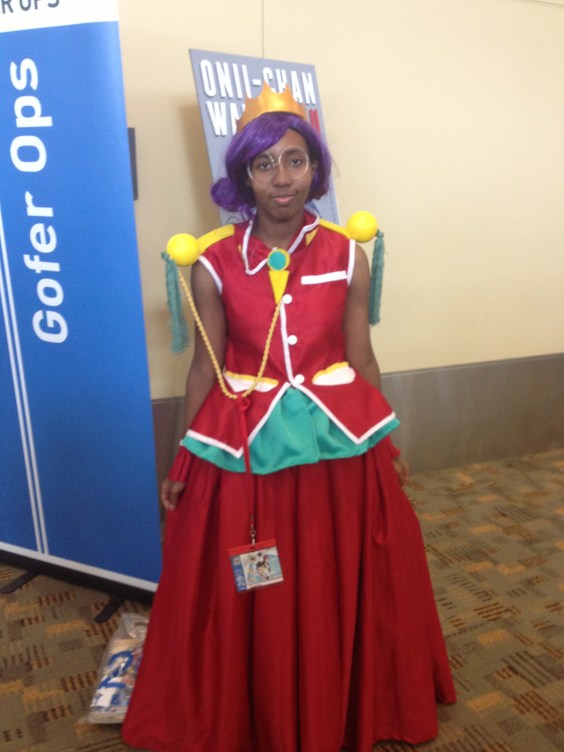
Cosplayer as Anthy Himemiya from Revolutionary Girl Utena
Study in Heroines: Utena and Madoka Magica
I was excited for this, since I adore Puella Magi Madoka Magica and am getting into Revolutionary Girl Utena (after many recommendations for it). Utena is one of the most influential and iconic shojo (anime aimed at teenage girls) series of all time, doing so much to both define and deconstruct its genre. Puella Magi Madoka Magica is a dark, subversive take on magical girl that’s one of the most popular anime of the last few years, which I discussed in my article on magical girls and feminism.
The panelist here was Katriel “Kit” Paige of Digital Flowerstorm, who does a variety of panels for conventions on Japanese culture, and she discussed issues of heroism and compassion in Utena and Madoka. The panel focused particularly on whether the heroines of Utena and Madoka Magica showed a different type of “heroism” from traditional male heroes.
Warning: Spoilers for Puella Magi Madoka Magica ahead!
Utena and Madoka may be major examples in the anime genre of female heroism, but they both subvert a lot of gender roles associated with it. For example, take the idea that men go for direct confrontation and women go for emotional manipulation. Both have confrontational female characters (like Madoka‘s Sayaka and Kyoko) and Utena has manipulative male characters such as Touga. Utena subverts gendered types of heroism in its very premise: Utena Tenjou is both a prince and a princess, who wants to save others and be saved. Yet, the bulk of Paige’s focus on how the shows play with gender roles was with their attitudes toward compassion and sacrifice.
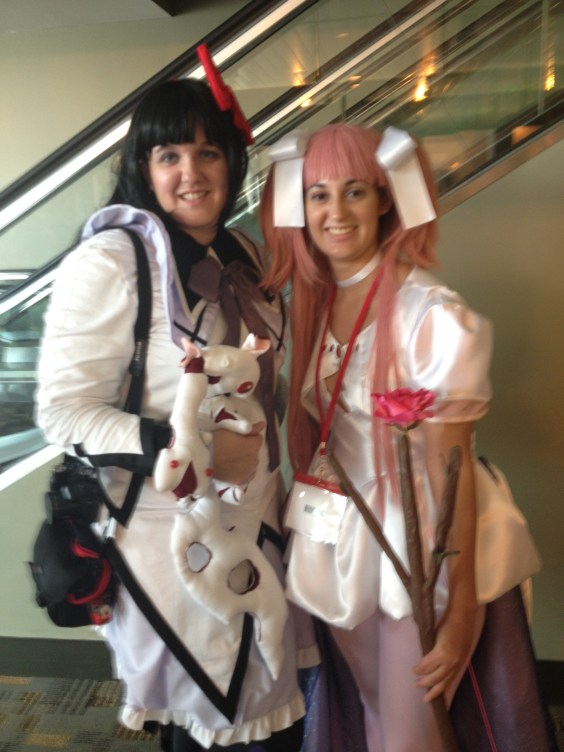
Cosplayers as Homura Akemi and Madoka Kaname from Puella Magi Madoka Magica
The difference in male and female heroines with regard to compassion is something that can be seen in a lot of magical girl series, when comparing them to boy-oriented series like those in the shonen (aimed at teenage boys) genre, which forms the plurality of popular anime series in the USA. While themes of self-sacrifice for others can be found in shonen (such as Fullmetal Alchemist), it’s a theme I’ve seen far more in stuff aimed at women and girls. There’s also much more of a sense of teamwork, rather than it all resting on one powerful hero(ine)’s shoulder, and of “defeating” people by being kind to them. (Princess Tutu, an iconic magical girl series I recently finished and loved, is a great example; the titular character cures those possessed by heart shards by dancing with them, and getting them to admit their true feelings. No “battle” necessary.)
Something Paige pointed out with regard to her two series is that they’re not as straightforward in their embrace of compassion as other works. There’s a repeated theme that compassion is good, but only to a point, and self-preservation is important, too. For example, in Madoka Magica, Homura’s strong investment in Madoka and continual time-resets to save her might temporarily make things better, but just keep delaying Madoka’s fate and, ultimately, worsen it. She’s paralyzed by her compassion, trapped in an endless loop. Sayaka, an even more altruistic character, is doomed to a sad fate in every timeline because she can’t separate her drive to save the world from her selfish desire to prove herself to her crush. Yet, at the end, it’s Homura’s and Sayaka’s compassion that cause Madoka to make her fateful wish that changes the system, and improves the state of magical girls by saving them from being turned into witches.
The point, Paige said, was that sacrifices had to mean something. One had to be fighting for something – not selfless – and to understand the consequences of their actions. Characters like Sayaka fail because she didn’t understand the consequences of her actions, and because toward the end, she was motivated by pure altruism, rather than toward any specific goal. Compassion is good, but it has its limits.
I thought one could apply this in a larger context in examining how these series’ approaches help feminism and better women. It’s easy for some to see a series that wholly praises compassion and self-sacrifice as a triumph for “feminine values” and therefore for feminism, while ignoring that those values’ emphasis for women has an anti-feminist purpose, too. Encouraging men to consider themselves first and keep going for their goals, while women are urged to sacrifice their ideals for others’ sake, reinforces patriarchal structures by making sure there are more men in positions of power. The fact that these series encourage women to think of themselves and not abandon their own desires, but still emphasize compassion as a virtue, means they uphold both female power and feminine-coded values.
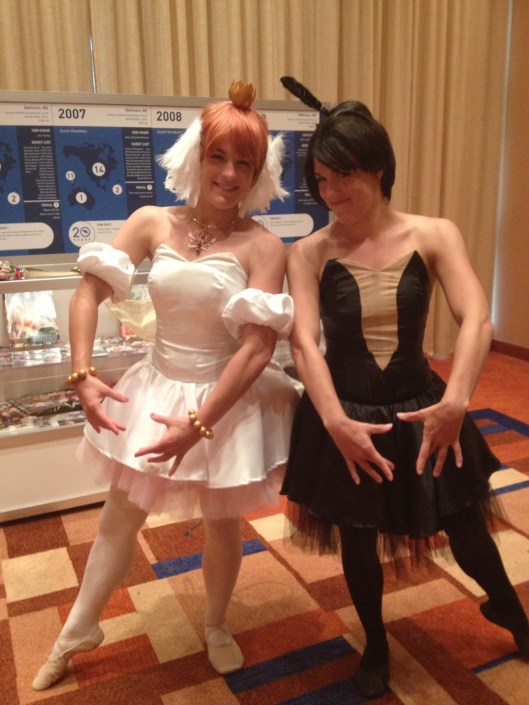
Cosplayers as Princess Tutu and Princess Kraehe
As Paige put it, overall these series emphasize the idea of having someone to look out for you: that you’re not alone, as per Madoka’s line at the end of Madoka Magica. This is again, something that can be seen in other series: Princess Tutu’s method of saving people is not by “fixing” their feelings but rather recognizing and processing them. The idea is that everyone has their issues and often the best thing to do is not to save them – something often motivated by a selfish desire for recognition – but to simply listen. And that’s a triumph of feminine-coded values, of emotional intuition rather than direct confrontation, that doesn’t involve women having to sacrifice anything.
There is so much to talk about with this panel and what it said about anime heroines, and how they save the world in their own ways. Of the two panels on female characters that I attended, it was the one less-focused on feminist analysis, yet there was still plenty of discussion in that vein to be had. For a more explicit approach to those issues, though, I only had to wait a few hours for another look at anime ladies and how they stacked up to the dudes around them.
Next: ANIME AMAZONS
Anime Amazons
Probably my favorite panel of the entire convention, “Anime Amazons” was hosted by Kristiina Korpus, Kim Grzesik and Carly Smith and focused on the portrayal of “strong female characters” in anime, manga and (mostly Japanese) video games. They had a fairly expansive definition of “Amazon” – not just stereotypical female superheroes and gun-or-sword-slinging “badasses”, but just about any woman who was fighting for something.
They began by talking about the obvious example: magical girl series such as the aforementioned three, Sailor Moon and Cardcaptor Sakura. Their characters are generally pointed out as excellent role models for girls, and have influenced even Western girls’ cartoons, such as The Powerpuff Girls and the latest incarnation of the My Little Pony series, Friendship is Magic. Yet, the panelists pointed out that even some of these have limits. In the early episodes of Sailor Moon, heroine Usagi Tsukino had a tendency to be a damsel-in-distress to her love interest, Tuxedo Mask. Of course, by the end of the first season, that dynamic was very much reversed and would remain there, with Mamoru becoming a favorite whipping boy for each season’s Big Bad. But still, even Sailor Moon had places to improve, for playing into that stereotype initially.
Unsurprisingly, most of the series where they pointed out awesome female characters were those aimed at women – shojo or josei (the older version of shojo, anime focused on young adult women). It’s no surprise that media aimed at girls is generally going to try harder to represent women positively. Yet, the panelists made sure to examine anime aimed at men or boys, like shonen, and show how it was often better than we expected, but still left a lot to be desired.
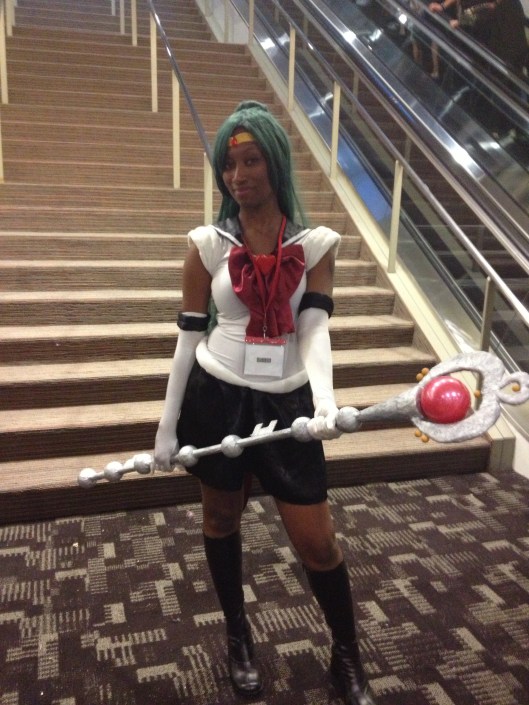
Cosplayer as Sailor Pluto from Sailor Moon
In this section, they did an in-depth look at the female characters of one of the most popular shonen series of the past decade, Fullmetal Alchemist. This was fascinating to me since I love FMA; the first of its two anime series is my favorite anime ever. The franchise is one that also seems to get a lot of praise in fannish circles for how it treats its women, but I always felt like it majorly missed the mark in that regard, and the “Anime Amazons” panel helped me better articulate why.
On the plus side, the show’s female characters are well-developed, often showing a blending of “masculine” and “feminine” traits – like real women. For example, Winry Rockbell, the protagonist’s best friend and love interest, is girly and enjoys domestic tasks like baking, but her main goal in life is to become an accomplished mechanic, and she obsesses over fancy tools and the like. The series is also not too big on gratuitous fanservice or male-gaze pandering, and what it does have in that regard, it more than matches with shirtless scenes for its muscular men. The author of the FMA manga, Hiromu Arakawa, is a woman, and that shows in how she writes women.
However, even if FMA’s women are better-developed than a lot of shonen girls, they still are largely defined by their male love interests. For example, Lieutenant Riza Hawkeye, a badass gunslinger and war veteran, is still defined largely around her commanding officer and implied love interest, Roy Mustang, serving as his bodyguard and as support to his goal to reform the country; she outright says she couldn’t live without him. And while there’s plenty of focus on Winry’s career and her personal struggles, she is, as the panelists put it, mainly there to provide someone for the male protagonists to come home to when their battles end. There are at least two older ladies, powerful alchemist and housewife Izumi Curtis and fierce military commander Olivier Armstrong, who are excellent exceptions. But overall, there’s a very patriarchal pattern to how the women of FMA are written, as the panelists pointed out:
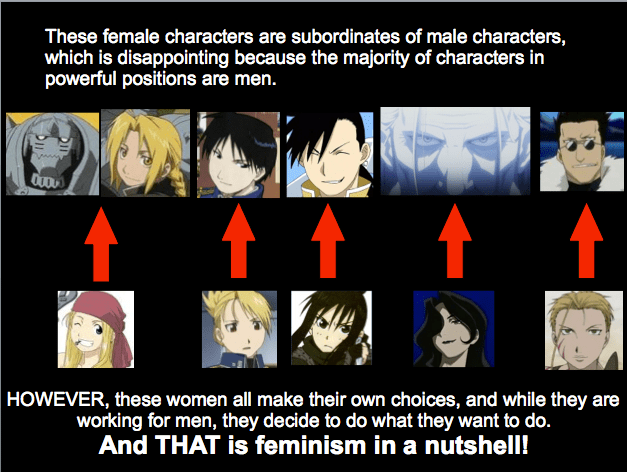
Slide from the Anime Amazons panel
This brings me to one of the few places where I disagreed with the panelists: the issue of choice. Their conclusion was, because these characters chose to follow men, FMA ultimately wasn’t sexist. However, while I agree that “choice” is an important part of feminism when it comes to real-life women (though, it shouldn’t mean we don’t examine how societal gender programming influences said choices), it doesn’t quite apply to fictional characters, who literally don’t have agency – their choices are determined by their writers. Ultimately, it’s very easy for an author (like Twilight author Stephenie Meyer, who also uses this defense for her own books) to give his or her female characters a pattern of choices that are in line with restrictive gender expectations and that define them around men, by making it as though it’s the female character who wants them that way. And when it’s a pattern, as it is in FMA, it can suggest troubling things about “what women want.”
Even within the shonen genre, though, the panelists mentioned that there were other titles where women had greater presence. The anime Soul Eater, for example, includes a powerful girl as main character as well as a strong female antagonist, something relatively rare in male-centered anime, especially in a form where her character doesn’t imply hateful things about women as a class. Another example, Claymore, has women filling nearly the entire cast, in roles where the boys would usually be, and the men are in the sideline, “useless” roles.
At this point, the conversation largely shifted to video games, a topic where I’m less well-versed. But one thing that one could easily take away is that women’s presence in games has improved over the decades. They mentioned the Tomb Raider games as ones where, while perhaps not all that progressive in how they catered to the male gaze, set a precedent that men would play games with female protagonists. They also mentioned franchises like Pokémon which have made more room for women as time goes on, such as adding the option of playing as a female character in 2001. And now we’re getting more games that are actually aimed at women, or at least acknowledge that women who want strong-yet-relatable versions of themselves in games are a market. Video game culture is still very sexist, but they revealed with their examples that the games themselves have often given us some well-rounded and capable female characters.
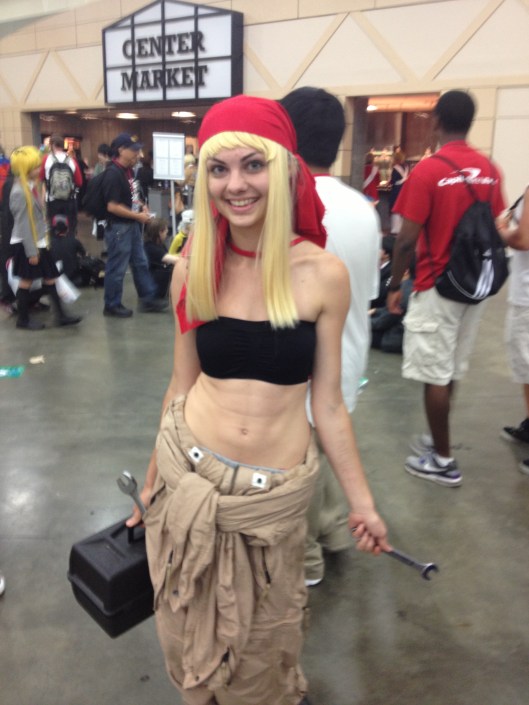
Cosplayer as Winry Rockbell from Fullmetal Alchemist
Overall, the takeaway that was there are a lot of ways to be an “Amazon.” The panelists didn’t just talk about good-vs.-evil stories, but even more slice-of-life ones like Nana that had fantastic women in them. As they said at the end, what makes a female character an “Amazon” is not how she fights, but what she’s fighting for.
What’s great about anime and other fan conventions that are as large as Otakon, is you can find whatever niche you want among its myriad panels, workshops and other activities. If you want an autograph from a famous voice actor, to learn how to improve your cosplay, or simply to blow lots of cash in the dealer’s room, there’s a place for you. But there’s also a place for difficult conversations about women and their representation in anime, from various perspectives. And that continues to be the most rewarding part to me, year after year.
Pages: 1 2See entire article on one page

i don’t know anything about any of this but found this all very interesting nonetheless !
Great article.
Madoka really has changed the landscape for anime and it came just at the right time, too. But parts of it felt very fan-pandering, for instance I can’t help shake the feeling that SHAFT (the production studio) had Homura be a shy meganekko and I understand WHY she was so different in contrast to the cool, almost cold and hardened character who opens the series… but it felt very… exploitative? But that’s a grievance I have with SHAFT on the whole. They have lots of female characters who have oodles of personality, but they’re also in some way purposefully meant to appeal to some aspect of the “male gaze” and the gross waifu culture.
What do you make of Panty and Stocking with Garterbelt? If anything, I’d say that was one of the most interesting anime to be released this decade and most people call it a fanservice anime, but it’s a direct and gross parody of it. I mean, in the very first episode, the two female leads transform into super sexy stripper-like titillating eye candy… and then they piss and shit and fuck guys because they’re not perfect or clean or virginal. And it felt like a giant middle finger to the perfect-female sex symbol immaculate anime girls we generally get.
I haven’t seen Panty and Stocking though it’s on my VERY LONG list of anime to watch! (The fact that I’ve written a few articles on here about anime makes it out as though I watch a lot more anime than I actually do, though I’ve been watching a lot of it lately.) I’ve heard great things along those lines, though, which make me want to watch it.
I sort-of agree about Homura, that playing into the “moe” stereotype didn’t seem necessary, but it didn’t bug me personally because it seemed like a very small part of her – even within her “backstory” episode? And I thought it was an interesting twist on this character who we’d been led to believe was so strong and inscrutable. My feeling with a lot of fanservice, in anime and elsewhere, whether it’s “cute” fanservice or “sexy” fanservice or whatever, is that it doesn’t usually bother me unless it’s objectification – unless the woman is reduced to it. (And in anime that’s a major difference between the bishie male fanservice in shojo and yaoi that people on Tumblr are obsessed with calling “fetishizing!” and the stuff that female characters get; the former are almost never JUST sexy, there is always more to their characters. Unfortunately, that happens sometimes with women.)
Like an example I’m thinking of, of a character who is WOAH FANSERVICE but where it didn’t bother me as much as it maybe should have, was Faye Valentine from Cowboy Bebop. Like, the way she dresses is clearly impractical and designed to show off her boobs and please the male viewers, and it’s irritating that they have to include that (the same way Moemura is irritating in PMMM in terms of that fanservice for that audience), but because she was an awesome, independent woman who took no shit from anyone AND well-developed with an interesting backstory, ultimately I really liked her and she was my favorite character in the show. And the fanservice just seemed like one small part of who she was that I could easily turn a blind eye to, because she wasn’t objectified. Which is not to say that excuses it or anything, and I can still see why others would find her character problematic. But it didn’t come off that way to me.
And per what I said before with FMA, that’s a thing I like about that series: there are lots of sexy ladies and sexy men (though not in the IN-YOUR-FACE kind of way, except with gag characters like Major Armstrong) but they’re usually not reduced to that. Arakawa just likes her busty ladies and Muscles McGee men. The only exception is Lust, of course, in the manga/Brotherhood anime but… well, that’s a big part of why I prefer her character arc in the 2003 anime, haha.
But of course, it is irritating that series like Cowboy Bebop or PMMM feel like they have to include that stuff to get guys to watch (I mean, with Bebop in particular, wouldn’t a show like that appeal to men anyway, sexy lady or no sexy lady? even putting aside the fact that it’s a REALLY GOOD show that it seems every anime fan likes). It just doesn’t bother me as much as it should, providing the lady isn’t objectified?
About Bebop, it seems to be coming out of a relic of time where the men smoked and the women with their exposed cleavage smoked even more. It was heavily influenced by jazz culture and early Hollywood — the “cowboy” in its title gives us an idea of the kind of legacy it subconsciously drew from — and in the end, it reflects exactly what you found in those kinds of art. Sultry, seductive femme fatales who hold their own and slick cool guys who just slide by life. I was particularly fascinated with Edward and her depiction and personality. Ed was very different and I think a little hopeful, having a female character not bound to the same objectification (be it sexual, physical or aesthetic eg. moe).
(Just to point out, every anime fan likes it because it’s the most “American” anime made to date. It’s a gateway series the way Evangelion, Naruto, Bleach, Samurai Champloo are to modern-day fans or Sailor Moon, Voltron, Akira, Pokemon, Miyazaki films were back in the 80s/90s. It’s like “my first anime” and everyone is fond of it.)
I can get why you’re not upset about Homura as per it not being objectification, but I otherwise consider it a mark on an otherwise perfect anime. Perhaps it’s because I know Shinbou (the director) and his production company and considering their prior and current history (re: all the “-monogatari” anime), something like Moemura could have been done much BETTER. Yet was done so superficially and fan-panderingly that I couldn’t forgive it. (Because there’s nothing better than taking an otherwise capable and powerful female character and making her appealing by showing her to be emotionally vulnerable, as “broken” and in needing of comfort/saving for the otaku self-insertion male character/male audience. In the 1000+ anime I’ve seen, the trend persists.)
And as good as the mangaka for FMA has been to her female characters, she still conforms to elements of what you get in shounen anime. Naruto and Bleach are the two worst and most popular offenders although they treat their female characters differently; in Naruto, they’re all either useless or props, in Bleach, they’re capable but are entirely sexy eye candy. Which is why FMA felt like such a breather, such a great series because the male characters aren’t all horrible cliches and the important female ones aren’t entirely painted the same colour of the wall/a pin-up poster. That’s not to say shoujo is free from objectifying female characters either. Ever took in some Morinaga Milk manga? Generally cute stuff but definitely moe-service.
(This is a total aside, but if you haven’t, read Aoi Hana/Sweet Blue Flowers and Octave. Their awesomness is too much to be contained. Aoi Hana for being really a great piece of literature and Octave for being the only manga to date to accurately portray a real girl x girl young adult romance.)
I think Baccano! might be a bit more “American” than Cowboy Bebop (speaking of anime that are more popular among US anime fans than in Japan, haha), but otherwise agree with you on everything you said about it. I still think the amount of fanservice Faye’s character got was a bit gratuitous, though. It’s not like the ladies of the jazz age and early Hollywood actually dressed like that. (I think Cowboy Bebop has as much of a “western” genre influence as that, too, and reminds me of Firefly a bit in that sense, although Firefly is a lot more literal and explicit about it. The whole “bounty hunters zooming from planet to planet catching baddies” aspect of CB just gives it that vibe to me.)
And yeah, I agree with FMA. It’s definitely better than a lot of shonen series and I think Arakawa gets some credit for that, but it’s very far from perfect, and that’s something I tried to emphasize in my article. What puzzles me is seeing it construed as “feminist” by people in the fandom who aren’t as into shonen and are more familiar with magical girl series like Sailor Moon or PMMM that are female-centered, feature women taking control of their own lives and where female-female relationships are the most important. You can’t really tell me that the ladies of FMA, who are primarily satellites to male characters, can stack up to that.
That’s interesting re: Homura – I never thought of her story that way, although it makes a lot of sense now that you point it out. I’ve been out of touch with anime culture for a while and so only vaguely know what “moe” means/that it’s a thing fanboys like/etc., so maybe that’s why.
Strictly personally speaking, I found her story really empowering. Instead of being immediately gifted with the power of badass, Homura develops power herself by practicing over and over and over again. Time is admittedly on her side, but I love seeing examples of weak characters who take realistic, grindy, boring routes to improving their skills. It’s much more satisfying to watch than “I put on the magic necklace, and…”
Also, before I saw Homura’s backstory, I wrote her off as the “cold, omnipotent warrior with no emotions” and immediately lost interest in her. That trope doesn’t do much for me, regardless of the character’s gender. Seeing a legit explanation for how Homura became what she is – that was NOT “raiders burned down her village and killed her only love, so now she has no feeeeelllinnngggsss” – instantly made her my favorite character on that show.
I really really love that we are having these conversations. (Also, a round of applause for Olivier Armstrong for being basically the best.)
She’s perfect. I really wish we’d been able to see more of her and she more of a legit “character arc.” She was my favorite female character in FMAB (and she’s second only to 03!Lust in the FMA franchise as a whole).
Pretty much all of the female characters in FMA are perfect IMO, although I do see your point about them being subordinate to men. Hawkeye, for example. I will never not love that woman.
She’s a character I really wanted to like more, because she’s definitely a badass, intelligent, strong woman. And I did like her a lot in the first anime, although I – yet again – wish she’d had more development. But in FMAB I was really put-off by her relationship with Roy and how much she seemed emotionally-dependent upon him, and how much her life revolved around his goals. Like it’s one thing to support someone you think is going to improve the world, and decide you’re better off as a subordinate than the actual leader of that change. It’s another to be like in that one scene where he asks what she’d do if he died, and she basically said she’d end her own life because it wouldn’t be worth living anymore. That’s a degree of dependency that just turns me off.
It probably wouldn’t have bothered me as much in terms of how I see Riza as a character, though, if so much of her character development hadn’t revolved around her relationship and history with Roy.
She’s awesome otherwise though, it’s just… gah, she’s one of those many female characters I love but want to rescue from their narratives because girl, you deserve so much better. (Like how I feel about a lot of the ladies on Glee, as much as I hate to make that comparison since FMA is, you know, actually well-written and stuff. Lol.)
Thanks for reporting on this. I’ve never been to an anime convention, so it’s nice to get a glimpse of some of Otakon’s offerings beyond awesome cosplay and bank-breaking merchandise. The panel sounds really interesting, and your observations were good to hear as well. Paige’s opinion on PMMM’s moral–that you have to be ready to shoulder the burden of your sacrifices; you can’t just rush into them–is pretty much the same as my own. It’s a good message, and one I haven’t seen many people take away from PMMM.
If you want recommendations on anime/manga with Strong Female Characters I have some (I’m addicted to giving anime recommendations sorry).
I’m definitely interested in your recommendations! If you want I could PM you my MyAnimeList profile (just kind of embarrassed to link it here since it shows just how little anime I’ve seen lol). I know most of the big magical-girl series – like Sailor Moon, PMMM, Princess Tutu and Utena obviously – but I’m always looking for more! (Especially if they’re yuri/full of lesbian subtext.)
You can PM it if you want to, but don’t go to too much trouble. My anime knowledge is probably a lot worse than yours (I never even finished Cowboy Bebop, which I’m pretty sure makes me some kind of heretic), so I’m always looking for recommendations too.
YOU’VE NEVER FINISHED BEBOP? OH, YOU MUST! Most of the best episodes are in the last third of the show, after all!
(you can probably skip “Boogie Woogie Feng Shui” though)
Great article! It got me wondering though… has Autostraddle ever done an article on must-watch lesbian animes? We always hear about the new TV shows or movies, but lesbian animes are pretty underrepresented. Accessibility isn’t really an issue anymore since there are now legal websites like Crunchyroll.com that allow you to watch for free.
Yes! I LOVE that you are writing about this on Autostraddle, and anime is often where I go to get my fix of complex/interesting/gaygaygaygaygay stories. I’m so pleased that I’m not the only person who likes to painstakingly (over)analyze magical girl stories.
Anyone ever see any Maria-sama ga miteru? It’s kind of a guilty pleasure, but I love it and its attention to stories solely about relationships between girls and all of their many, many feelings. There are even a couple legitimately queer characters!
Oh really? I was told that Maria-sama Ga Miteru was more subtexty? Dealing with scraps of subtext for so many years, I get sorta bitter about this now and for that reason, I’ve avoided it… Should I give it a chance? It’s been a while since I’ve gotten into a good anime and I know it’s wickedly popular.
I also wrote a really long reply below about my anime suggestions, if you have any more, please let me know!
It’s mainly subtexty, but to me the show doesn’t make sense WITHOUT that subtext. My queer Western mind just goes there when I see two girls holding each other’s faces, gazing deeply into each other’s eyes, and stressing out over Valentine’s gifts. (I guess they could all just be having really intense overanalytical friendships, but, yanno…)
There’s one main character and two side characters who are canon, explicitly queer. The main character’s gay storyline is short and angsty, but the character herself is one of the best people on the show. She also flirts with other main characters and has a brief what-might-have-been with another great side character. (Trying not to get too spoiler-y.)
That said, most of it is devoted to feelings processing, wistful gazing, and flowy hair beneath cherry blossoms or gingkos depending on the season. It makes me embarrassingly fuzzy and I get invested enough to yell at the screen when Yumi can’t decide where to take Sachiko on a date* or whatever. I’d give it a few episodes and see if it drives you crazy or not!
*Real SUBTEXTY? plotline. This is what I mean!
I’ve written all the recent anime articles and I’m not sure if I know enough about yuri to do a post like that, but I’ve been thinking about it for a while, so it’s good to know there’s interest!
Accessibility is still somewhat of an issue for certain series; Crunchyroll only has so many anime, and from what I’ve seen they’re mostly recent series. So you can find Madoka there, for instance, but for something like Utena you still have to resort to illicit methods or scour Amazon for DVDs.
There are more and more anime on Netflix Instant and Hulu, though, especially if you don’t mind dubs. Funimation also has most of its series on its website and its YouTube channel.
But again, yuri anime are often not as well-known or popular as other series, so unfortunately you still usually have to do some careful perusing to find them. And that’s not even going into yuri manga, especially if you want something that isn’t about teenagers…
You’re right about Crunchy Roll only having so many series. I’ve realized that a few of the shows I’m POSITIVE I’ve watched on there, have now been dropped, probably because they have been picked up by a major distributor. While annoying, this is technically a good thing because back in the day, these sorts of things never made it over the pond in any legit format. But! Are you aware how cheap anime box sets can be on Amazon these days? Also, I just found out that Utena is now available off of Amazon for streaming, although it DOES get expensive that way…
When I think of super lesbian animes, five titles come to mind:
1. Yuruyuri (Free streaming! http://www.crunchyroll.com/yuruyuri)
Okay, this is complicated because it’s like the gayest gay pervy anime I’ve ever seen… but they’re like in Jr. High. There is literally a character that every time she removes her glasses, she can’t stop from having weird fantasies (which are always blurred) about the other characters. Basically, it’s a ‘slice of life’ anime where nothing really happens but all of the girls are lesbians and everything is humor based. Japan is a weird place because something in this age range would never fly here… Honestly, I just pretend they’re older because it’s so damn FUNNY. To me, a lot of the humor seems almost like fourth wall breaking because as a fan of yuri animes/mangas, they do seem to make fun of a lot of tropes.
2. Strawberry Panic (I guess this one has been licensed, so I won’t provide a link but just say… I did watch it off of Veoh.com, which is a website that has never given me problems. Also, you can buy the ENTIRE series off of Amazon for $14.)
Strawberry Panic is like an awful soap opera in a super lesbian school. It’s kind of Utena-esque and over-dramatic and I absolutely love the shit out of it. Watch this one with the intention of making fun of it a bit. As far as plot, it’s your typical new student in elite school gets attention from super popular sempai, except everyone is a lesbian, you know how this goes…
3. Kannazuki no Miko
(This one appears to be licensed as well, but, *cough* Veoh.com. You can also buy the complete collection for $18 on Amazon)
This one is drama based and bound to break your heart, but involves magical girl and mecha themes. I don’t want to say much so as not to give anything away, but it involves a sort of star crossed lovers tale between two girls who discover themselves to be the famed Solar/Lunar Priestesses.
4. Simoun
(Veoh.com also… 15$ for the whole series on Amazon!)
This one is sort of a mecha/action anime that involves girls in an elite training school for airships known as Simoun. It evokes a sort of Enders Game feel, but the most interesting thing about the anime is that in this world, all people are born female and do not choose a permanent sex until they turn 17. Once a permanent sex is chosen, they can no longer pilot a Simoun. It sort of straddles that line between gay/straight because they’re potentially all unisex, although all of the “romance” aspect happens as they are females. I will admit that the emphasis is more on the action/fighting than the love aspect though, but I still very much enjoyed it.
5. Aoi Hana (Sweet Blue Flowers)
($20 on Amazon for the complete series.)
I can’t find this one anywhere for streaming, but it really is a sweet feel good romance/drama story. I honestly can’t remember why, but I preferred the manga over the anime, which is easy to find all over the internet. What I appreciated about this story is the realistic vibe of a character that identifies as a lesbian falling in love with her best friend. Also relevant is the manga, “Girlfriends” which I LOVE SO MUCH but they made one season of an anime in which NOTHING happened and for that reason, it was never continued, so I won’t even suggest you watch it.
Other stuff: People are literally bat shit crazy about Maria-sama Ga Miteru but I have never seen it because I was told it’s more subtext than canon and that just breaks my heart sometimes. Maybe someone who has seen it can elaborate.
Kashimashi (Girl meets Girl): This one is about a sensitive boy who makes a wish on a shooting star, that actually turns out to be an alien spacecraft that smashes to Earth and destroys him. The aliens feel bad and attempt to reconstruct him, except they turn him into a girl instead.
Candy Boy: This one is ridiculously popular but the blurbs make it sound like it’s about incest (although I’m not sure if it actually happens or comes to fruition) but I just… CAN’T.
So that’s probably way more than you asked for, but hey, think about it? At least Yuruyuri is available on Crunchy Roll, and I believe there is even a third season planned… Also, I know quite a bit yuri manga that isn’t about teenagers. (You know about lililicious.net, right?) Honey & Honey for one example, and the author/artist Morishima Akiko writes a lot of stuff about adults. I ADORE her art style and she manages to be cute/hilarious/sexy all at once. I could probably come up with more, but seriously, I need to cut myself off before I blab about this all day. Let me know if you’d like more recommendations though.
“But! Are you aware how cheap anime box sets can be on Amazon these days?”
Eh I’ve found that it depends a lot on the series and on the distributor (e.g., in terms of stuff still in-print: Funimation tends to keep their DVDs pretty affordable, but the distributor for the Madoka DVDs (I forgot who) made them ridic expensive. Sorry, I don’t feel like paying $50 or whatever for 4 episodes). And for stuff that’s older and/or long out-of-print I’ve found it can go both ways: either them being old means there are a lot of people selling their used sets for cheap, or it’s something like Cowboy Bebop where like, good luck finding it under $120. (Which is why I’m so happy that Funi bought Bebop and I’m really hoping they’ll be releasing a new DVD collection soon, because that really needs to go back into print.)
But thanks for all the yuri recommendations! It’s a genre of anime I’ve always wanted to get more into, for obvious reasons haha, and yuri series kind of got me back into anime in general recently (and hence, writing more articles about it). I watched Strawberry Panic anime and loved it and it’s been sitting on my Amazon wishlist for a while. And I read the manga for Kashimashi: Girl Meets Girl (have yet to get into the anime but plan to one of these days) and enjoyed that one a lot too and would recommend it. But I really would like to find some yuri that is focused more on adult women and less on teenagers.
Aoi Hana ♡
It has a special place in my heart – I watched it when 14 (I think?) and loved its calmness, pretty animation and characters, I had the HUGEST crush on Yasuko :)
Aoi Hana was one of the things that made me understand I really liked girls.
“But I really would like to find some yuri that is focused more on adult women and less on teenagers.”
YES YES YES. The day you find this is the day you should write this article and tell us all about it.
Although, my understanding of Japanese culture is that the reason the yuri storyline is so prevalent in JR High/HS is because they don’t take it very seriously due to most schools being single-sex education. They’re kind of expected to grow out of it and homosexuality is still frowned upon for the most part. This is why there is so little adult stuff, unfortunately.
Love my Life is an adorable manga turned live action movie that deals with adult lesbians.
Seriously thank you – i didn’t know at least two…or more precisely i didn’t know their level of gayness to be sufficient for bothering to watch.
I used to watch a lot of anime and def looked up shoujo-ai shows to watch as a little baby dyke, so my anime thoughts:
Well Known:
Aoi Hana / Sweet Blue Flowers: coming of age about two childhood friends reconnecting in high school. It aired in 2009 so the animation is getting there, but it’s pretty good compared to a lot of what’s out there. It’s more serious and relatable and the first thing I’d recc to get into the genre.
Simoun: reallly well known but tbh it was a little too ridiculous for me since I like my shoujo-ai to have plot and not just Feelings. gen y non-winner had a pretty good description above; there’s a pretty large ensemble of characters so a lot of potential
Strawberry Panic: definitely have to recognize that this is a ridiculous show and run with it. Some people call it like a “rite of passage” into yuri anime
Kannazaki no Miko / Destiny of the Shrine Maiden: tbh I don’t remember much about it but it’s a mecha lesbian drama so put all those stereotypes together and that’s pretty much it
Lesser known:
Blue Drop: I had this recc’d to me and just remember that it was a struggle to get through – basically, you can do better than this haha
Candy Boy: Twin lesbians in love with each other. They’re fraternal so if you try hard enough you can pretend that they’re not twins but it’s very clear. However, the animation is pretty crisp
Sasameki Koto: another coming of age high school romance, but Aoi Hana is much better. Worth a watch if you’re running out of other shoujo-ai series though
Mai-HiME: Haha okay this is actually one of my top 3 anime of all time. There’s one canon lesbian relationship but pretty much the rest of the ensemble can be paired up with each other without trying at all. Boiled down it’s schoolgirls with magical powers saving the world but the characters are well-written and the music is absolutely fantastic.
Honorable mention: Hourou Musuko / Wandering Son is a slice-of-life about two trans* people in middle school. Great story, watercolor animation, and simple yet effective.
I can get into the subtext-y shows e.g. Nana or shows with one lesbian character e.g. Azumanga Daioh but I feel like this comment is already really long, ha
You just made me realize that I made an error in my above post… When I said that they made an anime of Girlfriends that was so slow it sucked hardcore compared to the manga, I was actually thinking of Sasameki Koto. It really bummed me out though because I loved the manga and it was so cute! Girlfriends pretty much has the same plot but I did prefer Murusame’s character from SK because she was awkward and adorable about her crush on Kazama yet, still a kick ass karate chick.
IF YOU WANT TO FIND YURI
GO TO
http://www.lililicious.net/
SERIOUSLY.
It doesn’t have anime, but it does have a WIDE VARIETY of yuri manga. I mean seriously, there’s sad/funny/poignant slice-of-life comics, cute stories of girls from two different cultures falling in love, lonely lesbians struggling to find love in a homophobic town/nation, silly cliché all-girls school love stories, etc. Age varies. There are definitely adults in these comics. I’m not too big on reading manga about teenagers having lots of feelings unless it’s NGE (and even then it was a little difficult to sit through at times – god, Shinji, shut up with your whiny internal monologue jeez), so I was definitely looking for more sophisticated tales. Can’t remember the name of the one I liked the best and the archive, as far as I can remember, was not all that user-friendly (as in, in order to find out what the hell the manga’s like, you kind of just have to eyeball the covers and pick the one that looks best and download it and read the first few pages), so good luck I guess? Maybe it’s changed by now, I don’t know.
AND WHOEVER MENTIONED “WANDERING SON”
JUST
YES.
(Haven’t seen the anime, just read volumes 1 and 2 of the manga because they were at the library. I’m so in love. With all of the characters. But especially the two main ones and the girl who bought the main-main character a dress and then and then and – okay I have to stop or I’ll end up getting spoilers and embarrassingly earnest feels all over this comment.)
***WARNING: LOTS OF IRRELEVANCE AND PERSONAL SHARING BELOW…YOU MAY DECIDE IT IS TL;DR***
Oh hey! I just remembered. The reason I even found lililicious in the first place was because I was looking for Berusaiyu no Bara (The Rose of Versailles), which is on there in its entirety. I just never finished reading it because I got distracted by the other pretty things and also because the beginning is entirely too cute and sugar-sweet. Maybe if I had a print copy of it I would get through it easier because I could flip forward every now and then and be like “Aha! This part with the things happening in it will occur at some point, in only . . . (counts) . . . 238 pages!” Or, you know, a couple of volumes. With pdfs you don’t get to see how far you are away from the good stuff nearly as easily. Or I’m a dinosaur and I need an e-reader. Whatever.
My point being, Berusaiya no Bara is Famous in shoujo manga circles for being sort of a proto-yaoi/proto-BL in that Lady Oscar was raised as a boy and crossdresses throughout the whole thing, all while having lots of unresolved sexual/romantic tension with male characters. As a (mostly) gay trans guy (who hadn’t realized he was a guy yet and just thought his interest in gender bending stuff was part of his whole bisexual identity because sexual orientation is totally the same thing as gender identity, yeah!), this element called out to me. Anyway, Lady Oscar also has some unresolved sexual/romantic tension with Marie Antoinette, which is why it’s on lililicious. That was an awful lot of irrelevance and personal sharing (2 whole paragraphs!) to get to one half-hearted recommendation of a manga I haven’t even read in its entirety. Time to throw a TL;DR warning up above.
Lillicous is an amazing site. I wish that manga publishers would read the manga they post because I would to own quite a few of the stories. Oh, and Rose of Versailles is AMAZING!