You can now search an approximate 4% of the books ever published for, well, whatever you want. Last week, Google introduced the Ngram Viewer, a poorly named tool that can search five centuries of the written word. To what ends? I have no idea, but it’s really fun, so stop asking stuff like that.
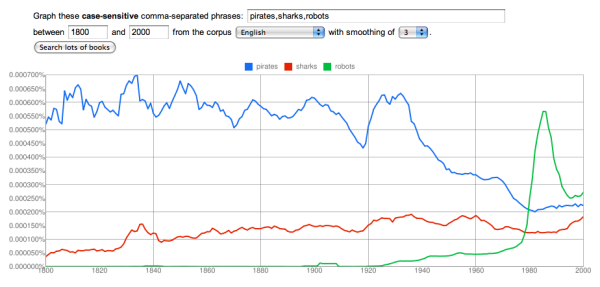
This will certainly fuel untold numbers of college theses written by students too stoned to conduct their own research, as well as providing an excellent, accessible and absurdly robust set of data for all kinds of fun stuff no one’s dreamed up yet. Google’s got a sense of humor so they went ahead and graphed a few funny things, but I’m sure we’ve got better ideas up our sleeves.
As CNET explains,
Ngram Viewer works rather simply. After you enter a word or phrase (up to five words), the tool displays a graph charting how frequently your term has appeared in books over that half a millennium. By default, the Ngram Viewer taps into books written in English. But you can change that to a different “corpus” or category of books, such as American English, British English, English Fiction, Chinese, French, German, Russian, or Spanish.
You can vary the years tracked, all the way from 1500 to 2008 or anywhere in between. Providing a wide range of years gives you more of an overview, while narrowing the years lets the tool graph a word’s usage in a more granular fashion year by year.
So go on! What are you waiting for? Below you can find some examples of the gems you can unearth, buried deep within the annals of our written language which are buried deep within a virtual pile of books on a virtual desk somewhere that is likely also virtual.


They should’ve named it Google CtrlF
roxy2 speaks the truth.
searching “penis, vagina and pregnant” is quite entertaining. i think i’m going to have a lot of fun with this.
so this is what countless word verifs have brought us
Ok, I can see why vagina was always written about more than penis, but was it so popular around 1880? No idea.
I meant *why was it so popular
The “clitoris” trend looks exactly like GDP / Economic Growth, no kidding
nipples present a gradual but steady growth while orgasm peaks just before the year I was born to slowly and gradually (and probably peacefully, happily, etc.) subside afterwards.
has anyone else gotten a “Whale Fail”? wtf?!
i saw that! it was awesome.
Try ngraming “she” and “he.” It’s unexpected, but still kind of alarming.
Search “he” “she” “they” and “it” at the same time. It seems all common pronoun usage has gone down. I’m baffled, someone explain this to me.
I am also baffled. Any linguists on?
It might have to do with the types of books in each year. Maybe there are more nonfiction books in the later years. I would think those would have less of those pronouns.
I found “fag” and “dyke” to be really surprising.
Same! I just did the same search, who knew dykes were so popular in the 1780s? Slightly bummed that the use of fag has gone up recently.
Massive irrigation projects?
Brilliant. Clearly I need to insert a dyke in my head to stop the massive outpouring of brain cells.
I’d take a dyke in a couple of other places too…
I searched sandwiches. A lot of people ate sandwiches in 1940, but it went down around 1980’s. However! It’s on a rise. It made me sad when “bagel sandwiches” didn’t come up with anything.
Have you looked up sandwiches on Wiki?! There are some awesome names for sandwiches. For example, Roti John, Muffuletta, Vada Pav, and my all time favorite name, Fluffernutter.
omg muffulettas are so gooooood
Muffulettas are epic sandwiches. Every time I’ve made a muffuletta someone tells me it is the best sandwich they’ve ever seen/eaten. So so good.
Why am I not having a muffuletta for dinner right now?
Fluffernutters are really wonderful. I eat them approximately all the time.
I have a cat named Fluffernutter.
aeroplane v. airplane is cool because you can see when it was invented and when wwii happened.
oh shit, that is cool!
so far i’ve learned that “blimey” hit an all-time high around 1935 or so with such classic lines as
“And ‘ere’s a fine girl, Gawd blimey, all this time fretting abart what’s only a man after all!”
and
‘Blimey, they’ve set the cart afire!’
I said Blimey when i accidentally set John McCain on Fire yesterday.
was it really an accident? c’mon now, you can tell us…
How was i supposed to know napalm is flammable?
I love this, who would’ve guessed that “jedi” would hit an all time high in the 1860s
It’s even higher from in the 1720s and 30s.
When I looked that up it was only set to show from 1800 to 2000, which explains why I missed the 1720s. Kinda sad, cause that would’ve blown my mind even more.
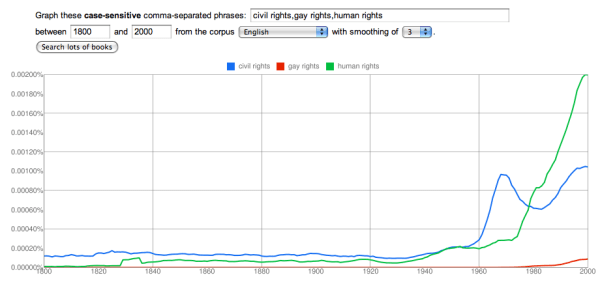
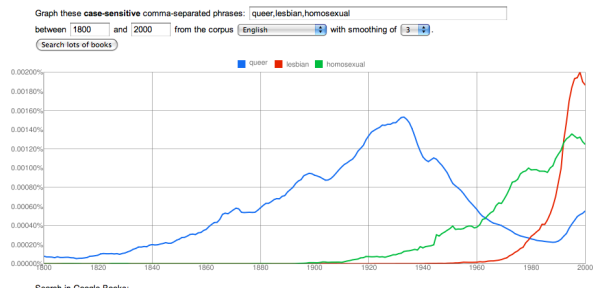
So for some reason, words pertaining to sexuality (gay, lesbian, etc.) all peaked around 1998, and have been falling since. Except “queer”. Weird.
Also, “straight” bucks the trend while “heterosexual” doesn’t. Maybe due to its having another meaning? I doubt that’s the case with “queer”, as it’s old meaning is pretty much completely unused.
autostraddle be full of nerdzzz.
you guys might be interested in the BYU corpora (http://corpus.byu.edu/), which include the Corpus of Contemporary American English, the
Corpus of Historical American English, the British National Corpus, The TIME Corpus of American English and
BYU-OED: Oxford English Dictionary. I can’t promise graphs but they’re still interesting – they’ll show you where each example of the keyword was used.
The Historical Thesaurus of English was just integrated into the New OED, but i imagine normal people don’t have subscriptions to the OED. Here it is, free-standing: http://libra.englang.arts.gla.ac.uk/historicalthesaurus/menu1.html
thanks!