





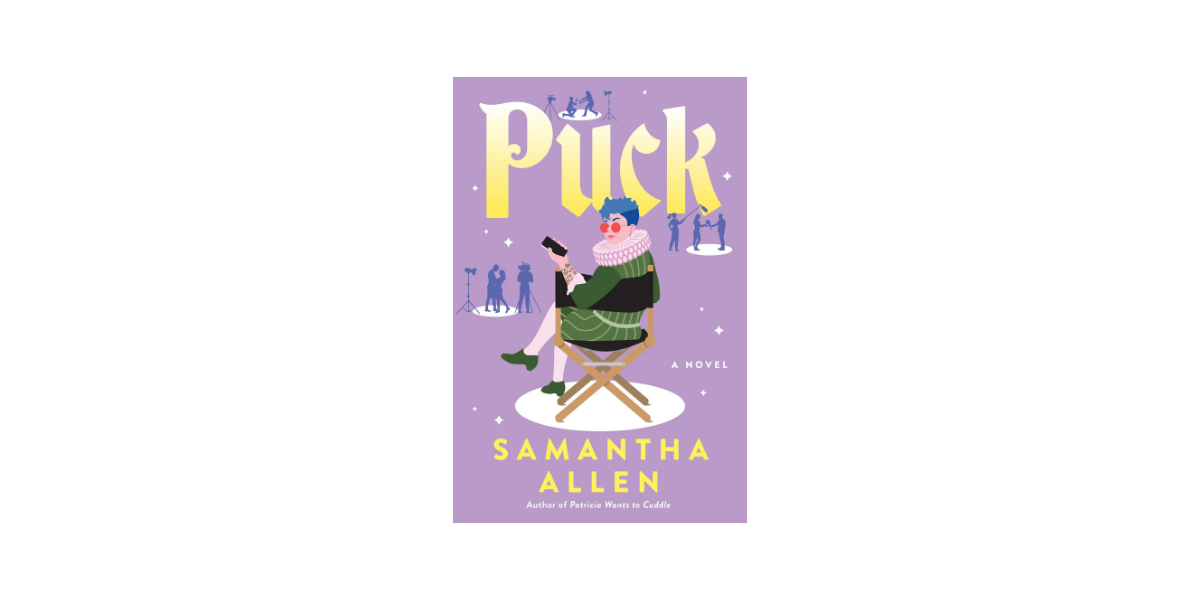
About a third of the way through Samantha Allen’s Puck, I started to wonder: Who gets to be an asshole? Are there limits to how much a character can drive you up the wall before you toss the book to the side and think: good riddance! I never loved you anyway? Are there types of characters that you are more willing to be annoyed by? If so, why? What does forgiveness look like when a character is, for all intents and purposes, a real dick for the majority of the time you spend with them? What happens then? If wrestling with these kinds of questions are something you are into, then I beg you to run to your local bookseller and grab a copy of Puck. And then come to the comments and talk about it with me!
First things first: I have been hugely bored of contemporary romance for the last while. It comes down to this feeling that the author’s first priority is not wanting to come across as—GASP—problematic. I’m just going to quote myself from another review I’ve written here, because I nailed it, okay?
You know how The Very Online™ never say: “Wow I love going to the grocery store?” They say: “I love going to the grocery store (a thing I know I am privileged to be able to afford and access and also grocery deserts are a real thing!)” It’s that urge to make sure no one reads you in bad faith, (a fool’s errand, truly) and it makes it hard to connect to the characters as real people.
Thankfully, Puck (mostly) avoids that narrative trap, by asking an even bolder question: What if the main character was someone you wanted to punch? Maybe not in the face, but…not not in the face?
Puck is, as you might have guessed, loosely based on Midsummer’s Night’s Dream. As a certified Slut for Shakespeare, I couldn’t wait to see how Allen took the basics of the play’s plot and fit it into a romantic comedy novel for 2026. Puck is a reality TV producer, so while they are not a fairy with the power to change heads into asses, a reality TV producer is basically as close as we can get in our modern age. Puck’s best friend, Mia is getting married—but not to the longtime love of her life, Xander. Instead, she is marrying Xander’s best friend, Damon. The whole group was close in college, but their lives have been surely but steadily drifting apart since. Because of this, Puck can’t figure out how or why their best friend has made this switch. And like their namesake, they cannot leave well enough alone. Destroying a wedding and getting Mia and Xander to fall back in love would seem a daunting task for many of us, but thankfully, Puck spends their days doing just that—with strangers for TV. They’ve got one week to get Mia to realize that marrying the group’s resident rich boy isn’t right for her and that she belongs with Xander. And just like that, we are off!
Here’s the thing. Puck is…the worst. Intentionally so! They are brash, self-centered and, most upsetting, dismissive of the ways their friends’ lives are changing. Granted, being the only nonbinary person at a weeklong wedding celebration in the south does sound exhausting! It’s not like I have zero sympathy for Puck in this situation! I know what it is like to be the only visibly different person in a group, and I know how much it puts you on the defensive. And in some ways, it’s even kind of thrilling to be a witness to Puck’s disdain for everything and almost everyone around them. It’s like watching your untamed id roam around and commit all the sins you’ve always wanted to commit at a wedding. Other times, it’s hard to believe that Puck ever liked this group of people—and vice versa. They are dismissive of pretty much everyone in their immediate friend group, with the expectation of Xander. The fact that Xander was an alcoholic for years and left Mia to clean up his mess alone doesn’t really seem to enter Puck’s calculus of why the two of them broke up, and they don’t seem to consider that that history might actually be enough to keep Mia from trying again with Xander, no matter how much she cares about him. But of course, based on the rules of the narrative, Puck has to be right, and the two of them do belong together. This book forces me to wonder if the emotional damage Puck wreaks on this group is worth it.
Also! This is a romance! On top of the couple swap, we’ve also got Robyn, Mia’s post college bestie and the maid of honor. She is running this week with an iron fist, sliding the day’s itinerary under every guest’s door each morning. Is it any surprise she and Puck immediately clash? I submit it is not! The second Robyn pushes back against Puck’s attempt to take charge over a game of croquet, sparks fly. Puck is immediately attracted, but they dismiss Robyn as just another uptight normie straight girl in the wedding party. Sure, she’s hot, but she’s wearing a matching workout set. Ew!!
Here’s where I take a break to say: Thank god for Robyn! It’s refreshing to have someone call Puck on their bullshit, and it’s even better that it’s coming from someone that they so handily dismiss at first. While Puck is pulling out all the stops they have learned from their time on Homewreckers, they are also fucking Robyn between yoga classes and lawn games as the day of the wedding gets closer. I understand the pull of hate-sex, or the less dramatic but more true-tolife “god you are so annoying I have to have you right now” sex, but I have a hard time believing that Robyn’s attraction to Puck would grow to more than just fucking. Maybe that’s unfair of me, and maybe I am simply being too hard on Puck. Maybe I am being too hard on Puck because for all intents and purposes, I am a Robyn. Assumed straight, dresses kinda normie, and can get really involved in running a wedding if given half the chance. Maybe I am sick of my own queerness being dismissed by the Pucks in my life and that’s why I was having a hard time rooting for our main character.
And when it comes down to it, do I have to root for the main character? Is that what makes a book enjoyable? I’ve happily devoured books with protagonists who are bigger assholes than Puck, so why am I chafing so hard here? I think part of it is genre expectations; I do want to root for a protagonist in a romance. I want to be invested in their journey, and I want them to grow and change for the better.
When it comes to the growth part, Allen succeeds. When the wedding blows up, and the part Puck played is discovered, everyone is hurt and furious. And to their credit, Puck does hear what everyone is saying. All of the things I was rolling my eyes about in the first half—Puck’s dismissal of their friend’s values, the fact that Puck hasn’t really been a good friend to these people since college—comes to a head, and a satisfying one at that.
Still, I couldn’t help thinking all these emotional revelations would have hit harder and felt more believable if we had gotten a few more scraps of the real emotional bonds these people had with each other. There is a moment toward the end where Puck remembers how they used to tend to Mia when she was hungover, reading Emily Bronte poems while she drank Monster on the bathroom floor. “It was sacred and profane, what could happen in a room alone with someone who really saw you.” That is a stunning little moment! I love how achingly tender it is, and it is the one of the few times I got to see how Puck was a good friend to Mia instead of just another example of Mia supporting them. I wish it hadn’t come at the end of the book. It would have been easier for me to care about Puck if more of that emotional closeness had been demonstrated a little earlier. I had a hard time rooting for someone who seems to hold their close friends in such obvious contempt.
If you want to know when I personally started rooting against Puck, it was this moment: “The bartender wants to know what kind of vodka Puck would like in their sea breeze, but Puck refuses to dignify a question that unnecessary with an answer. ‘The clear kind,’ they say dismissively.”
Apologies, but there are few things I like less in a person than being a dick to a service worker! Especially when said worker did nothing wrong! Then Puck has the audacity to be pissy about the “paint thinner” the bartender chooses for them? They try to pass this off as the bartender not liking them because they don’t know how to be fancy, but I don’t know. Try not being a dick from jump next time.
If you are reading this and thinking, “Wow Christina, sure sounds like you begged for messy characters and now that you got one, you are out here whining!” I can’t disagree! I’m well aware of the contradiction here, trust me. Puck is rude, and kind of a mess, but does that mean they don’t deserve love? Or forgiveness, or even a chance to try and repair the relationships in their life? I don’t think that’s how life works, and I don’t want that to be how books work either. And honestly? It felt good to be challenged by a protagonist, and it felt good to read a book and not have it immediately run through me and leave no impression. It was refreshing to feel frustrated by a main character, to talk about this with friends and say “talk about this with me, I’m not getting it.” It felt good to have some of my conceptions and ideas about queer characters challenged and maybe even changed!
And look, I am not going to lie to you: There is a joy in reading a nonbinary character who is free to be such an asshole. While Puck feels like a kind of queer person I know personally, I can count on one finger the amount of times I have read a book with a nonbinary lead who gets to be this messy and complicated. Especially in the contemporary romance genre, where nonbinary characters—if they exist at all— are typically supporting characters, and tend to feel flattened, like all their sharp edges have been sanded off to make them palatable and legible for readers. I’d rather spend my time muttering “Lord what fools these characters be!”
I’ll take messy and forcing me to think over sanded off any day of the week.



Comments
I appreciate the review! My Reading list is a LOT right now but Ill be sure to add to my list in the future! I appreciate that Puck is a messy fuck but is also called out on it and we have the space to be in our messy behaviours and examine them in fiction with consequences whereas in the real world, thats not quite the case.