





“You’re such a difficult person to be around,” a queer professor once said to me.
We were supposed to be talking about a short story I’d written for class.
In hindsight, being called “difficult” was much funnier than I want to remember. I was twenty-four, and they were forty-something. I wanted to study under them because I was new to this whole trans thing and they’d built a career around championing queer folks. A few months earlier, I emptied my savings to rent a truck and drive across the country, just to take a class with them. A year before that, they’d jumped through a stupid number of hoops to land a gig as a professor, which, in exchange for proving they overcame trauma, rewarded them with an uncommonly large salary for their industry, a mortgage, a car, healthcare, and bougier treats for their adorable rat-dog.
I was someone who felt like I couldn’t do anything right. They probably felt like they’d unlocked a secret to life. We both spoke from a place of hurt. Anyway.
The professor was frustrated that I kept calling my writing “stupid” and giggling. It was a term of endearment, I told the professor. The short story was about a babytrans OnlyFans creator who was bad at her work. Despite desperately needing money, she was more interested in seeing how many dinosaur figurines she could dangle from her junk than domming the men in her DMs. It was poorly written, sure, but how the hell do you read THAT and not feel like you’re in on some joke the characters have yet to learn? My protagonist was sloppy and kinda unlikable. But to me, the whole situation was so weird it let me laugh.
The professor waved over the server and paid the check.
Some of their last words to me were: “If you want my advice, you need to stop apologizing or no one’s going to take you seriously.”
***
Thankfully, I’m thirty now. Growing older brings on a new kind of gratitude—and weirdness. I’ve lived long enough to know everyone’s working through something dismissive an adult once told them. I’ve lived long enough to know most people need to convince themselves of their own choices. I open Instagram, and there’s a whole industry dedicated to talking heads who know the secrets to how we could be living better. The chorus is loud. (The chorus has always been loud.) But of that chorus—seated as close as possible to the fire escape—Mac Crane has been dropping gems on their Instagram reels.
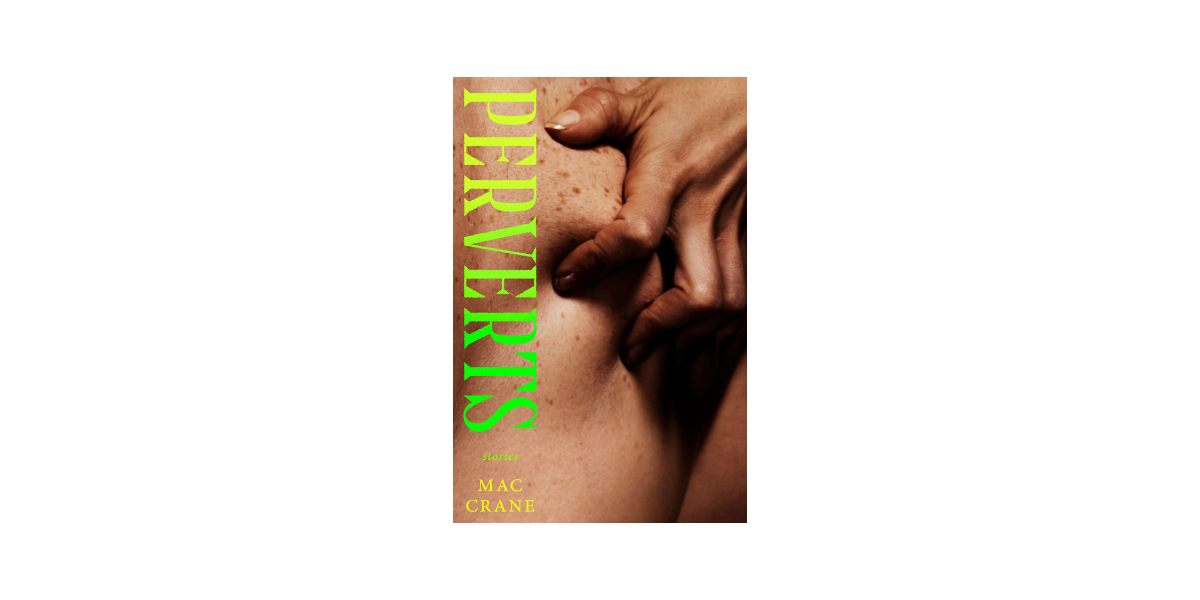
“If a Diet Coke is a fridge cigarette, then I think that my new book that’s coming out in July is a shelf cigarette,” Mac Crane says to the camera.
The book in question is called Perverts, Crane’s new short fiction collection, following their most recent novel, A Sharp Endless Need.
Of the 17 stories in Crane’s Perverts, just about every character could use a cigarette—Or at least a Diet Coke. They’re imperfect queers with hopes and dreams and flaws and fears who, were they to step foot in a self-serious institution, would be written off by ever-shifting pressures to be likeable. In short: they’re “perverts.”
They’re sex workers and disenchanted tradwives. They’re performance artists and gig workers. They’re neurodivergent people and people who understand twenty bucks is twenty bucks (inflation-permitting). They’re people who, after aging out of their self-destructive twenties, crave nothing more than to sabotage their lives. (Why? It’s what’s familiar!) They’re lonely people without the language for gender euphoria, lonely people in the company of others, trans parents, genderfucked Holden Caulfields, failed messiahs, Ms. Frizzle, and everyday trans people concocting fantastical routines just to find the courage to leave the house.
More than lending humanity to the types of queer folks society would rather not humanize, Perverts is for the freaks and geeks after a long day of masking. It’s a deeply tender-yet-hilarious collection that works through cognitive dissonance in real time, while holding a kindness for the messiest, most difficult, and most insecure parts of ourselves. It asks: now that cis people have a taste for corporatized platitudes—“Never apologize,” “Live out and proud”—who falls through the cracks?
Off the bat, Crane’s first story “Smear the Queer”, does its job as the first story in a collection called Perverts. By that, I mean it poses the kinds of questions well meaning allies might only consider on a whim while reading the New York Times. An unnamed former athlete, a “women’s” rugby player no less, finds themself asking: What if I could pay off my student loans by allowing transphobes to hate-crime me on a gig-by-gig basis? The pay would be black market worthy, sure. Clients wouldn’t be allowed to kill them, thank god. There’d be “wooden structures . . . from old playgrounds” to run around and draw out the experience, as if everyone were playing tag. And besides, the protagonist justifies, “We would take on [homophobes’] rage and aggression, give them somewhere to channel it so they wouldn’t take it out on some unsuspecting kid on the street or queers dancing at the nightclub.” If this is what it took to make rent—and atone for some survivor’s guilt I won’t spoil—then the speaker of “Smear the Queer” would be the best martyr, I mean worker. They’d keep “bleeding and bleeding, if you need [them] to.”
I can hear the reactions now: Those poor queers should seek help! Aren’t there more respectable ways to make money? How will they explain the gap in their resume?
This is, perhaps, the beauty of Perverts—and queer weirdos, more broadly.
With all the awkwardness of someone who showed up to their friend’s intervention drunk, yet all the subtlety of a Writer’s Writer, Crane’s characters make the uncomfortable comfortable and the hellish survivable (if not bearable). Despite shit circumstances, not a single character in Perverts settles for platitudes. “Live out and proud” won’t protect queers struggling to make rent in a puritanical town. “Never apologize” won’t save trans folks if they’re cornered in an alley. Crane’s characters are constantly apologizing, hedging, qualifying, but they’re also persistent fuckers, clawing and scraping and reclaiming every ounce of autonomy they can get when no one’s looking. And in what world do those informed gambles ever look professional?
In “Siren Island,” the fifth story, a janitor is promoted to actor in an immersive siren-themed burlesque. She (they?)—the speaker is only referred to as “Leesh” or “Alicia” in weird asides by characters who see them as a means to an end—wants to be good at their job, the best at their job. (“Why do something if you weren’t going to give it your all?”) But then Sara, the star siren—a former maybe-Olympian, no less—proposes to them mid-shift, saying she needs a green card. She’s being threatened with deportation back to France.
“You’re going to marry [Sara], right?” [Alicia’s boss] said.
“I mean, I don’t know?”
. . .
“We will certainly go under without her. We’d lose all her regulars. You don’t want that, do you? Don’t you love your job here at Siren Island? Hell, I just promoted you to captain. Don’t you want to keep that job?”
Yes, Alicia agrees, they want to keep their job. For the next thirteen pages, Alicia dangles from Sara’s arm like a Labubu. “Under normal circumstance, this would have embarrassed me, but given my deceit, I lacked the capacity for embarrassment. Guilt, though—I could do big, heaping mountains of guilt.” Wherever the two go, Sara’s fans grab at Alicia, excited to touch the person touching Sara. But like all humans, Alicia eventually snaps. In what feels like the first deliberate decision of Alicia’s life, they take a wine glass from Sara at their engagement party, step on-stage, and dump it down their collared shirt. “I would build myself a house,” Alicia thinks, “a perfect house, perfect for no reason than because I built it. Because I made the decision to. And I would be happy, but not all the time, and I would be sad, but not all the time, and I would be free, knowing these feelings were mine and mine alone.”
While boldness, certainty, and legibility are crucial to survival under capitalism—and to a questionable extent, queer liberation under the thumb of capitalism—lasting confidence is imperfect and personal—and difficult to mass-produce. In other words, it’s messy.
(The speaker in Perverts’ story “Harmony”, thinks they “beat” therapy by sleeping with their therapist, only to sober up and realize they actually need to talk to their friends if they want to consider them a support system.) (The protagonist in Perverts’ story “Catcher”—an uber-literal yet speculative “perversion” of Catcher in the Rye—pops pills and quiet-quits their job despite how much they love working with weirdo kids.) (The protagonist was one.) (The catch is: they’re supposed to prevent children from falling to their deaths, daily; adults keep blindfolding them, shoving them, promising them something better if they just jump off this one cliff into adulthood.) (“You’re never able to identify who pushes them . . . none of them look like the villains that kids are taught to fear.”) (“All of a sudden, six-year-olds are saying things like I’ll work until I die and How are the interest rates right now?”) (The protagonist is doing their best at a job meant for dozens if not hundreds.) (The protagonist makes a pact with themselves to climb the cliff one day and shove the adults right back.)
Crane doesn’t beg for legitimacy when they write characters like Alicia or the unnamed protagonist of “Smear the Queer”; Crane instead shows readers that marginalized confidence requires more public fuckups than professionalism will allow. Pouring a glass of wine on yourself isn’t a Happily Ever After™, but neither is laughing in an office full of straight people and declaring: “At least I’m not like those queers.”
Which, when speaking of “those queers,” always tends to find its way back to sex.
With the titular story, “The Perverts”, Crane has achieved something rare in the realm of writing about kink. Inspired by the boardgame Clue (Cluedo if you’re British), “The Perverts” is about a pregnant online sex worker, “xosportybisexual,” who wants their baby to have the life they didn’t get. The most financially soluble solution, circumstances say, is to enlist the help of their clients, their “perverts.” And so xosportybisexual concocts an oddly inefficient scheme to shame “SportFox,” “RunLakeCalhoun,” “Stripe,” “Russ,” “Jasper44,” “Brownnoser,” and “pantymancan” into attending an irl sex party, even though xosportybisexual “had no intention of actually hosting a sex party . . . [they] wanted to get all of these people in the same room, just to see what would happen.”
The result is comically horny. A horniness so deeply and profoundly horny, so existentially horny, it ceases to be horny at all and horseshoes into an unexpected innocence, equal parts taboo and wholesome, awkward naivety, forgoing anything to do with orgasm and embracing everything to do with falling in love with yourself as a messy, weird lil mammal.
I’ll allow this one spoiler because it’s emblematic of their entire collection: the twist isn’t that xosportybisexual is “found out.” The twist is that xosportybisexual’s clients, unanimously, realize they’d been deprived of loving acceptance. Without an ounce of regret, “the perverts, who weren’t perverts at all, who weren’t my playthings but my human proof of boldness” get to work opening boxes and painting the walls, prepping the house for a baby. It’s unspoken that “the perverts” want this baby to live a life less complicated than theirs. But as xosportybisexual thanks “the perverts” by rocking everyone to sleep, they have a realization so simple it’s playfully anticlimactic. “I could stand firmly in my life,” xosportybisexual thinks. And that’s all they need.
Ultimately, there’s no denying this collection is fucking weird. But in my books, that’s praise of the highest sort. Perverts and “The Perverts” upends what the status quo takes for granted, no different from “more palatable” fiction that points out the weirdness of exchanging money for goods, or raising children, or taking medicine, or falling in love. So, Perverts asks, the next time you think to write someone off, revisit what harm has actually been done.
Did anyone get hurt? Did anyone have fun? Could I stand to grow as a person for holding empathy?
***
The queer professor and I have emailed a handful of times since they called me “difficult.” The exchanges are always curt. Their time is important. I’ve no intention of changing their mind or pushing their boundaries, so it’s all business.
Still, a hurt lingers in me, holding onto what they said. It’s not just about being likeable; it’s about feeling like I’m worth anybody’s time in the first place.
I’ve accepted that, in all likelihood, I’ll never be “easy” to people who prioritize comfort. But all these years later, Crane’s Perverts reminds me that, maybe, just maybe, this living thing, with all its qualifications and knots, isn’t about being “easy.”
And so, somewhere, somehow, in my own messy way, I’ll build myself a house as the speaker of “Siren Island” hoped to do. This house—it’ll have its issues, for sure. But I know it’ll be surrounded by people who care for me because and not despite. There’ll be dips in the floorboards I can’t explain. There’ll be weeds I keep because they’re pretty. There’ll be noisy neighbors and nosey neighbors, and they’ll all check in more frequently than I’d like, asking if I’m doing well. Everyone is welcome to say “sorry” as much as they want, so long as they mean it. What matters is that we’re coming to terms with our quirks, parsing nuance from harm.
And who knows. In this hypothetical house I build, maybe there’ll even be a freaky, beautiful, untrained rat-dog. I’ll get frustrated with them sometimes, but not always. And each night I’ll kiss their lil head and cuddle them in bed. There’s so much of this world we don’t know, they’ll say.



Comments
*Clapping Emoji* well said, well written.