





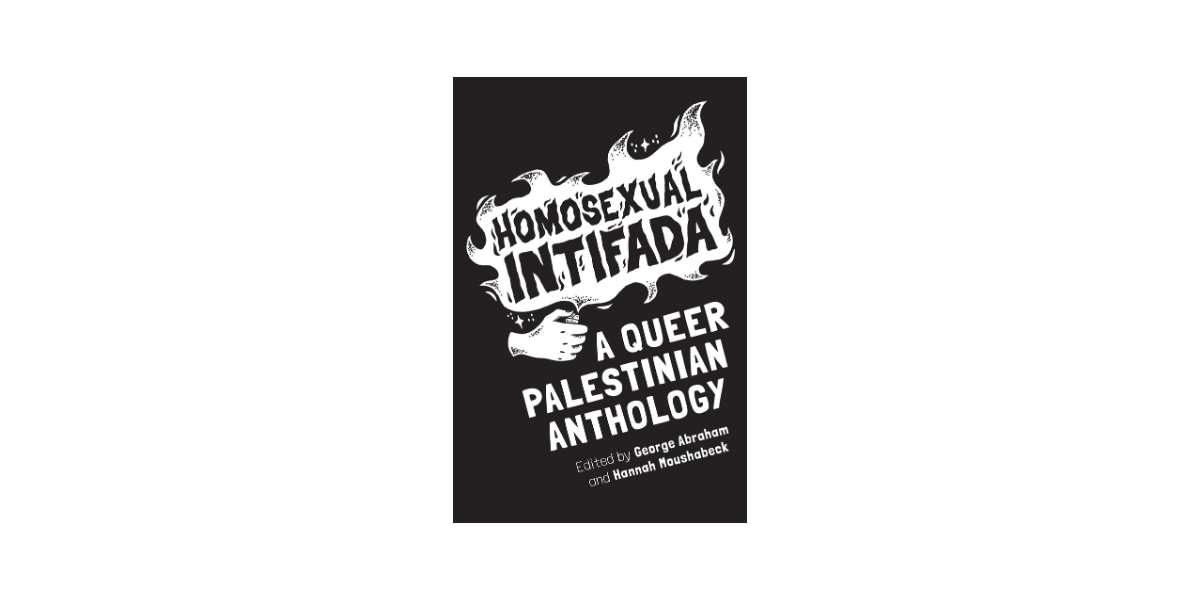
At the beginning of their introduction to Homosexual Intifada, the new anthology of queer Palestinian writing they co-edited alongside writer Hannah Moushabeck, George Abraham writes:
“Contextualized within this interconnected settler genocidal regime, it is unsurprising to witness a rise of queer and trans insurgence, both globally and domestically in the U.S., standing in solidarity with Palestinians against the very regimes that dispose of all of our bodies without hesitation or consequences.”
They go on to note:
“For the first time in my own life, I have seen the tangible ways this genocidal moment is changing our community’s understanding of queerness. In conversations with even the most conservative Palestinian Americans, several are starting to notice that queer and trans kin are visibly standing with Palestine in ways that put their lives and livelihoods on the line.”
For those of us who have been involved in anti-Zionist organizing for some time, this solidarity isn’t necessarily new, but as Abraham discusses, this larger involvement quickly became a new tool of attempted division for the Zionist West. Since the start of the anti-Zionist actions that began after October 7, 2023, powers in the anti-queer and anti-trans West — and even, as I’ve experienced in my own life, from Zionists who aren’t in the government or the media — have tried time and time again to use their perception of anti-queerness and anti-transness amongst Palestinians in Palestine as a cudgel with which to convince queer and trans people that this fight has nothing to do with us. And over and over again, what gets lost in these conversations and the constant pinkwashing of the U.S. and the Zionist state is the fact that there are queer and trans Palestinians here and abroad who are experiencing the precarity of being subjected to the death and destruction of the decades-long genocide against their people and the continued fight for understanding in Palestine and in the homes they’ve made outside of Palestine.
Homosexual Intifada, the first anthology of its kind published in the U.S., isn’t endeavoring to provide comprehensive answers to these intracommunal conversations or, as Moushabeck writes later, “to educate a Western audience that believes pinkwashed lies.” Instead, what readers will find here is a litany of voices writing “from within the dying days of western empire and racial capital” about their lived experiences within the double-bind of the precarious nature of their existence — not just in relation to witnessing and experiencing the horror and depravity of genocide but also the ongoing hopes, dreams, and moments of exuberant celebration that help keep them pushing toward an anti-colonial future.
The writing in the anthology ranges from personal essays about living as queer and trans Palestinian people in the West, to poetry on a variety of themes, to speculative fiction on life after Palestine is no longer occupied, to a poignant photo essay to the queering of different forms of storytelling and the ideas inherent in the fight for Palestinian sovereignty.
Randa Jarrar’s “The Fisherwoman,” a queer retelling of a Palestinian folktale, illustrates the ways supposedly powerless people can overcome those in power who try to destroy them and ends with the reminder for other Palestinians:
“We are entire worlds, bitch. So fuck these monstrous foul-smelling empires and fuck what they think they can do to us. We will never be erased. We will never be stolen from each other. We will continue to drive the king crazy, while the king thinks he can ask the impossible of us.”
Further into the collection, Sarona Abuaker’s experimental essay “Suture Fragmentations – A Note on Return” begins with a reflection on their time witnessing artist Basma Alsharif’s exhibition “The Gap Between Us” and evolves into an examination of the way the possibility and practice of “return” functions for Palestinians in the diaspora. Abuaker writes:
“Queerness here means the processes and acts of re-orienting return in relation to times, spaces, us. Return has always, then, been conceived as ‘unnatural,’ for it is a practice of making an order beyond the state-sanctioned order which we live today of ‘capitalist domestication’ and settler-colonial regimes. I propose return as practice, queering return so it realigns with orientations of possibility, a way of directing through future-thinking.”
Elsewhere in the anthology, we get to witness heartening and heartrending personal narratives and poetic confrontations on existing as queer and trans Palestinians in the diaspora. Elias Jahshan’s “Palestinian Dreaming” confronts feelings of grief and hope simultaneously through an exploration of different dreams and daydreams he’s had about how his queerness is seen by family members in the diaspora and in Palestine. At the end, he asserts:
“I’d like to think that it’s a reminder to myself that a free Palestine will always be something worth advocating for. A just cause that will be achieved in my lifetime. A Palestine free from the occupiers, violence, and dehumanization that comes from Zionist colonization. A Palestine that honors my ancestors — and also celebrates queer joy.”
In the poem “Avoid Us Like Oxygen,” Tariq Ra’ouf writes on the inescapability and indestructibility of queerness by reminding readers that “we are everywhere you are / and everywhere you don’t want to be” while affirming that “we are all / part of god.”
Nadia Shammas’s “For My Enemies” is a tiny, gut-punch of a poem reminiscent of June Jordan’s ferocity and Diane Di Prima’s terseness that begins with the line “I would not deign to water your graves with my piss.”
S.’s piece, “Queer as Ghareeb,” juxtaposes her father’s relationship to keeping certain atrocities and his sadness of being exiled from home secret — or his “ghourba,” as she explains — against reckoning with the fact of her queer sexuality. On her eventual recognition that she couldn’t hide from herself or others anymore, she writes:
“As a Palestinian, I am an embodied demand for decolonization. A call to divest from the homo-nationalist machine. My community, then, would be not received but built. Loved into existence, on connection at a time — at queer raves and on beaches, yes, but also in organizing spaces, vigils, and protests.”
As the anthology concluded, I couldn’t help but hear some more of Abraham’s words from the introduction in my head:
“…this anthology reminds us that our strength, as queer Palestinian writers, is in our fearless embrace of our more intimate reckonings: that in the depths of our interiors, we arrive at the most dangerous, earth-shattering, questions for our collectives.”
Because that’s exactly the gift that has been given to readers here. In a world that is insistent upon partition and splitting people into factions, the writing in Homosexual Intifada continually reminds readers that those schisms are inherently superficial and that the liberation of all marginalized people is dependent on the deconstruction of settler-colonial states, systems, and methodologies everywhere. Abraham writes, “…the whole world is at stake in this fight against imperialism,” and Eman Abdelhadi’s “Parallel Lives” prompts us to remember, “We can only win together!” This anthology provides an intimate and potent response to the question of how to keep pushing forward.

Comments
On hold at the library now 😎✨ thank you!