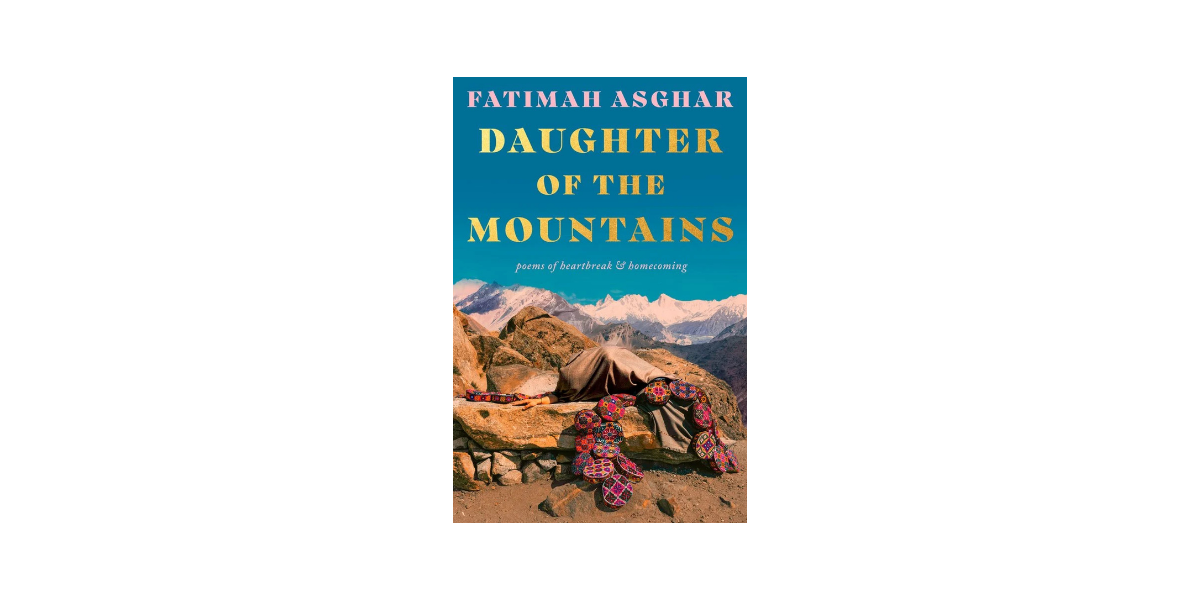
Daughter of the Mountains opens with a spell: a prayer to Allah and incantation that acts as protection against the negative forces the book will later name, and a prayer of gratitude for the stories Fatimah Asghar will weave together in their collection. No one describes diaspora like Asghar, whose work addresses what it’s like to see colonial violence echoed in today’s world through imaginary borders. While I don’t come from the same one, their latest collection reminded me of yearning for a homeland I barely know—a valley at the foot of a mountain range in Ilocos Sur, where my father’s extended family still lives—and how losing proximity to nature and our roots reverberates in our most intimate relational heartbreaks.
Asghar ties together history from the Partition of India in 1947 and their extended family’s exile from Kashmir with the brutality of Israel’s genocide in Gaza and the ICE raids happening all over the United States today. The commonalities of colonial violence spread across imaginary borders.
My family’s version is similar, but mostly conjecture. The lore is my grandfather sold part of his mountain range to the Filipino government in the ’70s before moving to the U.S., the country that owned the Philippines for the first 22 years of his life, in pursuit of the American Dream. Yet by fleeing the motherland for better opportunity, he was escaping what would become a military dictatorship and, perhaps, sold his mountain range to that corrupt government.
Those familiar with Asghar’s work are aware of the central themes in their earlier work: If They Come for Us wrote into their identity through grappling with growing up as an orphan while introducing their playfulness and experimentation in form, while their debut novel When We Were Sisters addressed this through the lives of three sisters while exploring their queer identities. Asghar continues to play with form throughout this collection, using redactions via erasure poetry and brackets to fill into the gaps of memory and lack of archival history. What struck me most about this collection was the restraint and deliberate use of erasure and redactions. I appreciated a poem with footnotes that filled in cultural knowledge Asghar failed to inherit from parents who died before passing it down to them. There’s a poem where text appears flipped, forcing the reader to concentrate harder on that section. Asghar’s brackets carry their inner monologue, and hearing Asghar read “daughter of redacted” aloud on the audiobook, over and over, is what made me understand the mystical elements of writing as a form of magic.
Through this collection, Asghar’s search for home through visiting family in their homeland is juxtaposed against the peak and denouement of their partnership. Though the two might be seen as completely separate heartbreaks, Asghar’s unraveling of history intertwined with the reckoning of their breakup share vocabulary.
The collection is split into five sections, each labeling Asghar as daughter of [ ]. I’ll add that the audiobook is just as compelling—it was a treat to listen and read the poems simultaneously—because only they could read their work with such conviction, providing a complementary experience to what’s on the page.
In the first section, daughter of [the return], readers are treated to a brief history and introduction to the poet’s conception of what the true idea of home for their ancestors must have felt like. In the narrative, we also see that Asghar’s arrival to the land their family was pushed out of brings about questions of filling in gaps of history and introducing their beloved partner to their extended family. The poem “[armor]” seduces in its first half, luring the reader in with promises of glass bangles and the lingering scent of musk and oud wafting with a volta that turns the simple act of cutting open a pomegranate into a massacre. The world these poems exist in is ours, but Asghar appreciates the beauty amidst the violence. This section also introduces a family secret, which involves the erasure (hence why the redactions and brackets are important to the form) of the existence of two late older aunts, both dying during a pilgrimage with the poet’s grandmother. Both are buried in unmarked graves in now-forgotten lands, lending to even deeper grief for the history they’ve lost.
There are dead in my family I only learned about as a teenager, mentioned in passing at a funeral and never again, and I’ve stopped asking about their history and where they’re buried, because nobody alive will volunteer that information. My paternal grandmother died when my father wasn’t even a year old, falling from a mulberry tree, picking food for her family. Because he wasn’t old enough to remember her, that’s all I know. When my grandfather was alive, he evaded questions about her tragic accident. So even though I’ve sat with the dying for a living, I cannot tell you where her grave is.
The second section, daughter of [hope] introduces levity and breathing room as we move into falling in love with a partner and reveling in that comfort. The horniest poem in the book, “[the ocean’s tryna fuck]” is visceral and raw, as Asghar explores their sexual dynamic with their partner, a seeming service submissive to a sapphic dominant. Amid falling in love, we witness the couple meeting Asghar’s family, even though they spend the rest of the collection openly grappling with what that means for someone orphaned at a young age. They make the argument that the idea of chosen family, through their rich friendships and romantic connections, is still a part of that. And that annoyance is part of family life.
They spend the middle section, daughter of [border], writing into that thesis, highlighting the bullshit of being alive in the world now. Armed with their support system, the poems in this section make the case for collective survival and resistance. The poem “[when we thought the world would end]” opens with the COVID-19 pandemic and trying to stay joyous by remembering good times, shouting out some poet friends and colleagues like Danez Smith, Safia Elhillo, and sam sax (all in conversation with this collection!) The humor of their last line “well bitch, this might be it” is indicative of their character—and probably how I’d text my best friend in resignation amidst apocalypse.
Another poem, “[here we are]”, looks at the genocide in Gaza and what it means to be complicit as someone with an American passport. Asghar writes that they “can’t condemn what they haven’t lived, that their parents died, tragic, yes, but not murdered.” This section closes with brackets, this time filled with the word border—so the redaction carries on even as the thing being redacted changes.
Next, the section daughter of [pain] is about the breakup, where Asghar is at their most cutting. They’ve written about this relationship for Harper’s Bazaar, where they explained one of their close friends cheated with their partner—despite a defined non-monogamous relationship with a set of rules and boundaries. The poem “[madness]” addresses this head on: “unwifed and orphaned daughter of who?” There’s so much white space here, sitting in the section and page breaks of this particular poem, as the poet processes being left. The poem “[pagamento]” is a curse: Asghar grieves, misses their sex, literally spends the poem hexing the people who hurt them, and calls on Allah in a single breath. “What is the opposite of Midas?” they ask. “What I touch leaves me dirt.”
The final section, daughter of [dirt], integrates the wide spectrum and roller coaster of emotions from the prior poems. This part mirrors and responds to earlier poems. In this last stretch, the chronology becomes clear (I didn’t realize I’d been reading a story in order until it ended). The poem “[i love them still]” on title alone makes us believe we’re about to grieve the break-up alongside Asghar; instead, we realize the poet is mourning their parents and the shitshow polycrisis.
The poem “[you]” is about leaving, and it holds the thesis of the entire book”: “to open your heart, it needs to break.” There are more reasons than a failed romantic relationship for a heart to break, and Asghar has spent the collection showing us the infinite expanses of grief in all its forms. But the poet reminds us of our roots in nature, that being part and one of the Earth–specifically, as the title says, a daughter of the mountain–is a necessary part of homecoming. Since dirt is what Asghar’s touch turns things into in the curse poem, we must remember dirt is what we’re all made from. So fuck Midas’ golden touch.
Like Asghar, I’ll take the dirt from the mountains. We are both their children.