Jane Schoenbrun is fascinated by screens. Whether it be creepypasta rabbit holes in their debut feature We Are All Going to the World’s Fair, the entrancing nostalgia of teenage dramas in I Saw the TV Glow, or the erotic escape of slashers in Teenage Sex and Death at Camp Miasma, each of their films has explored the complex and often contradictory relationships we build with these flat portals to other worlds. This isn’t to say that Schoenbrun loves screens. If anything, much of their work is about the disorienting and often dehumanizing effect that film, television, and the internet can have on the disaffected, lonely, and dysphoric. At their worst, screens become toxic panaceas, sucking us away from the actual truths of our lived reality.
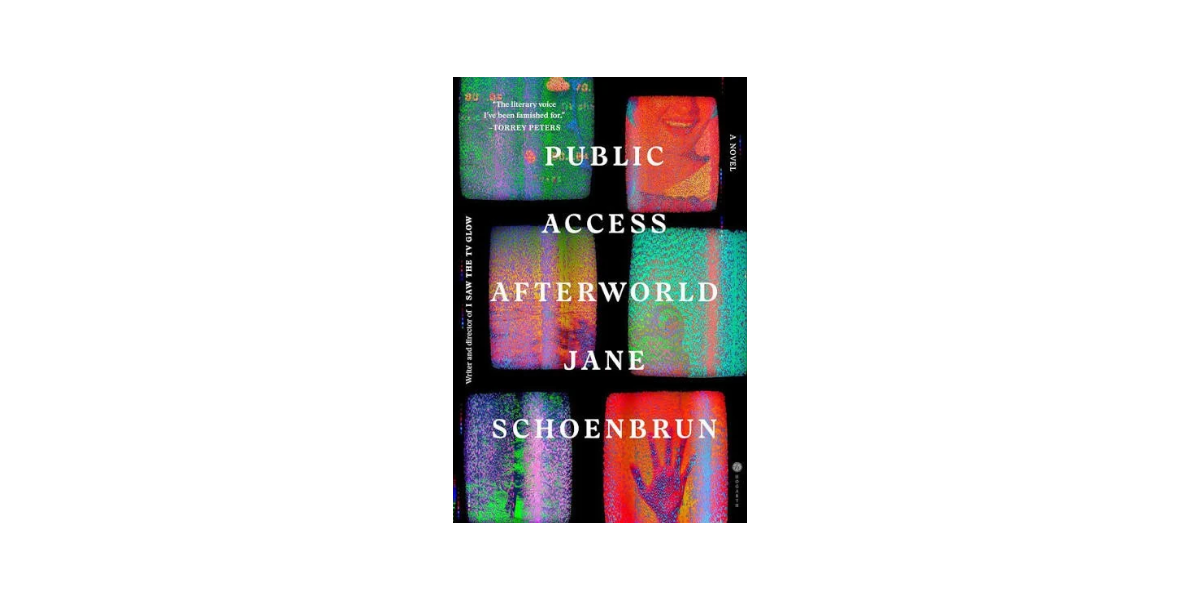
It should come by no surprise then that Schoenbrun’s debut novel, the dreamy and thrilling literary horror Public Access Afterworld, continues their creative obsession with screens and the escapist, disassociating pull that they have on us. Schoenbrun originally envisioned Public Access Afterworld as a television series while they were working on their sophomore film, I Saw the TV Glow, before reimagining it as a trilogy of novels. The DNA of its original medium is inescapable: Schoenbrun structures their novel like a season of television, breaking its plot structure into distinct episodes and even building in a “mid-season hiatus” about halfway through. It’s an inspired choice that allows them to not only play with the inherent storytelling and stylistic opportunities provided by episodic narrative, but deftly merges form, function, and theme. If anything negative can be said about Public Access Afterworld, it’s that I had a difficult time reading Schoenbrun’s novel without wishing it had the opportunity to be told in the medium it was originally envisioned in. There’s a distinct strangeness to reading a novel that’s fascinated by the storytelling sensibilities and audience experience of a different narrative artform, and it prevents Public Access Afterworld from reaching the sort of metatextual layering that makes their films, particularly Camp Miasma, so sublime. This should have been a TV show, but we unfortunately live in a world where a series this expansive in scope and narratively off-kilter would likely never get produced, especially given the fact that it was written by and mostly stars trans people.
Thankfully, Jane Schoenbrun is a damn good novelist, almost frustratingly so. Unencumbered by budgetary limitations and other practical realities, Public Access Afterworld allows Schoenbrun to really let loose and tell an impressively sprawling saga that’s arguably their most ambitious storytelling swing to date. The novel juggles multiple realities, different time periods, and a half dozen point-of-view characters. It’s part fugitive thriller, Lynchian liminal horror, and Vonnegut-esque social satire. The result is addictive and absorbing. Despite its hefty length, it’s easy to lose hours at a time to Public Access Afterworld and its sharply written, ever-twisting narrative.
Summarizing the plot of Public Access Afterworld is somewhat difficult. It’s built upon mystery and the unknown, and wandering in its pages with little preconceived notions of where it may go and how it may unfold is to your benefit. The episodic structure of its plot allows Schoenbrun to skip across time and rotate between characters in a way that blurs and reveals context as it unfolds. Discovering the ways that Public Access Afterworld folds and reshapes itself over six hundred pages is part of what makes it such a hypnotic read.
We begin in June of 2009 with the final broadcast of analog television before the government-mandated transition to digital. Awkward teenage best friends and av club nerds, David Sawyer and Erin Morrison, record the final moments of an era of television, only to discover a surreal broadcast hidden in the static that follows: a blurry image of a spatula-handed woman standing over a kitchen sink and the cryptic title of “Public Access Afterworld.” Seventeen years later, Bethany Peters, a trans woman going through an extreme quarter life crisis, is hired by the online video platform GlobalVill as a content manager, where she continually encounters videos referencing the same mysterious broadcast.
This is about as much surface-level description of Public Access Afterworld’s first two episodes as I can give. Like Schoenbrun’s other work, what follows is a narrative that blends popular culture with existential dread and personal reinvention. It’s an undeniably trans narrative while also engaging directly with the omnipresent hold that the screen age has over our collective consciousness.
It’s hard to read Public Access Afterworld and not think of I Saw the TV Glow in particular. Both works concern trans (or trans-coded) characters and their relationships to parallel realities hidden just behind television screens. If anything, viewing both works in tandem allows for a clearer understanding of Schoenbrun’s own particular stance on the escapist fantasies offered by screens, television in particular. As much as I adore I Saw The TV Glow, it’s not uncommon to encounter people that confuse the exact nature of The Pink Opaque, the film’s Buffy-inspired television series that also doubles as the home reality for its dual leads Isabel/Owain and Tara/Maddy. While Owain and Maddy are ultimately called to flee the imprisonment of their reality and find their true selves in the fantastical world of The Pink Opaque, the television series manifestation of that world is ultimately a corrupting force, entertainment that offers diminishing returns as the characters age. The power that lies in television comes from the truths their narratives reveal about ourselves and each other, while the stories on screen also threaten to keep us disconnected from our reality. Schoenbrun argues for a clear distinction between engaged, reflective viewership and the checked out disassociation the medium often invites. Public Access Afterworld plays with similar ideas, seeing our dependence on screens and the reality-hopping portals they offer as potentially parasitic.
What exactly Public Access Afterworld is and how it connects to identity, the history of American popular culture, and the author’s own fixations are truths best experienced firsthand. In early interviews about the novel, Schoenbrun described the project as a “trans Lord of the Rings” and, while there may not be much that’s transparently Tolkien about Public Access Afterworld (maybe The Matrix would be a more obvious parallel?), the comparison at least gestures to just how expansive their vision is. The thematic and narrative ground covered in this novel alone is so dense and rich that it’s hard to imagine what exactly might be in store should Schoenbrun complete their planned series, but if what’s to come is even remotely close to their debut, then we might be standing on the precipice of a literary trilogy unlike any to have come before.