





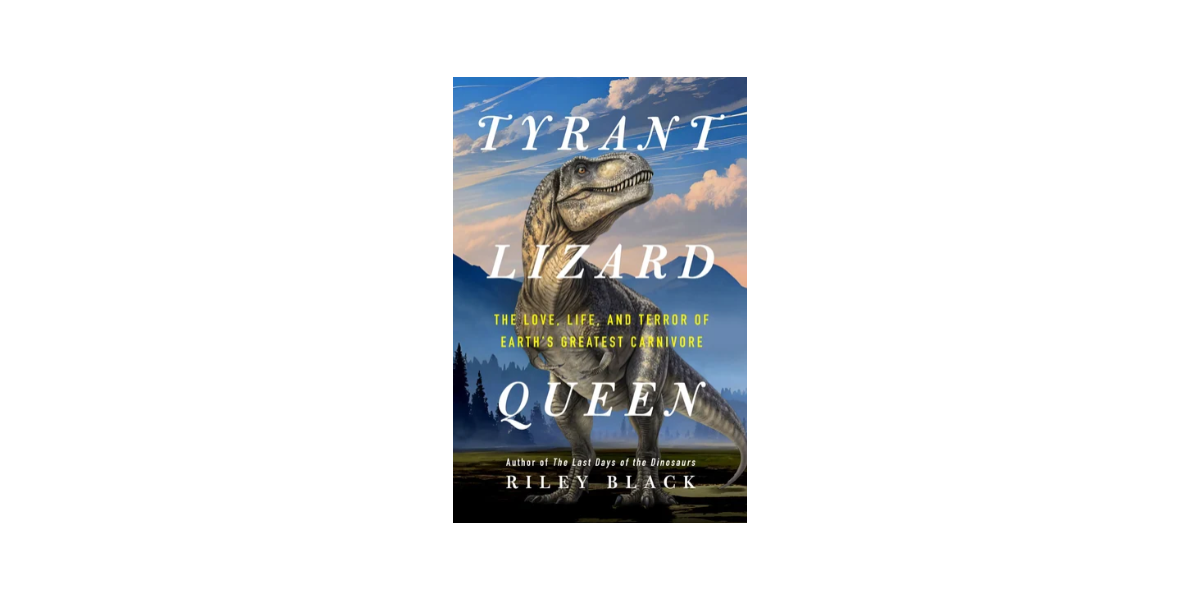
Like most baby dinosaur nerds, Tyrannosaurus Rex was one of my first hyper fixations. (Seriously, there’s video footage of me playing with a t-rex figurine in the background of my little brother’s baptism.) There are hardly any dinosaurs, or animals in general, that are quite as iconic as this sixty-five-million-year-old carnivore. We are so accustomed to thinking of T-Rex as something monstrous—the lawyer-eating antagonist of Jurassic Park or the damsel menacing beast that King Kong must bash into submission—that we often overlook the fact that these were, first and foremost, animals with complex lives.
When trans paleontologist and author, Riley Black, announced her next book, Tyrant Lizard Queen, would be the biography of one female T-Rex from hatchling to adulthood, I was ecstatic. My excitement only grew when Black started referring to the book on social media as “toxic dinosaur yuri.” Of course, I had to ask Riley Black about this directly and was lucky enough to have a lengthy conversation about paleoecology, fossils, the gendered stereotypes of carnivores, and, naturally, lesbian dinosaur sex. Yes, really. There is scientifically backed lesbian dinosaur sex in this book.
Nic Anstett: I feel like “Why T-Rex?” is a weird question, but why T-Rex?
Riley Black: I didn’t want to. That’s the thing. The first stage was denial. I was telling myself, “I can’t write a T-Rex book.” Because it’s obvious, right? It’s the dinosaur. It’s the one that everybody knows. It’s, you know, the ambassador of paleontology, the horror movie monster through scientific object, the whole thing. And I wrote an article for Slate a couple years ago about how T-Rex is overplayed and had become this symbol of toxic masculinity.
In a way, it kind of started that way. It was named by a white supremacist and was this icon of all these values that he had. And over time, it just became this kind of chomp monster that everyone was obsessed with, like the dominance of “the tyrant king.” Even a year or so ago, there was a book that came out called King Tyrant with a T-Rex on the cover, and it was a great book, but that was the vibe.
And I was like, “I don’t want to.” I want to write about some weird little thing that no one’s ever heard about before and expand people’s understanding of the past. But I’m also a writer, and I have to live, and I have to eat, and I thought “the T-Rex is the start, though. Like, who wouldn’t want this biography? And why can’t I play with the same dinosaur toys that everybody else does?
Basically, I pointed out the critiques of T-Rex and its reputation and the way it’s employed as a symbol of the past, especially of supremacy and dominance and all that kind of stuff. And nobody really paid attention to that. You know, it got me an article, but it didn’t really make a difference. So, I decided rather than critique it from the outside, why not tell the story? If I think that there’s enough here about the life of this animal that’s beyond just how it ate and how it hunted, I should be able to prove it.
And that was my challenge for myself. And it almost felt like—I say almost because I haven’t had this experience yet in my life—but it felt almost like making up with an ex. I’ve had this relationship with this dinosaur since I was a child with all these ideas and values and images and everything else, and I end up in this kind of tense relationship where it’s like, “I’m tired of talking about T-Rex all the time. I want to talk about something else.” And then kind of falling back in love with that dinosaur, remembering what it was like to, you know, be five years old and see that skeleton with the jaws towering over my head and wondering all these things about how it lived.
So it was sort of allowing myself to love the animal and separate it from this reputation.
NA: So, I lurk in a lot of online paleontology communities, as a hobbyist, I guess. And there’s a lot of chatter and discourse about how T-Rex is almost overstudied. Was that a benefit when writing this book, that there was so much to pull from?
RB: Absolutely. Yeah. We know more about T-Rex than any other non-avian dinosaur, by far. Because anytime anybody has had anything to say about T-Rex, there’s somebody else racing in to say, “Well, that’s not quite right,” or some nuance or debate and argument, which has led to a lot of research.
And we have a lot of them. There are at least, I think, 50 partial skeletons of varying degrees of completeness. There are a wider number, and many of them are privately held, and that’s this whole other problem. But still, that’s what you want when you’re writing about a species like this. If it’s just a singular specimen or skeleton, you don’t know whether that represents an average or a certain stage of life or what have you. But this is an animal that we have a pretty good idea about, from not only it but its relatives and the habitats it was in, from the time it hatched to the time that it was a full-grown adult.
And there was enough known about its habitat as well. This is almost an umbrella effect that happens in conservation. Where you have something like with Giant Panda, right? Where if you protect the Giant Panda, you protect those things that live in the same habitat. Well, by studying T-Rex so intensely, we also learned a lot about the other animals and organisms it was connected to. I’m primarily an ecologist at heart. It’s not about just the singular animal. I want to know about relationships and how they form and reinforce each other.
And it seemed perfect to take this dinosaur that everybody knows and broaden the view a little bit. It felt similar to when I wrote The Last Days of the Dinosaurs, where there’s dinosaurs in the title, there’s a T-Rex on the cover, but the dinosaurs are gone by chapter three with the exception of a few birds. It really is a Paleocene book, a fossil mammal book, about all these other sorts of creatures, but you use the iconic ones to bring people in. There was a benefit to being able to back up enough and even just talk about things like how they replace their teeth and all these little intricate little things.
I’ve been working as a science journalist for 20 years. So much of what I write about is like, “ A study came out, it says this, researchers agree or disagree,” and that’s more or less it. I don’t get to connect it to anything else. And now you take this huge body of research and start to thread through all these little references and implications.
NA: As far as I’m aware, this is your first narrative book out there. Is that correct?
RB: This is the third one. So, I have The Last Days of the Dinosaurs and When the Earth Was Green, but those are these big evolutionary epics. They take place over a million years, or in the case of [When the Earth Was Green] 1.2 billion years. It’s a lot of history to cover. There’s a changing cast of everything from little microscopic red algae through our earliest primate ancestors. But this is the first time I’ve really had a central character or protagonist.
I want you to love Snaggletooth. I want you to root for her, to know her as an animal, and to really carry that story.
How do I do this in a way that makes sense and is believable, without anthropomorphizing this animal as well? How do I build empathy? It’s like the longer you spend with a character, the better you know them, and in some ways, the greater the risk.
I just had to do it. I knew there were a couple of different ways I could approach the story. I’m working on something else right now that’s more of a look at a single species but over different generations. But writing a single character, yeah, it was definitely a different approach. I’m just glad I didn’t have to worry about dialogue too much, or at least spoken dialogue. We have dialogues between the animals, but they use roars and body language and all that fun stuff.
NA: It was interesting reading this because the closest thing I could really think of would be the novel Raptor Red by Robert T. Bakker. When you speak about the dangers of anthropomorphizing these animals, that book is what comes to mind. Because I remember reading Raptor Red way back when and thinking there are times where it felt like it was maybe bordering on the edge of what an animal would actually think.
Obviously, you’re coming at Tyrant Lizard Queen from a science perspective first. How do you balance that storytelling of making it a character that people can attach to while also not disrespecting what this creature actually was?
RB: The advantage to writing about another vertebrate is that we share a lot in common. Really with all life. You know, all life goes back to the last common ancestor, but specifically with the dinosaur, we seem so different, right? Like, I am not 40 feet long and 9 tons. You know, my HRT is not going to do that for me. But Tyrannosaurus Rex, much like us, had an endoskeleton made of bone and had a heart and liver and stomach and salivary glands and all these sorts of things and was able to smell and see and hear certain things. So it was a matter of finding commonality.
So often, we treat dinosaurs as so distinct and monstrous and so other, really, that they’re there to threaten us. As we saw in The End of Oak Street, they’re primarily there to be monsters. But I wanted to look at: What do we share with this animal? Would it have also felt good for Snaggletooth or another T-Rex to slide under the shade of a tree on a hot day and feel some relief from it? Did they itch from bug bites? What did hunger feel like to them? We know that animals sense a lot, they feel a lot. They have complex emotional lives. You know, even reptiles play. We have studies on this. It allowed me to highlight those points.
Because all the stuff that makes them different like being an apex predator 67 million years ago in this fundamentally different ecosystem, that’s going to be obvious. Instead, I focused on thinking about how if I were a T-Rex, how would I feel?
I have complex post-traumatic stress disorder. Flashbacks are a common thing for me. I have them basically every single day. When I’m writing these narratives, it feels like a positive flashback. It’s going someplace else mentally and trying to key into something different. I’m thinking, “Okay, if I’m a dinosaur, I can’t hear how we’re speaking now.” Like, T-Rex wouldn’t be able to hear us. And this is also good news if you ever find yourself around a T-Rex. You can just talk your way through what you’re going to do, and it won’t be able to hear you.
Or if I’m smelling something, what sort of scents would be of interest and weaving that into the story. I wanted everything that I said to be scientifically justifiable in some way, which is a little bit of a challenge. I talked about some things that we do not have direct evidence for yet, like dinosaur pheromones, for example. But we know that crocodiles use them. We know that birds use olfactory cues and stuff as well. So it’s likely that T-Rex did, even though we haven’t seen it.
So I focused on bringing in that baseline of technical knowledge and what I know from experience about what nature is and how it works and then finding a way for people to feel it.
NA: That feels like a good segue to talk about the fact that I’ve sometimes seen you refer to this book as “Dinosaur Yuri.” And there’s a T-Rex lesbian sex scene in the book. Where did the inspiration to include that in the story come from? What was it like to write that sequence?
RB: That chapter, chapter seven, is titled “The Rival,” which I love. That’s my own little sleight of hand because I’m not telling you it’s going to happen. I just indicate that this character Sweet [another T-Rex in Snaggletooth’s territory] is going to reappear.
That’s the first chapter I wrote. It’s a large part of why I wanted to write this book, because I wanted to push a little bit. I wanted to push beyond the standard image of this animal.
So, within my science journalism career for years, I wanted to write about the specific bone that’s found in many female mammals called the baubellum. It’s the equivalent of a baculum. Everybody knows about the baculum. It’s a big joke. You can buy a raccoon baculum at a curio store. Female and intersex animals have an equivalent that’s sometimes more complex. We don’t really know anything about what it does—much like the clitoris, it’s understudied.
I was pitching around a piece on this for ages just asking, “Why? Why don’t we know more about this?” And just nobody wanted to touch it. Nobody wanted to take it. But then I finally had an excuse, not through that specific bone, but something related. There was a study that came out, I think in 2023, about the hemiclitores of snakes. The hemipenes of male snakes and lizards have been extensively studied, extensively mapped out, used for species distinction for a whole bit. Hemiclitores hadn’t even been confirmed whether they existed in the technical literature. Finally, they did.
The researchers even went a step further and tied this to behavior. They said, not only do these structures exist, they seem to be important for the pleasure of these reptiles. You can see them kind of pressing their cloaca, down the single vent on the outside, kind of to the ground or rubbing them against each other.
And it was just this reminder to me of how important sensation and pleasure are to other living things, right? We so often question what their internal life is like, and think that we can’t know them, that they’re so different from us, but there are so many things that are held in common if we just look and kind of change our frame of reference.
So I wanted to do that with dinosaurs. And it was a bit of, you know, a poke back against, “the Tyrant Lizard King,” imagery. And to just say, like, what if dinosaurs had gay sex? They almost certainly did.
There’s a great book called Biological Exuberance. It’s the source book through, I think, 1999, of all these documented sorts of same-sex interactions between different species.
And, you know, of course, what we see around us today was also true in the prehistoric past. Almost every dinosaur book that I have seen has some kind of courtship and mating theme to it, and it’s handled in various ways. There’s a book called The Year of the Dinosaur that came out in the ’60s about Brontosaurus and it sort of just says just “in spring mating occurred,” and that’s as far as you get. In Raptor Red, we have a kind of courtship and mating scene about sort of the choosiness of females, but there’s always this kind of misogynistic gloss of where it’s like this important moment to dinosaurs, but we’re going to speed right past it. And so, I wanted to do something different.
And I wanted to give something for women like me to root for, to have a toxic yuri dinosaur love story, really. Or at least, you know, some kind of encounter like this. Because we so rarely get to hear our community or our voices in any of this. I feel so lonely in a lot of the science work that I do, because there are more trans people in paleontology than there used to be, but we’re still really scattered and it’s hard to connect with each other, to find any kind of anchoring position or anything else. And I think beyond the scientific reasons and the historical reasons and just personal reasons of wanting to do it, I wanted to have a chance to say “This is real. This is important. This is part of nature as well.” So that, to me, was the anchor for the book. If I couldn’t get away with that, I wasn’t sure I wanted to write the rest of it.
NA: Has there been any pushback to it? In the appendices, you allude to the fact that same-sex interaction between animals has been a known thing for a while, but the study of that has been suppressed. Do you anticipate there being any kind of reaction to that, particularly coming from a trans writer?
RB: I don’t worry about it scientifically. Because scientifically, I know it’s known.
I’ve done my homework. I’ve got my references. I don’t think it’s controversial, in the least.
I do wonder whether somebody in some school district somewhere is going to open chapter seven and see the two Tyrannosaurs boning, basically, and raise a fuss about it for one reason or another. I imagine not, because throughout my career, it is the one topic that people want to know about when I mention dinosaurs. It’s like, “How did they reproduce? What was dinosaur sex like?” It’s goofy enough that I think you can get away with it. There’s more latitude, I think, to discuss it.
Just in this political climate, being a trans woman doing anything out in the open, much less anything that directly has to do with personal experience, there’s always a little bit of risk there. But that’s part of the reason I know I have to do it. If I’m not risking a little something, then what am I doing? We have libraries full of dinosaur books that handle everything very scientifically, conservatively and very close to the bone, pun slightly intended. I think there’s always a little bit of a risk when you’re going to a space that’s not necessarily your own and saying, I belong here. But so far, I’ve done this through several books now, and the response has only been good. I’ve only heard back from people about how they relate or it has changed the way that they see the world around them. I hope that somebody reads this book and goes to a museum and looks at a T-Rex skeleton and thinks about how lesbian dinosaurs would go about courting each other.
NA: I’m also interested in, like you mentioned earlier, the masculine archetypal obsession with T-Rex. This is despite the fact that arguably the most famous T-Rexes in pop culture scientifically are female. Were there any other ways, besides the lesbian sex that we were just referring to, that you were trying to lean into the feminine or non-masculine aspects of the animal that showed up in the book?
RB: So we don’t know much about what T-Rex nesting behavior looks like. Whether, you know, both parents are involved, whether it’s a communal thing, how long they stay with their offspring. I expect that it probably was something like what we see in alligators and crocodiles today, sort of guarding the nest, watching them be offspring for a little while, and then moving on.
But, you know, the egg layers being primarily female and intersex T-Rex, that to me was more of a complete story. I had focused on just purely the male archetypal T-Rex, there’s really less to talk about for a lot of its life. And I felt like it was important to emphasize not only, you know, nesting and laying eggs and hatching those, but sort of the cost to that, the toll on that, and the importance of it.
T-Rex stands as this example of supremacy and dominance, not just for itself, but for all dinosaurs really. We often talk about, you know, “The Age of Dinosaurs” and all mammals were shivering little things. We know all this stuff isn’t true, but that myth is true for many. And I’ve given talks about this and made similar arguments about this, but it’s hard to make it stick. I feel like the people who are receptive hear it and the broader paleontological community just kind of slides right by.
Why were dinosaurs around then? Why have they been around for so long? We can talk about ferocity all day long or how powerful they were, how numerous or whatever, but they likely evolved parental care before mammals did. It really was looking out for their offspring, whether you want to deem it as a more masculine or feminine thing or what have you, that kept them alive. I think that is the secret of dinosaur success. It wasn’t that they just kind of filled up the world and tore it apart. It’s that they took the time to look after their offspring in many cases. Then some evolved in different ways and separate times, but this was the critical story of dinosaurs that gets too often overlooked. Because eggs and embryos and babies and stuff are hard to find, and therefore we don’t talk about them, and yet we know that they were doing it. We know that every single dinosaur that ever existed laid eggs. They started life really, really small, and there were dangers to it.
I also wanted there to be some social interaction, which felt important to me.
We talked about the toxic Yuri relationship between our Tyrannosaurus Snaggletooth, our protagonist, and Sweet, which is this other Tyrannosaur that she meets off and on again throughout her story, and I wanted the girls to fight a little bit. Partially because we can. And I know especially, you know, amongst my own community, fighting is very popular. I didn’t want it to be this sort of masculine fight for like control of an area or a carcass or something like that. I wanted it to be basically like a tiff, a fight that goes poorly but isn’t devastating. It could be a kind of life lesson or it could be of just like, “I keep smelling her around. I really don’t like that other Tyrannosaur,” and give us that impetus to get to the next scene.
So really both in terms of the book’s softness, and the parts in which it gets violent, I wanted to think very carefully about how I am bringing sort of gender expectations into this.
NA: I was interested in the fact that you set the book in Utah. Why did you pick Utah specifically?
RB: When I thought about where to set this book, there was something very specific that I wanted, and there were really only two possible places to get it: One was Utah and one was New Mexico. And that has to do with one of the animals that T-Rex likely ate. There is a gigantic, long-necked dinosaur, a titanosaur called Alamosaurus. It’s found in the southern part of North America at the same time that T-Rex lived. And we find T-Rex and Alamosaurus together in Utah and likely New Mexico, those fossils are a little sketchier on the dates which is why I didn’t go with that area. But in Utah, we know that we’ve got T-Rex, we’ve got Alamosaurus, and we have this kind of southern dinosaur fauna that’s less familiar.
I patterned an entire chapter around this. When those big, long-necked dinosaurs perished, that was more than 40 tons of meat on the landscape. This would have been a bonanza for basically every living thing that ate meat in that ecosystem, from flies all the way up to T-Rex. It would be the equivalent of when a whale dies out at sea, and you see the sharks congregate. I remember watching a video years ago of a spotted hyena that was just kind of curled up inside the body cavity of a giraffe. And it was just gross and grody and rolling around in this carcass of this much larger herbivore. I thought, I can do that with T-Rex, that scene with the rib cage. The body of one of these Alamosaurus were so big that T-Rex would have been able to fit a lot of its body, if not all of itself, inside this other dinosaur.
I love creature features and horror movies. I needed to have this scene in it, and then came the justification for it. Sure, there are all these other sort of creatures that make it so I can do something a little bit unfamiliar and give readers something a little unexpected, but I primarily set it in Utah because I wanted an excuse to get as gross as I possibly could with this. Because I feel so often when we think about dinosaurs, and we think about nature in general, everything is too clean. The carnivores are pristine. They don’t have parasites or wounds or things like that. We get to the moment of the kill or feeding and then we pull away.
Because it is gross and violent and kind of distressing. But it’s different when you’re writing it. I’m not a documentary crew that’s basically zooming in on something that’s just going to appear on somebody’s television. There’s a little bit more safety.
There are sort of guidelines that you have attached to you when you’re reading. You can always close the book. Camp Miasma’s been living in my brain lately, so if it gets too real, you can always turn it off. It’s very much like that when I’m writing one of these scenes where I expect there’s going to be a few things that gross people out a little bit or seem a little scary, but these animals were gross. They are gross. It was a little bit like, if you want me to talk about this, I’m going to talk about this, but I’m not sure you’re going to entirely like it.
I had a lot of fun doing that. I grew up in New Jersey. There’s that kind of punk rock contrarian, disaffected suburban kid still in me somewhere, where if I have an opportunity to kind of, like, push and poke a little bit, I like taking it.
NA: You also draw attention to the fact that there’s maybe an indication that they would have had pigmentation, that they could have had flushed cheeks or lips. Again, we always think of the T-Rex jaws as being this like horror movie weapon almost. Did you purposefully want to draw attention to the potential dual usage?
RB: I wanted to make the jaws sensitive. Because we know that. We even see this with alligators and crocodiles today, where sometimes they will just lay in a stream, and something just touches their jaws, and they snap them closed as a reflex. You have that on one side, the power and the speed of this carnivorous apparatus. And on the other, when a baby caiman or a crocodile is trying to break out of this egg and they can’t quite do it, in many species, the parent will come along, take the egg in their jaws, and crack it a little bit, and squeeze it to help that baby get out.
Even though it seems that T-Rex jaws were not quite as precisely sensitive, because they were in different environments or doing slightly different things, you can see on their skulls that they have all these little openings along their jaws with these foramina for blood vessels and for nerves that indicate that were was a lot of sensitivity along their lips. And when we look at fossils as well, you can look at fossils that Tyrannosaurs have fed on and see how precise they could be with their jaws.
It’s a huge scale, so it seems terrible. But at the same time, for example, there’s a duckbill dinosaur fossil that’s been found in Eastern Asia that has theses scrapes that a T-Rex relative called Tarbosaurus left behind, caused by its front row teeth, basically their incisors which are packed closely together. What that tells us is most of the meat was gone from that carcass and this Tyrannosaur is basically just peeling off, like an orange skin, whatever was left. It could have just chomped through the whole thing. It can digest bone. We know that from coprolites and fossil feces. You find bone shards and muscle tissue and all that stuff in ones that Tyrannosaurs ate. But it could just be that delicate with it.
Similarly, a lot of Triceratops skulls have a specific pattern of bite marks on them that suggests that Tyrannosaurs had a specific way that they liked to eat Triceratops, or other large horned dinosaurs, where they would basically snip around the musculature of the neck, grab that big shield of a frill behind it, and kind of pull away to get better access to the things that they actually wanted to eat. It’s sort of what we see, for example, in a grizzly bear today, where if it’s a good salmon run year, they’ll eat the brains, they’ll eat the fleshiest parts, and they’ll eat the eggs, but they’ll leave the rest of it. And it seems that Tyrannosaurs much like most carnivores were doing something similar, given the choice. They’d kind of snip away and take the best parts, then if they were really desperate, that’s when they would just crunch through everything.
It felt important to emphasize that these weren’t just the world’s most destructive pair of scissors. They’re not biting at maximum force constantly. It’s their main tool for interacting through the world, whether it’s with eggs, or a rival, or food that they’re eating, or something that they need to manipulate and get out of their way. Those arms were so tiny. Everything was all about the jaws and the head, so they should be sensitive.
NA: You mentioned in the book that everybody’s going to have their own version of T-Rex and it’s fun that you get to have that kind of interpretation with it while also balancing it in the science. Does it feel like playing to some degree?
RB: Absolutely, and I want to encourage other people to play with T-Rex as well. That’s really how I end the book. It’s encouraging readers and saying like, “I’ve shared all of this with you. How do you see the same animal? Or think about them walking through our world now or back in the past? Look at their skeleton. What is it that you see? How do you think they’re going to behave?”
Because dinosaurs are kind of this shared dream, really. We have the science, and the authority of science is ever-present and important and tells us all the technical stuff that we need to know, but the fact is that the curiosity is always about what these animals were like when they were alive. And we’ll never have as much information as we want.
For example, no one’s ever found a T-Rex heart, but we know it must have had one, and we can start to make some educated guesses about what it would look like and how it would behave and how it would work and what their appearance was, how their behavior was.
Science gives us the bumpers on the lane that we’re staying within, but there’s so much latitude in there. And I think when we get too focused on what the science says, it becomes this kind of intellectual sort of clamping down and tightening, as if that’s all that there is. When science is a conversation, the more we’re going to be ready to discover, to perceive, to see the stuff that nobody thought was possible, or we haven’t found yet. It’s essential.
So, this is me kind of urging other people to use your imagination. You don’t have to just read a technical manual and say, “This is all we know.” These were living, breathing animals, and everybody should feel free to contribute to that project. Because it’s amazing to me, especially through paleo art, what people draw, what people think about, all the things that folks predicted that eventually come true that we didn’t have direct evidence for and now we do. Even if it contradicts the original intent, it still opened people to the ability to see those things because they’re looking for them. They’re asking those questions. Feathers on dinosaurs at all in the 1970s, that was big speculation. And now we know that birds are living dinosaurs, and many of them, not most of them, are fuzzy and fluffy and feathery. So, with that in mind, yeah, keep playing with T-Rex.
NA: What do you want or hope queer readers in particular take out of this book? Or what do you hope that they see in it?
RB: What I hope people take away from Tyrant Lizard Queen when I close the last page is a different perspective on the past and on themselves. Basically, how do we interact with these animals that can’t tell their own stories, that we can’t observe? What sort of tales do we tell about them? And what do they say about ourselves?
We project a lot on dinosaurs. We always have. It’s been pretty constant. The history of paleo art, for example, is really a history of political art as told through dinosaurs and other creatures. And the same happens now. So, with that in mind, we can all have different manifestations of these same animals because we bring something to it. It’s urging people to not sort of be passive consumers of anything. It’s to look at something as static and seemingly inert as a dinosaur skeleton, and say, “How would you make it look?” And offering that invitation to people and to foster a sense of empathy with the monstrous, with something that you think is so different from you.
Of course, I have a very vested interest in this. I often talk about my own transness in terms of monsters and monstrosity, because that’s how I relate and how I often feel moving through the world, especially now. But I still maintain there’s far more shared in common than not. If I can get people to empathize with a T-Rex that’s been dead for 67 million years, maybe that’s another little crack that’ll help people empathize more with each other.


Comments
I am maybe the most seated for a book I have EVER been as a queer dinosaur nerd!!! (also having checked out her website also excited for the megalodon book two years from now.) this is a MUST buy!!
It kind of reminds me of Big Al, the Walking with Dinosaurs standalone following one Allosaurus – was this an inspiration?