





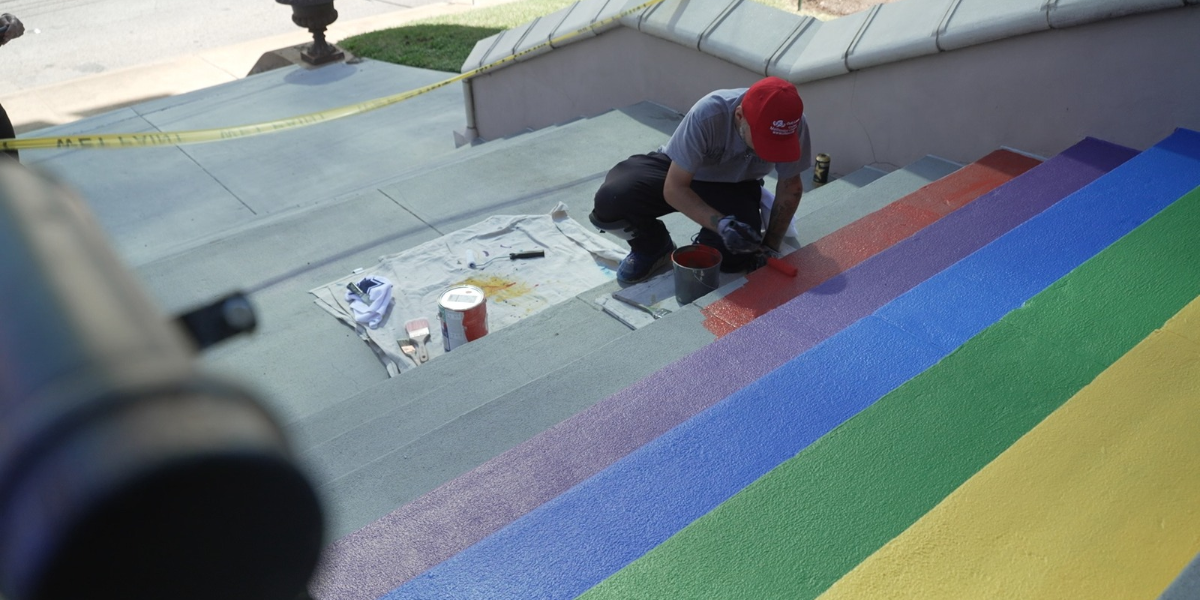
For years, rainbow crosswalks marked each end of Cedar Springs Road, the iconic strip in Oak Lawn, Dallas’s beloved gayborhood.
As a native Texan, I vividly remember the first time I saw Oak Lawn’s rainbow crosswalks. I was excited to see such a visible sign of belonging and it led me to learn more about Dallas’ rich LGBTQ+ history. I immediately felt welcome and spent more and more time in Oak Lawn as the years passed.
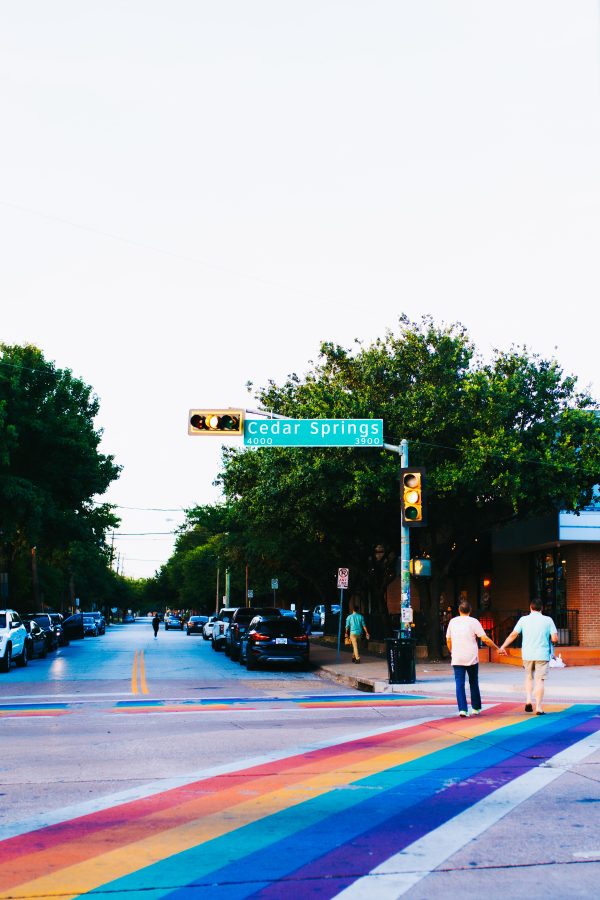
“[The crosswalks] meant inclusion, acceptance, diversity,” David Fisher, an Oak Lawn resident and election judge at the Oak Lawn Branch Library, told me. They communicated that, “this is a neighborhood that’s accepting, and people should feel … comfortable, and like they belong.”
“They almost served as a demarcation point of the Cedar Springs corridor, the neighborhood, of like, ‘This is our street,’” Lee Daugherty, owner of the long-standing gay bar Alexandre’s on Cedar Springs and an active member of the Cedar Springs Merchant Association, told me. “We have long historical ties and cultural ties to this area and to the street. It was a recognition of those who came before, the work they did, the struggle they had, and the continued struggle we have going forward.”
“Symbolically it was … a welcome mat: You are welcome here. Everyone is welcome here,” Daugherty continued. “A lot of people I’ve talked to who are much younger than me, or got here during their teenage years or early adulthood, felt it was the first time they saw a physical representation of being welcome and being home.”
In October 2025, Governor Greg Abbott directed state transportation officials to enforce rules against certain roadway markings, threatening to withhold transportation funding from cities that failed to comply. Officials cited concerns about driver distraction, even though the rainbow crosswalks had been in place for years and similar markings were allowed to remain. Dallas’s Oak Lawn rainbows were slated for removal.
This follows the directive of the Trump administration, who has argued for uniform street markings nationwide as a “safety initiative.” This transparent act of censorship has forced multiple cities in Texas and Florida to remove their crosswalks.
Many studies have found that decorative crosswalks actually make drivers more attentive. The Knight Creative Communities Institute found drivers drove roughly 25% slower around the decorative crosswalks installed near schools. Bloomberg Philanthropy found a 50% decrease in the rate of crashes involving pedestrians around decorated crosswalks. Yet despite this evidence, these street markings are being censored.
The crosswalks in Dallas had faced scrutiny before. The community had already paid to refurbish them in an effort to meet roadway requirements, replacing solid blocks of color with a striped design. That investment did not spare them from removal.
When it became obvious that crosswalks might be a target, the Cedar Springs Merchants Association, composed of bar and shop owners along Cedar Springs, raised funds along with the LGBTQ Chamber to paint their crosswalks in compliance with standards, Susie Hess explained to me. Hess is a Dallas County Democratic Party precinct chair and former president of Stonewall Democrats of Dallas, a political organization representing the interests of LGBTQ community in the Dallas area. “The only difference was instead of white stripes, they used colors,” Hess explained. “Governor Abbott’s decision to pressure cities into removing these was just petty and really targeted.”
“It took years to get these things installed,” Daugherty said. “Then they were installed and weren’t installed correctly. We had to go back and spend even more years, and then we finally got them removed and put down the right way.”
The rainbow crossings were not the only community-funded symbols targeted. All of South Dallas’ ‘Black Lives Matter’ crossings, first dedicated on Martin Luther King Jr. Day in 2022, were removed, targeted under the same directive. Crews removed them in March 2026. The state’s official stated concern was roadway safety and distraction. Meanwhile, the Southern Methodist University mascot, the red Mustang, remained embedded in the intersection of Hillcrest Road and Daniel Avenue in University Park. Officials said they considered the intersection compliant with the directive and that the Texas Department of Transportation had requested no further action.
As Hess put it: “It’s okay to have pride in your school, but not pride in who you are?”.
“They’re threatened by our vibrant, wonderful, accepting community where people can just be who they are,” Hess added.
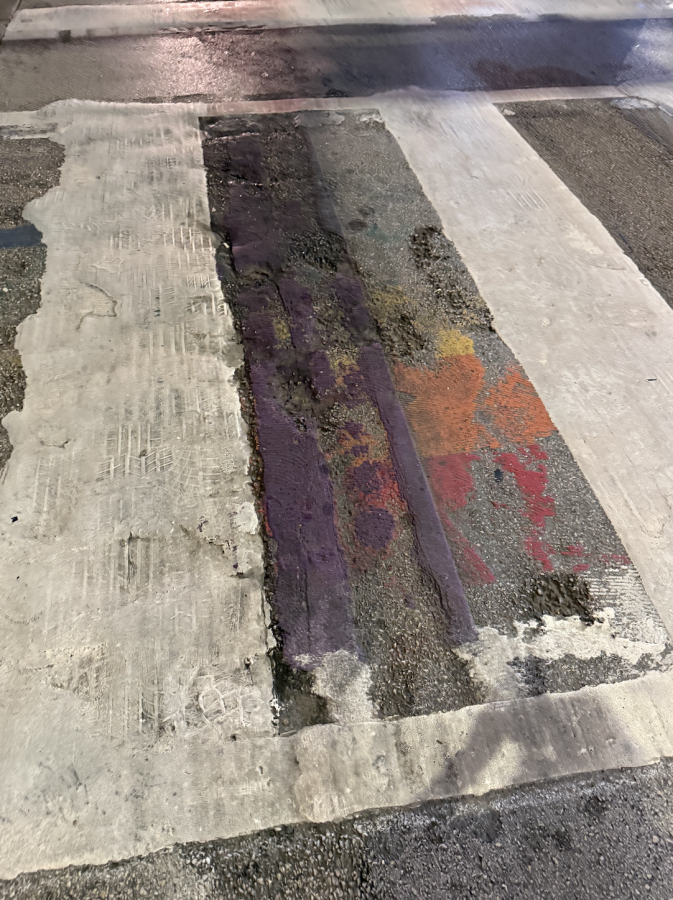
After months of uncertainty and an unsuccessful request for an exception, Dallas began removing the crossings in March 2026. The actual removal came without warning for community members.
“We were planning a neat photo where everyone would come out and take one last photo, something for the history books,” Daugherty said. “That never happened.”
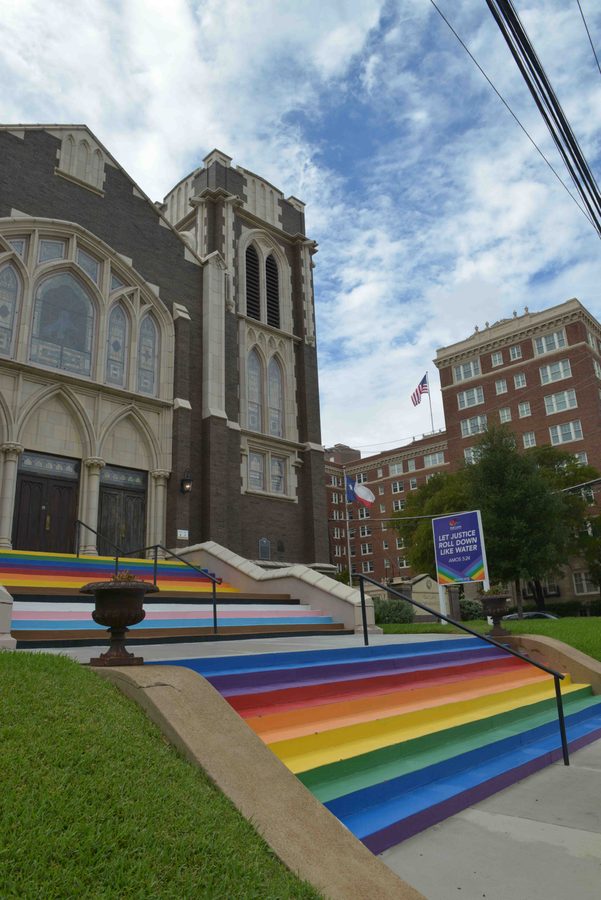
After hearing about the state directive, Rev. Rachel Griffin-Allison, senior pastor of Oak Lawn United Methodist Church, proposed painting the church’s front steps at the corner of Oak Lawn Avenue and Cedar Springs Road. One of the church’s security guards, who also worked as a painter, helped turn the staircase into a Progress Pride flag.
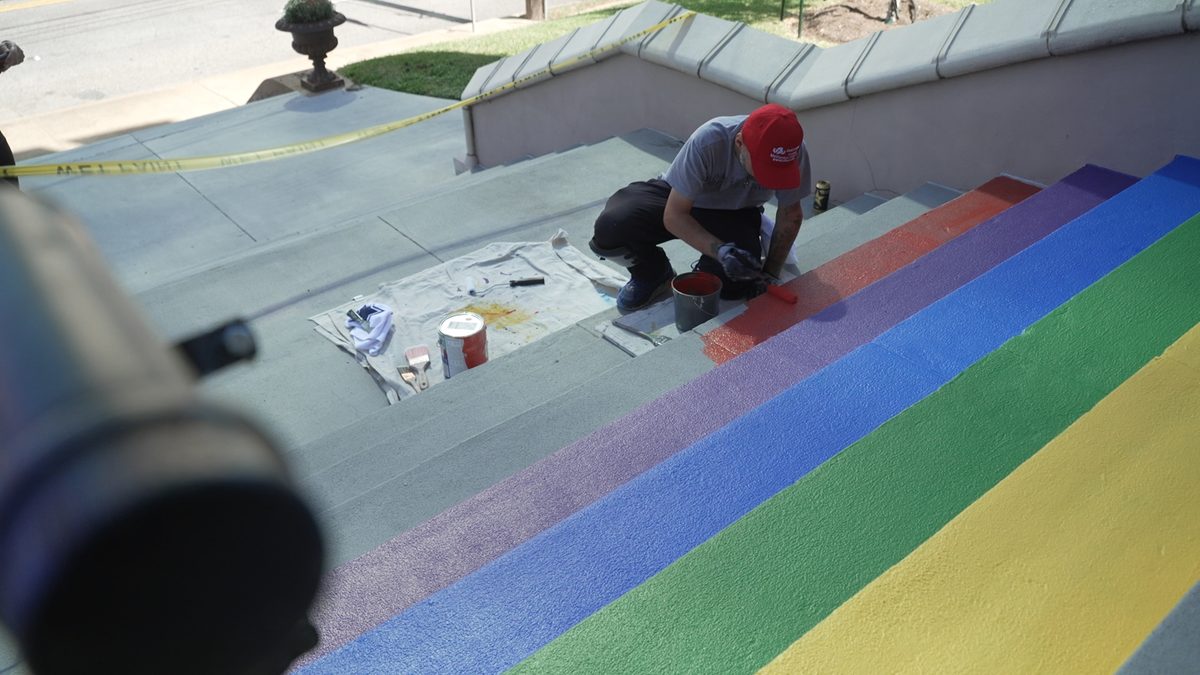
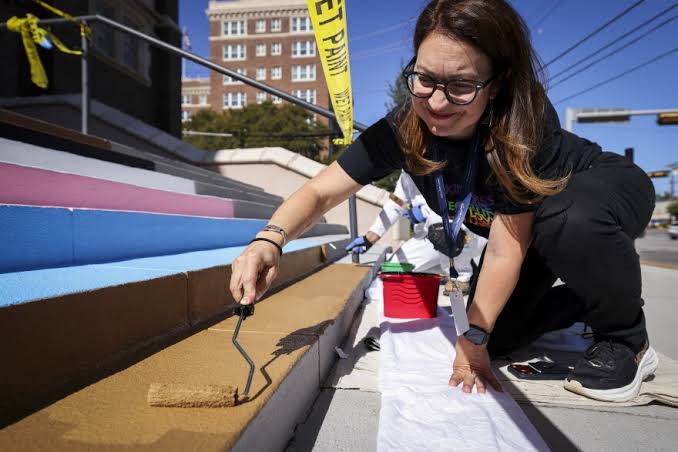
“If they’re taking [the rainbow crosswalks] away, then we’ll use our property to put them back in a bigger and bolder way,” Griffin-Allison said.
After the church painted their steps, at the other end of Cedar Springs, Fisher was walking the library’s perimeter when he saw what remained of the crossing outside.
“It was when early voting was going on. I always walk the perimeter to make sure everything’s functioning correctly… That’s when I first saw that the rainbow crosswalk was taken out. I’d heard and read about it, but when you actually see it– when they actually rubbed it out and took it out– it really affected me,” Fisher said. “It was like, ‘This is wrong. This is totally wrong.’ Then I remembered the church down the street and their stairs.”
Fisher brought the idea of painting the library staircase to neighborhood contacts and Dallas City Councilmember Gay Donnell Willis, who helped move the project forward. The church shared its paint colors, allowing the library’s steps to match exactly. The library also recently added a rainbow mural depicting iconic Oak Lawn locations such as Sue Ellen’s, Round Up, and Jr’s.
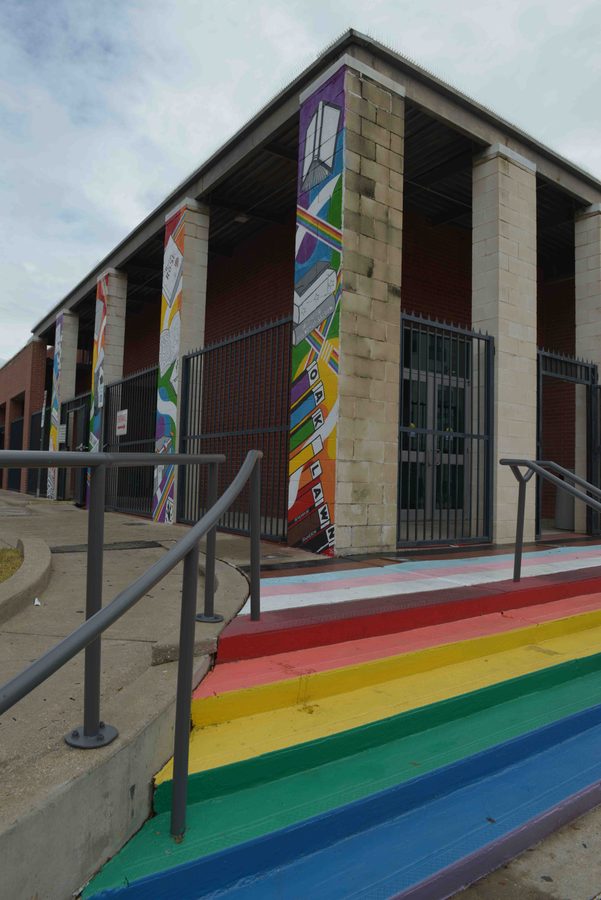
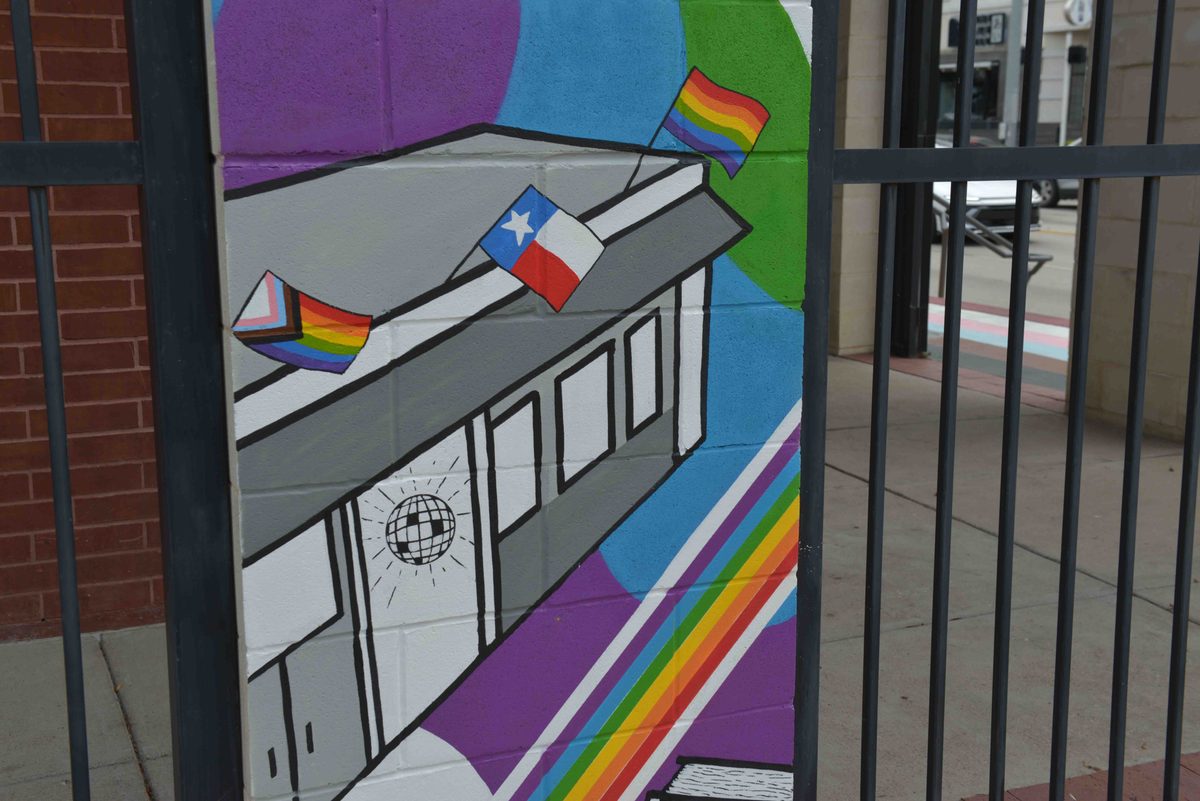
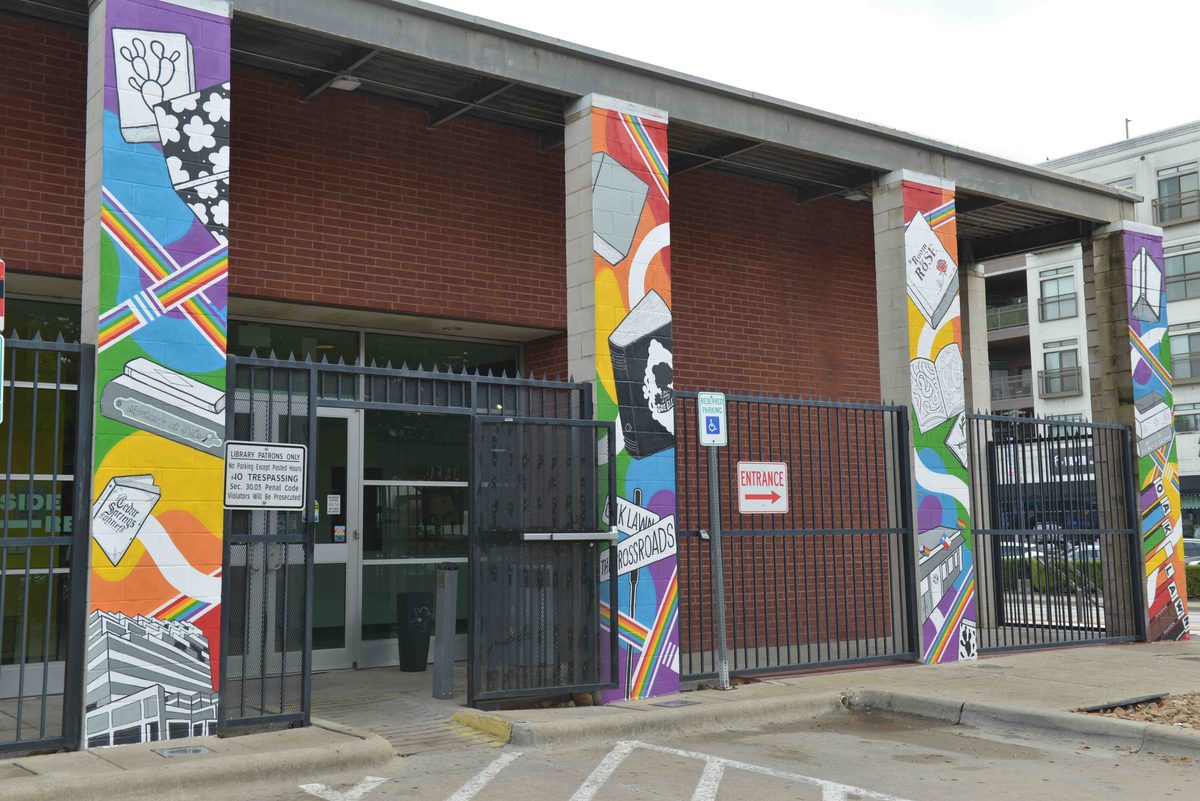
By June, the two staircases formed rainbow bookends along Cedar Springs.
“It brought tears to my eyes,” Fisher said of seeing the completed steps. “I was very proud of it.”
Keeping those colors visible required work, too. Because the church is a designated historic property, its painted steps faced a challenge through the city’s preservation process. Supporters turned out to defend them.
“I think people’s reactions have been, ‘Those are our steps,’ and they are,” Griffin-Allison said. “I count myself fortunate that we have some bold, queer leadership in some significant places in Dallas.”
The painted steps received approval to remain for three years as an art installation.
For Daugherty, the response is already visible throughout the neighborhood. “It did motivate a lot of private businesses to step up the rainbow game,” he said. “I lit my building, I lit my patio. Everyone started doing what they could in their own right.”
The church has since painted more entrances and begun extending the colors to an accessible pathway. Right now, we’re in the process of painting this pathway that comes into the church because a lot of our congregation are also of differing abilities. We don’t want that ‘pathway of protection,’ which is what we call it, to be only for those who can access the steps,” Griffin-Allison told me.
The fight isn’t over. I asked the community members I spoke with what the next steps were, both in response to the crosswalks’ removal and to queer oppression in Texas more broadly.
Fisher wanted to see more support for transgender youth and the transgender community.
“We need to help our transgender youth and our transgender community,” Fisher said. “That’s what I would like to see, first and foremost, because they’re really being discriminated against and being used as political pawns. They’re vulnerable people in our community.”
“People’s reactions steel you for further political action,” Hess said. “I’m not trying to be a mom to the universe, but I want to do my part and encourage everyone to do their part.”
“We’ve just been replacing rainbows everywhere we can in the face of them taking them away,” said Griffin-Allison of these ongoing efforts. “We refuse to see anything about who we are being erased.”


Comments
So proud of this community standing up to petty cruelty!
I know someone who has fragments of the rainbow crosswalk. If there’s a demonstration that they’d be useful in, or a place where they can be safely put on display, please reach out to my email.