





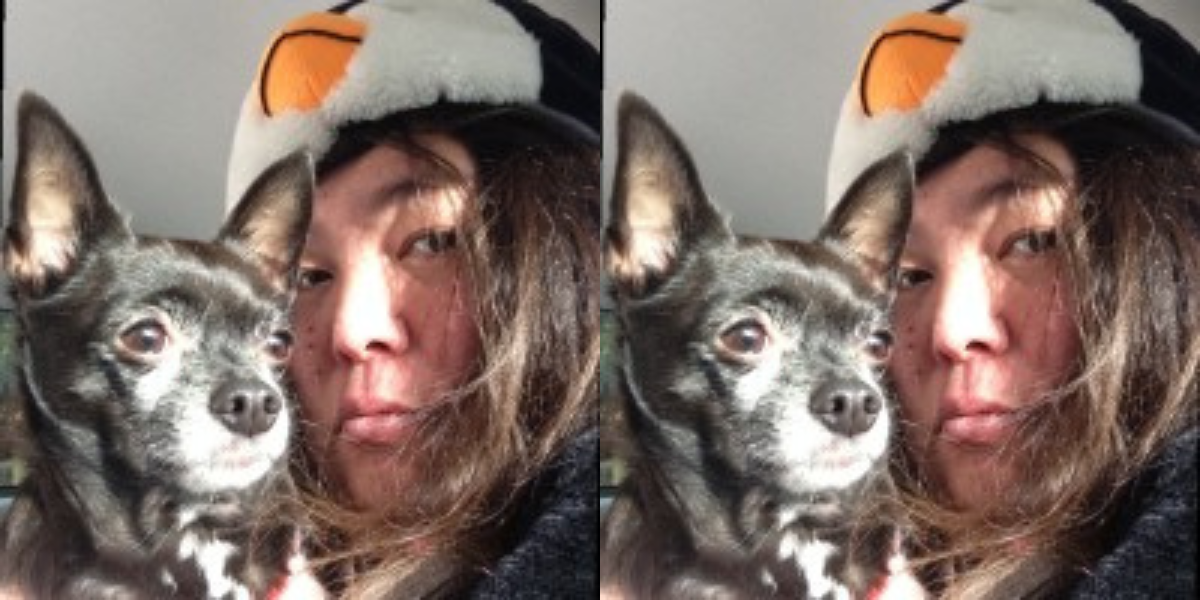
“It is hard to convey how vital Emi Koyama was to both intersex activism and the burgeoning transfeminist movement during the 2000s,” writer and activist Julia Serano says to me. “She was a huge influence on many of us doing trans activism back then.”
Emi Koyama, a prolific Japanese American trans and intersex activist and writer, passed away from cancer in June. A self-described “multi-issue social justice activist and writer synthesizing feminist, Asian, survivor, dyke, queer, sex worker, intersex, genderqueer, and crip politics,” Koyama’s work deeply shaped the last three decades of trans, feminist, and intersex thinking.
Koyama interned for Intersex Society of North America in the early 2000s, where she later became a staff member. She is a co-founder of Intersex Awareness Day as well as the Intersex Initiative of Portland, Oregon. In a recent interview with Lux Magazine, she talked about her experience with sex work and sexual violence, and what motivated her to direct the Coalition for Rights and Safety for People in the Sex Trade and co-found the mutual aid organization Aileen’s, which supports and builds community for sex workers in Washington State.
“Rarely have I known someone whose life and work have had this strong of an impact across so many movements, who was this brilliant and humble, or whose commitment to service was this strong,” wrote her colleague and fellow anti-violence activist Chris Ash.
Koyama is most well known for writing the groundbreaking essay “The Transfeminist Manifesto,” a visionary piece of writing that reimagines feminist activism and theory by centering the experiences of trans women. Another tour-de-force essay by her, “Whose feminism is it anyway? The unspoken racism of the trans inclusion debate,” argues that narrow definitions of womanhood used to exclude trans women from women’s spaces are predicated on racist and classist assumptions that leave out all marginalized women. Both pieces have been cited hundreds of times.
Koyama’s writing bridged activism and academia: She spent her career in community organizing while publishing scholarship both online and in academic venues. She was a frequent speaker on panels at colleges, academic conferences, and social justice events around the country.
I first read “The Transfeminist Manifesto” in graduate school, and it deeply moved and excited me. To be blunt, every line of “The Transfeminist Manifesto” is a banger. It’s a piece of writing that feels both brilliant and common sense, both theoretical and grounded in lived reality. With crystal clear prose, Koyama lays out her vision for transfeminism (a term she and fellow activist Diana Courvant coined, by the way!).
I love re-reading and teaching this piece, in part because Koyama’s prescient writing helps us think through a contemporary moment suffused with anti-trans bigotry. In a political landscape where the rights of cis women are so often pitted against the rights of trans people, as if we belong to mutually exclusive categories in competition with each other, Koyama lays out how trans and feminist issues are inextricably entwined. “The Transfeminist Manifesto” insists that coalition between trans and cis women is necessary for our collective liberation.
When I heard about her passing on social media, I was shocked. Koyama was only 50 years old. After she died, I looked for tributes to her in LGBTQ, feminist, and academic outlets. Besides a number of individual posts online, thus far only the intersex advocacy organization InterACT has released a poignant statement in her honor.
Where were the obituaries? I wondered. The public mourning and celebration of her life and legacy?
This piece is one small step towards filling that gap. In early August, I contacted a number of trans, queer, and feminist scholars and activists to share their reflections on Emi Koyama’s life, work, and influence. What follows here is a tribute to Koyama and to what her work made possible, one of what I hope will be many to come.
I became aware of Emi Koyama around 2000 or so, when she first published her “Transfeminist Manifesto,” and was working with the Intersex Society of North America. She was one of the first people writing on trans, intersex, feminisms of color, sex work and disability from what what’s now called an “intersectional perspective.” When my colleague Stephen Whittle and I were pulling together the first volume of The Transgender Studies Reader (published in 2005), Emi’s “Whose Feminism Is It Anyway?” was really the only thing we could find in print at that time that critiqued the transgender movement of the 90s for its unmarked whiteness, so we made sure to include it.
Emi and I were neverthat close personally, though there wasn’t any bad blood that I knew of. I saw her a time or two in the Pacific Northwest when I was up there for gigs, and I invited her to speak on a panel I organized once at the American Studies Association annual meeting. But I always appreciated the grassroots quality of her activism and writing. She kept it real.
Oddly enough, after being out of touch with her for several years, I recently got one of the AI-generated scams that a lot of writers get these days, supposedly inviting me to present my latest book (for a small fee of course) at an online book group. This one was supposed to be based in Portland, supposedly run by Emi. I forwarded the email to her just to give her the heads up in case she didn’t know how her name was being misused. She said I was maybe the 20th person that day who had forwarded that to her. We had a good chuckle, and chatted a bit, and that’s when she told me she was quite ill, probably dying.
It was a few weeks later that I learned of her passing. As it happened, I was then in Lesbos, Greece, in the village where the poet Sappho was born 600 BCE, to participate in the summer school of the Athens-based Theros Transfeminist Laboratory. I can’t think of a more fitting tribute to the global reach of Emi’s thought, and her influential coinage of the term “transfeminism,” than to observe a moment of silence in her honor while sitting around a campfire on the beach with a bunch of people who had gathered to be transfeminists together.
It is hard to convey how vital Emi Koyama was to both intersex activism and the burgeoning transfeminist movement during the 2000s. When I first became involved in Camp Trans in 2003, her MichFest documents archive was invaluable. Her essays were among the earliest to apply intersectionality to trans issues and activism. When I was writing Whipping Girl in 2005, I decided to use “cis” terminology (which was still extremely obscure) because of a post Emi wrote explaining why such terms are useful. She was a huge influence on many of us doing trans activism back then.
Of any trans feminist, Emi Koyama is easily the one who has had the most profound impact on my own theory and politics, and I certainly can’t imagine teaching a course in trans feminism without including some of her work. Both Koyama’s “Transfeminist Manifesto” and “Whose Feminism is it Anyway?” are foundational to trans feminist politics and thought. The key move in both essays is the application of a genuinely intersectional framework – a framework that can be traced back to at least the Combahee River Collective Black Feminist Statement. This move is crucial in not only answering anti-trans feminists and class- and race- privileged trans activists, but in opening a plethora of possibilities for coalition building. And it’s a move grounded not in abstract theory, but in the stark realities of structural violence confronting both nontrans women and trans folks alike. For me, then, Koyama blazed a trail not only through her writing, but through the very life she lived, the very example she set. She leaves behind an invaluable legacy.
Koyama’s work fueled so many queer, feminist, trans, nb, and crip communities in so many ways, articulating critical and productive insights before most of us could figure out how.
I first encountered Emi’s work on her blog, Eminism.org, when I was a teenager grappling with an intersex diagnosis. I was searching for guidance, for a politics, for a way to envision a livable future, and Emi’s brilliance provided all of that and so much more. She was the first person I’d ever read who co-articulated intersex justice, trans politics, sex worker feminisms, and an acute, layered analysis of racism and its insidious operations in trans, queer, and feminist movements. She offered a diagnostic and a roadmap towards a more just future. On the day we found out she passed, I was in San Francisco and met up with Julia Serano, Amy Marvin, and Eva Pensis (all brilliant transfeminist thinkers in their own right). We toasted to her, talked about how crucial her work was and is, about how tragically underread her work is. I remember saying that, while that’s true, it seems like every single person who has read her work has gone on to do incredible things; Julia said “she’s like the Velvet Underground of feminism.” That feels right – she was brilliant, unapologetic, and under-appreciated in her moment, but totally formative and visionary for the people lucky enough to learn from her. We need her analysis now more than ever, and for always.
Author’s note: After Malatino sent me this, I asked him a few follow up questions in an email: “As you say, her work is so crucial, and yet tragically under-read,” I wrote. “One question I’m thinking about as I write this is: why is it that she is such a foundational thinker and yet so under-appreciated? How come she didn’t become (or hasn’t yet become) one of the titans of the field? Is it because she didn’t have a “traditional” academic career, or adhere to a politics of academic respectability? Because of the intersections of classism, racism, ableism, and prejudice against sex workers? And/or some other reason?”
Malatino replied: These are the right questions! I think, honestly, it’s all of those things – academic publishing, and academia more broadly, is ruthlessly ableist and also tends to deprioritize politically committed scholarship that doesn’t come coupled with the “right” (scare quotes) credentials. I think another piece of it has to do with her commitment to intersex justice – even within the small corner of academia that I occupy (wgss, trans studies and feminist philosophy), it is rare that intersex scholarship *by* intersex folks is actually assigned, taught, and really critically engaged. People use intersex bodies as examples of the “construction of sex/gender,” but are much less likley to engage work produced by intersex bodyminds – especially, again, if they don’t come with credentials.
Emi Koyama’s writing, speaking and activism changed the world. She was not cited nearly as often as she should be, but the current she created under the waters of feminism undoubtedly changed its course closer to the direction of liberation. I read her essays as a graduate student, and the questions she asked, and demands she made for the liberation of trans women to be part of the project of feminism had a profound influence on my life and scholarship. I could not have done the work I have done without Emi Koyama’s brilliant pathbreaking work already being in the world.
Having grown up on the outskirts of Miami, Florida, I didn’t even learn what the word transgender meant until I moved to California and was starting graduate school, five years after Emi wrote “The Transfeminist Manifesto”. Note that in that essay, she describes having moved to Portland only months before writing it, and says that Portland was the first city she moved to as an adult. She was responding to reading Audre Lorde’s book Sister Outsider and Cherrie Moraga and Gloria Anzaldua’s edited collection This Bridge Called My Back in an undergraduate class. This should tell you how young she was at the time of writing this incredible essay which has reverberated around the world. I still, often, see academic essays using the word transfeminist, referring to trans inclusionary feminism, without citing Emi. I had the good fortune to meet her at the International Trans Women of Color Network Gathering at the 2014 Allied Media Conference, which I co-organized with Lexi Adsit, b. binaohan, Luna Merbruja and Sam Andalzola. She was such a sweet, funny, crip presence in her scooter with her cute little chihuahua, yet I held her in a kind of reverence that made me feel too shy to talk to her.
Rereading her essays “The Transfeminist Manifesto” and “Disloyal to Feminism,” I am struck by her incredible capacity for self reflection. I learned a great deal from her writing about being able to critique one’s self and one’s work. Since then I have learned, in recovery, that it is absolutely essential to be able to see and admit one’s own mistakes in order to heal and grow. In her writing, she was not afraid to say “I failed,” at not living up to her own high standards for feminists. In “The Transfeminist Manifesto”, she did what so few academics do: she addressed the mistakes in her earlier thinking. I wish that the many feminist authors and theorists who have made harmful claims about trans women and trans people in their writing would take this step to acknowledge that they were wrong.
Emi’s writing and activism made visionary demands for better futures which challenge academic institutions to this day. I believe that her openness about being a trans woman of color, intersex, antiracist feminist, crip, sex worker activist was too much for the vast majority of academic institutions to allow space for, because the racist, ableist transmisogyny that she described continues to shape universities. I don’t know if she wanted an academic career, but I believe that if she had the kind of support that tenure track academics receive, we would certainly have many Emi Koyama books to read today, and a far different world. Her model of being an independent thinker and activist was foundationally important to my practice of bringing activism into my scholarship and art. Her descriptions in “Disloyal to Feminism” of her own experience in women’s shelters, both as someone who was a client, and as a worker, are powerful to read. IIt brings tears to my eyes to re-read the final line of her second addendum to “The Transfeminist Manifesto,” a short piece called “Bonus: Racist Feminism at the National Women’s Studies Association,” in which she says of Audre Lorde, “I hope that I did my part to make her proud.” This line speaks powerfully of Emi’s commitment to examining the impact of her own actions and it models a way of being a trans woman of color scholar activist in dialogue with our ancestors and trancestors. Not only was she in dialogue conceptually, but also at an affective, relational, emotional level. I hope that she knows how many of us were proud of her, inspired by her, and have great love for her.
This tribute that you have assembled is a beautiful, rare thing, and I hope that she feels it in some way. Thank you.
Like many other feminist scholars, I first read Emi Koyama’s “Transfeminist Manifesto” while in graduate school, and what an impactful read it would turn out to be! The feelings of “alienation and frustration” she describes while in her own women’s studies classes–in which the experiences of women of color received only a week’s worth of attention–felt like a mirror of my own experience as a black trans woman pursuing a PhD in Women’s and Gender Studies, in which “trans and nonbinary issues” were similarly given only a week’s attention, if that. While providing a model of experience-based, intersectional feminist analysis, Koyama’s “Manifesto” not only validated my experiences, but also fortified me in its fierce advocacy for trans women’s liberation.
Foregrounding self-autonomy and self-determination as central principles of transfeminism, the “Manifesto” taught many that both sex and gender are social constructs, that biological sex play out in the experiences of intersex people, and that we must fight sexism and other forms of oppression in all arenas of human life: economic, social, political, sexual, religious, medical, etc.
For me, the most significant takeaway from the text is the deep connection between trans women’s liberation and women’s right to choose. This emphasis on guarding women’s control over their bodies given the right-wing tactics in play to take away that very control proves this to be one of the most prescient political alliances that we see the need for now more than ever given our current political climate, one that is post-Roe v. Wade and #MeToo. In 2022, I recorded a roundtable with five other black trans scholars in which we discussed the ways in which trans feminism, black feminism, and trans studies might address the rising fascism and white Christian ethnonationalism in the U.S. During that conversation, which was later published in the 50th anniversary of Feminist Studies as an article “Between Inconceivable and Criminal: Black Trans Feminism and the History of the Present,” we discussed “the histories of comparative anatomy, racial terror, and compulsory reproduction as blueprints for the current rise in domestic and global fascism. Overall, the roundtable discussion touched on the ways that Blackness, transness, and feminism are in harmony and dissonance with each other and how we see collectivism in coalition politics as the way forward” (2). Both as a model for coalitional politics and transfeminist analysis, Emi Koyama and her writings were undoubted, unparalleled resources and gifts to the trans liberation movement.
I mourn the loss of a dedicated and brilliant transfeminist writer and advocate and add her and her writings to the growing genealogy and legacy of radical women writers and trancestors who helped move us closer to liberation by showing us how we might transform our ideas and language into action.
“The Transfeminist Manifesto” was the first piece of political writing by a trans woman that I’d ever read when it was circulated among undergraduates at my women’s college. It is impossible to overstate how much the experience shaped me and the ground from which my political consciousness grew. Its simple and strident affirmation that women’s liberation would involve giving up on the racist, classist, ableist idea of positive representation and equality with cis men in favor of a collective liberation of all people became my bottom line. Her work in centering sex workers, all workers, BIPOC people, and disabled people in feminist thought and action grounded my perspective in ways that would unfold in time in my life and in my work. I mourn her passing and I will endeavour to celebrate her life in all I do going forward.
Emi Koyama’s assertion that trans feminism is for everyone who is committed to liberation for trans women helped me understand why I am so compelled by the work of radical trans femme artists, even though I am not a trans woman. She gave me language for understanding myself and how I fit into the world we need to create.
The first time I encountered Emi Koyama’s work I was in grad school, reading “Whose Feminism Is It Anyway?” Her work was a revelation to me—her pairing of incisive critique with an expansive alternative vision clarified so much that I had been struggling to understand. I’ve returned to that piece, and to her work in general, often in the years since. I’ve also frequently found myself on her website, which is a treasure trove of her writings and comments. It’s thorough and meticulously well organized. I know I’m not the only researcher who has relied on it, and I’ve always thought it was generous of her to preserve that archive so carefully and make it accessible.
Like so many others, Emi Koyama’s “Transfeminist Manifesto” and “Whose Feminism is it Anyway?” became formative essays in how I came to apply the intersections of theory, activism, and identity in both my scholarship and my politics. I first read Emi’s Transfeminist Manifesto as an undergraduate student in the early 2000’s where, as a queer, multiracial Asian American that was only beginning the journey to unpack the nuances of their gender identity, I was unaware how much I needed someone to challenge me to practice being kind and radically inclusive to my self, my body, and others in my worldview and my politics. Today, as a scholar at the intersections of critical race studies, queer and trans studies, and women’s and gender studies, Emi’s works have become fixtures in my course reading lists for their ability to plainly outline what self-reflexivity looks like, how bodily autonomy and self-definition are and should always be core tenets in our feminism, and how to practically model meaningful coalition in our political movements. Her profound impact will continue to be felt for years to come.
In the late 2010s I was a 30-something, newly out transguy, and Emi Koyama’s work was transformative for me. Their work shaped how I understood my own transness and my evolving transfeminist politic. I was challenged, engaged, and greatly impacted by “Transfeminist Manifesto” and “Whose Feminism is it Anyway?,” – the first two pieces I read of hers. Her insights and intellect challenged me to sit with what it meant to navigate gender in a world where sexism, misogyny, racism, ableism, and classism shape our understandings of who we are. She pushed me to consider my role as a white transman and how whiteness and white supremacy had and would continue to shape my transness, my masculinity, and my relationship to power more broadly. I still teach both of these pieces – they are not only prescient and unique, but accessible to a wide range of students. I know that her words have impacted my students as well, across all identities. Her work helps us to imagine how we might work towards a more livable and just future, and I am so grateful she shared her brilliance with all of us.
Emi Koyama was, and remains, an absolute force of intellect, care, and courage when it comes to transfeminism, intersexuality, and the lives of those who find themselves on the margins. She and her work have impacted thousands, including me, but more than that she has permitted so, so many quite literally the chance to exist more comfortably and freely in this world. Indeed, her writing has created entire worlds for so many of us to emerge into when this world said we should not exist. That is a tremendous gift. Rest in transfeminist power, Emi.
Want to add your own tribute to Emi Koyama to this piece? Please do so in the comments!



Comments
Thank you so much for writing this and for reaching out to so many scholars to share and collect their experiences of Emi’s work and activism and life. I didn’t know her well but she was a tremendous influence on my writing and activism, in the areas of sex worker rights and surviving sexual abuse, as she was for so very many others. She was so sweet in answering my questions and always stopped by my booth at zine fests, and I found it amazing that a writer I admired so much and who worked so hard always had so much time and space for random people like me. Her death leaves a huge hole for sex worker communities, and I encourage everyone to donate to her passion project, Aileen’s, in her memory.
Thank you endlessly for writing such a beautiful piece and creating space for those who knew her to express their gratitude and collectively mourn. I did not know her personally, but her work has had such a profound impact on me for many years. She was such a trailblazer in a lot of spaces and her wonderful way of communicating ideas built such a solid foundation of transfeminism for me that pushed me always to consider who is being left out of the conversation. Her constant learning process and repeated reflection of her work and old ideas made her especially inspiring to be so introspective. Her theory permanently changed how I saw myself, the world around me, and the systems that keep us locked in place. I found out about her passing from a post by Eli Erlick, and the lack of coverage was strange to me. I reached out to confirm it was even true, then began reaching out to queer papers to ask if they knew and if they were going to write about it. It left such a sour taste in my mouth that I did not see her image and work everywhere, that tributes were not flooding in on the internet spaces where she is discussed, in the PR of orgs shaped by her work. It saddens me deeply that mass mourning hasn’t swept through, but speaking about her and what her legacy has done for someone like me and so many countless people has connected me to a lot of lovely folks who are also feeling the weight of the hole of her absence. She made space for all of us and touched so many of our lives. She will not be forgotten. May her memory and influence continue to ripple through our lives forever.