One of my favorite things about being a high school English teacher is the books I get to bring into my student’s lives. It’s a job I take very seriously. I’ve spent countless hours thinking through what I put on my syllabus and what my selected books might mean for my kids. I search for books where my students can both see pieces of themselves and understand the world beyond their daily experiences of it. Books that expand their minds, challenge their world views, deepen empathy, give a sense of the magic of language. Books that bring them joy and push them to grow.
Almost every book I’ve chosen is on a banned book list: There There, The Fire Next Time, On Earth We’re Briefly Gorgeous, Beloved, Parable of the Sower, Pet, Never Let Me Go, to name just a few. I have a level of curriculum control thousands of educators around the country do not. Book censorship has skyrocketed in the past five years with the American Library Association citing 4,235 unique book challenges in 2025. The second highest documented case number was in 2023 with 4,240 book challenges. There were 6,870 instances of school book bans in the 2024-2025 school year with the highest number of books bans in—you guessed it—Florida, a state with a long history of queer resistance far too often used as a testing ground for fascism.
Back in February of this year, Illinois Representative Mary Miller introduced the insidiously titled HR 7661: Stop the Sexualization of Children Act. If passed, the bill would amend the Elementary and Secondary Education Act of 1965, cutting federal funding to purchase materials the government deems to be “sexually oriented material” which includes “gender dysphoria or transgenderism.” The bill also states it should not be used to prohibit funding for “classic works of literature.” In defining what might be considered classic works of literature the bill points to two booklists put together by Compass Classrooms, a homeschooling website meant to support families who want to “teach their children with a biblical worldview.” Reader, I went through those book lists. Every single author included on these lists is white. Every. Single. One.
In the face of these outrageous book bans, countless educators, booksellers, and librarians have stepped up to protect these stories and the children who need them. If you want to feel the full value of having these stories available I highly suggest you read Florida author Kristen Arnett’s piece Before and After the Library. (Author Sidenote: If one more person tells me queer people should just leave red states or acts like queer people aren’t doing work there, I will bite. It’s a viewpoint that is both small-minded and also really fucking boring.)
For many, the work of this protection comes at a price. I know teachers who were told they couldn’t have any queer material in their classrooms, including mention of their own identity. I know educators who have been doxxed. A friend of mine called me a few months ago to tell me a parent spit in her hair and ripped a copy of Gender Queer up in front of her students while she was overseeing school pick up. These violences are happening every day, all over the country. And every day, activists are creating new literary spaces, circulating books, making art, and organizing.
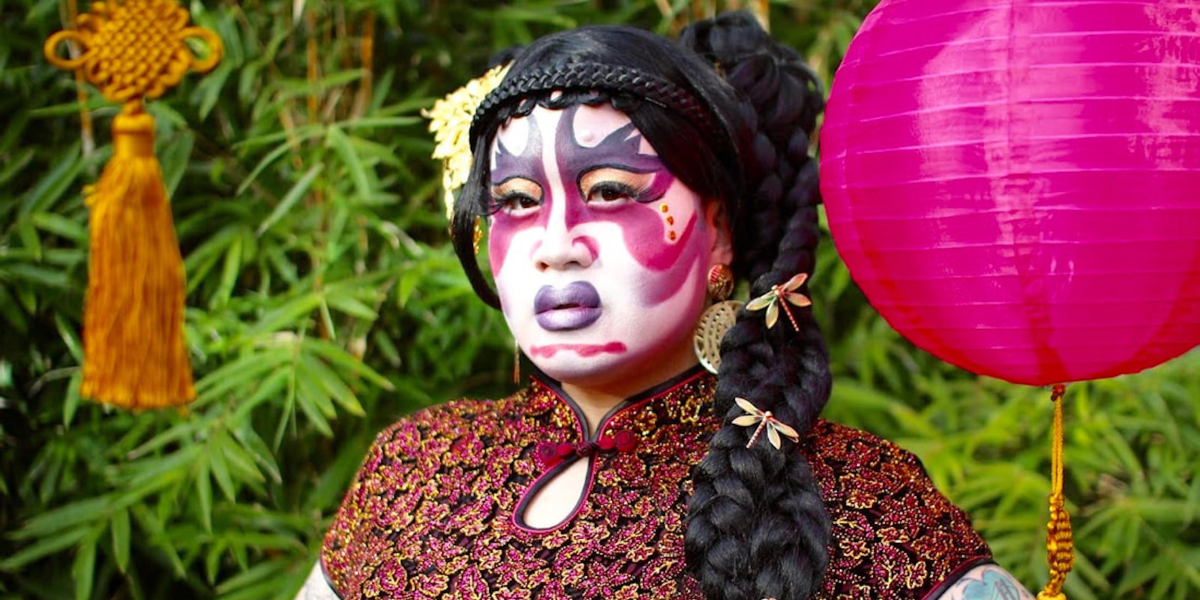
I recently had the chance to speak with one of these activists, Kyle Chu (AKA Panda Dulce), a Bay Area drag queen, musician, author, and filmmaker. For Kyle, drag has been a creative outlet and place of joy since she was in high school. Early in her drag career, she found her drag mom Estée Longah of the Rice Rockettes, the longest running Asian American Drag House in the United States. Kyle went on to become one of the founding queens of Drag Story Hour.
“It was an effort founded by renowned lesbian writer Michelle Tea after she had a kid and realized there weren’t dedicated queer spaces for her and her child,” Kyle says of the origins of Drag Story Hour. “That made her decide to bring drag queens into youth spaces.”
Kyle was one of the founding queens. She had been working as a second and third grade Spanish Immersion teacher and a Special Education teacher and was tapped to pilot the program in San Francisco. “I think of myself as a drag grandma now,” she says. “I don’t drink, and Drag Story Hours gave me the space to engage with drag without having to participate in night life. Grandma can’t hang!”
(Second Author Sidenote: Can we please create more queer community spaces that don’t center alcohol?)
“[Drag Story Hour] also allows me to continue my youth work in my hometown, where the cost of living has skyrocketed due to the housing affordability crisis,” Kyle continues. “For younger kids, we were like a bright animated cartoon character, and it was a wild, fun sensory experience. Kids get to see and understand the value of being playful and imaginative when it comes to presentation. It was an immediate hit so, of course, the right flipped their wig about it.”

In 2022, Kyle felt the right’s panic over Drag Story Hour first-hand while reading in the San Lorenzo Public Library. After her event was flagged on Libs of TikTok, a group of Proud Boys burst in yelling transphobic slurs and shouting “save the children” while actively terrifying the children present. Kyle retreated and locked herself in a back room. Police came and politely asked the men to leave (something they were actively refusing to do). Ultimately, the men faced no consequences, with the police saying there wasn’t enough evidence to file it as a hate crime despite the transphobic insults shouted and the harassment of the children present. It fell to Kyle to follow up with the department where she was met with empty phrases like, “This is an unfortunate circumstance we hope doesn’t happen again.”
The story went viral, and Kyle became a public sensation overnight. She was inundated with media requests to talk about one of the most harrowing experiences of her life over and over. There were endless interviews. Politicians wanted her to stand behind them for public safety announcements. She was asked to speak on behalf of entire communities. “It felt like I was being used as a symbol,” Kyle says of this time. “This happened amidst the Stop Asian Hate campaign and also the Drag Panic run by far right extremists. So media outlets used me as a spokesperson for everyone. And in my state of fight or flight, with Pride festivities approaching, I felt like I needed to take every media request. There was all of this notching up of tension with no clear landing or resolution.”
“These men got to terrorize me and nothing happened,” Kyle continues. She took countless interviews where reporters wanted her to detail the event in a way that disregarded her well-being, she explains. “Then I saw them play my testimony back on screen, using a one second soundbite of me saying ‘I’m so scared’ before they said whatever they wanted about me and the culture wars at hand.”
Kyle was used as a pawn on both sides. Marco Rubio used Kyle’s likeness to promote an anti-trans campaign. “People used me to promote things like increased police presence at Pride, something I vehemently disagree with,” she adds. “So on top of being super traumatized, I felt I was used and puppeted for whatever other people wanted.”
As a filmmaker, Kyle was able to regain agency over her voice and her story, putting together a narrative short titled After What Happened at the Library. The film recounts a fictionalized version of that time in her life, highlighting how the events at the library and the media aftermath affected her physical and mental health. While the film showcases the extent of what Kyle went through, it is far from a story of defeat and culminates in a heart-stopping TV interview. The film has received great acclaim, including a Special Jury Award at Florida Film Festival, Best Narrative Short at Charlotte Film Festival, and Best 2SLGBTQ+ Short at The Vancouver Asian Film Festival in 2025. Chu is now fundraising to expand the short into her debut narrative feature film.
In addition to her work as a filmmaker, Kyle has continued to advocate for queer and trans stories in her role as a middle grade and picture book author. She partnered with queer historian Andrew Shaffer to create the children’s book What Kind of Queen?: A Royal Biography of Drag Queen and Activist José Sarria. Sarria is a legendary San Francisco queen and the founder of the Imperial Court System, an organization of queens that still operates today, putting on shows to raise money for various causes. “Sarrio worked hard to create a sense of ‘us’ and ‘we’ at a time when the concept of a queer community didn’t yet exist,” Kyle says. “When bars were getting raided by police doing ‘garment checks’ to make sure no ‘male person’ was wearing three or more garments they associated with ‘the opposite sex.’ Everyone was isolated by that invasive experience and hadn’t established the solidarity needed to fight back as a unified front.”
When cops raided San Francisco’s Black Cat café and accused the venue’s drag performers of “female impersonation,” Kyle explains, Sarria gave the performers buttons that read: “I am a boy.” “Pointing to these buttons helped performers defend themselves from further police harassment,” Kyle says.

Kyle has also written an Asian Pacific American Labor Alliance award-winning queer middle grade book titled The Queen Bees of Tybee County. The story follows Derrick Chan, a star basketball player with a secret love for nail polish and a crush on his teammate JJ. When Derrick is sent to live with his grandmother Claudia for the summer, he finds a new sense of joy and family in the world of small-town southern beauty pageants. “I always wanted to write a novel for that age,” Kyle says. “I had such a sea of conflicting emotions during that period of my childhood dammed up behind this need to fit in. When I think back to when things got difficult for me, it was probably around the beginning of middle school. That’s around when I shored up with the social norms of growing up. When I met who I was becoming and how I fit into everything around me. I wanted to speak to who I was back then and the kind of hope and clarity I needed at that time.”
“A lot of other books I read only depicted part of who I was,” she continues. “I remember there were certain books about Chinese Americans, but as a fourth-generation Chinese American I didn’t quite relate to it because the majority of it was geared toward first and second generation stories. Back then, there was a representation desert of queer stories for that age. Beyond just stories of resilience and representation, I wanted to assure them there’s a whole spectrum of feeling youth have access to. Something that shows that this one passage isn’t representative of their entire life, but more so a small chapter in one’s overall story.”
Kyle’s second MG book, Juana Fanta Needs a Hero, the companion novel to The Queen Bees of Tybee County is set to hit shelves this October.
Speaking with Kyle reminds me of the essential nature of community literary engagement. There are so many different things we can all be doing. Keep creating art. Pay attention to what’s happening legislatively and contact your representatives. Show up at protests, readings, and community events. Show up in-person, if you can. Support your local libraries and independent bookstores. Help circulate books to those who need them: communities with limited library access, students impacted by book bans, people who have been incarcerated. If you have an organization, event, or way to get involved you want to share, drop it in the comments below! We all have a role in this fight, and we need to find ways to take care of each other.