





I love dinosaur movies. Whether they’re brought to life with stop-animated models by old school effects wizards like Willis O’Brien or Ray Harryhausen, or through digital effects, there’s nothing quite like seeing prehistoric animals resurrected, if only for a moment, on the silver screen. There’s a reason Jurassic Park shattered box office records when it debuted in 1993 and remains the undisputed king of dino cinema, spawning six middling sequels in the three decades that have followed. Still, in recent years, it’s hard not to feel that Jurassic’s reign has become a bit tyrannical. It’s been quite a while since Hollywood has bankrolled a dino project that doesn’t somehow link back to a doomed amusement park on Isla Nublar. I’m not sure that this would be an issue if the last four Jurassic movies had been stellar, but the world’s premiere prehistoric film franchise has more often than not decided to chew on the same brittle skeleton of 90s nostalgia rather than offer anything new or thrilling for us dinosaur devotees.
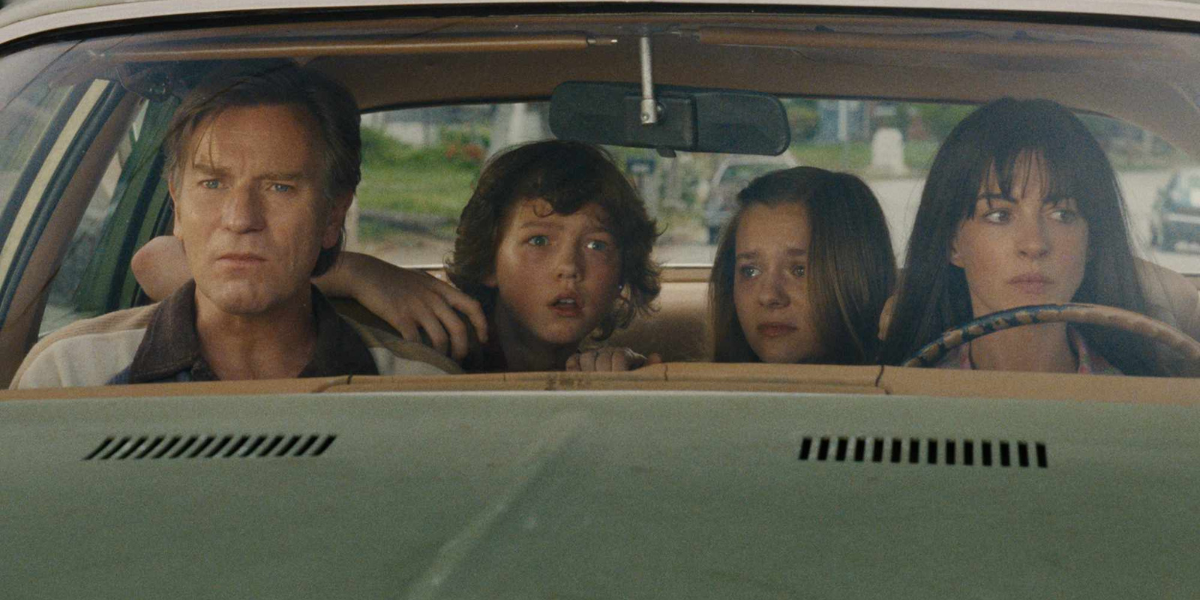
Imagine my excitement when I first learned David Robert Mitchell, director of one of my personal favorite horror movies It Follows, was set to direct a brand-new dinosaur-filled adventure thriller titled The End of Oak Street, starring Ewan McGregor and Anne Hathaway. I’ve been so dino-starved that I’m sure I would’ve happily devoured even a mediocre summer movie about prehistoric beasts ravaging 1980s suburbia, but thankfully Mitchell has delivered something more. While this may sound like faint praise, The End of Oak Street is the best dinosaur film in 30 years.
The Platt family is fraying at the seams. Greg (McGregor) hides the loss of his factory job by picking up pizza delivery shifts to make ends meet, while his wife Denise (Hatheway) spends her free time in the basement typing away at an autofiction novel manuscript that doesn’t paint the rosiest picture of her family life. Their children aren’t doing much better. Brian (Christian Convery) has run afoul of the neighborhood bully after a prank gone wrong, and Carl Sagan-obsessed Audrey (Maisy Stella) can’t seem to connect with her less nerdy peers and pines for the chance to study astronomy at a school her parents could likely never afford. The Platts’ problems are pressing, but unordinary. They face the kind of quiet tension that bubbles beneath the façade of all seemingly perfect suburban homes. That is, until their normally quiet neighborhood is inexplicably transported into the middle of a prehistoric jungle, thrusting them into the path of its gigantic and hungry inhabitants.
While its calm-before-the storm introduction makes it clear Oak Street is pulling at least aesthetically from Amblin “kids-on-bikes” style blockbusters from the 70s and 80s, the film that follows is a decidedly less precious and far more vicious affair. As sadistic as it may sound, I absolutely delighted in the carnivorous carnage that unfolds for much of Oak Street’s refreshingly tight 100-minute runtime. Since the mid-aughts, the PG-13 blockbuster thriller has been just as extinct a genre as dinosaur movies. There was a time when summer movies aimed at teens and preteens were allowed a bit more bite. My middle school sleepovers were spent binge-watching movies like Anaconda, Reign of Fire, or Cloverfield, disaster movies and creature features that weren’t afraid to frighten their adolescent audiences with real stakes and consequences for its characters. I was traumatized by the melting grandma in the Pierce Brosnan 1997 volcano extravaganza Dante’s Peak, but I don’t know if I’d even remember the film otherwise. Preteens and teens deserve a little edge-of-your seat tension, especially in an age when so many big budget productions aim for mass market consumption on as wide a scale as possible. Sure, there are moments of intense violence in The End of Oak Street that push the limits of its PG-13 rating and left my theater gasping in shock, but that’s all part of the appeal. Gen Alpha deserves their melting grandma too; theirs just might be when an Allosaurus [redacted]s [redacted].
It helps that David Robert Mitchell stages the hell out of his suspenseful dinosaur attack set pieces. Just like how It Follows trained its viewers to constantly scan the background for disguised demonic attackers, The End of Oak Street revels in the nail-biting tension of predators stalking prey. Because the film has already established its bloodthirsty tendencies, it’s hard not to clutch tightly at your arm rests for safety as carnivores creep up on unsuspecting characters or slither silently through cramped suburban homes. It’s been a long time since dinosaur films have felt this frightening or tense.
As for the dinosaurs themselves, unsurprisingly, Oak Street prioritizes spectacle over scientific accuracy. Dinosaurs from different continents and geologic eras mix and mingle, and their designs are often a far cry from their biological reality. (Queer paleontologist and author Riley Black wrote up a rather great, if more critical, breakdown of the many ways the dinosaurs and other prehistoric flora and fauna don’t match up with the fossil record.) Even still, I appreciate Oak Street’s commitment to trying something different with its creatures. Its long-necked sauropods are covered in wooly layers of furry feathers, the Coelophysis-like predators have an eerie turkey vulture like design, and a pale and slimy Titanoboa slithers through scenery like some sort of ghostly death wyrm. While the last few Jurassic World movies have offered up dinosaurs that are neither scientifically accurate nor interesting to look at, The End of Oak Street at least opts for creative spectacle, which it offers in spades. (Those of you looking for big budget, scientifically accurate dinos should absolutely check out AppleTV’s lovely Prehistoric Planet series, narrated by David Attenborough.)
“But Nic!” you say. “This is Autostraddle! Is The End of Oak Street gay?!?”
Maybe! Following a stressful day of dodging dinosaurs, Audrey Platt escapes into the family car and emotionally scream-sings along to Steve Winwood’s “Valerie,” which certainly isn’t the most heterosexual activity in the world. More than one friend of mine has also pointed out that Audrey bonds rather quickly and intimately with fellow neighborhood teen survivor, Jeannette, seems to harbor some sort of yearning feelings for a friend in the film’s opening sequence, and shows up holding hands with a girl at the end. Nothing is explicitly stated, but hey, there’s some gay subtext to nibble on, especially considering that Maisy Stella is queer, too.
Now, is The End of Oak Street a perfect film? No. While Anne Hathaway absolutely kills it as a wannabe-author-turned-hardened-survivalist, Ewan McGregor’s performance at times feels far less dynamic. The film’s conclusion also feels a tad too clean, even safe, considering the gnarlier sequences that preceded it, particularly since there are some darker implications to its ending plot twists that are merely hinted at. Even still, I left The End of Oak Street giddy. I’d just watched an original Hollywood creature feature that didn’t censor itself for its audience and put forth a whole lot of badass dinosaurs. I can forgive scientific inaccuracies or a sampling of cinematic schmaltz in exchange for that.
So, yes, if you’re a fellow dinosaur gay like me, absolutely rush out to see The End of Oak Street before it leaves theater. You’re in for a bloody good time and will, hopefully, send the studio bigwigs the message that we don’t need to see the word “Jurassic” on screen to see dinosaurs.


Comments
NICE. As a fellow dinosaur devotee I had written this off after I was so disappointed by 65 (watched on a plane and still so boring I turned it off in the middle of an attack), but now I will DASH to the cinema!
this movie is absolutely horrendous i do not recommend, who tf wakes up and decides to make this movie i actually regret buying tickes. The best part of coming here was the trailers of the other movies. Looks like a 5 year old made it