





Jane Schoenbrun’s third feature, Teenage Sex and Death at Camp Miasma, begins with a film set, a geyser of blood, and an opening credit montage celebrating the fictional history of the titular franchise told via brief glimpses of news clippings, movie reviews, fan memorabilia, online retrospectives, a Funko Pop, etc. Camp Miasma’s pop cultural lifecycle is purposefully familiar. Its in-universe original transphobic (more on that later) installment followed a vengeful masked killer named Little Death, clad in a white jumpsuit and blocky air vent headgear, cutting their way through horny camp counselors before being banished once again to their purgatorial home at the bottom of a nearby lake. It’s all very Jason Voorhees meets Angela Baker. From there on, Camp Miasma follows a recognizable trajectory: Sequel after sequel spawns, each with diminishing critical and financial returns. At some point, Little Death even goes to space. Years later, queer bloggers debate the offensive tropes and undertones of the franchise. Schoenbrun knows horror history, and the ways in which Camp Miasma and Little Death slot so easily into the slasher subgenre is part of what sets up Teenage Sex and Death for success. There’s just one little detail that goes relatively unnoticed in this lore dump of a montage.
The original Camp Miasma movie was directed by Ray Blanchard. Yes, that Ray Blanchard, the infamous sexologist maybe most known for creating the backwards and misogynistic transsexual typology and the concept of “autogynephilia”: the belief that women attracted trans women experience sexual arousal by the idea of becoming or being women. (Whipping Girl author Julia Serano has written at length about the many issues with this concept and its role in anti-trans activism. In short, it makes sense that an act that’s as tied to gender and body as sex and sexuality would be an incredibly dysphoric experience for many trans women, so escape into an imagined less discomforting reality would feel necessary.) At first, this simply seems like a one-off gag, a dig at the original Camp Miasma’s particularly weird approach to gender (again more on that later) and an in-joke easter egg for the trans people in the audience. Except, it very much isn’t. While it never says so explicitly, Schoenbrun’s film is very much a rebuttal of the core ideas behind Blanchard’s worldview and is instead a loving embrace of the role that fantasy, imagination, and performance play in sex and sexuality regardless of gender.
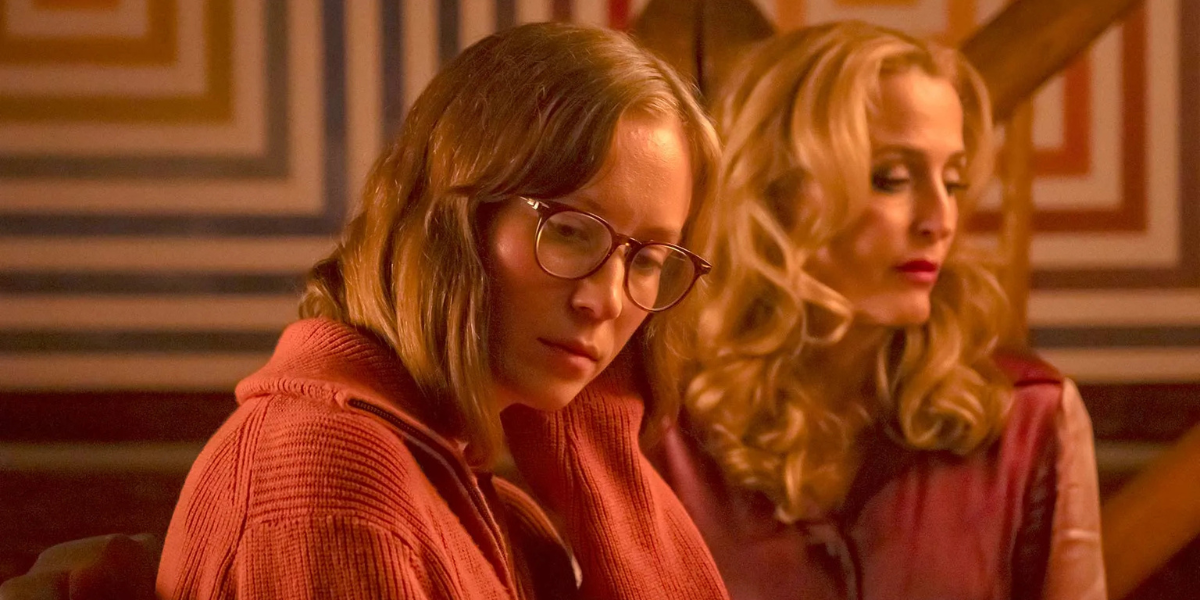
Teenage Sex and Death at Camp Miasma follows up-and-coming indie queer filmmaker Kris Williams (Hannah Einbender), as she struggles to find the hook for a studio-mandated reimagining of the Camp Miasma franchise. Kris, rightly, suspects the producers simply hired her because they want to use her queer identity to dilute potential criticisms of the original’s problematic elements. Kris isn’t interested in a simple retread or prequel though; instead their eyes are set on recruiting the series’ original final girl Billy Presley (Gillian Anderson) to reprise her role. The issue is that Billy has retired from acting and public life, now spending all her days living in a luxurious cabin located on the property of the filming location of the original Camp Miasma. So, Kris is left with no other choice but to make the lengthy trek up to Billy’s secluded hideaway in the middle of winter to make her pitch. The woman they find though is a far cry from the shut-in starlet that many expect and the connection and chemistry between Kris and Billy soon becomes far more than that of a director and their potential star.
Tonally, Camp Miasma feels like a stark departure from Schoenbrun’s first two films. We’re All Going to the World’s Fair is an anxiety-producing, understated thriller about finding connection and purpose in the hidden away corners of the internet, while I Saw The TV Glow is a devastating, existential portrait of the ways nostalgia can devour our sense of self. Both are horrific and heartbreaking in equal measure. In contrast, Camp Miasma is a buoyant, playful film that’s erotic, campy, and uproariously funny. It’s a mood maybe best displayed by Kris and Billy’s disarmingly sensual dinner time conversation over KFC takeout. (Trust me, you’ll never think of dipping sauce the same way.) Schoenbrun has made a sexy, blood-soaked crowd pleaser that deserves to be watched in a packed late-night showing with the loudest, gayest audience possible.
This isn’t to say that Schoenbrun’s latest is any less heady or intellectual than their last films. I’d argue Camp Miasma is maybe their most sophisticated work to date and the shift in tone simply showcases they know the genre they are playing in. With few exceptions, the slasher film is not a dread-inducing, can’t-sleep-at-night horror movie. No, slashers are a baser pleasure, concerned with bodily sensation and release rather than tickling the dark corners of your brain. Despite the clearly puritanical messaging boiling beneath much of the genre, the experience of watching Friday the 13th or its many imitators isn’t exactly a chaste one. Blood mixes with sweat, and bodies writhing with pleasure are just as common a sight as carved open corpses. Even the much-maligned jump-scare that these films employ ad nauseam relies on a buildup of tension and quick bodily release. I mean, there’s a reason the masked killer of the Camp Miasma franchise is called “Little Death.”
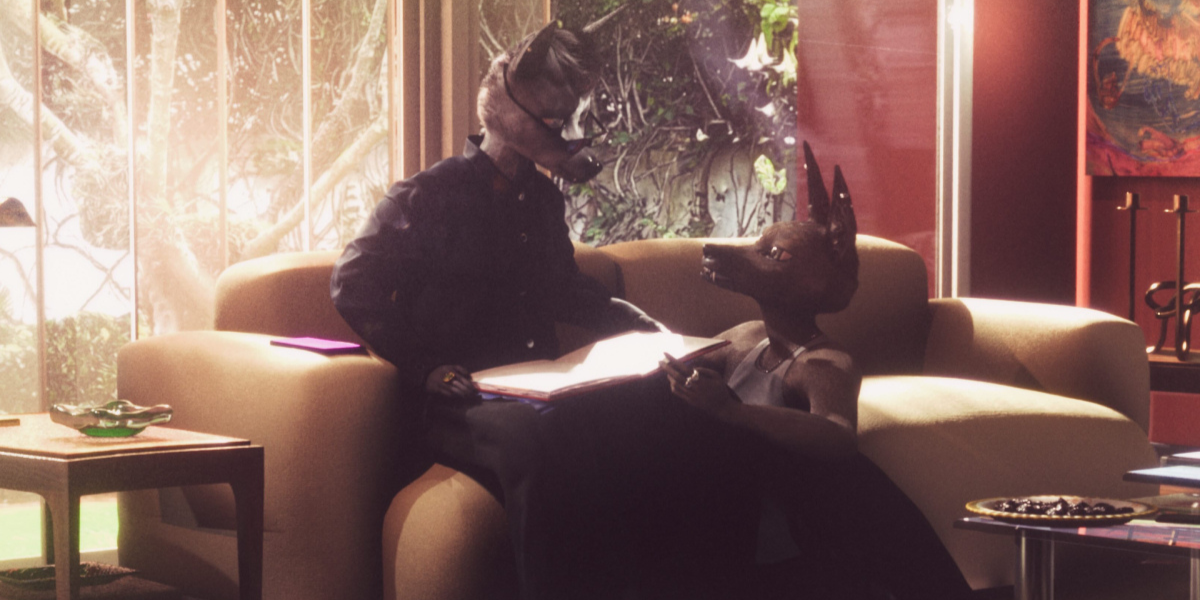
It’s this understanding of the inherent sensuality of the slasher genre that sets Schoenbrun’s film apart from the many meta slashers that have appeared over the last few decades. Teenage Sex and Death at Camp Miasma isn’t interested in identifying tropes or critiquing genre trends as much it is a movie about the sensations and fantasies that they evoke. Yes, Schoenbrun has Ray Blanchard’s Camp Miasma mirror Sleepaway Camp in its blatant discomfort of anything or anyone that exists outside of a clear gender/sexual binary, but its transphobia is so blatant and absurd that it almost ceases to be a point of discussion. Little Death, played by Jack Haven, was a former Miasma camper who was raised by two “hermaphrodite” parents to be a “different gender every day of the week,” whose death by drowning is treated by the movie-within-a-movie as an inevitable and obvious outcome to daring to exist in a queer body. When Kris and Billy finally sit down to watch the original Camp Miasma together, Kris is quickly shushed when they try to point out the transphobic tropes unfolding on screen. We don’t need to be reminded. Carol J. Clover’s Men, Women, and Chainsaws is almost 35-years-old. The offensive subtext is just full-on text. Blanchard’s cartoonishly reductive and offensive thinking is apparent to anyone who is willing to think on it for more than two seconds.
While Schoenbrun does allow Little Death one gloriously choreographed and cathartic kill spree set to Counting Crows, Teenage Sex and Death at Camp Miasma isn’t a story of queer reclamation either. If anything, that’s the route Kris’s grossly cynical producers would want a film like this to take. Instead, what interests Kris (and the movie itself) is the split-second moment in the original film when an approaching Little Death is reflected in Billy Presley’s eyes as her character loses her virginity. Where exactly Schoenbrun takes Kris’s fascination with this image is an experience I wouldn’t dare spoil in this review, but it’s this fascination with the artifice of death and sex that Camp Miasma truly comes to life. Kris’s sex life is not so much a source of repression as it is dissatisfaction and frustration. Her long-term partner seems much more interested in their boyfriend, a long-haired himbo appropriately named Thor, but her sexual blockage sits much deeper in an inherent disconnect between her body and pleasure. Orgasm is only achievable through a combination of disassociation and fantasy. Neither Kris nor Schoenbrun call this experience “dysphoria,” but I’ve rarely seen a better depiction or description of navigating the maddening combination of discomfort and pleasure that comes with sex in a trans body. Escape into fantasy, into play, or into cinematic horror becomes the key to climax. The surprisingly joyful emotional arc of Teenage Sex and Death at Camp Miasma comes in Kris finding someone who not only understands their sexual needs but is prepared to meet them. The result is sexy and cathartic in ways that would give Ray Blanchard a heart attack.
I would love to gush about the many campy, erotic, and thrilling delights of Schoenbrun’s latest (I’ve barely even talked about how damn good Gillian Anderson is in it), but to say too much more would rob you of the chance to witness this disarmingly uplifting slasher-sex romp for yourself. Like the many stab-happy movies it imitates, watching Camp Miasma is as much a physical experience as it is an intellectual one. Trust me, you deserve this release.



Comments
ISTTVG is “a devastating, existential portrait of the ways nostalgia can devour our sense of self”?? Did we watch the same movie?
This line did surprise me – would love to have this further elaborated on and hear thoughts, as this wouldn’t have been my go to description either!
The dipping sauce scene my goodness…Great review here, and loveeee the phrasing of the final. comment…I have so many details I want to talk about but will respect others not having seen it! (Everyone! Go see it it was EXCELLENT!!). Would love a deep spoiler-FULL analysis sometime
Overall I enjoyed the movie, but I found it weird that the woke queer main character and thinly veiled author avatar always called Little Death “him”. Obviously there’s a lot of enjoyment to be had in the theme of allowing ourselves to de-shame our embarrassing kinks, but I was surprised that the transphobic tropes of the slasher seemed to go largely unchallenged or unexplored. To me it seemed like Little Death continued to be solely relegated as a prop for a cis woman to have sexual fantasies of.
Oh shit, that is an interesting observation. Just contemplating – maybe that shallowness was an intentional and unsettling point, to reinforce the point. Despite there being a literal woke queer filmmaker at the helm of this reimaging of a poorly aged movie, Little Death remains misunderstood at their core. It is clear as day that Kris hijacks the film making process as a self-involved journey to explore and work through their own sexual frustrations. The resulting lack of ignorance I hypothesize is due to the assumption that a queer person can make the perfect reboot. Which, kinda fits if we acknowledge the reality that there are queer identifyinG TERFS out in the wild (whether they explicitly know that or more subconscious). Perhaps Little Death will remain trapped in that lake ad infinitum ’til the unlikely installment written by an actual trans woman with lived experience. I will remain curious on what our world’s Teenage Sex and Death at Camp Miasma creator’s [Schoebrun] real intention was, or if it truly was a TERF-y overlook IRL too. Disclaimer: I haven’t seen Schoebrun’s other movies or read anything about their making of this movie. 0.o
after thought.. maybe using TERF was pretty aggressive. Replace w my completely made up acronym: TMQP
x)
I think that Little Death being referred to with He/Him pronouns while being the embodiment of Ray’s reductive typology is meant to invite us to explore our preconceived notions of gender in each of the characters. A lot of tropes about trans feminine people are referenced throughout the movie (Buffalo Bill, Angela Baker, Norman Bates, and though this might be a stretch: Patrick Swayze’s Vida) but a notably missing one is Cis Men Playing Trans Feminine Characters. I got a lot out of the movie by reading it as Gillian and Hannah taking part in employing that trope turned on its head, or put another way Cis Women Playing Trans Feminine Characters. Viewing Kris and Billy (both traditionally masculine names) as trans women ties a lot into invoking Ray’s back of the napkin math attempt at a typology. Sorry for the long reply! I’m just desperate to talk to anyone and everyone I can about my new fav movie
Not sure how to mark this as a reply, but: I don’t think we are necessarily supposed to interpret these characters, but Kris in particular, automatically as “cis women”. I think the use of he/him for Little Death is supposed to come across as jarring and raise questions (like is that choice a result of latent transphobia), but I also think it’s possible that that choice has more to do with Kris’s identification with Little Death. The characters discuss how the disassociation allows them to, essentially, see things as both themselves and as Little Death; I wonder if the he/him pronouns are either transphobia, but as a result of some kind of internalized revulsion for Kris’s own gender variance, or a fantasy projection (a way for Kris to try he/him pronouns). Anyway, just my two-cents. Definitely noticed it and thought it was there for some purpose. Although it could definitely be meant to be transphobia, I didn’t get TERF transphobia, specifically, from it, if that makes sense
also the filmmaker is transfeminine. so terfy overlook seems…beyond implausible.
Kris’s “sexual blockage sits much deeper in an inherent disconnect between her body and pleasure. Orgasm is only achievable through a combination of disassociation and fantasy.”
I really don’t think that’s the problem at all . . . it’s that Kris feels self-conscious and guilty about it! Billy helps her get through that. Embrace Your Kink—Here’s to Little Death! (in all senses of the term)
Can anybody help me understand why “A Long December” (Counting Crows)? I mean, I like the song—but it fits neither the early 80s time period, nor a theme I can recognize.
I also still haven’t figured out wazzup w/ LD at the bottom of the lake (beyond a cool Excalibur kind of moment!), and the rather vaginal abode LD inhabits (that may be a surreality that’s supposed to stay surreal tho)
I’m not sure if links in comments are kosher here, but Steven Hyden wrote for Uproxx about Jane’s choice of “A Long December” by Counting Crows! It’s a good read
https://uproxx.com/indie/jane-schoenbrun-interview-a-long-december-camp-miasma/
For an article on a meta movie, it just got MORE meta. Please enjoy this tweet from the real Ray Blanchard where it looks like he only saw one line from this article and responded in kind:
Tweet from “Ray Blanchard”, @BlanchardPhD, posted on August 31, 2026:
“People online have made many wacko statements about me, but this one is great: “The original Camp Miasma movie was directed by Ray Blanchard. Yes, that Ray Blanchard, the infamous sexologist maybe most known for creating the backwards and misogynistic transsexual typology and the concept of ‘autogynephilia’: the belief that women attracted trans women experience sexual arousal by the idea of becoming or being women.”
I have never had the slightest connection to the movie business in any capacity: director, producer, actor, set designer, writer, stunt man, or anything else.“
I was a closeted trans teen when these transphobic slasher movies were in the theaters and to say that they were cringe is an understatement! They were esteem-destroying. I think that Jane has taken this and turned it on it’s head. Easter eggs like the notoriously transphobic Raymond Blanchard listed as the director of the original Camp Miasma film were LOL moments. I think that the gender thread throughout the movie was brilliant. So you have this, in a quirky movie with BEAUTIFUL cinematography, the homages to classic cinema (Billie’s outfits) and I am a fan. But wait, there is more. . . I thought the interaction between Billie and Kris, the looks, the dialogue, was some of the hottest scenes this old gal has seen! I don’t think I’ll be able to go into a KFC and watch a woman handling chicken and not get excited! But seriously, the romantic, sexy scenes topped with the fact that the monster in this movie, “Little Death” (Le Petit Mort) was a clinical term for orgasm, particularly female orgasm, made this movie almost perfect for me. Totally obsessed and I have seen this five times already. Yeah, crazy but life is short!