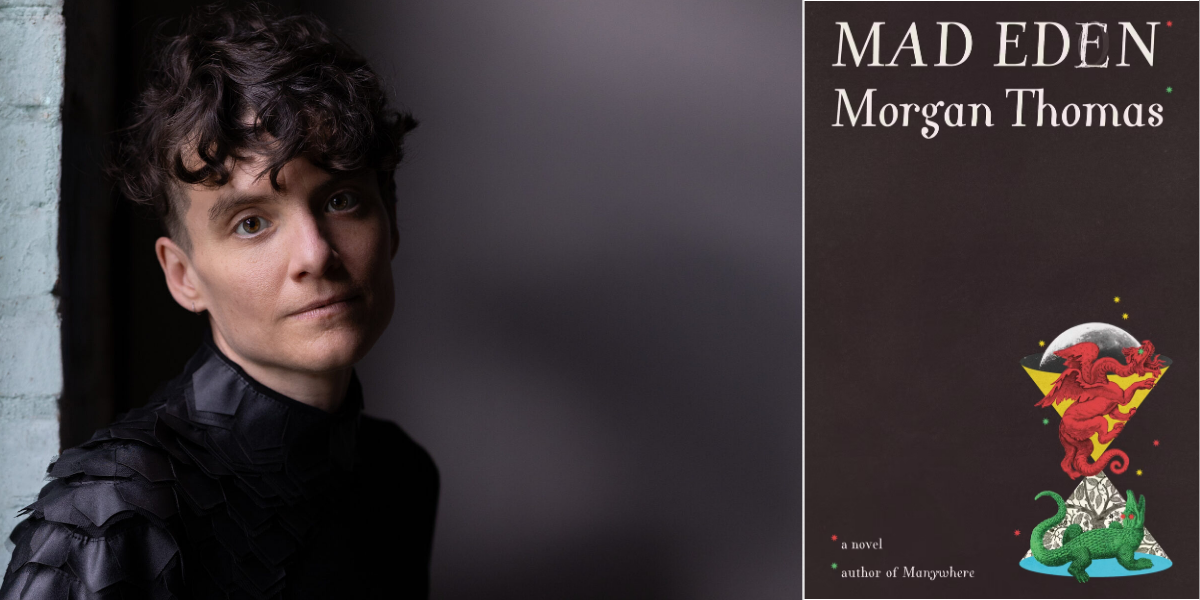
Mad Eden, the second book of fiction by author Morgan Thomas, is a prescient, lyrical work of literary fiction that I’ve been unable to stop thinking about. It’s rare to encounter a work of fiction that so accurately captures the particular anxieties of this particular moment in trans history while still remaining a contemplative and intensely intimate story. Mad Eden is a unique and necessary novel that should absolutely be on your radar.
Nestled away in a small cabin in the Florida swamps, Ro and their partner, Liam, try to find peace in a world that never seems to quiet. Ro’s work as a patient navigator for trans people has grown dire as state after state passes laws restricting gender affirming healthcare. Their surrogate son, Quentin, himself trans, struggles to find independence and security as a newly enrolled college student. Liam can’t seem to make any progress on their book and routinely finds themselves frustrated with Ro’s all consuming fascination with an online fantasy serial known as “Mad Eden.” Although they are both neurodivergent, Liam and Ro can’t always meet or understand each other’s needs.
Yet, even with this stress, Ro and Liam have managed to find their own kind of joy in their remote little world, a bliss that is precious and at times inexplicable. That is, until a sudden unexpected crisis threatens to bring the country’s anti-trans political campaign crashing through their front door.
I had the privilege of chatting with Morgan Thomas about Mad Eden and how this urgent, complex, and surprisingly tender novel came to be.
Author’s note: This interview has been edited for the purpose of clarity.
Nic Anstett: This is kind of a funny question to start with given that so much of this book is about causality and relationships to time, but I wanted to ask, if we’re thinking of the backwards facing light cone of this book, what is encapsulated in there? Where did this novel originate from?
Morgan Thomas: Yeah, I love that framing. So I think there are two answers to this question. One is sort of silly, and that is that the first sentences that I wrote that became Mad Eden I wrote while I was at a residency in Oregon, and there was this herd of elk that would sort of come through on their grazing pathway, right past the house where I was staying. They came through at what seemed to be sort of random times. Then, at some point in the residency, I thought that I had picked up on a pattern, which was that every time I had my period, the elk would be outside my window. I don’t think there’s any scientific basis behind this, but I just became interested in this idea that my genderqueer menstruating body and their like elk bodies are on these same lunar cycles.
And so, the first scene that I wrote is about someone who sees these elk every time they get their period. And then the book moved to being set in Florida, and the elk became an alligator and the scene sort of changed. And there’s no evidence at all that alligators respond to lunar cycles that I can find. I’ve looked.
I think that was the first just scene I wrote. And then I think the sort of deeper thematic answer to that question is that I’ve worked in public health now for eight or nine years. I am not a patient navigator like Ro is in the book, but I worked mostly writing copy for health campaigns and writing blog articles and organizing events. And up through 2022, the work was super low-key. It was really fun. Nobody cared. Nobody was paying attention. Then suddenly in 2023, we were getting political attention and negative attention and were starting to have to think suddenly about security. I talked to a consultant who was an expert on the dark web, and I started to think about whether or not my email recipients were FOIA-able and all these different things. I got really nervous that I would mess up and do something that created danger for my colleagues or the folks that we worked with.
And that worry was sort of consuming. And so eventually, I just started trying to write into a worst case scenario like, “okay, what happens if I do make a mistake and this thing happens?” And that sort of fictionalized worst case scenario inspired what eventually became Mad Eden.
Nic Anstett: That’s so interesting. So that kind of ties into one of the other questions I wanted to ask. Your short story collection Manywhere is kind of a book that is not exclusively but partially concerned with queer and trans histories and looking for analogues in the past. And then your novel is about as contemporary as you could really get. And so I wanted to ask: What did it feel like to write a book that is basically as prescient as you possibly can get with a form like a novel?
Morgan Thomas: I didn’t think this through as I was writing it. I wasn’t like, “Oh, I’m going to set this novel now because suddenly there are laws passed criminalizing gender affirming care.”
I wrote it in like 2022 into 2023. and I finished it and sold it just before the current administration began. So, at that point it felt just like I was writing contemporary fiction. And then, I think in 2024, 2025, obviously things changed a lot and they got a lot worse for trans people, especially thinking about access to gender affirming care for young folks. So suddenly, what’s weird is that now it actually feels like Mad Eden is historical fiction even though it’s literally about 2023, like three years ago. But I think the the political landscape it describes is no longer up-to-date and I couldn’t update it.
I actually had a whole conversation with my editor about what to do because at that point the book wasn’t situated super specifically in time. I just decided to make it very specifically about 2023 and be really clear about that. I could no longer sort of pretend like there was this shifting present, because things had changed so much in the span of a year and a half between when I sold the book and when we finished editing it.
Nic Anstett: It’s interesting that a big trend I noticed in a lot of trans novels from the last year or so is that a lot of them seem to take place in 2016 or so. Trans history is moving so quickly right now that if you’re writing contemporary fiction, or literary fiction set in the now of transness, you kind of have to pick a specific point to set it in.
Morgan Thomas: Yeah, novel writing is so slow too. I think Mad Eden came together really fast and basically that was 2022 to 2026, from when I started writing it to it being out in the world. That feels really fast to me, almost too fast, but it’s still too slow for it to know how to manage and think about and keep up the shifting political landscape around trans rights and access to healthcare. It feels like no matter what, I end up writing historical fiction.
Nic Anstett: I know you actually work in healthcare, so was it draining to be writing about something that was already a huge part of your day job?
Morgan Thomas: No, it was great. I think, because I was so full of concern, it gave me a place to sort of channel my worry and anxiety. I also think on some level my day job acted as research. I’m not a patient navigator, but I worked with folks who were, and I was in meetings talking to clinicians about “What do we do? Where are we sending patients? What are we doing”? I fictionalized all of that obviously, but I think that in the same way that research like reading a book about the physics of time is generative for me, I think that the work of the day job was also sort of generative.
Nic Anstett: Speaking of reading papers, a big feature of the novel is the “Mad Eden” online fiction series that the protagonist reads, which to my understanding is an erasure fantasy that draws from an actual paper about the perception of time for individuals with autism. And so I wanted to ask where that originated from? How did that become a part of this project?
Morgan Thomas: Yeah, I knew I wanted that to be a part of the book from the beginning. I found “Autism as a Disorder of Prediction,” the scientific article that “Mad Eden” is based on really early on while I was just doing research about neurodivergence and perceptions of time. And what I liked about it was that it was this very serious scientific article that also used the word magician many times. At first, my brain was sort of like “Oh these don’t quite fit within my understanding of what scientific or medical language is” and that just piqued my interest and so I knew I wanted that to be a part of it.
Basically what I did is I took the scientific article and made a list based on all the discrete words that were in it. And then I used those discrete words and only those discrete words to write “Mad Eden”, which ends up being this sort of dragon fantasy fanfiction type of story. I knew that that was going to be a part of the novel from relatively early on. However, it was really hard to do and took a lot of revision to actually figure out whether or not I could tell this story. And the reason that I wanted to try was just mostly to think about if we are limited to a sort of like medicalizing or stigmatizing language along one axis of identity, how far can we sort of push the bounds of that language? Like is it possible to really turn it on its head and write this dragon fanfiction romp but only using the words that we’ve been given from this single scientific article?
Nic Anstett: I’m really taken with how the protagonist of your novel, Ro, responds to “Mad Eden” as a work. I’m ADHD and not autistic, but I have my hyperfixations particularly when it comes to things like this. And so I was kind of wondering, were there are there any works that are analogous to “Mad Eden” for you, that have helped you understand your perception of the world or you found yourself similarly drawn into?
Morgan Thomas: I mean, the idea of being immersed in something that I’m reading is really familiar to me, and it’s something that I did a lot as a kid. A lot of those books probably haven’t aged well, but a lot of them have dragons in them. Like I loved The Inheritance Cycle. I loved Dragonriders of Pern. There’s just so many! Like Ursula K. Le Guin’s dragons! There are so many great dragon stories, and I definitely found those really immersive as a kid.
If I’m thinking now about texts that I have that sort of relationship with, it’s interesting. I think in professionalizing my writing, I’ve also sort of shifted my relationship to reading, so I’m trying to think what texts that would be. I think River Solomon’s work comes to mind. I find it really immersive and I really adore it. All the Little Bird Hearts by Victoria Lloyd Barlo, which is another book about an autistic woman and her complicated relationship with her daughter, comes to mind. As I was writing Mad Eden, I also was thinking about Blackouts by Justin Torres, which also uses erasure of different queer historical texts. I think those are the texts that I feel strongly pulled toward as I’m reading and don’t necessarily ever want to end.
Nic Anstett: You have an interlude almost in the center of the novel that switches away from Ro and Liam to a different character, Gabby, who is kind of a detransitioner TERF online activist. And I wanted to ask about where that character come from and what was it like to write in that kind of perspective?
Morgan Thomas: So the seed for that part of the novel came from this New York Times Pamela Paul opinion column that purported to tell the story of several young people who had transitioned or considered themselves to be trans, and then in some way their gender journey had continued. They had maybe detransitioned or changed the way that they were thinking about gender as adults. And it was a frustrating column to read on a variety of levels, but I think not least because of the way that it felt like these complex stories of gender journey and transition were being simplified and at times abbreviated for a specific political gain and to move forward a specific political narrative and a specific anti-trans narrative.
There was one story specifically about a young person who had shifted the way they were thinking about gender after they went home and their father didn’t recognize them. He had dementia and he didn’t recognize them. It was one tiny line in this opinion column and then it was left there. My dad has dementia and Alzheimer’s and often doesn’t recognize me. So, I think there was a sort of personal component, but more than that I was just like there’s so much to this story. This is what happens to trans narratives, because they’re politicized, they just become flattened and just become a data point that someone is using to try to put forward a specific opinion. And so I wanted to just explore that story like: “What does it mean to shift your relationship to your own gender because a parent hasn’t recognized you?” So, I started to write Gabby’s story based on that data point and tried to flesh it out to ask myself: “Who is this character?”
I was also thinking about the prevailing narrative among TERFs that autistic young assigned female at birth folks are somehow especially prone to being persuaded or victimized by trans folks and convinced that they’re trans. And in the novel, I wanted to sort of flip that narrative on its head and recognize the ways that as young people, if we are genderqueer or trans, we’re often told again and again and again and again that we’re not. That actually is the sort of prevailing arrow of society, the way that wanting to fit in with your family or with a group of people who seem cool or with a female friend are often actually pressures to be more normative, not more trans. So those were sort of two of the things that I was trying to explore in that little narrative.
Nic Anstett: Was it hard to kind of write a character that is like so deeply in that mindset that finds themselves persuaded by that propaganda? Or, on a similar note, was it hard to kind of write that in a way that didn’t feel too reductive? Because I feel like sometimes when you’re writing fiction about the opposite political view, it’s hard not to present it in a way that flattens the harmful nuances of it.
Morgan Thomas: Yeah, I mean I think it was hard and I think I felt afraid of doing exactly that. Of being unable to actually fully inhabit Gabby’s perceptions and understanding. And I did as much research as I could. I also tried on some level to put those potential limitations into the narrative. So, I guess, without saying too much, at some point we realize that the narrative of Gabby has been filtered through another character. And that was my attempt to try to reckon with my own limitations of perspective and the fact that it is going to be harder for me to inhabit a character like Gabby than a character like Ro.
Nic Anstett: I think you bring up an interesting point earlier about how with neurodivergence and transness, queerness in general, but I think transness maybe more so in this current moment, there’s a level of distrust and also infantilization that is sort of put upon both of those. I wanted to ask what your thoughts are about engaging with and pushing back on that sort of idea within the characters within this novel.
Morgan Thomas: The main thing that felt really important was to push back on the way that autistic trans folks, especially young autistic trans folks, are often not believed when they talk about their gender identities, whether that is by their families or by broader online communities. I think the central way that I tried to do that in this novel was just by ensuring that none of the characters here were stereotypes, and also by having both Ro and Gabby have very different relationships to gender and also different relationships to neurodivergence. Originally, it was just Ro, and I realized at some point that no matter how complex I made Ro’s story and no matter how much I drew on my own experiences as a late diagnosed autistic person or talked to friends in community or researched, no matter how much I tried to make it complex, one narrative of an autistic trans person just wasn’t enough. It was still somehow reductive. It still felt like it wasn’t enough in this moment because of how sort of political and like flattening our narratives are about these specific intersecting identities. And that was another reason that Gabby felt important, because I wanted to show multiple different lives and experiences that autistic trans folks can have.
Nic Anstett: Yeah. I think another way that you complicated and show a level of emotional nuance is the way you write Ro and Liam’s relationship in the novel. One thing I really appreciate about them is that they have these very clear relationship rituals that they share with one another. How did you develop the dynamic between the two of them? How did you write a couple that feels very loving but also I think realistically faces some understandable struggles at the same time?
Morgan Thomas: The inspiration for their relationship came from a Medium essay that I read and I haven’t been able to find it, so I can’t say the title, which frustrates me. So, I’m hoping at some point someone will will find it and send it to me. But essentially, as I remember it, it was an essay about two women who were, per their own sort of self-identification, not gay. They both had stigmatizing sort of mental health diagnoses and had decided based on their own experiences that because of those diagnoses, they weren’t going to be able to access the sort of heteronormative relationship that they wanted. So they decided that they would just move in together and basically be platonic life partners and have that sort of diotic relationship with each other, which interested me at first because I’m really interested in non-normative family structures.
But then I think there was something the essay did that interested me even more, which is I expected it to go in this sort of direction where it’s like “And then we lived happily ever after together!” I think that that would have been a compelling essay, because there is so much stigmatization around certain mental health diagnoses and also around neurodivergence specifically within romantic partnerships, but the essay didn’t do that. It did something even more interesting, which is that it gave this sort of honest and nuanced portrayal, of both the beauty and the wonderfulness of their relationship and also the moments where, because of mental health, they weren’t actually able to like show up for each other in the way that maybe they wanted to or they caused harm and had to be accountable for that harm. It just laid it all out, and I really loved it. I loved how complicated the relationship felt by the end of the essay and how I couldn’t quite categorize it as like “this is a great idea” or like “this was not a good idea.” It felt way more complicated than that. And so, I really wanted the relationship in the novel to have a similar sort of complexity. That was my starting point.
In the novel, Liam and Ro are both neurodivergent, and they’re sort of in this partnership together, and they’re trying to work it out. I spent a really long time trying to calibrate the relationship and make sure that it would fall in this complex space. And I think I felt recently quite excited because one early reviewer called it idyllic bliss and then another person read it and told me personally they thought that the relationship bordered on emotional abuse. And the fact that one person can be like, “It’s so blissful.” And the other person could be like, “I think this might be abusive.” I think that’s exactly what I wanted: to craft a relationship in which two readers can read the exact same book, have the exact same facts and experiences, and have totally different sort of judgments about whether this relationship is good or bad. I wanted it to be uncategorizable along that specific axis.
Nic Anstett: Yeah. And I think it’s interesting because there’s a moment where, not to give too much away, but Ro is speaking to their therapist and they’re describing a discussion with Liam and their therapist kind of floats the idea that maybe this relationship isn’t the healthiest thing for them. But we also see moments where they do seem genuinely really wonderful for one another. And yeah, I love the fact that readers are already coming in on opposite sides of the spectrum about it. I feel like my own opinions about whether they were right for each other or not, quote unquote, flip-flopped a lot as the novel went along.
Morgan Thomas: Yeah. Which is what I wanted. And with the therapist, I also wanted to offer a window into the way that sometimes non-normative and even imperfect relationships can work for someone even if maybe an authority figure or an outside figure is like “Why are you doing this?” I do think that as a trans neurodivergent person who ends up in non-normative sort of relationship and family structures, often there are a lot of folks who are like, “Is this good? Is this smart? Should you be doing this?” and I think I just wanted to show that and then also show the way that sometimes these like these these non-normative family structures are really beautiful. They’re really beautiful without being like an answer to everything, right? They’re complicated in the way that any family is.
Nic Anstett: I guess because you mentioned non-normative family structures, we haven’t really touched about Quentin much yet, which is the trans guy surrogate son that Ro and Liam have sort of taken on a parental role for. What was it like depicting this queer non-normative family structure and also writing a younger person within this moment of like legal fragility when it comes to accessing gender affirming care?
Morgan Thomas: I think again here I just wanted to try to avoid stereotypes. So I thought a lot about who Quentin was. I think we talk a lot about queer family and chosen family and the importance of it. At least, I talk a lot about it, especially in my sort of public health and in my activism work, and I believe in it really strongly and I also think that, again, it’s no easier than any other sort of family.
So in Mad Eden there are these two sort of informal adopted parents and then their trans son, and at times they’re all showing up for each other, but they also all have their own shit going on. So sometimes the parents are arguing with each other or they’re frustrated with their son or the son is annoyed at the parents and there are these like generational divides. There’s some real lack of understanding and even some casual transphobia on the part of Ro and Liam at one point and these things that I think exist within our family and relational structures. And I think, again, I just wanted to offer a portrait that felt realistic and nuanced and not too “It’s so sunny and perfect,” but also still felt hopeful, especially in a moment when there are political pressures and Quentin is having difficulty accessing testosterone and they do need like they need each other.
Nic Anstett: I guess I’ll close out by just asking quickly: You have a novel that just came out, but are you working on anything right now?
Morgan Thomas: No, thank goodness. I have an idea that I’m sort of holding dear inside my brain, but I’ve learned that it’s better for me not to write through the publication process, but to sort of let myself do the outward facing work and then when that feels mostly done, then return to the inward facing work of creating.