





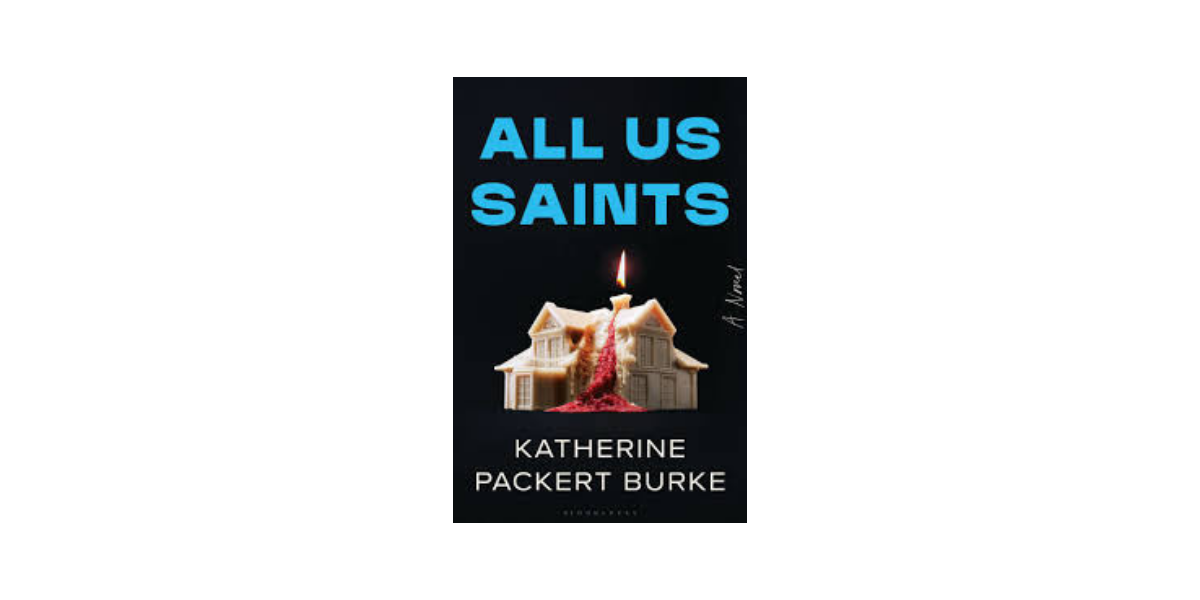
Every year on May 31, the scattered members of the St. Cloud family in the new novel All Us Saints by Katherine Packert Burke return to their childhood home to perform a ritual remembrance of the fateful night in 1992 when their brother, Roland, clad in his sister’s clothes and makeup, murdered three teenage girls and forever altered the course of their lives. Since then, the St. Clouds, a family of artists and performers, have been thrust into the pop cultural spotlight, becoming the subject matter of true crime books and even spawning a transphobic slasher franchise loosely based on the killings. Their ritual, which involves lighting and snuffing out candles symbolizing the murdered teens, becomes a way for Roland’s siblings to reenact, perform, and retake ownership of a traumatic experience that has long since escaped the walls of their family home.
The crossdressing, trans-coded murderer is a familiar storytelling trope that’s haunted the queer community ever since it sprang into pop cultural prominence with Alfred Hitchcock’s Psycho. I don’t need to state the obvious in pointing out that the idea of murderous trans people is the stuff of sensational fiction; even Psycho and other offending media like Silence of the Lambs try their half-hearted best to distance their villains from actual trans people. Yet, what All Us Saints author Katherine Packert Burke does is give her fictional world an actual trans feminine murderer who targeted cisgender girls in an attempt to sacrifice their bodies for an occult ritual gender transition. Roland’s (an alternative feminine name is never provided by the novel) actions are the exact sort of horror story that transphobes have imagined into existence over and over, and Burke, a trans woman herself, intelligently depicts the traumatic personal and cultural ripple effects that a story like the St. Cloud’s would have across time. Roland is allowed to cast a complex and unsettling shadow over the book. While we do discover there was more to Roland than the wider cultural narrative and the surviving St. Clouds want to ascribe, Burke doesn’t shy away from the fact that the trans figure at the center of the novel did in fact do something monstrous. It’s not so much a reclamation of a tired trope but an interrogation of, as the book jacket describes it, the “cisgender gaze” and how it shapes violence and the events that precede and follow.
All Us Saints is hardly the first work to critique and analyze the prolific horror trope of the transgender slasher killer, but few have done so with as much courage and creative daring as Burke. This is a challenging novel, not only in how it forces its readers to stand witness to a family transformed by an act of horrific violence, but also in its form and style.
Just as her debut novel Still Life took inspiration from Stephen Sondheim’s musicals to interrogate the creative tics and limitations of autofiction, All Us Saints borrows its structure from a two-act play. On a macroscopic level, this means that the novel opens with a dramatis personae breaking down the different characters and is structurally split into two distinct halves, both occurring on the night of one of the St. Cloud’s nighttime rituals on 2011 and 2012 respectively, with a short intermission sandwiched in between. However, Burke’s novel achieves a formal genre hybridity through her prose style as well. All Us Saints’s chapters read like staged scenes, often taking place in a single location somewhere in the St. Cloud home, and primarily focus on conversations held between different characters. The dialogue itself contains a heightened quality that is at first jarring in how it shirks naturalism in favor of the sort of expository lyricism common in most modern and contemporary stage productions. The sparse narration provided is delivered in declarative present tense sentences that mirror stage directions. All Us Saints’s intermission is the only section in the novel that reads like more traditional literary fiction with a first-person narrator. It is also, fittingly, the segment where Roland, referred to in the dramatis personae only as “The Monster,” is given the chance to speak.
This formal play doesn’t come off as experimentation for the sake of needless complexity but is intelligently built out of character and informs the themes of the story itself. The St. Cloud parents themselves were playwrights and the children, Roland in particular, can vividly recall seeing their dramatic doppelgangers depicted on the stage. Calla St. Cloud, the youngest daughter, has continued their legacy but, due to a recent spat of writer’s block, has forsaken playwriting in favor of repeatedly building up and then burning down her family home in The Neighborhood, a fictional video game that feels like a Minecraft/Second Life hybrid. Edna, Roland’s twin sister and best friend of the three murder victims, married the true crime writer who chronicled and popularized the St. Cloud story and achieved fleeting success as a photographer. James, the youngest St. Cloud, has developed a fascination with the slasher film franchise inspired by his older sibling and rewatches the original adaptation every year following the family ritual. Even Edna’s teenage daughter Wren can’t escape the shadow events of May 31, 1992 cast, often following around after her mother, aunt, and uncle. Homeschooled and well-read beyond her years, Wren is an atypical teen in a traumatized family who hardly ever leaves her house. The St. Clouds are a family stuck in time; everything they do is a performance in response to Roland’s killings.
It’s in this metatextual marrying of trauma and performativity with narrative form that All Us Saints is at its most fascinating but likely polarizing as well. There is an inherent disconnect between the novel’s stage play elements and the prose that it is rendered in, as gorgeous as Burke’s sentences can be. The referential and exposition-heavy dialogue, for example, feels uncanny when written in fiction but would absolutely sing if delivered on stage. All Us Saints uncomfortably straddles form and genre, but part of me wonders if that’s the point. Burke’s novel shouldn’t be easy to read; its narrative conceit alone is squirm-inducing and asks uncomfortable questions, particularly of trans readers. Just like the St. Clouds, All Us Saints itself is unsettled and off-kilter but entirely fascinating in its dark vulnerability.


Comments
dd