





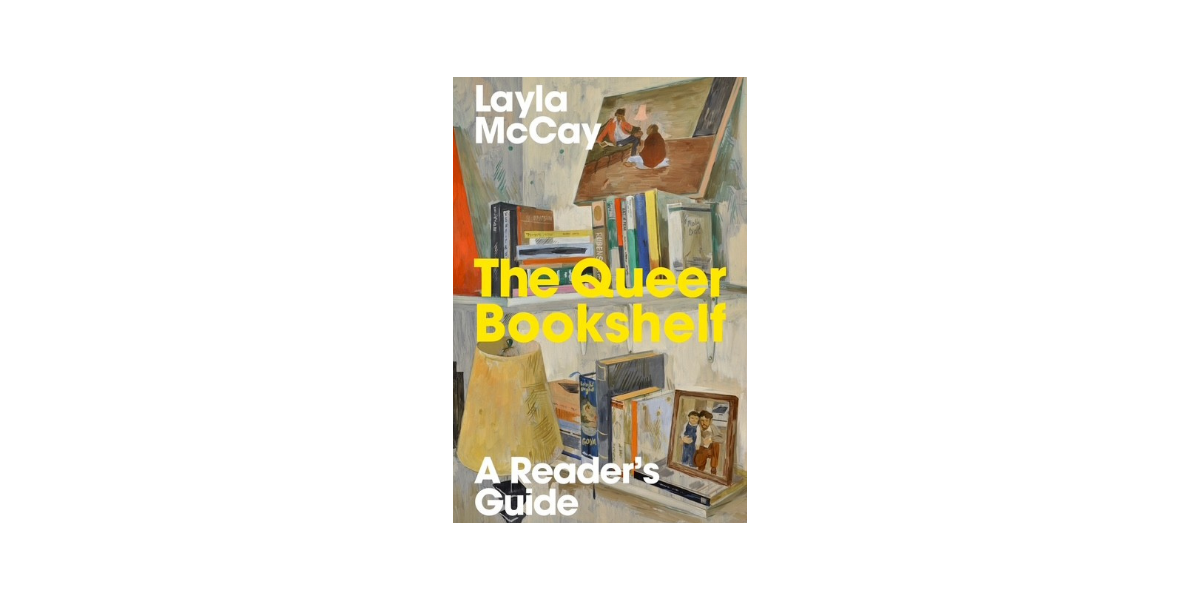
To survey the entirety of queer literature is no mean feat. You could even argue it’s close to an impossible task in the face of the exponential growth of LGBTQ+ books published over the past few years. Undaunted, London-based author Layla McCay has written The Queer Bookshelf to bring us a reader’s perspective on what a queer canon may look like, from the famous and the forgotten to potential future classics.
Through broadly chronological chapters, McCay takes us from antiquity to the present day, pinpointing the moments of queer history and culture that spurred signature literary works, predominantly fiction. This is all bookended by the personal recollections of the author’s own introduction to queer literature and her thoughts for what the future may bring.
Ambitious in scope and carried along by the sheer enthusiasm of the author, The Queer Bookshelf purposefully eschews an academic approach to instead warmly embrace as much of the global queer creative output as possible.
Necessarily, The Queer Bookshelf tears along quite breathlessly through its curated catalogue of the history of queer literature. I think it’s a book that makes sense to dip in and out of. Indeed, it almost recreates that feeling of serendipitous literary discovery to open the book and see what catches your eye.
And you will discover something here. By my rough estimate, there’s close to 500 books referenced. I particularly liked the specific inclusion of books in translation for each era or genre. An avid reader will undoubtedly find authors missing; I don’t view these as omissions but rather a way to realise which books really matter to you.
My favourite parts of the book are the interjections from various authors, friends and booksellers that the author talked to, describing the queer books that impacted them. Almost all are positive and life-changing, even visceral, like Caro de Robertis physically shaking from reading Kiss of the Spider Woman. There’s the occasional side-eye too. Jeanette Winterson’s excoriating take-down of The Well of Loneliness is one to keep an eye out for!
For me, these aren’t just amusing asides. They show how we as humans layer our experiences over one another to create our own stories.
I also liked the parts that discuss more generally the impact of queers books, or lack of them. The book convincingly argues that Section 28 in the UK set back YA publishing in the country by at least a decade, which I’m only now starting to make sense of for myself. It also describes the struggles (and inventive ways) people have getting hold of LGBTQ+ books in many countries still.
I feel like The Queer Bookshelf arrives at a moment when we’re having a collective realisation about the gravity of queer books and the communities they pull together. See also: AJ West’s recent How Queer Bookshops Changed The World and A Bookshop of One’s Own from Jane Cholmeley. I think part of it is queers of a certain age being hit by the stark contrast between what was available in their youth and what’s out there today. Personally, I’ve been noodling on my own formative queer reading experiences for months. I think it also comes at a time when we’re facing a two-pronged attack both on rights and creativity itself, which makes genuine, human queer stories more important than ever.
Fascinated by this whole endeavour, I got on a call with author Layla McCay to learn more!
Autostraddle: You’ve been a lifelong reader and a lover of queer literature. What was it that made you think now is the time I want to take my experiences and my enthusiasm and turn it into this book?
Layla McCay: I hadn’t really been thinking about writing the book, but what I have been doing over the years is running lots of different book clubs in lots of different countries around the world, with queer themes. It is just so apparent that every time people will say to me, what should I read? What should I have read? What are the classics of queer literature? It just felt like people really, really wanted to know the answer to that question and they didn’t know where to find it.
I went to a queer book group just before I started writing the proposals for this book, where there were quite a lot of younger people in the group, from all over the country. I mentioned something from Tales From the City, which is a quintessential standard, and only one person on the whole call had even heard of it.
I thought: It’s so interesting those people are so keen to talk about queer literature, they’re so keen to understand the classics and the queer history. They would love to read that book, but they don’t know it exists. How do people actually find out what exists and how do they know what books have some historical or cultural significance, versus maybe not so much? How on earth would you actually unpack that?
I like to think of it as: If I went into a really, really cool queer literary crowd who are having a fabulous cocktail party and I wanted to study up in advance and make sure that I sounded like I knew about queer literature, where would I start? What would I want to know about? I thought it would actually be really useful for a book like this to exist.
It’s interesting as we probably had quite similar experiences when we were growing up where there was a paucity of queer literature and it was hard to find things. We’re getting towards the other end of the spectrum now where there’s this abundance and it’s a different sort of problem: It’s not where to find it, it’s where to start.
Well, exactly, and I think that people can get quite stuck in different sorts of reading silos, especially with the algorithms quite often telling you: you like this, here, read 27 other books that are a bit like it.
I think that people, through no particular intention of their own, might find themselves reading less diversely because they’re reading a really, really specific genre, and they’re less likely to come across something that they might love that is a brilliant queer book, but it might just be in a different type of a genre.
Considering the quantity of queer literature that we’re lucky to have now, how did you go about working out how you wanted to structure the book so that you could encompass that breadth?
I started off by thinking: I’m gonna do this in chronological order because that feels sensible, let’s do that. The first chapter is everything up to the end of the 19th century, so it has a lot in it. Then I thought: I’ll work my way through different parts of the 20th century, and that is sort of what the book does.
But as I was doing it, I thought: I don’t think that I should just be going through it time by time, because actually there’s themes, and I got really interested in the really important role that genre fiction has played in the history of queer literature.
When I started writing this book, I just intended it to be “here are some books, let me tell you about them, this is why they’re important.” The more I was writing this book, the more I realised that, actually, in telling the story of what queer books were important and what emerged and when, it was also telling the story of queer history. It was really getting into why is queer culture today the way that it is? I had no idea that when I started it that I was writing a book that would cover that sort of thing.
It’s been so interesting that because of the censors and various limitations on people who were writing literary fiction, some of the really interesting innovative stuff was happening in science fiction and crime fiction. So I wanted to dig into those, and they didn’t quite fit in that chronology, so they needed to be pulled out.
Then children and young adult felt like it was its own thing, so it got its own chapter. Then I was like, how do we actually address the massive quantity of books of the 21st century?! So it got its own chapter, and there’s a little chapter at the end about the future.
How did you deal with working out which books you were going to feature?
Honestly, every single day I wake up in a cold sweat because I realise there’s some book that somebody will argue ought to have been in! How I’m managing that is I’ve created a little list on my phone of books that I wish I’d put in The Queer Bookshelf. Every time somebody tells me “oh, why’s this one not in?”, I’ll just note it in case of a second edition.
Ultimately, it is not possible to fit in every single important queer book. What even is important? In terms of culturally important, in terms of historically important, everybody has different views, and I specifically didn’t come at it from an academic perspective. I came at it from a “we are people who are queer and love reading” and I’m revelling in the joy of having those queer stories.
Because of that, I think it’s easier because there’s no one answer. There’s some very clear books. Nobody’s going to not mention The Well of Loneliness or Giovanni’s Room. They’re books that nobody would say shouldn’t be there.
But then there’s millions of books that you could decide either way. I’d been reading a million queer books for decades, so I came with quite a lot of my own views, which I supplemented with lots of research. I also interviewed lots of other queer people, particularly authors and queer booksellers, to get their perspectives about what were the books that were important to them.
I also supplemented that with a few social media surveys that all sorts of random people responded to, and they pointed out what they felt were the important books. Those social media surveys really underlined for me how important this book was, because almost everybody only mentioned books that were written in the 21st century.
So I thought: These people are going to be so excited, I hope, when they get this book that opens up all the other lovely reading that they can be doing.
I quite consciously tried to bring voices from different countries, different age groups, different racial diversity, from people with disabilities. I was trying to think, with all the glorious intersectionality that exists in the queer community, what are the books that touch people?
I would say probably about half of the books come from the European Western tradition, but I was really conscious that I wanted to include different voices, which is tricky because a lot of things haven’t been translated. I wanted books that people could actually get access to and read in the English language, which was a good way of narrowing it down.
What I wanted to do was not snobbishly say, “well if it’s not filed in the literary fiction section, then it doesn’t belong here,” because actually it’s some of those other books that have the biggest impacts on people.
Is there a particular book that’s available today that you really wish had been written when you were first discovering queer literature?
All of those young adult, joyful books where people are queer, they’re out about it, other people are cool with their identities. I grew up during Section 28 when there was just no visibility of queer stories at all. I think it’s really bad for your self-esteem and for understanding who you are in the world and what your opportunities are, what your life might be like.
I think it’s why so many adults really enjoy reading young adult queer books, because we were deprived of that, we didn’t have it. There is something joyful and bittersweet, I think, about reading novels like that. I had my launch party and Simon James Green came to it, and he’s quoted in the book. He wrote that wonderful book Boy Meets Boy, about Section 28. His books, for example, are some of those that I would have just rejoiced in reading when I was a teenager.
The books by Becky Albertalli, Simon Versus the Homo Sapiens Agenda and that whole series, things like Heartstopper. They’re just so bright and thoughtful and optimistic. They give you a feeling like things are going to be okay, and you’re okay. I think that was very much missing from my childhood.
I interviewed lots of friends and authors for the book. People told me these stories of how the first queer book that they came across was, in retrospect, wildly inappropriate for their age range because it was about much older people who were out clubbing and taking drugs, and having all types of sex, and it felt like quite a transition from their current life.
For you personally, what untold or lesser told queer stories would you really like to see more of?
I’m conscious that quite a lot of queer stories don’t really address the class question. There are a few that are emerging, but when I was doing the research, I was quite conscious that there’s so much opportunity for more working-class stories in queer literature. I think that is an area that will hopefully expand a bit.
The intersection of queerness and disability is another one. Again, we’re seeing more of those stories coming out now and in ways that are really interesting, and I think we’ll keep seeing more of that. People who come from a working class background, or people who have certain disabilities, there are more barriers in place to getting published in the first place, which is why you then end up hearing fewer of those stories.
It’s interesting looking at the publishing industry and thinking: Who gets to have their stories heard and what does that mean? I think it’s really interesting what’s been accelerating in the last decade in terms of self-publishing and the different routes that exist now so that people can get their stories out there.
That creates such a wealth of stories that it is sometimes hard to know where to start, but on the other hand, it removes some of the barriers to getting those stories out there. Hopefully, in due course, it’ll really contribute to lots more complex stories and lots of more different perspectives that are available. It feels like a really positive development.
Your next book is going to be your first novel. I was very excited to see that it’s going to be about queer book smuggling! Can you tell us a bit more about that?
In some ways, my novel is inspired by and underpinned by The Queer Bookshelf, because I did so much research about the history of queer books. So then when I was thinking about writing a novel, I thought: I would really like to use that research in delivering a historical fiction novel.
The novel is set in the 1970s, a time where it’s quite hard to get hold of books with LGBTQ+ themes, and it’s about how a diplomat’s wife makes that happen. It’s a fun, quirky, charming read with romance elements and thriller elements. I really hope that people enjoy reading it. But what was really important to me was that, actually, this is about people discovering queer books.
So it’s full of the sorts of books that I talk about in The Queer Bookshelf and people’s experiences as they come across those books: what it makes them feel and how it empowers them to do things. It’s also inspired by my previous book, Breaking the Rainbow Ceiling. It’s a careers book, it’s a very different vibe. It’s about how being LGBTQ+ affects you on the career ladder, and I interviewed lots of diplomats for that book. So I was also able to bring the research for that book into the new book-smuggling book.
It’s been absolutely lovely talking with you, I love how enthusiastic you are about queer books!
That’s the fun of talking about queer books that did not exist with my other, more serious, workforce-focused things. I really wanted to be talking about the joy of reading!
Comments
Oooh I want to read this!! I really want to know what did/didn’t make the cut, of what I’ve read, as well as learning loads more books! (also enjoying my UK pub privilege)
Yes, it’s so rare we get publishing first dibs! We should enjoy but also possibly start a trans-continental smuggling operation for those less privileged.
I would recommend you do read the book, but don’t blame me when your heightened TBR pile topples over.
Layla McCay’s passion for queer literature shines through in her work, and it’s refreshing to see a book that embraces the joy of discovery without the constraints of algorithms. The inclusion of diverse voices and experiences makes The Queer Bookshelf a vital resource for anyone looking to deepen their understanding of queer literature. I can’t wait to explore the recommendations and reflect on my own reading journey.