





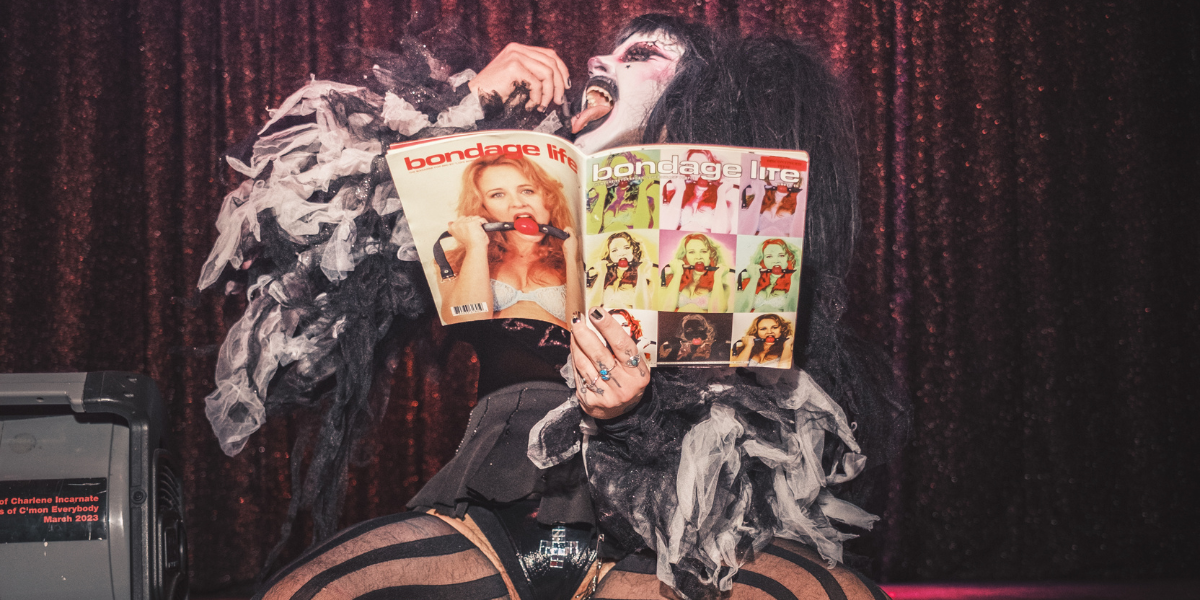
all photos by Angel Rivera
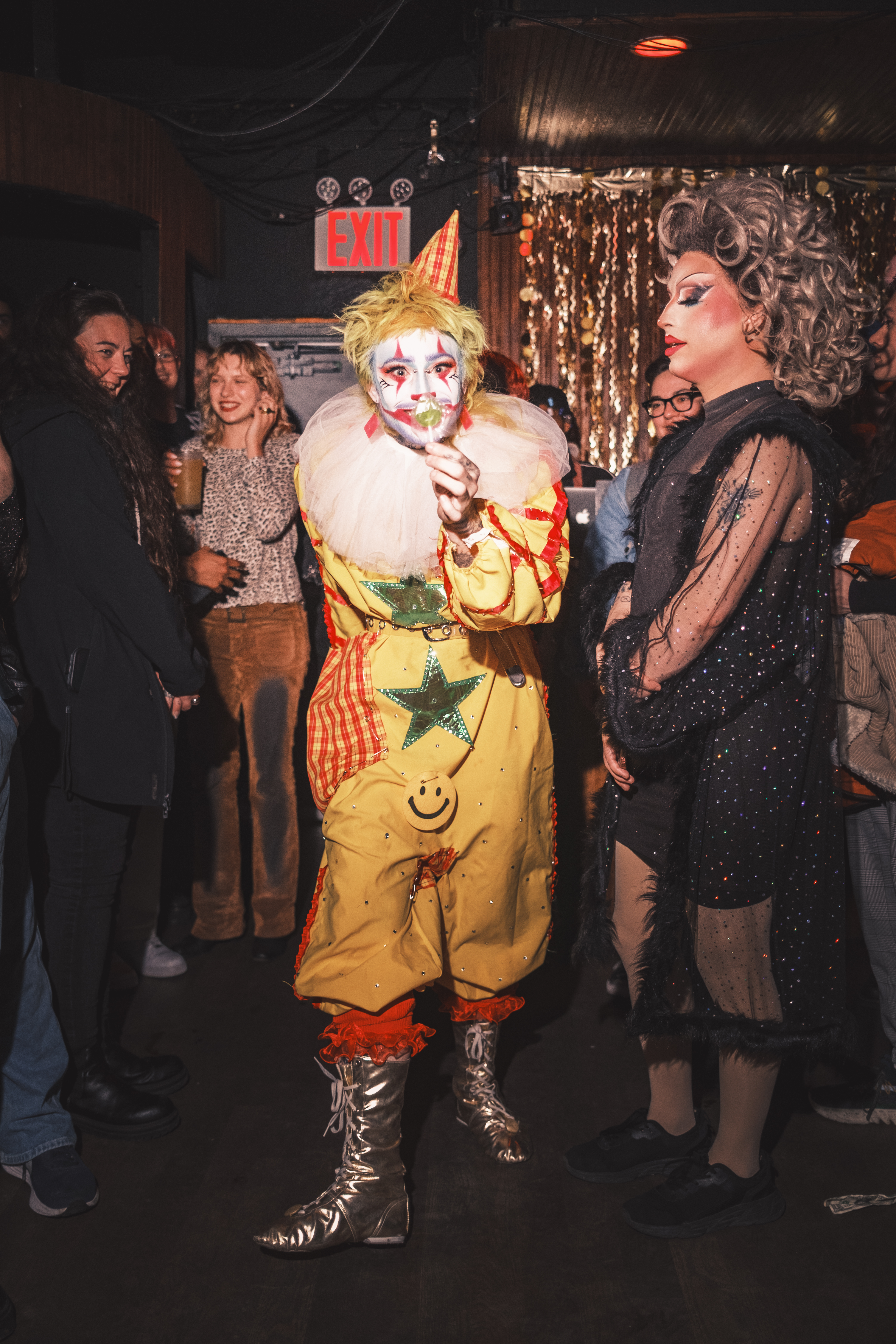
In late April, in the back room of a gay bar in Bed Stuy, Brooklyn, a yellow mullet appeared in a spotlight. Wearing a puffy jumpsuit that evoked Ronald McDonald, a lacy white ruff, and a smiley face over the crotch of his pants, Lollygag the clown made the crowd fall silent.
Instead of doing a sexy dance number like the drag king performers that had preceded their act, Lollygag came out with a bit involving a copious number of lollipops and one pre-rolled joint. After sticking the candies into their mouth one-by-one—the insertion of each timed to the pop sounds in his circus-music backing track—Lollygag considers the joint. He sticks it in his ear and his nose; he tries, and fails, to coax it through the sticky mass of candy.
The audience is struggling to square Lollygag with the awe and melodrama that came before him—including a rousing rendition of Kate Bush’s “Babooshka” by the drag king Mauve —and they can’t. That is, until he starts to remove the lollipops from his mouth one by one to make room for the joint, handing each wet stick to an audience member.
Suddenly, we realize with a cringe, Lollygag the clown is sexy.
Are clowns fundamentally queer figures? A visitor to the burgeoning Gen-Z clown scene in New York City, where Lollygag and other transjesters roam free, might say yes. At queer haunts like C’Mon Everybody, the carnivalesque Bushwick event space Rubulad, and gay club 3 Dollar Bill, clowning and clown aesthetics are proliferating in a never-ending rainbow handkerchief of drag shows and dance floors tangled by neon-patterned limbs.
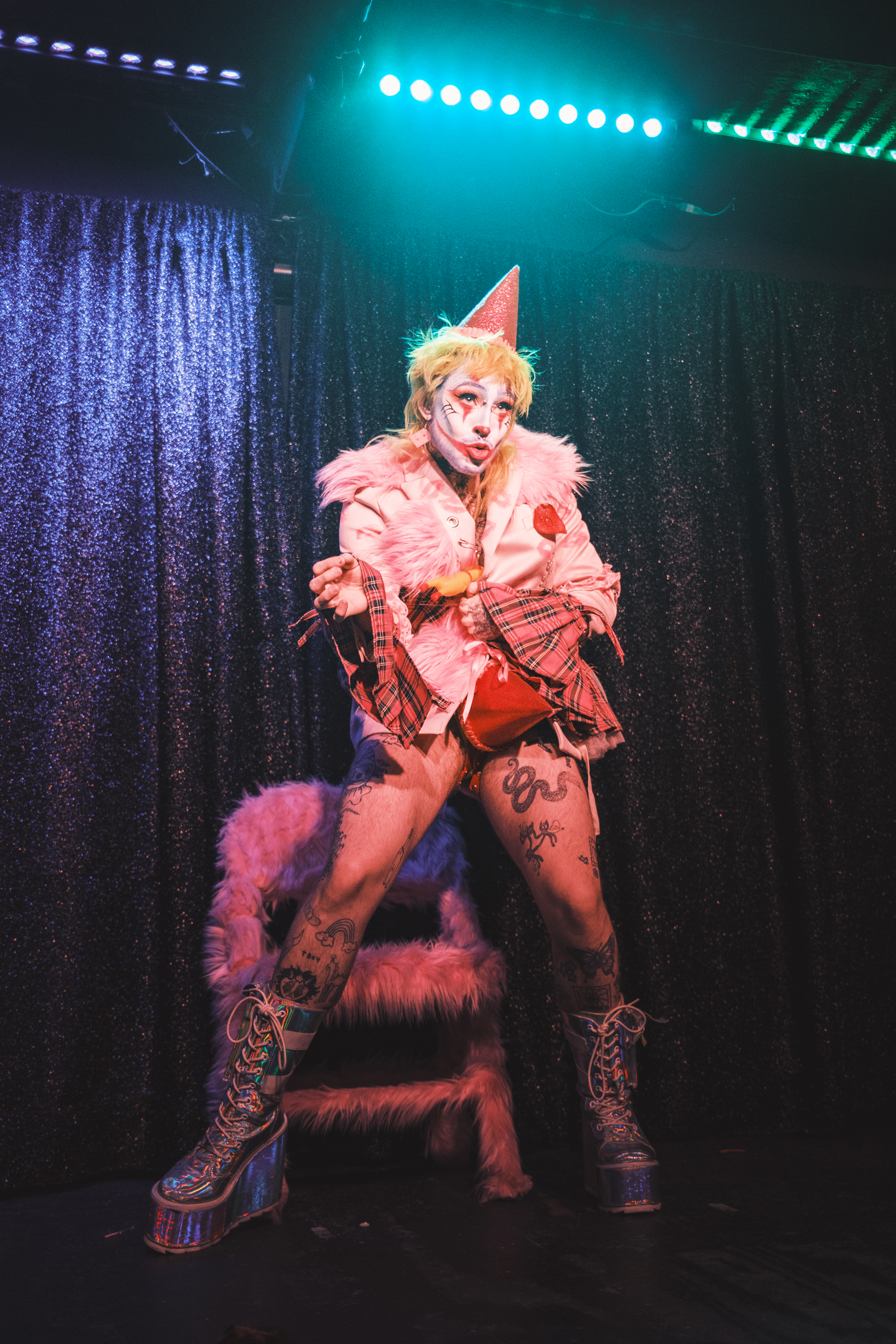
Lollygag, also known as Miles, got into clowning during the pandemic, when clown makeup looks had taken over TikTok. They describe how they had to overcome their aversion to “making a mess,” which became easier with time. “I’m making a mess all the time now,” they say. “I just had to get over the hump of accepting that.”
For the past year, Miles has been bringing Lollygag to audiences around the city, often with a tattoo machine in tow. Lollygag does “ignorant” style tattoos at events, the postage-stamp sized, amateurish linework pieces that many queers use to fill empty space in their patchwork sleeves. Miles thinks of his tattoos as “permanent doodles,” a style he developed through the “literal dilemma of learning how to tattoo and not being very good at holding the machine still, but trying to just make it work.”
They add that clowning, with all its experiments in transgression, isn’t so different. “Clowning is all about breaking rules, revisiting rules, and also problem solving through dilemmas,” Miles says. “I think the perspective that I have as a clown also informs everything that I do, and the way I move through the world.”
This is the punkish spirit that animates a relatively new—and unabashedly queer—lineage of performers known as street clowns. Street clowns are more likely to be spotted at a casino party than entertaining at a child’s birthday, though some street clowns also adapt their art to more profitable outlets. Lottie, a circus performer currently teaching overseas at France’s prestigious Ecole Philippe Gaulier clown school, started her clowning journey as “Silly Lottie,” working for a buttoned-up family entertainment company in Boston. She still does birthdays, but now wears “mismatched eyeshadow, or giant earrings, or a funny hat of pom-poms” rather than the white-face-red-nose combo.
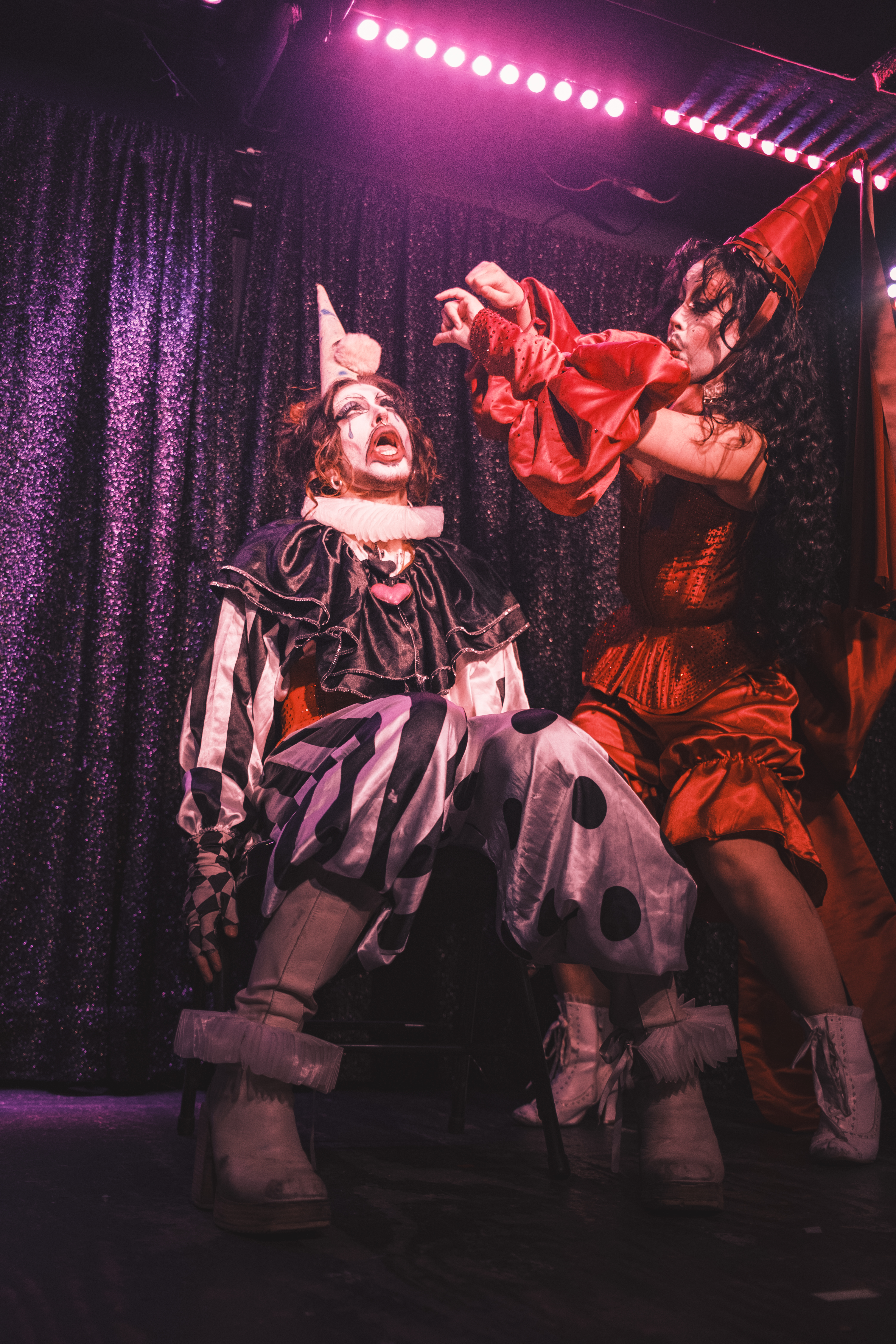
Street clown style prioritizes “funky clothes and bright colors,” Lottie says, and can be assembled from everyday wardrobe items—though many performers, like Lollygag, DIY their costumes. She speculates that many queer people who embrace loud hair colors and unconventional piercings are drawn to street clown style for the same reason.
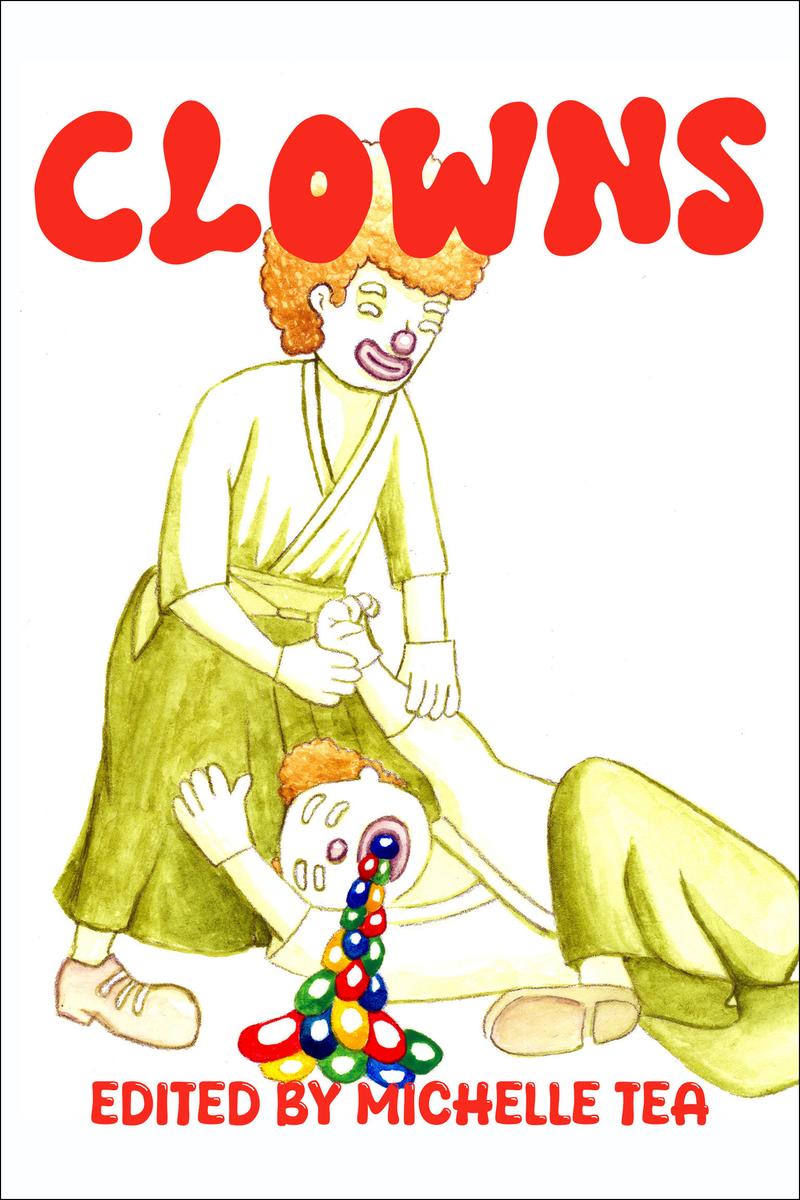
Another reason queers are drawn to clowning is because The Clown, as an archetype, possesses an intrinsic queerness. “Clowns are faggy,” as publisher Michelle Tea puts it simply. Her L.A.-based publishing house Dopamine Books published a clown-themed anthology on May 26, partly to give voice to the ongoing “underground clown renaissance,” she says.
To her, the queerness of clowns is particularly gender-based. “Masculinity in our culture is very controlled and self-protective, and the mechanisms of clowns are sloppy and open and sort of connective and relational,” Tea says.
Clowns practice a fanatic, freewheeling philosophy of exteriority that allows them to pave a way beyond the gender binary. Miles, a trans man, says he feels “genuinely euphoric” when in clown. “I feel hot in a way that I don’t experience not in full clown makeup, and which I also don’t experience in traditional drag.”
Queer clowning makes light of gender—not out of disregard for the very real harms cisnormativity perpetuates, but in spite of them. As Tea writes in the anthology introduction: “Gender normativity is the clown which does not understand its clownishness.”
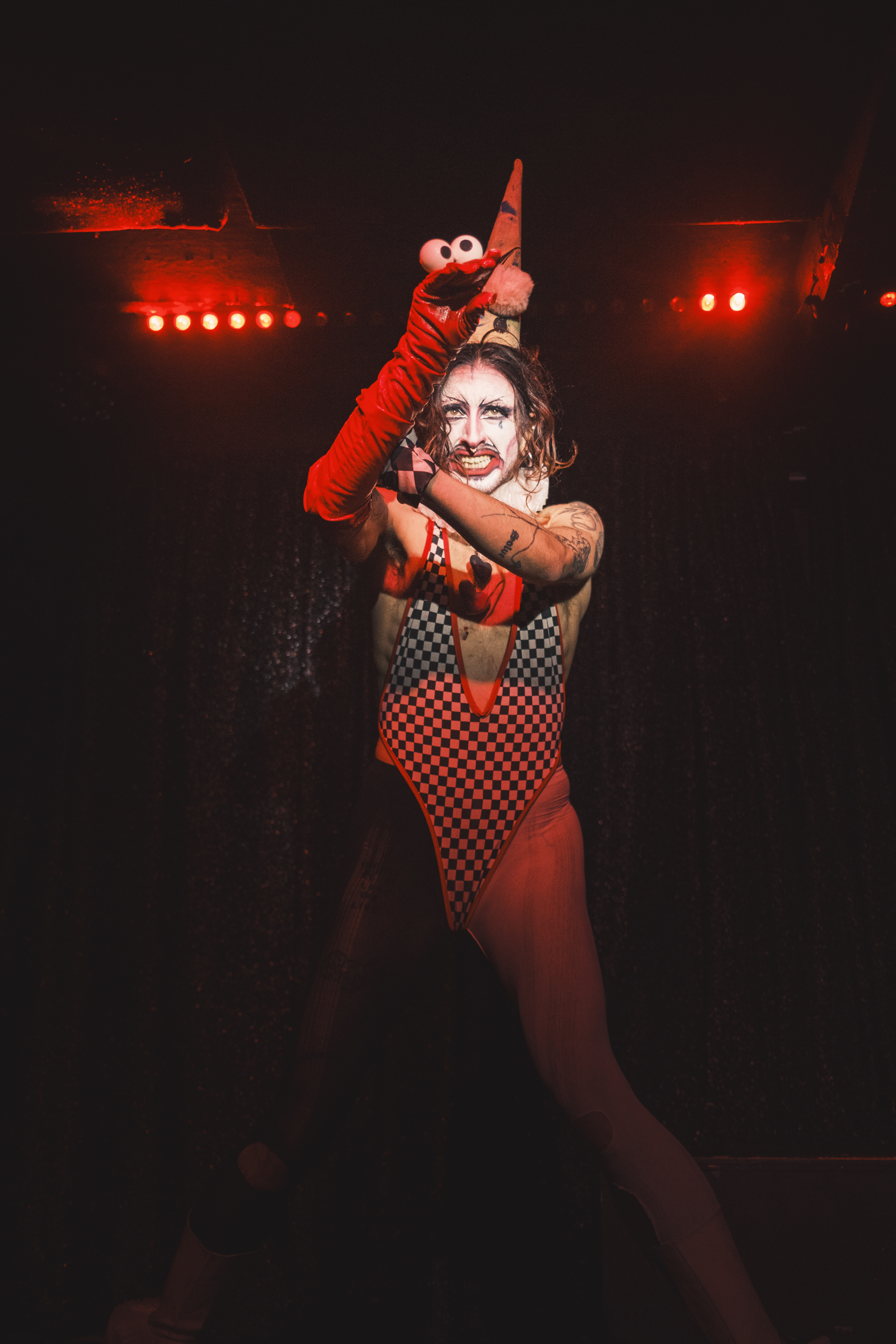
Back at C’Mon Everybody, deep into Fagnet’s second act, Lollygag returns. He dons a baby-pink blazer flared-out with pieces of a plaid skirt and holographic platform heels; he appears considerably looser than during his birthday-party-gone-pervert shtick earlier in the night. Nat King Cole’s “L-O-V-E” devolves into a glitchy, slowed-down remix, which Lollygag lip syncs to looking like a Five Nights at Freddy’s animatronic.
Suddenly, the music cuts, switching to Lady Gaga’s “LoveGame.” Lollygag rips open his jacket to reveal his “disco stick”, concealed by a bright red birthday hat. His choreography becomes increasingly unhinged until he’s bouncing up and down on a furry pink chair, rubber chicken flailing on a string around his neck.
Street clowns complicate the picture of goofy innocence we usually associate with the archetype animating them. In April, Clown Cult put on a joint event with Frick Frack Blackjack, a wacky-West troupe of dealers specializing in the “lawless economy of trinket gambling chaos,” per their Instagram profile. That same weekend, Fagnet’s Show Ponii entertained as a cigar-smoking, porno-reading clown to the tune of Oingo Boingo’s “Nasty Habits.” He also made jokes about beating his wife, which earned cackles from about half the room.
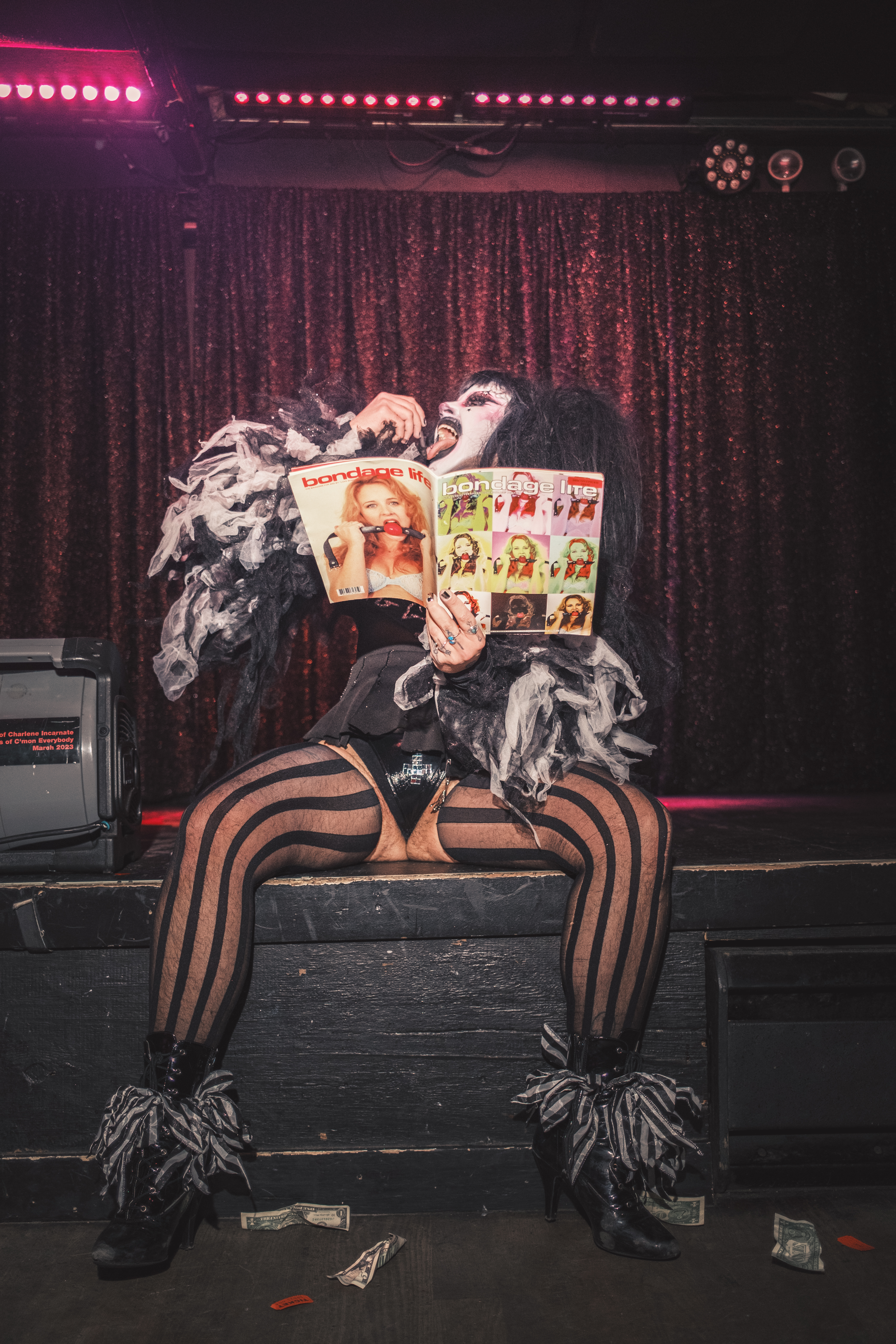
When clowns are crass, Tea says, they have the effect of “taking the piss out of sex”—or any other uncomfortably embodied human experience, for that matter.
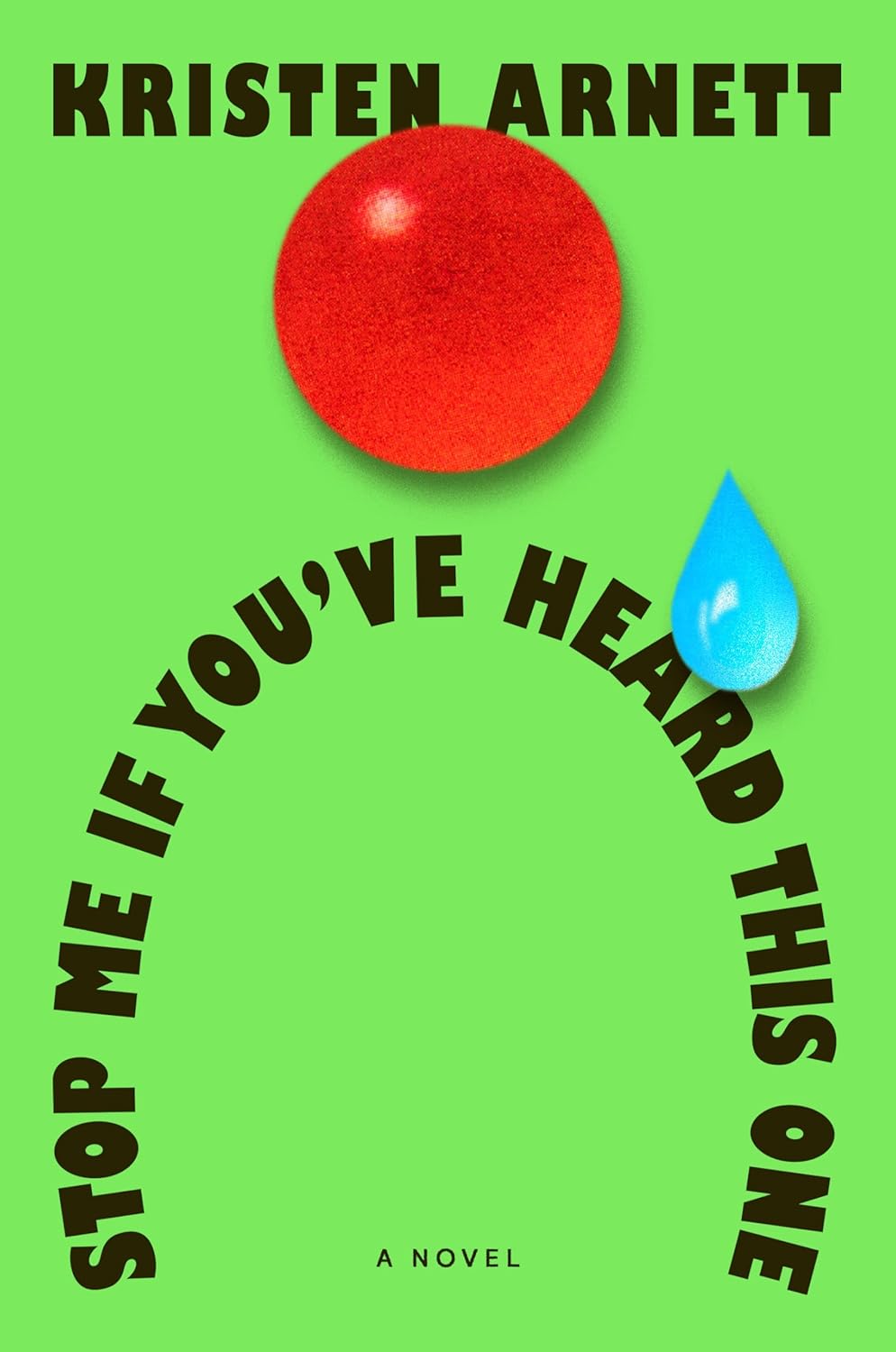
One of the best iterations of this idea by a queer writer can be found in Kristen Arnett’s 2025 lesbian clown novel Stop Me If You’ve Heard This One.
In it, Arnett interprets the queerness of Cherry, her Central Florida–native protagonist, through her alter-ego Bunko, a rodeo clown with a fear of horses. As a clown, Cherry is able to be transgressive in ways she couldn’t otherwise, given Florida’s politics—and opens up the possibility for her clients to do the same. At the very start of the book, the curtain rises on Cherry/Bunko the Clown in the bathroom at a kid’s birthday party, having a quickie with the supposedly straight mom who hired her.
Bunko is the purple-and-orange shadow of Cherry’s queerness, the last vertex in her tripartite identity: “woman, lesbian clown.” Clown is a poignant allegory for the experience of moving through a hostile world as a femme queer person. Cherry has to deal with men thrown into fits of rage by Bunko’s mere presence—including one particularly egregious incident in the parking lot of a hospital. “Clowning requires a kind of steeliness that I associate with my coming-out-process: the knowledge that there will always be people in your life who will hate you for who and what you love,” Cherry says early in the book.
Cherry somewhat revels in the way that Bunko commands attention, rageful or otherwise. At one point, she gobbles down a Thai curry and puts herself into anaphylactic shock to spite her emotionally distant mother, who is insisting Cherry doesn’t have a peanut allergy. At the same time, she’s desperate for connection. “She courts your goodwill because a laugh means you like her,” Cherry confesses of herself during a breakdown near the end of the book, “that she’s necessary for this world, that people couldn’t possibly do without her!”
When done well, clown is an exercise in vulnerability for both the performer and their audience, a sculptural practice that uses humor and discomfort to carve raw desire (and repulsion) from the confusion of social pretense. Other times, it’s simply a social lubricant. Miles says that Lollygag heightens “all of the pieces of me that I like and that I’m confident about,” which allows him to have “interactions that I wouldn’t feel as confident having otherwise.”
The “experience of having the eyes of the clown on you, someone who is so bold and their vulnerability—you can’t help but feel that on some level, it’s a dare or challenge for you to be so vulnerable,” Tea says.
Clowns pose a similar dare to society at large. Like satire and political cartoons, clowns have been on the front lines of resistance to conservatism in France, Spain, the U.K., Sweden, and elsewhere throughout the 21st century. Last September, a cadre of femme, harlequin-style clowns continued that tradition and took over Rubulad in support of the Save Coney Island campaign, protesting the construction of a casino in the neighborhood.
Though beyond the scope of this piece, there is probably something to be made of the French penchant for clowning. In Clowns, Danny LeVesque’s “Flies on the Windscreen” paints a portrait of a French-Canadian man watching his father die. A hobo clown figurine perched on his bedside table becomes a sort of shepherd into the great unknown. The father says he can “see through everything now,” how “everything we’ve been taught to think is important is actually opposite,” as his consciousness flickers between the afterlife and an old memory of performing as barefoot clowns with his son.
The Clown, queer or otherwise, is a philosopher by accident. The archetype is an iteration of The Fool, via commedia dell’arte, a Medieval Italian theatrical tradition featuring exaggerated characters, slapstick, and trope-y conflicts. The Fool, one of these stock characters, typically commits a series of blunders that end up unintentionally revealing some wisdom.
Many have written about the clown as a vehicle for the absurd, another French concept, originating with Albert Camus, that speaks to the mismatch between our modern lifestyle and our knowledge that we will one day die. At the end of her poem “The Antidotal Ghost,” which was published in the Clowns anthology, Jennifer Hasegawa offers up a visual that encapsulates the clown’s specific genre of absurdism:
Slapstick wands
cast spells
clearing the smoke
of knowing,
and in the clearing:
flush with potential,
the beautiful
red nose
of nada.
When Lollygag reveals his sparkly pink strap-on, hard plastic instead of soft red foam, clown slices right through the heteronormative veil. Here, queerness is laid out in its most exaggerated, material form, making itself impossible to ignore.

Comments
well this was a delight
I never thought of clowns as inherently queer…until now. This is so awesome!
Really enjoyed the perspective on clowning as a form of self-expression and vulnerability. It’s always interesting to see how art and identity connect in unexpected ways. In the same spirit of creative expression, tools like Fancy Text can also add a unique touch to digital profiles and content.
A great look at how performance art evolves with culture and identity. Creative communities thrive in many spaces, including car parking multiplayer mod.
Really enjoyed your perspective on clowning as a form of self-expression and vulnerability. It’s fascinating how art can reveal identity in such unexpected ways. Along the same lines of creative expression, tools like Fancy Text can also help people add a unique personal touch to their digital profiles, usernames, and content.
I really enjoyed this perspective. I never thought about clowning as a way of exploring identity and vulnerability, but this article made a compelling case. The stories about performers like Lollygag were especially memorable. Thanks for sharing such a thoughtful piece. I also write about indie and niche gaming projects at melancholiannaapk.pro, so I always appreciate creative communities finding new ways to express themselves.
This was such an interesting read. I liked how the article connected performance, humor, and self-expression instead of treating clowning as just entertainment. The personal experiences shared here really added depth. I spend a lot of time covering open-source gaming tools over at mojolauncherapk.pro, so I always enjoy discovering creative communities like this one. Great article!
This was a fun read! The image of Lollygag with all those lollipops and the joint is hilarious. Love how they broke the typical drag king expectations. Thanks for sharing this unique queer performance art.
This piece really captures the wild creativity of queer performance. It reminds me how we express ourselves in all kinds of ways, even in games like Minecraft. If you want to add playful text to your builds, check out the Minecraft Text Generator (https://1000fontgenerator.com/minecraft-font-generator) for easy font styling.
This was such a fascinating read—the way it connects clowning with queer identity, vulnerability, and creative self-expression is really thought-provoking.(smalltextgen.com)
Really enjoyed this perspective on clowning as a form of self-expression. The way the article connects performance, vulnerability, humor, and identity shows how creative art can challenge the usual boundaries of expression. I also liked the idea of using visual details and style to communicate personality—something that applies to digital creativity too. Exploring different font generator can be another simple way to experiment with personal style and expression online.
betboostwin.net Love how they broke the typical drag king expectations. Thanks for sharing this unique queer performance art.Really enjoyed the perspective on clowning as a form of self-expression and vulnerability.
What a lovely piece — the way it frames clowning as a deliberate practice of vulnerability and self-expression really stuck with me. Both Lollygag and Cherry/Bunko show how performance can become a kind of permission slip to step outside the usual rules of gender and presentation. It reminded me of a small, oddly complementary tool I came across recently, the PSL Scale Test. Thanks for the great reporting.