





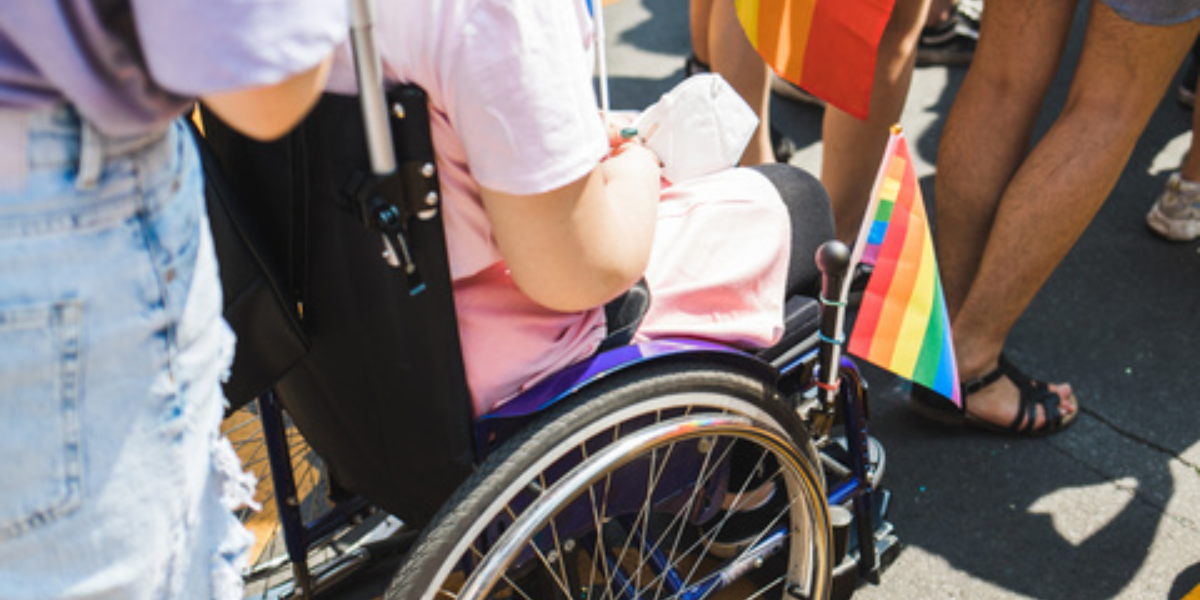
Last year, an Instagram post promoting a queer burlesque pride celebration caught my attention for all the wrong reasons. It sounded like a really fun, empowering, body positive event. The post noted the event would create a safe, supportive space that welcomed a diverse community. But the event was being held in a basement down what the venue’s Yelp reviews website described as a steep set of stairs, and the building didn’t have an elevator. I am disabled in a way that makes that at best dangerous and at worst impossible.
I commented on the post to say that calling an event body positive, welcoming, supportive, safe, and diverse couldn’t possibly be true when many disabled queer people couldn’t even set foot in the building. This event was not in some remote area with few options; it was in one of the biggest queer friendly metropolitan areas.
Their response sounded good on the surface. They acknowledged the venue wasn’t wheelchair accessible. They said this wasn’t aligned with their values. They said they were actively exploring alternatives and hoped to find a better solution in the future. They emphasized that my presence mattered “deeply” to them.
The response sounded sincere, and they said they were actively looking. Maybe next year will be different.
So this year, when I saw another flyer, I clicked with hope.
And there it was: same basement, same steep stairwell, same promises of inclusion.
Once again, they told me they understood my frustration. They explained they couldn’t install an elevator at the venue. They explained accessible venues are expensive and difficult to find. They explained they were trying to balance accessibility with the “realities of a grassroots community event.” They said they “appreciate the feedback and ongoing conversation.”
I never expected an event organizer to be capable of getting a new elevator installed. And I understand that the costs and difficulty of running a community event for queer people can be prohibitive.
What I don’t know how to reconcile is this: If accessibility matters, and disabled people remain excluded from LGBTQ+ spaces, why does accessibility keep losing? Because this isn’t the first time I’ve had this conversation, and it certainly won’t be the last.
I’ve had it after arriving at a drag show and being told I couldn’t use the elevator.
I’ve had it while sitting outside another drag show because the music was so painfully loud that my body couldn’t tolerate being inside.
I’ve had it after discovering the “fully accessible” Pride pool party had a tiny bathroom with no grab bars, the path into the building was made of stepping stones, and the pool had no stairs or railings let alone a transfer chair.
I’ve had it while standing in the heat waiting for the single accessible porta-potty at Pride while everyone else had choices.
I’ve had it while emailing medical documentation to strangers just to be approved to sit in the accessible section with only one other “guest” at a parade while my friends all made plans to celebrate together.
I’ve had it after arriving at a venue only to discover that nobody thought the steep staircase or inaccessible bathroom were important enough to mention beforehand.
I’ve had it after being promised an accessible seat only to discover that my seat was up two flights of stairs.
And these are only the events I tried to attend. There are countless others I skipped entirely because I already knew the answer. I knew there would be nowhere to sit. I knew there wouldn’t be a quiet room. I knew there wouldn’t be captions. I knew ASL interpretation probably hadn’t been considered. I knew there would be no information for blind or low vision attendees. I knew the bathroom situation would probably be a disaster. I knew shade and water would be an afterthought.
And maybe all of those things are true. But I don’t have the privilege to stop thinking about accessibility because it’s difficult or inconvenient. I don’t get to decide that living in an apartment with an elevator is too expensive for my limited budget. I don’t get to just show up to a space and hope it works for me without spending time researching seating, shade, water, parking, noise, lighting, and more. I don’t get to take my mobility device into any bathroom without issue. I have to spend countless hours and dollars advocating for, requesting, and sometimes installing accommodations (like grab bars) for myself in any home, work, school, or travel situation. Ableism follows me every single day, whether I want to think about it or not.
And when my disability needs aren’t addressed, I’m expected to give grace and understanding. To reassure everyone that it’s okay. To accept that accessibility simply couldn’t win this time. To be grateful that people tried
In fact, most of the time I’m asked to do free labor to solve my own exclusion. Do you know any venues? Can you explain it to me? Can you give us feedback? We’re listening. We’re listening. We’re listening.
You may be listening, but you certainly aren’t understanding. Because disabled people have been saying the same things for years. We need bathrooms we can use, seating, shade, water, information ahead of time, ASL, captions, sensory considerations, accessible transportation and parking nearby, allergy considerations, and for people to stop assuming that access is limited to just ramps. I am so damn tired of being expected to accept excuses and defenses for ableism.
We have always been here, and many LGBTQ+ leaders have been disabled, too. Frida Kahlo painted pain and desire while living with disabilities. Black LGBTQ+ Congresswoman Barbara Jordan navigated public life with multiple sclerosis. Bobbie Lea Bennett challenged Medicare’s exclusion of gender-affirming care. Audre Lorde wrote about cancer, survival, race, and sexuality. Eli Clare, Mia Mingus, and Leah Lakshmi Piepzna-Samarasinha gave many of us the language to understand disability and queerness together. Even the legendary Marsha P. Johnson was disabled and used an intersectional approach to organizing that included housing disabled trans youth and advocating for community care. Erasing queer disabled people in the present amounts to erasing queer history.
For decades, homosexuality was classified as a psychiatric disorder. Conversion therapy, electroshock treatments, criminalization, and institutionalization were all justified in the name of medicine. Disability was (and largely still is) viewed through a similar lens. Disabled bodies and minds were problems to be cured, controlled, hidden, sterilized, and segregated rather than people deserving rights, dignity, and self-determination. But the relationship between these histories has always been complicated.
As gay liberation movements fought to rightfully prove homosexuality wasn’t an illness, many embraced respectability politics. The message became: Queer people are normal, healthy, productive members of society—not like the mad, sick, freaks of the hospitals and psychiatric wards.
And while that strategy helped advance rights and acceptance, it often reinforced stereotypes and stigma about the sick, disabled, and mad. Historian Regina Kunzel argues that queer movements often achieved acceptance by distancing themselves from disability and mental illness rather than dismantling the stigma surrounding them.
Queer and disabled communities did become deeply intertwined during the height of the AIDS crisis. HIV+ people fought not only for survival, but for home care, bodily autonomy, community care, and accessibility. They challenged institutions that treated sick and dying people as disposable. They built networks of mutual aid and reimagined what care could look like.
Then, in the 2000s, we saw slogans like “born this way,” new treatment options for HIV/AIDS, and the continued rightful fight to declassify transness as a mental illness. The mainstream queer liberation movement again separated itself from the sick and disabled.
As Victoria Rodríguez-Roldán, coordinator of Maryland’s state autism strategy and a queer disabled advocate, puts it: “Why are you feeling the urge to yell so hard that you’re not mentally ill? What does that say about how you perceive mental illness?…There was always resistance along the lines of, Oh, we don’t want to be like those people.’
But some of us are those people. Some of us are mentally ill. Some of us are chronically ill. Some of us depend on caregivers. Some of us are autistic. Some of us can’t work. Some of us use feeding tubes, ostomies, hearing aids, wheelchairs, or service dogs. And none of those things make us less queer.
Another survey commissioned by Stonewall found that disabled LGBTQ people described discrimination and poor treatment from within LGBTQ spaces themselves. People described being laughed at during Pride events and feeling excluded by their own communities. Even spaces created specifically to serve LGBTQ+ communities often fail to provide meaningful access for disabled people. Accessibility gaps are not confined to bars, Pride festivals, and nightlife. According to the 2018 LGBTQ Community Center Survey, while 73% of LGBTQ+ community centers reported having accessible restrooms and 70% had accessible parking, that still left nearly one-third without these basic features. Only 61% reported having accessible paths of travel, such as ramps, elevators, handrails, automatic doors, or unobstructed routes. Communication access was even rarer: just 16% provided Braille signs or materials and only 13% offered TTY services for Deaf and hard-of-hearing visitors. In other words, many spaces created specifically to support LGBTQ communities still fail to imagine disabled LGBTQ people as part of the communities they serve.
Disabled LGBTQ people also experience disproportionately high rates of loneliness and psychological distress. A 2018 Stonewall survey found that 59% of disabled LGBTQ people had felt that life was not worth living during the previous year, compared with 31% of LGBTQ people without disabilities. Additionally, 28% had self-harmed and 8% had attempted suicide during the previous year.
So where do we draw the line of acceptable exclusion? Is it acceptable to exclude disabled people because we’re seen as such a small part of the community? The truth is that the image of queer life that dominates Pride marketing—young, abled, fit, dancing bodies—bears little resemblance to the reality of our communities.
According to the Center for American Progress, nearly half of LGBTQ adults are disabled. Among transgender adults, that number rises to 70%. Among intersex adults, it’s 66%. Nearly one in four LGBTQ adults report mental health disabilities. Others live with chronic illness, sensory disabilities, emotional disabilities, mobility disabilities, chronic pain, autism, PTSD, other types of neurodivergence, etc.
If nearly half of LGBTQ adults are disabled, why is accessibility still treated like a special interest issue where accessibility is nice to have and not a necessity? Why are we still talking about it as though disabled people are unexpected guests who crashed the party?
As a community, we generally recognize that some barriers are fundamentally incompatible with the values we claim to hold. We don’t spend years defending them because they are inconvenient to remove, nor do we celebrate the intentions of the people who created them. We understand that exclusion is unacceptable, even when fixing it is difficult.
And yet, when disabled people are excluded, the conversation somehow shifts. Accessibility becomes just one consideration among many. There’s the budget. The history of the building. The community organizing. The atmosphere. The performers. The location. The volunteers. The vibe. The sound system. The fact that queer spaces are disappearing. Accessibility is treated as one value to be weighed and balanced against everything else. Too frequently, it falls to the bottom of the pile.
But not all of us have the privilege of treating accessibility that way.
Because when accessibility is lost, disabled people don’t get a slightly worse experience. We don’t get a less convenient seat or a less ideal view. We don’t get to come. When people talk about accessibility as one value among many, disabled people experience it as the difference between being inside the room and being left outside of it.
On the surface, it sounded reasonable. Accommodating, even. But I don’t want another event some time later. I don’t want to hear about how much fun everyone had at the pride burlesque and see pictures afterward. I don’t want to be told that my presence matters while simultaneously being reminded that my absence is acceptable.
I want the same things everyone else wants. I want to dance badly with my partner. I want to make awkward small talk with strangers. I want to make new friends. I want ordinary joy. I want ordinary belonging..
Why are disabled people so often expected to do the emotional labor of making everyone else feel okay about excluding us? Why are we supposed to be grateful for mere scraps? Why are we supposed to be okay knowing that when it comes down to accessibility will always fall to the bottom of the priority list? Why are we expected to show grace to people who have already decided our absence is an acceptable compromise?
What will it take for exclusion to stop being unfortunate and start becoming unacceptable? And when will all of this grace, understanding, and labor we’ve been doing to make the abled LGBTQ+ community comfortable start flowing the other way?
Trans people are under attack. Disabled people are under attack. Community matters. Solidarity matters.
And if disabled people can’t even get into the room with the rest of our community, how are we supposed to organize together? How are we supposed to protect each other? How are we supposed to build something bigger than ourselves?
Presence is the bare minimum. It’s not even the end of the conversation. Because once disabled people get in the room, we still face ableist assumptions, inaccessible language, judgments about our bodies, skepticism about our needs, and a lack of solidarity when disability rights are threatened. Access is only the beginning. But we can’t even begin if we never make it through the door.
Exclusion doesn’t always look like cruelty, but the impact is still the same. Sometimes it looks like forgetting. Sometimes it looks like making assumptions. Sometimes it looks like saying “everyone is welcome” without ever asking who can’t get through the door. Most people don’t wake up and decide to intentionally exclude disabled people. Most people mean well. But disabled people still live with the consequences.
So don’t wait until disabled people are excluded and then ask us to solve it. Involve us from the beginning. Value our expertise before there’s a problem. Understand that accessibility isn’t charity or generosity. It isn’t going above and beyond. It’s the absolute bare minimum for belonging.
And after years of hearing why I should understand everyone else’s perspective, I can’t help but wonder how many abled LGBTQ+ people have tried to actually understand ours.For years, disabled people have been told accessibility matters. But if accessibility always loses when it comes into conflict with convenience, budget, tradition, or vibes, then what exactly are we saying matters?
We don’t need another apology. We don’t need another explanation. We don’t need to be told that people are listening. Disabled people have been explaining ourselves for years. I’m done having this “ongoing conversation.” I’ve spent enough years understanding. It’s your turn.

Comments
Great article. On a related note, the commitment from most organizers to ignoring Covid is still a thing, and implicitly decididing to roll the D10 on long covid every time, is certainly not encouraging.
@mods: apparently wanting HEPA air filters to be as common as bathroom sinks is “victim-posing” and presumably refusing “harsh reality”. Fascinating how articles on disability attract the most trollish and least empathetic people.
@Nonna: bait used to be believable
I do think it’s likely that a lot of groups can’t find an accessible venue for their event within their budget, and so end up not holding the event at all. I have been a part of such decisions. That obviously doesn’t fix the lack of accessible event options. But I think the feeling of being at the bottom of everyone’s list isn’t necessarily as true as it might seem, it’s just that events that aren’t happening don’t get posters.
“It’s not economically viable”? Then stop paying us lip service. These venues are cheap because they lack the facilities. And we’re the acceptable losses so you can host more frequent events, and these inaccessible venues keep being inaccessible because people keep giving them their money because they balance it by being cheap. Stop telling us you value us and will keep “looking into options” when you quite simply aren’t because those options are “outside your budget”. And quit lying with your posters saying that they’re inclusive when they aren’t. We’re sick of mollifying your feelings when we’re the sacrifice you seem to ALWAYS be willing to make. Be willing to admit these venues aren’t in your budget because you aren’t factoring US into your budget.
Thank you for this essay, I want to send it to everyone I know. I have a sticker on my water bottle that has a door labeled “ALL WELCOME” at the top of a flight of stairs… and a stick figure in a wheelchair at the bottom of the stairs, swearing. That… about sums it up lol.
The best luck I’ve had with accessibility at queer events were events I personally helped plan, but 1) I don’t always have the energy or time to plan things (dynamic disability, babey! Plus I have a day job that is not event planning) and 2) it’s really nice to be able to just. Show up and have fun like everyone else. If something isn’t accessible, just say so, don’t give me fake apologies just to assuage your own guilt or embarrassment. The fake apologies and “we are listening” with no follow through are worse, frankly.
Not everyone can organize events; not everyone is good at it or suited to it, and not everyone wants to. When someone else asks about my access needs as an attendee, or considers access needs beforehand, it means the world to me. I shouldn’t have to personally organize every event I go to, just because I use a wheelchair!
As a person unaware in my own ableist world, this was a wonderful read. Thank you for sharing!