





Editor’s Note: In April, we released Issue #02 of our new print magazine, featuring this incredible cover story by Jaya Saxena about heartthrob chef Melissa King. Now, with our next print issue around the corner, we’re sharing this story with you, digitally. For the full experience — 212 pages of queer writing and art, and a Melissa King CENTERFOLD —subscribe now.

Melissa King knows how to create a vibe. She knows, for instance, that while throwing a pop-up dinner on a cold February night in New York, diners will growl “oh my god” at the appearance of black vinegar-glazed beef rib, a hearty Flintstones-like bone right on the plate, served with shiso leaf and horseradish fried rice. It’s just her flavor of Chinese-inflected modern cooking, at once playful and refined. She knows that to impress a girlfriend, she should have a pot of meatballs simmering on the stove, and maybe a fire going. And she knows to request both Cheetos and chopsticks for a photoshoot, because it’ll make a great shot. Watching her in real life, she seems just as she is on TV —cool, relaxed, unfazed. It would be intimidating if she didn’t laugh so often and over anything, but she does. She leans in and she listens, which is all the more powerful because you know she doesn’t have to.
Melissa King is a queer, Chinese-American chef who built her career in the San Francisco fine dining scene before emerging on the national stage on Top Chef Season 12. She made it almost to the end before being eliminated for serving a great-but-not-as-great-as-the-others dish, but don’t worry, she got her revenge in Top Chef All Stars Season 17, where she won with a Hong Kong milk tea tiramisu that made one of the judges cry. She was also voted fan favorite of the season, concrete proof that viewers couldn’t get enough of her.
From there it seems like she just hasn’t stopped. She’s been a Top Chef judge, the host of Tasting Wild on National Geographic, modeled for a Levi Strauss pride campaign, sold her own spice mix (King’s Mala Spice Mix), hosted pop-up dinners across the country, and, in 2025, published her cookbook, Cook Like a King. This October, she’ll publish her memoir, The Girl Who Became King.
King wasn’t the first queer contestant on Top Chef, nor were queer contestants even rare on the show. But it was the way she carried her queerness, and her Chinese heritage, that made so many people watch week after week just for her. She appeared totally game, ready to try anything, and somehow unbothered by the pressures and expectations of reality TV. It also appeared that queerness was just a fact of her life, not something that required a maudlin backstory or a Pride™-ready monologue. We see her calling her then-girlfriend in season 12, and then competing with her mom, who appears entirely loving and supportive, as Melissa instructs her what to cook without intervening.
Mostly, she was there for the food, repeatedly telling the judges about the knife skills she wanted to show off, or how she didn’t think every dish needed to be centered around meat. How refreshing, to see a queer woman of color exuding quiet confidence and just being herself. She wasn’t trying to win over the audience, which made it easier for them to love her on their own.
She laughs when I say this and chalks it up to good editing. Because she was not, to use the common parlance, born this way. “I was really painfully shy as a kid and even until I did my first Top Chef,” she says. For anyone who saw her in a Thom Browne shorts tuxedo on the Met Gala red carpet in 2023, this may seem impossible. But like many third-culture kids, King says she felt awkward and out of place growing up, not totally Chinese and not totally American either. She says her family held traditional Chinese values, which felt at odds with a childhood in the San Gabriel Valley in the ‘90s, especially as she started developing crushes on other girls in high school. More than anything, she wanted to fit in, and for a long time it felt like the easiest way to do that was to compartmentalize her identities, and become someone who was comfortable being quiet in the background.

But she’s also described herself as someone who never liked being told what to do. Food was a way to navigate the tension of trying to stay quiet while dying to do her own thing. She was an early help in her family kitchen, washing the lettuce for her mom’s pork lettuce wraps, and regularly cooking jook on the stove when she was only eight years old. At 13, she graduated to the Thanksgiving turkey (which she writes “ruined Thanksgiving for my entire family.”) She wasn’t just inspired by her family’s Chinese cooking. She reminisces in her cookbook about the street tacos and Taiwanese fried chicken she and her friends would eat after school, and a trip to France as a young teen that introduced her to the mind-blowing flavors of good steak tartare. Food became a creative outlet, a way for her to express herself and experiment without being the center of attention. At home with her family, and later in a professional space, she could make something beautiful and comforting and let it speak for itself.
At first, her parents hoped cooking would remain a hobby, and wouldn’t allow her to attend culinary school out of high school. “I felt like they didn’t understand me. There was a lot of that teen angst and rebellion,” she told Eat Drink Films last year. She wound up graduating from the Culinary Institute of America in 2007 anyway, and from there moved to San Francisco. There, she worked at restaurants like Campton Place and Luce, where she was mentored by the celebrated chef Dominique Crenn. Her friends were the ones who encouraged her to apply for Top Chef, which she wasn’t sure about, the tension rising again between wanting to challenge herself and be seen and wanting to stay hidden. Even still, she says, “there are parts of me that would love to be running away to the kitchen, and that was who I was for many, many decades of my career.”
But there’s no hiding in the kitchen when the kitchen is on Bravo. Viewers may have seen a composed, self-assured woman, but inside King was on an emotional roller coaster. And it wasn’t just that now she was in the spotlight, it was that she didn’t quite realize just how much the reality show format would reveal about her life to the world. That viewers would see not just a chef, but a whole person, and specifically a queer one–that matter-of-factness again being a wonder of TV editing. Though she had a girlfriend and was out to friends and colleagues, within her family, she was only out to her parents and sister, she says. It’s one thing for them to know, and a whole other thing for everyone to know. “I think I’m just going to cook, not realizing it’s a TV show and that it’s going to be syndicated in all these languages. So I naively jumped into coming out on national television to everyone in my personal world.”
In some ways, the Band-aid rip off was helpful, precisely because these truths could be aired all at once. In Boston, she bonded with fellow contestant Mei Lin over their families disapproving of their culinary careers. And she told the LA Times that for much of her career, her father never ate at any of the Michelin-starred restaurants she cooked in. It was only after she spoke about her disappointment and desire to impress her family on television that he began telling her how proud he was of her.
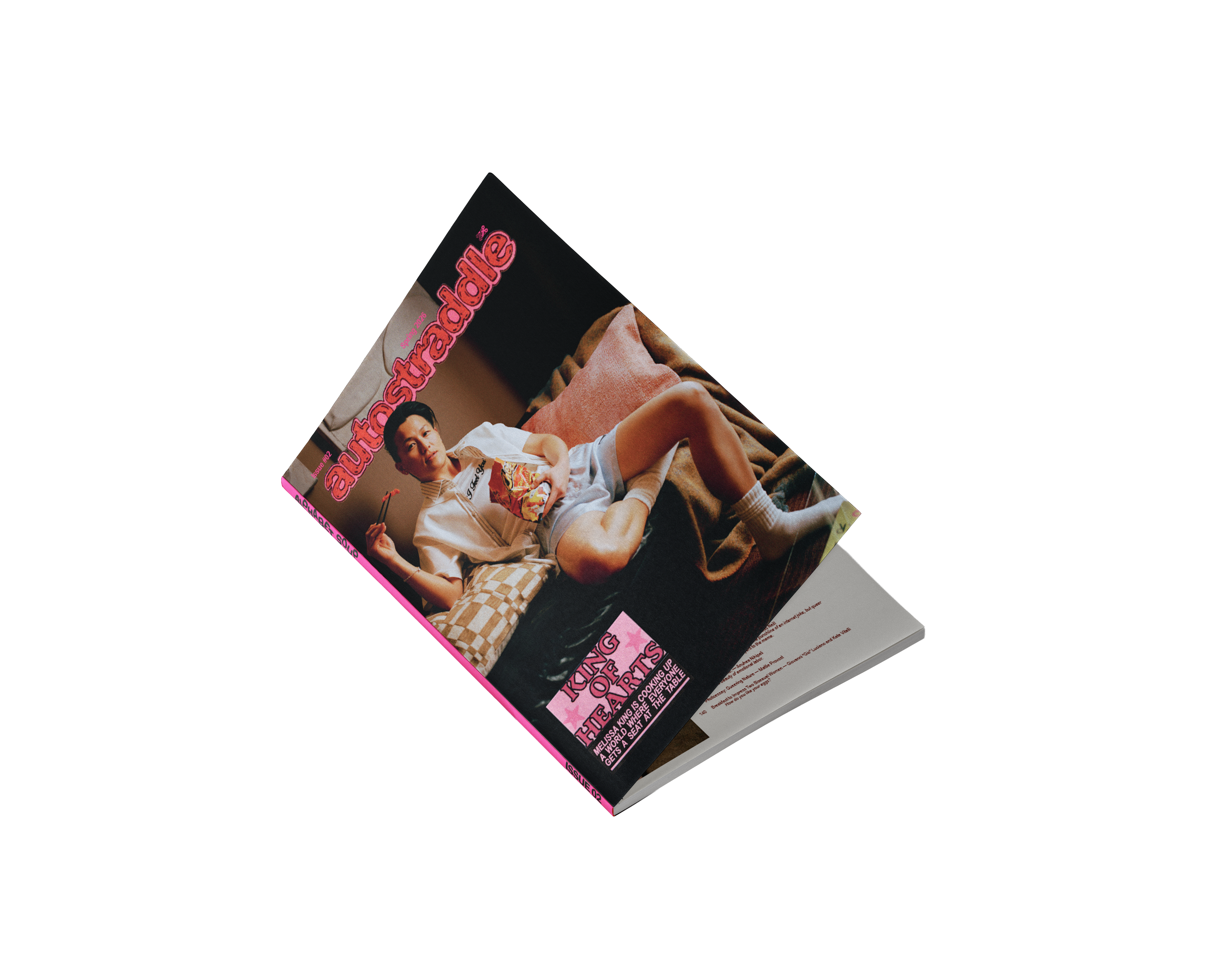
Keep queer media alive — subscribe to our magazine now to read this story (and 50+ more) in print!
But unpacking why the idea of being known more deeply was so nerve-wracking is a huge part of her forthcoming memoir. She began thinking of writing one while working on her cookbook, looking through the recipe headnotes and realizing there was a deeper story to be told. Or really, a more layered one. “It was like doing therapy for five years, writing this book. It was just really sitting in those feelings,” she says. First, she had to realize it wasn’t just her story. She says she was inspired by The Joy Luck Club, a book and later movie about a group of Chinese immigrant women and their adult daughters in America, and the hidden pasts and pressures that create the tensions between family members who have been raised in such different contexts. King wanted to explore the “generational layers and, I hate to say it, trauma” that influenced her upbringing, and to bring empathy and curiosity to her family’s stories. “There was a lot there to be told with my life, but I kind of had to start it with my grandma,” she says.
Then she had to look at what allowed her to make the choices to “break out of that shell” of shyness, quietness, and always wanting to please those around her. And a lot of it boiled down to her chosen family. Even though every straight person is doing Friendsgiving these days, “chosen family” is a queer idea. Sometimes, chosen family looked like a kitchen crew she sweated side by side with. Sometimes it was girlfriends who showed up for her when she felt closed off from herself (in her cookbook acknowledgments she thanks “every ex-girlfriend.”). After moving to San Francisco, she built a group of friends with whom she throws hot pot dinners during the holidays. “The communities in my life that for me have always showered me with love, even the love I maybe didn’t have from my own blood family,” she says, are who has helped her build a sense of self-worth that ultimately came across on screen and allowed so many viewers, especially queer viewers, to connect with her.

Ok so we all saw the Instagram video. The one where King and Padma Lakshmi are standing hip-to-hip in Lakshmi’s kitchen, King in a fashionably boxy striped button down, Lakshmi in a black muscle tank with a pair of red cherries and the words CHERRY BOMB lettered across her chest, like they just woke up and threw on hot people’s version of pajamas. They are there to demonstrate a recipe for podimas, a turmeric-spiced potato dish, from Lakshmi’s book Padma’s All American, but I’m not sure any queer person got to that part. “Your nails are so gay right now,” King points out, as Lakshmi reveals, one by one, eight fingers manicured to blood red points, and two— her left pointer and middle finger — bare and short. “Stop starting rumors,” Lakshmi giggles.
Too late, as this was already after Lakshmi threw King a birthday party in her apartment, and after the two dressed up as Morticia and Gomez Addams for Halloween, with Lakshmi’s daughter as Wednesday. Lakshmi hosted Top Chef from 2006 to 2023, and while she later become friends with some of the contestants, none have felt as publicly supportive and downright intimate as this one. Like, you know who else went as Morticia and Gomez for Halloween this year? Me and my wife.
“I really enjoy her company a lot, it’s such a joy to be around her,” Lakshmi says of her friendship with King. She says her first impressions of King as a contestant were that she was “elegant and reserved.” She liked that, especially in comparison to some chefs who are all bluster. She watched as King absorbed feedback, and kept pushing herself to grow. And mostly, was completely impressed by her craft. “I think she became more confident as she did well in her cooking, but there was no shell that she needed to come out of. She was just doing her work minding her own business and that’s her personality.”
They didn’t really get to know each other until King was no longer a contestant (Lakshmi kept strict no-socializing rules while on Top Chef to avoid any whiff of favoritism). But King joined as a fellow judge on Season 18 in Portland, which was also filmed during the early days of the COVID pandemic, so there was lots of testing and sheltering in place for the talent. “Our friendship really blossomed,” says Lakshmi.
“Padma is a very special, amazing human in my life,” says King, though she admits she was terrified of her when she first got on the show. But ultimately, they bonded over their similar backgrounds, growing up in immigrant communities near each other in LA. In fact, she’s learning more about that by reading Lakshmi’s memoir, which she brought to the Autostraddle photoshoot.
I tell her all of this is doing nothing to dispel the rumors about the two of them. “Let’s keep it that way,” she laughs.
It used to be that, to be a chef, one had to have a restaurant. But the emergence of food entertainment, peaking with Top Chef, basically obliterated that notion. “[Top Chef] changed what it means to be a successful chef in America by unmooring chefs from restaurants,” wrote Joshua David Stein for Eater in 2022. In fact, Stein name checks King as “one of [Top Chef’s] most talented and compelling contestants,” who instead of opening a restaurant, is curating culinary experiences and brand collaborations. This is a bittersweet trade. Restaurants are naturally limited things, requiring one to be in a specific place with a specific budget in order to enjoy the cooking of a specific chef. And they are also famously difficult businesses, operating on impossible margins even at the best of times. So why not, if the current allows, travel all over the country to cook? Or put out a cookbook so everyone can follow along at home? Or hell, model because you’re hot and known and there’s no risk of slicing the tip of your finger off in a mandolin?
“My entire life I grew up thinking I wanted to own a restaurant and be a chef and get a Michelin star. It wasn’t until my experience with Top Chef that the world became so much more vast and open. I can do anything I want,” she told Food & Wine after winning Top Chef: All Stars. And so she did, with the game-for-anything attitude that first brought fans to her. She’s spent much of the past five years cooking at various pop-ups and collaborating with other chefs, including fellow Top Chef alumnus Mei Lin and Buddha Lo. In 2022, she was invited to create the first course for the Met gala, a hamachi crudo with yuzu olive tapenade, and got to walk the runway in a Thom Browne shorts tuxedo jacket and custom Chinese nail guards from queer Filipino designer Chrishabana (Browne has remained one of King’s go-to designers). She’s consulted for restaurants and hosted virtual cooking classes for causes close to her heart. She’s equally at home at the Big Queer Food Fest and cooking at the luxury 1 Hotels. She even taught some muppets how to pleat dumplings in a Sesame Street special, living out literally everyone’s childhood dream.
But now that she has done much of what she wants, she’s thinking about a restaurant again. Maybe it’s that after years popping up here and there, she wants a place of her own. “It’s a dream of little baby Mel to have that anchor where people can go and try my food and really experience the feelings that I evoke through my food,” she says, a place where she can create the vibe instead of always ceding some control to someone else. Or, she jokes, it’s because on top of being a Libra, she’s a double Sagittarius, and is just itching to do it all.
(“I want to see her open a restaurant, preferably in New York, so that I can go to it on a regular basis,” says Lakshmi, who adds that she would invest in one. Though King likely already knows this.)
King has built her culinary reputation by cooking food that allows every influence on her to sparkle, a combination of Chinese technique and ingredients, a Californian sensibility, and whatever else inspires her. On the Top Chef: All Stars finale in Italy, that meant char shiu octopus, squash agnolotti with chile oil, and her now-famous Hong Kong milk tea tiramisu. Her cookbook is full of dishes like lion’s head meatballs and scallion pancakes inspired by her family’s cooking, and experimentations like al pastor bao Thai-inflected elote. A lemongrass beef stew is a blend of “French beef bourguignon and Vietnamese bo kho,” while her sheet pan pizza comes from her time as a line cook making family meal for her coworkers. It’s a kind of cooking that’s recently come to be called “third culture cuisine,” a redefinition of authenticity that isn’t tied to one country or tradition of cooking, but instead lets chefs (especially immigrants, children of immigrants, and mixed race chefs) cook with the breadth of their multicultural experiences. Really, you think a girl from East LA isn’t going to make elote?
“Her style of cooking, it’s not authentically one thing, and that’s something I appreciated,” says Alex Chang, chef and owner of Kiko in New York, who recently collaborated with King on a Lunar New Year pop-up. Chang, who has Mexican and Chinese heritage, welcomes more chefs embracing every influence, whether it’s the food of their family or city or just a dish they fell in love with. “It’s that broad spectrum of flavors, and putting your own perspective on it…it’s a more personal story.”

Third culture cooking has typically focused on racial and ethnic backgrounds and influences but this is, in my opinion, an incredibly queer way to cook. What else do you call a sensibility that doesn’t box itself into narrow definitions of what can and cannot be done, what should be done, and instead allows chefs to just… try things? Queer food is a relatively recently named category, first explored by writer John Birdsall through the influence of James Beard on American cuisine. And as queerness doesn’t have a country of origin or an indigenous ingredient list, defining what makes food queer can get kind of murky. As Birdsall later explains in his book What Is Queer Food?, it’s about intention, whether it’s dismantling the structures and traditions of the kitchen, or cooking for the purpose of serving and celebrating a marginalized community. It is, as he writes, “pleasure as defiance.” It’s a lot of things, and maybe you know it when you see it.
Looking at King’s cooking, I see queerness. She’s spoken a lot about how on her second round of Top Chef, she stopped worrying about impressing her family or professional colleagues by following the rules she learned at school or on the line. Instead, she started cooking for herself, leading with the idea of what would taste good? I think of every queer person who has shed the rules they grew up with, who built new language and new relationships for themselves outside of any model they were given. Perhaps that’s a lot to compare to a basque cheesecake made with salted egg yolk. But what is more queer than seeking pleasure on a hunch, even if no one has tried it before, even if everyone around you is telling you you shouldn’t?
When King talks about her memoir, it’s clear her career successes, her confidence, and her embrace of her queerness are all intertwined. Her journey, she says, is going from the shy kid she was to being “loud and proud. I’m going to show you the style of food that I do, and I’m going to show you my very open queerness and be proud of that.” Just as she is not going to limit herself to one idea of what a chef can be, she is not compartmentalizing her identities. And she’s not letting them dictate what she can and can’t do. “We can easily put ourselves in these little prisons, but how do we break out of that?”
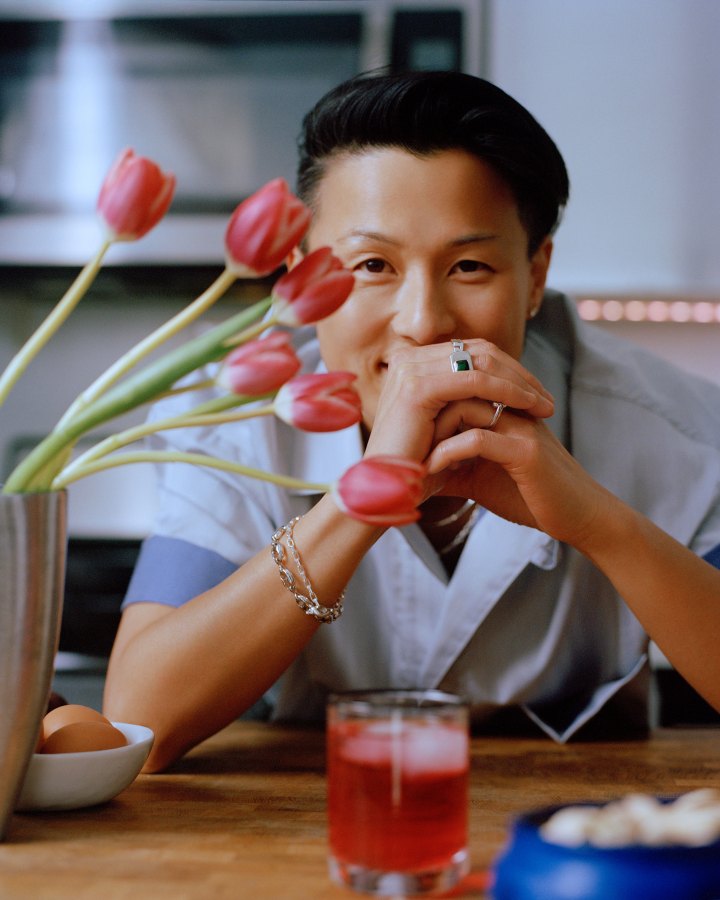
On the day of the photoshoot, King looks perfectly relaxed in every scene she’s put in —leaning on a kitchen counter, dangling her bare feet off a spiral staircase, slouching down in a chair in nothing but her underwear and an oversized jacket. She takes up space. I realize this is what I think confidence looks like, the ability to make oneself at home everywhere, even in the most ridiculous situations. To go with the flow with the knowledge that you won’t be carried away by it.

It takes work. It is still “terrifying” to King that, come October, anyone will be able to pick up her memoir and read about so many of her challenging and intimate moments, and the family history that influenced them. But that terror is a feeling she’s learned to embrace. After all, it’s what got her here. “All the times I felt scared, those have always been the most powerful moments for me. The moments where I decided, you know what, let’s lean into it and let’s see what happens,” she says. “There’s a beauty that comes from it.” The memoir will become another moment, and on the other side, King will get to declare a little bit more of who she is. After all, why hide?
This story looks even better in print. Support queer media and get your copy before we run out!
Photography: Emmie America
Photo assist: Taylor Schantz
Creative direction: Em Chad
Set design: Rae Godin
Stylist: Evren Catlin
Style assist: Grace Brown
Makeup: Ai Yokomizo
Hair: Rei Kawauchi
Art and props:
Joey Aj – Spike Lamp, 2025 (Resin, Lamp Hardware), Curb Lamp, 2024 (Cement, Lamp Hardware)
Devo Plett – “Coyote”, 2025 (oil, charcoal, gesso, on canvas), “Together no.1” & “Together no.2” 2025 (oil, graphite, paint, gesso, on canvas)
Quarters – drinking glass, cushendale blanket, table top objects
Wardrobe:
Bucket chair:
Shirt: Kid Super SS26
Shorts: Willy Chavarria SS26
Kitchen:
Shirt: Jacquemus SS26
Pants: Shao New York SS26
Shoes: Vintage
Rings + bracelet: Maggie Agnew
Sofa:
Tank: Acne Studios SS26
Shirt: Maison Margiela SS26
Shorts: Prada SS26
Stairs:
Top: Issey Miyake
Pants: Issey Miyake
This story looks even better in print. Support queer media and get your copy before we run out!


Comments
Read and loved it in the magazine! Incredible stuff