





feature image via shutterstock
One of the most quintessential moments of queer life is the act of coming out. It’s such a life-changing event that we have entire day devoted to celebrating it every year. While the coming out process and experience is different for just about everyone, the actual act of coming out is often a unifying concept for the LGBT community. At almost any queer event, you’ll probably overhear some folks discussing how and when they came out, whether it’s about their sexual orientation, gender identity, or both.
We come out to lots of people, of course. We come out to ourselves, our friends, our family, to our cats (who are universally the most accepting, of course). Often the coming-out moment that gets made the biggest deal of is coming out to your family. This makes sense; some of the most emotional coming-out stories, whether heart-warming or hear-wrenching, come from the family talk, and the risk — of being disowned or rejected — is often greatest. But, for many of us, myself included, a more important (and scary) reveal is when we tell our friends. Don’t get me wrong, I was scared to death when I told my parents that I’m trans and queer. However, I have a complicated family history, so it’s my friends have long made up the vast majority of my support system, so their rejection would have been so much more devastating than any blood-family rejection could have ever been. I think that’s the case for a pretty large swath of queer world. And really, the content of the conversation with your friends is so much different than with family.
So just how does one go about coming out to their friends? The Autostraddle team held a roundtable to impart our vast wealth of queer experience to help you through this big step.
Mari
For me, I came out to my friends in stages. I knew early on that my social network has going to be critical in survivingmy transition, and I wasn’t prepared to risk all of it in one big shout. It started with my very closest friends, who were actually the first people I came out to at all. It was probably a little overwrought and dramatic, but I sat each of them down individually and started with that cliche line “I have something important to tell you…” and just let the words flow out. Oh, and then I cried (the crying is totally optional). After the closest of my friends were taken care of, I started picking particular friend clusters that I felt ready to share my journey with, then picked out one or two people from that group that I felt would probably be supportive and told them first, followed by a broader announcement to the larger group later on. Wi. With some groups, it was easier to make the announcement by email. With others, it was easier to catch everyone at a big gathering and talk to the stragglers afterwards. Once I had taken care of all of the “friend groups” and individual people that I felt it was important to have one-on-one conversations with, I just made one big final Facebook announcement along the lines of “Hey everyone, this is what’s going on. I’d love if we could still be friends, but you can’t deal, you can see your way out.”
I knew early on that my social network has going to be critical in surviving my transition, and I wasn’t prepared to risk all of it in one big shout.
So that’s the process, but how about the words? Well, I found that there was a basic set of information that every talk/speech/email needed to cover. The first was the obvious: that I’m trans and what being trans really means. I found it really helped people relate better if explained how emotionally painful dysphoria really is. Second, people needed to hear the really practical stuff, like how my coming out would affect them. This is where I explained my new name, my new pronouns, that I would “look different,” and all of that. Third, I wanted people to know what was expected of them (which wasn’t much). I let them know that what I cared about was their friendship, and that I didn’t expect them to automatically become a champion for trans issues, just that I expected them to respect me as a person. Fourth, I gave them permission to feel whatever they were feeling, and to make mistakes. Adjusting to a trans friend is complicated, and I wanted people to know that I wouldn’t get angry at them for making mistakes. It’s also a pretty huge change, and sometimes people have pretty strong reactions or take some time to process the information, and I wanted them to know I was cool with that and wouldn’t judge them for it. Lastly, I offered them resources. Sometimes, it’s easier for people to grasp things when they’re explained in alternative ways, or when they’re outside an emotionally-charged conversation with a close friend. So, I linked helpful resources from groups like PFLAG that explained transgender concepts and language.
Nowadays, I find myself having to come out in the “opposite” direction at times. I have a pretty cis-normative appearance, so people generally don’t know I’m trans unless I actually tell them. I’ve become a little more casual about those moments. I treat being trans as basically one more incidental fact about me, like where I went to college, or when I got my driver’s license. If it comes up in the context of conversation, then that’s how they find out.
Laura
I don’t think I ever sat anyone down with the intention of having a serious “coming out” conversation. Like, I didn’t even do that with my mother. I just started slipping, “my girlfriend, M,” in casual conversation. And watched people’s wheels spin as they tried to act cool.
It’s bullshit that I would need to come out as bi when I never came out as straight… I’m not going to create high pressure situations that make me feel awkward about my queerness, when it’s other people who should be feeling awkward about their heteronormativity.
This approach worked really great for me! I think only two people asked any follow up questions, and it was to clarify how long I’d been seeing my girlfriend. I’m pretty sure some people still think I’m using “girlfriend” to mean “chummy female best friend,” but like… I’m fine with that. They’ll definitely get it if they ever check my Facebook or look me up on Google, you know?
I guess my main feeling on this is: why should it be my responsibility to baby people as they work through their own mistaken assumptions? It’s bullshit that I would need to come out as bi when I never came out as straight. I’m going to take care of my own feelings, and they should take care of theirs. I’m not going to create high pressure situations that make me feel awkward about my queerness, when it’s other people who should be feeling awkward about their heteronormativity.
Lydia
I came out to most of friends long before I came out to my family. I distinctly remember coming out to two of my gay male friends first, and I was terrified. I was (and still am) navigating what my identity was exactly — I knew I liked girls, but I had a boyfriend — so I was really scared to tell them what was up.
It doesn’t get less scary for me, per se, but the more times I do it, the better equipped I feel to deal with the backlash (if there is any).
The first two were the hardest, and they were really accepting and didn’t question me even though it was all very new. I spent my teenaged years in the suburbs, in a closed-minded, conservative environment. This queer/lesbian/gay realm was all very, very scary to a little conservative girl like me. After breaking up with said boyfriend, my dating wasn’t limited to a specific gender, so I had to slowly start telling my other friends as well. It doesn’t get less scary for me, per se, but the more times I do it, the better equipped I feel to deal with the backlash (if there is any).
I officially “came out” to my entire network of friends, so to speak, when I posted a link to my Autostraddle interview for Straddler on the Street on my Facebook profile, and on my blog. It was the first time I had spoken publicly about being queer, and I was SO nervous. Again, I was very afraid of the outcome, but I also knew that hiding away this important part of myself was slowly eating at my well being. The reaction was far more supportive than I thought it would be. People that I hadn’t spoken to in years sent me messages saying that they were happy to see a person like me — someone who perhaps doesn’t necessarily fit the stereotype of what a queer person “looks” like — come out and be proud of their identity. I suppose I’ve learned that the friends who support you are the ones who were worthwhile, and who gives a fuck what the others say?
Mey
A lot of the time I’m totally wracked by extreme anxiety, so when I knew I had to come out, I was literally shaking in my boots. Confronting people has always been something I’m terrible at, and for me, coming out seemed a lot like that. So for a lot of people, I came out without actually talking to them face-to-face. I wrote letters, I sent texts, I sent emails and Facebook messages and eventually I came out to everyone by making a Facebook post declaring that I was a big ol’ trans lesbian. By coming out like that, I was able to write out all my feelings and all the information that I wanted my friends to know without messing it up or forgetting something. I also wanted to make sure that I presented it in a way that fit in with who I am. I was able to write out a narrative of my life and show how being trans fit into that. Yeah, this was a change, but I was still the same person, and I wanted to make sure that that was still clear.
Now, I did end up talking to all these people in person eventually, but when I did, they came into the conversation knowing what to expect and knowing more about what it means to be trans. Also, there were some people I told in person, but even with them, I rehearsed and rehearsed and rehearsed what I was going to say. I wanted to make sure I got every word, every pause, every inflection just right. I wanted to be in control of my coming out. I also rehearsed a bunch of answers to questions I thought they might ask, just in case. Basically, I had a script of everything I wanted my friends to know and I made sure that I was able to get it all out.
I was able to write out a narrative of my life and show how being trans fit into that. Yeah, this was a change, but I was still the same person, and I wanted to make sure that that was still clear.
I was also very careful about who I came out to and when. I came out to my closest friends, the ones who I was most sure would be supportive, first. That way, with each new friend I came out to, I had another friend backing me up the next time I came out to someone. This also allowed me to build up a group of friends I could be myself around before I was out to the whole world. Eventually, I built up a whole army of people who had my back and were going to stand by me no matter what. That way, when I came out to the people in my life who I’m not as close with, I knew that even if they reacted negatively, I would still have a strong support system.
Maddie
“I’m pretty sure I’m bisexual,” I said to my two best friends on my fifteenth birthday. The statement was not related to the conversation, said well within earshot of my parents (who weren’t paying attention), and driven by the raging crushes I had on both of the friends — both girls.
I nudged my way into these girls’ friend group at the beginning of high school by chatting with one of them about the Grateful Dead pins on her bag during Spanish class and hanging out at lunch in the hall in the basement outside the girls’ locker room. In the group, a lot of them talked about being attracted to girls, but I kept my own girl-oriented attractions to myself, because I’d worried it might seem like I was just trying to copy them. Finally, as I sat with them at my kitchen table, newly fifteen, emotions running high after watching Rent and the thrill that these girls were my close friends, spending my birthday with me, I found myself laying it out there, giving myself a label in the LGBTQ alphabet soup.
They spent the rest of the night grilling me about this new development. I reveled in the attention and affirmation given to my newly vocalized identity.
It wasn’t unusual for me to be the only person in the room who openly talked about being attracted to women.
I don’t remember much else about the gory details of my high school coming out experience. I know I told my friends in clumps, some more explicitly than others. The only friend I was really scared to tell was my very conservative friend who had once said she’d disown a friend if they came out to her. But gathered in another girl’s basement in our sophomore year, I said to her, “Do you know I like girls?” She wasn’t surprised. I was a Democrat, after all.
I was lucky that my friend had moved past her middle school plan to reject her gay friends, and after that, my queerness gradually became something embedded in my everyday identity and interactions in the world. My college was a really great place to be queer, and there it wasn’t uncommon for people to learn I’m queer before or at the same time as they learned my name. It took me a long time to find other queer women friends in college, and so for a long time, my role in the friend group was to be the token lesbian amongst straight women and gay men. It wasn’t unusual for me to be the only person in the room who openly talked about being attracted to women.
I live in a new city now, and most of my new social interactions center around queerness in some way: queer activism, queer events, writing for Autostraddle, OKCupid situations — you get the idea. I don’t think I have actively Come Out to anyone in quite a while, at least not to friends. It’s an amazing feeling, and one that I’m trying not to take for granted.
KaeLyn
I had a false start in 8th grade, when I told my friends at a sleepover that I thought maybe I was a lesbian because I was attracted to girls. Soon after, I realized I was attracted to boys, still, because I developed a crush on this skinny kid with Eminem hair who wore circus-tent-baggy pants because it was the 90’s. So I recanted my former statement immediately. Those confusing feels for girls didn’t go away, though. I think I knew I was bisexual pretty much since I learned there was a word for such an identity. I became good friends with the couple gay guys who were out at our school, and was a known “fag hag,” but I didn’t come out until senior year — December 3, 2000, to be exact.
Partly because, even though my family was not very supportive, I felt good about finally saying the words. Partly because I really craved validation and hoped my closest friends would be cool.
I came out to my parents that day, which is a whole other story with a rough beginning and a happy ending. However, coming out to my parents emboldened me to come out to my two best friends. Partly because, even though my family was not very supportive, I felt good about finally saying the words. Partly because I really craved validation and hoped my closest friends would be cool. In the back of my friend’s mom’s minivan, staring intently at my lap, I told my two best friends I was bi. There was no pause or awkward moment. They were immediately super supportive. I can’t thank them enough for being so great. It changed everything for me. I swore them to secrecy and only told a few other people in high school, but their reaction helped me make the decision to be out at college, unapologetically.
From undergrad freshman orientation on, I have been out 100%. Once I made the decision to be out, it was surprisingly simple. I’m out at work, to friends, colleagues, publicly on the web, and to all my family that I’m in touch with. I’m really active in LGBTQ communities, politics, etc. I still have to come out fairly regularly, because I don’t “look queer” to most folks, but it’s not a big production anymore, just a subtle correction or dropping an obvious reference. Honestly, these days, I feel like I come out just as much as bi to LGBTQ people who think I’m a lesbian.
Fikri
The first time I said the words “I’m gay” to a real life human in my very own real human life — not in pseudonyms on fringe online forums, or lurking in the comments section of AfterEllen — I was 14 and still hiding behind a computer screen. MSN Messenger: I probably said it in 9pt Trebuchet MS in some shade of seafoam. She was my best friend then, one out of many Special Friendships I’d develop over the course of my teenage years (and coincidentally the last one that wouldn’t turn into a More Than Friendship), and I believe her response was along the lines of “oh k, cool.”
There were some exclamations of disbelief. Some questions. …Then we just stopped talking about it.
I wrote lengthy letters to 6 of my closest friends. These were people I’d known since 10 but weren’t necessarily the kind of friends I had heart-to-heart talks with (g-d I love teenage awkwardness) so I’m not quite sure what compelled it — the discovery of Ellen and her coming out story? — but I found myself in one of their living rooms nonetheless, trying not to squirm as they went through rows of my very, very tiny handwriting in front of me. There were some exclamations of disbelief. Some questions. And that awkward moment when we realised our friend’s parents had been at home the whole time, and might have heard everything we’d said.
Then we just stopped talking about it.
My semi-secret queer life exploded from that year on: I explored girls and words and myself, but I stopped telling people. (I wouldn’t have denied it if they’d asked, but they didn’t.) I’d developed an online community on LJ and DW that made me feel like I could be myself, I was dating deeply closeted straight girls, and I later grew increasingly skeptical of “coming out” altogether. But most of all, I guess, I was scared.
This had to change when at 21 I ran for LGBT Officer at my undergraduate university, which meant two surprising things to my friends: 1. I was back on Facebook, 2. I was posting photos (selfies, even) of myself. In light of this, I thought 3. “surprise I’m gay!” would be less of a big deal. Jk! Of course not. It was fucking awful. So I did what all the young people do now: I poured my heart out on the internet (and clearly, haven’t stopped since).
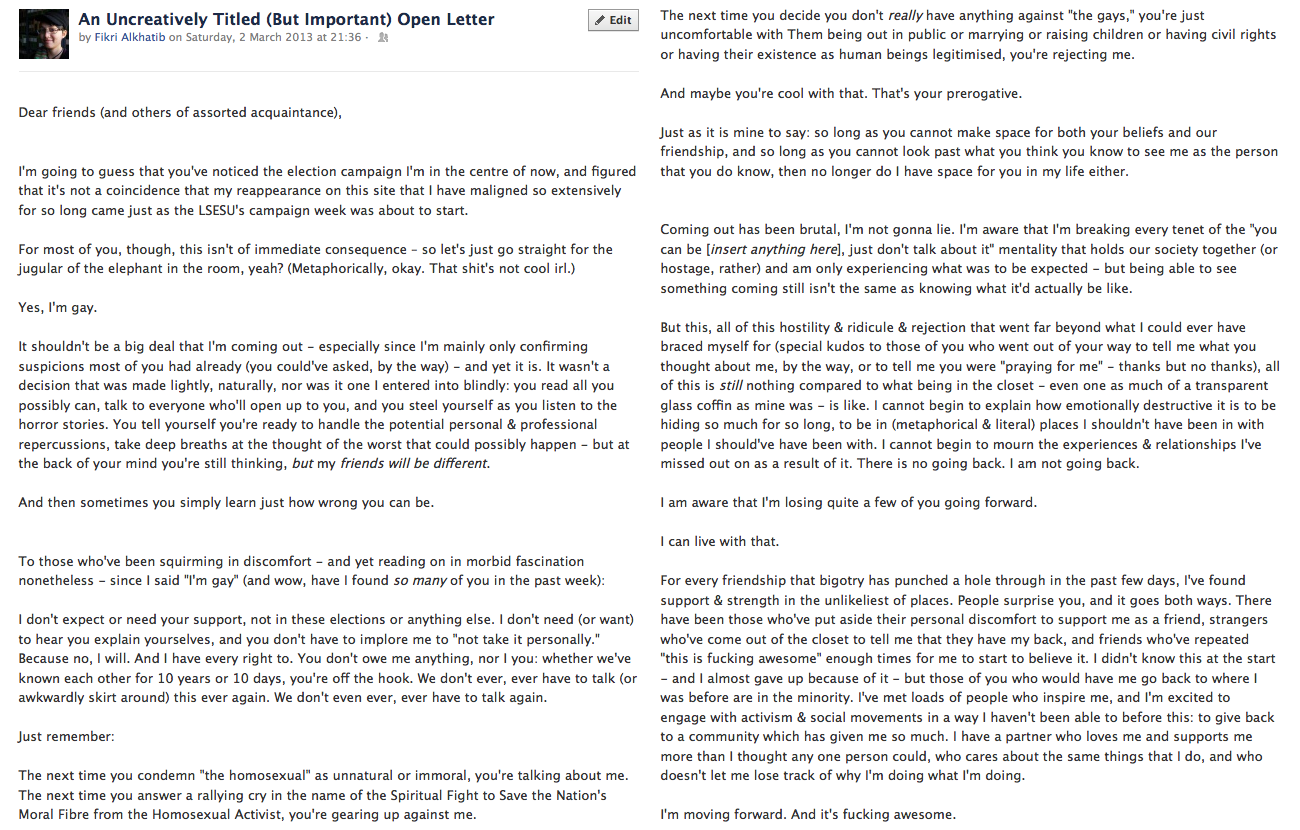
Coming out in this public, spectacular way was one of the lowest points of my life. It was exhausting, demoralising and broke my brain and my heart and my body. But it also gave me the opportunity to rebuild all those things: friendships that lasted got stronger, I met so many new wonderful people, my social circles changed radically and the communities I now belong to have proven to be invaluable through other crises — and celebrations! — that followed. I live in a happy queer bubble in NYC, have found people who’ve (re)made Singapore home for me, and am surrounded by weirdos who energise, inspire and make bad sex jokes with me every day.
I’ve moved forward. And it’s fucking awesome.
Kaitlyn
I’m having a much harder time writing about this than I thought I would. When I was in high school, I dated a girl for the first time, but it was long-distance and the only people who knew about it were my friends who lived where she did and two of my guy friends from school to whom I felt I had to explain myself when one of them asked me out and I said I wasn’t interested. So until I got to college, I had only ever come out to friends because of a sort of guilty necessity — either they had seen me with my girl and asked what was up, or they were curious why I didn’t like a boy who liked me. It wasn’t anybody’s fault (no one had ever made me feel unsafe or anything like that) but I only had uncomfortable memories associated with coming out.
But then I moved a thousand miles away from anyone I’d ever known, into a dorm full of people who seemed (on the outside) so cool and fearless. I wanted to be like them, one of them. So I got to school, and I was out. I didn’t come out. I just was. During my very first residential college meeting, I responded to the costume theme “what you wish you did this summer” by dressing up as Megan Fox. I talked about my ex-girlfriend and my current girl-crush and I went to Rainbow Alliance events and I hosted a kissing booth radio show for charity where I kissed my two best friends live on the air while jokingly apologizing to my (new, long-distance) girlfriend. And that’s actually how I accidentally came out to my ex-boyfriend from high school, who was listening, who then told the rest of our circle, none of whom knew how to react.
Over the next few weeks, I had a few fun conversations with people via text or phone. My parents had moved to a new state, but I was going back to my high school town to visit during winter break, so I decided to take a big leap and add “interested in: women” to my Facebook profile to make sure everybody who needed to know would see. I answered everyone’s questions about “how long?” and “are you sure?” and “did anybody know?” and felt like a total asshole the entire time, for reasons I’m sure I still haven’t really worked through.
…until I got to college, I had only ever come out to friends because of a sort of guilty necessity.
In the end, nobody really freaked out or was that upset. Most of them just didn’t understand. A few of them felt hurt that I hadn’t shared, confused why I thought they wouldn’t accept me when they’d spent the last year of high school showing me how great they thought I was. But that’s why it was so scary, right? I went to high school in the South, and the two or three out kids I knew at school were harassed and teased mercilessly for it. Girls were accused of faking it for attention; the one guy was just sort of ostracized. I worried that I’d put all this effort in to get people to like me — watching new tv shows, listening to new music, changing my hair and clothes, dating someone — and that if I revealed this big secret, they’d dismiss me like those other kids they hadn’t even tried to get to know. I was terrified that they only liked me because of those things I was trying to be. It never occurred to me that they might just find me likable because I was me.
Meanwhile, I was still at college, surrounded by amazing, welcoming, warm people, most of whom thought I was this out-and-proud lesbian who would never hide who she was. It was really surreal, because while I felt lucky to be in that place, a huge part of me was still this terrified teenager who wasn’t sure how to “be gay” or who wouldn’t have really blamed anybody who didn’t want to be friends with me because I was. I was in the best possible place in the world to love myself, but I still couldn’t bring myself to do it. Sometimes I still struggle with it, to be honest. But I do know that once I told my friends, the circle of love only widened. People who loved the parts of me they knew were by-and-large happy to welcome a new part that made me complete.
Heather
It took me a long, long, loooooong time to come out to myself, and I felt so much better after I finally did it that I started blurting out “I’m a lesbian” and “Hey, I’m a lesbian” and “This probably won’t come as a shock or anything, but I’m totally a lesbian” to every single friend in my life almost immediately. Every time I said it, no matter how people reacted to it, I felt like I was throwing off another brick on the massive self-hating shrine of shame I’d built on top of my psyche over the years. My friends’ reactions didn’t always make me feel good — I grew up in rural north Georgia in the clutches of the Baptist church, after all — but I didn’t care because I just kept feeling more and more free every time I came out to a new group of buddies.
Every time I said it, no matter how people reacted to it, I felt like I was throwing off another brick on the massive self-hating shrine of shame I’d built on top of my psyche over the years.
I think, generally speaking, people mostly care about other folks’ stories only inasmuch as they intersect with/affect their own personal stories, so most of my friends reacted with shrugs and hugs, because the only thing that changed about me is I started dating girls. I lost a few friends who were convinced I’d left the path of righteousness and was consorting with the devil. I lost a few friends who couldn’t get past the fact that I’d been struggling with something so big and for so long without sharing it with them.
But most of my coming out conversations with my friends were all:
“I’m pretty sure, like between 99 and 100 percent sure, that I’m gay.”
“Dude, awesome. Thank you for telling me. Can I buy you a beer?”
I got a lot of free beers for coming out, which was the second best part after finally getting to feel whole.
Gabby
The first person I came out to was my friend, Christina. We were fourteen, watching my brother play Little League baseball. We took a walk to the store and in that five minutes, I blurted out that I liked girls and was in love with Angelina Jolie. (This was way before Brad and their gang of Jolie-Pitts. This was the year of Gia.)
She stared at me, grabbed me by the shoulders, and told me she liked girls too.
We were both so fucking relieved. Finally, someone to gush over hot girls with and talk about gay stuff and how to come out to our parents. We were from the same neighborhood, went to the same elementary school, both Latinas and then we had this other major thing connecting us.
She stared at me, grabbed me by the shoulders, and told me she liked girls too.
We were inseparable for almost a year until she told me she loved me. I couldn’t handle it so I shunned her, went back into the closet. We didn’t speak for almost three years.
I didn’t start coming out to people again until I was seventeen. I was desperately in love with a boy and a girl. Shit was complicated and friends were safe places to drop secrets and receive hugs.
I called Christina and begged her to forgive me. I told her how sorry I was and what an asshole I was and that I’d do anything to make it up to her and oh, please could we be friends, again? Of course, she forgave me. She’d forgiven me before I even asked for her forgiveness. We made plans to chill and talked about my love triangle.
When I finally let go of that boy and that girl, and fell in love with someone new, I only felt safe telling friends. I was 19, in college, and feeling myself. Everyone was cool, weird, and no one even blinked about gayness. I found a thriving, supportive, and fun group of friends. I didn’t need to have any major coming out moments with them because we were all trying to figure ourselves out.
I even made trips to visit Christina at her college in upstate NY. Damn, that girl could party.
Eighteen years, that’s how long it’s been since Christina and I came out to each other during that Little League game. This past August was the third anniversary of her passing and all of it is still so very fresh. I’m thankful that she was the first person I came out to. She prepared me for all of you.
Audrey
I don’t connect strongly with the concept of coming out, because I never really felt like I was “in.” I spent 22 years having no idea that the feelings I had for girls meant I was bisexual. I wasn’t fighting to keep my feelings a secret because I didn’t understand them well enough to articulate them to myself, let alone anyone else. When I finally said the words “I am queer” out loud, it was like I grew wings. Within 36 hours I met the girl who quickly became my first girlfriend. I introduced her to all my friends in Austin — everyone was happy for me, and no one was surprised. I got more bold about referring to myself as bisexual and queer in relevant conversations and felt more confident claiming those identities each time. Only a few people asked me for more information, and their questions came from well-meaning curiosity. I encountered a few bisexuality-deniers, but none among my close friends.
I got more bold about referring to myself as bisexual and queer in relevant conversations and felt more confident claiming those identities each time.
When I moved to Nicaragua last June, I was terrified that I would have to go inside a closet I had never been in before. I was very timid about telling my new friends about my sexuality or my ex-girlfriend because I didn’t know how to bring it up in a place that is, on average, far more conservative than Austin. However, I quickly found myself in a fabulous progressive social group of Nicaraguans and other foreigners. Many of my best friends here are queer men and women, and my personal and political connection to my queerness has grown and blossomed so much here. The country as a whole is not receptive to LGBTQ identities – I’m not out at all at work, for example — but I got lucky and found spaces where I can spew glitter out of my ears.
As a bisexual person, I realize the coming out process will be continual and lifelong, even and especially when I’m in monogamous relationships that indicate to most people that I must be either straight or a lesbian. Instead of finding that intimidating or annoying, I hope I can approach it with a spirit of joy. Several friends have told me that my positivity about my bisexuality and queerness gave them the courage to came out, which is a huge honor that far outweighs the pain of the moments of rejection and fear I’ve experienced. When I wrote about my journey for Autostraddle and shared the piece around, I got tons of messages from old friends and acquaintances about the piece, and a lot of folks called me brave for coming out. But I hadn’t thought of it as a coming out essay. I simply wanted to state who I am and tell my story, and I feel blessed that story has had almost universally positive reception.

Comments
I was the worst at this, I cut all my hair off and told everybody to shut up if they asked about it for like three years, then went to camp and wouldn’t shut up at all ever
One night I got really drunk, told the friends I was with and then proceeded to make a Facebook status proclaiming “FYI I’m a lesbian.” This was around the time that fraping (a term I hate) was big and so I woke up to a fair few text messages asking if my post was for real. It wasn’t necessarily the way I wanted to come out, but it was like ripping off a band-aid – clean and taken care of in one sweep.
I first came out to my best friends at school when I was 17, after a lot of thought (and knowing there were other not-straight people in that group). Then panicked, was terrified that EVERYONE might find out and I already kind of thought I was weird enough without adding queerness to the list – and I didn’t tell anyone else for about 3 years. For the first two years of university, nobody knew. I think I’d have told the truth if asked, but nobody asked. Eventually I realised that this was making me miserable, so used my year abroad as a convenient way to experiment with being ‘out’, and that was that. Didn’t tell any family members until I was 22, but all my friends knew before that.
I work in a profession with high staff turnover (EFL), so every academic year either I move on to a new place or there’s a lot of new people in a place I stayed in. I still have to come out a lot. That’s been much easier in the last few years though, because a) I have no hang-ups about it and b) it eventually comes up in conversation that I have a girlfriend, which gives me a good opportunity to tell people if they haven’t already assumed. That usually happens early on, so people who have a problem with it don’t end up as my friends. It’s been a long time since I’ve had to come out to anyone who mattered to me.
“I already kind of thought I was weird enough without adding queerness to the list” oh hello my life
I came out to my closest group of friends three weeks ago, it didn’t really go the way I was hoping it would, but it was worth anyways because I realized that in the process of coming out you will lose some people and eventually gain new friends who understand and don’t really give a fuck.
Even if it didn’t go well I’m still really happy I told them because I feel so much lighter already and it’s just so fucking nice.
I’m sorry it didn’t go the way you wanted, but I’m so so so glad you are feeling somewhat positive anyway. It’s sort of indescribable, the lightness that comes from being honest, and fuck the consequences.
I got a reaction from a good friend that was basically “go get drunk and make out with boys” a bit more than a decade ago. That stung like a nest of yellow jackets. We’re friends again, probably because she grew up a little, the social environment shifted a bit, she saw a bit more of the world (literally and figuratively), and I got tougher. The moral of this story is that some people come around after their first reaction. Good luck!
I hope you are right because those are some life long friendships that I really cherished, but I don’t think that will be the case, and if it did I don’t think I could forgive them (A LOT of things were said). But I’m really your friend came around and got that friendship back.
I had to pause reading for this:
“why should it be my responsibility to baby people as they work through their own mistaken assumptions? It’s bullshit that I would need to come out as bi when I never came out as straight…I’m not going to create high pressure situations that make me feel awkward about my queerness, when it’s other people who should be feeling awkward about their heteronormativity.”
Hell. fucking. yes. I wish someone had said that to me like 5 years ago. It’s bad enough that I’ve been taught to hide myself and be ashamed, but now, when I’m trying to be real with you, *I’m* the one that’s supposed to be uncomfortable? nahhhhhh
agreed!!
I’ve come out about being trans to several internet friends over the past few years and had mostly good experiences. When I got to know them over several months they simply knew me as Erin who identifies as female so as our friendships grew stronger it became unavoidable to not come out as trans if our relationships were going to continue to grow. It was scary every single time but everyone of them was accepting and a few are now my very best friends. Only one person seems to have pulled back at all. I really like her and shared a lot of personal stuff but it seems to be a one way street and has gotten worse since I came out to her last December. She feels distant now. She still is a tumblr friend but I get the bare minimum back when I try to engage her and she never initiates. It hurts. Maybe I overshare and scare people?
Autostraddle is about sharing isn’t it? You’re cool w/ me. I’m glad I have the potential to have so many new friends :)
Aw, thank you. *hugs* That’s why I love this place so much. <3
I’m lucky in some respects. I’ve always been obviously gay. Always. It landed me in ex gay therapy at 12, got me thrown out of church at 16, and had me not living with my parents for awhile at 14, which is the age I officially came out, even though it was pretty much common knowledge way before that. I never had to sit anyone down and tell them. I also didn’t have many friends in high school at all, and certainly no one close enough for me to give a damn about what they thought of something like that. Now, I work online for two liberal websites as an IT person and a writer/editor. Again, nobody gives a damn.
I have don’t ask, don’t tell policy with my family these days, to keep the peace, at least until my grandparents are dead and I can tell everyone else but my sisters to go fuck themselves if they have a problem with me.
I’m 36 and my older brother told my Mom that “I’m going through a phase”. Longest phase ever…been w/ the same girl for many years. I can choose to be pissed or I can energetically pat him on the head and send him love.
PS We give a damn about you even if you don’t care.
Your brother is in a most serious state of denial! I love your optimism and the way you handle the situation! I’m working on not being bitter about the lack of acceptance from the people who should love me unconditionally, even though I realized long ago that I shall never get what I want from them.
And thank you! I mean the “nobody gives a damn” in a good way. As in, they aren’t batting an eye at it. Autostraddle is such an awesome family!
I’m glad I found Autostraddle. It’s very nice to have you all as family, also. Love and acceptance isn’t always a prerequisite of being a part of a biological family…I’m still learning that. I can definitely relate and I love you guys :)
I have a very detached emotional feeling toward many of my family members. I had a really weird, traumatic upbringing. Some of it was related to being gay, some of it not. I was born exactly one week after my mother’s 22nd birthday. she simply was not ready to be a mother, and the circumstances surrounding my birth were…not good for her, to say the least. So, to that end, I am a bit of a loner. Hopefully, I find a family of my own making one day. If not, that is okay as well. I function quite well on my own. I learned a long time ago that love and acceptance are not guaranteed in this life. It is wonderful if you find them. I don’t count on it, though.
Thank you for these stories. It was really awesome to hear multiple bi voices.
I think I definitely went in stages when coming out to my different friend groups. At first I could only do it when I was incredibly intoxicated with no cares in the world, then it was over emails that I would stress over for days, and finally in person. Now I’m pretty much at the point that as long its not family, I don’t care who knows that I’m gay. Some friends were super supportive, others were ok and then we never talked about it again, but no one ‘disowned’ me, which I’m so thankful for.
I was super lucky in that I was not worried (I mean I was worried, but just because I was stressed out, not because I thought they wouldn’t love me anymore) about telling ANY of my friends. I told a couple of my best friends privately, and then came out to the rest of them at my birthday–we were at the bar in a big group, and one friend asked how I’d been doing because we hadn’t seen each other in a while, and I said “well I’m a lesbian, so there’s that” and everyone got quiet for a second, and then broke out in happy laughing and cheering and congratulations, and someone bought me a drink to celebrate! It was a really wonderful night.
This is the greatest story!
A good portion of the friends I had in college (who I have now drifted from, sadly) were queer or LGBT-identified. So I never had to come out to them.
The ones I did come out to were -are- completely fine with it.
Then there are some friends who I’m not out to (unless they’ve paid any attention to my Facebook page) because…I never felt fully comfortable doing so. …If the last relationship I’d had lasted coming out to the friends I’m not already out to might have been necessary. But it wasn’t. So…there’s that.
I remember the first friend I ever came out to. We were both seniors in high school. I don’t know if I would have come out to him if we weren’t both GLBT/queer/etc but…it helped.
Mostly I just leave it/things related to identity on Facebook and let that do the rest/hope people aren’t oblivious.
And most of my friends knew before my parents/family did.
I’m awkward at talking so I’ve decided that from now on, I’m just going to come out using gifs (like I express 99% of my feelings). Something like: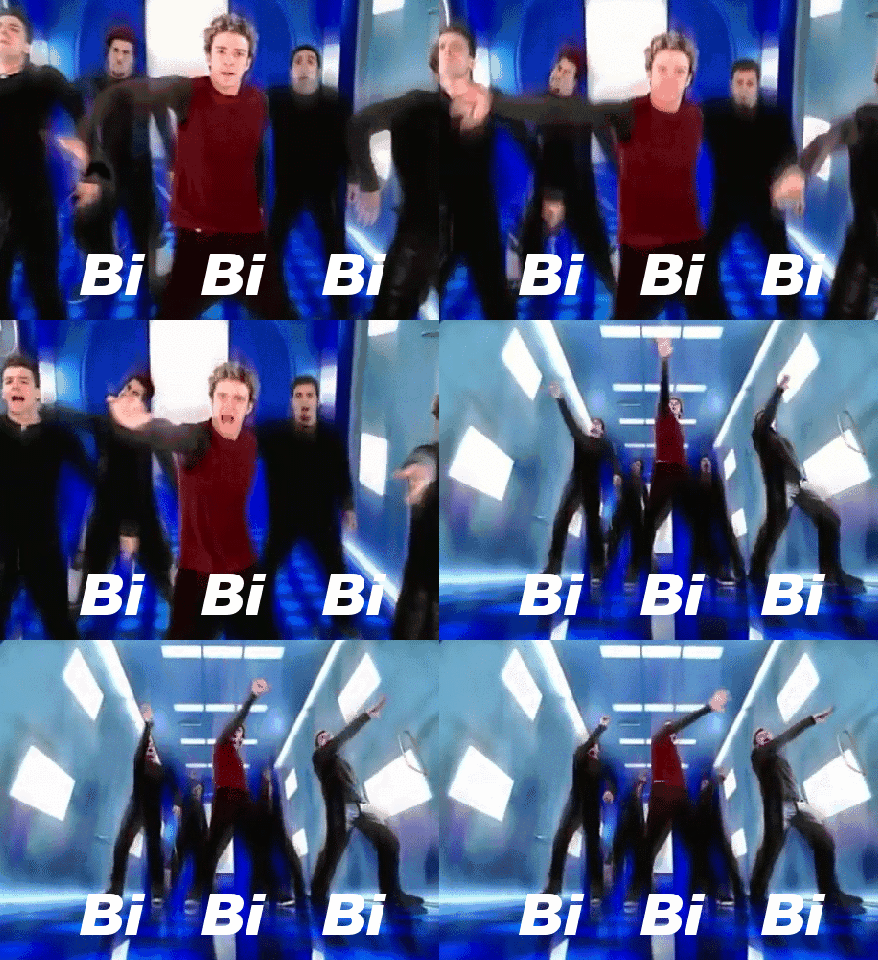
-Hey, how are you today?
-I’m
It would be so much easier.
Well that’s going to be in my head for the rest of the day.
You made me laugh, and I really wanted to come up with a funny gif-reply for you, so I thought I would google “bisexual gif” and find inspiration.
But porn. I found porn.
do you not find porn inspirational, I don’t understand
This gif is amazing!
I never really had a big coming out moment, to my parents or anyone else. I think part of it’s because I didn’t realize I was queer until most of my friends were LGBTQ+, so I had that support system which I am so grateful for. I was actually nervous about coming out to my queer friends, though, because I was afraid that they’d think I was pretending as previously everyone had operated under the assumption that I was straight. But they were great and that made me feel better. I was really nervous about telling my parents, not because they would be unsupportive (I am fortunate in that aspect also) but because I didn’t think they’d “get it”. It’s still a subject that is difficult to talk about in my household but I’m working on it. I ended up not really coming out to them, and just telling my mom “hey so I asked a girl to the end of year dance and she said yes and I have a crush on her” and the information sort of worked its way around to the rest of the family. I do wish I’d been better about that, because it might be easier to have conversations with my parents about my queerness now if I’d built the foundation with my coming out. But they’ve stopped making allusions to hypothetical boyfriends so that’s a start.
[Also apparently my autocorrect thinks the word queerness is synonymous with quietness . . . I feel like this has deep social connotations.]
I am not out to my parents or most of my family, but I came out last year to my sister and she a bit in denial. While she’s familiar with genderqueer/agender she doesn’t believe that her sibling(me) is one. This was on national coming out day. We haven’t really talked about it since. Also, that year I came out to my oldest and closest friend while driving home after a party. I asked him about dysphoria since he is a getting is doctorate in psychology, but he wasn’t too familiar with the topic. I want to say he is trying his best, but he really isn’t as few months ago when we were out drinking he asked me if he can be on some exception list for using my pronouns, but I said no, because I am genderqueer trans*.
Actually, the first time I came out was to this my female bff at the time. We had a lot in common and told her I liked her in that way, but she didn’t feel the same(sort of, called me her soul mate). We were on the country side in Scotland, walking to a wildlife preserve. Saw a broken adult toy on the road, & admitted I own a few myself. Then told her I think I am lesbian trans female. She got confused and said, “you want to steal the guy I like away from me, or have some threesome action?” I said, “uh, no I feel like a lesbian, and I am into women.” She didn’t get it, and it was frustrating. Things happened during the trip and I was just tired of walk on egg shells & her not getting it, and by the end of the trip the 5 year friendship was over. I thought I would be sad about it being over, but I was more relaxed.
Thank you for reading.
That’s horrible to hear about your friend, and that good you were open to them.
I can’t wrap my head around someone who wants to be “exempt” from respecting you as a person. That’s such bullshit.
The first person I came out to (I was 17) was my friend Matt. I told him over MSN Messenger. He then told me he was also bi, so that was encouraging!
I told most of my high school friends over Messenger. To varying effects, honestly. When I went to college, I just made my queerness obvious from the start and that was that.
These days, I find it much harder to come out to my queer friends as bi than coming out to the general public as being generally queer/having a wife.
I came out to one of my best friends kind of on accident…she saw me disappear, holding hands, with this girl and then when I came back I had a hickey on my neck and she put two and two together. With another one of my friends, I was terrified to tell her I was gay. My heart would start racing every time I got close to telling her. When I finally got the words out, it ended up being fine. Every time I come out to another person, I feel so relieved and lighthearted and giddy once the words are finally out of my mouth. Now that all my close friends know, it makes it so much easier when I’m around new people, because my friends are great at doing the hard work for me by casually dropping hints in conversation.
I came out to my friends (and everyone) a while ago. All good reactions, but one of my closest friends for the last like 10 years was initially fine with it, but I noticed in the past 4 months she’s really distanced herself from me. It’s really a shame, but I think that’s why I told her last because I was afraid of a bad reaction/she used to be kind of homophobic in high school (my only friend who was).
But on the bright side, my very best friend from college has from day 1 to now been so supportive and never weird about it, just acting like it’s no big deal- because it’s not! It’s just one part of me that is who I want to date and who I will marry someday, so really not affecting 99.9% of people at all.
Also somehow all of my friends are straight. How does this happen??
Because, unfortunately, straight people are the vast majority and it can be hard to find other queer people. I’m the only out gay person at my job, in my extended family, etc… In order to find gay friends you sometimes have to purposefully seek out queer spaces – or accumulate enough ex-girlfriends to be friends with ;)
It is always lovely reading other people’s experiences.
For me, I find I never stop coming out. Wether it is because I have to re-explain to someone who already knows I’m bi HOW being attracted to more than one sex works, or because someone outs me as “fake lesbian” to other people, and I have to explain how bisexuality isn’t “fake”, or because someone wants to challenge my claims that I like women by pointing to the experiences I’ve had (and still have) with men.
The first time I heard this sentence : “coming out, as a queer woman, is something you have to do everyday for the rest of your life”, I was at a LGBT conference in High School. At the end of the conference, I felt very excited and nervous. Finally, I felt like I could maybe TALK to someone! So I discretely went up to the woman who delivered the speech and somehow tried to tell her who I secretly was (I’d never told anybody before!) and when she heard me refer to “LGBT folks” as “us”, she blinked in disbelief, and asked me : “I’m sorry, what do you mean, us?”
She said it loud enough to make me feel embarassed. I blushed, politely ended the conversation, and walked away. It would be the first time I would have this feeling that I couldn’t belong in the LGBT scene, because I wasn’t queer-looking or queer-acting enough.
Bisexual feminine queer girl. This is who I am. I’ll come out everyday, for the rest of my life, cuz I have to.
Ugh that woman. That is a horrible reaction, I’m sorry it happened to you.
This is super timely for me. I’m out to most of my friends, but, with a few exceptions, I did it sort of backwards. Newer friends know but friends that I’ve known for years don’t. I’ve told a few of my best friends and I’ve been trying to get up the nerve to tell one of my other best friends. We’re in our mid/late twenties and have been good friends since I was 12, so I’m worried she’s going to be really upset that I didn’t tell her earlier. She’s definitely going to be upset that other people knew before she did. I’m crazy nervous because while she won’t have any problem with me being gay, I’m worried it’s going to be all about how it affects her and how I’ve wronged her. UGH.
Its so easy to just drop it into the conversation with new friends. Some of the first people I told were my coworkers, best friends were some of the last. Good luck :)
I’ve had a similar pattern–it’s so much easier to come out to people who haven’t known you long as anything else!
Guys, this is so relevant right now.
Just yesterday, I was thinking about how, at 25, my life is passing me by. There are so many normal coming-of-age social things that I have never experienced, ever. I’ve been to a dance or gotten drunk at a party or been on a date. I’ve been single (and closeted) my whole life. Part of this (being forever-alone) is due to my lifelong struggle with anxiety, part of it is due to being an introvert. But largely, it’s because (a) men didn’t interest me in the slightest, so there was no reason to date them, and (b) women were simply NOT an option in my childhood social environment, and I internalized that shame into my adult life.
But honestly, I’m reaching a point where I’m tired of being alone. And I don’t want to be burdened with secrecy either.
But sometimes I wonder if it’s too late. I hate feeling so behind on life. I hate feeling so naïve. I think I had to overcome a lot of other interpersonal demons (related to anxiety coping mechanisms, OCD, self-worth, etc.) before my brain could even begin to examine and accept myself as queer.
I mean, my life isn’t bad. I have a job, a college education, a cute apartment, and a loving family. I’m actually really close to them, and if I had the reassurance of knowing that they’d accept this part of me, it would make my heart soar. It’s not too late to be “just getting started”… right?
No, its definitely not too late. Many many queer women have had to take the time to work through shit and accept themselves. Even coming out to ourselves can be hard as fuck yo. So if you’re feeling ready to start coming out to others, then its the right time for you.
Thank you. And yes, coming out even to yourself can be hard as fuck. It’s a journey I guess. I don’t know if I’ll ever be ready. I think it’s just about reaching a point of being brave enough to just do it and bite the bullet already.
You can do it! I felt the same way, like my life didn’t truly begin until I was able to come out. It was hard, especially with my family, but being out is an incredible feeling and I’m glad I didn’t wait a second longer.
Thank you for the kind words.
It’s definitely a journey…
Your story is similar to mine; I was 26 when I first seriously had the thought that I could be anything other than straight (I then had a series of panic attacks about the possibility of being a lesbian, which wasn’t so good.)
My family and community growing up were not a great space for asking questions about sexuality/gender, and by college I had normalized this non-specific sense of guilt and shame as just part of life. Throw some undiagnosed learning disabilities and accompanying anxiety into the mix and….well let’s say it was not great.
Two years later, I look back just want to hug my past self and say “You are worthy and deserving of affection and friendship and support and acceptance. Don’t let anyone tell you otherwise.” I mean I still have to tell myself this on a regular basis, but I’m starting to believe it now.
Coming out to yourself is fucking hard and scary enough, so coming out to other people is very daunting. It will definitely take people some time (for me, family has been slower than friends), and some days are still super hard, but I would never go back.
–> We are ALL are worthy and deserving of affection and friendship and support and acceptance for who you are. Seriously. For real. :) *hugs*
Thank you so much for sharing. That’s very encouraging to hear. YES – we are worthy of affection and friendship and support and acceptance. *hugs*
Definitely not too late! (IMO, it’s never too late). You have a full half of your twenties left, which I’m terribly jealous of.
I started the coming-out process in a panic at 29 because I realized I absolutely hated the life I was living and couldn’t imagine living any longer in the closet.
You’ve got this! We’re all behind you!
Thank you – it’s so nice to hear from someone else who got a “late start” too. Thanks for all the kindness, everyone.
Patricia – me too. At age 24, I can’t even quite find the courage to come out to my (lesbian) therapist.
I spend a lot of time on that weird fence of, “well, would just deciding to be permanently single really suck that bad?” And the truth is, yes! It would!
But, for the first time in ages I like my life. I’m comfortable, I’m confident, I take care of myself, and the thought of upsetting that delicate balance is just so so so terrifying.
And yet, sometimes it feels like theres no one in the whole world who really knows me. And I want to be known. I want to be known.
oh yeah, I totally know what you mean about not wanting to disrupt that balance when things are finally stable in life. Change is scary, and the unknown is scary, especially when you’re afraid of disrupting something you hold dearly (like your relationships with close family/friends).
You remind me of someone I know. Please don’t settle for what you believe now is comfortable. You’ll love and be loved, know and be known if you stick to the truth in you. You already know that :)
Thank you for the kindness. <3
I’m a couple of years older than you and only started coming out within the year. My family isn’t 100% on board (probably not even 50% on board), but I feel 1000% better, and I have an inkling you will to (when you’re ready!). The time to get started is whenever you want it to be, and it will never be too late.
Thank you – I’m glad to hear it was so worth it for you and that it’s never “too late.”
I don’t think it’s too late … if that’s what you want in life. I was never out to more than a handful of people (very close friends) or my family until I was 25.
I’ve had similar thoughts, on occasion, about missing out on great “life experiences” due to being in the closet (namely, relationships with people who I was actually attracted to). But I’ve also had some awesome experiences that I wouldn’t have had if I had chosen a different path in life (like going to a more liberal college in a city or something like that). It is what it is, and I try not to regret anything.
It’s still something I struggle with, because there’s times when it just seems completely incompatible with everything else in my life. Not because people in my life are homophobic — hell, I live in supposedly the most gay-friendly city in America — but because who I am does. not. fit. in. with. the. queer. community. It doesn’t matter how accepting people say they are, if there’s not really any common ground (other than identifying as LGBT/queer), there’s going to be a gap. I may never have a serious romantic relationship, but I’m sort of starting to be okay with that. I live a fucking epic life of traveling around the world and doing cool stuff, and I don’t think giving that up for the sake of sleeping next to someone is worth it.
I find this really relatable in a lot of ways. As an introvert, I don’t necessarily have the same social needs as most people might. I can actually relate a lot to you, I think – I live in the Pacific NW, and I find a lot of joy in my life in having outdoor adventures. I’m content spending a weekend alone hiking, and I don’t need the same sort of social interaction that some other people do (like my outgoing younger brother, for instance). And I like my independence, so I don’t feel the NEED to be in a relationship right now.
But at the same time, I don’t really want this secrecy. I want to be able to go on a date or talk about my crushes. I don’t really see myself ever getting married, at least not at this point – too much commitment. I like my independence. But at the same time, I want to be able to date or be in a relationship, if the opportunity arises. I want that option to be open at least. I find that a lot of being in the closet for me is fear-based. And as someone who struggles a lot with anxiety disorders, it’s my constant goal to overcome fear barriers where I see them.
I really like your attitude. Keep on with the epic adventures!
I came out to myself and the world at 24. It was HARD and it was AMAZING. Life really begins when you come out! It’s like switching the world from monochrome to full colour. You can do it. Hugs.
That’s so encouraging to hear. Thank you.
Yes. This. Suddenly the world becomes FULL of possibilities. I went from being a heterosexual who thought she was really picky and would never find a man she was attracted too, to a flaming gay who finally looks at women for the first time and thinks “she’s hot! and so is she! and her too! wowww all the women are so hot”
Thank you to EVERYONE who replied to my comment/story. Thanks for all the words of hope and encouragement. This community of people is so loving and accepting and kind. I love you guys, even if I only know you over the internet. Seriously.
You’re not too old at all! Never too old. I just came out at 34 and that’s ancient.
: ) When I turned 34 I realized the years could just keep passing me by and life, too unless I did something to change this. I only wish I had the wherewithal to trust myself/know myself and were capable to come out at age 25. Don’t let the best sex years of your life pass you by! Life is so much better once you feel comfortable with your sexuality. Being out is still new to me, it’s only been since this past summer I came out to friends and family. It’s been all positive, but definitely a big deal. Take the leap! It’s so worth it! I’m thankful that at least I figured it out by 34, and not 40. And only regret I wasn’t able to come to terms with myself sooner. Time, man, it flies.
This is so refreshing to hear. Yeah, time definitely flies… but at there’s no race to achieve milestones in life, just as long as we keep moving forward, right? I guess no matter what age we are, we will look back to when we were younger and say “I wish…” (And 34 isn’t ancient either :)) So glad it has been a positive decision for you.
Hey Patricia ! I can relate too. I came out less than a year ago to myself, at age 26. It took finding what I thought was the perfect guy for me, and then realizing I did NOT want to get involved with him, to understand there was something about me (before that I told myself I was just “picky” with men. Yeah right).
I got really angry for a while about this heteronormative society which made me think I might be emotionally stunted or destined to live alone forevever before i even LET myself think I was gay.
My life and YOUR life, they’re just starting now. Think about how the world has opened to us now that we’ve accepted who we are !
I know the narrative of ‘born this way’ can be confusing for us ‘late bloomers’, because even if going back to my teens I can identify the crushes i had on girls, I had NO IDEA back then. But trust me, you’re not the odd one out :). There’s tons of us realizing in our twenties, thirties or later, and it’s SO, SO okay.
After getting my “first time with a girl” out of the way (just to confirm: boobs are awesome), I’m now in the process of finding community in my home town. Trust me, women my age and older don’t think it’s weird that I’m basically a “baby gay” !
Oh gosh, I can relate to so much of what you’ve written. Thank you for letting me know I’m not alone. YES the world has opened up… and I’m just now beginning to see this part of my life unfold, and it’s exciting (but still laden with a lot of lingering shame and fear). And your paragraph about being angry at the world for letting you think YOU were the problem or were socially/emotionally stunted… I get that too. It’s so nice to hear that it’s not too late in life and that life has opened up so much for you now.
I think I am the latest bloomer of the late bloomers here! I’m 41 and just came out to a gay male friend yesterday because I didn’t know who else to talk to or how to broach the topic with any female friends (I don’t have any lesbian or bi friends). Looking back in hindsight, I realized my first crush was on a girl in elementary school, then I developed a few crushes on girls in college. I grew up in an ultra conservative christian household, where there was only one way to be, so I didn’t know what to make of these crushes and never mentioned them to anyone. Fast forward to my late 20s – I did a brief stint in an office where my supervisor was a lesbian (on the more butch side of the spectrum). At first I freaked out, but couldn’t understand what my problem was. Turns out I had a big crush on her, but because I had no exposure to anything outside of the straight world, I had no framework on which to build my very strong feelings. That’s when I started researching whether I might be a lesbian. I was smitten for the better part of a year and never told her exactly how I felt, although I’m sure it was obvious to her (and turns out she was in a long term relationship with another woman anyway). I told one gay male friend about it at that time, and he was supportive, but my job took me to another city, and life moved on. Fast forward to my early 40s – over the last 10 years, I’ve only had two serious relationships – both with men (one I was married to briefly), and both ended because I could no longer stand the physical touch of a man. After my divorce, I hit the cosmic pause button to take a break from all relationships, and I felt so wonderfully liberated being on my own again. Then a few months ago, I met a colleague with is androgynous (leaning more towards butch), and now I am smitten again. All those some questions and feelings came flooding back that I had in my late 20s. I have no way to label or define myself at this point and no one to talk to. Most social media sites, YouTube videos, etc., are maintained by women at last 15 years younger than me, so I feel like a fish out of water. But I’m learning to take things slow and not force anything too soon. I’m very encouraged by all you younger ladies coming out. I *wish* I had acknowledged my feelings for women when I was in my 20s and actually done something about it.
Inspiring coming out stories :)! I know my coming out to my friends and family was extremely dramatic and life changing. I’ve have written so many papers about coming out and how it has changed me
My coming out was pretty weird, or at least all my friends tell me it’s pretty weird. See, before I realized I was gay, I was a super out-and-proud queer ally. I was the co-president of my high school’s GSA, I was really into theatre so of course I had a zillion gay friends, and I was well-known for being super obnoxious about telling people off for using “that’s so gay” as a slur. And then one of my best friends came out, and he didn’t tell me. He told a bunch of other people, and I sort of found out by accident. And I know now that it was totally unfair, but I got REALLY mad at him! I was super pissed that there was this HUGE thing happening in is life, and he hadn’t told me, of all people. Also around that time, two of my good friends started dating. One I knew was a lesbian, but the other hid it from me and everyone else for years. And again, I realize now how unfair it was, but I was SO MAD at her for keeping it from me, when she should have realized that I would not have been anything but supportive.
So, when I came out to myself the summer after 2nd year of undergrad, I knew I had to tell the people who were important to me, because I knew how upset it had made me when my friends had felt they couldn’t come out to me. So I made a list. I know, it’s a little weird. But I made a list of about 30 or so people who I had to tell, individually, in person if possible, before I could come out to the world at large. I felt like I owed it to those closest to me to sit them down and have that conversation so they didn’t just find out by accident. And while going through that process of one by one sitting down everyone who mattered in my life to share this huge thing that I had discovered, I finally realized how unfair I had been to my friends in being mad that they hadn’t come out to me. Because I realized that coming out is HARD. Even to someone you love, even to someone you know 100% will support you no matter what. Even to people who are queer themselves. Coming out is HARD. And when I sat down those two friends and came out to them, I told them how mad I had been, and I apologized for not realizing earlier how hard it was to come out.
It took me just over two years to get through that list. I didn’t really do it in any specific order. Sometimes I had it planned out, but more often than not, it exploded spontaneously in a burst of courage. 99% of my friends were completely shocked and completely supportive. I was 20 when I first came out, so by that point I was only friends with people who shared my values. I was confident enough that if anyone had reacted badly, I would have felt no qualms about cutting them out of my life entirely. I also grew up in Toronto, and went to school in the small, liberal university town of Kingston, Ontario, so I was surrounded by a culture that had no problems with queerness.
By the time I’d worked my way down my list, it was two years later, and I’d just started law school. The first day of law school orientation, I came out very casually in a conversation with a girl I’d just met who instantly became the best friend I have ever had. From that point on, I didn’t have to come out, I WAS out. Law school was my time to start over, and no one I’ve met since then has ever known me as anything other than queer. The first week, I very nervously went to a meeting of OUTLaw, the queer group for law students, and through OUTLaw, I met some of my very best friends. I’d finally found my people.
A little over a month after starting law school, it was National Coming Out Day, and I realized I only had one person left on my list – my roommate from the previous 4 years. Yeah – I managed to hide it from her while living with her for two years. That was the hardest one, but I skyped her that night, and I did it. Immediately afterwards, I posted to Facebook “Well, I’ve only got a few minutes left in National Coming Out Day, so here goes nothing…”
I still have to come out to people, and I don’t mind doing it, because i like knowing that they KNOW, you know? Like right now, I’m working in a super lefty labour law firm where literally no one will care if I told them. I’ve tried to drop it casually in conversation, but it’s kind of hard when you’re single. But really, all someone would have to do is spend ten seconds on my Facebook profile to figure it out :P
Thank you so much for sharing this ! It made me think a lot about who I should come out to first. You must be such a good friend to have made this list and chose what I think is a pretty hard path instead of coming out to people you ‘barely know’ first like I’m doing. I still haven’t come out to my family (even if I KNOW they will be 110% supportive) or some of my best, oldest friends, because yeah, somehow that’s the hardest, they’ve known me as straight my whole life…
So thank you for making me reconsider everything. Thank you for making me be a bit more courageous. I guess I’ll have work to do this year when I go home for Christmas :)
I’m glad I could help! What I found was that the more I did it, and got positive responses, the easier it became. The first few were the WORST. But eventually, once I became more comfortable with saying the words, it got less scary. Good luck!
Gosh, this article gave me so many feels. I’m only out to my immediate family and my close friends for the most part, as well as parts of the internet. I sometimes post or like queer stuff on fb, so potentially some people have noticed, but if so, they never mentioned it. I have a couple friends who did look through my fb one time, and figured out I was dating a girl. I just feel trepidacious in telling people, and though ppl should accept me for who I am, I’m not willing to lose people. Also, I feel like my immediate fam doesn’t really acknowledge when I mention my queerness. Like, they’re cool with it, but they do feel uncomfortable about it to an extent. Also, I feel like I don’t like telling ppl what I am in concrete terms because sometimes it can be fluid.
I definitely think that coming out is our common ground in a way. Its a thing we all will probably have to do and it wont be once but many times.
I like to do that thing where I just say I have a girlfriend and take it from there. I was lucky in a way that I was sort of obvs gay..like I always dressed more like a tomboy. I went through this time where it looked like I didnt know how to dress myself properly. Dapper is better. Anyway. A lot of people tell me they get this sort of vibe Im gay or whatever and just go with it. I dont remember the first person I came out to sadly. I just remember having a GF in high school and telling people that fact.
Even coming out to my sister and bro in law wasnt eventful. She said “its not like you were ever girly anyway” I was like thanks. But like I said..my vibe. Maybe Im giving off rainbows only other people can see??? Lol.
My parents are a different story as Im sure is the same for a lot of us. It took them some time to really grasp it but I remember commenting the story on here on a different post.
Yeah, aren’t siblings great :p
My sister’s first comment was along the same lines as yours–>”But you’re still going to wear a dress to my wedding, right?”
I was just like “uh huh (are you even thinking about what I have actually said, which is that I am gay, not anything to do with gender presentation aaaaaa…)”
Parents…well let’s say it’s a work in progress
At least your sister didn’t tell you not to hit on her friends or try conversion tactics.
Nope but once in while she’ll tell me they have a co worker who is a lesbian. But im always like uh…im committed. You know…i dont wanna cheat..haha
I guess I’m more explicitly coming out to my classmates/friends on Saturday, in that I am bringing my girlfriend (!!!) as my date to a student-organized dinner.
She is wonderful and approachable and genuinely friendly, so I’m not really worried about her as much as my own behaviour. I’m pretty newly out (about a year) and I worry a lot. And when I worry I get quiet and serious which is not good for a social event.
I’m nervous…like really big “butterflies” nervous…
Does the Straddleverse have any advice?
I came out to myself when I was 18 which also means I came out with the friends I had who were gay, then to my mum when I was 20. And then my mum told my dad, my grandma, my aunts… and so far it’s been a non event. Every time I casually drop a comment to new people I meet about being a lesbian what I get is a complete non reaction, or if they are curious they ask questions about whether I have a girlfriend or if it was hard coming out, etc. I’m so lucky to live in this environment, and I realize just how much when I see people around me who are my age or older still in deep denial and clearly struggling.
Coming out is different for everyone but for me it was such a liberation and it brought so many great things into my life. I believe that each person has the right to choose who to tell and at their own pace, if a big revelation isn’t for you then it isn’t, if you do want to make a post of Facebook, do it. There’s no right or wrong way to go about it. Just follow the decision that makes you feel powerful and happy. The closet isn’t a nice place to be in.
Gosh this article warranted a trip down memory lane. I was motivated to “come out” in the queerest most Canadian way I know. I had just downloaded So Jealous and Rufus Wainwright’s Want 1 & 2. I listened to those albums about love and queerness and heartbreak and realized I wanted that, and couldn’t have that if I just stayed in the closet forever as I had previously planned. This lead to an all night texting session with one of my closest friends and a “come to the soundproof practice room in the band room I need to tell you something important” conversation the next day. The actual process of “coming out” took years and still happens with new friends (hooray for femme invisibility) but it’s much less scary now and I can’t imagine closeted life.
In conclusion, thank you Canadian Queer Recording Artists.
so I’m in this weird in between phase between coming out to myself and coming out to everybody else. Basically, I’ve only come out to a few friends yet. I’m trying out this thing where I’ll casually tell people if they ask me if I have a boyfriend yet or something, but that’s it for now.
However, I wanna meet queer people in my city, date and everything, so I’m networking, flirting and everything, and when the two worlds (those who know vs. those who don’t) overlap it leads to the most ridiculous situations.
Like, today, I wanted to follow a lesbian/queer/feminist group in my city on facebook to know about upcoming events, so I had to figure out how to hide from my friendlist that I liked the page. And the thought was just ridiculous. I thought to myself “you’re in the process of coming out and you’re jumping through HOOPS instead of letting your facebook timeline do the coming out for you”???
Someone I used to be close to and I had this conversation about coming out to our friends, and the very different reception we got.
According to her, she had a hard time admitting her sexuality, but was pretty quick to find community.
I on the other hand have a giant I AM QUEER sign flashing on my head and yet nobody believes me.
I came out to my group of friends from high school on a tubing trip down a slow, lazy river. There was one other gay dude in the group and people were teasing him about being a top or bottom and I had had enough beer to chime in with a joke about how stereotypical that questions is for us queers. Everyone was really accepting and nonchalant about it, but the message must not have gotten passed through the whole group because when I saw those same friends a year later, one of them tried to set me up with a male friend of his. But at least most of them got the message. We haven’t talked about it since.
I’m out to most of my friends. Not all, though, and I kind of find myself stuck. Because I’m not out to one set of friends because we’re all part of a pretty insular community where I’m also currently employed and hoping to get another job in it, and it’s not a community that I feel good about being out in (because it’s shitty enough dealing with sexism without throwing homophobia and transphobia in the mix, thanks). I’m not worried about most of my friends reacting negatively* (because due so some indiscretions with facebook postings that I thought were more private than they actually were, a number of them have dropped hints that they know things and they’re supportive and it’s great), but I’m very concerned about how being out would impact getting a job.
I’m pretty sure my current boss would be a little weirded out but hey, I’m good at my job and we’re kind of short staffed already, so I don’t think anything would happen.
*There’s a few friends that I honestly don’t know how they’re going to react, and one in particular concerns me to the point where coming out will not happen in person for safety reasons.
I came to the safe realization at 18 that I might be bisexual (i was still in denial) so, I guess because it was art school, it was like no big deal to my friends at the time. Then again, everyone was too busy sleeping with each other to care about labels. Oh, youth.
Having said that though, my best friend at the time did not take it well. It still hurts to think about. It’s like this sweet, caring guy became a homophobic douchebag over night. He even went out of his way to show me a logo he designed “one man, one woman”, making stupid jokes, all the typical bullshit and then became violent. When that happened, I ended the friendship. It’s been 12 years. This is one of the reasons why I’m still scared to come out to my mother. You just never know how someone will react. :(
I told my family and then did a funny Facebook post. It is here: http://brandymars.blogspot.ca/2014/09/givemeeeeaggivemeaaanagivemeeaaaaaay.html
I realized I was bi when I was 13 (I’m 19 now) and it felt like I finally really knew myself.
Haven’t come out to all my friends, but those who know are thankfully completely okay with it.
I told my older brother a few months ago, he’s like a best friend to me. We’re muslim and our parents are very strict and homophobic and wouldn’t hesitate to throw me out if I ever told them, so I was scared of what my brother would say, but I couldn’t hide it any longer. So I went to my brother’s room and I asked him a few stuff, “do you see yourself as a “modern” kind of muslim? What would you do if one of your best friends turned out to be gay? Remember when you liked a picture of two girls kissing each other on instagram?” After that I told him, and I couldn’t stop crying and shaking, and he told me he’d love me no matter what, I’m still his little sister, and it’s okay. And then he hugged me.
In the space of two months, I have gone from in the closet (though one cousin and my younger sister did know) to: Coming out to my husband and asking for a divorce, Coming out to most of my family except my mother and older sister. Several of my female cousins not only now know, but one is even trying to hook me up with her best friend. I have no idea why I was in denial for so damn long if this is the reaction I was going to get. Now grant it my mom has giving me shit about ending my marriage, and my older sister is a holier-than-though Catholic, but other than that for the most part my family (even my soon to be ex husband) has been supportive. I think the hardest part for me now really is I live so far away from the majority of my family and since I have been in the same relationship since I was 20, I really don’t have dating experience to draw from, straight or lesbian, so its a bit intimidating and I’m not really into country-music at all and the only lesbian bar really of note in Phoenix is a country-western place…total not my scene when I’d rather listen to metal or something, anything but country.