





 Another week of the Proposition 8 gay marriage trial is over, and you know what that means! Yes, that you got four more glorious recaps of the action. BUT ALSO Jessica, your favorite lawyer ever, is back to explain everything to us laypeople!
Last time, Jessica told us about the equal protection clause. Specifically, she explained how our side is trying to prove that Prop 8 violates that clause because it discriminates based on sexual orientation.
This time around, she’ll explore Team Totally Right’s other arguments — there are several! So here we go, these are all the possible ways we could win this thing, it’s like a choose your own adventure book but a judge gets to do the choosing:
If you support marriage equality, it’s obvious to you that discrimination on the basis of sexual orientation violates the equal protection clause of the U.S. Constitution. And even if you don’t understand the legal rationale, that discrimination seems inherently wrong.
Conveniently, there’s a good argument from a legal standpoint, too. So with a strong legal argument and a convincing message, can’t we just focus all of our attention on equal protection?
No.
I. We Got 99 Reasons but They Just Need One
Effective advocacy can’t stop with one convincing argument. Our side wants to ensure they’re providing the judge with multiple paths to rule in our favor.
For example, take the arguments regarding discrimination based on sexual orientation. Obviously, our attorneys argue, discrimination based on sexual orientation warrants some form of heightened scrutiny — either intermediate or strict. Proposition 8 is neither “narrowly tailored to serve a compelling government interest” nor “substantially related to an important governmental interest,” which means that regardless of which level of review the court selects, we win! But, if through incomprehensible twists and turns of logic the court doesn’t decide that classification based on sexual orientation warrants heightened scrutiny — well, we still win. The government has no legitimate reason for denying marriage equality. So using the rational basis test, Proposition 8 must be overturned.
But what if the court doesn’t agree with us there, either? Then we need alternative arguments. So, in addition to arguing that Proposition 8 violates the Equal Protection Clause because it discriminates based on sexual orientation, we’re also arguing that this is blatant gender discrimination in violation of the Equal Protection Clause. And in case that’s insufficient to persuade the court to strike down this ridiculous law, Proposition 8 is also unconstitutional because it violates the fundamental right to marry as established by the Due Process Clause.
For Proposition 8 to be declared unconstitutional, we only need the court to agree with us on one of these points. The rationale matters because it will help to define how much this affects future issues pertaining to marriage equality. But for this case, any will suffice. Unconstitutional is unconstitutional; you don’t get extra bonus points because the law violates the Constitution in multiple ways.
II. Gender and the Equal Protection Clause
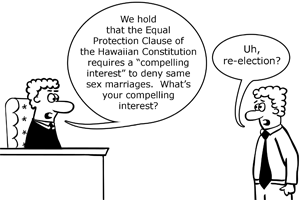
With that in mind, let’s begin with gender discrimination. Fortunately, the law here is well-established, and therefore much easier to follow. We don’t need to evaluate the four factors to determine whether gender is a suspect class. Since Craig v. Boren in 1976, a law that discriminates on the basis of gender has been subject to intermediate scrutiny. Classifications based on gender are unconstitutional unless the government can demonstrate that the classification is substantially related to an important governmental interest.
We can’t simply jump into talking about what intermediate scrutiny would mean for us, though. We first have to establish that the law classifies people based on gender. This may seem obvious. I mean, I cannot marry my girlfriend in California. If either of us were male, we could marry in California. Seems like a pretty clear classification based on gender, no? But it’s not quite that simple, because it depends on how you frame the issue. As H8ers (and Mark Harris from the Log Cabin Republicans documentary) are happy to remind us, even with Prop 8, anyone is allowed to marry someone of the opposite gender. Based on that logic, there is no classification; everyone is treated the same. So which interpretation is correct?
Conveniently, this issue runs parallel to a case the Supreme Court has already considered. Virginia maintained laws making interracial marriage illegal up until 1967. At the time, those supporting the law argued that it was perfectly constitutional because it treated everyone the same. When declaring the law unconstitutional in Loving v. Virginia, the Supreme Court noted that the mere “fact of application [to both the white and African-American members of the couple did] not immunize the statute from the very heavy burden which the Fourteenth Amendment has traditionally required of state statutes drawn according to race.”
By extension, our attorneys argue in their trial memorandum, the fact “that both sexes — gays and lesbians — suffer from Prop. 8’s discriminatory classification does not render it constitutional.” To uphold the law, the government must meet the heavy burden reserved for these types of discriminatory classifications: intermediate scrutiny. This doesn’t mean we win, it just means that the court must examine the law and its purposes more carefully.
III. Due Process & Fundamental Rights
And if none of these equal protection arguments persuade the court? We turn to the Due Process Clause. In addition to offering one more reason for the court to invalidate Prop 8, this clause offers one more opportunity for mental gymnastics (just in case the gender discrimination arguments were too straightforward).
The Due Process Clause of the Fourteenth Amendment asserts that the government shall not deprive any person of “life, liberty, or property without due process of law.” The Supreme Court has interpreted this to mean that there are certain individual liberties and freedoms that inherently restrict government power. For example, in Lawrence v. Texas, the Supreme Court held that intimate, consensual sexual conduct is part of the liberty protected by substantive due process, thereby invalidating sodomy laws across the country.
In some cases, these liberties are so important as to be deemed “fundamental rights.” When the government interferes with these fundamental rights, the action is subject to strict scrutiny review; to withstand a constitutional challenge, the government must demonstrate that this interference is necessary to achieve a compelling governmental purpose.
But what is a fundamental right? Some things are clearly established as enumerated fundamental rights — the First Amendment guarantees free speech and religious freedom, and these rights are widely recognized as fundamental.
But the Court has also found several fundamental rights outside of the text of the Constitution. For example, Loving v. Virginia provides that there is a fundamental right to marry a person of any race:
“Marriage is one of the “basic civil rights of man,” fundamental to our very existence and survival…. To deny this fundamental freedom on so unsupportable a basis as the racial classifications embodied in these statutes, classifications so directly subversive of the principle of equality at the heart of the Fourteenth Amendment, is surely to deprive all the State’s citizens of liberty without due process of law.”
When the fundamental rights are found outside of the text of the Constitution, though, legal scholars and Supreme Court Justices debate the nature and scope of these rights. Some believe strongly in the existence of non-enumerated fundamental rights, while others allege that the court is usurping the political process by protecting these rights.
So how do our attorneys persuade the court that Proposition 8 interferes with a fundamental right? They begin with the words of the Supreme Court. Without necessarily recognizing the long-term implications of their assertions, the Court has provided strong guidance. According to Cleveland Board of Education v. LaFleur, the Court held that “freedom of choice in matters of marriage and family life is one of the liberties protected by the Due Process Clause.” In other cases, the Court has noted that “marriage is the most important relationship in life” and that “choices about marriage” are “sheltered by the Fourteenth Amendment against the State’s unwarranted usurpation, disregard, or disrespect.” This sounds like the language of fundamental rights to me.
But again, this is just one step in the process. Establishing the violation of a fundamental right does not inherently mean we win — it just establishes the appropriate standard of review (strict scrutiny), and the court will determine whether the infringing action is permissible.
So How Do We Win?
Clearly, this is the question everyone cares about. As much fun as tracing the legal analysis may be, the part that matters to everyone on both sides is how it’s going to end. So how does this end?
It depends.
As I’ve mentioned previously, the issue in reviewing these claims is not whether the government is discriminating against a protected class or violating a fundamental right, but whether they have a good enough reason to do so. So each time our attorneys argue for intermediate scrutiny or strict scrutiny, they’re really just asking the court to look more closely at the government’s reasons for their actions.
For different levels of review, the lawyers have to prove different things about the government’s reasoning regarding Prop 8:
+ With strict scrutiny, Prop 8 lawyers have to demonstrate that the law is narrowly tailored to further a compelling governmental purpose.
+ With intermediate scrutiny, Prop 8 lawyers have to demonstrate that the law is substantially related to an important governmental purpose.
+ With just rational basis, Team Totally Right has to demonstrate that the law is not rationally related to any legitimate governmental purpose.
+ Much like the concept of substantive due process, though, compelling/important/legitimate governmental purposes or interests are not clearly written down in a single place. Instead, this is one more place for attorneys to present their arguments.
What are the governmental interests at stake?
In their trial memorandum, the defense provides a lengthy list of “legitimate” reasons, and promise that they’ll demonstrate that these are also compelling reasons at trial, if necessary. These legitimate reasons include “promoting the formation of naturally procreative unions,” “increasing the probability the each child will be raised by both of his or her biological parents,” “providing men with a stake in families and societies,” and “using different names for different things.” To my knowledge, there is no Supreme Court case asserting that any of these things count as legitimate state interests, let alone important or compelling state interests.
Our attorneys are a bit more specific; they preemptively tackle five arguments that they expect the defense to suggest — procreation, responsible procreation, tradition, recognition of California marriages by other states, and administrative convenience. Using actual legal analysis and citing actual case precedent, they reassure us that none of these can be considered legitimate reasons, let alone important or compelling interests.
 They illustrate by analogy: clearly procreation cannot be the state goal, because we do not (nor should we) deny the rights of marriage to people who are incapable of having children. At trial, they offer expert witnesses like psychologies Dr. Michael Lamb to make it abundantly clear that gay marriage doesn’t harm kids, and actually benefits them, to demonstrate that same-sex couples are fully capable of responsible procreation.
As for tradition, they reassure us that the Supreme Court has already ruled on this matter in Williams v. Illinois: “[N]either the antiquity of a practice nor the fact of steadfast legislative and judicial adherence to it through the centuries insulates it from constitutional attack.” And again from Lawrence v. Texas, the Court has recognized that “times can blind us to certain truths and later generations can see that laws once thought necessary and proper in fact serve only to oppress.” They presented testimony from Dr. Nancy Cott, who explained that marriage has not been a static institution as a legal matter; the laws have evolved with time to reflect our changing values, needs and understanding.
The defenders of Prop 8 have alleged that California has a legitimate interest in ensuring its marriages are recognized outside the state. Take a moment and think about it. They allege that the State might have been concerned about same-sex marriages receiving too little legal recognition outside of the state — so it banned them entirely. Thanks, California? (Tragically, the defense doesn’t really elaborate on this point, so I’m afraid I can’t comment much on their argument. It just seems bizarre and untenable.)
Administrative convenience? Seriously, defendants? Administrative ease is well-established as insufficient grounds for discrimination (see Craig v. Boren). It doesn’t matter that it would be easier for the state government if they didn’t have to distinguish between same-sex marriages and opposite-sex marriages. Moreover, there’s no connection between administrative convenience and Proposition 8 (in fact, they presented testimony from Dr. Edmund Egan to demonstrate the costs for cities and counties of denying marriage equality).
Obviously, all of these alleged interests are nonsense. So what’s really prompting Proposition 8? I know this is going to come as a shock to you all, but the evidence is pretty clear: the real purpose of this law was to express moral disapproval of gay men and lesbians and their families. (Because if they pretend we’re not here, maybe we’ll just go away?)
My favorite insane witness William Tam promised that if Prop 8 didn’t pass, every child will grow up dreaming about being gay and that the gay agenda is to “legalize sex with children.” As an Official Proponent of Proposition 8, he gets to be the voice of their people — but certainly he is not alone. The h8ers were such great campaigners and left behind such great campaign material that our attorneys are using this to prove the point, as well. The arguments are not rational or well-considered; they’re motivated by hate and fear of the unknown.
But moral disapproval doesn’t mean that you can take away someone else’s rights. In Lawrence v. Texas, the Supreme Court struck down sodomy laws because “moral disapproval” of gay men and lesbians, “like a bare desire to harm the group, is an interest insufficient to satisfy” even rational basis review.
Paths to Victory
How do we win, you ask? Let me count the ways:
+We persuade the court that sexual orientation is a suspect class worthy of intermediate scrutiny, and the defendants are unable to demonstrate that Proposition 8 is substantially related to an important governmental interest.
+ Or we persuade the court that marriage is a fundamental right, and the court finds that there is a compelling governmental interest, but Prop 8 isn’t narrowly tailored to this interest.
+Or we fail to persuade the court that sexual orientation is a suspect class, but the court decides that Prop 8 fails even rational basis review, due to a lack of a legitimate governmental purpose.
But how do we lose? We can also count those ways…
+ We persuade the court that sexual orientation is a suspect class worthy of intermediate scrutiny, but the defendants can demonstrate that Prop 8 is substantially related to an important governmental interest.
+ Or we persuade the court that marriage is a fundamental right, and the court finds a compelling governmental interest and decides the law is narrowly tailored to meet that interest.
+Or we fail to persuade the court that sexual orientation is a suspect class, and the court decides the Prop 8 passes rational basis review.
The thing to remember, though, is that we only need to win once. Prop 8 only has to violate one part of the Constitution for it to be declared unconstitutional. We could lose both equal protection arguments and win because Prop 8 violates the Due Process Clause. We could lose on sexual orientation discrimination and the due process argument, but win because Prop 8 discriminates based on gender.
What happens next?
 The presentation of evidence will wrap up soon, but the case is far from over. Judge Walker has requested time, possibly quite a bit, between wrapping up the presentation of evidence and closing arguments in the case. Ostensibly, this is because he wants time to review the evidence in detail and mull any remaining issues so that he can ask informed questions.
However, I can’t help but assume that he maybe also just wants some time away from these people. (At times, just watching the Prop8TrialTracker live blog and Twitter feeds of the trial were painful. I can only imagine sitting through hours of cross-examination as the Prop 8 attorneys try to persuade scholars who have devoted their lives to this work that gay men and lesbians aren’t really a distinct group of people.)
So at some yet-to-be-determined point in the future, Judge Walker will hear closing arguments, and at some point after that, he’ll render an opinion. And more or less immediately, regardless of the outcome, this process begins again when one side or the other brings the case to the Ninth Circuit Court of Appeals.
Any questions? I will, again, be in the comments.
[cartoons from bobster1985]


Comments
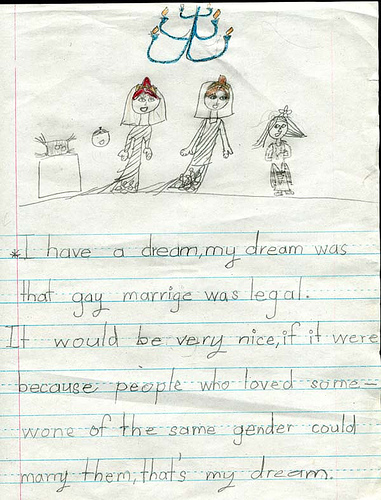
I love that little kid’s I have a dream drawing.
Also, it sounds like we totally have the advantage here. Is that a pipe dream, or do we actually have a really good chance of winning this?
We have a good chance of winning at the Trial Court.
We have a pretty good chance of winning in the Ninth Circuit.
We have a pretty slim chance of winning at the Supreme Court.
Our arguments are strong, our lawyers are brilliant and our expert witnesses could not have been better. But we definitely don’t have the advantage. If this case makes it to the Supreme Court, we need five of the nine Justices to rule in our favor. Based on the current composition of the Court and the inclinations of each Justice, we will have a really hard time getting there (which, incidentally, is why many LGBT organizations advised against pursuing this case at this time in the first place).
Ultimately though, any Supreme Court decision will depend upon the reasoning of the lower courts. So until Judge Walker gives his opinion, anything I say is really just speculation. (It will be speculation after he gives his opinion, too, but then it will be slightly more informed speculation).
Fantastic explanation- a must read for pretty much everyone I know. As I will make abundantly and annoyingly clear to them via every social media mechanism possible (as the majority of my friends are currently an ocean away, in person badgering is reserved for a select few).
This really clears up my confusion over why certain questions were asked etc.
Now, on to the inevitable appeal: what is the appeal based on? I think you (or someone) said before that it has to be on a point of procedure or an issue with evidence used, but knew stuff can’t be introduced? Is this true or am I confusing my Autostraddle education with episodes of lawyer shows?
THANK YOU!
Yeah, new stuff can’t be introduced on appeal. All the arguments will be based on the information presented in this trial. They’ll basically just be arguing points of law.
Yup, as Sarah said, new stuff can’t be introduced after the trial court (Generally, that is. There are always exceptions).
At the appellate level, they’ll just be arguing over the interpretation of the facts, from a legal standpoint. So, they’ll be arguing over whether the trial court should have used strict scrutiny for equal protection (because sexual orientation discrimination is akin to racial discrimination) or rational basis (because sexual orientation isn’t a suspect class), for example.
Not only are you cute and smart, but you make it sound so good! Which makes me optimistic! But that’s probably because despite the fact that I’m a trained conflict mediator and it is my job to listen to and understand multiple perspectives on any issue, I CANNOT FOR THE LIFE OF ME UNDERSTAND HOW ANYONE COULD EVER CLAIM THAT THE H8ERS ARGUMENTS ARE RATIONAL.
And if our judges somehow, ridiculously, decide that the h8ers arguments prevail over ours, then I am *seriously* devoting my life to inventing a new political system that is not democracy, because obviously democracy is fucked up.
RIGHT EXACTLY.
I’m with you 100%. Reading the trial transcripts, I can’t help but laugh at their arguments. Then I remember that they’re 1) serious and 2) still winning from a legislative/public opinion standpoint, and I cry.
Thanks for explaining that; however, I have a question. Will the depositions of the proposition 8 witnesses who have withdrawn from the trial, because they’re afraid of gay retaliation, be used against proposition 8 to bring it down?
Okay okay… I admit it, I haven’t exactly been keeping up with all of the trial recaps. It harshes my mellow. Nevertheless, thanks Jessica for making this understandable! I’m totally optimistic now. *bows down to the brilliance*
thank you for doing this! autostraddle has basically been my only source of info on this …and I like it.
So I have a question about the appeal process… if we win (yay!), would there be any reason that the opposition might not appeal, like to not have it make it to the Supreme Court and set a national precedent? I am assuming that if we lose we could appeal our way to the top (even though they don’t have to hear the case), but if we win and then no appeal, would the ruling have any effect nationally?
Everyone I’ve seen talking about this acts as if appeal is a foregone conclusion, but overall strategy is always/should always be a consideration.
A single opinion in a federal court case doesn’t offer much more than a suggestion to other federal courts. It’s not binding for any other jurisdiction. So, if they really don’t appeal beyond the this court’s opinion, the nationwide effect would be very limited.
There might be some strategic value in that (particularly because the next challenge might come from outside of the Ninth Circuit, and I’m quite certain the defendants would prefer to litigate this issue through the courts in a circuit not known for its liberal persuasions). But I still don’t imagine it will happen.
But…such a decision might also embolden challengers in other states, thereby making them fight this battle in lots and lots of courtrooms, rather than really targeting a single case.
Hmmm…I meant to delete that last paragraph before posting. I fear I was having some trouble organizing my thoughts and the comment had multiple forms before reaching its final version. Ignore that last part, please.
Thanks for all of your legal knowledge! As someone from a southern state, I am on the look out for the national impact of the appeals process…
I’m glad you brought up gender discrimination. I hate continually hearing the argument that various propositions and opponents of same sex marriage are not discriminating because “every person has the right to marry a person of the opposite sex”. I am always getting into arguments touting that if they want to play that game then they are getting into gender discrimination because if a man can marry a woman than a woman should be able to and vice versa. With the ammunition that Loving v Virginia provides, I really don’t see any rational way we can lose (but then again i’ve said that before). Thank you for the clear and concise explanations. We appreciate you! . Cheers!
And I appreciate the fact that you just called me concise, after something like 4500 words. :-)
For legal jargon, 4500 words might as well be a tweet.
[…] the original here: Prop 8 Gay Marriage Trial Explained Part 3: How Do We Win This Thing? AKPC_IDS += "5715,";Popularity: unranked […]
I just wanted to thank you again for doing this! Seriously I feel like I’m ten times smarter this week than I was two weeks ago. So even if we lose, I’m smarter. Which is really important. To nobody ANYHOW THANK YOU
Question, From a legal, constitutional standpoint why isn’t religious persecution also involved?
Not everyone who voted for prop 8 is a hater. They discriminate against us, they are prejudiced against us, and they persecute us; but they do not necessarily hate us.
I have a very close friend who is a devout Catholic. She loves me and my family, and I love her family. She had a gay brother who she gently nursed until his passing of AIDS in the late 1980s. She thinks the civil injustices against us are unfair but will never support gay marriage. She has no clue the hurt she causes. She has no clue that every time I see her, my insides are in a knot and I wonder why I maintain this friendship. She has no clue that in reality, she is saying to me that my family has less value than hers. I have tried to talk about it with her, but her religious convictions run too deep.
I truly believe that I am being persecuted because of religion. Is only protection of religion in the constitution and not the other way around? I am interested in the legal aspect of this. Thanks in advance.
Hmmm….
Your question potentially implicates two different constitutional issues, the First Amendment guarantee of religious freedom and the Equal Protection Clause of the Fourteenth Amendment.
Let’s start with the equal protection issue. The Equal Protection Clause prohibits discrimination based on religion. But the first question is whether a group of people that is being treated differently than others because of their religious beliefs. In this case, gays and lesbians are not facing persecution because of their religious identifications. Those who are unable to marry because of Prop 8 undoubtedly hold a wide range of religious beliefs. Religion doesn’t decide the classification at issue, so there isn’t an equal protection challenge to be made on that ground.
The First Amendment reads in part: “Congress shall make no law respecting the establishment of religion, or prohibiting the free exercise thereof…” Much like the analysis of the equal protection and due process, religious freedom as protected by the First Amendment has a precise meaning.
The free exercise clause has been interpreted to mean that the government generally cannot prohibit someone from the free exercise of their religious practices (though there are exceptions). This doesn’t really affect the definition of state-sanctioned marriage; religious institutions that want to perform marriage ceremonies for same-sex couples are free to do so, the state just won’t validate these marriages.
The establishment clause means that the government cannot establish a religion or become excessively entangled with a religion. Certainly marriage and religion are intertwined (religious officials can sign marriage certificates), but sanctioning a relationship between two people isn’t akin to declaring a national religion. And excessive entanglement generally affects things like public funding for religiously sponsored programs or public displays involving religious symbols or prayer in schools.
So, in the summary version that you were probably hoping for in the first place, the Constitution provides protections for religious freedom, but these protections are somewhat narrowly defined — and this falls outside of those protections.
Jessica,
Just because someone doesn’t have religious beliefs does not mean they are not being persecuted because of religious beliefs.
Religious persecution has two forms: persecution of a person based on their religious beliefs, and persecution of a person based on the religious beliefs of the one doing the persecuting.
In this matter, as in the matter of same-sex marriage, persecution is taking place wherein the parties doing the persecuting do so based on their own personal religious beliefs in marriage.
In that regard, this is in fact religious persecution.
Further, because religious believers went to the polls and voted to persecute same-sex couples using the law, Proposition 8 and other same-sex marriage bans in fact violate the Establishment Clause because voters mistakenly believed they were voting to protect their belief in a religious institution; an act specifically banned by the Constitution when one considers that the government is one “of the people…”
The problem with this argument, Michael, is that the First Amendment guarantees of religious freedom don’t guarantee that no one can be persecuted for their religious beliefs. The First Amendment doesn’t promise that individuals will behave decently or civilly or sanely or respectfully with regard to others’ religious beliefs, but only that “Congress shall make no law respecting an establishment of religion, or prohibiting the free exercise thereof.”
To make a viable constitutional argument based on the Establishment Clause, you have to establish that somehow the government has established a religion or has become excessively entangled with a religion. To my knowledge, those are the only two lines of reasoning the Supreme Court has used when invalidating legislation because it violates the Establishment Clause.
It’s not sufficient to argue that a law was influenced by religious beliefs or that voters made decisions based on their religious beliefs (among other things, courts are hesitant to infer the beliefs of the voters). It doesn’t matter. The question is: has the government established a religion (it hasn’t) or is the government becoming too entangled in religious affairs (providing public funding for religious programs or creating public displays involving religious symbols or public prayer).
Your argument that this violates the establishment clause doesn’t fall under any existing line of Supreme Court cases. The Supreme Court gets to say what the law means. They get to say what it means for Congress to Establish a religion. And thus far, they haven’t indicated that your argument has any merit (which is why Olson/Boise didn’t try to make this argument, as well).
Thanks to Jessica for another installment of brilliance!
i’ve totally become my friends’ main source for real information, and it’s all because of autostraddle and jessica.
i’m just curious, how will DOMA play into all of this?
For right now Prop 8 is the only thing at issue in this case; DOMA is an entirely separate law and it is not directly challenged here. However, presuming this case reaches the Supreme Court, the Court’s holding could have implications for DOMA.
Pretend for a moment that the Supreme Court decides that any law which limits marriage to one man and one woman violates the equal protection clause. Under DOMA, the federal government treats marriage as a relationship between one man and one woman exclusively. Such a broad holding would seem to automatically invalidate DOMA.
Alternatively though, the Supreme Court could rule on a more limited basis. For example, the Court could consider the unique situation in California: first the state made it clear that everyone had particular rights, then the state stripped an unpopular minority group of these rights. If the Court’s holding is more narrow and more focused on the factual background leading up to Prop 8, then it might not have much of an impact on DOMA.
Also worth mentioning: another case out of Massachusetts (Gill v. Office of Personnel Management) is directly challenging the constitutionality of DOMA. MA is in the First Circuit, which is generally much faster than the Ninth Circuit, so despite the fact that Perry is currently further along, there’s a decent chance Gill will reach the Supreme Court first.
Is there an argument based on the intentions and motivations of the proponents of Prop 8? If so, how could that invalidate Prop 8? Is there actually case precedent that some sort of wrong intent can invalidate a proposition? I thought I heard something about this earlier.
http://twitter.com/NCLRights
So what happens if you win? Does that mean same-sex marriages become legal, or that no one can ever specifically ban them, or something else?
It depends.
Presuming the Supreme Court takes the case and rules in our favor, then Proposition 8 is invalidated. California will return to its pre-Prop 8 status, and same-sex couples will be allowed to get married. But the broader implications depend on how the Court reaches this decision.
If five Justices decide that the Constitution provides a fundamental right to marry the person of your choosing regardless of gender, or that it violates the Equal Protection Clause, then any federal or state statute or state constitutional provision that limits marriage to people of opposite genders could be challenged (and should succeed).
If instead, two Justices find that that Prop 8 violates the Equal Protection Clause and three find that it violates the Due Process Clause (or some other combination of reasoning that gets five votes for us), then we have five Justice on our side, but no majority rationale. As a result, it becomes more difficult to challenge related legislation, because only the majority rationale becomes binding precedent. Everything else just becomes part of the argument. Should this happen, we’ll likely see quite a bit of litigation as lower courts try to figure out what exactly is and is not permissible.
That doodle is the most precious and inspiring thing I’ve ever seen.
Am I the only person wishing there was another name for “suspect class”?
Also, another interesting case that might be relevant is Plyer v Doe, where the Court struck down a law denying public education to illegal aliens. The reasoning was rather unique in SCOTUS jurisprudence, it seems. First, education is not a fundamental right, but it was deemed to be so important that they gave it a kind of quasi-fundamental right status. Second, the classification based on legal status (not to be confused with alienage) does not get heightened scrutiny, but the Court deemed this to be a quasi-suspect classification. Combining this quasi-fundamental right status of education and the quasi-suspect class status of illegals, the Court seemed to apply a somewhat heightened level of scrutiny.
The relevance here is that classification based on sexual orientation hasn’t explicitly received heightened scrutiny. And same-sex marriage has never been considered by the Court, so its status as a fundamental right is uncertain. But I wonder what you think of the argument that the combination of the two might create a Plyler-esque situation: if same-sex marriage is at least a quasi-fundamental right, and sexual orientation is at least a quasi-suspect class, then the combination of the two should lead to a heightened level of scrutiny, just as the combination of education and illegal aliens did in Plyer v Doe?