





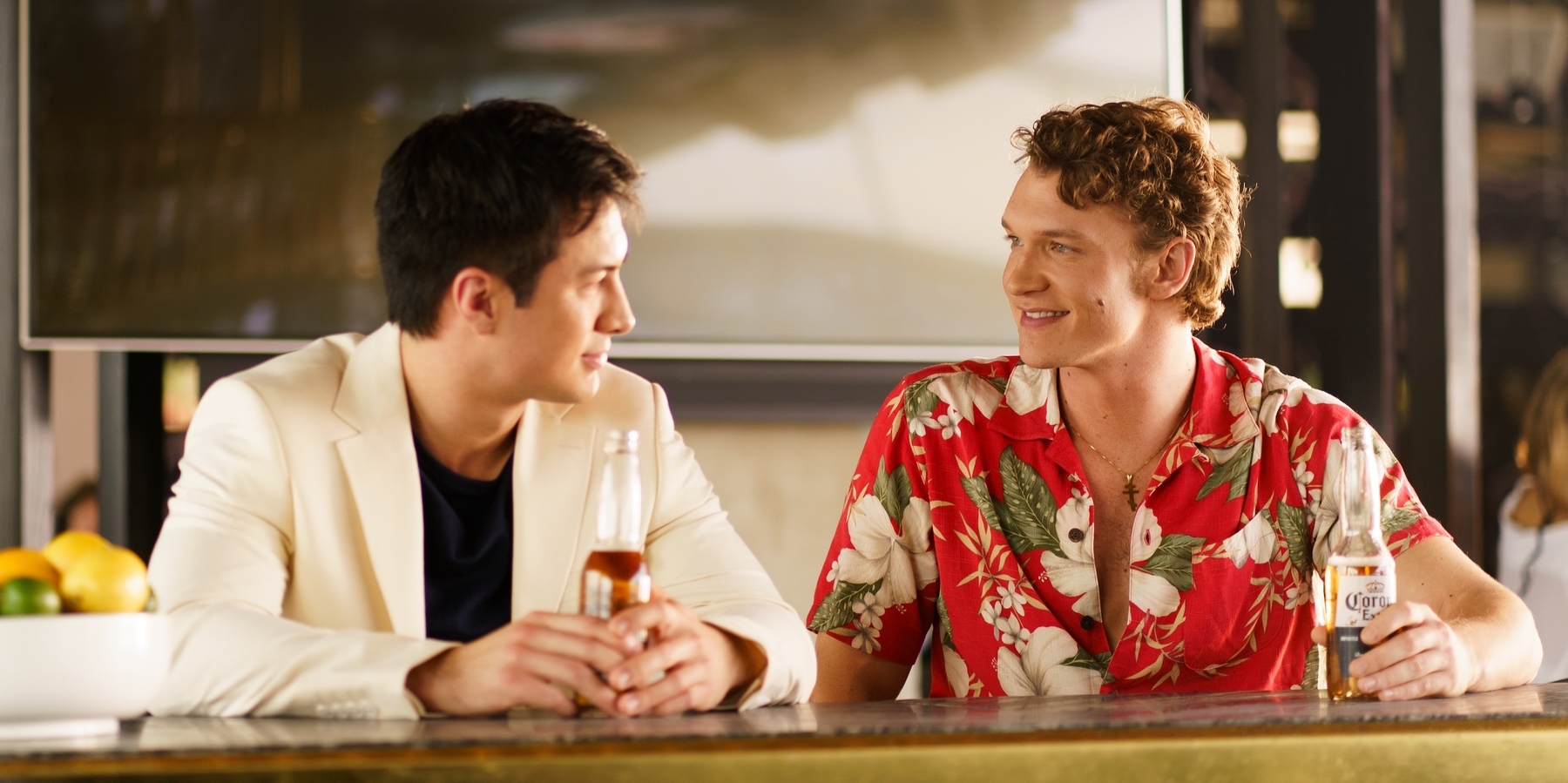
Famously (amongst fans of Heated Rivalry), Heated Rivalry’s fifth episode, “I’ll Believe in Anything,” has become the second most highly rated television episode of all time on IMDB, sandwiched between celebrated episodes of two certifiably prestige programs — Breaking Bad‘s “Ozymandias” and the acclaimed finale of my favorite show of all time, Six Feet Under. It would be difficult to argue that “I’ll Believe in Anything” achieves, artistically, the heights of its compatriots, but it has given us something else, as a community. Something dear and hopeful and hot, something completely unreal but of this world, a story whose adherence to the well-worn tropes of its genre is not boring but comforting, is not corny but delightful. Heated Rivalry has united us. It has transformed us. And it has come into our lives when we needed it most.
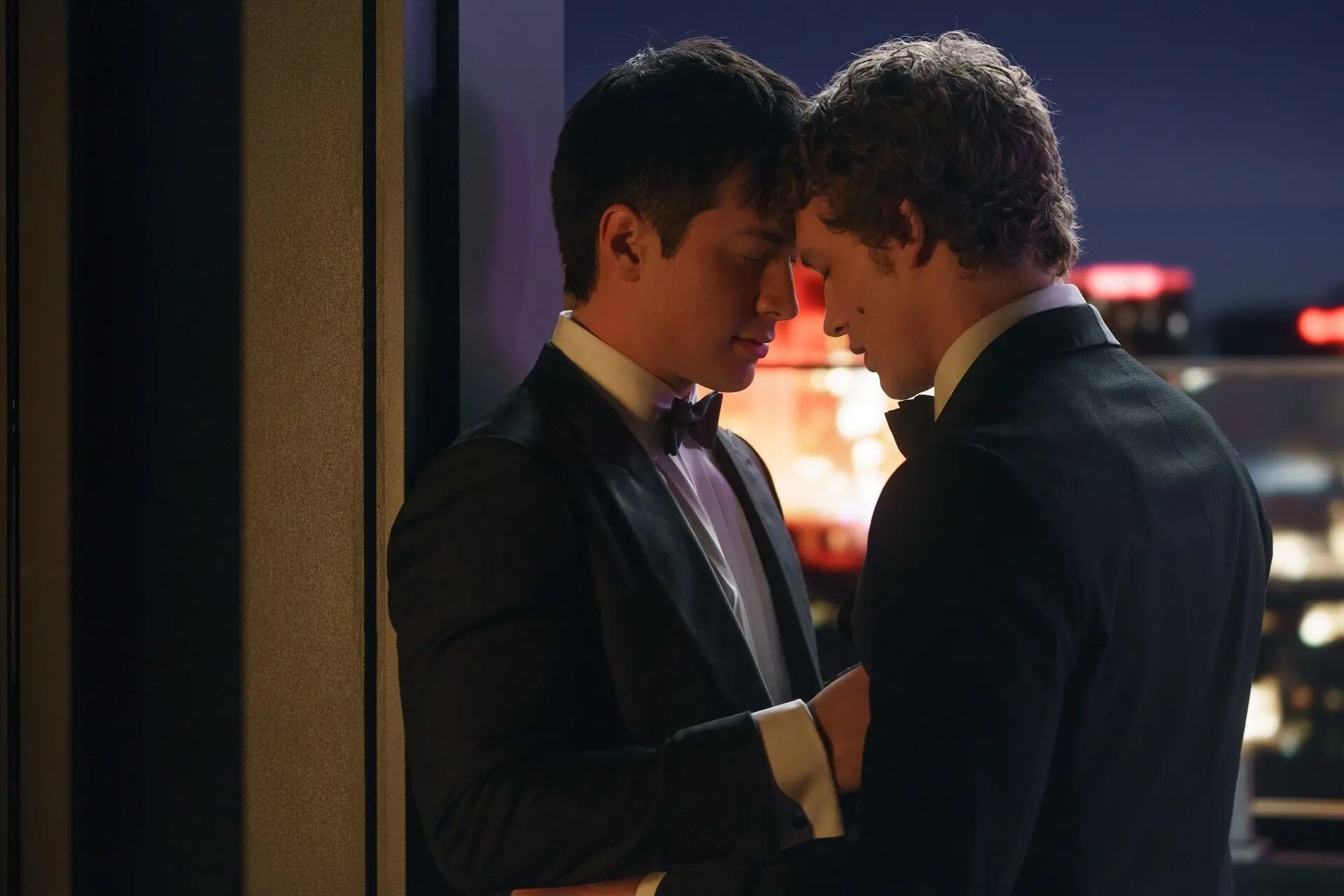
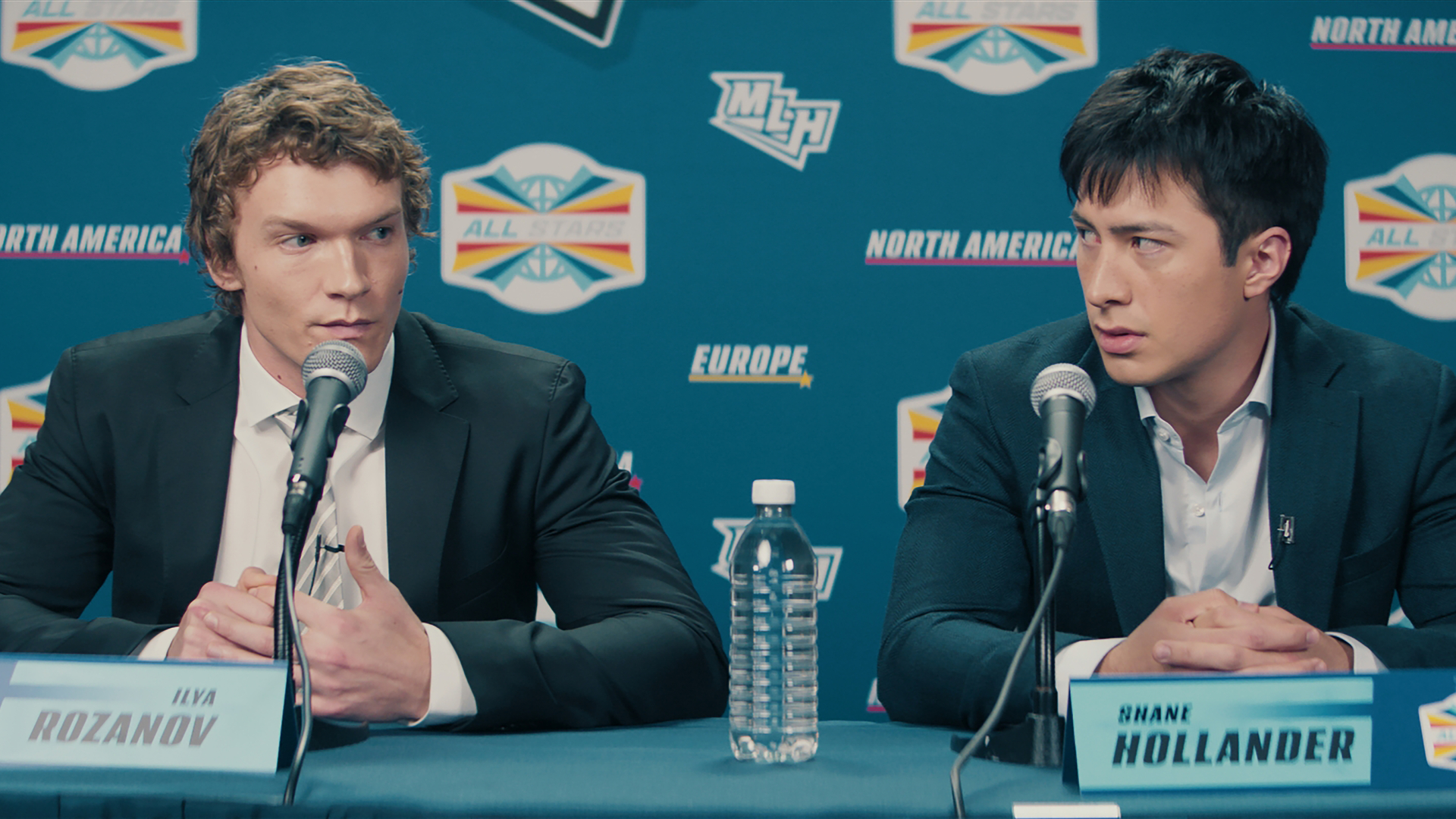
Based on the “spicy gay hockey romance” book by Rachel Reid, the Crave-produced Canadian series picked up by HBO Max follows the long-term situationship between amiable phenom Shane Hollander and his rival, brash Russian antagonist Ilya Rozanov, from 2008 through the nine entire years that follow, during which, schedules allowing, they have elicit gay sex every few quarters or so.
It’s safe to say that nobody involved in creating Heated Rivalry, including its gay showrunner Jacob Tierney, was prepared for it to blow up like this. Its premiere party took place in a Montréal college auditorium as part of a queer film festival, its social media presence was low-fi and press coverage was initially minimal. Then, the show debuted at #2 on HBO Max’s charts over Black Friday weekend, fans scoured the planet for material on its charming unknown leads, Hudson Williams and Connor Storrie, and the press caught up. At first, the buzz was focused on those aforementioned explicit gay sex scenes, scenes notable for their girth and length, scenes in which every threat of a fade is merely a cut to a new angle, a new position. But the story itself was fun too, the characters charming and compelling. The internet lit up with gifs and Heated Rivalry Tok roared into life. Celebrities made their adoration public. A straight male hosted hockey podcast started recapping it. Print copies of the book quickly sold out (a situation Harlequin was somehow completely unprepared for) and the e-book vaulted to the top of Amazon’s charts.
The first book in Reid’s six-installment “Game Changers” series is not, actually, Heated Rivalry. That’s book number two. The first, aptly titled Game Changer, follows league veteran Scott Hunter and his romance with smoothie barista Kip. This storyline is smashed into the fourth episode of the Heated Rivalry television series to set us up for the final sequence of “I’ll Believe in Anything.”
The sequence is so audacious and so unrealistic yet so grounded in the familiar that it transcends the traditional boundaries of space and time.
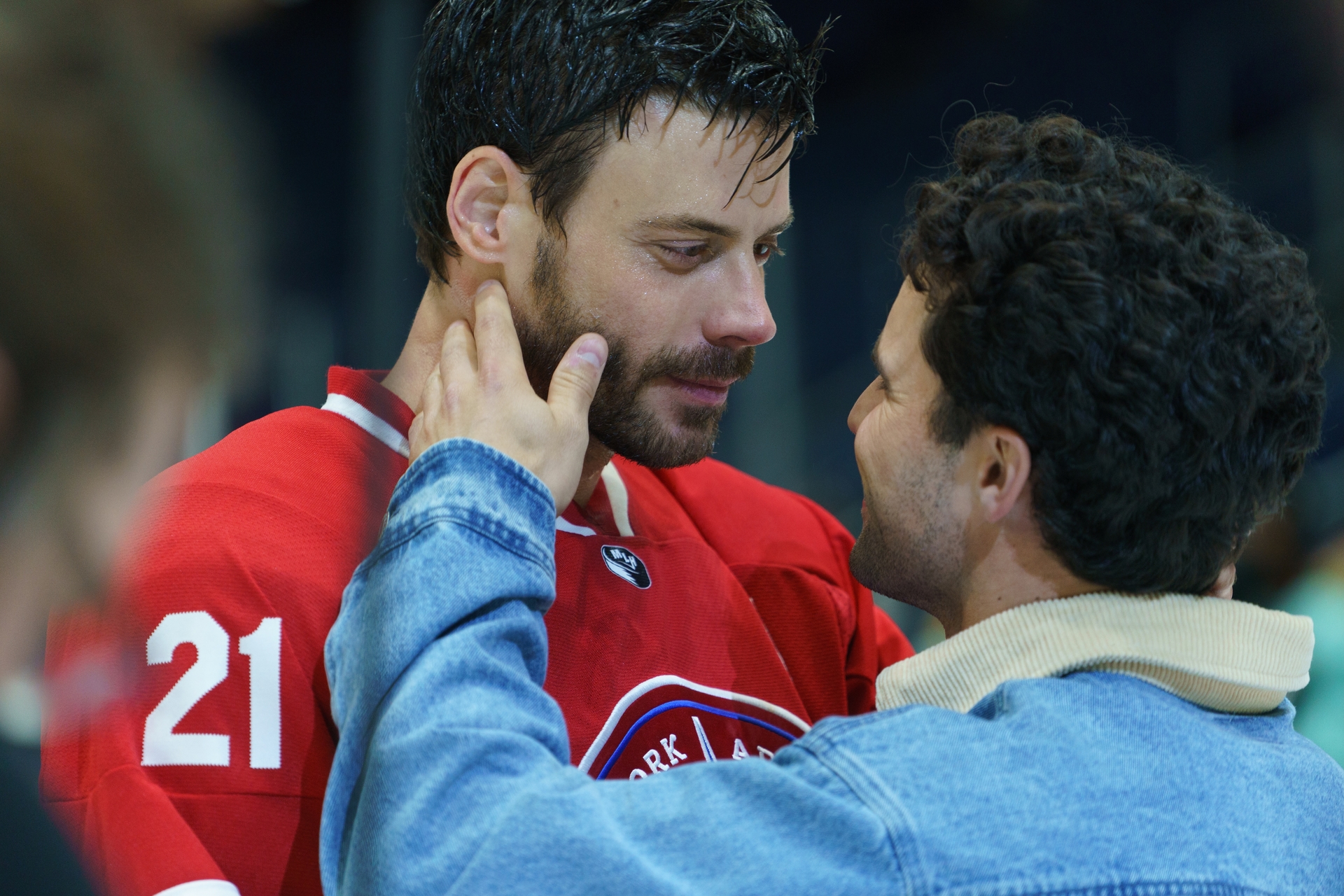
It has been a minute since I’ve rewound a scene to watch it again for a reason besides not having paid attention the first time, but that’s what we did after Scott Hunter’s team wins the coveted Fake Hockey League Stanley Cup, and is inspired by his isolation (his teammates are immediately met on ice by their glowing families but Scott finds himself alone out there with only a tween-sized trophy to keep him warm) to summon his ex-boyfriend, aforementioned smoothie barista and aspiring art student Kip, from the stands. Kip takes a remarkable amount of time to make his way to the ice, where Hunter pulls him close and kisses him, with tongue, in front of the entire world. It vaguely echoes other fictional moments of gay bravery, like Brian Kinney striding into Justin’s prom and dancing him across the dimly lit floor to the dulcet tones of “Save the Last Dance For Me.” But mostly it echoes the kinds of scenes we really only see in M/M romance novels.
This scene is spliced with two others — Shane and Ilya watching the game from their respective homes, the former with his family, the latter with his friends. After years of fucking, “I’ll Believe in Anything” confirms that both Shane and Ilya are in too deep emotionally, building a genuine connection that simply cannot ever become a publicly actualized relationship. Shane recently invited Ilya to spend a week at his cottage, and Ilya said “maybe.”
As the scene unfolds, Shane and Ilya are stone-faced, staring at the screen, as unclear as the fans themselves what is occurring, or about to. After the kiss, everybody is stunned. Shane and Ilya are surrounded by equally shocked viewers, but thinking only of each other. Ilya gets up, leaves the room with his phone, Shane gets up as his buzzes. “What the—” Shane begins.
“I’m coming to the cottage,” Ilya says.
I AM COMING TO THE COTTAGE!
There are dances to this sound, if you are interested, all over TikTok. You are invited to pre-order an “I’m Coming to the Cottage” hat, which will deliver in January 2026. There are videos of watch parties in gay bars where the entire crowd erupts with joy so pure and entire you can feel it through the screen. We needed this. We really, really needed this.
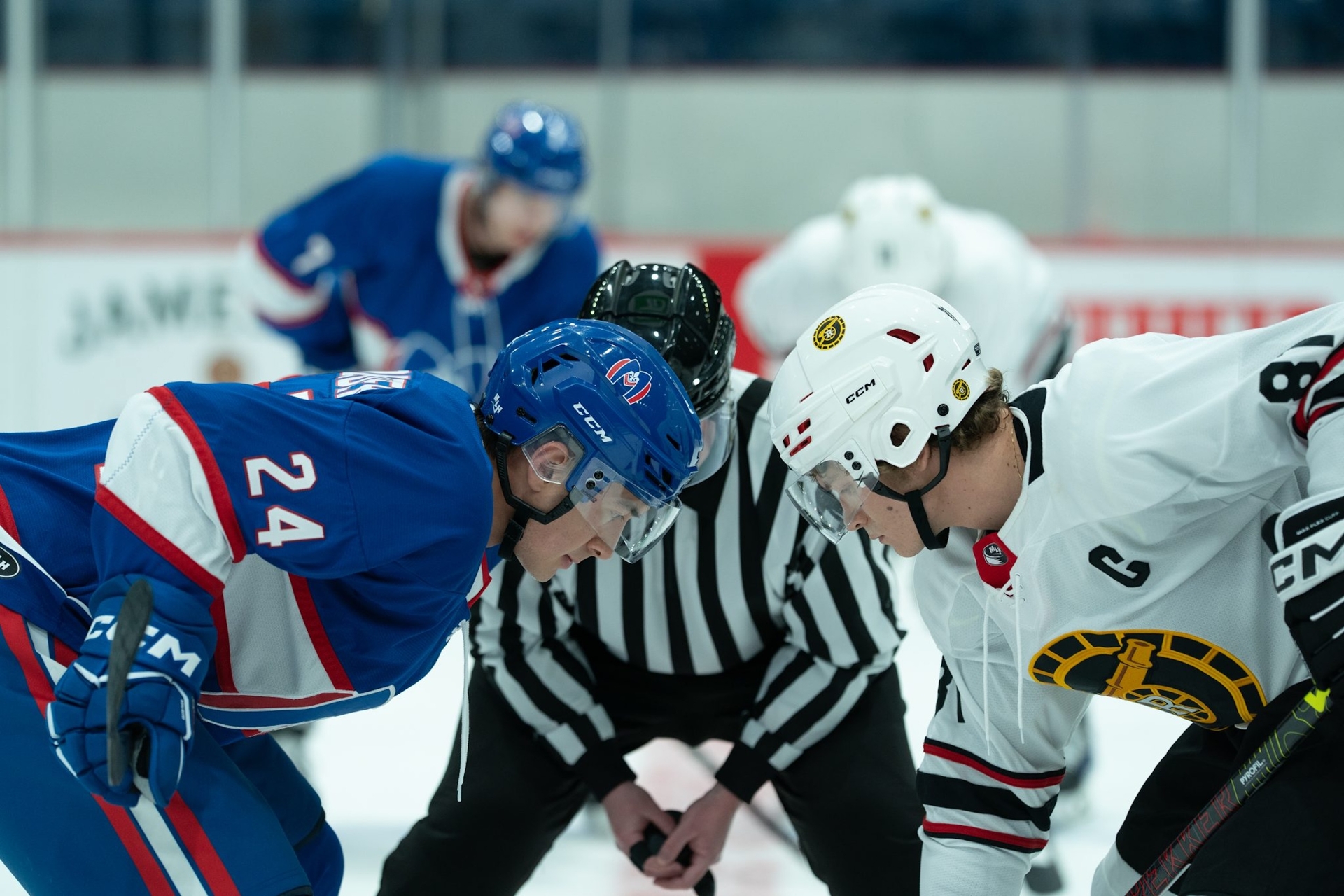
Last week, a “real-life Heated Rivalry” story began making the rounds, the tale of rivals-to-wives American Olympian Julie Chu and Canadian Olympian Caroline Ouellette, captains of their respective national teams who met at a 2002 match and then reconnected in 2005 at a summer hockey camp. Initially best friends, the two found themselves, eventually, falling in love. Chu and Oullette were certainly before their time, but these days their story is be one of many that have taken place between professional female athletes or Olympians. When the Professional Women’s Hockey League launched last year, it boasted 36 already-out gay players.
The once openly homophobic world of professional women’s sports has become, in recent years, very friendly to queer players and fans. The multitude of off-court romances in leagues like the WNBA and NWSL are part of what we love about the league. There were 44 openly gay players in the WNBA last year, and it’s not unusual for wives and girlfriends to embrace their partners on court after big wins — those that aren’t also on the team.
Men’s sports, meanwhile, haven’t shifted much in their attitude towards gay players. It’s not the era in which it takes place that makes the Scott Hunter on-ice make-out so fantastical. Even now, there has never been an out gay player in the NHL — in 2021, American Hockey League defenseman Luke Prokop became the league’s first player to come out as gay, but he’s yet to earn a call-up to the NHL.
OutSports noted last fall that of 4,592 rostered players in major men’s US pro sports — the NBA, NFL, NHL, NSL and MLB — not a single player is out as gay or bisexual. Only a literal handful of publicly out gay and bi athletes have ever played in a regular season game. Even if the Heated Rivalry timeline was moved up (it currently stretches from 2008 to 2018), the events of “I’ll Believe in Anything” would still be inconceivable. There’s never been any out gay male player at Shane, Ilya or Scott’s level in the NBA, NFL, NHL, NSL or MLB.
But boy are there plenty of readers out there eager to fantasize about that not being the case! Sports romance is a fairly massive subgenre, and I was surprised to learn that hockey is actually the most popular sport within that subgenre. While not all of those books are M/M romance, many are. There are lots of theories about why hockey is so popular — including that publishing and the world is racist, and the sport is 90% white — the game itself is high-risk and tense, the teams are smaller, it’s the only league that still allows fighting and “there becomes a contrast between the brutality of the sport and the softness of the romance.”
Many contemporary M/M romance novels are centered on public figures occupying those few remaining rarified worlds where, even now, being public about a same-sex gay relationship is risky — boy band members, British royalty, professional athletes. For Shane and Ilya, it’s not just being professional hockey players that complicates their situation, it’s that they’re league MVPs and rivals and Ilya is Russian and his family is terrible. These are Brokeback Mountain conditions, basically.
Like others in its genre, the stakes in Heated Rivalry are deeply informed by those real-world scenarios — until they aren’t, until the scene where the narrative flees reality for the kind of world we all wished we lived in. That’s the best part. That’s the thrill that vaulted “I’ll Believe in Anything” to the top of the IMDB charts, that turned a passionate fanbase into a rabid one.
Apparently, Heated Rivalry has also increased public interest in hockey itself. An NHL rep told the press, “there are so many ways to get hooked on hockey and, in the NHL’s 108-year history, this might be the most unique driver for creating new fans. See you all at the rink.” The trailer played on the big screen for the Montreal Canadiens’ Pride Night. These are small, tentative steps on a tender surface.
“The league in Game Changers isn’t my ideal version,” Reid told The New York Times. “But it’s one where players are just starting to create real change.”
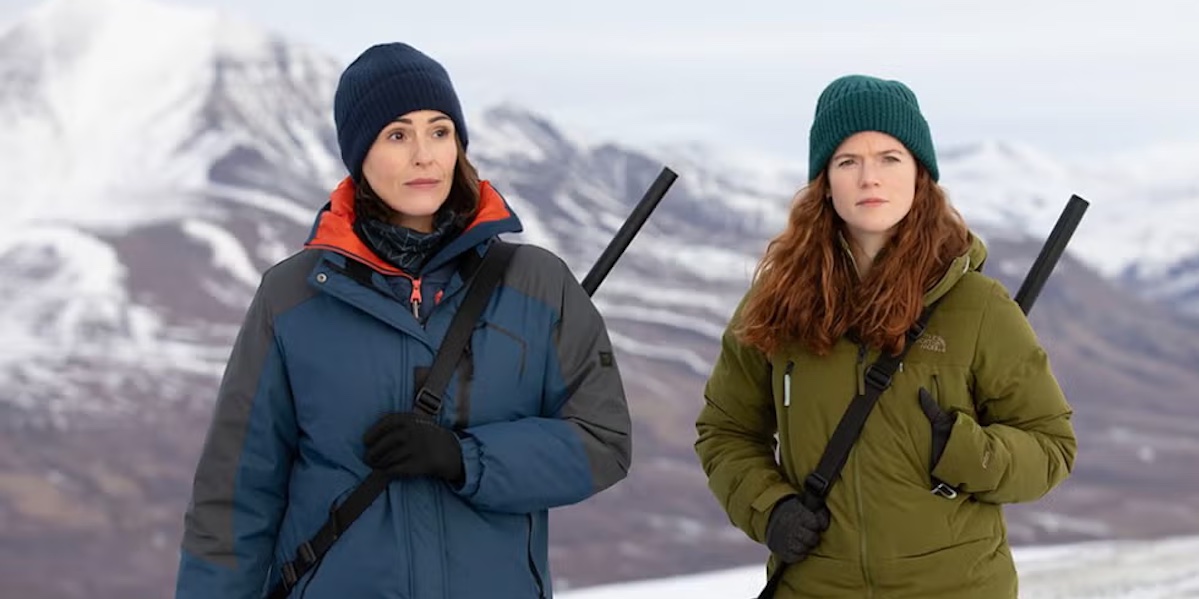
I’ve been thinking about Heated Rivalry in the same breath as The Hunting Wives since its second episode, and apparently I wasn’t alone in doing so. During a conversation about Heated Rivalry‘s popularity amongst straight women on The View, one host called it “The Hunting Wives phenomenon, but the male version.”
The View ladies were comparing the respective programs being breakout hits and having sex appeal that transcended sexual orientation and gender, but they have more in common than that.
Both Hunting Wives and Heated Rivalry feature unexpected people having gay sex, but neither embrace or really even consider the concept of a queer community. Erstwhile smoothie king Kip has gay friends and goes to the gay bar, but his story only occupies one episode. Shane and Ilya’s storyline thus far has been an isolated island of homosexuality. Most of this is explained away by the pair’s fame, and Ilya’s Russian-ness — there really is no risk-free way for them to explore. In The Hunting Wives, Margo and Callie, as well as Callie’s husband, are aligned with a heteronormative political movement, publicly opposed to the greater cultural universe most queers occupy. Besides, they’re too busy with murder stuff to sneakily binge The L Word under the covers.
In Vulture, Brian Moylan argues that it’s this distance from society that makes Heated Rivalry “so revolutionary and irresistible” to gay audiences, noting: “Every gay show before had to exist in the context of society, and, I hate to break it to you, society hasn’t been that great for gay people.” At Slate, Jim Downs suggests the opposite, that Heated Rivalry‘s lack of engagement with the gay community’s thriving social media culture of its era delivers “an impoverished narrative framework.”
I’m inclined to side with Moylan, here. Downs’s criticisms are mostly correct, of course, and I’ll get back to that in a minute. But I don’t care.
We don’t want to see society. We don’t want to see reality.
We want to see something better.
These shows aren’t successful because they represent our lives, they’re successful because they don’t. When TikTok creators film themselves packing to join Ilya and Shane at the cottage, they’re waiting for a train to Never-Never Land, for a door to the holadeck, for a ride through the Peppermint Forest into the Lollipop Woods.
And that, ultimately, is why it’s not just horny straight people bingeing these shows — it’s us, too.

On every measure that matters — human rights, the economy, the environment, civil rights — this year has been horrifying. For queer people specifically, the foundations of our commercial and community-focused enterprises are being drained of support and funding, trans people are being written out of public life, their very existence denied and their supporters criminalized. So it’s no surprise that we find such incredible emotional comfort in the worlds of Heated Rivalry and Hunting Wives. Their adherence to the conventions of their literary genres — the enemies-to-lovers romance, the psychological thriller — provide peer-reviewed structure, a reliable outline of well-worn beats to hit to keep us invested and somehow also surprised.
I’m not sure if the easy pleasures of Heated Rivalry or The Hunting Wives would’ve earned the widespread, unadulterated acclaim and relatively mild critical dissent they’ve received in 2025 if they had debuted in, say, 2019. It wasn’t that long ago (last year, even) that we demanded more. We want shows by queer creators starring queer actors! Shows that feel honest and important, with progressive politics that challenge homonormativity! Shows that portray not just gay people, but gay community. Queer television critics often argued that we’d had enough of narratives propelled by the constraints of the closet and by coming out stories. As Downs so adeptly writes, we “deserve stories that help us navigate our own lives — or at least reflect a nuanced version of reality that we can recognize and learn from.” He’s right! He’s completely right!
But right now, there are days when we don’t want to learn, we want to fantasize, we want the old chestnut of a closeted romance, we want stupid camp and fantastical hotness.
Perhaps it’s also delicious to consider the rich white Republican Moms idiotically endorsing their husbands’ design for their own decline are secretly fucking and shooting each other — and that one of their husbands, a cop, is secretly fucking his co-worker.
It’s frankly inspirational to entertain the idea that two male athletes, at the pinnacle of their sport, are also, in fact, fucking each other — not just fucking, but falling in love, that a hockey player could open-mouth kiss his boyfriend on the ice while the announcer declares, “Good for him!”
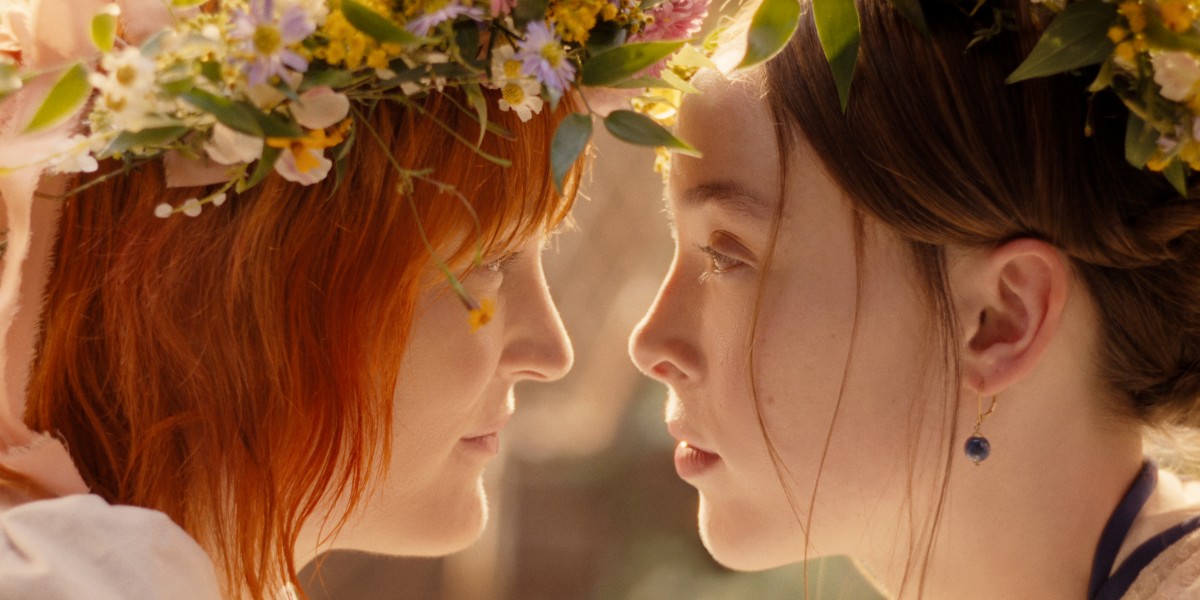
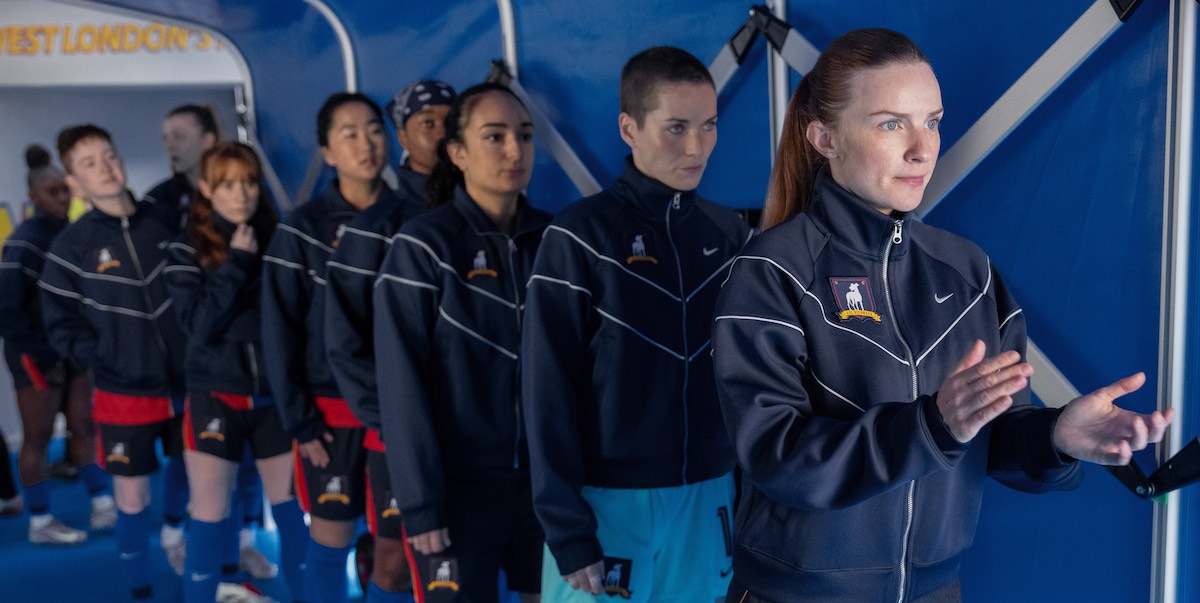
Of course, Heated Rivalry is actually much gayer than The Hunting Wives, and I do wish that wasn’t the case. Heated Rivalry has also benefited from HBO Max’s weekly episode release schedule, enabling buzz to build week over week. Its cast, while understandably wanting to keep their sexual orientations private, have been otherwise accessible — popping up at gay bars and book signings, filming cute TikToks, saying yes to seemingly every interview request they receive. It’s hard to imagine a sapphic show catching on in the mainstream like this — but this was hard to imagine once, too.
M/M romance appeals to straight women because it shows men being soft, sharing their feelings, engaged in relationships with negotiated, rather than inherent, power dynamics. They like W/W romance because it lacks the male gaze and shows women in their own power, getting by and getting off without men at all. Both offer an escape from heterosexual straight male culture, the famous patriarchy that controls and destroys us all. Gay people need an escape from that, too.
Because right now, today, after this hellscape of a year? We will, in fact, believe in anything.

Comments
Ok, so you might have convinced me that I actually do want to renew my HBO Max subscription to watch this. I could use some corny, unrealistic joy.
I read the books and thought they were OK. I’ve seen a lot of squee about the show and I guess I was waiting for a trusted queer reviewer to write about it. So thank you Riese.
it’s actually SUPER faithful to the books, like I was surprised by exactly how close it was. (which was also sometimes annoying). Anyhow i am curious to know what you think! It took my wife a minute to get into it, but once it got us, we were gotten.
I really enjoyed it! I’m surprised by how it’s both really faithful to the books and also better (imo). I think the pacing is definitely better in the show.
I might be reaching, but maybe part of the reason for there being less interest in the “queer community” in media is we see that just because someone is queer, doesn’t mean they stand with the community. Between Bari Weiss, Peter Thiel, and others, I could see why there could be an element of disillusionment there. Like I said, feels like a stretch.
to stretch even further, your comment made me think about how i hear so much about people going through the experience of discovering their own idealized real-life queer communities aren’t the utopias we imagined, that there’s toxicity and potential for hurt there, too. which i think has always been true across the generations but we forget sometimes, at our own peril.
Another cool thing about the show: Harrison Browne (the first openly transgender athlete in a professional team sport) plays a minor role as one of Ilya’s team-mates.
oh wow i didn’t know that, that’s very cool!!
This show hooked me immediately. Your take is spot on and love the mention of facts in terms of how many openly queer people are members of professional sport teams.
With much respect to the source material, Jacob Tierney is a better filmmaker than Reid is a writer. Both are fun, to be clear, but I think there’s still a lot to love about the TV show even if you were less into the books.
That’s good to know. I (mostly) enjoyed the books but definitely had issues with the writing. I’m planning to binge it this week.
*vague spoiler* The lack of gay community, and how that’s a problem for the closeted characters, is addressed in the books, so I assume we’ll see it in season 2 or 3 of the series.
yep, 100%. can’t wait for season 2! also sad for season 1 to be over. hope season 2 is longer. 6 episode season is nonsense
Another thing that makes it so great is that it genuinely seems to capture love and romance in a way I have never seen a straight movie or show even glimpse at. The respect that has been given to the concept of sex and love here are just beautiful – I feel like a lot of shows like this end up having casts or even directors who seem to internally cringe at the material and it shows. Sigh wow wholesome although I don’t know if I feel the Hunting Wives. I think this might just be because the world of Hunting Wives in some ways still feels to real to me (I don’t know how to explain). But yes ice hockey is not something I am very familiar with and so that fantasy of it and the high yet low stakes just make this show AMAZING! I hope we can get a sapphic version of this because I can not watch another sad lesbian love story (ok I can but it would be nice). Although I do think that unfortunately creating something like this for queer women and non-binary folk may be harder due to to the weird way the male gaze can interact with sapphic sex scenes and so forth. Anyways great way to end the year!
In what way does the tv show “capture love and romance in a way I have never seen a straight movie or show even glimpse at”?
THE PPL NEED A RECAP PODCAST PLZZZZ
Ok. So I just finished this – I actually binged the entire season in two days. And I came back and read the full review and I feel the same way.
I read Heated Rivalry in 2018 and in my GoodReads review I wrote that Scott Hunter kissing Kip on national television “pushed the book into alt reality for me. In the era of carefully orchestrated coming outs for (male) pro athletes in the big team sports, it just wasn’t at all believable.”
And that is still true. It’s still not at all believable. But today I don’t care. Today I sat on my couch and cried watching that ridiculously unrealistic scene. It didn’t take me out of the story, it made me want to live in the story, at least for a little while longer.
that’s so funny and prescient that you wrote that in your review! because part of what inspired me to write this at all was feeling like nobody was really talking about how part of what made that episode so fun was that it was completely bonkers but we’re at a stage now in culture and society where we are in the market for bonkers.
This, exactly: “…that is still true. It’s still not at all believable. But today I don’t care. Today I sat on my couch and cried watching that ridiculously unrealistic scene. It didn’t take me out of the story, it made me want to live in the story, at least for a little while longer.”
Right?! I’m pretty impressed with past me.
We’re living in a scary, bonkers time, so I guess it’s not that surprising that we crave entertainment that’s bonkers but hopeful.
Randomly, I also really liked Laura Sackton’s take on that final sequence of episode 5 – she focuses on queer possibilities.
https://poetryschool.beehiiv.com/p/volume-5-no-16-queer-syntax-is-infinite
I cried more reading this article than when Scott kissed Kip. I am finally at the stage in my Heated Rivalry psychosis where I can read ABOUT it (instead of just watch it and read it and watch it again and read it again). And obviously Riese is the only person I could trust to write about this obsession – this show that has altered my life probably more than any show since the L Word.
“It’s hard to imagine a sapphic show catching on in the mainstream like this — but this was hard to imagine once, too.” EXACTLY. Now that we have Heated Rivalry, maybe we’ll get a sappy, happy, mainstream beloved lesbian show in, oh, 8-10 years?
Can’t wait to read the Autostraddle recap when we do.