





This post contains minor spoilers for the third season of Vigil, which has aired on BBC One. Peacock’s U.S airdate has yet to be announced.
When a TV detective is called onto a crime scene, we all know what to expect: dirty laundry will be aired, long-buried secrets exhumed; the population of any nearby picturesque village will likely halve within the hour.
When DCI Amy Silva (Suranne Jones) and DI Kirsten Longacre (Rose Leslie) – partners in life and crime-fighting – get called into action, we don’t just get a stacked body-count, but also a conspiracy workout and a healthy dose of geopolitical brinkmanship.
BBC One’s Vigil began its run in 2021, with Season One taking place aboard an eponymously named submarine, where Amy had been shipped in to investigate the death of a British military serviceman. It was an instant hit, thanks to its twisty Cold War-style plot, the innate claustrophobic tension aboard the sub, and Jones’s standout performance. Over six episodes she fearlessly clanked up and down tight passageways, solving mysteries, battling back-stabbing baddies and thwarting military subterfuge, all while re-living the trauma of having survived a watery car crash that saw her fiancé drown.
Why were the gays paying attention to this? Because the only way Amy was able to get to the bottom of it all was by exchanging coded messages with her ex-situationship, Kirsten, back ashore in Scotland. Only queer women would think it a good idea to avert certain nuclear disaster by re-hashing their relationship woes while long-distance yearning over a shaky satellite link. Astonishingly, it all worked out! The world remained un-nuked, and Amy and Kirsten reunited, realising that the couple that counter-espionages together, stays together.
Season 2 stuck with a military theme but broadened its scope to the wider military industrial complex, including drone warfare and the economic drivers for endless war. While performances remained strong, it lacked that locked-room mystery element of the first season and didn’t always hit the mark with its political undercurrents.
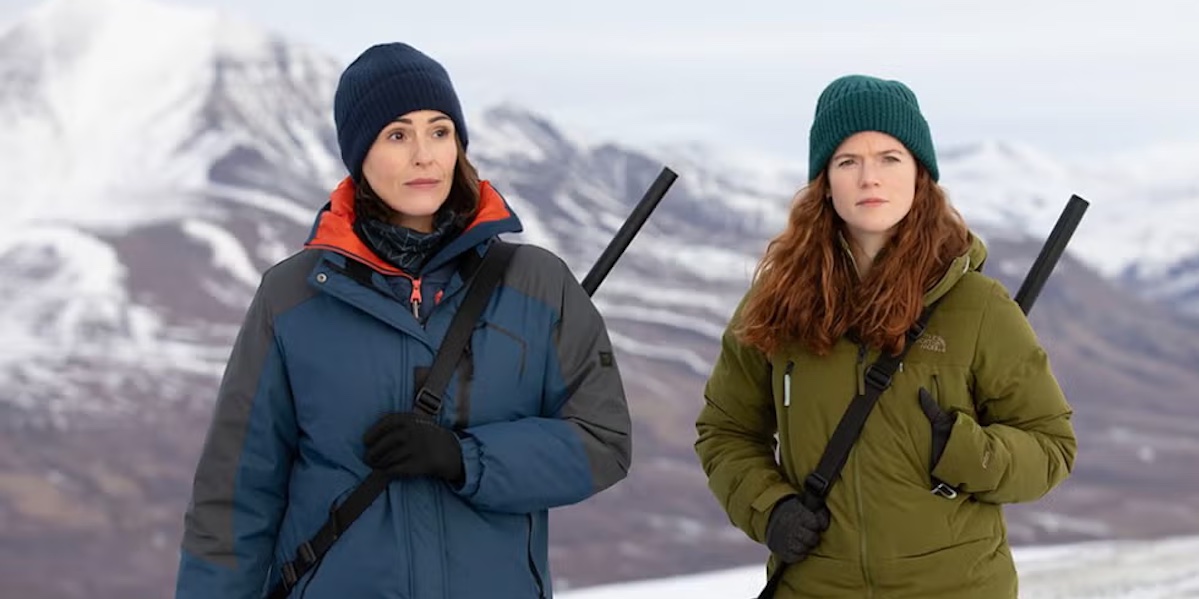
Now that they’ve conquered the underwater level and the desert level, our heroines are back for a third adventure and this time it’s on ice!
We’re venturing north to Svalbard, a remote archipelago in the Arctic Ocean, housing an international contingent of scientific researchers. Although governed by Norway, Svalbard is technically demilitarised, which means anyone turning up waving guns around is highly liable to cause a diplomatic incident. I can’t imagine why anyone would want to kick up a ruckus to lay claim to an icy island full of mineral deposits in a strategically important location though?!
The action kicks off when British forces, who are pretending they’re not there, are intercepted by Russian forces, who are pretending they’re not there, as they attempt to extract a Chinese scientist, who absolutely wishes she wasn’t there. After a somewhat shooty scuffle, this results in the disappearance of said Chinese scientist — Shen Jia —and the dumping of a dead Brit in a nearby Russian enclave.
The diplomatic incident-o-meter thus triggered, the British intelligence services do the only intelligent thing possible: turn to a pair of queer women while they’re trying to get the family ready for work/school/childcare in the morning.
You know how people say if you want something done, give it to a busy person to do? This has obviously been internalised by the posh government dude and his sidekick who rock up at Amy and Kirsten’s house and invite themselves in for a cuppa while Amy’s still in bed and Kirsten’s fretting over which shirt best says “I am a strong, capable woman” for her first day back after maternity leave.
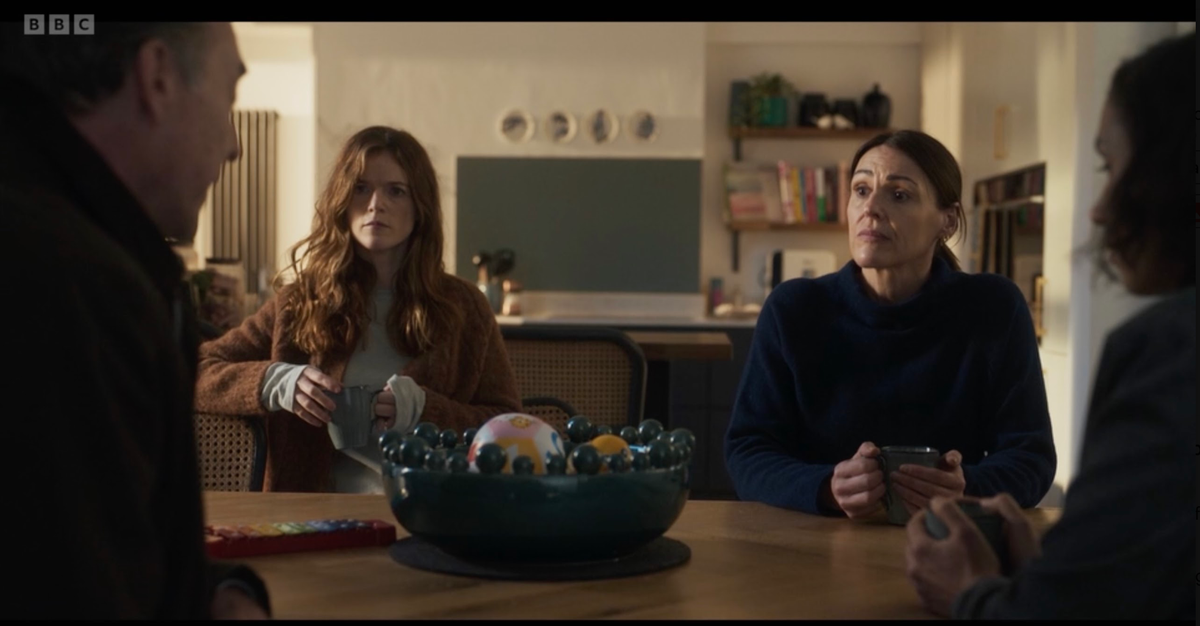
Sir Ian explains the delicate situation on Svalbard and, with Amy’s experience policing sensitive military situations, it’s no surprise that he’s turned up on her doorstep to ask for help. What is a surprise is that it’s Kirsten they want to send into the icy unknown. The job: work alongside a Russian investigator to make sure the whole dead-British-soldier-in-a-Russian-compound situation doesn’t escalate into a full-scale crisis.
Now, I once took a year-long leave of absence and, like a regular human being, spent the first day back gossiping and desperately trying to remember my passwords. Not so DI Kirsten Longacre, who immediately jumps at the chance to prove that she’s just as much of an action woman as Amy.
Like previous seasons, Vigil uses personal scenes between Amy and Kirsten sparingly but effectively. As Kirsten gets ready to leave, we quickly get an understanding of the couple’s dynamic with their newly-expanded family. The way that Poppy — their adopted pseudo-step-daughter — clings to Kirsten shows that she’s the emotional lynchpin, while Amy appears comfortable with her role as the one that sorts shit out. Will their roles need to switch now Kirsten is the one off on an exotic detective mission?
Kirsten arrives on Spitsbergen (the main island of Svalbard), and takes about ten minutes to realise that all is not as it seems with the killing. Between the surly Russians, the outwardly friendly Norwegians, the secret British military and the scientists from many nations with many agendas, the only thing she can really be certain of is that everyone is lying, and the missing scientist and her mysterious research is the key to unlocking everything.
Meanwhile back in Scotland, Amy tracks down a scientist who left the island just before the deadly incident, only to find herself caught up in an explosion, hostage-taking and eco-warriors attempting to expose what the British are really trying to excavate on Svalbard.
This — for better or worse — is where things start to get rather convoluted. The Brits are there working out if they can mine a bunch of rare earth minerals from the arctic seabed in an attempt to wean themselves off other nations (specifically China) to have self-sufficient renewable energy infrastructure. All sounds rather admirable, except it will likely cause a shit-ton of damage if they do so, begging the question of whether short-term environmental pain is worth the long-term gain.
At the same time, Shen Jia has discovered…something under the ice. Things get almost X-Filesy at times – both in terms of potentially unleashing ancient shit starting to thaw and the aphorism to trust no one. Whether good or bad, whatever she’s found is enough to get all the world’s superpowers after her for it.
The interesting part is that this is all based on real science, because climate change is causing permafrost to melt at pace, revealing all sorts of microbial oddities that have lain dormant for millennia. It’s a good setup, but I fear the writers’ research stopped at the headlines and likely any real microbiologists will be weeping into their petri dishes with the slapdash way the science is handled.
Of course, we’re mostly here for the drama and, increasingly, it looks like Kirsten has been sent into a trap, especially when a stabbed Russian turns up at her feet. Time to send in Amy — and quickly, before anyone asks who is looking after their infant son!
The middle chunk of the season keeps the action solely in Svalbard and, for me, this is the strongest part. While not quite the locked room of a submarine, the isolated territory keeps things tight and the barren landscape brings its own character to proceedings.
While Kirsten and Amy spend each episode navigating the duplicity of everyone on the island, their own tensions remain simmering. Anyone that’s been in a long-term relationship will know that there’s a time and a place for a massive blow out. Amy and Kirsten decide the place is in the middle of arctic tundra where they’ve been stranded with no transport or supplies, and the time is when a massive storm is poised to sweep in and one of them has concussion. Honestly, I loved this for them!
Finally taking shelter from the storm, they get down to what’s bothering them. It’s well telegraphed that Kirsten’s feeling like she needs to prove herself and wants to feel like Amy really believes in her.
For Amy, it’s the feeling that she’s a spare part in the family, possibly spurred on by being the non-gestational mum of their son. Early in the season a couple of people note Amy’s lack of empathy. My initial reaction was that a bloke detective would never get called out on that, but perhaps it was hinting at something more substantial. By her own admission, she doesn’t always know how to show her love for Kirsten. I get the impression that Amy is leaning on her sense of uber-competence to demonstrate her worth, but in a show that doesn’t like to dwell on emotions for more than thirty seconds at a time (a bit like Amy), this is up for interpretation.
What’s frustrating is that this is a really interesting dynamic and one that we rarely see on screen: two same-sex parents navigating what their roles are. In a show like this, where the personal is always secondary to the plot, we are never going to explore it in great depth, but I’m left scratching my head for any other examples.
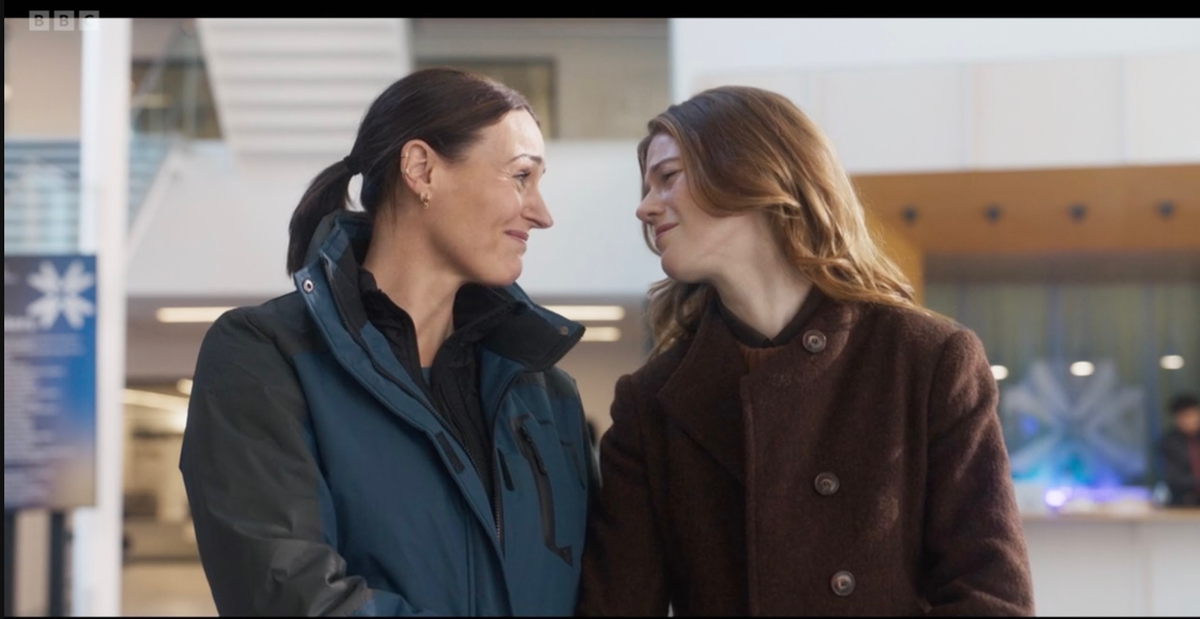
Of course, Amy and Kirsten quickly get through this with some emotional forehead touching (seriously, did these writers learn everything about queer relationships from looking at lesbian movie covers??). No time for snogs – they have murders to solve and crises to avert!
The final episode brings everyone back home to Scotland and, for me, was a giant disappointment. While the show draws from real life events and tensions to build a believable world, it suffers greatly from clunky handling of politics and science. Unfortunately the resolution is cringingly naive, spurred on by Amy making some choices that just didn’t feel warranted by the story.
After getting double- and tripled-crossed by almost every single character — including those supposedly on her own side — I’m guessing we’re supposed to think Amy wants to see justice served, but this would have worked better for me if it felt like it was really personal for her. As it was, I don’t think the show does a good enough job of fleshing out the many side characters or developing relationships between them and the central pairing to make this work. Plus, after three seasons spent showing the shady global web of corruption, are we really meant to believe a couple of Glasgow coppers can take it down that easily? Even Suranne Jones’s acting chops can’t quite pull that one off.
Overall, I felt Vigil season 3 was a step up from season 2, thanks largely to returning to its strengths of building tension in interesting places, with a geopolitical spin that mostly falls the right-side of far-fetched. I appreciated the screen time we had with Amy and Kirsten; it felt more than previous seasons that they were in this one together.
Each of the seasons has been self-contained; perhaps the conclusion of this one suggests we’ve come to a natural end of the show, which has been hinted at by the show-runner. There’s no doubt there’s a ton more stories to be told in Vigil’s world. For now, it looks like we’ll have to stay content that Amy and Kirsten have managed to survive the only threat greater than mutually assured destruction (burying your gays), to walk hand-in-hand into an uncertain future.


Comments
i watch this show and enjoy it as a soapy silly treat but kind of resent having to watch a tory play a lesbian as asexually as she can.