





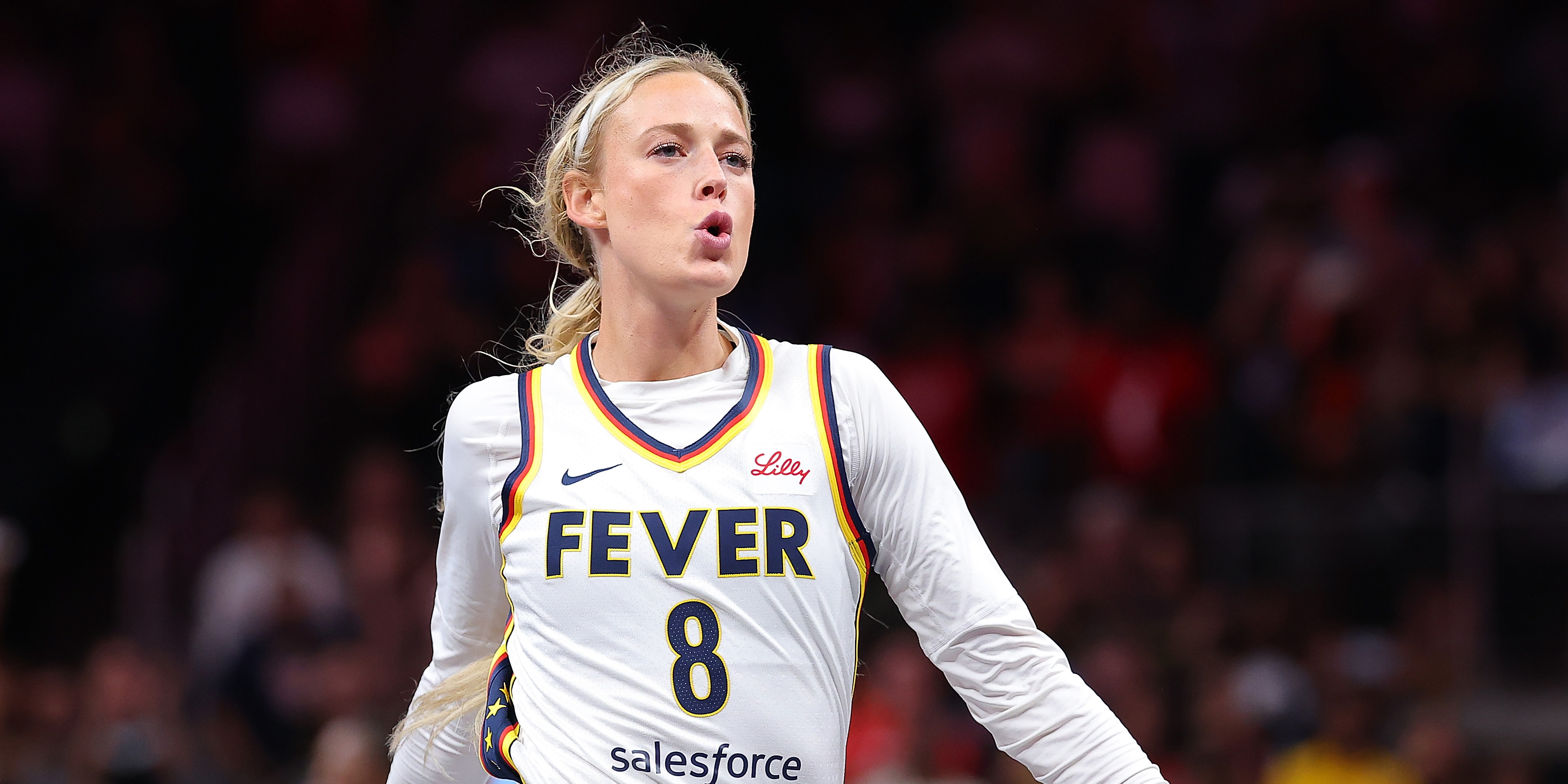
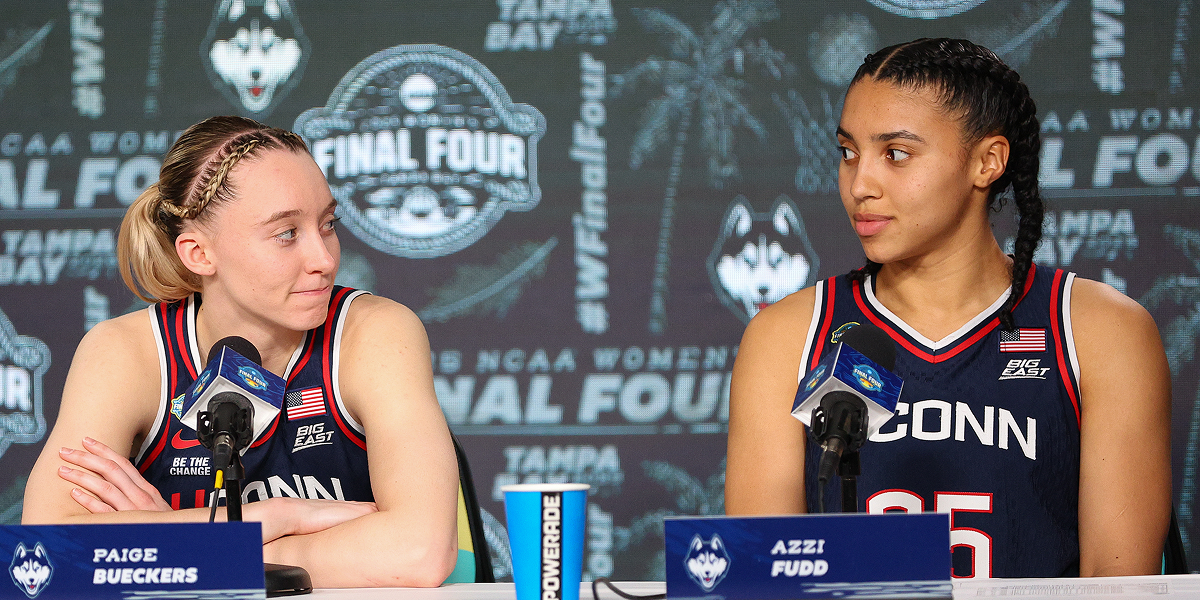
On Thursday outside the Climate Pledge Arena in Seattle, the groups Women Are Real and Known Heretic, along with right-wing influencer Brandi Kruse, hosted a rally to show their support for Indiana Fever bench player Sophie Cunningham’s ignorant comments about trans inclusion in sports and celebrate their lack of support for female athletes in general. Around 30 losers showed up for the rally, and it was probably the closest anybody in that group had ever gotten to a professional women’s sports event.
Asked by reporter Roberta at a post-game press conference about the rally, Sophie’s comments, and the impact of this conversation on locker room vibes, a Fever PR rep read the following from a laptop: “Neither our organization nor Sophie had any knowledge of this demonstration and no contact with its organizers. Our only goal as a team, whether at home or away, is to win basketball games and make Fever fans for life, and we are united in that mission.”
Apparently, Seattle Storm co-owner Celeste Keaton admonished a group of teenage Sophie Cunningham supporters at the game, which led to her getting suspended from attending the team’s next five games. The team itself was also fined by the WNBA. According to ESPN, “The fans told unDividedPod.com that Keaton directed expletives at them for a sign that thanked Cunningham “for speaking up for girls.” Cunningham responded on twitter that the co-owner’s behavior was “truly embarrassing” and gave the girls a “bravo” for “standing up for what they believe” and promised they’d be “hearing from her soon.”
The Seattle Storm said in a statement that they “respect the league’s decision to fine and suspend co-owner Celeste Keaton” and “remain committed to creating a welcoming and respectful environment for anyone who attends a Storm game.” Except trans women, I guess?
This is just one piece of the fallout from an ESPN profile in which Cunningham volunteered her opinion on trans women in sports, claiming she doesn’t “hate trans” but then going on to say: “I think that I am here to extend love. But I also think with that love is truth, being honest. And I want to protect young girls in a locker room, or young girls in sport who shouldn’t have to go against biological men.”
Girl — if you’re referring to trans girls as “biological men,” you do, indeed, “hate trans.”
Cunningham continued to double down on this response when asked by press and on her own social media, calling it “common sense.”
Generally, I believe the impact of any single celebrity’s opinion on any given political issue is overestimated, and that journalists writing articles like the one I’m writing right now are just plucking low-hanging fruit, participating in an ultimately harmful outrage cycle that favors hot takes over genuine engagement with complex issues. But trans inclusion in sports is a very unique case. Due to an effective and audacious campaign from the right-wing asshats obsessed with the distraction and financial rewards provided by said manufactured controversy and due to all kinds of misinformation around the science at play here and deliberate confusion about what trans inclusion at the elite level actually looks like — trans inclusion in sports remains, sadly, a contentious issue across the political spectrum. It’s arguably a political issue for which popular opinion has been determined far more by celebrity discourse than by actual first-hand experience or by information shared by actual lawmakers or stakeholders. This issue is just four hot takes and J.K. Rowling’s cat in a trench coat.
I’m not actually certain that Cunningham’s opinion matters — but I’m also not certain it doesn’t. It probably matters a great deal for queer residents of the Indianapolis metro area who’d like to feel as welcome at home games as fans do in other cities across the country. It might still be an opportunity to dig into what’s wrong with takes like hers.
Who Is Sophie Cunningham and Why Is She So Wrong?
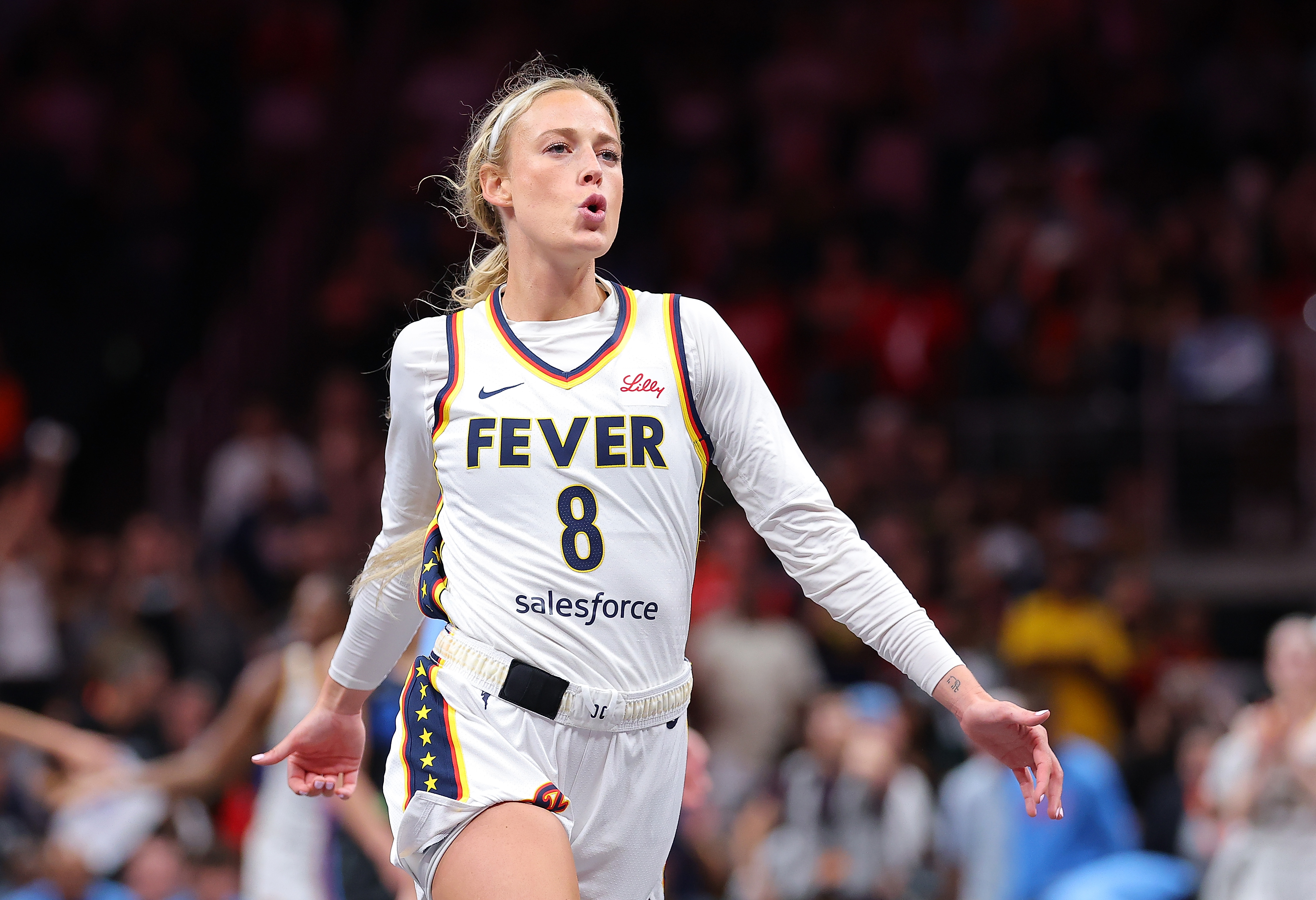
Known as “MAGA Barbie” for her assumed political leanings and approximate physical similarities to a Barbie doll, Indiana Fever guard/forward Sophie Cunningham has been a lightning rod of controversy on and off the court, with a career that began in the dry heat of Phoenix, Arizona before landing her in the midwest in 2025, where her friendship with and proximity to Caitlin Clark elevated her to a new level of fame. (Her behavior has consistently been subject to a stark racial double standard in the league: Her physical aggression earns fans and supporters, while Black players exhibiting remotely similar behavior earn racialized harassment and media criticism.)
She pushed back against the MAGA Barbie accusations in an interview with the Times in September of 2025, claiming her political views were “right in the middle,” and that she considers herself a moderate rather than an outright Democrat or Republican. These claims didn’t dampen the right wing’s affection for its white, blonde, conventionally attractive star, and her anti-trans opinions have earned praise this past week across the spectrum of bigotry, including support from Donald Trump himself as well as noted scourge J.K. Rowling.
Her assertion is fascinating coming from an athlete who, earlier in that 2026 ESPN piece, described a childhood that involved playing sports with actual, literal, cisgender biological men. She was a place-kicker on her high school football team, and, per the profile, when a young Cunningham “wasn’t playing against older girls, she was playing against boys, but even then, skepticism persisted” about her inclusion on girls sports teams. Her parents fielded criticism that Sophie was too old and too big to be playing on the teams she was playing on, that her style of play was too physical and aggressive. Under the legislation Cunningham now seemingly supports, that scrutiny would’ve likely subjected her to invasive sex testing.
Youth sports are, in fact, often co-ed, and without incident or locker rooms. At the high school level, women who want to play baseball or tackle football in high school do, in fact, play on the men’s team, with cisgender men, because high schools don’t offer those sports for women. (I learned this editing the Autostraddle Sports Issue, which includes stories on women’s football and baseball!) That’s what Sophie did, and she survived. Of course, Sophie’s not just attempting to defend women from playing amongst people assigned male at birth, but against them, or pose some kind of threat in the locker room.
But ultimately the only woman Sophie is helping here is herself.
There is currently more legislation in the pipeline to prevent trans girls and women from playing sports than there are trans girls playing sports at any recorded level. When Utah governor Spencer Cox faced a bill banning transgender kids from sports, he said of the 75k high school students in the state playing sports, only four were known to be trans, and only one of those four was a girl. In South Dakota, a similar bill was passed despite, again, only one trans girl trying to play sports in the entire state. But this manufactured controversy has proven to be profitable and played well on both sides of the aisle, as Cunningham has so adeptly demonstrated, again.
Many WNBA Players and Coaches Have Spoken Out To Support Trans Inclusion
The WNBA is arguably the most politically progressive major professional sports league in this country. This is unsurprising, of course, for a women’s league that is mostly Black and very queer, a league celebrated and noted for its legacy of progressive political activism. There aren’t any trans women in the WNBA (there has been one out nonbinary player, Layshia Clarendon), but many WNBA players are the targets of persistent harassment for various failures to conform to gender norms. Brittney Griner, who is 6’9” and has a deep voice, and was bullied throughout her childhood for these qualities, remains unable to appear on social media without a cadre of incels putting down their video game consoles and swarming the feed with sharp burns like “a man for sure.”
Griner is also amongst many WNBA players who have voiced their support for trans athletes. When asked about trans inclusion in 2023, Griner affirmed: “Everyone deserves the right to play. Everyone deserves the right to come here and sit in these seats and feel safe and not feel that there’s a threat and that they can’t be who they are.”
Las Vegas Aces WNBA player Brianna Turner, formerly of the Indiana Fever, wrote a USA Today op-ed in April in response to the IOC’s policy shift declaring “Don’t use athletes like me to exclude trans women.” She noted, accurately, that “policies that single out transgender women and athletes with intersex variations do not protect women’s sports. They manufacture a scapegoat while the real challenges to women’s sports go unaddressed: unequal funding, limited access to training and facilities, pay disparities, male-dominated leadership, gender-based violence and harassment across race, sex, sexual orientation and gender identity.” For example, last year a Fever staff member was fired for sexual harassment, and Turner says they were encouraged to keep quiet about it.
Minnesota Lynx head coach Cheryl Reeve wrote in Sports Illustrated back in 2021, “when we welcome all woman athletes, including transgender woman athletes, to bring their full authentic selves to the game, we are stronger as individual players and as a team.”
South Carolina coach and former WNBA player Dawn Staley was asked for her stance on the issue during the NCAA Final Four in 2024 and affirmed her support for inclusion.
Australian baller Anneli Maley, currently on the New York Liberty, has advocated for inclusion, saying in an interview, “the biggest threat to women’s sport is not trans women, it’s actually men thinking that it’s trans women.”
Sue Bird has also been a vocal supporter of inclusion and, along with Layshia Clarendon, Natalie Achonwa and Brianna Turner, signed a 2024 Athlete Ally petition favoring inclusion. Unrivaled co-founder and Lynx superstar Napheesa Collier said in a July 2026 MPR interview that trans youth “have every right” to what sports provide. Breanna Stewart called for “establishing policies that are inclusive of the transgender community and afford them every opportunity to succeed both in sport and in society.” (But she also has a Harry Potter-branded shoe.) Candace Parker joined 170 other athletes in filing a friend-of-the-court brief against an anti-trans sports inclusion law in Idaho. Last night, Stephanie Dolson wore a t-shirt supporting trans people to the game against Indiana.
On an episode of their podcast, Unsupervised, WNBA veterans Syd Colson and Theresa Plaisance recalled a recent journey to a restaurant in Annapolis where they found themselves in line behind a man in an American flag t-shirt with the words SAVE WOMEN’S SPORTS emblazoned on the back. TP recalled, “I was like, no way Syd, I really think this is an anti-trans shirt.”
“One hundred percent,” Syd echoed.
Sure enough, the shirt had “xx xy” printed on its chest pocket. TP joked: “The thoughts that went through my head in this moment were for me to walk up to him… and say, hey sir, women like me across the world thank you for saving women’s sports because we’re so terrified of trans women ruining sport.“
“Insane,” Syd agreed.
TP — a 6’5″, masculine lesbian with a deep voice — concluded, in jest, “So thank you sir. Women like me — and I know you are representing women like me everywhere— thank you.”
All Gender Non Conforming Athletes Will Be Harmed By Anti-Trans Legislation
Historically, it’s not just trans women, but any woman who seems too “masculine” in any regard who have been the most common targets of invasive sex testing, abuse and harassment. Furthermore, women of color are particularly vulnerable to this, wrote Orion Rummler in the 19th after the targeting of cis boxer Imane Khelif at the 2024 Olympics, concluding “women of color are the ones most at risk of being targeted for not adhering to fragile notions of gender and unrealistic expectations of femininity.”
There are myriad ways in which legislation Cunningham supports serve as a gateway to further legal discrimination against all female athletes. As soccer legend Megan Rapinoe wrote two weeks ago in Marie Claire, “In their witch hunt for a few trans kids in the entire state who play school sports, I-638’s backers will drive thousands of girls out of sports because their parents cannot afford the necessary testing or refuse to submit their daughters to genital inspections. That’s a feature, not a bug, of these laws. Preventing girls from playing sports is the whole point. Spaces that leave girls and women feeling empowered are the spaces they want to constrict — and then eliminate.”
The harm these policies have on trans women and girls has been widely documented and discussed in spaces like this one. But, as athletes like Megan Rapinoe and Brianna Turner have made plain in their own public statements, these policies — harmful enough at face value — have wider-reaching, more sinister applications. The Heritage Foundation literally and plainly wants to dismantle Title IX altogether. The manufactured controversy around sports bans is also a deliberate strategy. Polling showed it was the easiest anti-trans issue to earn support for, so that’s what they went after, knowing that by agreeing that trans girls are “really boys” when it comes to sports, wrote Katelyn Burns for MSNBC in her analysis of anti-trans election ads, “they would also be considered boys in the bathroom, boys in the medical offices, and thus, denied access to female hormones. If trans girls are boys when they’re playing sports, then trans women should be considered men in all contexts.”
While many are calling for the WNBA itself to speak out, any type of satisfactory or progressive position from the league feels unlikely; they’ve barely managed to summon the will to speak out against racism. The best a league response will net us is fresh material for the outrage cycle.
Three days after her remarks garnered waves of attention, Cunningham’s new adidas shoe sold out in under 24 hours. Also, it’s the colors of the trans flag. Shooting yourself in the foot is a fascinating way to sell shoes, I guess.

Comments
This comment has been removed as it is in violation of Autostraddle’s Comment Policy. Repeat or egregious offenders will be banned.
Moderators please review this comment
sorry, i hadn’t removed it because i had been fashioning a brilliant searing reply to this comment that i never finished, i’ll just remove it instead!
I’m sick of all the transphobia I’ve been seeing in these commments lately. It’s gross seeing that from what I think is a section of the queer community, and it doesn’t look like moderators have been as on top of these comments as in the past.
But I do appreciate this piece! I grew up playing boys hockey because we didn’t have a girls team, and frankly, I think more sports should be co-ed anyway. I think our society vastly overstates the “natural athleticism” of people assigned male at birth and at the same time, we diminish AFAB people’s athletic abilities and their ability to compete. That is another consequence of these jerks claiming to “protect (cis) women’s sports.” What Brianna Turner said is right that “policies that single out transgender women and athletes with intersex variations do not protect women’s sports. They manufacture a scapegoat while the real challenges to women’s sports go unaddressed: unequal funding, limited access to training and facilities, pay disparities, male-dominated leadership, gender-based violence and harassment across race, sex, sexual orientation and gender identity.”
But most importantly, trans and non-binary people belong on the teams that feel most comfortable to them, whether they are playing on teams that are women’s, men’s or co-ed. I am proud to skate in a competitive hockey league that is deliberately inclusive of trans women, non-binary players and a few trans men. I wish all sports could be like this.
hi! we really do try our best to stay on top of deleting comments, but we don’t actually have moderators. it’s just Riese and I trying to play whack-a-mole in between all our other editing tasks. I do appreciate the feedback but just wanted to make it clear we don’t have a dedicated person/team for this and are trying our best as a two-person editorial team.
We appreciate you both, thank you! 🙏
I know you are all overloaded and appreciate all the work you do with just two people monitoring the comments. That is no small task, especially on top of running a whole website.
AND looking at all these anti-trans comments here, I’m not seeing the inclusive space that I’ve come to expect with Autostraddle historically. Trans women’s womanhood isn’t up for debate, but so many of these comments treat it like it is. And I’ve seem these kind of comments more consistently across the site lately. I know it’s hard to keep track of everything that everyone writes, but those comments make things feel more toxic here. Both are true.
I’m bi and cis, which is obviously different than being trans. But one of the things that brought me to Autostraddle originally was the deliberate effort that y’all took to include bi people in the community. I think it was on Rachel Kincaid’s old posts where she’d have a disclaimer that comments that invalidated bi identity would be deleted. We can find people attacking our existence everywhere else, engaging in good and bad faith debates. It meant a lot to have that breathe of relief knowing I was supported here without that noise. I want to see that same fierce protectiveness of our trans readers. Because they are here…but honestly, might be less likely to join the conversation themselves if they’re seeing a bunch of comments that invalidate who they are. It’s jarring on the bottom of such an awesome, affirming piece.
Great article, I just want to out that Sophie and Caitlin Clark aren’t friends, they’re just teammates. Sophie has actually gone quite cold on her in the press, when she’s come up on her podcast she either changes the subject or criticizes her. It’s odd, maybe she’s trying to form her own identity outside of her because she knows her time in Indiana/the league is winding down, I don’t know. Caitlin’s brother (who is super woke and pro-Palestine it turns out) was also liking tweets apparently about Sophie only using CC for clout.
Might seem like an insignificant thing to point out, but to me it’s an important distinction because I wouldn’t assume Sophie’s teammates agree with her stance, just like Bri Turner was teammates with her for years in Phoenix and clearly doesn’t agree with her stance. I’m a trans Indiana fan, and this gives me hope and I hope other also find hope in that.
i understand and i want trans women to be safe and live their lives but there is biological reality especially at elite levels between those born male and born female. a trans man would never make it to pro men’s team, where’s those stories at? there’s none bc it’s not the reality . therefore we don’t see that at all. i’m a tomboy thru and thru and yet i know even in my own backyard im not messing with a man that outsized me by three. title nine sports was created specifically for born female women.
Look up Patricio Manuel, Chris Mosier and Schuyler Bailar. Just because the media don’t elevate them for not fitting their narrative doesn’t mean competitive trans men don’t exist.
Why would they just outright ban trans women, erase trans people, end the studies and pursue a media beat-up before anything was proven?
Why wouldn’t they allow inclusion to continue so we could settle the matter scientifically? What don’t they want us to find out?
The idea that we might find trans women can fit fairly in that category crumbles the creationist argument of biological differences and the idea there’s no place for trans people in society.
I think it’s fascinating that rather than acknowledging a very real divide in the queer community and the left more broadly on this topic — reflected in the comments, among other places — anyone in opposition to the argument in this article should be “moderated” out of existence.
You can’t just kill legitimate concerns with “it’s transphobic.”
I think people should focus on winnable arguments — like the possibility of allowing trans girls who didn’t go through male puberty to play in women’s sports. I think it’s likely that they have no competitive advantage. But that is dismissed in favor of making blanket assumptions, calling anyone transphobic who challenges the notion that self-identifying as female is sufficient for membership on a female sports team.
And it is hardly a “manufactured” controversy! You are just using words and failing to substantiate them with facts. I live in one of the bluest states in the nation and work at a progressive school where MAGA, etc., is despised. And most people in my circles are very skeptical of trans women in women’s sports, especially after the Lia Thomas fiasco.
This fixation on sports is only hurting trans people and queer people more broadly. It makes us look irrational and fundamentalist in our position, refusing to look beyond whatever cherrypicked “data” seems to support our argument. I can’t stand this refusal to meaningfully engage with people in good faith (and I don’t mean MAGA jerks, I mean normal Democrats). We’re the party of science, etc., and refuse to acknowledge that in general people who have undergone male puberty are stronger than whose who have undergone female puberty.
Riese, I have been a reader of autostraddle since its inception — you are so smart and such a good writer. But this essay was one long exercise in question-begging. I can’t tell if you genuinely believe in what you’re saying or if you’re just playing to the loudest part of your readership.
Hi, I appreciate that you are really trying to lay out your view, and can acknowledge that you are trying to come off reasonably. I am interested in you mentioning the Lia Thomas fiasco, since she didn’t even win, and was tied with Gaines, who fabricated that whole thing to serve her own purposes, so what relevance would that have had for the supposed superiority of trans athletes?
I do want to say something here though, because it has been coming up a lot lately from others on the left. What happens when we concede this point, do you think? Let’s say, ok, no trans women in sports unless they transitioned early on. I doubt we would get that to fly, personally. But when we think about the bigger picture, and why some of us care so much about this, I think it is naive to believe this is actually about sports. It is naive to think it would end there, or even that it is us on the left pushing this! Unfortunately we are only responding to right-wing pressure, which seems to be working to convince people like you and your colleagues that if we were quiet about it, everything else would be fine.
No trans girls in sports would mean, as it actually has, that cis girls would get excessive testing, that cis girls who don’t fit the mold of what a woman looks like, would be pushed out of sports, and then out of other kinds of public life. I know that for some, this sounds really crazy because the idea of sex and gender being more complex is not the common sense thing we get taught, but this is a really good example of that because we can see before our eyes how what a cis female is, is getting redefined.
I believe, or want to, that you’re approaching this in good faith, and I think dialogue is good, but I think we do need to consider that women’s sports have been isolated, and girls have been driven from athletic life, in ways that we really need to reckon with when thinking about biological difference.
Hello! I actually really appreciate the response. My initial comment was regrettably heated, as I am sometimes frustrated with this topic.
The LGBT rights movement had some fairly recent major wins in the form of constitutional protections for gay marriage and antidiscrimination protections for trans people derived from Title 7 from the Supreme Court. Prior to some major decisions, you could be fired for being gay or for presenting in a gender-nonconforming way at work and you couldn’t legally marry someone of the same sex.
I think that society was able to change and accept these new legal interpretations because they reflect a live-and-let-live philosophy — you do your thing, and if you leave me be, I won’t get in your way. This didn’t require anyone to adopt a new philosophy about the nature of sex or gender — it just asked people to accept other people whose views might differ from their own.
Trans women in sports in sports asked for something else; it demands something else really. It asks anyone whose child participates in sports to believe either that gender has no correlation to sex and/or (I can’t tell sometimes) that there is no real physical difference between males and females (i use these terms to restrict to biological categories, not to undermine anyone’s gender identity). Sometimes it seems to be arguing two things at once: 1, that trans girls should be allowed to compete against cis girls REGARDLESS of whether they have a competitive advantage but also 2, that no such competitive advantage exists.
This is a very difficult pill for most people to swallow. And no. 2 does clearly defy common sense. Serena Williams, perhaps the greatest female tennis player of all time, lost to a man ranked somewhere around 200 in men’s professional tennis. I feel silly giving even one example because it is such a timeless truth that the vast majority of men are stronger than the vast majority of women.
I feel like these arguments are just really hurting the LGBT movement. Popular opinion is turning against us because this line of reasoning is specious and — I’ll say it again — fundamentalist in nature, almost religious. And I just don’t believe in it myself.
I also think that sex, unlike gender, is not particularly complicated. We are a sexed species and within that species are disorders or sexual development. There are people who fit within neither male nor female, but most trans women, biologically, have XY chromosomes and no disorders of sexual development. This argument is like saying that because some humans are born without legs, humans are not bipedal animals. But this feels like a tangent to me.
By Lia Thomas, I am really just referring to the picture of her on a pedestal that made waves on the internet and the fact that she dominated women’s swimming after not being a star while swimming for the men’s team.
And to be honest, I am not conceding to people on the right over here. I agree with the restrictions. I don’t anticipate massive and invasive testing on girls’ sports teams. Is there any proof that this is happening among schoolchildren? Or that more is happening due to restrictive policies? This has always been a concern in women’s sports unfortunately — see, e.g., Caster Semenaya.
I think male puberty is probably what should exclude a person from women’s sports rather than a weird chromosomal requirement. We need to learn a bit more about that, though. As I said before, this would allow trans girls without a competitive advantage to play.
I will also add that Chase Strangio even offered this as an argument when interviewed by conservative NYT podcaster Ross Douthat. Excerpts below:
“Now, do I think that we need to have sex separated sports because of some concern about women not being able to have access to sports teams if they’re not sex separated for the reasons that you identify? Yes. I accept the premise that, in the aggregate, men have athletic advantages in a majority — though not all — sports and that one of the ways that sex separation has worked is to ensure those opportunities for women.
However, I do not think that’s the only reason. I also don’t think that’s the relevant question when we talk about trans inclusion in sports. But I do accept that sex separated sports is an important part of preserving women’s opportunity in sports right now.
[. . .]
One, I think that complete exclusion from athletic opportunities that align with gender identity — even practices, even intramurals, even club teams — violates the promise of equality under Title IX and the equal protection clause. Because if the question is about not participating if you have an athletic advantage, then why not in the noncompetitive spaces? That’s the first piece of it.
And then the second is, we do have a group of young people who have never gone through a male puberty. They transitioned before they did. They received puberty blockers. All of the evidence in those cases is that they do not have that athletic advantage because in the aggregate, the driver of athletic advantage is circulating testosterone. They have never had that. They’ve never gone through an endogenous puberty. And they too are categorically barred from all women’s teams.
[. . .]
My rule would be that you have to undergo hormone therapy for a period that is studied for the age group, and then at that point you can participate.
We don’t test individual athletic anything in order to participate on a team for boys and girls. I think that we come up with a rule, it’s applied. Once you meet the threshold, then you can participate. I think that balances equity, inclusion and concerns about athletic advantage. That would be my proposal.”
Entire interview here: https://www.nytimes.com/2025/12/04/opinion/transgender-rights-strangio-douthat.html?unlocked_article_code=1.2VA.S9_R.bTJE6bZ-X-n7&smid=url-share
hey elvee — i did try back up my points with links where i didn’t want to clog up the post rehashing. it’s a topic I’ve read a lot about (Fair Play by Katie Barnes was a great resource, for example!) and do genuinely care about it, so I appreciate your engagement.
for me, it’s hard to separate this issue from the larger fight over trans rights and equality in athletics — if male puberty became the guidepost for trans inclusion, as you suggest, we then run into the problem of the (so far quite successful) campaign underway now to prevent humans under the age of 18 from receiving any kind of gender-affirming care at all, which would effectively erase that category. and not everybody knows they’re trans by that age, or feels safe enough to come out. i don’t think the leaders on this issue have proven or even truly believe that harm is caused by trans people existing (and thus accessing healthcare, sports, the bathroom) — they’re focused on it because this has proven to be an effective culture-war issue that earns $$.
where i land is close to where most LGBTQ+ rights orgs do, that trans inclusion in sports at the elite and professional level should be approached with an aim of the most inclusivity possible, and scientifically informed, requiring certain medical standards be met — something like, as chase suggests in the interview you link to, “you have to undergo hormone therapy for a period that is studied for the age group, and then at that point you can participate.” (one thing i keep coming back to is that if the concern is really about a trans female athlete’s ‘advantages,’ i wonder why there’s no equivalent concern about her growing up in boys’ leagues that may have had more funding, better facilities, and more encouragement and opportunities to compete against other elite athletes. that kind of unfairness could actually be addressed with the money being spent on this issue, but it doesn’t seem to come up, you know?) sports have always been a place for bodies that stray from the norm and thus have assorted innate “advantages,” even when only cis people are competing.
Even if someone disagrees with me and believes that it’s unfair for trans women to play at an elite level even under scientifically applied standards — I have a hard time seeing how this extends to youth and teen sports, where the whole point is supposed to be learning to play on a team and have fun.
even if someone believes that it’s unfair, i guess my real question is whether the potential harm they perceive could come of this is enough to justify what comes with it: the bullying and abuse of trans athletes that has resulted from it, the broader rollback of trans rights that are being stripped away as part of the intentional and declared right-wing strategy that began with sports bans, the heritage foundation coming for Title IX next (they moved to next stage of their plan after the july 8 ruling), the money and time spent on this instead of on improving economic inequity and stopping rampant abuse in women’s sports, all the bans or restrictions now placed on recreational sports leagues and youth sports leagues and sports leagues, including non-physical sports like chess, the trauma of gender testing, of intersex and gender non-conforming athletes being pushed out of sports from a young age and thus becoming the target of witch hunts and invasive medical screenings (as we saw on the elite stage with Imane Khelif and Lin Yu-ting).
I think about someone like Blaire Fleming, a “middle-of-the-pack” volleyball player at San Jose State who was outed as trans (her teammates didn’t know), which inspired riley gaines to make her a national spectacle. She became the subject of a lawsuit against the school and was targeted by Trump. She was just a girl who wanted to play sports, just a literal human being. Her case led to other trans athletes getting kicked off their teams bc schools feared similar controversies at their schools.
Right now, women’s pro rugby players are fighting against their league’s determination to exclude trans women categorically. A new york women’s roller derby league was told by their republican governor that they’d be banned from using county-run parks or athletic facilities unless they asked players for birth certificates and expelled those not designated female. (i believe this case is still working its way through the courts) This is a recreational roller derby league people play in for fun. They are determined to remain trans-inclusive, as so many other women’s athletes are.
i guess, that’s where i’m coming from. i know we might not land in the same place, but i wanted to lay out why i feel the way i do, aside from what i’ve already stated in the article.
it’s a new dawn where women are standing up for eachother, every women’s event gets co-opted, every women’s sport team and locker room-we fought for this decades ago and we will fight for it again. i’m sorry as a black working class lesbian i will fight for women’s rights which includes not letting biological men infiltrate spaces which are ours based on sex. men and bio men can’t have everything!
Trans women are not our enemy. They hold none of the privileges of men and do not have “everything”. Who are we as women when we fail the most oppressed group of our gender — trans women? Where was all this fervor, “standing up together” about all the other much bigger, more prominent problems in women’s sports?
Professional sports is insanely difficult and requires so much discipline & training, which matters more than any physical trait given at birth. As an athlete, if a trans woman who has to go through all the trauma the world gives her manages to beat me at my sport, then good for her. She deserves it. It’s also never happened — no trans woman has ever dominated any women’s sport, all the research and actual competition results show there is no real advantage. Cis women aren’t collectively inferior in athleticism to trans women.
yes, this!
To all the anti-trans women commenters — What are ya’lls thoughts trans men playing on women’s teams if the testosterone they’re taking may give them a medical advantage? Or trans men who intentionally do not medically transition just so they can play on women’s teams?
On a different note, what does it say about women that some of ya’ll are okay with saying we’re all just inferior to men? Have you not seen our athletes? Those at the top of their game are not intimidated by anyone of any gender. The best athletes trust their training and their hard work, rather than the genitals of our opponent.
Those of you “protecting” women’s sports — please clarify what exactly you are protecting, I’m honestly genuinely confused.
Not sure if you saw my comments above, but I think testosterone should be the test. I definitely think that trans men taking testosterone shouldn’t be allowed to play on women’s teams. If they don’t medically transition and want to compete against women, I don’t think they have an athletic advantage and can play if they wish to. I don’t think a chromosomal requirement makes sense — it should be based on testosterone, a position Chase Strangio has recently begun advocating in favor of. (See my above comment.) Trans girls and women who didn’t undergo male puberty should probably be allowed to play on women’s teams because they likely don’t have any athletic advantage.
In absolutely NO way are women “inferior” to men! But men after puberty, in the aggregate, do have athletic advantages in the realm of not only physical strength but cardiovascular capacity in most competitive sports. There is no denying this. Look up marathon times, etc. See my above comment about Serene Williams v. a lower ranked male player. I don’t understand the insistence that this isn’t true.
If you think trans women who’ve undergone male puberty should be allowed to compete against women REGARDLESS of any athletic advantage because that is a civil right or somehow a more morally compelling argument than excluding them from women’s sports teams to preserve a fair competitive playing field for cis women, then you please just make that argument. It is a fair argument reflecting certain values and it is a more honest one than simply denying that a conflict of rights exists.
I honestly don’t know how to have a reasonable discussion on this topic which has a lot of nuance to it. People claiming that male puberty confers no physical advantage and virulent transphobes are both difficult to have a reasonable conversation with. I’m more sympathetic to the former because they are arguing in support of an oppressed minority group, but this is a losing argument because it is untethered from facts about sexual differences that persist regardless of a person’s felt gender identity or social/medical transition (if it’s post-puberty).
I will add one clarifying comment. It appears that trans women, even if they begin HRT, maintain physical advantages over cis women if they have undergone male puberty. Certain physical advantages, like cardiovascular capacity, persist. So my statement that T alone should be determinative was not entirely true.