





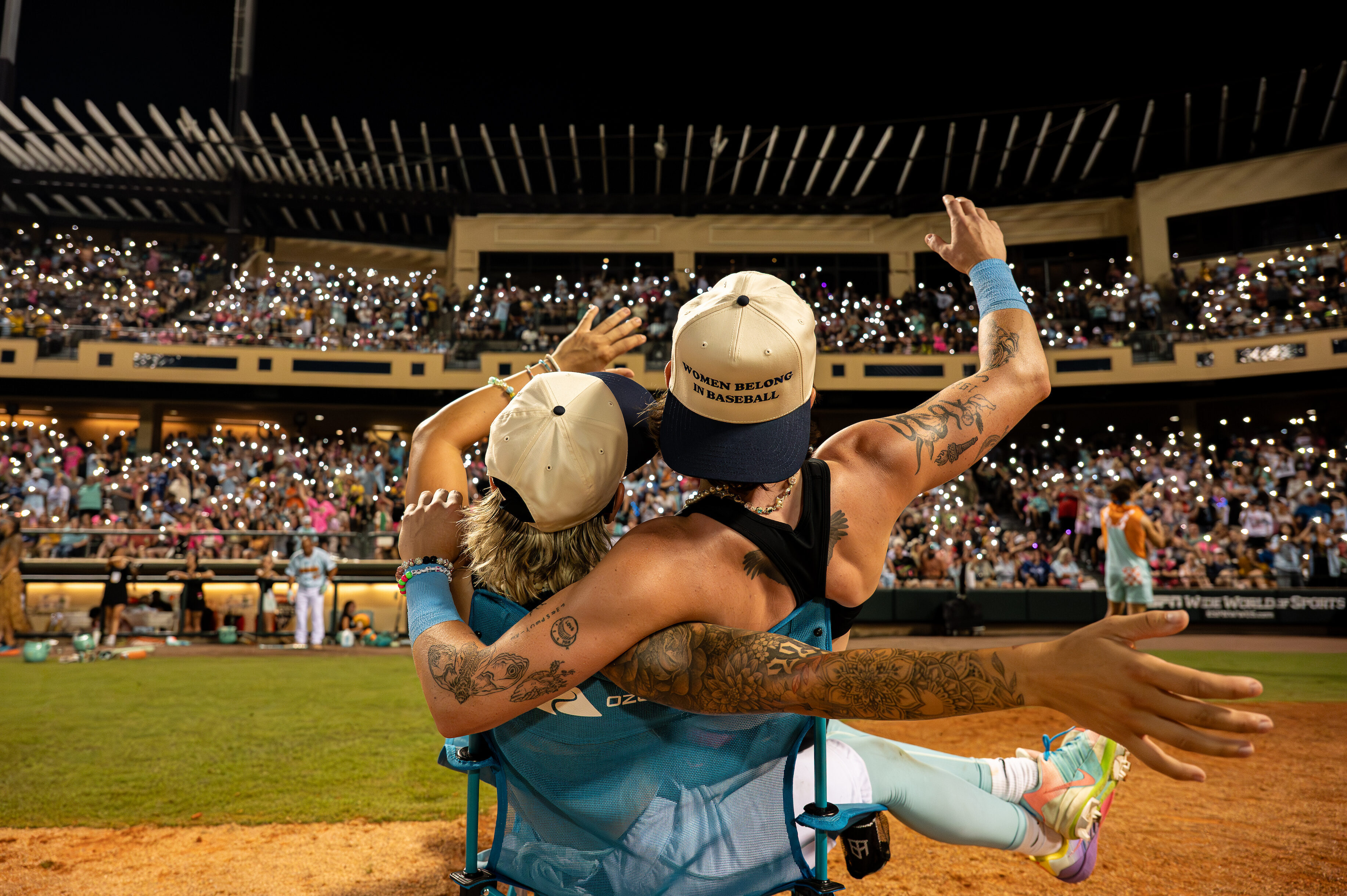
This piece comes from issue #03 of our print magazine, Sporty Spice. Your purchase or subscription helps Autostraddle stay afloat at an extremely perilous time for queer media. Get yours here.
Ashton Lansdell and Denae Benites are finally living their dream — a busy year for Women’s baseball.
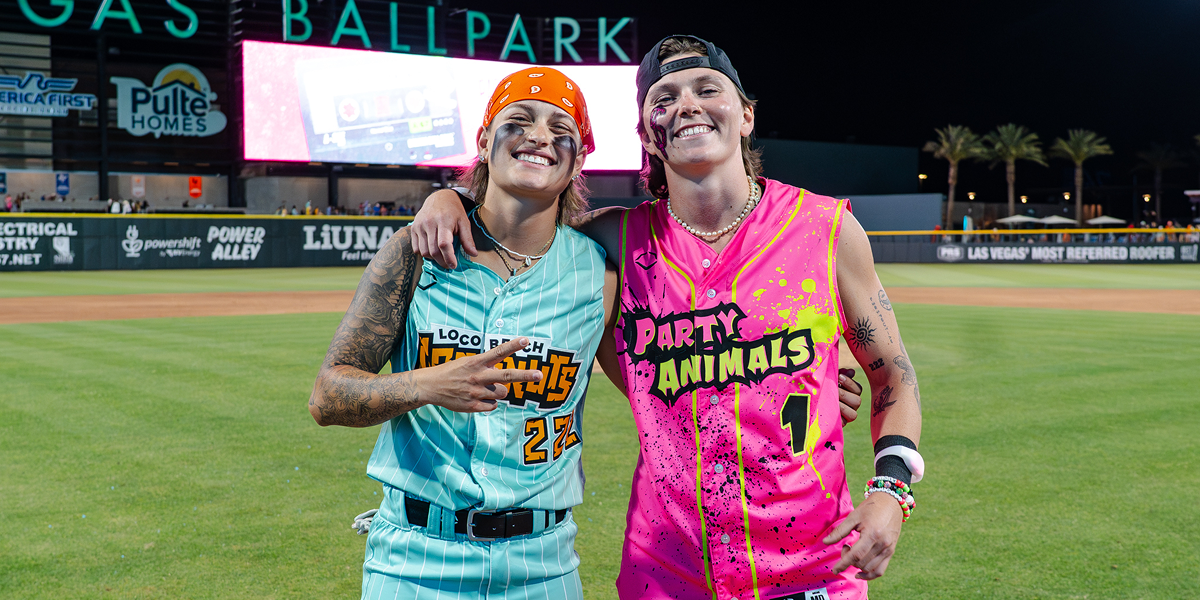
It’s been a busy year for women’s baseball — and in the decade that I’ve been covering the sport, that’s the first time I’ve ever gotten to say those words. The best women’s baseball players in the U.S. have been consistently booked, and for some, the possibility of making an actual career out of being a professional baseball player is finally becoming a reality.
All year, two veterans of the sport, Ashton Lansdell, 25, and Denae Benites, 24, have been building hype on social media — and the baseball diamond — as members of the Banana Ball league, whose season began in February. This July they took the field as members of the U.S. Women’s National Baseball Team in the Women’s Baseball World Cup in Rockford, Illinois. And finally, on August 1, they’ll both be members of the inaugural season of the Women’s Professional Baseball League, the first pro women’s league in the U.S. since World War II.
The pair first met back in 2016 at a Major League Baseball-hosted girls’ development event. “[Lansdell] immediately caught my attention as an athlete and brought a ton of energy that I gravitated towards right away,” Benites remembers. They’re now relishing the opportunity to play baseball on the kind of stage they dreamed about as kids.
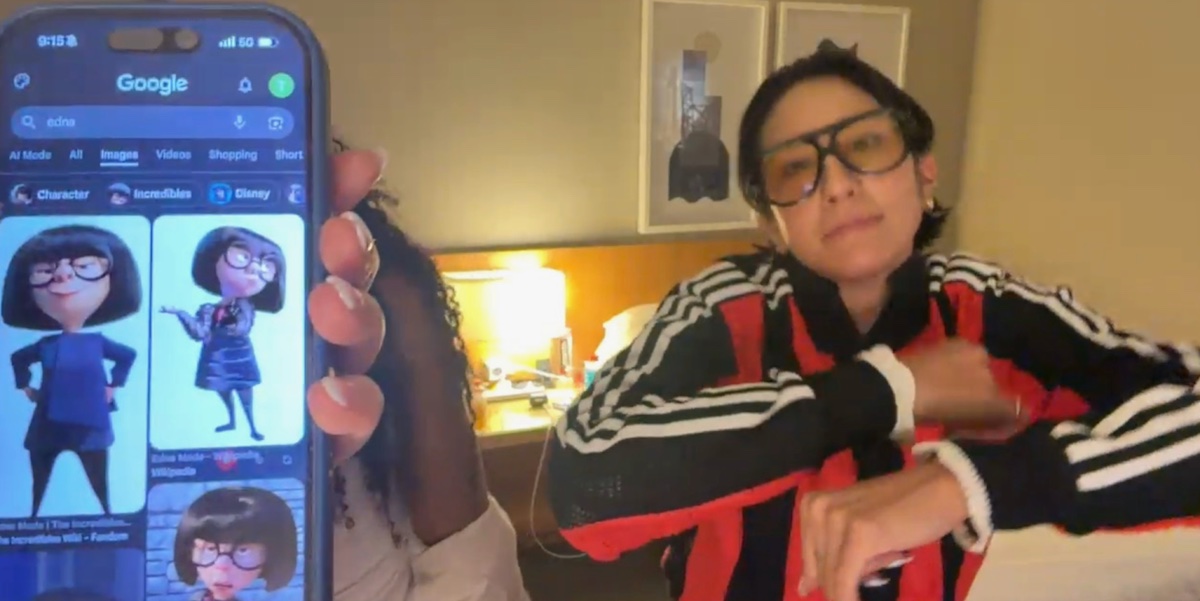
Being based in Savannah, Georgia together for the Banana Ball season is helping a close friendship bloom. They’ve gained a social following for their Banana Ball content — Benites is a catcher who plays for the Loco Beach Coconuts and Lansdell is a utility infielder for the Party Animals — which ranges from videos of their fun and involved “walkup dances” at games to viral trends that enable the two of them to show off their swagger. There are choreographed dances to the Black Eyed Peas’ “Pump It” in the empty stands before a game; photoshoots on the pitching mound in their sports bras; and gameday content showing the transition from locker room casual to on-field uniforms. They’re cultivating their own individual personas, while together giving off “StudBudz of women’s baseball” vibes (what would you call a white, baseball-playing version of the WNBA fan favorites? “Butch Buddies?” “Masc Mateys?” Let’s keep workshopping it).
“I love that,” Benites says when I bring up the comparison. “We look a lot alike, so we do get ‘twin’ a lot.”
And they do share an aesthetic — white mascs with shaggy, dirty blonde hair and rizz for days. Lansdell is a Pisces, while Benites is a Virgo — sister signs. It seems only natural that they would team up both on the field and on social media. And judging by the comment section, lesbians are eating it up. “I get gayer every day I stg” reads a comment on a BTS gameday video of the two. “Projecting this onto the screen at my coming out party,” another commenter wrote on a dance video.
“This is the first time that me and Ashton have actually been in the same space together for more than a month,” Benites says of their time with Banana Ball. “We’re building our bond as well, and I think it makes our content better, it makes our chemistry better in our videos, and I think people can feel that, too. But it is kind of surprising, I didn’t expect people to gravitate towards us like that.”
For those unfamiliar with Banana Ball, it’s basically baseball but if baseball players were allowed to have fun. Baseball in the U.S. can have an incredibly conservative and uptight culture —Major League Baseball is full of “unwritten rules” about how to “play the game the right way” that are meant to enforce respectability politics around whiteness and straightness. These rules discourage overly celebratory behavior, including bat flips. Banana Ball sells out stadiums with their high energy games full of dancing, trick shots, and gimmicks. Player walkups for an at-bat can begin all the way in the stands before involving half the team’s roster in a choreographed dance by the time the player makes it to the batter’s box to hit the ball. An outfielder may do a backflip while they catch a ball in midair. If a fan catches a foul ball in the stands, the batter is automatically out. And, crucially to our story here —all of the league’s six teams signed a woman to their roster for the 2026 season.
“I feel like it’s so freeing, because at the end of the day we’re playing baseball, the game that we fell in love with, the game that we wake up wanting to do every day, but it’s weight off your shoulders knowing that you can show up as you and bring your personality to the table,” Benites says. “They want to see you be happy, they want to see you dancing, having fun with people around you. I think it just makes a better environment for everybody here.
To understand why it’s such a big deal for Benites and Lansdell to be having the year they’re having, you need to understand the world of women’s baseball. Which is to say, you need to understand that there both is a world of women’s baseball, and isn’t a world of women’s baseball.
As kids, girls can join their local Little League or rec teams and play alongside their male peers thanks to a 1974 lawsuit that ruled keeping them off the team violated anti-discrimination laws. But as girls approach high school, they begin to get pressured out of the sport and towards softball. This happens because there are more opportunities for girls to have college scholarship opportunities playing softball, but that disparity is, of course, a result of that push-out. No high schools offer women’s-only varsity baseball, but Title IX requires that girls who want to play baseball must be allowed to try out for their school’s team, and many do, with rough data suggesting around 1,300 girls currently play on their high school “boys” baseball team. While there are organizations like Baseball For All, who host all-girls’ baseball tournaments, those tend to be one-off or once-per-year experiences, rather than the all-the-time team that girls play on.
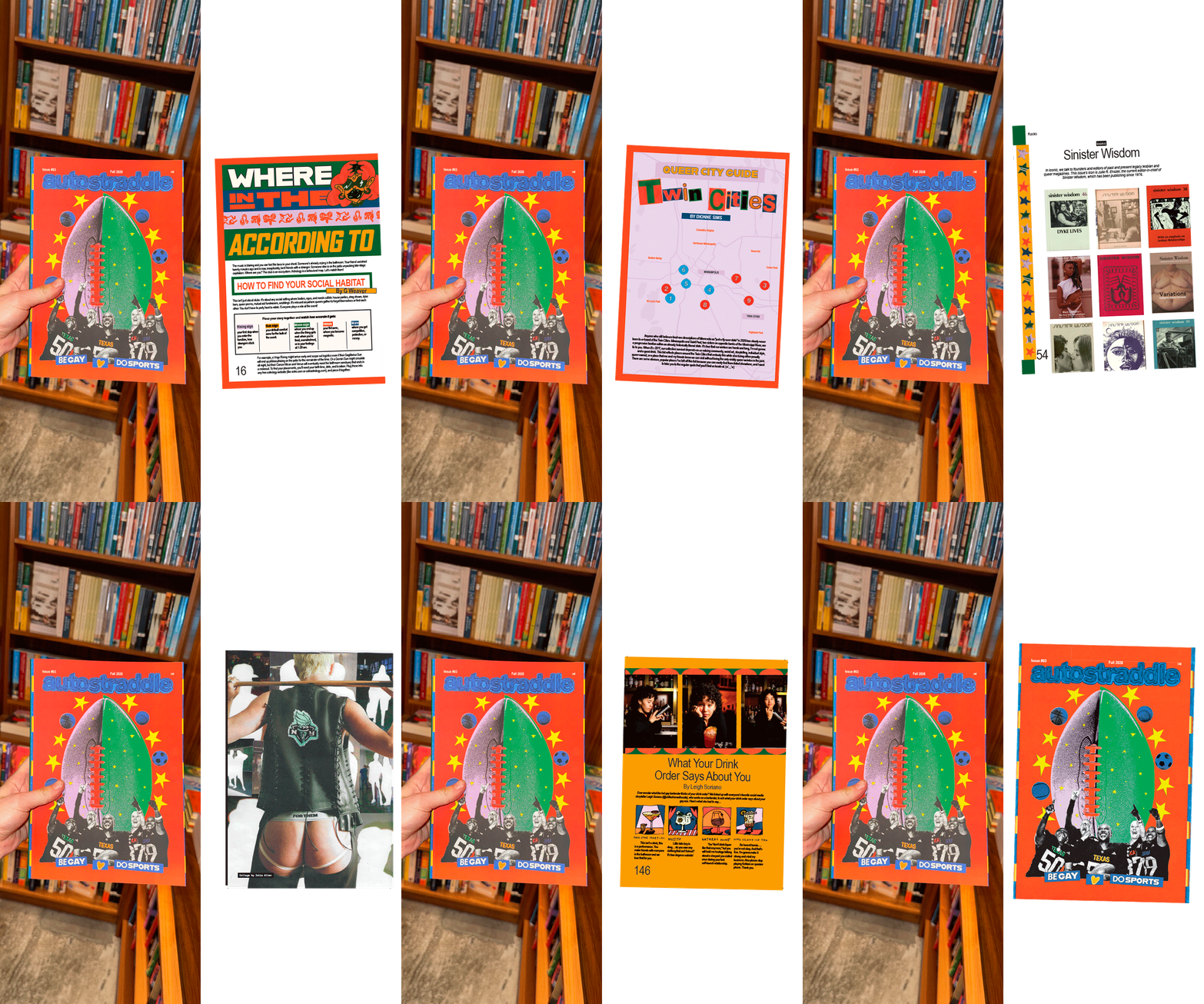
This story looks even better in print. Subscribe to get your copy of the Sporty Spice issue today!
Women who play baseball as adults — usually on the USWNT or in independent leagues like the Eastern Women’s Baseball Conference — tend to have one of two different experiences. Either they resist the pressure to switch sports and continue playing baseball, often being the only girl on their team for their entire lives and sometimes dealing with harassment or bullying as a result, or they leave behind the sport they fell in love with to learn a new one. Until now, there hasn’t been a pro league for women, so playing for the national team was the highest level of baseball they could play.
Benites and Lansdell are examples of each of those paths. Benites grew up in Las Vegas, Nevada and played baseball through high school. After graduating, she became an EMT and a volunteer firefighter and found a local men’s rec league that allowed her to join — she needed a place to hone her skills and stay in shape as she worked towards her goal of making the USWNT, which she did in 2019.
“I would play on Sundays” with the men’s league, Benites says. “I would work out by myself throughout the week, trying to find any tournaments I could get into, just to stay on that level of play.”
Lansdell is originally from Marietta, Georgia, and also played baseball through high school. She made the USWNT in 2018 and played juco (junior college) ball her freshman year but tore her ACL. Then COVID hit, which wiped out the season. She eventually decided to switch to softball because it was the only way she was going to be able to get a college scholarship. She played two seasons at Florida International University before finishing her career at Ole Miss.
“I thought [the adjustment] was going to be somewhat easy, and it absolutely woke my butt up,” Lansdell says. “There was a lot to learn; baseball and softball are completely different sports. It’s not easy going back and forth.” There’s a common misconception that softball is an easier sport than baseball, a perception absolutely rooted in the fact that softball is considered a sport for girls. It’s not; it’s just different. The ball is bigger, the diamond is smaller, and the pace is faster.
“Baseball is flowy, and it’s kind of swaggy in a way,” says Lansdell. “And softball is just like go, go, go, go, go, quick girlypops!”
The one thing that playing collegiate softball did allow Lansdell to do was to stay in shape for the USWNT, which would play for two or three weeks each summer. But for players who’ve aged out of somewhere to play baseball, they often spend the year training in isolation in order to stay in shape for those few, magical weeks.
Speaking to Benites and Lansdell during the middle of their Banana Ball season, I was starting to ask what it was like to be the only woman on their men’s Banana Ball teams, when I stopped myself. For them, being the only woman on a men’s team was the norm. It was how they grew up, and it was the only way they really knew baseball.
Those few weeks each summer when they played with other women as members of the national team were the outliers, not the norm. Most people don’t even know the U.S. has a women’s national baseball team; Stolen Bases: Why American Girls Don’t Play Baseball author Jennifer Ring calls it “the best kept secret in sports.” The WPBL will be a similarly novel experience —a pro league entirely for women.
“It’s like this whole time we thought that we were the only one — the only girl on the team, or we’re the only girl in our community, or in our state, who play baseball — and we all come together on this one team, on this one field, and it’s like, ‘Wait, we’re not the only ones,’” Lansdell says of getting to play on women’s teams. “Then you start learning about one another and you get to learn how special it is to be a female baseball player, because we’ve all gone through similar things but at different times, and it’s still brought us all together and built us into who we are. And then we’re playing the game that we all fell in love with, while representing our country, all at the same time, so it’s really cool to be able to play alongside other women in this sport.”
Playing with other women helps them realize they are not alone in other ways, too. Lansdell met her girlfriend, pro softball player Aliyah Binford, when they played together at Ole Miss. “I can’t speak for everyone, but I definitely feel like the community of women’s baseball is probably 95% gay — not a legit statistic!” Lansdell jokes.
“No, but there are a lot of people who are very similar to Denae and [me], who are women baseball players. It’s cool to be able to represent that and be a part of that community to show people that, ‘Hey, we’re here, you’re not the only one, this is an open and free and safe space.’”
Benites and Lansdell know how lucky they are to be able to be openly themselves while playing the sport they love. Former All-American Girls Professional Baseball League player Maybelle Blair is still incredibly involved with women’s baseball, and both have known her for several years now. Blair is also a member of the WPBL’s advisory board, and she recently came out at the age of 95 — coming out as a player in the 1940s or even in the ensuing decades was, obviously, not an option.
“I honestly couldn’t imagine having to know that [about yourself], and then not be able to show it,” Lansdell says. “So I’m definitely very grateful, and we’re all just blessed to be alive in this moment in time because we are allowed to be ourselves while also playing the game that we love, and being on this stage.”
What started as mutual respect for each others’ games has grown to be a real, deep friendship. “Through the years of getting to know Ashton, I started to see her for who she was, how she cares for people, how she shows up when the people around her need it the most,” says Benites. “I saw her as more than just an athlete.” Being in the middle of a season doesn’t give them a ton of downtime to hang out since they’re often resting or recovering from games, but the two enjoy beach days when they can get them.
“That’s basically twin right there,” says Lansdell. “I think she’s a great person. “She has a great head on her shoulders and puts good energy out into the world, and those are people that I want to surround myself with and have in my life.”
As kumbaya as Benites and Lansdell are about their budding friendship and baseball careers, they’re still opponents much more often than they are teammates. And building familiarity with each other in Banana Ball, playing each other often, will help them learn each other’s games. Yes, that will make them better able to have success against each other, but it will also strengthen their chemistry as USWNT teammates when the time comes. Especially since Benites is a catcher and Lansdell plays the infield, having a connection and knowing each other’s nuances is essential to on-field success.
The WPBL will see Lansdell and Benites based in the same place, too. Over eight weeks, the league’s four founding teams will play a six-week regular season and a two-week postseason at Robin Roberts Stadium in Springfield, Illinois. The centralized location allows the new league to keep travel and logistics costs down as they build something new. The WPBL is also another opportunity for Lansdell and Benites to take what they’ve learned playing baseball growing up, as well as with Banana Ball, and help shape the culture of a new league that isn’t beholden to the rules of a game that was founded by and for men. So even though Benites is playing for the New York Heights and Lansdell is playing for the Los Angeles Queens, they’ll be able to bring that friendship and connection with them all year.
“I can’t wait to mess with her across from the dugout and talk shit, but also just be hard on her when it’s needed,” Lansdell says. “We’re just here to have fun, honestly, and everything that we say to each other is lighthearted, no matter what.”
“I think being on different teams and the same team is going to help us,” Benites agrees. “Different teams, we can yap at each other, we can give each other a hard time, it’s all fun and games, but friendly competition. It’s just gonna motivate both of us and make each other want to be better. And then being on the same team, just being able to use that to our advantage.We know we have each other’s backs.”

This story looks even better in print. Subscribe to get your copy of the Sporty Spice issue today!

Comments
saving to read for when my print issue arrives but excited for then!
I TOO AM READY FOR THE GIRLS TO PLAY HARDBALL
I love this. Something to see in Springfield that isn’t Lincoln related. Though I would love to see Mary Todd in attendance.
It’s great to see athletes like Lansdell and Benites thriving. It reminds me of fnaf 2, where teamwork and strategy are key to success—just like in sports!