





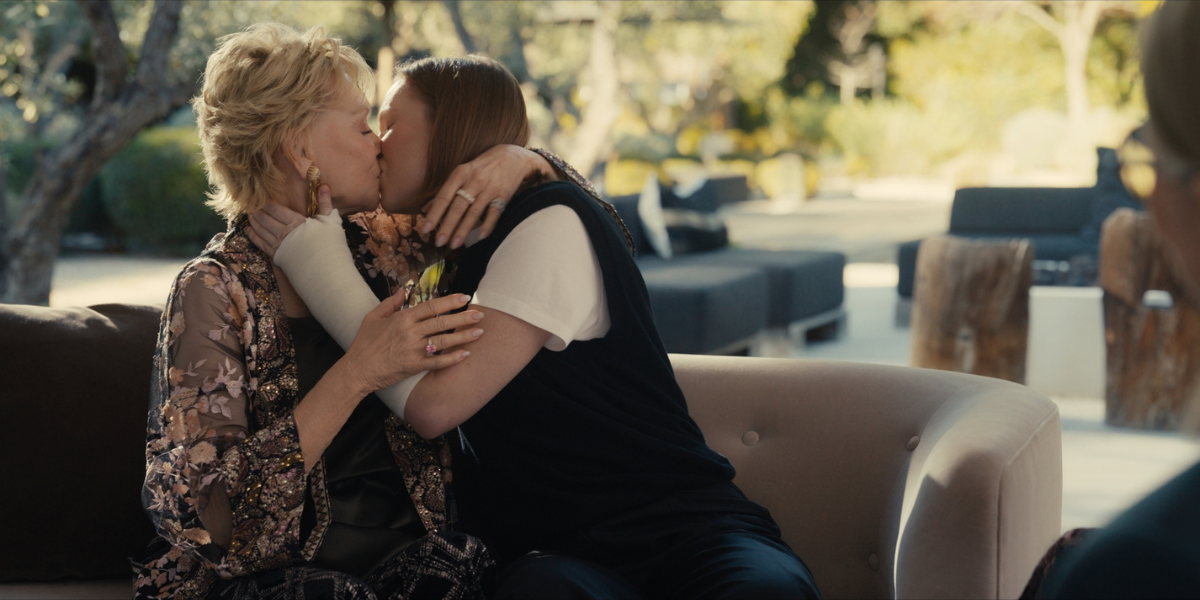
It’s finally happening. Hacks has given us everything we’ve ever wanted: a romantic relationship between Deborah and Ava. Never mind that it’s a fake relationship, because that makes the storytelling so much more real.
In “Montecito” — written by Guy Branum, Andrew Law, and Bridget Parker and directed by Paul W. Downs — Deborah sets a meeting with fellow comedian Kelly Kilpatrick (a much anticipated guest turn from Cherry Jones) in order to try to get a specific designer jumpsuit worn by Carol Burnett from her because she wants to wear it for her MSG show. Deborah and Kelly hate each other, quite fair on the part of Kelly’s animosity given that Deborah has made a lot of jokes about her through the years that skew homophobic. When Ava shows up at their lunch to return Deborah’s phone she left in the car, a misunderstanding begins.
Because of the way they interact with each other — Ava nagging Deborah for drinking coffee so late in the day and saying it’ll keep them both up — Kelly assumes Deborah and Ava are in a secret relationship. With wildly perfect delivery from Jean Smart, Deborah goes to say she isn’t gay but ends up saying “I’m…gay.” She needs something from Kelly, and if she needs to use a lie to get it, she’ll do so. Kelly invites Deborah and Ava to spend the weekend in Montecito with her and her wife Monica (the incomparable Leslie Bibb).
Deborah doesn’t tell Ava until their arrival at Kelly and Monica’s Montecito doorstep about the little lie: “Oh by the way, Kelly Kilpatrick thinks I’m gay and you’re my secret wife, so we have to spend the weekend pretending to be lesbian lovers so I can get that Carol Burnett jumpsuit.” Ava doesn’t have much time to react.
So Deborah and Ava embark on their fake dating scheme, and Deborah quickly realizes she bit off far more than she can chew, with Ava leaning into the lie with a UCB-improviser-level commitment to the bit. Things are complicated by the fact that Ava is clearly attracted to Monica, but that only adds more comedy and deliciousness to the already delightful setup.
When Kelly asks how Deborah and Ava met, Ava tells the actual story of their first encounter from the pilot. She doesn’t have to change any of the actual details of how they met, just the way she delivers it. The story indeed sounds like the tale of two unlikely lovers meeting, and their bickering dynamic only adds to the perception that they’re together. It taps into what I’ve written about so many times: Ava and Deborah’s dynamic is so easy to map onto a relationship. It speaks to society’s tendency to glorify romantic love and downplay other forms of it that Kelly and Monica see Deborah and Ava and automatically think lovers. It seems so obvious. And it’s not all that hard for them to pretend at the end of the day.
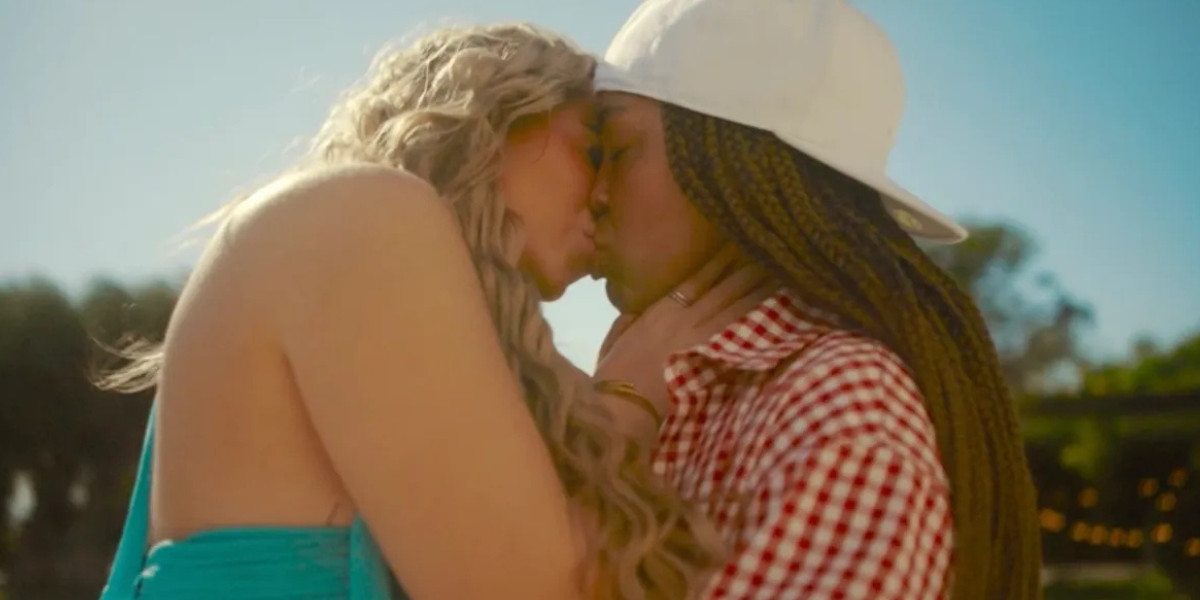
Ava, thrilled to make Deborah squirm after she forced her into this lie, asks for a kiss and then goes in for a make out. Later at dinner, when Monica asks if Deb straps, Ava hops in and says she’s a pillow princess who also loves eating Ava’s ass. Ava makes it clear she’s not going to let Deborah off easy for this lie. Between Leslie Bibb’s wonderfully over-the-top performance as a chaotic femme, Cherry Jones as a cigar-smoking butch with a penchant for younger women, Ava’s commitment to the bit, and Deborah’s discomfort, it’s all a recipe for exquisite comedy.
Not only do Monica and Kelly think Deborah and Ava are in a relationship, but they then start to believe it could be a toxic or abusive one. And boy, they’re not entirely off the mark there either! When they imply Deborah may have hurt Ava’s arm (in actuality, she was hit by a Waymo), Deborah insists she has never hit her, but Ava refutes that. Deborah did slap her that time. Their relationship indeed is not always healthy and is sometimes quite far from it. Again, Monica and Kelly are picking up on something real, even if the dial is turned just slightly left of reality.
Ava and Deborah are having real relationship issues. Deborah is lying to Ava, and she knows it. Kelly has a theory: She thinks Deborah has betrayed Ava and that Ava isn’t over it. She thinks Ava might be trying to heal that betrayal by oversharing about their sex life and demanding to know everything about Deborah’s life. Again, this isn’t really far from the truth. Ava wishes Deborah didn’t have so many walls up still. But Ava and Deborah have always had different ways of approaching intimacy and relationships, and Kelly points out that isn’t necessarily a bad thing. Ava does need to hear all of this…even if it’s not going to lead to the incredible orgasms Kelly promises it will. It will lead to amazingly written punchlines though! And that’s their own version of good orgasms.
Deborah does confess to Ava she had lied to her. She’d had a mass removed in a medical procedure, and she just didn’t want to worry her. Everything is fine. They reconcile with their different communication styles. It’s a productive conversation, and maybe they needed to fake date in order to get there. It’s a brilliant subversion of the “fake dating” romance trope, if you think about it. The usual trajectory for that trope is the two people realize they’re in love with each other and begin to date for real. In Deborah and Ava’s version, they do still have significant realizations about themselves and each other, even if it doesn’t result in a “real” romantic relationship. This presents a more realistic endpoint, sure, but it’s also a very meaningful one. Hacks proves over and over that there are more forms of love, intimacy, and life partnership than just romantic and sexual (I think Kayla and Jimmy often show this, too) and that we should honor them just as much as we do the romantic ones.
Even when Deborah and Ava confess to Kelly and Monica they lied, the other couple doesn’t believe them. They still think they’re in a relationship but that Deborah can’t come out. They refuse to see their dynamic as anything other than clearly romantic.
Recently, I listened to Fred Armisen’s episode of Amy Poehler’s podcast Good Hang, which opens with Amy talking to Carrie Brownstein about her working relationship with Fred. Amy asks Carrie to define that relationship, and Carrie says the following:
“It’s not romantic. We’ve never had that kind of relationship, but there is something that is deeply loving in a slightly romantic way, and I mean that because it’s kind of heightened in the way that romance is heightened. So it is just a seamless, loving, heart-to-heart but platonic friendship, but it feels like family.”
I was instantly reminded of Deborah and Ava and how Hacks positions them as platonic soulmates. There is something so intimate about creating work together the way Fred and Carrie have done for so many years and the way Deborah and Ava do. I remember there used to be a ton of internet rumors and fan theories about Fred and Carrie being in a relationship back in the day, and I think it’s for the same reason Kelly and Monica see Deborah and Ava in a relationship and so much shipping culture has emerged around the characters, too. There is something that reads as romantic about the dynamic, and I think it’s fine to say that outright the way Carrie does herself in that quote. But I think we should all be challenging ourselves to consider why our brains automatically go to romance when encountering these types of relationships. There should be more language and more imagination for what intimacy and partnership can look like and be. Carrie uses words like “romantic,” “friendship,” and “family” all at once, speaking to the multidimensionality of the relationship and why it’s hard to categorize succinctly. Deborah and Ava are like that, too. Kelly and Monica slap the “girlfriends” label on them because it’s a straightforward encapsulation of their dynamic, even if it isn’t the full truth.
On a lesser show — or at least one weaker in the character development department — this whole plotline would purely be played for laughs, comedy for the sake of comedy, as “Who’s Making Dinner?” contemplated last week. But here, Hacks is laugh-out-loud funny about the conceit while also using it to deepen Deborah and Ava’s relationship and more interestingly explore the simple conflict of Ava catching Deborah in a lie. In order to get through this conflict, they had to fake date. It turns a comedic setup into something deeper and more dimensional. It is perhaps the most realistic and most compelling instance of a fake dating storyline I’ve ever come across. Because at the end of the day, it’s rooted in real intimacy and care, even if there’s no possibility of romance.
You can read my piece about the other episode of Hacks that dropped this week here.

Comments
I love that debs insists on being monogamous in the fake relationship. unlike disgusting ava. I am pro Deborah! also no pillow princes bs!
Great recap of Hacks! The Deborah and Ava dynamic continues to be one of the most compelling character relationships on television right now.
This was hands down my favorite episode. It was so well crafted from the writing to the acting.
Also Ava isn’t “disgusting” other commenter. What a mean thing to say. Especially how cruel Deborah can be.
I loved this episode (and your recap) so much. What could have been nothing more than gay baiting cringe was deeply funny and endearing