





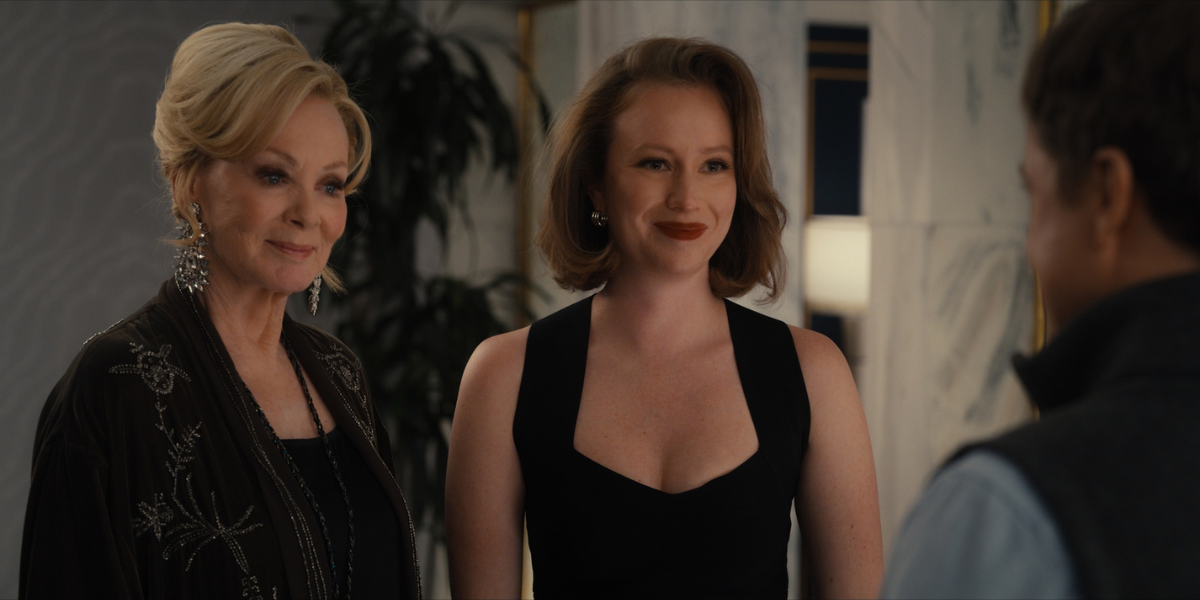
Hi and welcome back to my Hacks coverage, where instead of recapping the episodes in full, I’m focusing on the parts I found most interesting in the episode. Last week, I wrote one recap of both episodes that dropped, and this week was a double episode drop as well, but I’m going to write two separate episodes because, well, if you’ve seen them both, you know the second deserves its own piece…and place in some sort of hall of fame???? So let’s start with “Quik Scribbl”, written by Carolyn Lipka and Joe Mande and directed by Jen Statsky.
Jen Statsky—who co-created Hacks with Lucia Aniello and Paul W. Downs—made her directorial debut with “QuikScribbl”, the sixth episode of the show’s fifth and final season. And I actually want to open with an excerpt from what she wrote on Instagram about the experience of directing it, because it gets to the heart of the episode’s creed against AI. She writes that after 15 years of writing and producing TV, doing something new pulled her out of her element, which can be scary and intimidating. She continues:
“I’d had years of watching [Lucia Aniello and Paul W. Downs] masterfully do it, I didn’t want to let anyone down — though logically, I knew it’s a team effort and the safeguard of collaboration doesn’t allow for anyone to totally blow the ship up. But those illogical feelings — the nervousness, the self doubt, the being out of one’s depth — that’s an important part of the the process. Overcoming that doubt and trying despite it all IS the process of creating anything worth creating, and to try to sand it down with automation or tools of optimization just makes it emptier, soulless, and robs us of the joy of finding the answers within ourselves and our fellow collaborators.”
While Kayla and Jimmy are busy trying to secure a comedian for a residency at The Diva (the casino Deborah’s opening with Marcus) in a subplot that twists into something eerily similar to the recent Netflix docuseries Should I Marry a Murderer?, Deborah and Ava take a meeting with Graham Sweeney, a young tech developer Marcus finds for them who has a big pitch. Would Deborah and Ava like to be a part of his new company QuikScribbl, a new generative AI tool that’ll help “anyone” become a “writer.” Bridesmaid struggling to write her wedding speech? Just use QuikScribbl! And even better, if Graham gets what he wants, then Deborah and Ava will sell all the rights to their written material to the company so they can use it to better train the LLM to mimic their comedic voices. In turn, he’ll invest in the casino.
Ava is of course skeptical. Deborah, less so at first. I think this has less to do with her age and more to do with Deborah always being a pretty staunch capitalist. There’s no doubt in my mind this wouldn’t be the first time Deborah has invested in a shady technology company. And Graham, much like generative AI chatbots, knows how to tell someone exactly what they want to hear. He goes the flattery route with Deborah, making it clear they want her voice because of her immense talent. Graham uses the line all lackies for Big AI use, too: “AI is here, and it’s here to stay, so you either get on board or you get left in the past.” Ava pushes back on this false sense of inevitability, because that’s MY GIRL!
The problem with Ava’s attempt to talk Deborah down from AI is she uses the wrong talking points. I spend a lot of time in my life these days trying to talk people out of using AI (or worse, parroting those lines Graham says about the inevitability of AI), and I’ve found rhetorical discretion and strategy to be so important. Some people simply don’t care about the environmental impact. Some people like, say, Deborah Vance, who flies private. Ava detailing the environmental devastation of AI just isn’t going to work on her. Ava tries to pivot to an argument about the economy, but that doesn’t work on capitalist Deborah either. She believes that if your job is replaceable then that’s your fault. She also falsely believes that if Ava is a good enough writer, AI’s threats to writing jobs won’t impact her. Deborah’s arguments in the episode are frightening, because I’ve heard them all verbatim.
This tension drives a wedge between Deborah and Ava, with Ava threatening to sue Deborah if she decides to sell any material she also wrote. If anything, I almost wish this fight were bigger.
Deborah meets with Graham to tell him she’s in on the deal. But then things backfire. Ava’s lectures don’t convince Deborah to abandon the QuikScribbl deal, but Graham himself does accidentally. He says after they shake that he’s pretty sure Deborah will soon be using it to write her own material. Yes, he’s so delusional about AI that he thinks she’ll use the LLM trained on her comedic voice to…write in her own comedic voice. Again, he pushes the false sense of inevitability, saying all comedians will be using it so she’ll have to use it, too.
“I like doing the work,” Deborah asks. Graham asks her if she was stuck on a punchline if she really wouldn’t use a tool to help her figure it out. “There’s no shortcut,” Deborah responds. Ah, but you see, that’s exactly the mirage Graham is selling: a shortcut to creativity (never mind the fact that reliance on it can cause cognitive atrophy, thereby destroying your ability to think creatively). Deborah points out that if she uses a shortcut to the process, then it’s not art anymore.
She also talks about the importance of failure. She became a comedian through that process of failure. “Why are you trying to optimize the creative process?” Deborah asks “I mean, that’s one of the things we’ve actually figured out; we’re good there.”
It shouldn’t be easy. The creation of great art never is. I don’t say that to glamorize “the struggle,” but the struggle is indeed all part of the process. It’s exactly what Jen Statsky is talking about: self doubt and anxiety while creating is a sign you are an artist making something worthwhile. Don’t let imposter syndrome tell you otherwise.
When I get stuck on part of the novel I’m currently writing, I go on a run without headphones or I read a book or I go on a very long walk. Sometimes I figure it out after doing one of those things; sometimes I don’t and have to keep trying. And no, I don’t want a way to shortcut myself out of that, because it won’t be good. It won’t be me. Recently, I had to delete four thousand words from that draft that likely took at least four days for me to write. None of that was wasted time. It was all part of the process.
Even if you’re already staunchly anti-AI, watching this episode of Hacks will be a great reminder of the importance of failure, of rejection, of struggling to find the right punchline — whatever that looks like for you.
And as Deborah learns in the episode, there isn’t really a way to segment AI usage because of how deregulated it is. There is no “good use case” because every tool is catering to every type of use case. I think it’s meaningful for a television series to take this hard of a stance against AI, especially as we’re seeing some Hollywood creators and talent come out in favor of it in ways that downplay the harm. (Reese Witherspoon is trying to make “embracing AI” a…feminist issue?!) I’ve seen other television shows grapple with the fact of AI with somewhat mixed messaging on it (including The Morning Show and Scarpetta), and the best show about the dangers of AI is one that wasn’t intentional or explicit about that critique. Hacks addressing the issue head-on may feel heavy-handed for some, but it absolutely lands organically and feels at home in the series’ larger storytelling about finding your voice and building a career that isn’t always perfect.
Okay, stay tuned for my recap of episode seven, easily one of the best Hacks episodes of all time. I’m working on it now and as quickly as I can, but as we know, there are no shortcuts.


Comments
I was just thinking a few days ago about how frustrating it has been to feel forced into both side-ism with AI. I’m rude if I don’t acknowledge that it’s okay in this limited situation, or it’s complicated… when my feelings on generative AI are 100% negative, and while I’m naturally a very curious and open-minded person, in this case I don’t think I need to learn anything new about it, at least not as it applies to my job (teaching).
I was a little nervous watching the episode because in most other comedy shows I feel like the resolution would have involved some sort of compromise. I shouldn’t have been worried! Found everything that Deborah said really meaningful.
I see what you mean about wanting them to disagree more, but I actually felt like this was a pretty serious disagreement, just one between two women who have matured a bit during all their previous fights, and know what they are stepping away from if they blow up the relationship after trust is finally being earned back. I got the sense that both knew this was a huge thing, possibly partnership ending, and it would change their relationship if Deb said yes. They just didn’t need to have the fight and say everything (at that point in the process).
great point about them maturing into fighting/disagreeing better than they have in the past! i think this whole season is largely about that, so I take back what I said about wanting them to fight more about it haha
I was just telling my husband about this episode and how perfectly it summarized my feelings about the creative process. I’m currently forcing him to read your recap in lieu of watching the episode, so thank you for your service.