





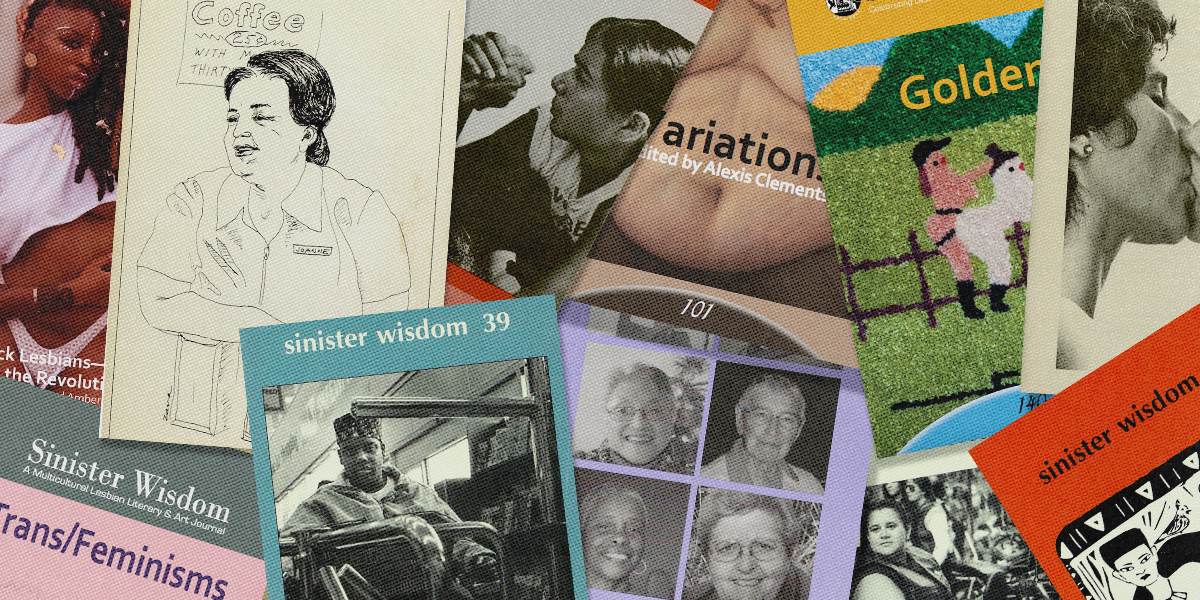
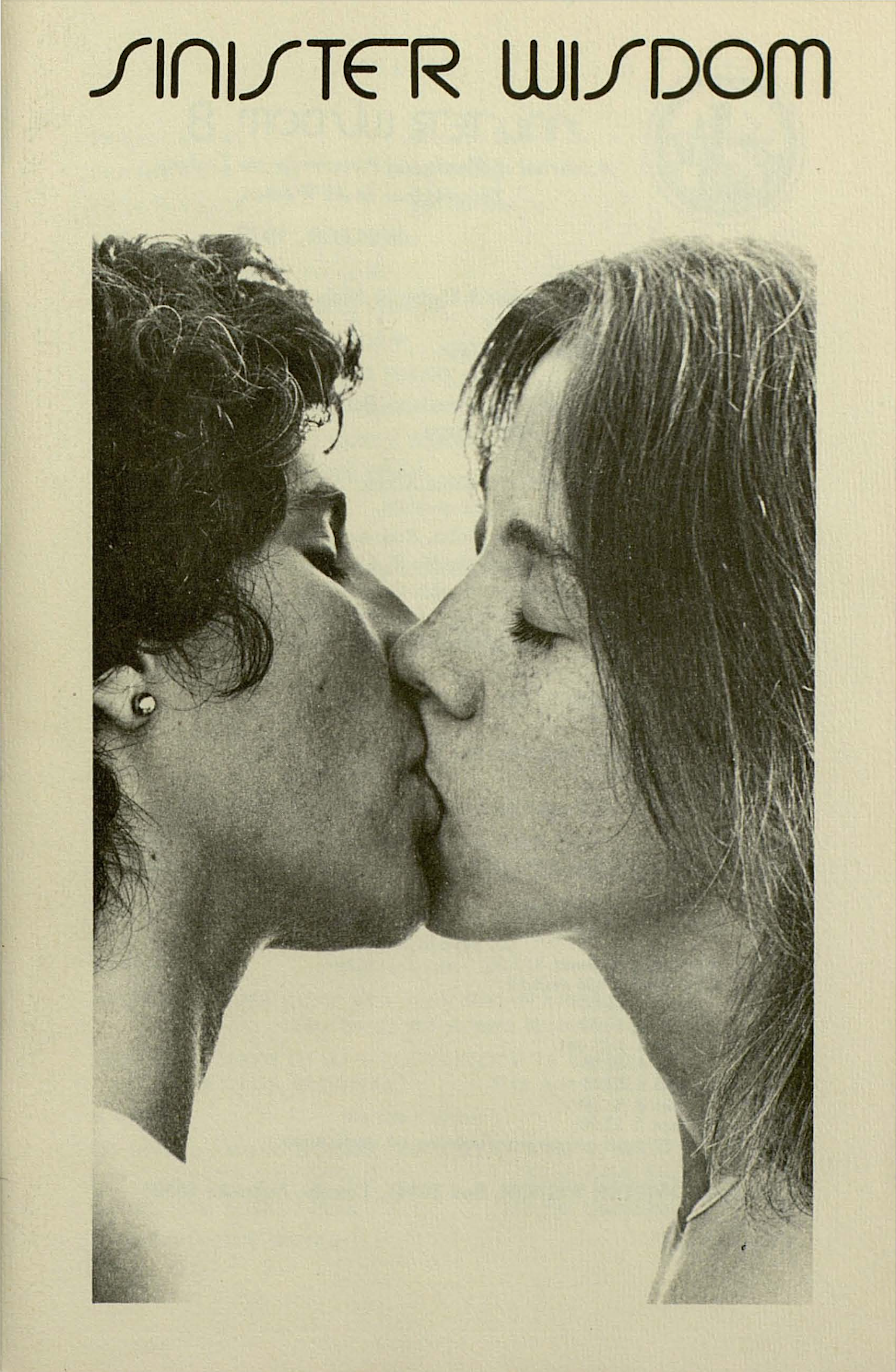
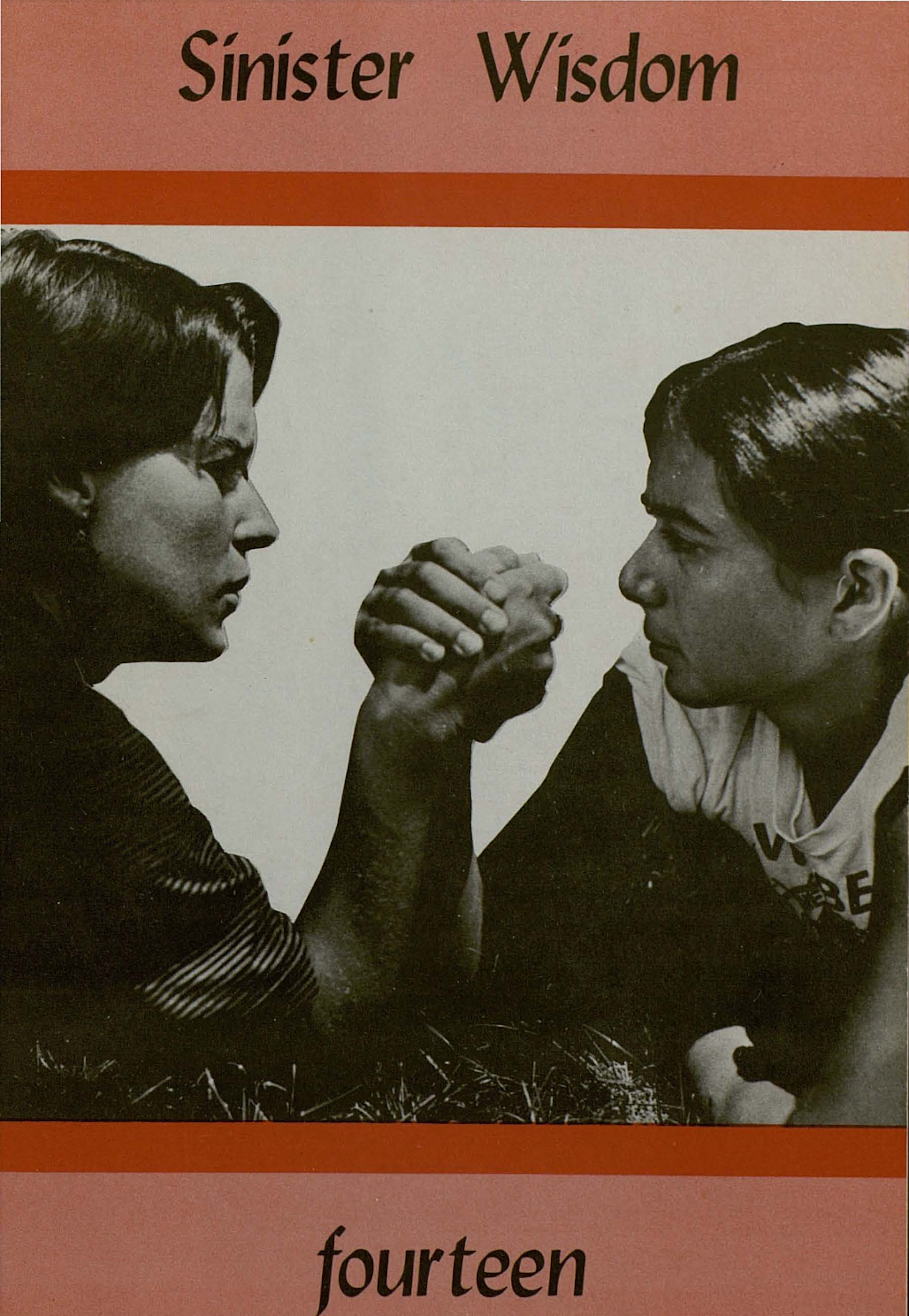
On a weekday in June, I received a package in the mail from Julie Enszer, longtime editor of the multicultural lesbian literary and arts journal Sinister Wisdom. The package included three recent editions of the journal, nine books released from its Sapphic Classic series, its annual wall calendar of lesbian art, and some fun swag: a bookmark and a sticker that say, “Sinister Wisdom: Your Bedside Companion since 1976!”
An all-volunteer run organization, Sinister Wisdom works to create multi-class, multicultural, multi-gender, multi-racial, world-wide intergenerational queer and lesbian spaces. Founded in 1976, Sinister Wisdom releases quarterly editions of its journal, which has published the work of hundreds of lesbians over its 50 years in print, including iconic writers like Audre Lorde, Adrienne Rich, Gloria Anzaldúa, and Minnie Bruce Pratt.
Sinister Wisdom is also much more than a journal. As a non-profit, a book publisher, and an event hub, it is a living archive and a force for intergenerational queer community. Per its mission, Sinister Wisdom recognizes the power of language and art to create radical, empowering, resilient, and joyous sanctuaries that build and sustain vibrant lesbian futures.
I spent the rest of the day pouring through the items in the package, skimming the books and reading pieces from the journal. While few lesbian and feminist publications remain from the revolutionary women in print movement of the 1960s and 1970s, and while many digital queer outlets have shuttered as it becomes harder to sustain independent content online, Sinister Wisdom continues to survive and thrive. I couldn’t help but wonder: What makes the journal unique, and what keeps volunteers invested in its mission, 50 years since its founding?
I interviewed Enszer, as well as six board members, interns, and volunteers, to find out.
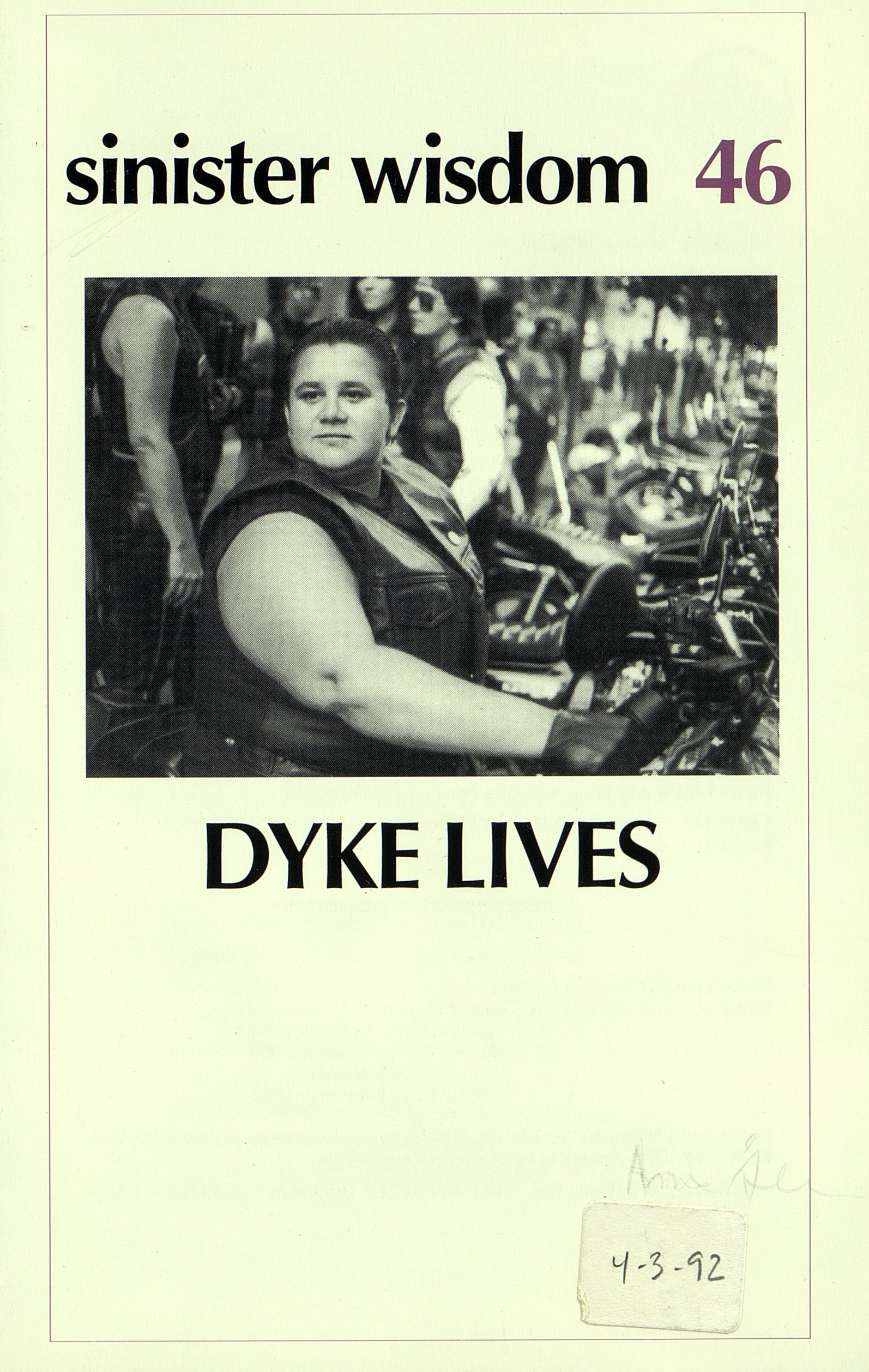
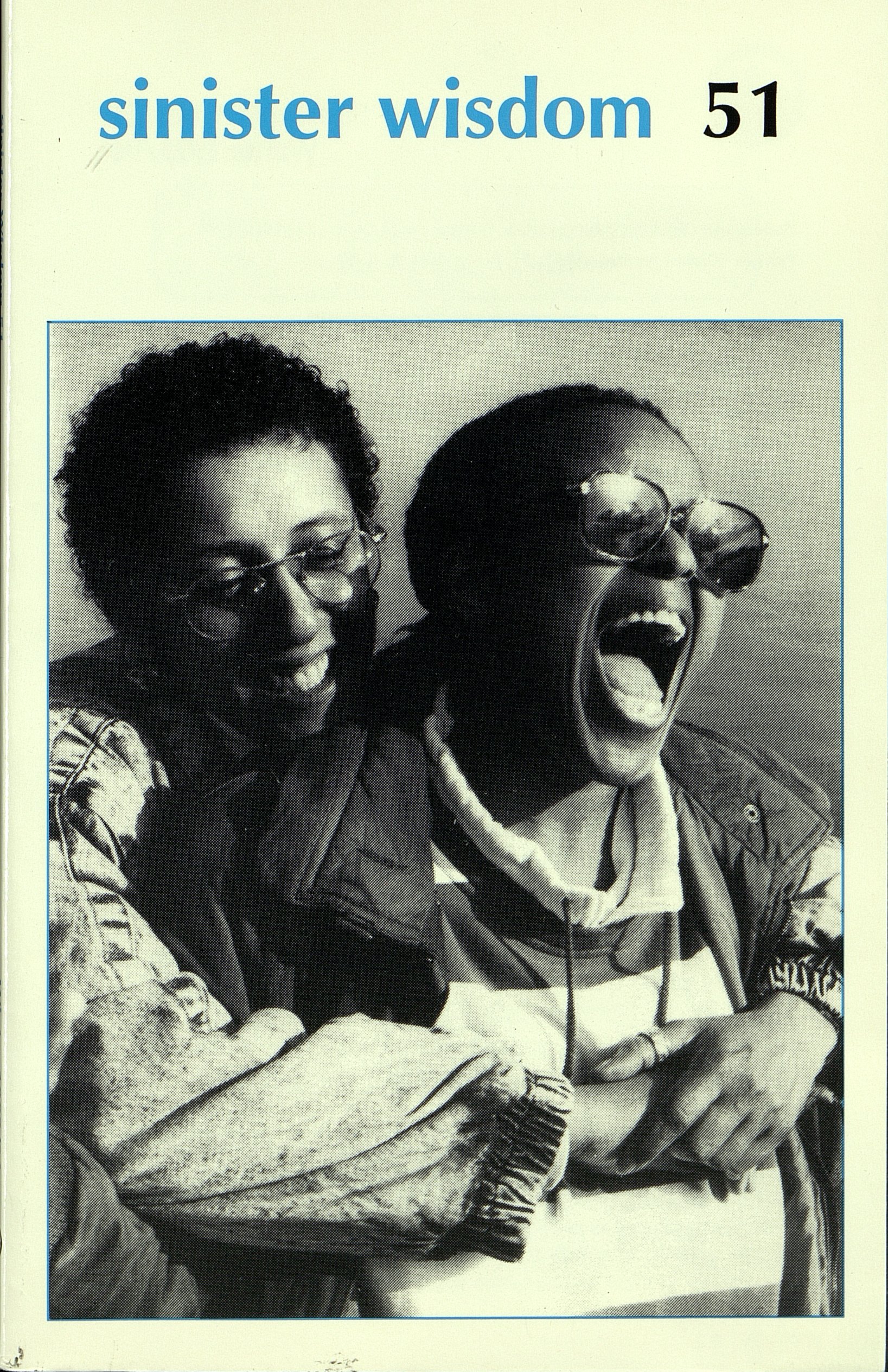
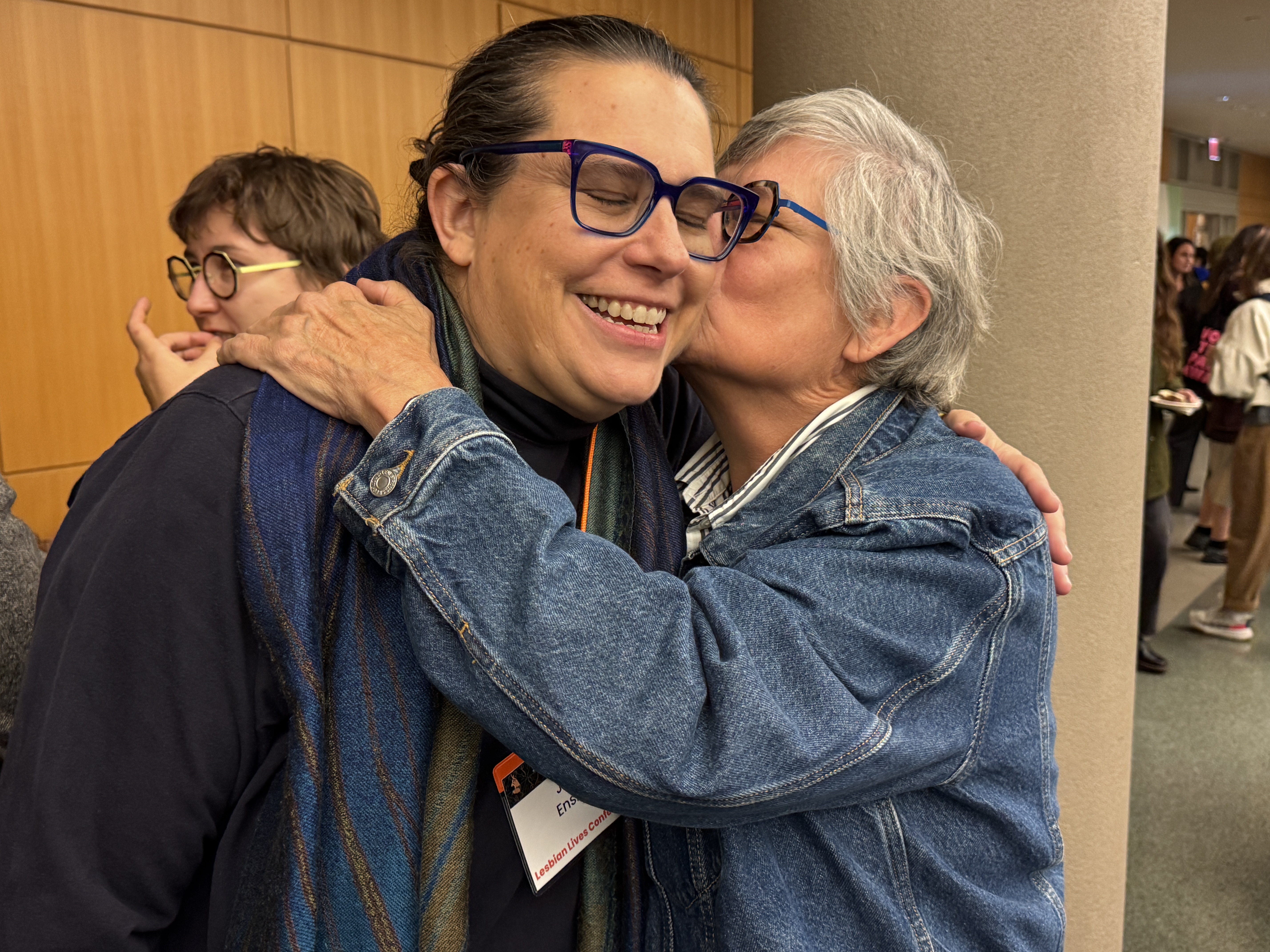
Enszer, a scholar, poet, and Instructional Assistant Professor at the University of Mississippi, began editing Sinister Wisdom in 2010. She first encountered the journal as an undergraduate in the 1980s. “I would find copies in used bookstores,” she tells me. “I bought those and read those and loved it.”
After serving as a guest editor for Sinister Wisdom’s issues on Lesbian Theories/Lesbian Controversies and Lesbian Poetry, former editor Fran Day approached Enszer about taking over the role.
“I tell people that she reached out to every other lesbian in the world before me…Everybody said no, they wouldn’t take over as editor and publisher. So Fran reached out to me. I think of myself as the person of last resort,” Enszer jokes. “I said, ‘Sure, I’ll do it.’”
That was in 2009, when Enszer first started editing the journal. “So that was a long series of early dates with Sinister Wisdom, and then the beginning of the love affair in 2010,” she says.
Under Enszer’s leadership, Sinister Wisdom has inaugurated a number of dynamic initiatives that help connect the journal’s history to the contemporary moment.
Their Sapphic Classics series publishes original books and reprints of iconic lesbian texts, making them more accessible to new readers. Recent Sapphic Classics include Acts of Resistance, a new collection of the essays, poetry, and correspondence of Black lesbian feminist writer Cheryl Clarke (who also happens to be Sinister Wisdom board member), as well as S/HE, a reprint of Minnie Bruce Pratt’s poetic memoir in which she challenges oppressive frames of respectable womanhood and narrates her life with partner Leslie Feinberg.
Sinister Wisdom also hosts frequent in person and digital events that create opportunities for lesbian and queer community and connection. The event formats are wide ranging in topic and structure: a few of its events in the last year alone have included a silent pop up book club in Chicago, an oral history of the national feminist newspaper Off Our Backs, a celebration of the poetry of Black lesbian writer Pat Parker, and a 50th anniversary fundraising auction, as well as launch parties for each of its issues and publications. Its digital events are all recorded and archived on its YouTube channel, preserved and shared to make them watchable to wider audiences.
The increase in digital events was spearheaded by Enszer. During COVID lockdown in spring 2020, “it became clear that what was happening in our country and around the world was going to present an existential threat to a number of organizations, and particularly small nonprofit organizations,” Enszer says. “We were either going to meet that existential threat by leaning in, finding relevance, and making ourselves meaningful in this huge disruption that we were experiencing, or we were going to fall apart.”
“I was asking myself, ‘how can Sinister Wisdom lean into this moment?’” she continues. “We started offering online events and doing more to knit lesbian community together around art, literature, and culture.”
I first heard of Sinister Wisdom during one of these online events, a 2024 panel celebrating genealogies of Jewish lesbian novels featuring one of my friends, writer Sam Cohen, as well as Sarah Schulman, Judith Katz, and Ellen Galford. It was thrilling to witness this intergenerational conversation about queer Jewish literature and politics.
“There’s something special about creating conversation about being a Jewish queer person, because it’s a particular experience,” Sam tells me, reflecting on the event. “One of the women on the panel sent me her books in the mail with a nice note. That felt meaningful.”
After the panel, I signed up for Sinister Wisdom’s biweekly newsletter, Sinister Snapshot, and was quickly impressed with their curation of events, links, announcements, and news stories.
It doesn’t surprise me when Enszer tells me the newsletter began under her leadership as well, an idea pitched by former intern Sierra Earle. Many of Sinister Wisdom’s events and initiatives start as ideas formed by interns and volunteers.
“Sinister Wisdom is a space that says yes to lesbians,” Enszer says. “When people come to us with ideas to do things that they want to do, I want ‘yes’ to always be my answer…That’s part of what I think of as the ethos of Sinister Wisdom. We want to be a space where people can initiate projects and experiment with them.”
Another example of this ethos: the annual Sinister Wisdom wall calendar. When an intern pitched the idea of a calendar filled with images of lesbian art, Enszer was initially skeptical: “I thought, who uses a calendar? I haven’t used a calendar in over 20 years. I do everything on my iPhone. I was like, ‘Yes, and I’m worried that no one will want to use it.’
But according to Enszer, the intern was adamant she thought people would like the calendar idea. “That was 10 years ago,” Enszer says. The calendar now regularly sells hundreds of copies each year.
During our conversation, I find myself surprised by the amount of work Enszer and others take on without compensation. The administrative work of editing and publishing a quarterly journal alone must take up much of their time, not to mention the process of publishing books, planning events, mentoring interns, connecting with board members, and scheduling meetings to organize all of the above. What keeps volunteers continually committed to this lesbian labor of love?
“I give a lot of time as a volunteer, but an extraordinary number of people show up to do the work, to experiment in different ways, to find work that’s meaningful to them, and that allows them to connect with a broader community,” Enszer says. “So I do a lot of work, but I’m surrounded by lots of other people also doing a lot of work as volunteers. And that’s incredibly gratifying.”
Boston-based artist Bell Beecher Pitkin, one of youngest Sinister Wisdom community members, began working with the organization as an intern in 2022, between their junior and senior years of college. Among other projects, Pitkin has curated the Sinister Wisdom calendar for the past four years.
“I had submitted some work that was featured in Issue 125 [of the journal]…It was the first time my work was ever published and it was being published in a lesbian feminist multicultural magazine, which was a big deal for 19-year-old me,” Pitkin tells me.
In their first week at Sinister Wisdom, Enszer told Pitkin a surprising fact: Sinister Wisdom was founded in a house on the same street where Pitkin grew up, in a small town in North Carolina.
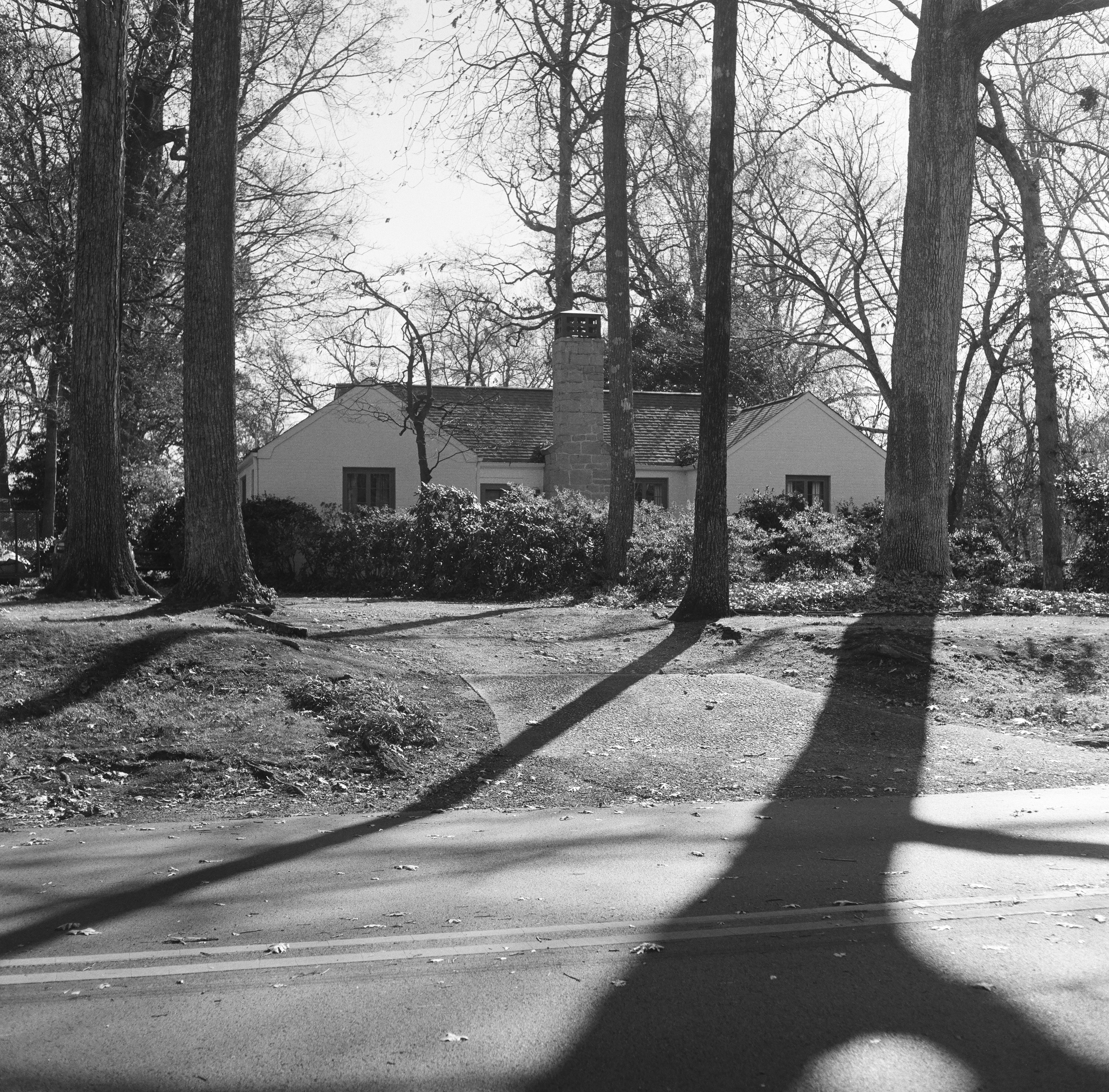
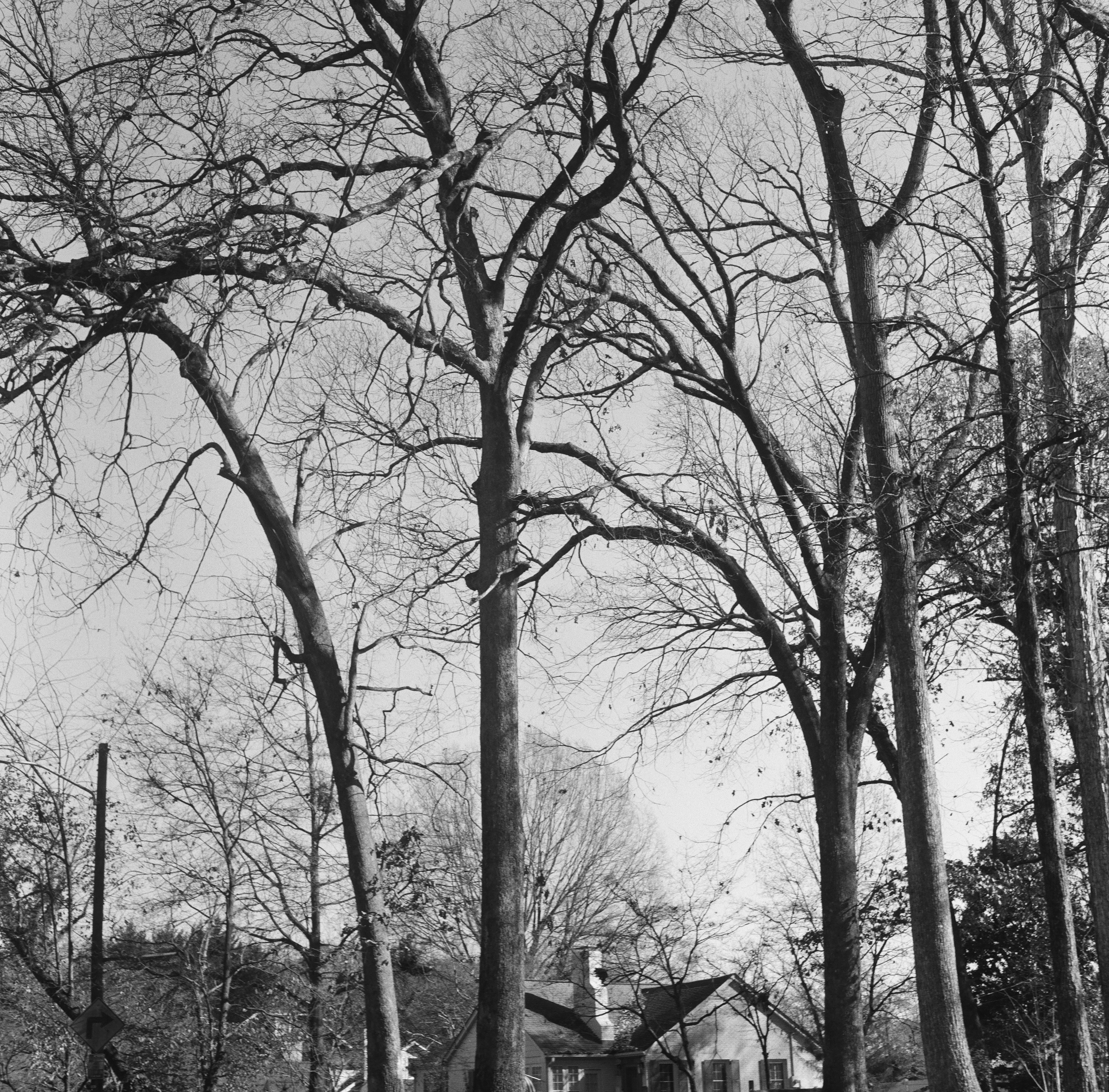
“For a long time, I felt like I couldn’t be a queer person in the South,” Pitkin says. “Now whenever I am home and back in North Carolina, I always do a pilgrimage to the house…it is a physical reminder of living history and all of the people who came before us. What it represents for me is a reminder to keep forging these radical agendas, to push forward lesbian feminist organizing, and to continue to fight for justice and equity.”
Pitkin now focuses on curatorial work for Sinister Wisdom, building networks and collaborating with lesbian artists of all ages. This October, one of their projects will come to fruition: an exhibit at the Dyke+ ArtHaus in Philadelphia “celebrating 50 years of Sinister Wisdom‘s creative legacies and the role of visual arts within the journal.”
As a Sinister Wisdom board member, Pitkin feels “tapped into this global lesbian ecosystem.”
“I still get a sense of awe or get shy sometimes, because it’s like, Joan [Nestle] is on the call, and so is Cheryl Clarke, and all of these people who I grew up reading,” they say. “But it’s really wonderful. There’s a great sense of collaboration. We’re all really committed to Sinister Wisdom‘s next steps in whatever form that is, bolstering ourselves for a more prepared, more committed, really enriched future.”
Award-winning journalist and author Sara Youngblood Gregory, a Sinister Wisdom board member who began as an intern 10 years ago, describes her experience with the organization as “a gift.”
“How many of us can say I get to spend an hour or two every few months with a group of influential and emerging lesbians who range from maybe 25 to 85?” she says. “Board meetings have given me a sense of how continuous the work of lesbian feminist publishing is, which both humbles me and inspires me.”
While most interns and volunteers with Sinister Wisdom work remotely, Youngblood Gregory was able to visit the organization headquarters in person—in Dover, Florida, where Enszer lives and works—because she went to college nearby.
“I would get to go into this house, with I mean, literally, floor-to-ceiling bookshelves, the whole room, all lesbian and queer works,” she says. “So many of them were originals and first editions too, from the 60s and 70s. It was incredibly impactful being in that room physically.”
At a moment when she was craving lesbian community, Sinister Wisdom connected Youngblood Gregory to “this world of lesbian writing and thinking and community building.”
“There’s a genuine interest in what lesbians and queer people are thinking and talking about, what matters to them and what feels urgent to them,” she says. “That’s a really great environment to do creative work and projects.”
Youngblood Gregory co-edited the journal’s groundbreaking Trans/Feminisms Issue, the first in which Sinister Wisdom publicly asserted itself as a trans-inclusive publication and organization. Now she is editing a forthcoming issue titled Butch/Femme Renaissance.
“I love orienting myself in butch/femme spaces and with butch/femme language,” Youngblood Gregory says.
The issue will “celebrate the breadth of work and the seriousness with which people came to the table with their ideas about butch/femme.”
Youngblood Gregory believes spreading awareness of Sinister Wisdom’s work can counter a “scarcity mentality” about lesbian and queer media that she sees circulating online.
“I can really understand why people are saying this. They’re frustrated. They’re feeling like they’re not seen in media,” she says. “That’s very real. And also, there is a lively, robust, ongoing well of queer, feminist, lesbian, trans, dyke cultural works that do not live only in the past tense…I mean, there’s so much happening. It actually isn’t hard to find, and it actually isn’t inaccessible.”
Indeed, the first 86 issues of Sinister Wisdom are digitized online and available for free. “What a wealth of knowledge,” Youngblood Gregory says.
Towards the end of our conversation, Youngblood Gregory encourages folks interested in Sinister Wisdom to reach out about interning or volunteering: “You can pitch guest issues, themed issues if you want to edit a project. Let’s collaborate on events. Let’s do a social media takeover. We do a blog. We do book reviews. There’s so many ways to get involved!”
“I want to express how deeply Sinister Wisdom has shaped my life,” she adds. “I began my career as a journalist because of what I learned with Sinister Wisdom.”
For Youngblood Gregory, the impact is both personal and professional: “I met my wife through Sinister Wisdom. Julie officiated my wedding!”
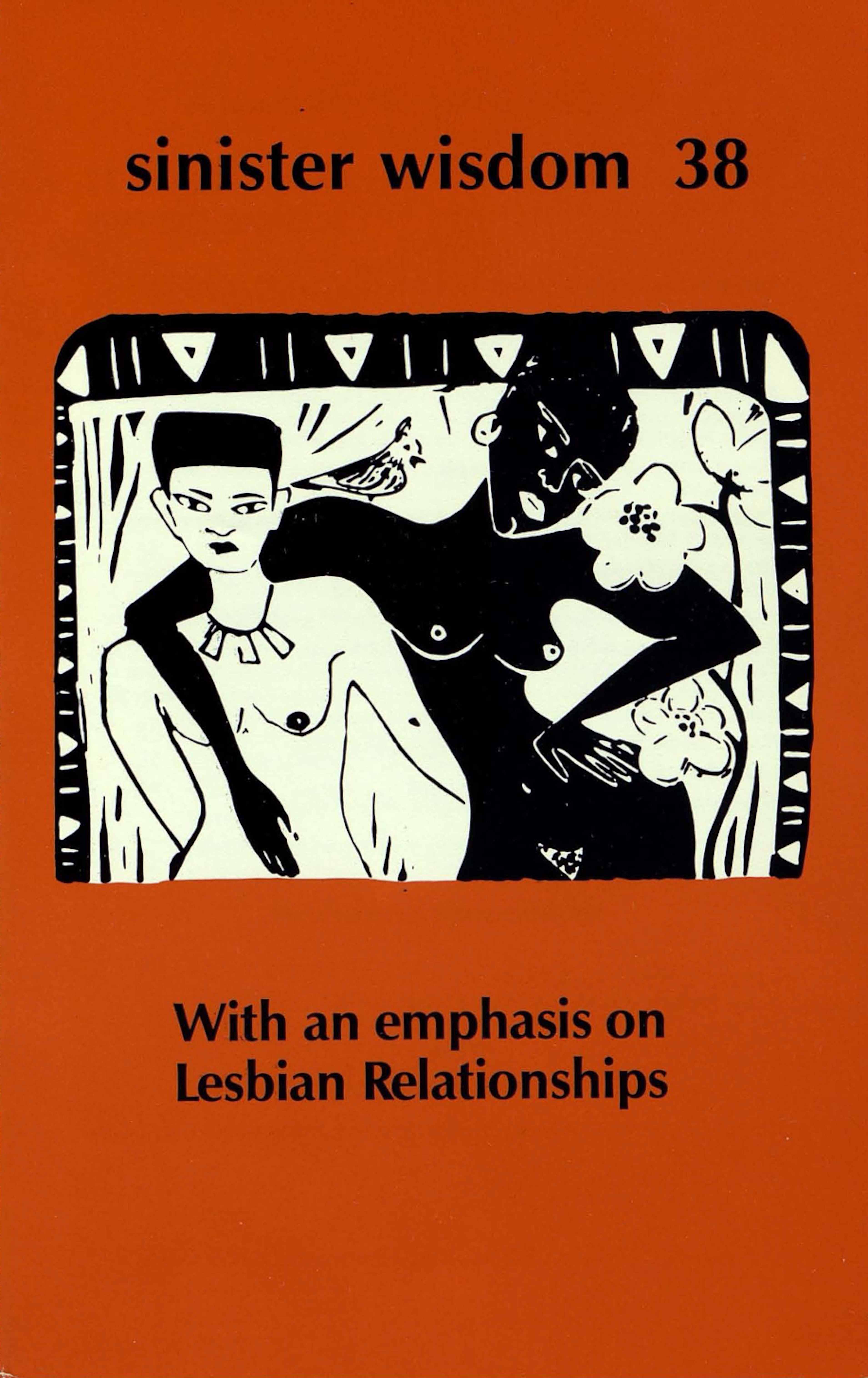
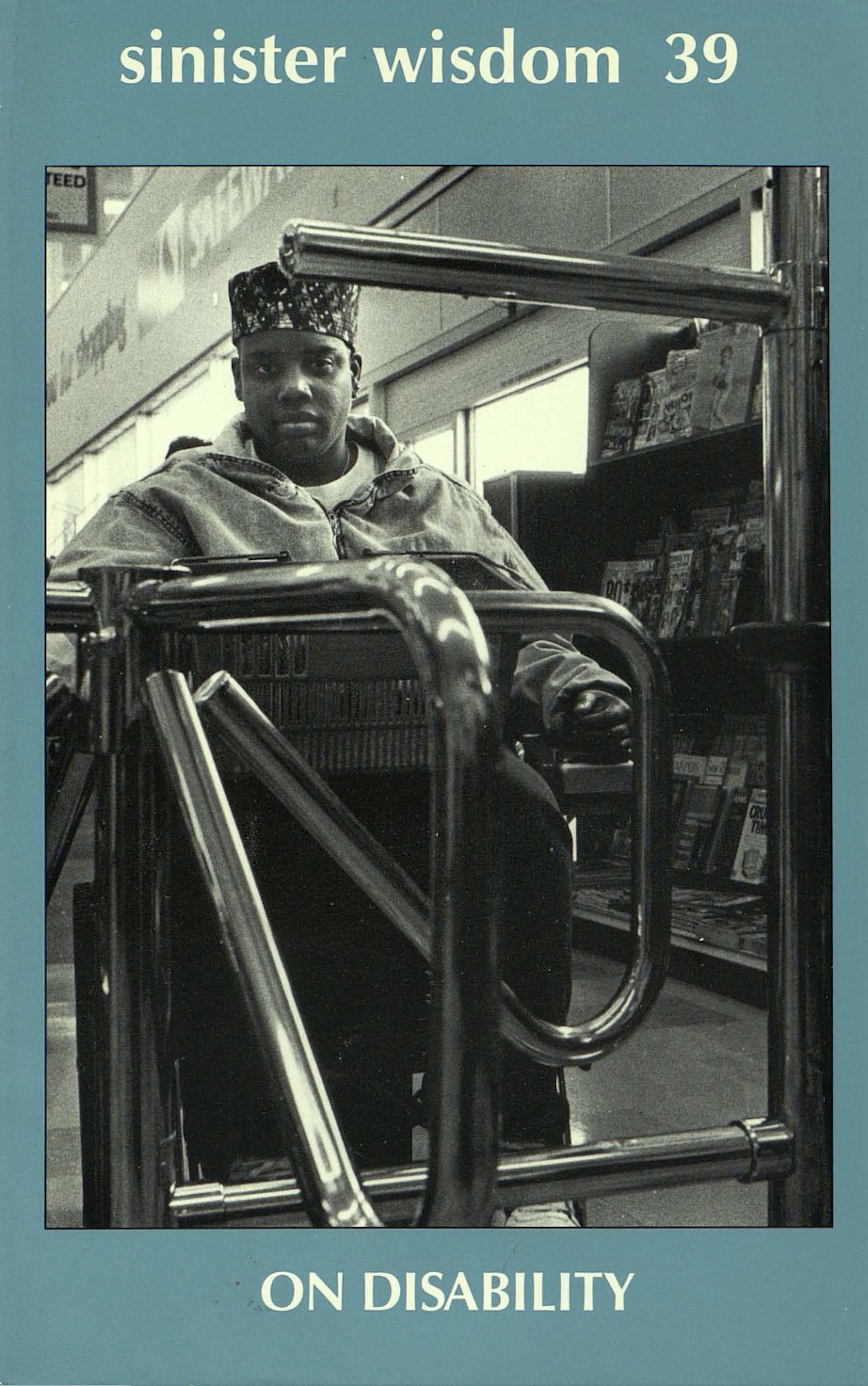
As I speak to the millennial and Gen Z members of Sinister Wisdom, I find myself impressed by the extent to which the organization has been able to recruit and retain younger queer folks among its members. The mentorship process they discussed feels deliberate.
Enszer refers to this intentional process as “generational transfer,” which describes the intergenerational collaborations at the heart of Sinister Wisdom’s everyday work. Generational transfer “ensur[es] the journal’s continued vitality and imbu[es] the value of lesbian culture to contemporary formations of lesbians and queer women.”
Generational transfer is key to Sinister Wisdom’s ongoing success. The process of knowledge sharing, mentorship, and relationship building across generations makes volunteering with the organization deeply fulfilling work for all those involved.
As Enszer writes, “Being in relationships that cross generations and are outside of heterosexual nuclear family structures offers lesbians and queer women an opportunity to know one another and begin to map out the spaces of where we align, where we conflict, and what the meanings of our shared and separate lives are.”
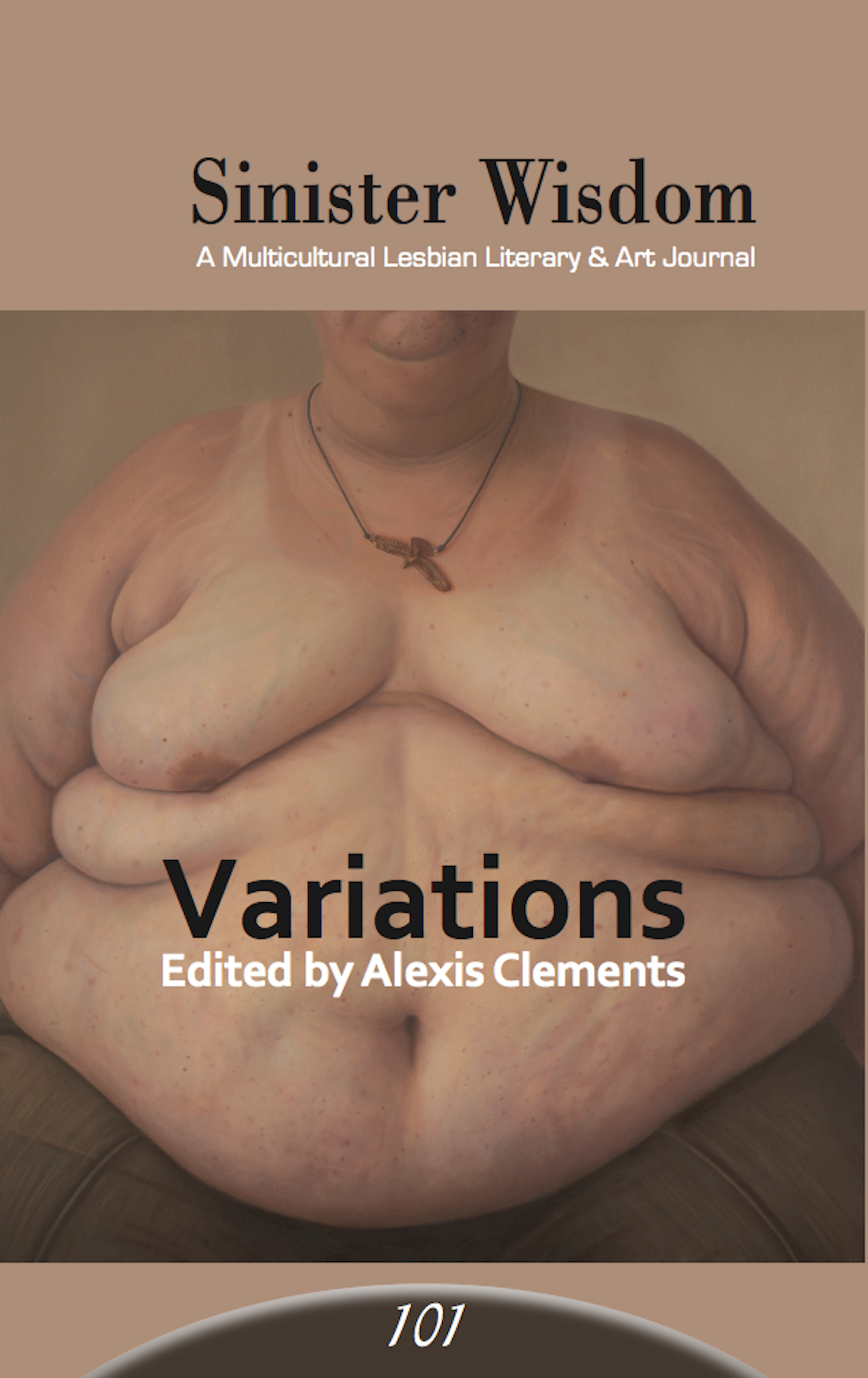
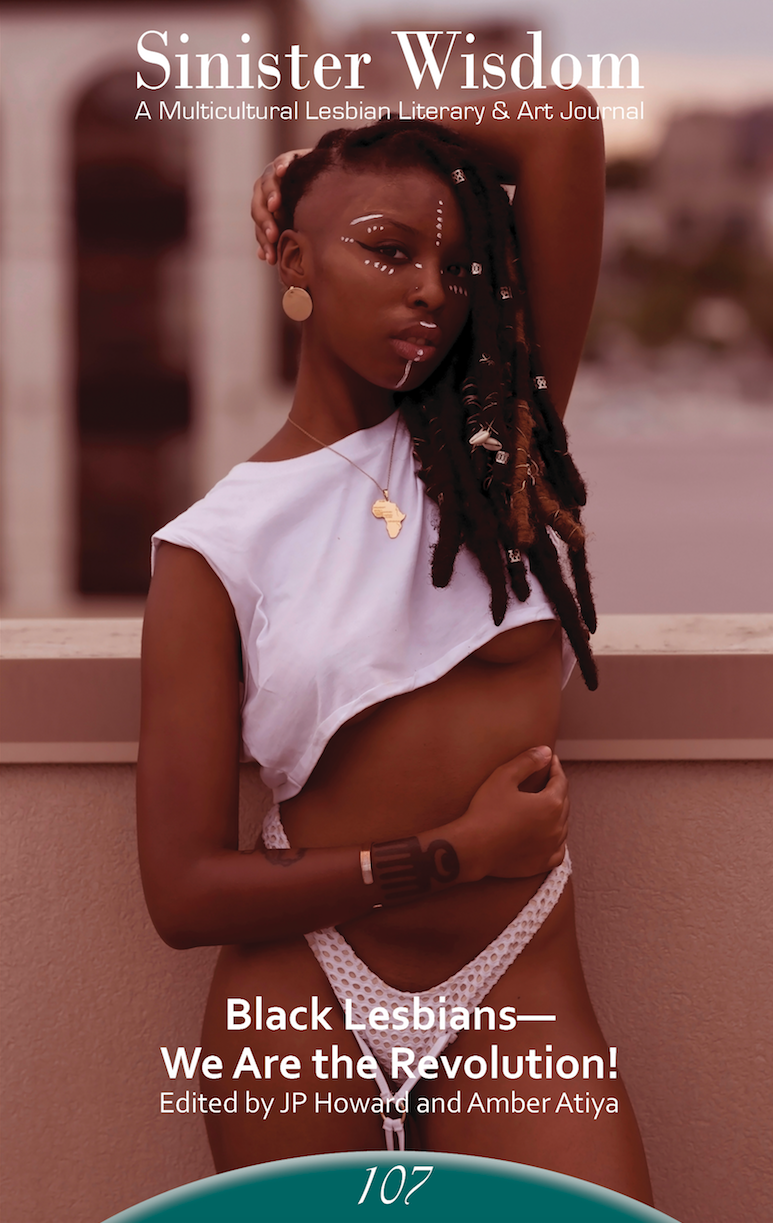
For Mel Oliver, a mixed lineage Black Native lesbian poet, storyteller, and educator who interned with Sinister Wisdom last summer, joining the organization gave her “a continuous space to explore exactly what I wanted.”
Working closely with Enszer, Oliver has taken on a number of projects, including reviewing journal submissions, collecting data to support Enszer’s scholarly research on the history of lesbian feminist publications, indexing Sinister Wisdom publications, and producing many of its Zoom events. Working on a wide variety of projects has allowed Oliver to hone her skills as she explores various career paths as a young professional.
“I have a place with Sinister Wisdom,” she says. “I feel valued through the work that I’ve done and the continued enthusiasm to experiment.”
“In my experience, it’s been really difficult to find other queer Black lesbians that I can be in coalition with and build with in that way,” she adds. “Sinister Wisdom has given me those arms or that network to do it.”
She mentions recent conversations with Cheryl Clarke and Black lesbian academic Briona Simone Jones, both of whom she met through the organization, as particularly meaningful and moving.
Coming of age in the 2010s, Oliver primarily found queer community online. While digital spaces provide lifelines for many LGBTQ folks, their membership skews young, and so can lack the sense of historicity that intergenerational queer communities can provide.
Sinister Wisdom “continuously bridges the past and the present and connects women and queer folks to women’s struggle and stories,” Oliver says. This is particularly important to Oliver, who has a background in journalism and archival work. As someone curious about the way information gets disseminated across space and time, she sees Sinister Wisdom as “a pillar or beacon” for those invested in feminist and queer storytelling.
“There is a tradition of women who have been doing this work,” Oliver says. “Are we carrying that lineage with us, understanding where our foremothers and foresisters came from, to build on feminism, to build on queer theory, to build on our movement, to build on our identity as a community? I think that Sinister Wisdom stands as a testament to that space of anchoring communal identity.”
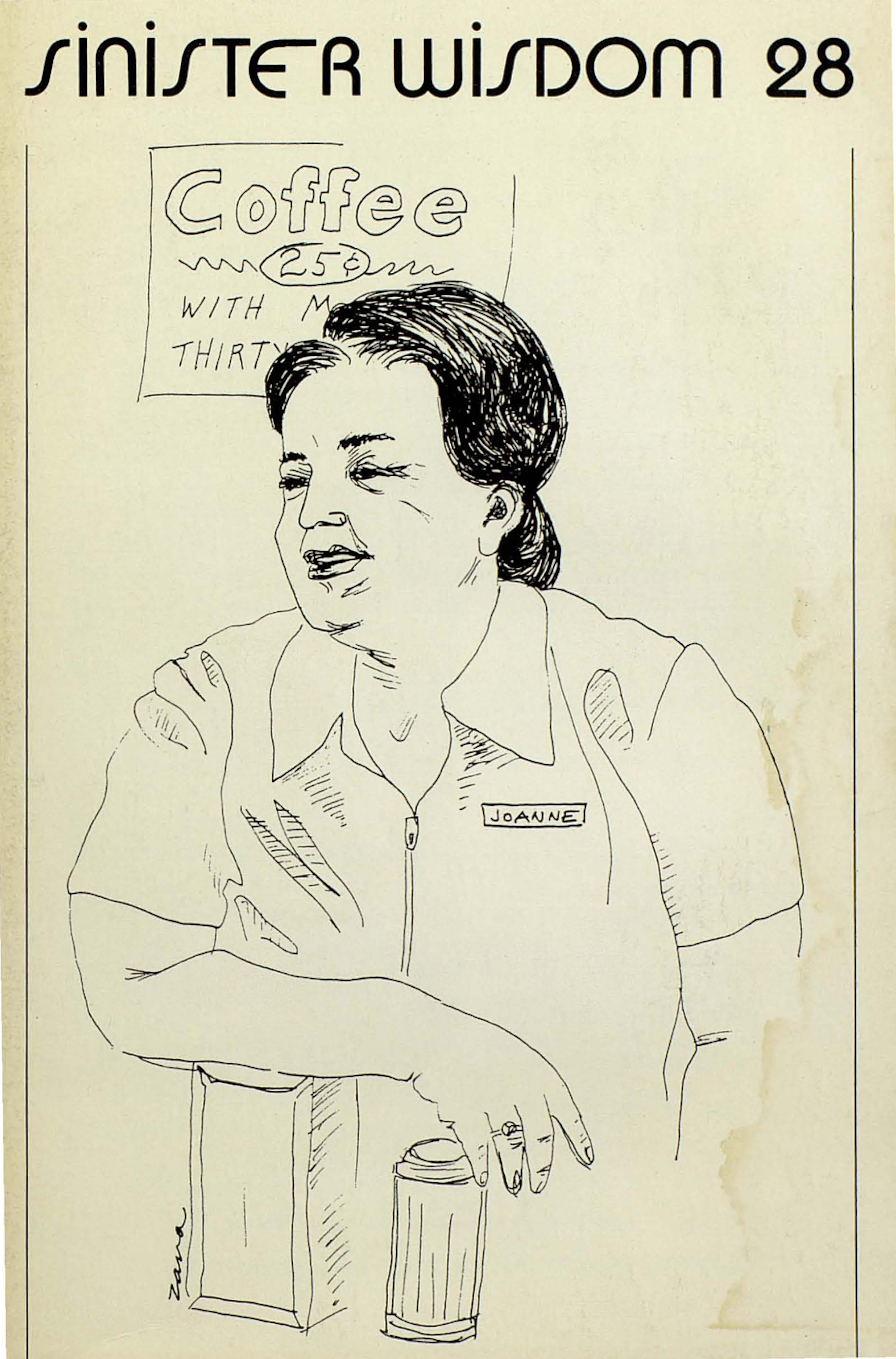
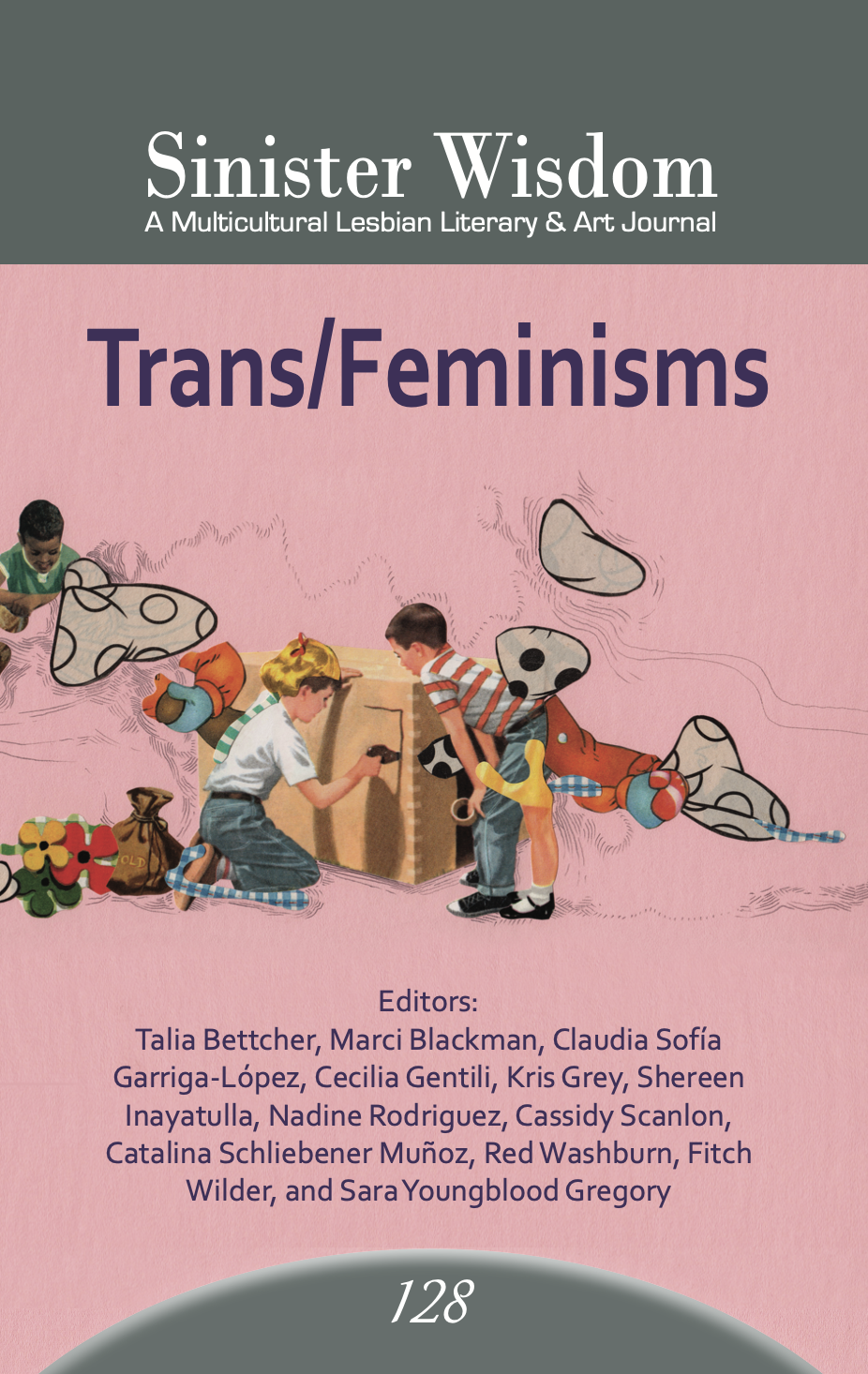
I feel the sheer force of generational transfer most acutely during my conversation with Joan Nestle, legendary lesbian writer and co-founder of the Lesbian Herstory Archives, who has served on the board of the Sinister Wisdom for over a decade.
“I’m an 86 year-old, anti-genocide, pro-trans 1950s femme,” Nestle answers when I ask her to introduce herself in her own words. “I’m deeply in the present,” she adds.
“I love the image of it, the auto straddle. I love the word straddle,” Nestle says when I tell her the interview is for an Autostraddle feature. “Anyway, I’m so pleased. If there’s something erotic to be found, I will find it!”
I’m thrilled to bring her into the world of Autostraddle, especially as someone who has taught Nestle’s classic 1987 essay, “My Mother Liked to Fuck,” which staked a claim for sex-positive feminism in the midst of the feminist “Sex Wars.” To hear her make a sex joke was icing on the lesbian feminist cake.
Nestle’s work was first featured in Sinister Wisdom in 1979, when writer Beth Hodges interviewed her and Deborah Edel about the Lesbian Herstory Archives, which was a new project at the time.
Decades later, in 2014, Nestle began to co-edit an issue of the journal called Lesbians and Exile with Sri Lankan lesbian writer Yasmin Tambiah. “That got me more immediately involved, and then Julie asked me to be on the board in 2015,” she recalls.
One of Nestle’s key goals is “internationalizing” Sinister Wisdom. She and Tambiah, who both live in Melbourne, Australia, are working on a forthcoming issue called Body of Land, which will center the work of Indigenous Australian writers. It will be the first issue of the journal published outside of the U.S. She hopes future issues continue to expand Sinister Wisdom’s transnational focus. “I want there to be a Palestinian lesbian issue,” she shares.
Nestle’s own work recently became a Sapphic Classic. In 2022, Sinister Wisdom published A Sturdy Yes of a People: Selected Writings, a collection of Nestle’s iconic essays. “It was Julie who really gave my writing a second renaissance, with publishing this collection,” she says. “Sinister Wisdom keeps writers alive. And for that, as one of those writers, I’m eternally grateful.”
For Nestle, the most unique thing about Sinister Wisdom is “its willingness to change.” She elaborates: “Yes, it’s lauded for its continuity, but that always makes me smile. It’s like people who’ve been together for 40 years and everybody applauds, but everybody knows they hate each other. It isn’t continuity in itself—that is one kind of success. But for me, it’s the vitality of change within a history of continuity.”
Nestle credits Enszer with creating a cultural environment that embraces evolution: “That only happens because of Julie. You need a general editor who’s comfortable with that… Julie’s very strong in her sense of her mission with this journal, but she has created autonomies within that structure.”
These autonomies—the systems that Enszer calls “saying yes to lesbians”—give all members a voice in the organization.
“At the bottom of Sinister Wisdom is a love for the expression of new voices,” Nestle says. “The most amazing thing about Sinister Wisdom is all its movable parts are all going on at the same time…Everybody’s passion is being enacted in some way.”
The ways that Sinister Wisdom navigates conflict and disagreement are central to this process. “That’s to me the most interesting thing. How a cultural institution, that’s an awful word, but a cultural creation of a community works that out,” Nestle says. “Sinister Wisdom successfully struggles because it’s always trying to do something new.”
“Thank god we’re not all the same!” she adds. To Nestle, the embrace of difference is necessary, especially in the contemporary moment.
“I’m grateful for every decade of argument, of anger, of struggle,” she says. “It’s all the imperfections of our attempts that are so important to me, particularly in a time of Trump, of vapid, brutal triumphalism.”
“This is such a crucial time that we be in unity, that we be appreciating and supporting our communities under siege,” she adds. “This is the time for us to take delight and strength in the richness of our difference, based around a respect for our right to desire, and love, and touch, and have a body that expresses ourselves.”
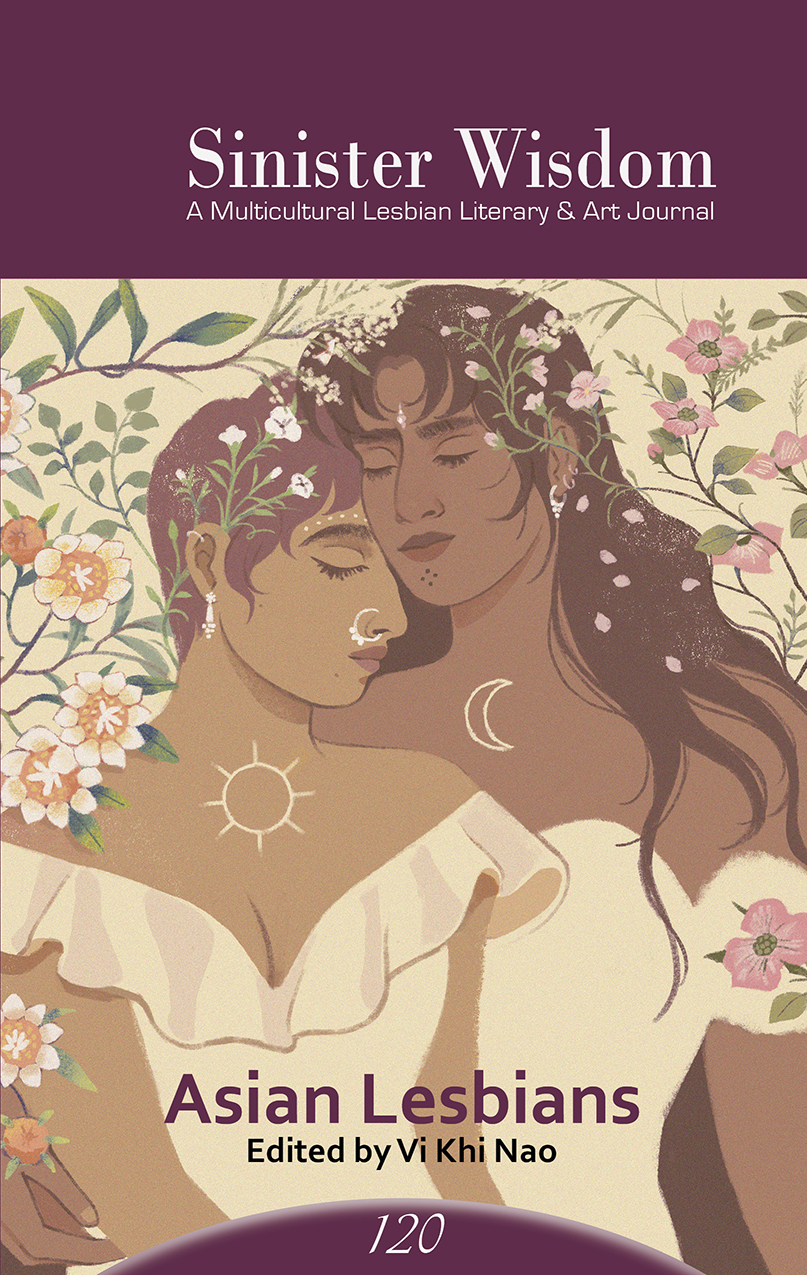
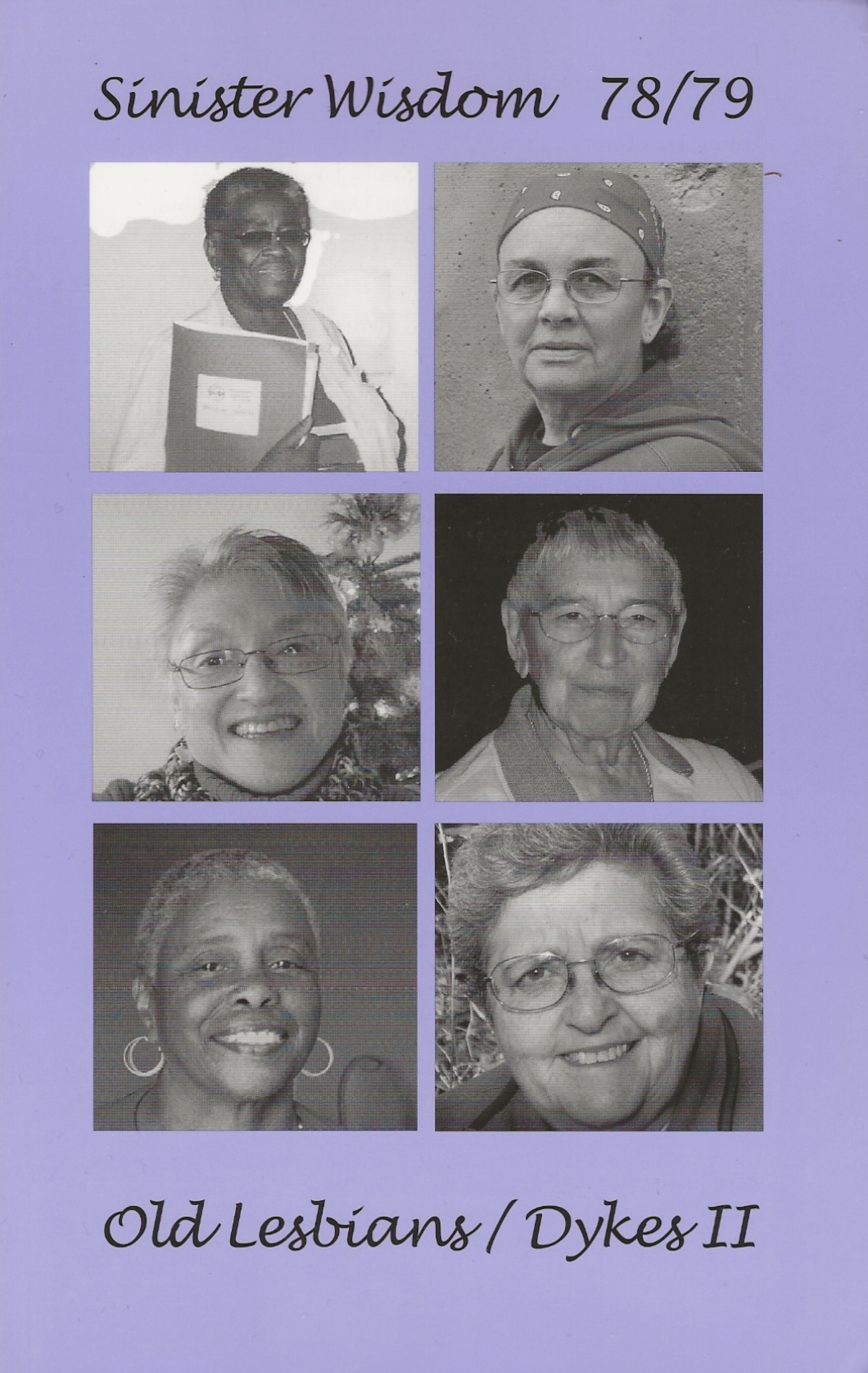
Throughout our call, I was moved by the depth and clarity of Nestle’s wisdom as well as her willingness to share it with me. I could envision how Sinister Wisdom harnesses the sustaining power of ongoing, intergenerational, communal conversations.
In her writing on generational transfer, Enszer argues, “Being in these relationships enables lesbians and queer women to connect with one another as human beings, not simply as representatives of different generational cohorts. By knowing one another and working together, we imagine a shared future and work to create it.”
Over the course of its 50 years, Sinister Wisdom has created a multiplicity of spaces—in print, in person, and online—for lesbians and queer women to come together to imagine a shared future and work to create it. With any luck, they’ll be able to continue doing so for another 50 years.
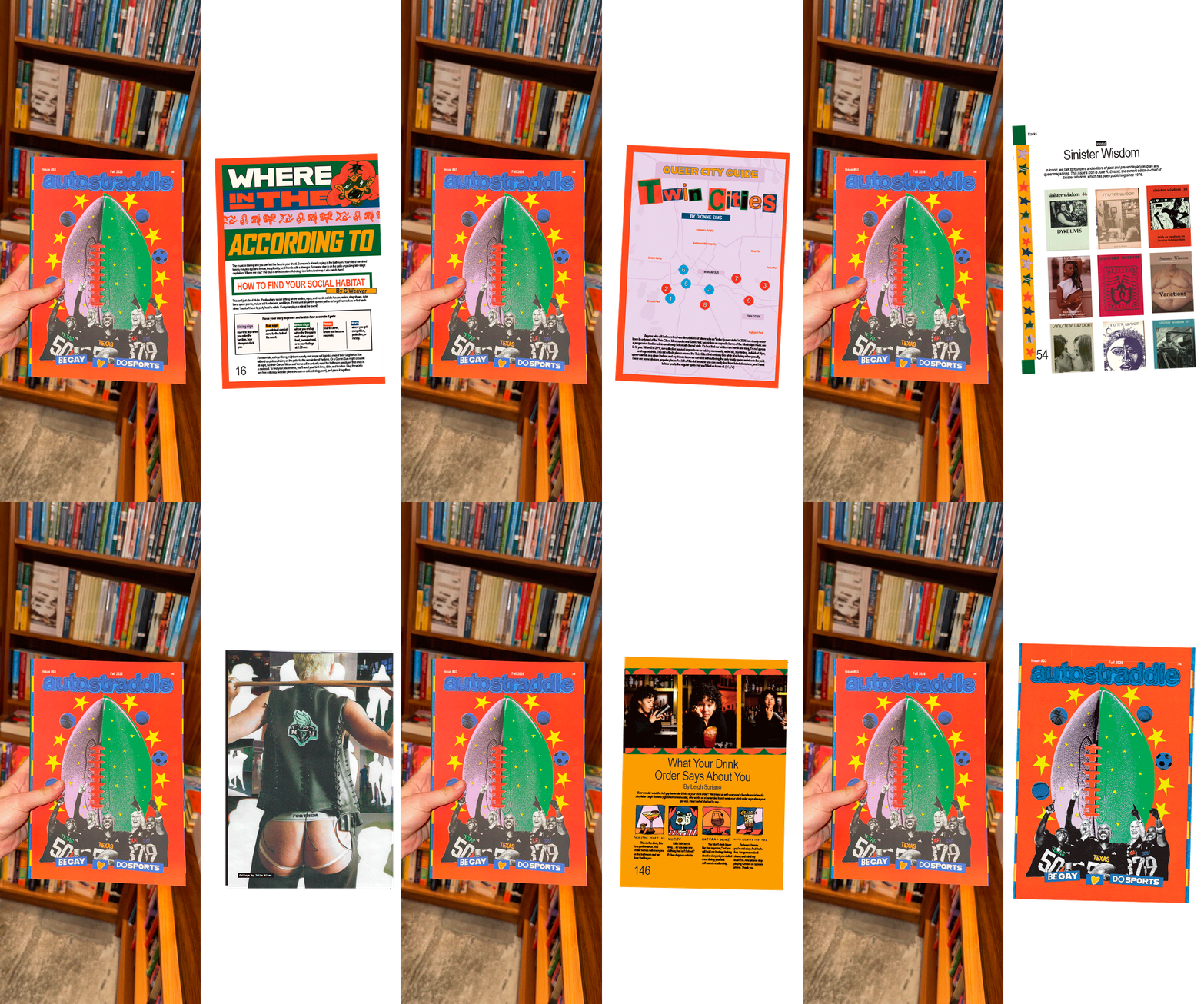
To read more about Sinister Wisdom and support more queer media in print, check out the latest issue of Autostraddle’s print magazine!


Comments
Great article, thank you!
this is awesome!! long live lesbians
Fifty years of Sinister Wisdom staying in print is genuinely staggering, and the part that stuck with me is how much of that survival was distribution work rather than editorial work — getting the thing into the hands of people who did not know it existed.
That problem has not gone away, it just moved. Small queer presses and zines now lose readers not because the writing is weak but because nobody scrolling ever sees a cover. The one thing I have seen actually move the needle for tiny publishers is a 20-second vertical clip: one poem or one paragraph on screen, read aloud, captions burned in, cover art at the end. No face, no studio, no budget. Editors who hate being on camera can still make one.
If anyone here runs a small press or a zine and wants to try it without learning video editing, https://facelessreels.video will do the narration, captions and timing from a block of text, and you drop in your own cover scans. Not a substitute for an archive like Sinister Wisdom’s, obviously — but it is a way to point people toward one.
And if you have not, subscribing directly is still the single most useful thing. Print survives on subscribers, not impressions.
This is such a lovely piece — the “generational transfer” framing really captures what makes Sinister Wisdom special, and Joan Nestle describing herself as an “86 year-old, anti-genocide, pro-trans 1950s femme” is the best sentence I’ve read all year. The wall calendar story is the detail I keep thinking about: an intern’s idea that’s now sold hundreds of copies a year for a decade — proof that the “yes” ethos actually works. One practical note for anyone preserving or digitizing old issues: scanned covers and interior art almost never match the aspect ratio you need for a website gallery, newsletter, or social post, and cropping a cover crops the artwork. I’ve been using imagestretcher.io for that — it stretches width and height independently, locks or unlocks the ratio, and runs entirely in the browser with no uploads. Handy for putting a 1976 cover into a modern layout without losing any of it. Long live Sinister Wisdom!
A beautiful article!!!! I am so grateful for Sinister Wisdom, for everything the journal has been and will be, and for this beautiful article sharing such powerful reflections about Sinister Wisdom. Thank you Autostraddle and thank you Lauren!