I remembered every kiss. In Kids (1995), which was one of two films we possessed on VHS and thus were able to view on the small TV/VCR Ashley kept hidden in the back of her closet at boarding school (the other was Fear), it was two girls, not main characters, in sheer bras and underwear in a swimming pool at night, egged on by their sexually aggressive male friends who “truth or dare” them to kiss each other. “Sure,” one says, turning easily to the other, “We do it all the time.” The boys lose their shit as the makeout ensues, their mouths agape. One asks the girls if they’re “dykes” and they say no, “it just feels good.”
“I don’t know,” a boy says. “I’ve never seen shit like that in my life. I think it looks nice, though,” he bites his lip, grinning. “Do it again,” he urges.
Before this, I hadn’t known that there was a context besides pornography in which watching girls kiss was considered, by boys, to be not only not gross but actively hot. Because back then, the kinds of boys who watched those girls kiss were the same kinds of boys who would describe actual lesbians as frumpy, preachy, militantly feminist losers.
But if I hadn’t known before, I was certainly about to know — as the century turned on its infamously chunky heel, ostensibly straight girls kissing were everywhere.
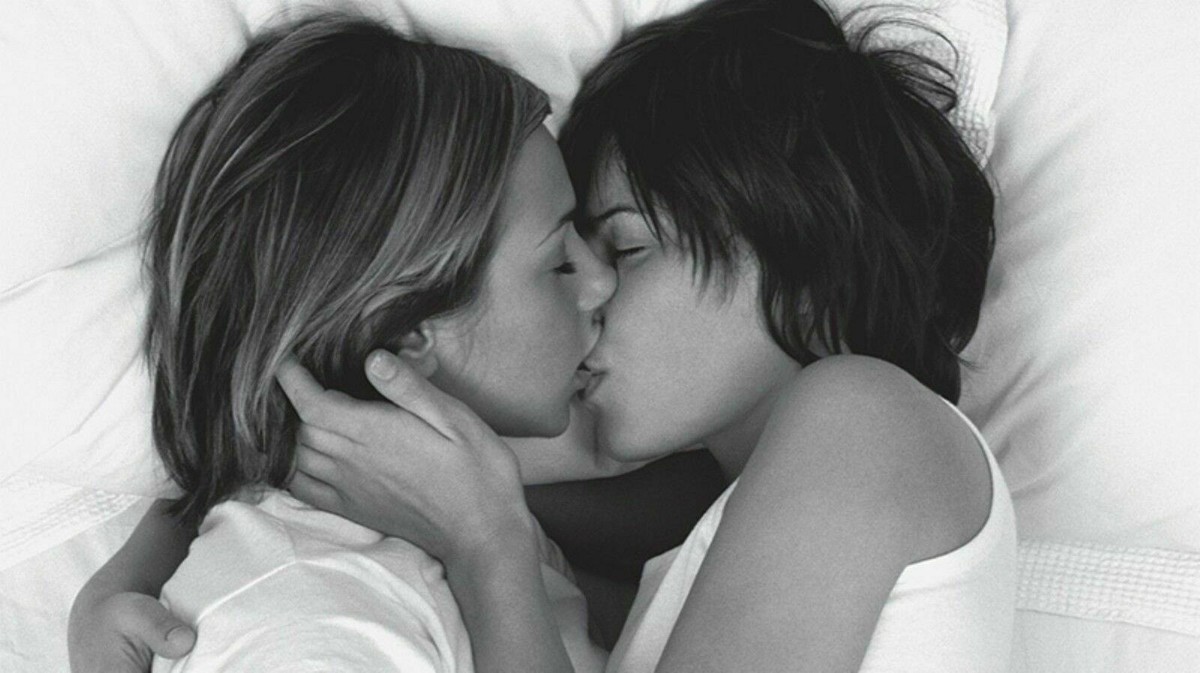
This era contained the most important kiss of all — between Madonna, Brittney Spears and Christina Alguilera, the 2003 moment that launched a million desktop backgrounds. This era gave us t.A.t.U and music videos like Blink 182’s “I Miss You” and Jimmy Eat World’s “The Middle” and American Pie 2’s “lesbian tease scene” and most of the qualifying examples of the “Girl-on-Girl is Hot” trope and The Real World’s first threesome (in Las Vegas, a relatively tame hot tub experience involving Trishelle, that season’s raised-religious hot Southern girl, and go-go-dancing party animal Brynn, who famously went on to throw a fork at Steven).
But perhaps most importantly of all, it was the era of Girls Gone Wild, a franchise whose astoundingly ubiquitous body of exploitative work played in an infinite loop on the small televisions of frat houses and dorm rooms throughout the collegiate system. These same rooms often proudly sported The Kiss poster as some kind of talisman, an invitation or a warning. In Girls Gone Wild, the second-most popular way for girls to go wild (after showing their boobs) was to make out with each other for the camera. So in these clips, boys ask girls to make out, and the girls do —for the boys in the room who asked, but also, ultimately, for all boys, in all rooms, everywhere, forever.
Netflix’s new TV series The Body is set in 2004, during this time when the longstanding nationwide interest in girl-on-girl action stripped of its lesbian context was peaking, a remarkable period of homophobic homoeroticism. Searching “girls kissing” on the internet, as a character does in the series, truly would deliver one picture of Ellen DeGeneres and ten pictures of girls with iron-straight hair touching lips, bras on, lingerie often some shade of turquoise or somewhere on the spectrum between mauve and pink.
I was in college in the early 2000s and can testify it was a time wherein if you were a certain type of girl, you were allowed to kiss other girls in public — encouraged to, even — without claiming any type of political or emotional resistance to the heteropatriarchy. Or, at least, that was the story we told at the time. Another story simmered beneath it, one where a very bizarre door was swung open for girls who were consciously or unconsciously curious about their own sexuality. But it was also the only door open to them, and the room on the other side of that door? Empty.
Of course, I knew what actual lesbians were, that they existed, that Rosie O’Donnell was one and the Indigo Girls two more and my mother a late-in-life lesbian herself. I knew that lesbians wanted to marry each other but the vast majority of Americans were against it, and in 2004 actively voted to prevent it, in droves. But it didn’t matter, ultimately, that I taped Rosie’s show every day in high school to watch after soccer practice, that Ellen had at one point been my favorite sitcom, that the Indigo Girls were secretly my favorite band. Those women had nothing to do with the worlds I traversed as a teenager and young twenty-something in the ‘90s and early 2000s, a world free of actual lesbians but lightly occupied by girls who kissed in front of boys because boys liked to watch girls kiss, and that didn’t mean they were like, gay, it just meant that they were fun and hot and cool. Possessing no inherent social skills or understanding of neurotypical human behavior, I looked towards pop culture to tell me how to behave, who to be, what to do.
“Girls kissing at parties” became so popular during this era that it spawned multiple academic papers and a 2006 Salon trend piece entitled “live girl-on-girl action!” about college and high school girls who say they are “firmly straight” but will “ kiss their friends as a performance for guys — either for material gain, like free entry or alcohol, or to advertise that they’re sexually open and adventurous.” (It was a great side hustle.) A girl is quoted as saying, “[kissing another girl] is definitely a good, well-worn, tried-and-true route to hooking up with a guy that you want.” Interview subjects cited girls hooking up at somewhere between 50%-85% of the parties they attended and recalled that circa American Pie 2, guys “suddenly seemed obsessed with lesbians, [believing that two girls together] was the hottest thing ever.”

It is this context in which I read Anya’s approach to her relationship with Elise in The Body and everything that comes to bear upon them both on the second floor of the Devil’s House, the night of the Halloween party that changed everyone’s life. They are best friends, the kind that hold hands and sit in a tangled mess of limbs to watch television or sleep, and call each other wives. But now, on that second floor, Elise in her devil costume with her hands all over Anya and between her legs, Anya breaks away only when Elise goes in for the kiss — for a moment she kisses back, but then breaks. She can’t kiss Elise. She has a boyfriend.
“So you were gonna tell him about this?” Elise asks, confused.
“Yeah. I mean, who cares?” Anya brushes it off. “He’d probably think it was hot?”
Of course Anya isn’t going to tell Steven, but these mental gymnastics — that she could and it wouldn’t matter, because girl-on-girl is hot —enables her denial.
“Wow, okay,” Elise scoffs, and turns to go.
“Okay, he knows I’m not like… gay,” Anya says.
“Well, you were super wet,” Elise shoots back. “So I don’t know how—”
“I’m fucking rolling, you know that makes me horny.”
“Yeah,” Elise laughs, point proven. “I know it makes you horny.”
Elise and Anya have sleepovers every Saturday night. “Who knows what those two get up to in Anya’s room for hours,” Anya’s mom says, of the sleepovers.
“Mostly just scissoring,” deadpans Elise. Anya’s Mom and boyfriend are as unfussed about this joke as everyone is about the 4-5 gay jokes told in every episode of The Body. These jokes are less about being mean to gay people than they are about the fact that being gay is essentially a joke. Well, sometimes it’s a party game, but usually it’s a joke.
Everything’s different at Anya and Elise’s first sleepover after the night at Devil’s House. Anya’s in tumult because of the secret about Grace that she’s keeping from Elise, a secret that has bound her to outcast Lisbeth.
In Anya’s bedroom, a very specific episode of The Simple Life is playing in the background —the reality show that challenged best friends Paris Hilton and Nicole Richie to sacrifice their socialite lifestyles to live in the country with people who shopped at Wal-Mart. In this episode they’re shaking up small town Arkansas at the annual spring gala, raising funds with a kissing booth. Inevitably, two teenage boys ask for something else — they wanna see Paris and Nicole kiss each other. In my memory, they do, but that turned out to be a false memory because in fact, they do not. They protest that it’s like “kissing your sister.” The boys say “so?” and then Paris and Nicole convince the boys to kiss each other in exchange for kisses from each of them. Elise and Anya watch this, gazes impenetrable.
Eventually, Anya drifts off enough to have a sexual dream about Elise, wakes with a start, and pushes Elise away, literally and figuratively. She asks if Elise is too wasted to drive home, avoiding eye contact while muttering her need for a good night’s sleep. Elise grabs a pillow and sets up on the floor, frustrated.
Later in the episode, the Lions initiate Lisbeth with a trip to the strip club — again, we have allegedly straight women enjoying an objectively gay activity —where a dancer grinds on Elise, asks if she likes girls, and gets, “I just like who I like.” Anya rolls her eyes, and later, the whole team has a fight and after that, Anya and Elise duke it out alone. “I really thought that you wouldn’t throw our entire friendship away just because I kissed you,” Elise says. “And then you wouldn’t make me sleep on your floor like you were scared I was going to fucking rape you.”
Anya says it’s not about that, which is true, but it’s also true that it is a little bit about that. “I don’t want to fight with you,” Anya says. Then, echoing Paris and Nicole: “You’re like my sister.”
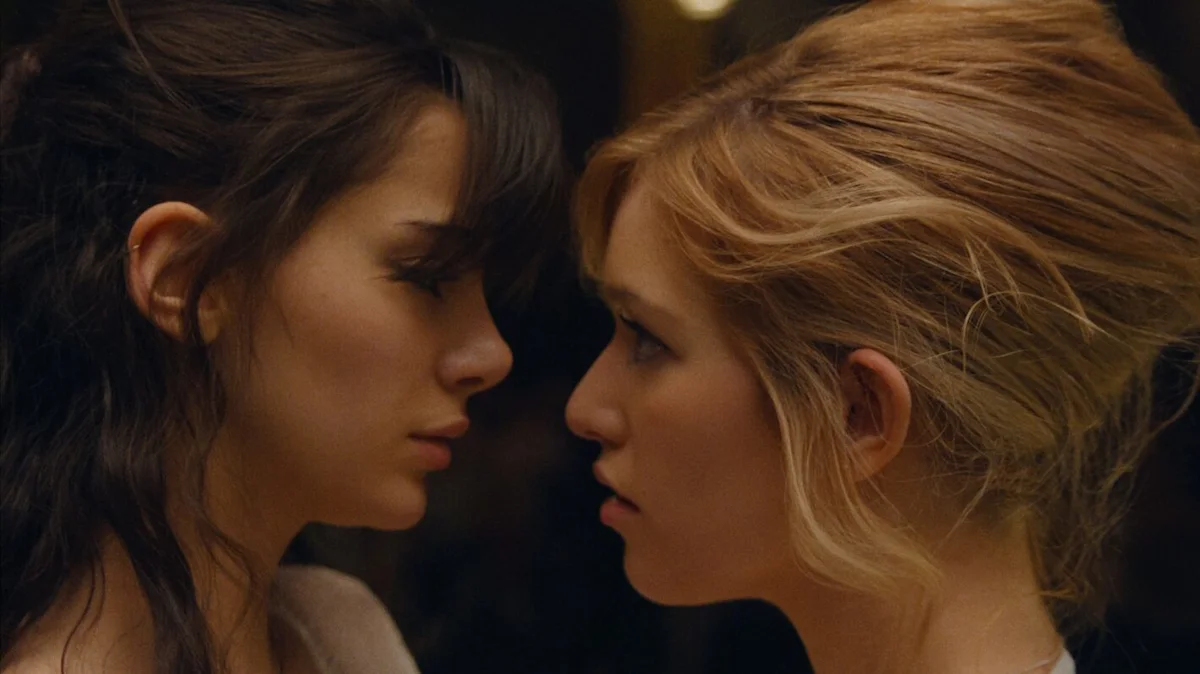
Late in the season, Elise and Anya will, as someone jokes without concern, “kiss and make up.” But they don’t actually kiss. They do actually have sex, and continue to. Anya continues to refuse the kiss, certain this intimacy is what will carry their affair over the line into something potentially problematic to her relationship with Steven.
It’s late afternoon at Anya’s, Elise and Anya in bed together, naked and happier than they’ve been at any other point in the series. But, the boys are coming over later. Elise nervously dares to ask her what Anya’s “plan is” with Steven, and Anya’s thrown by the ask. She has walked through a narrow crack in the door — lying to herself that what she’s doing with Elise isn’t really cheating, that he’d probably just think it was hot — but has no plans for what to do in the room on the other side. The possibility of actually dating the woman she is in love with is not on the table, not on the menu, not served within a 90-mile radius of their town. It’s incomprehensible.
Thus, Anya asks Elise: “Break up and do what, dude?”
“I don’t know,” Elise sighs. “You just say a lot of stuff… like you want me to sleep over every day. And you’re like, I want you to touch me and let’s sleep naked. All that stuff. That’s confusing.”
“I don’t really know what to say to you,” Anya says. Elise’s steely facade is crumbling. Anya begs her not to be sad.
Elise, eyes wet, can’t ask for what she maybe already knows she wants, even if still inchoate, but she can ask for this: “I just want to kiss you. You won’t even let me kiss you.”
The first time Anya really gets to kiss Elise, at last and finally, is in front of a boy.
(The first and second and third and fourth and fifth and sixth time I kissed a girl was in front of a boy. The first time I had sex with a girl was in front of a boy. The first time I dated a girl, in 2004 when I was 22 years old, I was also dating her boyfriend. I didn’t like the boyfriend but this lack of interest did not flag to me as relevant to any decisions I might make about my participation in the relationship overall.)
Before kissing, Anya and Elise have recently fought. “Be real for once in your fucking life, say how you feel!” Elise begs of her.
Anya apologizes and says she never wanted Elise to feel like she had to lie for her, even though she is, actively, asking Elise to lie for her.
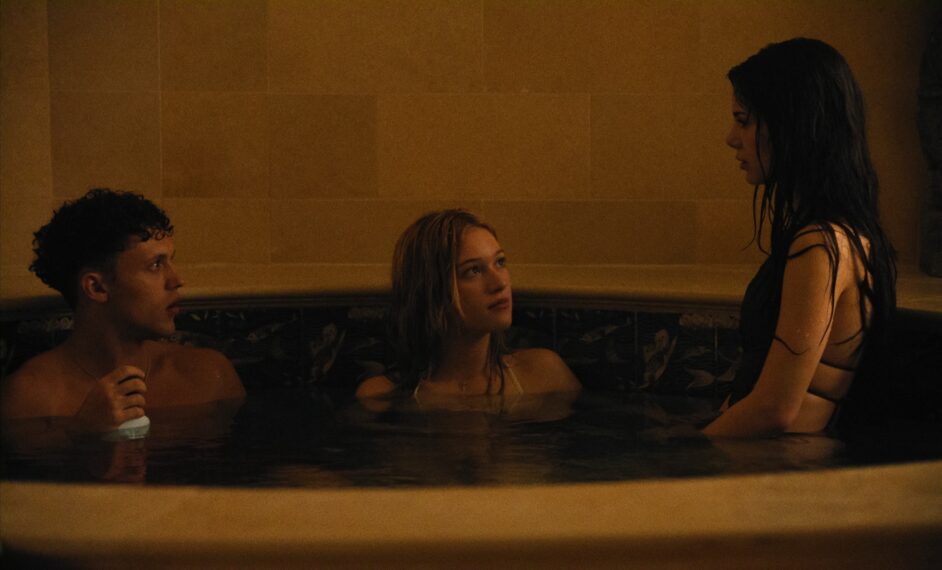
And now, Anya, Elise, and Steven are in the hot tub together, all drunk and high.
Steven sloshes into some kind of settlement in the water, eyes hazy and limbs loose, too drunk to think, really, but he picks up on the tension between Anya and Elise enough to ask if they want him to leave and, even though Anya does want him to leave, she can’t ask for that. Her survival instinct is louder than even her intoxication. Instead, she turns to him, “Do you think it’d be hot if Elise and I kissed?”
The audience is her alibi. A performance the only permissible circumstance for Anya to kiss Elise. Elise takes what she can get but not without some heartbreak.
The only door she can open, a lock that keeps her there.
Walking past the pool room in their towels, Lisbeth and Tyler see the trio in the hot tub. Tyler exclaims: “Oh, Steven, you lucky dog!”
In the 2006 Salon piece, the interviewed girls insist that questioning their sexuality is not part of the picture. They “feel free to hook up with other girls precisely because it’s understood —by the girls involved and their spectators —that all parties are straight.”
I don’t think the girls interviewed for the Salon piece had seen The L Word, which premiered in 2004, nor do I think the characters of The Body were aware of it or of Queer as Folk. Representation of lesbian relationships was thin, to say the least. If you knew where to look, there was plenty, but very few knew where to look, or could. There were queer movies (Saving Face debuted that year), fledgling websites, magazines and novels, but none of that would’ve been on Anya or Elise’s radar. When San Francisco legalized gay marriage in 2004 and Gavin Newsom began marrying gay couples on the steps of City Hall, the parents of St. Mark’s likely had nothing good to say about it. Anya and Elise are trapped in the specific dynamics of 2004, a year them.us called the “apex” of cascading political and cultural contradictions for queer public life.
In 2004, there was nowhere Anya could look and see any representation or acceptance of a future that could involve a real relationship with Elise.
Elise, though, is braver than Anya. She’s less insulated by Anya’s privileges of whiteness and pedigree, already familiar with grief and trauma, less preoccupied by status or popular opinion. She’s the only Lion that doesn’t confess anything in the ritual led by Lisbeth, unwilling to participate in any type of hive mind. This attitude makes her frustrated and a little mean, for sure, but it also keeps her honest. Elise doesn’t need permission or representation or even a plan for the future to act on her desires. Anya, though? Anya cannot see beyond her bubble.
When Anya thinks Elise has told people about their affair (she hasn’t), all the internalized homophobia unfurls out of her and onto Elise’s heart all at once: “Elise, you’re gonna ruin my life. My Mom is gonna kick me out and the girls will never wanna get changed in front of me again and we’ll never get married, I’ll never have babies!”
By the time lelia j. rupp and verta taylor published “Straight Girls Kissing” in Contexts: The Quarterly Magazine of the American Sociological Association, in 2010, the world described in the 2006 Salon piece had shifted. Yes, Katy Perry’s “I Kissed a Girl” had become a kind of straight girls kissing anthem, but also, actual lesbianism had gained a good deal of acceptance in a short period of time. There were more and more real lesbians on television, in movies, online, in politics, in music and in our lives. Future queer celebrities who had internalized the messages of the girl-on-girl era were building opinions and bodies of work that would eventually push back against them, declining bisexuality as a party trick. Contexts declares the girl-on-girl party kiss “just normal for most people now,” but they talk to plenty of girls who will admit that they are experimenting with sexual fluidity, too, explaining that the “heterosexual context of the hookup culture and college party scene provides a safe space for some women to explore non-heterosexual possibilities.”
As the decade marched forward, men, for their part, became slightly less obsessed with watching girls kiss IRL, perhaps no longer trusting the titilation of of the girl-on-girl makeout now that the girls actually being gay was on the table. In fact, some men began building deep state edgelord incel platforms designed to go completely apeshit whenever a movie or television program they enjoyed dared to prioritize or even include queer female sexuality. Girls kissing stopped being hot and started being woke.
I’m certain that many of the girls kissing for alleged male entertainment back then were future queers, a new generation of bisexuals and lesbians incubating through a restless era that both propelled us and shrouded us from our own journeys of self-discovery.
I suspect many who already had some awareness of their own queerness avoided those scenarios entirely, and many who were “95% heterosexual with a mild interest in having sex with girls” were the most eager to initiate, secure enough in their overall straightness to fearlessly engage. Who was the real target audience for Jen Sincero’s very 2005 manual The Straight Girl’s Guide to Sleeping With Chicks? All I can tell you is that I bought a copy the day it came out.
Most of the conversation around sexual shame in The Body has been centered on its Christian messaging, but girlhood has many sacred texts. Women’s magazines, sexy music videos, campy movies, direct-to-consumer video series, soapy teen dramas — all of these had more to say than even the Bible about what it meant to be a girl who wanted to kiss a girl in the early 2000s. And so little to say about falling in love with one.