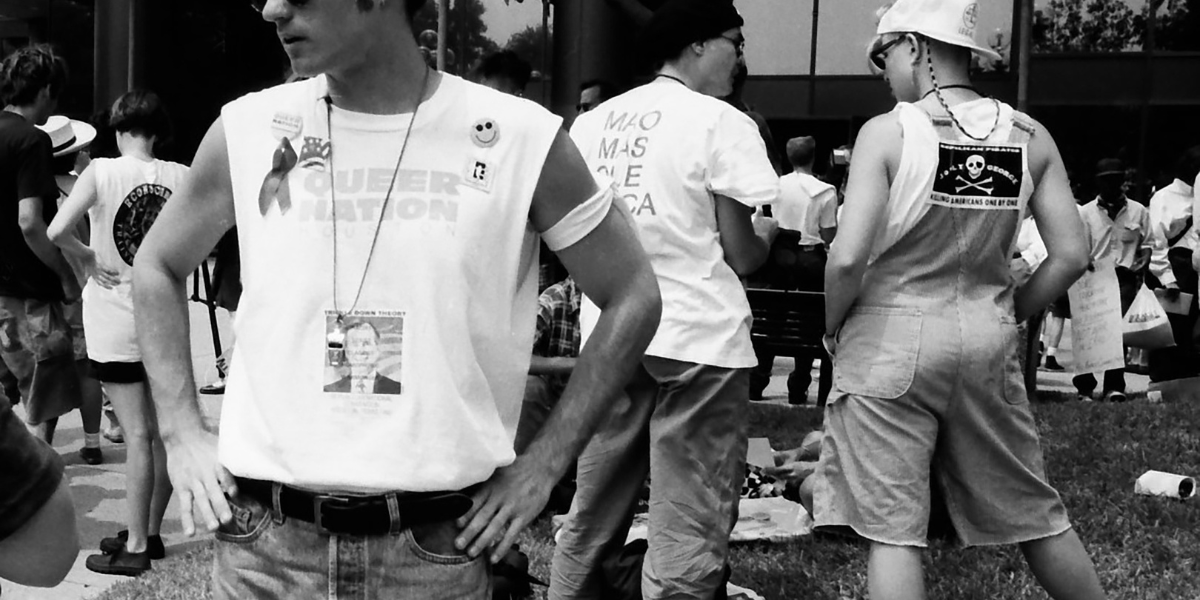
In August 1992, a group of intrepid gay and lesbian reporters traveled to Houston to cover the Republican National Convention (RNC). Reporters interviewed delegates on the floor of the convention, each of whom openly voiced homophobic opinions, including that gay people don’t deserve the same rights as other Americans, shouldn’t be able to teach children, and can and should be cured of their homosexuality via psychotherapy. The footage they captured, which aired on the weekly LGBTQ public access news show Gay USA, was designed to expose the deadly homophobia of the 1990s-era Republican party.
Outside the Houston Astrodome, Gay USA cameras captured police brutality at an ACT UP protest. Officers beat protesters with bully sticks and trampled them with horses: 12 were injured, three hospitalized, and six arrested. Security officers later approached and harassed a gay reporter wearing a shirt that read “Nobody Knows I’m HIV Positive.” When the rest of the team came to his defense, security officers escorted the reporters out of the RNC, despite their visible press credentials, and arrested and detained a lesbian correspondent.
This Gay USA episode chronicling the 1992 RNC is one of many examples that demonstrate the power of local queer media. The LGBTQ press has long been committed to documenting and resisting homophobia and transphobia. This is particularly true at the local level: By reporting on local news, politics, art, and events, LGBTQ reporters use media as a tool to expose and fight back against right wing politics.
Today, this history is as relevant as ever. The second Trump administration has relentlessly attacked both LGBTQ rights and the freedom of the press. Earlier this year, the administration demanded federal funding cuts to NPR and PBS, which help fund public radio systems around the country. By attacking news and entertainment media, Trump aims to silence his political rivals, a tactic used by the authoritarian and fascist leaders he often praises.
My colleague Annie Sullivan and I explore some of this history in our new edited collection, Local TV: Histories, Communities, and Aesthetics. Chapters in the book detail how television shifts and shapes local communities, as well as how local producers disrupt the political, social, economic, aesthetic, and national norms of mainstream TV.
The power of local media to share a unique perspective is underestimated. As Edward Alwood writes in his book Straight News: Gays, Lesbians, and the News Media, “the news plays a critical role in shaping people’s image of the world around them.” This includes “the capacity of the news media to create and perpetuate prejudice,” what he calls “one of the most unsettling and frightening aspects of American journalism.”
National outlets tend to reproduce the prejudices of the status quo under the pretense of objectivity. The work of the gay press — as well as the Black press and the feminist press, and other outlets created by and for marginalized communities — has been to expose those prejudices. By speaking from a specific perspective, local media can defy the norms of American journalism to promote community solidarity against the far right.
“There is a long history of fighting oppression by challenging the conditions of television production at the local level,” Sullivan told me recently. While producers create local media for a wide variety of reasons, Sullivan and I are both particularly interested in its activist potential. My research examines LGBTQ media history and Sullivan, an Assistant Professor at Oakland University, explores Black media production in Detroit in her work.
“We can create spaces or channels of communication where the voices of vulnerable and marginalized communities are safe to speak,” Sullivan added. “There are openings in local media networks today to air anti-fascist and anti-racist messages; we just have to identify them and find ways to use them. Systemic change can be produced through a constellation of local efforts to push back against oppressive hierarchies of power and generate openings for alternative forms of representation and discourse.”
Local queer media offers one example of these kinds of “alternative forms of representation and discourse.” Earlier this month, I spoke to two other scholars to talk about how LGBTQ folks can use local media to resist fascism.
First, I talked to Axelle Demus, a media historian and postdoctoral fellow at the School of Information Studies at McGill University who studies the history of queer community television in Canada.
“The story of local queer media is persistence despite backlash,” Demus told me. “I argue that LGBTQ2+ community television programming is guided by this concept ‘queer access mobilization,’ which to me denotes this community driven effort in which people collaboratively build these pathways to greater access, to media, to information, and to vital social, cultural, political networks.”
Demus traces these efforts back to the 1970s, when conservative activist Anita Bryant brought her homophobic crusade to Canada. “Local queer media actively reported on Bryant’s Canadian Tour,” they shared. “Toronto’s local queer cable shows, like Gay News and Views, were responding to Bryant’s campaign. The show regularly brought up Anita Bryant’s Canadian visits, informing their viewers of the various protests that were planned by gays and lesbians across Ontario specifically, and strongly encouraging them to attend. Folks who were part of these TV programs also were actively organizing against Bryant.”
Demus sees the 1970s as “a pivotal moment” in Canada queer history, in which queer media helped “galvanize and unify the emerging queer liberation movement in the country at the local and national levels in opposition to right-wing backlash and anti-queer rhetoric.”
“Cable access foreshadowed the kind of hybrid media ecology that we have now, in the sense that it was part-corporate, part-community, and always controlled by the cable company,” Demus said. “We really have witnessed this come back to the local. Thinking about TikTok or Instagram, people are still using those platforms to circulate things about local community and creating really smart workarounds to still circulate information, despite the fact that they’re corporate-controlled platforms.”
“This organizing or mobilizing around access is not just about getting into the structures that exist, but about transforming spaces, including media spaces, to be more inclusive and sustaining for the community,” Demus explained.
Aymar Jean Escoffrey’s work is a prime example of the transformative power of local queer media. Escoffrey is the Margaret Walker Professor of Communication Studies at Northwestern University. Based on five years of deep, complex work developing the platform OTV | Open Television, which streams stories by diverse creators, his new book Reparative Media: Cultivating Stories and Platforms to Heal our Culture paints a portrait of what a healing media ecosystem can look like.
“There’s just something you can do at the local level that you cannot do at the national and global level. It’s something very embodied and material,” Escoffrey said. “The prevailing ideology is that national is better, bigger is better…Have you considered that this period of rising social division and distrust in institutions is also correlated with the evisceration of local media?”
Through his work building OTV with diverse artists throughout Chicago, Escoffrey observed that people gathering in physical space “is both the start of friendships and relationships and the bedrock of solidarity.” The local production and exhibition of OTV programs allowed for community members across the city to come together and build relationships. He added, “I have found that the most important technology in developing any kind of media are relationships.”
“We need to start making the case that what local media does, on the news front, is remind people who might have different ideological differences that they still have a stake in something with the people they ideologically disagree with,” he said. “I worry that the nationalization of this discourse is further alienating people from what’s going on where they live, which is really the work we need to do, of rebuilding our social fabric…I worry that the evisceration of the local media infrastructure and the nationalization of the conversation via social media might perpetuate or allow for these authoritarian dynamics, because they don’t build trust across political and cultural differences.”
Producing media locally allowed OTV to bypass “a lot of the systems that would otherwise be exclusionary,” Escoffrey added. Hollywood’s hierarchical systems privilege white, straight, wealthy, cisgender insiders. As Escoffrey argues, commercial media corporations further a “colonial project that was really about exploiting the world and sowing social divisions.” He sees the Trump administration’s attack on public media as a part of that “centuries-long drive” to create social division. Working outside those hierarchical and corporate systems allowed the OTV team to reimagine what intersectional and transformational production and distribution could look like.
Both Demus and Escoffrey encourage folks to get involved with local queer media projects or to start their own.
“A lot of local media is essentially volunteer-run, and it doesn’t have to be fancy. You don’t need much. Most phones these days are pretty good cameras. And microphones are fairly inexpensive. That’s most of what you need to get some decent local media,” Escoffrey said.
While funding can be a challenge, he suggested connecting with friends and colleagues to share resources. “If you share resources, if you share knowledge, if you create structures for mutual benefit, and you go slow, and you scale things within the capacity of you and the people around you, and you’re not trying to scale to get investment to become national, or to get the biggest foundations to fund your operations, you can go pretty far and long sustainably.”
“We need to be imaginative about how local media can show up in the 21st century, but it needs to be about the people who are trying to connect storytellers and communities,” Escoffrey added. “That is how we have accountability, sustainability, and real, consistent community building.”
“We’ve always been really skilled at sharing and circulating information when people are trying to pretend that we don’t or shouldn’t exist,” Demus said. This could include a community radio show, newspaper, zine, podcast, TV or web series, or Instagram or TikTok account. They recommended checking out the Local LGBTQ Media Mapping project to scout what already exists in your area. “At a time when queer and trans voices are being suppressed, I think doing whatever you can to amplify local issues is really important, no matter the medium,” they said.