





The following is an exclusive account of Rusty Rose, as told to Faith Reidenbach in video interviews, telephone conversations, and emails over six months. Rusty and Faith co-wrote the article.

I went to the Stonewall Inn with an older woman when I was 17 on June 27, 1969, my first visit to a gay bar. I’m one of the few who can say what happened inside the bar, and one of a tiny number of lesbians who were there. I’ve told my account for decades, but never in much detail. Now, before I leave this earth, I’m ready for my full story to be known.
Starting when I was 15, I’d take the train on weekends and blow into the Village. My family had moved from Brooklyn out to Long Island, which had nothing but crickets and darkness. I needed to get where there was life. I’d bring my tambourine, put out my felt hat, and sing in Washington Square. Sylvia Rivera would always throw a penny in if she was around, and I became friendly with other people we now think of as trans, like Marsha P. Johnson and Zazu Nova. If I missed my train, I’d be in an alleyway with Sylvia and Marsha and others, keeping warm. They looked out for me, especially Marsha, who was 10 years older.

Part of that group was a butch lesbian named Vinnie, who was about Marsha’s age. She was Italian, close to 6 feet tall, and “built,” very muscular. Quite handsome. We’d go to the Night Owl, Cafe Wha?, or head shops, and sometimes we’d treat Sylvia and Marsha to pizza. Vinnie was sweet on me, but I considered her just a friend. One Friday afternoon, she said, “Let’s go to the Stonewall tonight.” I had never been there, but I knew what it was. We met up later in the Square and walked over, her in a men’s suit and me in a men’s shirt and blue jeans. She had some words with the doorman, and I was allowed in.
There were two rooms at the Stonewall, both with a bar and dance floor. Sitting at the front bar, with their backs to the door, were several older drag queens, along with transvestites—that’s something trans women called themselves then. They greeted Vinnie when we came in. Of course, since I was 17, “older” could have meant they were 30. Vinnie was meeting a lesbian couple, and we stood at the bar so Vinnie could chat with them and a bartender. I also noticed a few other women. I saw Nova later, with lashes and makeup looking like Diana Ross. She was gorgeous. She was pissed about being stiffed for the club performance she’d just given.
Vinnie asked me to dance, and we went to the back room where the music was better. But she kept looking over at this other gal, frowning. Then the gal walked out. After a while, we went back into the front room and picked up our drinks, and in came straight-looking men in street clothes, along with four uniformed policemen. The music stopped and the lights went on. The leader, later known to us as Detective Seymour Pine, called out something like, “This is a raid! If you stay calm and don’t give us trouble, you’ll be okay.” We stood there, like, what? Some of the men went behind the bar, others went toward the coatroom, and the uniforms led bar employees out in handcuffs.
That left only plainclothesmen in the bar. They started asking for ID and writing court summonses for kids who were underage. Those people were allowed to leave, but the cops held back Vinnie, me, the trans women, and the drag queens—everyone they thought was inappropriately dressed. In those days, vague state laws from the 1800s that prohibited “masquerading” were used as a pretext to arrest gender-nonconforming people.
The cops tried to take us into the bathrooms. I learned later that was where they would inspect what sex you were. Drag queens and transvestites would be inspected by policewomen, and butch lesbians would be inspected by policemen. Often, gender-nonconforming people let themselves be arrested rather than submit. This night, Vinnie and the others mouthed off, refusing to do either. Then there was chaos; everything seemed to happen at once. Vinnie took swings at the cops who were trying to grab us. They shoved Vinnie and me against the wall, trying to look down our shirts. When a cop grabbed me by the front of my shirt, years of boxing lessons kicked in. I drew back my arm, but I failed to connect with him and ended up throwing my glass of soda. It broke a mirror behind the bar and ripped a psychedelic poster.
Nova, who was by the bar steering clear of the cops, laughed and threw her own glass before an officer yanked her off her stool. There was constant shouting. The cops called us names like faggot and pansy, and we yelled pigs, pigs, go away pigs. Detective Pine told the plainclothesmen to stop asking for ID, and people started spilling out the door. But others started breaking things, like chairs.
A plainclothesman handcuffed Vinnie to himself and dragged her to the door, and another cop pushed me along behind. I wasn’t handcuffed; at 5 feet tall and 100 pounds, I wasn’t much of a threat. Just after we got outside, as Vinnie was still struggling against the cop, one of the officers got hit by some projectile. They retreated with us back into the bar along with a few uniformed officers.
There was pounding on the door and windows. Then I heard glass break and wood splinter. The plywood that was nailed over the window was ripped open on one side and pushed in. I felt terrified! At one point, a piece of fiery trash came in. For a minute, we were unified, the police and us. The police shouted, “Get back, get back,” to protect us. Behind the bar there was a plastic tray full of glasses and water, and one of the officers used it to douse the fire. Then there was a lull inside, although we heard banging continue outside.
After a long time, the riot police came in, dressed in their gear and carrying billy clubs. That was when the beatings started. Vinnie and I were clubbed and dragged outside toward the paddy wagon, which was near Seventh Avenue with transvestites already inside. Vinnie threw punches and made herself dead weight, sinking to the ground. The picture of her being beaten with one of those clubs plays over and over in my head. An officer jabbed a knee into the small of her back, trying to put a second handcuff on her as she tried to buck him off. She called out for help, so I jumped onto the cop’s back, with my left arm around his neck, and as we fell backward, I jabbed him on the side of his head, near his eyebrow. Another cop ran over, and I remember seeing transvestites escaping from the now-unguarded paddy wagon. I started running like crazy with the first cop chasing me. I ran down Christopher Street and then down Seventh Avenue. Finally, the cop grabbed me. He yelled at me, “What’s your name?” and I answered honestly. He looked me over, and maybe because he saw I was a woman, white and young, he let me go. He told me not to go back to the Stonewall.
I never saw Vinnie again.
Years later, I connected with Christy Henderson Jenkins, a Black trans woman who remembered Vinnie and me from Washington Square. Christy told me she was arrested at Stonewall and saw Vinnie at the police station. What happened next, we don’t know. It’s possible Vinnie returned to Florida, her home state. Christy has become my dear sister and gives her own interviews about Stonewall. I’ve always avoided reading published accounts of the uprising, but Christy discussed with me whether Vinnie might have been “the Stonewall lesbian,” the never-identified butch who fired up the crowd by resisting arrest as she was taken from the bar. Some people say the Stonewall lesbian escaped from a police car and, surprisingly, headed back to the bar door. That would make sense if it was Vinnie, feeling responsible for me and trying to find me. But my co-author tells me eight people gave accounts of that incident, each different from the other. I can only relate my experience and let people draw their own conclusions.
I have a kind of PTSD from Stonewall. It was one of the worst nights of my life; I still have nightmares and flashbacks. My mom had taught me to turn to the police if I was in trouble, and I never imagined I could hit a cop or be hit by a cop. Some things I’ve tried to forget. Some memories have faded with time. But parts of a very emotional scene stick with you.

When I started telling my story publicly in the 1990s, I received death threats from within our community. I was also told my house would be burned down, and later I did have a housefire, although that could have been coincidental. Stonewall has been nothing but a thorn in my side. People seem to want it depicted in a certain way, with certain heroes.
In recent years, Stormé DeLarverie—Vivi, she invited me to call her—has often been celebrated as the first to throw a punch at Stonewall, as if anyone could know that. Starting in the 1990s, she told journalists she punched a cop there, but she changed the story near the end of her life. I don’t know whether she was there or not. What’s important to me is that Stormé became my dear friend. She was gentle and kind, very protective of me. When we rode in a car at Pride Marches, she always wore a motorcycle helmet and wanted me to sit beside her. We enjoyed many restaurant meals together, and we’d sing Alberta Hunter songs as she escorted me to the train. Stormé deserves to be remembered forever as one of the first drag kings and for having the courage, like Vinnie, to live as a butch lesbian presenting as a man. She would have decked anyone who persisted in calling her a trans man.
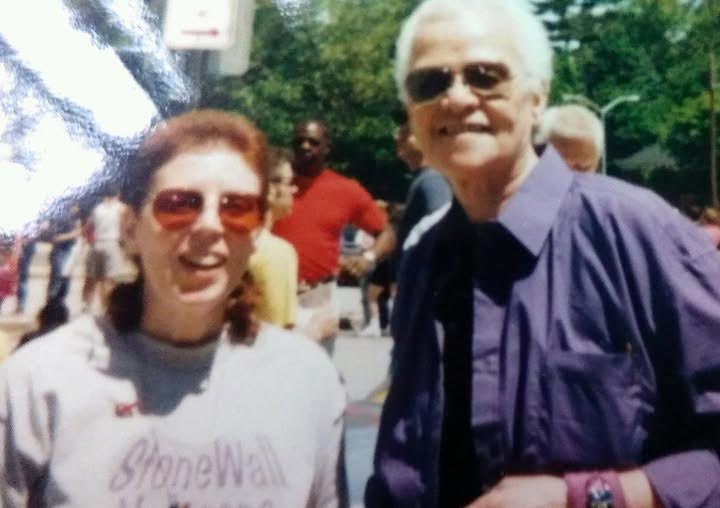
I also loved my friends Marsha and Sylvia. They became stars, true stars of queer and trans liberation! But if they were at Stonewall that first night, I didn’t see them. We can honor them without insisting that they led the resistance that night. There were no “leaders” that night; we all worked together to try to resist the police violence and were reacting in real time. But movies and other art about Stonewall often over-simplify things. The trans and gender-nonconforming people who helped initiate the fight inside the bar deserve to be honored, which was the goal of my poem “Put the T First.” But we need to acknowledge that every part of the queer community and straight supporters were represented in the rebellion. Today, more than ever, we need that unity.


Comments
Wow. Thank you for sharing your story and your perspective. I am truly sorry that you were abused for simply stating the events as you experienced them.
Thank you, Teka, yes it happens. Happy Pride, Rusty
Lesbians have ALWAYS been at the frontlines fighting for our liberation, yet are so often erased by others. Very heartening to read Rusty is sharing her story
Thank you, Liana, yes our Lesbian herstory is rich and I am glad I am still around to share it. Happy Pride!
Really appreciate this valuable narrative from a primary source. Thank you for coming forward with your story, Rusty, and I am truly sorry for the trauma you experienced.
Thank you KC, I thought it about time I leave my legacy for younger generations to learn by and carry on. Happy Pride!
Put the T first! ❤️
Thank you Zona, yes, Put the T first! I wrote this because just like our Lesbian presence at Stonewall, many tried to erase the T presence too. At the time they suffered greatly and needed to know how much they are loved. Happy Pride!
Thank you, Zona. It was important to let our T community know how much they were loved, especially when, like our Lesbian community, some were trying to erase them from being there at Stonewall.
I forgot, Happy Pride, Zona!
Thank you Rusty for your courage that night, and throughout your life. And thank you Faith for helping Rusty share her story so we all can learn from it ♥️
Thank you Hallie, it was time to tell my account and I did not want to entrust it to just anybody. I knew Faith would preserve my story for future generations. Happy Pride!