





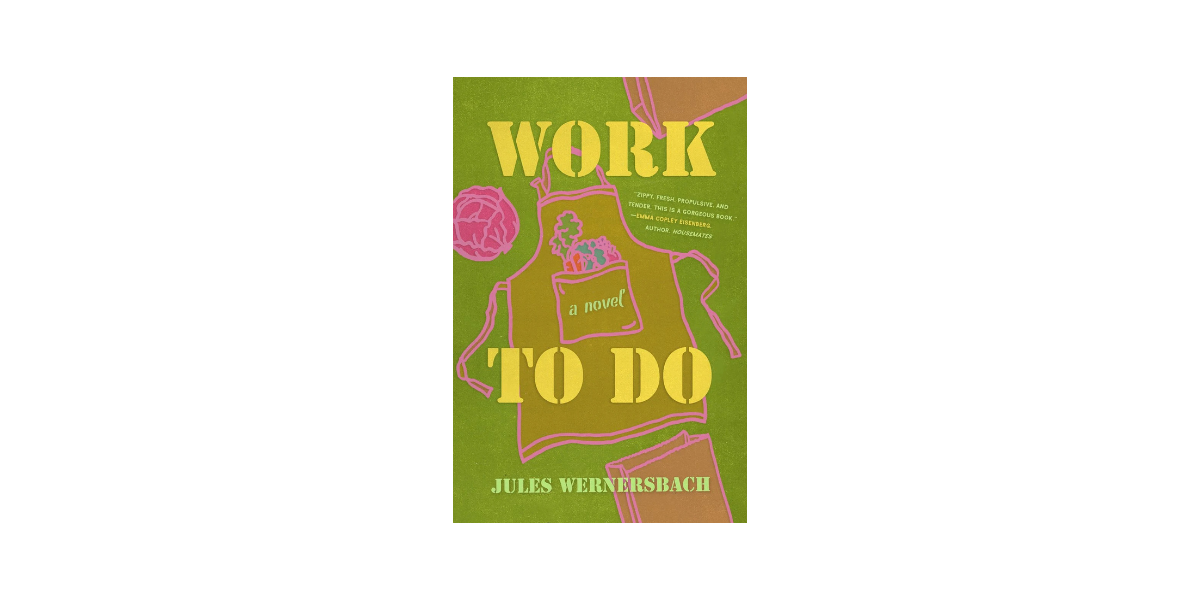
When I lived in Austin, Texas, on those rare afternoons when the sun wasn’t a bullet aimed right for my sweat glands, I would often walk down Guad (short for Guadalupe) to the Wheatsville Co-op. Wheatsville, which is set to close at the end of the year like so many old-school Austin locations, is very similar to the Guadalupe Street Co-op at the crux of Jules Wernersbach’s debut novel Work To Do. Also opened in the early 1980s, also a beloved Austin institution, and also customer-owned, Guadalupe Street Co-op reminded me so much of the hallowed fluorescent halls of Wheatsville, lined with organic beeswax soaps and fresh produce and loose eggs to be bought one at a time. Other Austin mainstays flit throughout the novel like bees in an orchard: Broken Spoke, Spider House Cafe, Barton Springs, Central Market. Reading Wernersbach’s novel transported me to a more whimsical point of my life and simultaneously popped a bubble on the beauty of “community-centric” businesses.
Work To Do is not an exposé, but rather a workplace drama that seizes on the petty squabbles of romantic trysts, the looming threat of climate change, and what it means to live beneath the capitalist thumb (typical queer experience). Taking place over one week from three different perspectives, Wernersbach from the jump sets a high bar for their self. It pays off: The novel’s stark seven-day structure, looping through various characters’ perceptions of one another, allows for a richly conceptualized world where the consequences are quick and dirty.
The three perspectives in question are: Roz, the floor manager who is caught between her employees’ and employer’s concerns, all the while cyber-stalking her ex-wife; Eleanor, the owner who opened shop in the 80s, reflecting on how much has changed (much of it motivated by a recent breast cancer diagnosis); and Randy, the dairy manager, who is unionizing and sleeping with Molly, their co-worker and Roz’s girlfriend. Mix in a chaotic Texas hurricane that threatens to flatten the store before bankruptcy gets a chance to, and you have the juicy plot of Work To Do.
The three central characters of the book provide a lush examination of the plot from several angles, shifting easily from protagonist to antagonist chapter by chapter. Eleanor to Randy and Roz is an overbearing, uncaring boss, who doesn’t understand what it means to live paycheck-to-paycheck and hasn’t understood the needs of the co-op since she opened it in the 80s. But when we read Eleanor’s passages, we see that the co-op’s continuation is not a result of Eleanor’s greed, but a harrowing attempt to keep her ex-wife Meg as a fixture in her life (considering Meg remains as a shareholder from states away).
Similarly to Eleanor, Roz is a lapdog desperate for approval, and to Randy, Roz is a potential ally but also a romantic enemy. In Roz’s brain, we see the push-and-pull of her relationships to Molly and her own ex-wife Audrey; her mother’s struggle with dementia, and Roz’s brother’s attempt to appeal to Roz to come home; and her own desires to buy the co-op as proof that she hasn’t wasted her whole life pursuing this job.
Amidst the union-busting, each character must contend with what brings them all so ferociously into the fight for the co-op: that it is the one place none of them feel alone. It connects Eleanor to Meg, and connects Roz and Randy to a sense of a higher purpose, however misguided. No one’s actions are excused, but rather explained: The intense loneliness each of them feels anchors them to their goals, and their attempts at connection with customers, coworkers, and each other’s lovers. Both a romantic and familial loneliness pervades each of their stories. The co-op becomes a symbol of their need to be loved, need for community, and engages with the question of what “community” means. You can’t simply plaster the word across the white walls of a store that underpays its workers and call that the same thing as reaching across the divide.
Roz appeals with desperation to Randy, both of them in their 50s among their college-aged counterparts. She touts that obnoxious phrase used by business managers to silence their workers — “we’re a family” — but the difference is that Roz believes it. Or at least, she needs to believe it. So often, we say things we need to be true, regardless of their objectivity. Of course we want to believe the coffeeshops we buy our cold brew from every morning are treating our favorite baristas with care, that the train operators and bus drivers who take us to and from home have their own homes to comfortably return to after a shift, that the grocery store co-op is not mere hippie facade but a true neighborhood within a neighborhood. Unfortunately, this doesn’t come from just saying it; Roz can’t just claim the co-op is family without taking care of them. Molly can’t claim to love Randy or Roz without actually communicating her feelings. Eleanor can’t claim herself the victim in her marriage without recognizing the damage she has caused. Honesty is something each of these three characters struggle with, in particular the disquieting honesty that requires one to be at fault.
Work To Do can stand as a manifesto toward that honesty. Put our money where our mouth is, literally: shopping local, but also, recognizing those that bag our groceries at the local market may need more than just our cash. They need our support against the cruelty of shady business practices. And figuratively too: We can’t expect those we love to love us against all odds if we cannot face what odds we may contribute, through our less-than-seemly behaviors. In this book, some characters learn to rise to this challenge, while others falter even as the reader begs them to listen.
This book, like many manifestos, is also a love letter: to Austin, to unions, to queerness and found family. It is a snapshot of a larger world we can all be lucky to be a part of, if we put the work in.



Comments
I appreciated this article because it connects personal growth and social change with honesty and passion. It was thoughtful and inspiring to read. https://www.wordlelimericks.com/
I’ll definitely be picking this one up!
putting this at the top of my list!
also the author co-owns and runs the queer bookstore Hive Mind in brooklyn
Thanks for the recommendation!! Just bought this following the article and read it during this week’s heat wave. What an excellent book with fantastic originality. The characters felt familiar and relatable even when they were behaving in flawed ways! Loved the epilogue. 5/5 for me!!