While we might not recognize it at the time, there are some pieces of art that become portals to a future we hope never comes to fruition.
When I was first seated in the theater to see Scream 4 in 2011, we were only about four years into the iPhone and Facebook-ification of our society, and many of us still weren’t fully indoctrinated into the “ideal” of constantly-connected tomorrow. People were excited about the prospect of new technologies, as they always are. But the question of what we were really supposed to be doing with this new technology and the burgeoning social media cyberscape beyond the obvious hung above every conversation we had. The possibility that these things might one day poison our brains or be used against us punctuated our considerations, but the extent to which that might happen was impossible to imagine at the time.
In Scream 4, teenagers in a northern California suburb are, as in the original, tormented by the Ghostface-masked killer we’ve all come to know. This new crop of high schoolers in Woodsboro have grown up watching the Stab films — the intra-movie version of the Scream franchise — and hearing about the legendary murders in their town. Sidney Prescott is out on tour for her new self-help book about overcoming the trauma of her various encounters with different Ghostface killers, and Woodsboro is her most recent stop. Sidney’s cousin, Jill (Emma Roberts), and her crew of somewhat “cool,” somewhat nerdy horror film obsessed friends — Olivia (Marielle Jaffe), Kirby (Hayden Panettiere), Charlie (Rory Culkin), and Robbie (Erik Knudsen) — are the new targets of Scream 4’s mysterious Ghostface killer(s). Gale Weathers (Courteney Cox) and Dewey Riley (David Arquette) are living in Woodsboro, and they’re both immediately on the case as soon they find planted evidence in the trunk of Sidney’s rental car.
While all of this is happening, we’re given a glimpse into the ways the Web is morphing the teenagers’ perceptions of the freshly broken-open world around them. For them, the Internet, social media, and YouTube are now highly accessible and starting to infiltrate every aspect of their lives. A scene in which Gale and Sidney agree to visit Robbie and Charlie’s high school Cinema Club as honored guests gives us another famous Scream franchise meta-conversation on the perceived “usefulness” of these tools in the “new version” of the Woodsboro murders:
Sidney: You film your entire high school experience and what? You put it on the ‘Net?
Robbie: Everybody will be doing it someday, Sid.
Charlie: It’s kind of the one component the killer is missing.
Gale: Wait. What do you mean?
Charlie: Well, if you want to be the new-new version, the killer should be filming the murders.
Robbie: It’s like the natural next step in the slasher/psycho innovation. You film them all real time, and before you get caught, you upload them into cyberspace.
Charlie: Make your art as immortal as you.
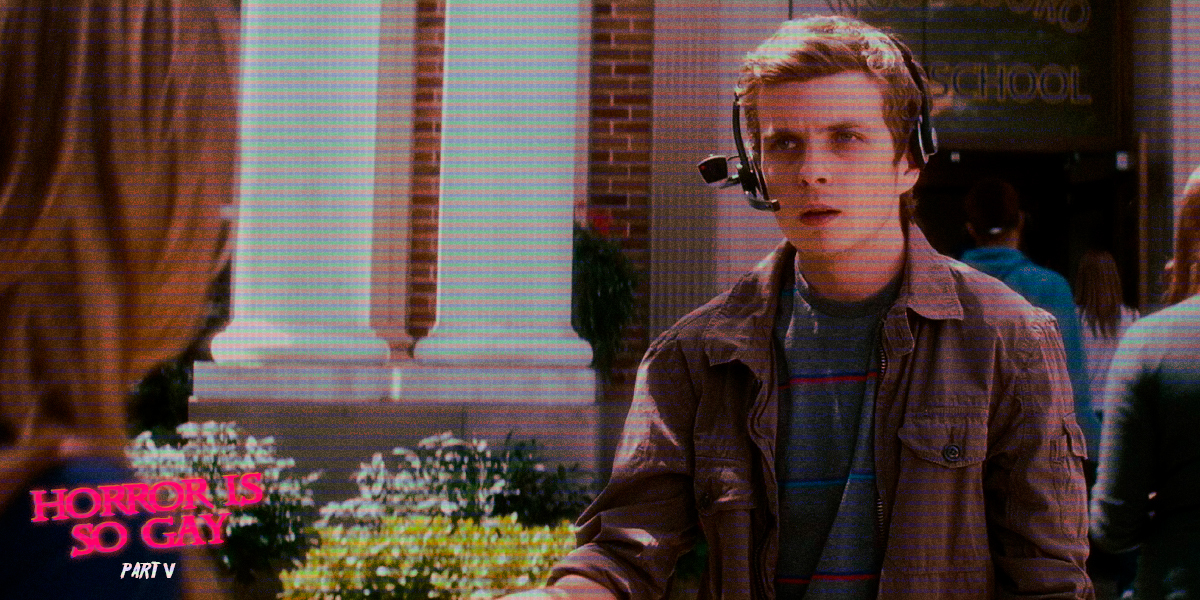
Robbie is constantly live-streaming (a concept that still seemed foreign to us in 2011) all of the upheaval in Woodsboro. In response, Gale tries to use video surveillance to spy on the Cinema Club’s Stab-a-thon party, and when her plan is thwarted by a Ghostface killer, she uncovers cameras that help prove the murders were being filmed all along. She tells Dewey, “He’s recording the murders. This time, he’s making the movie!” The rest of the film unfolds according to the familiar formula: Teenagers are hunted by the new Ghostface, some are killed, and some survive, and everything is served up to us with a heavy-handed helping of dark humor.
At the end of the film, all of the mounting questions are revealed one after another: Our mysterious Ghostface killers are Jill and Charlie, and the reason they’re doing their damnedest to recreate the famous Woodsboro killings that birthed the Stab franchise is because they wanted the videos of the murders to go viral on the Internet. To ensure their anonymity, they set up all the evidence to be traceable to Jill’s cheating ex-boyfriend, Trevor (Nico Tortorella), and intend to be the only survivors of the new Woodsboro massacre. But it wouldn’t be a Scream franchise without our expectations being subverted again, so it doesn’t end there.
Jill has other plans — she, and she alone, will be the only survivor this time, just like her cousin Sidney. After this revelation, we get a simultaneously hilarious and excruciating monologue from Jill after Sidney reminds her she had to kill all of her friends in the process of doing this: “What world are you living in? I don’t need friends. I need fans. Don’t you get it? This has never been about killing you. It’s about becoming you […] You had your 15 minutes. Now I want mine! I mean, what am I supposed to do? Go to college? Grad school? Work?! Look around. We all live in public now. We’re all on the Internet! How do you think people become famous anymore? You don’t have to achieve anything. You just gotta have fucked up shit happen to you.” She isn’t successful in accomplishing this, of course, but the sentiment envelopes the rest of the final act.
When my friends and I saw the film in 2011, we walked out of the theater totally delighted by the absurdity of this ending. As an already huge Wes Craven fan, nothing surprised me about the fact that he was trying to say something important about the world around us. I knew his films well enough to look for the messages and interpret them properly, even if he wasn’t the sole writer of them. But at the time, the warnings in Scream 4 felt wildly unrealistic and almost alarmist. We were still reading blogs for music recommendations, our favorite publications were still widely available in print, YouTube wasn’t yet the Wild West of media, social media was mostly just an enigma slowly unfurling itself, and many of the people I was growing up with who dreamed of becoming “famous” did so in the old-fashioned way — by creating art so beautiful and impactful that it would garner some kind of long-term recognition. Things like Bumfights and Rotten.com sadly also existed, but these were niche areas of the Internet that most people who visited them knew to keep hidden because their very premises engendered shame in those who dared to witness. If Craven and his co-creator Kevin Williamson were right — and to be fair, Craven mostly had been up to that point — then the Internet was bound to turn us into absolute monsters. It was a fourquel, after all. Naturally, the ante had to be upped.
Fifteen years on, it feels completely arbitrary to go on about how correct they were, but hidden throughout all of the metatextual analysis and the alarm about the future of our digital lives is a striking representation of the ways we’ve come to surveil each other. Aside from the various cameras Jill and Charlie are using to document their kills, Robbie is constantly recording everything he sees via the camera attached to his head, and Gale attempts to weaponize the teenagers’ strategies against them by utilizing video surveillance at the Cinema Club party. Robbie is already completely indoctrinated into the idea that everything and everyone around him is content waiting to be picked at, and it doesn’t take Gale long to recognize how that could be turned into something much more “useful” (for her purposes, anyways).
Although Sidney’s question — “…and what? You put it on the ‘Net?” — seems like such a throwaway self-referential joke, it has become one of the most pronounced aspects of our communally lived reality. Meta Glasses, GoPros, and DJI Osmo Pocket cameras abound, and influencers and “content creators” recording their every move provide flashes of the lives of everyone their cameras catch in their paths. In turning the cameras on themselves, people have both willingly and unwittingly made everyone else around them an unconsenting subject in the documentation of their lives. Beyond CCTV and Flock cameras, it’s becoming more and more difficult to avoid having your image sent into the void of the Web simply because there are so many cameras around all the time. And that’s not even where the surveillance ends.
Rewatching Scream 4 for the sixth time this year, I was struck so significantly by how easy it was for Gale to go from annoyed skeptic to being almost joyful about embracing the technology the teenagers were using as a tool for her own gain. Like so much of our society over the last 15 years, Gale’s belief in the line between what is public and what is private shifted in the name of “keeping others safe.” She believed the killer would be in attendance at the Cinema Club’s Stab-a-thon party, and instead of making sure people knew there was a threat, she installed a set of security cameras to document a new attack should it actually occur. Her intentions might have been (somewhat) well-meaning, but the execution serves as a stunning reminder of how video surveillance has come to be weaponized against all of us all the time. No matter where you go or what you do, you can’t escape the digital eyes of some constantly watching entity — whether it be big tech companies or the actual U.S. government or both — claiming to be watching us in the interest of making sure nothing dangerous or injurious happens to us without a witness. And many people have not only gotten completely used to the idea that we have very little privacy anymore, but they freely consent to it by constantly participating in the surveillance through the numerous ways our tech overlords have developed since the film’s release. No one’s any safer, yet our images are stored in places we’ll never see, and we’ve found a million new ways to police each other’s behaviors in the process.
As funny as her declaration is inside of the context of Scream 4 and outside of it, Jill’s words — “We’re all on the Internet!” — feel more ferocious than ever. We’re all on the internet watching each other and reconstructing how we interact with the people and relationships around us as a result of what we see. It’s not even our choice anymore.
This essay is part of Horror Is So Gay: Part V, Autostraddle’s series on slashers rolling out during October 2026.