





When I originally pitched writing about Cherry Falls, the news about Jane Doe’s horrific rape at the hands of seven Cornell fraternity brothers had not yet dropped. I’m not a survivor of that particular kind of violence, but I’ve worked closely with rape survivors, inside and outside of the carceral system. And I’ve struggled with how to write about this particular film while we’re all drifting in the wake of this news, in our reactive rather than proactive conversations on rape and rape culture, and in our collective grief about how our systems are constantly failing us in the most physically, emotionally, and spiritually devastating ways. If this is something you’re struggling with reading about right now, consider skipping this essay for now.
When Rogue Pictures and October Films first announced Cherry Falls was in development in Fall 2018, director Geoffrey Wright, who at that point was most famous for the 1992 Australian cult classic Romper Stomper, promised Cherry Falls would stand out among its predecessors and peers, saying: “It’ll be generic, but it’ll have some thematic resonance and a more intelligent script.” What exactly he meant by “a more intelligent script” wasn’t really clear. But I don’t think anyone expected the plot of Cherry Falls to attempt to subvert well-known slasher tropes so brazenly and to take on multiple important cultural discussions at once.
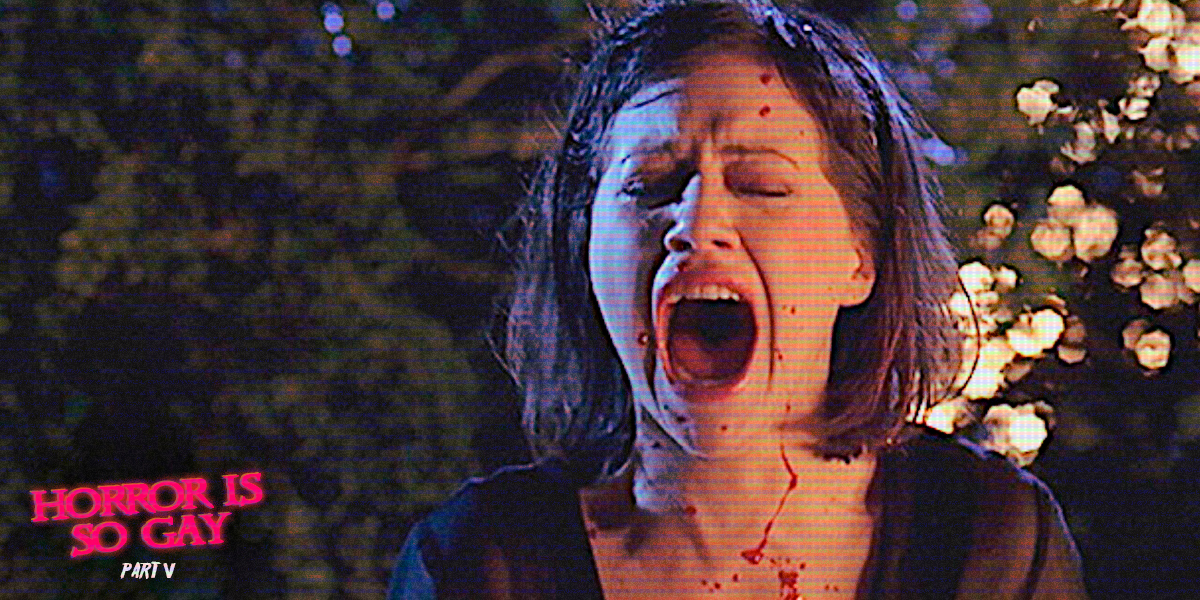
Late at night in the woods outside of the town of Cherry Falls, Virginia, a killer brutally murders two teenagers (Jesse Bradford and Bre Blair) just as they are getting hot and heavy in the front seat of one of their cars. On the other side of town, Sheriff Brent Marken’s (Michael Biehn) daughter Jody (Brittany Murphy) is once again refusing to put out for her boyfriend Kenny (Gabriel Mann), which leads him to break up with her. The next morning, Sheriff Marken and the rest of the local cops are horrified and confused by the levels of violence they’ve encountered at the murder scene. They notice the killer has marked his victims by carving the word “virgin” into the meat of their inner thighs. The town coroner confirms the female victim’s hymen is intact, signalling that the killer’s assertion is true, as far as they can tell medically.
At school, news of the vicious attack makes its way around. Students become increasingly concerned about the possibilities of their imminent deaths. In Mr. Marliston’s (Jay Mohr) English class, he gives his students space to discuss the murders and their “feelings” about them, but the conversation is cut short when Sheriff Marken comes in to question the students about their murdered peers. Marliston insists that if there’s anything the teenagers should know in order to protect themselves, then Sheriff Marken should share that information, but he chooses not to.
That night, another teenager (Clementine Ford) is murdered and marked in the same manner, which prompts Sheriff Marken to hold an important town meeting with all of the local parents. In the high school gym, Sheriff Marken tells the parents about the nature of the killings, revealing that the perpetrator is targeting virgins, and implies parents should do with that information what they will. In one of the funnier scenes in the movie, a worried parent stands up and exclaims “If word gets back to these kids that someone is murdering virgins, we’re going to have a goddamn fuckfest on our hands!” As Jody and her friend Timmy (Keram Malicki-Sanchez) spy on the town meeting, Timmy steps away to make a phone call about Sheriff Marken’s news that ultimately leads to him falling prey to the killer, and then Jody is pursued through the halls of their school by a shadowy figure intent on ending her life.
When her father and the rest of the town police take her statement, Jody describes someone with a striking resemblance to a girl who used to live in town named Lora Lee Sherman. Sheriff Marken immediately becomes tense and alerts the school principal, Tom Sisler (Joe Inscoe), about this new development as Jody secretly listens in on the call. Back at school, news about Sheriff Marken’s town meeting spreads rapidly, and the students take their survival into their own hands by organizing a giant orgy at a hunting lodge outside of town they’ve named the “Pop Your Cherry Party.”
This is where the plot gets a little wilder and much more convoluted than it ever needed to be. After listening in on the call, Jody is reeling, trying to solve the mystery of Lora Lee Sherman. She confronts her mother (Candy Clark) who, after significant prodding, tells Jody that Lora Lee Sherman was a quiet, isolated young woman who accused a group of well-liked young men of raping her when Jody’s mother and father were in high school. She explained how the rape was swept under the rug by town authorities in such a dramatic way that it forced Lora Lee Sherman and her family out of the town entirely, never to be seen or heard from again. Until now, maybe. When Jody pushes her mother to reveal who was involved in Lora Lee Sherman’s rape, her mother emotionally confesses that Jody’s father was also one of the accused, revealing what is basically a decades-long conspiracy built to protect the reputations and positions of some of the most prominent and powerful men in the town.
In the midst of trying to keep control of the “goddamn fuckfest” the teenagers are having in the present, Principal Sisler is killed and Sheriff Marken is kidnapped by the shadowy figure who looks like Lora Lee Sherman. Soon after, it’s revealed that Mr. Marliston — the high school English teacher who insisted that Sheriff Marken share the details of the killings with the other Cherry Falls parents — is actually the son of Lora Lee Sherman who was born of the rape of his mother. As a child, Mr. Marliston experienced horrific abuse at the hands of his “disturbed” mother and vowed to take his revenge on the people who ruined their lives. Marliston forces Sheriff Marken to confess to Jody and recount the night of the rape in detail, and although Sheriff Marken was so drunk that night that his friends had to physically hold his body on top of Lora Lee Sherman’s in order to make him participate, he didn’t stand up for Lora Lee Sherman (or himself!) and instead chose to cover the violation up with his friends and the rest of the town authorities. Marliston dreamt up the plan to kill virgins, because what could be more of a symbolic punishment for the people of Cherry Falls than robbing these parents of their “precious virginal children”?
Marliston’s reign of violence ends, as most slashers do, with Jody — somehow still our virginal final girl — killing him before he can kill her. At the end of the film, Jody is questioned about Marliston with her mother at her side, and when one of the sheriff’s deputies asks about Lora Lee Sherman, Jody acts as if she has never heard that name before, protecting her father and the rest of the men who attacked Lora Lee Sherman 25 years prior.
Much like Scream had four years before the release of Cherry Falls, the filmmakers tried to grapple with so many new questions and nuances about the teenagers coming of age in the late 1990s and early 2000s while also trying to reconcile their experiences with many of the organizing principles — violence, sexual violence, misogyny, institutional oppression — of our world. The filmmakers were asking audiences to both accept that stereotypical slasher tropes could be easily upended by a couple of keystrokes in a script and that a vicious killer — or at least, one who takes aim at completely innocent parties — could be created as a result of unmet justice. What happens when the lines between “victim” and “perpetrator” are blurred entirely? What happens when someone born from violence turns to a similar kind of violence as a means of seeking retribution? Is that quest for retribution ever free of a person’s own, intimate desire to assert power over a situation in which they feel completely powerless?
Mr. Marliston becomes a conduit to explore these questions, but he’s an imperfect one. The filmmakers want to paint Marliston as a fierce and loyal protector of his mother, going so far as to have him don a Lora Lee disguise when he’s killing people to make it seem as if she’s returned to the town to exact her revenge. When Marliston is finally given his time to explain himself (a horror trope they decided not to subvert), the intended motivations for the killings are obscured by his own beliefs that he is owed something. The film briefly flashes back to Marliston’s memories of growing up with Lora Lee, and the images that streak across the screen are horrifying, too: a disheveled, dirt-covered toddler Marliston chained to the inside of the crib he’s outgrown on the receiving end of a belt lashing from a shadowy female figure whose face we never see. Of course, the backstory of our killer in Cherry Falls is necessitated by the plot, but this set up undermines the audience’s expectations of Marliston and turns him into less of a misguided vigilante in pursuit of justice for his mother’s savage rape and more of a pissed off victim-survivor who is seeking payback for the violence he experienced at the hands of his emotionally tortured mother. Although the questions of what kind of justice he’s allowed to seek linger throughout these revelations, the filmmakers push — as so much of what happens in our society pushes — the narrative that we can never truly untangle a person’s learned impulse to punish others because of their own experiences with brutality.
While this aspect of the film might be a failure on the filmmaker’s parts, the ending of the film helps Cherry Falls become one of the most honest and unflinching confrontations of people’s complicity in the rottenness of the institutions that were supposedly built to protect us. Everyone in the generation above the teenagers being killed in Cherry Falls spent the decades before the events of the film covering for the group of men who destroyed Lora Lee’s life in the first place. And they went above and beyond in their perceived duty to protect these men — they gave them positions of power in the town, making one of them the Sheriff and another the high school principal. Then, just when it seems like Lora Lee’s story might be brought out into the light again by a new generation of women who appear to deeply care about how she was treated, Jody chooses to protect her father instead. Could anything be a more apt representation of what has happened and is happening in our society right now?
The social reckonings we constantly seek in regards to rape culture and the misogynistic and patriarchal systems that perpetuate it through the media (and through social media to an extent) keep failing us. These conversations evolve and revolve, but the cycle of sexualized violence in our society never ends no matter how many times we’re horrified by what it’s wrought. Cherry Falls brings viewers back to the true reason the loop is so endless. It’s not just the systems and the people who run them that keep preventing this violence from ending — it’s others outside of the system who are too invested in what the system provides them that allow these atrocities to keep happening, even if they’re instinctually unnerved and angered by them. Should a teenage girl be responsible for upending the controlled narrative that has ruled her town for two decades? Not necessarily, but Jody isn’t the only one who knew the truth. Her mother does, and so do so many of the other older leaders and stakeholders of the town. But no one comes forward, not even after their own kids are brutally slaughtered at the hands of a man who believes he’s allowed to take their lives because his was made so tormenting by the lie they perpetuated.
Even through all of its failures, Cherry Falls forces us to sit with the uneasiness of knowing we can’t move forward without accepting that our responsibility to each other goes beyond our individual comfort. Complicity might not be as directly aggressive as a physical attack but it kills just the same.
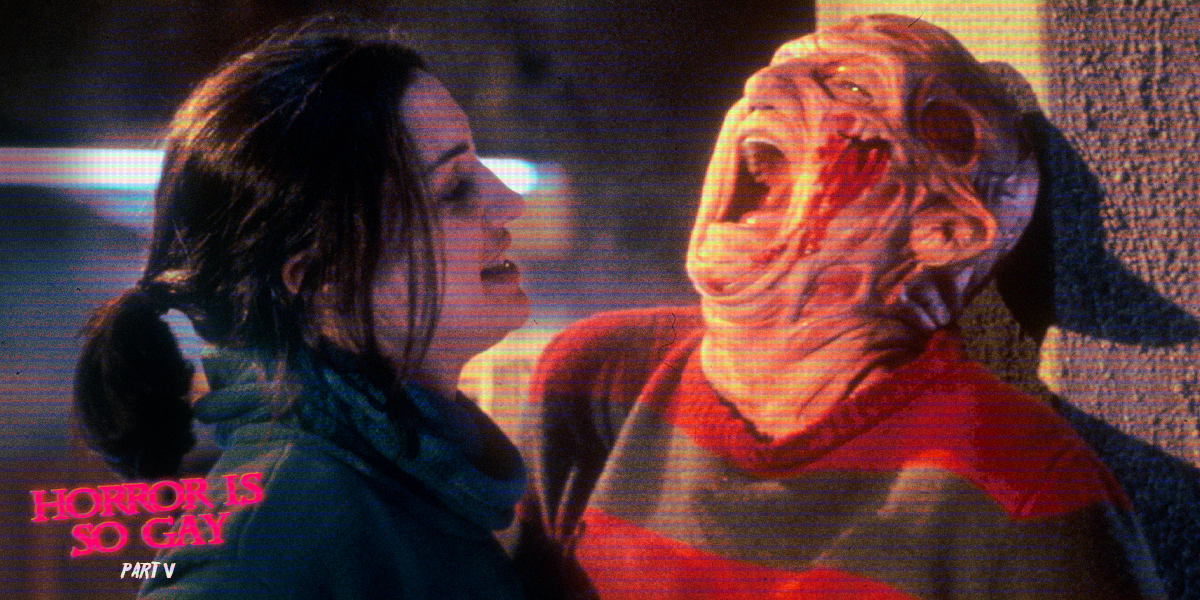
This essay is part of Horror Is So Gay: Part V, Autostraddle’s series on slashers rolling out during October 2026.

Comments
I am not a slashers guy but I really loved reading your take on this! Horror is so gay is one of my favorite series here 💜👻
thank you for reading <3