I tell people I’m from LA. Having moved to the opposite side of the country at 18, I’ve long learned that when East Coasters ask for specifics, they’re just hoping I’ll name one of the five trendy neighborhoods that have reached peak gentrification in the decade plus I’ve been gone. And it’s not a lie, exactly, just shorthand. True but imprecise. Really, I grew up in one of the small, working-class suburbs that orbit the city proper, close enough to have the requisite LACMA spaghetti photo (courtesy of my parents) but well-removed from the celebrity sightings and health food bistros people associate with Los Angeles. Life there was mostly quiet and boring: The main teen activity was wandering the sizable mall with an assortment of friends, buying dumb knicknacks with small change, and privately yearning for more.
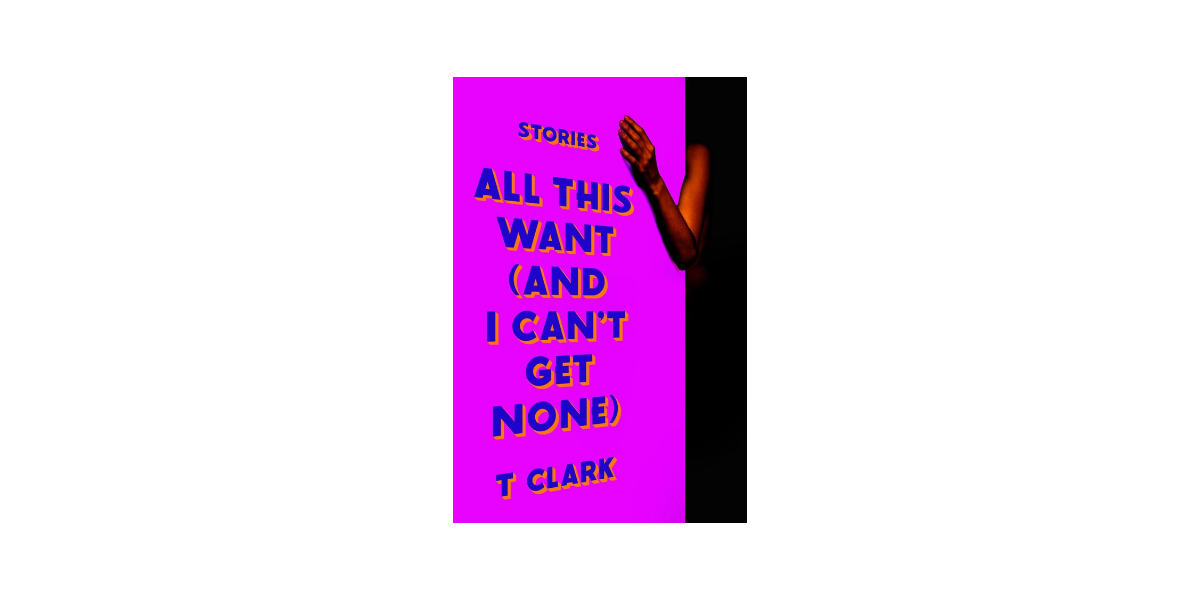
All this to say: I recognized the world of T Clark’s debut immediately. The twelve stories comprising All This Want (And I Can’t Get None) may take place primarily in the small cities just north of New York, but they could just as easily have been set in my hometown. Clark’s characters—listless, hungry Black kids (mostly girls) on the verge of adulthood—were intimately familiar, too. I knew them. I was them.
One of the hardest things to capture as an adult writing young characters is the tension between the extremity of every teenage feeling and the retrospective understanding that, more often than not, nothing that crazy was even going on. The emotions need to be real, lived-in, appropriately out of control, yes—but also, the scope of the situation needs to be put in perspective. Clark proves themself right at home in this contradiction. They narrate the horrors of youth hilariously, with a wry precision that nonetheless maintains enormous compassion for its subjects. Because here’s the thing about these characters—and you might have guessed this from the title—they want. These teens are hot and bothered, electric with longing, and absolutely languishing in working class suburbia. And tragically (again, see title) their desires are rarely met—or, when they are, turn out to be much less fulfilling than expected.
In the titular story, thirteen-year-old D’Asia wants more from an already overfamiliar relationship with a school security guard twice her age. Or, well, maybe she doesn’t. Sure, his attention skeeves her out sometimes, but god, how good does it feel to be wanted? Here and throughout the collection, Clark treads confidently through difficult territory. The situation is remarkably inappropriate, but that’s not the point. Instead, they focus on D’Asia’s interiority, taking her seriously as she weighs the pros and cons, giving her agency. After all, what is D’Asia if not a hormone-riddled teen, wanting sex even if not with the right people? We’ve all been there. And yes, we know it’s not that simple, but to her, it kind of is. Clark treats their protagonists as complex individuals navigating circumstances that, however appalling, do actually happen. They challenge their readers to do the same.
I said before that I saw myself in these stories. That’s especially true of “Nutcracker” and “Red-Hot Door.” The former follows Shelly, a young employee of Modell’s Sporting Goods; the latter, a religiously sheltered high schooler named Sadie. These girls are on the quiet side, sweet but a little awkward, prohibitively responsible and treated like they don’t have a clue. Shelly is the only girl on the register who’s never been “honored”—semiconsensually play-assaulted—by the boys in the stockroom, which of course only makes her want it more. When she asks one of them for an explanation, he tells her she’s “too nice and shit.” He says, “You don’t seem like you’d be that fun.” Sadie, too, is plagued by the projection of propriety, living in the shadow of her god-fearing mother even as she clumsily weasels her way into a bad kid’s basement to catch a glimpse of porn.
It’s a funny experience, one I’ve rarely seen depicted: being labeled the innocent one. Every girl you know will tell you you’re gorgeous, so hot, but boys seem allergic to flirting with you. You buy shorter skirts, learn to bat your eyelashes, study other girls in hopes of understanding why they don’t come off so damn virginal—to no avail. Growing up, fiction and life led me to believe that the sweet, uninitiated girls are always white; Black girls are sexualized too young and too intensely to be seen as virtuous. So what to make of myself? All This Want offers some much needed answers. Clark’s characters wrestle with the same profound embarrassment that I hated in myself as a teen: that roiling jealousy of the unwanted attention foisted upon girls who looked like me. There’s room for everyone, the girls who get some and ones who don’t, in this expansive portrait of Black girlhood.
For me, the turmoil of perceived innocence was resolved late in college when I realized what, in hindsight, was hovering above my head in bold red text all along: you’re not repulsive, you’re GAY! What a relief. The latter half of All This Want sees characters experience similar epiphanies. In “Walks Like a Duck,” Itara befriends April, the offbeat new girl who’s secreting lesbian erotica from the back of her sister’s bookshelf. “The Thing About You” follows Netty, a newly out college freshman, as she reunites with her estranged gay cousin, G, on a quest to track down G’s elusive internet girlfriend. Kiki of “Dark Times” has been out for years, is hung up on a chaotic sort-of ex-girlfriend who they should probably stop talking to, if we’re being honest. And queerness isn’t the focus of “A Great Dad,” but we learn on protagonist Cliff’s meandering journey to his daughter’s birthday party that he used to kiss boys on the low—maybe still wants to.
You might think, for a collection described on the inside cover as “queer coming-of-age,” that there are relatively few explicitly queer stories. As a younger, less discerning gay, this might have annoyed me. But that would be my loss, because I’d be overlooking the aching thread of queer desire woven throughout this book. D’Asia might be contemplating sex with Tevin, but when it comes down to it, she’d drop everything to raise a baby with her friend Kay. The unnamed narrator of “Insults for Ugly Girls” is obsessed with cool girl Tiffany in a way that might surpass simple jealousy. Shainey (“If I See You First”) wonders about kissing her best friend, Jamilah, even as she sleeps with the white boy from her dorm. These stories are the kind of queer that will resonate with anyone who grew up not really understanding that queerness is even an option. It’s in the subtext of every friendship, the tenderness with which Clark’s girls handle each other—a perennial sapphic yearning as yet undeciphered.
All This Want (And I Can’t Get None) is particularly special to me as a collection that lets Black girls be messy and lustful and humiliatingly wrong. With this debut, T Clark traverses territory largely unexplored, joining the ranks of authors like Toni Morrison and Jacqueline Woodson, whose works were my first introduction to a Black girlhood I recognized. But also, this is fiction for all erstwhile sufferers of big feelings in small places, a raucous study of opposing truths that deals lovingly with desire’s mortifying, all-consuming presence—and its absolute banality. It’s an ode to and elegy for that mundane delirium of adolescence; a funny, incisive reminder that maybe, all this want isn’t meant to be resolved. Maybe the best thing we can do, the most honest, is sink into it, feel it all the way through. Call it home.