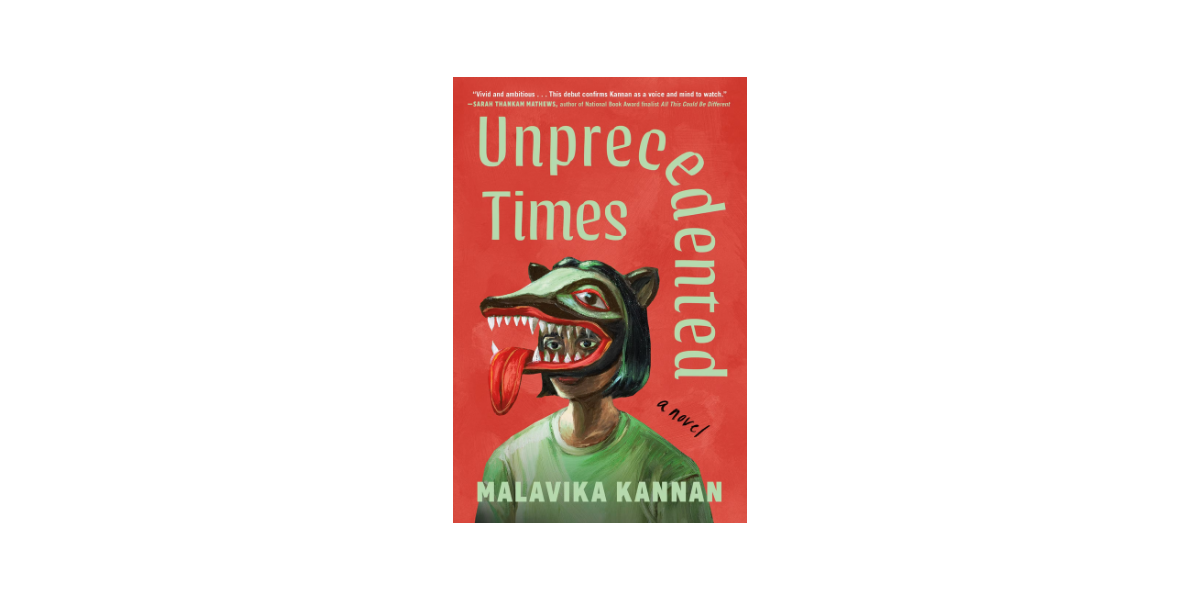
At the opening of Malavika Kannan’s debut novel, Unprecedented Times, Rishi Kumar launches into her freshman year at Stanford with audacity and purpose. “I get to attend college for the main purposes of reading books and kissing girls,” our narrator declares on the very first page. “Women used to get burned at the stake for that shit! My timing couldn’t have been better.”
On day one, she meets her roommate, Georgia Becker, and informs her she plans to take notes on her life so as to emulate her idols Virginia Woolf and Alison Bechdel. She is only 18 and has spent most of her life in a conservative Florida suburb, but she is confident she will soon “become somebody with something to say.” It is this belief that drives her to live a life worth writing about, for the express purpose of writing about it.
For the most part, Rishi thrives at Stanford. She wins a major writing award. She applies and is accepted to a summer study abroad program in Moscow. She develops a tight-knit group of diverse queer friends: “I half expect a photographer to jump out to record us for the campus brochures,” she muses. Together they go to parties, excel in their classes, and smoke a lot of weed. Even when it comes to her short-lived, devastating situationship with the first girl she ever sleeps with, Rishi spins a win: She writes about the experience for her Asian American Autofiction class, and her reading is met with near-universal acclaim. It seems like nothing can stop her from claiming the future she has always believed will be hers.
Then the COVID-19 pandemic hits. Everything Rishi valued so highly, all her academic and creative ambitions, all the interpersonal dramas that felt so all-consuming, become minuscule in the face of the global emergency. After struggling through a grueling online term in her childhood home while dealing with her mercurial mother, she and her friends decide to take a gap year and move to a farming commune in western Pennsylvania together. It is here, under the forced proximity and the lack of elite university trappings to provide a lifestyle buffer, that the glittering life Rishi only just started to build for herself begins to fall apart.
The COVID-19 pandemic struck in the middle of my junior spring semester at Yale. The rest of that semester and my entire senior year happened online. Unlike Rishi, when we got the eviction email from our university president, I was decidedly not thriving. I hated everything about my major. I was on the express train to academic probation. My best friend and my roommate were both studying abroad, leaving our previously cozy two-single suite cold and lonely, and my other best friend and I had just had a horrific falling-out. Days before we were all sent home, I was seriously considering dropping out. In my head, the choice was either that or the Yale-New Haven psych ward.
But once lockdown started and I was actually back in my childhood home in the Hudson Valley, my story began to strongly overlap with Rishi’s in concrete, wrenching ways. Reading about her commiserating Zoom calls with friends and enduring the drudgery of online classes, I was thrown right back to spring 2020. We both fought fiercely with our parents over joining the protests for Black lives (and were ultimately not allowed to participate). We both uncomfortably dodged the topic of our burgeoning lesbianism around our mothers to make things easier. We both felt the restless agony of being trapped indefinitely in the towns we’d fought so hard our entire lives to escape. We both finally realized how meaningless it all was: the glitz and glamour of our elite academic institutions, the stress of applying for summer internships, everything we’d been led to believe was life-endingly important to strive for and pressure each other (and ourselves) over, what did any of it matter when body bags were piling up on the streets of New York City?
Kannan is unafraid to write a queer woman of color as a real human person, with all the complexities and flaws that being human entails. Rishi is an audacious, acerbic, and unintentionally hilarious narrator. Her reaction when the white girl she’s sleeping with ends things: “Is this how it feels to be hate-crimed?” Her eye is sharp and unforgiving. Many of her internal observations fall under the category of Somewhat true, but you absolutely shouldn’t say it. I laughed aloud from shock and delight more times while reading this novel than any other in recent memory, always thinking, Oh my god, she WENT there.
“Some days, I’m not sure if I want to live at all,” Rishi says at one point. “Not in a self-loathing, suicidal sense—I’m not a skinny white girl, I don’t have that luxury.”
I predict that some readers, particularly white ones, will struggle with Rishi’s abrasive inner dialogue. From experience, I can say there are two paths for a lesbian of color growing up in a racist hometown: You let the constant indignities chip away at your sense of self until you believe all the lies you’ve been fed about your lack of humanity OR you learn how to fight back at every perceived slight as protection, developing a skin so thick no barbs can penetrate it. But nor can any tenderness escape it.
There are no good choices when you’re fighting for your life. I went down the first path, and even now that I’m nine years removed from that period of my life, I’m still working to put the pieces of myself back together. It was refreshing to finally read a character who gives a voice to all the same bitterness and frustration that built up inside me after taking years of micro- and macroaggressions in silence, but (mostly) directs it outward at a world she has every right to distrust rather than inward at herself. This is not to justify her behavior, but rather to provide context for where it comes from, and to caution readers against writing her off as an “unlikeable” character just because they find her aggression unpalatable.
Rishi’s relationship with her mother and how it evolves over the course of the novel was one of the most moving parts of the book to me, in particular how her mother copes (or doesn’t) with her sexuality. Parental relationships in general are a massive theme of this book: The way Rishi and every single one of her friends behave can be directly traced back to their relationships with their parents, which are explored to varying degrees in the novel. This is another impressive feat of Unprecedented Times: Kannan’s ability to manage so many characters while developing them all sufficiently to feel vivid and real.
Rishi’s coming-out scene early on in the book rattled me to my core for how directly it felt ripped from my own life, how accurately it depicts the belief shared by many immigrant parents that their children are choosing queerness out of a twisted desire to torture them specifically, rather than it being an intrinsic part of who they are. I read this scene while walking just two blocks from the subway to a bar in the East Village for a reading, and I showed up with eyeliner running down my cheeks. This idea of “love like wrestling, round after round,” of your mother being the person who simultaneously loves you like nobody else in the world and will never, ever truly know the real you, will resonate for many queer women of color.
At times, Georgia (who is white and whose parents support her choices unconditionally) is critical of the same parenting styles Rishi was raised with, and though Rishi can acknowledge to herself that her mother made many mistakes, she is defensive in the way many children of immigrants are. We understand the context of our parents’ upbringings. We know why they make the choices they make, why their beliefs might be limited, why they struggle to communicate their love in the ways Americans understand. For us, it’s not as easy as “just setting boundaries” or “just cutting them off.” It was such a respite to see this conflict depicted on the page so accurately.
There’s a circular irony to how Kannan builds Rishi’s character arc that I found extremely effective. As a result, the ending has lingered in my mind long after the final page. Her story is compelling because of her contradictions and how we watch them play out over the course of the novel. She wants to break free of her mother’s overbearing love and backwards ideas, but ends up repeating the cycle. She interrupts her friends repeatedly during conversations, a habit she developed from her mother’s communication style, and is furious when they ask her for space during conflict: “What in the white woman is she talking about? Not once in my life have I heard anybody request ‘space,’ and least of all from the person who loves them most. No matter how badly my mother hurts me I call her every day.” When Georgia pushes her to go to therapy, Rishi’s resistance feels like it’s coming straight out of my own immigrant mother’s mouth: “Therapy is for women with problems with themselves, not with the world.”
Rishi wants to find a big love worth writing about, but her focus on grand, sweeping arcs and lovers she can easily turn into characters prevents her from seeing what’s right in front of her and leads her to make careless decisions just for the sake of it. The heart of the book is Rishi’s friendship with Georgia and their descent into a codependent devotion that Rishi realizes far too late is in fact deep, romantic love. Rishi’s feelings for her are rendered with breathtaking tenderness from the very beginning of the book: “I really like hearing her talk,” Rishi says. “Her sentences remind me of origami, these little gifts of insight that she folds into my palms. I could line a shelf with them, keep them forever.”
As they dance together in the forest on a camping trip, drunk on a Nalgene of tequila, Rishi says perhaps the most romantic sentences I’ve read in my life: “I see it all in Georgia’s mouth: the solar system, millions of asteroids, comets with their loyal tails. All the truth of being a person, all the novels that will ever be written. Everything on earth I am looking for—was it here all along?”
When her friend Kavya asks about the nature of her relationship with Georgia literally right after this, Rishi insists they are just friends, but then in nearly the same breath admits: “If I imagine my wedding? At the end of the aisle, I can only see her. Do you know what I mean?”
Yes, Rishi. It means you are a giant lesbian, in love with your best friend, and in deep denial about it. But abstractly “knowing” your sexuality and actually recognizing when you are in real, sustainable, potentially “adult” love with a woman for the first time are two very different things.
Rishi wants to be a Great Writer, but she cannot take criticism gracefully. After the professor she idolizes tells her her preferred themes are overdone, Rishi mentally switches to cruelly calling her an “old hag” who “isn’t special at all.” In attempting to force a narrative upon her life as she’s living it, she completely destroys it.
As a writer who often works within the genre of autofiction, I found it fascinating to watch Rishi grapple with the same questions of ethics, self-disclosure, and consent I consider on a daily basis. Narrativizing my own life was for so long a way of surviving it; if the pain I was going through had some kind of broader meaning, some kind of tidy arc that ended with a concrete lesson I could tie up in a bow (or a slim and urgent novella), I could find a way to make peace with it. I wouldn’t have to accept the crushing reality that sometimes bad things just happen to people. Sometimes your heart just gets broken and there are no heroes or villains. That’s life. The world is not a book, and there is no satisfying ending. Rishi is forced to learn this the hard way, and I felt for her deeply as I watched it happen.
Ultimately, Unprecedented Times is really a story about unprecedented love — romantic, platonic, and familial — and how it creeps up on you when you least expect it. It’s about a young woman coming to terms with the patterns and behaviors she’s inherited and how, or if, she can break them. It’s about learning how to regulate your emotions so you don’t end up hurting the people you love, but also how to stay true to yourself as a passionate queer woman of color in a world that tells you that you are “overwhelming” and “suffocating.”
I will carry Rishi in my heart for a long time. I will let myself lean just a bit further into the part of myself that people declare is too much, because just like her, “I will dive even when I don’t know the depth. I am okay with the free fall.”