Hollywood has seen a decline in queer representation lately, especially for queer characters of color, offering middling if not nonexistent portrayals of queer Black women characters across TV, while countless stories of contemporary Black communities—especially those centering Black femmes—are left on the unproduced floor. GLAAD reports a steady decline from 101 Black LGBTQ characters in 2023 to 95 in 2024, and now down to 85 in 2025. Just the idea of a movie led by a lesbian, a queer non‑monogamous woman in a polycule, and a Black trans woman would have studio execs shaking in their boots and running for the hills.
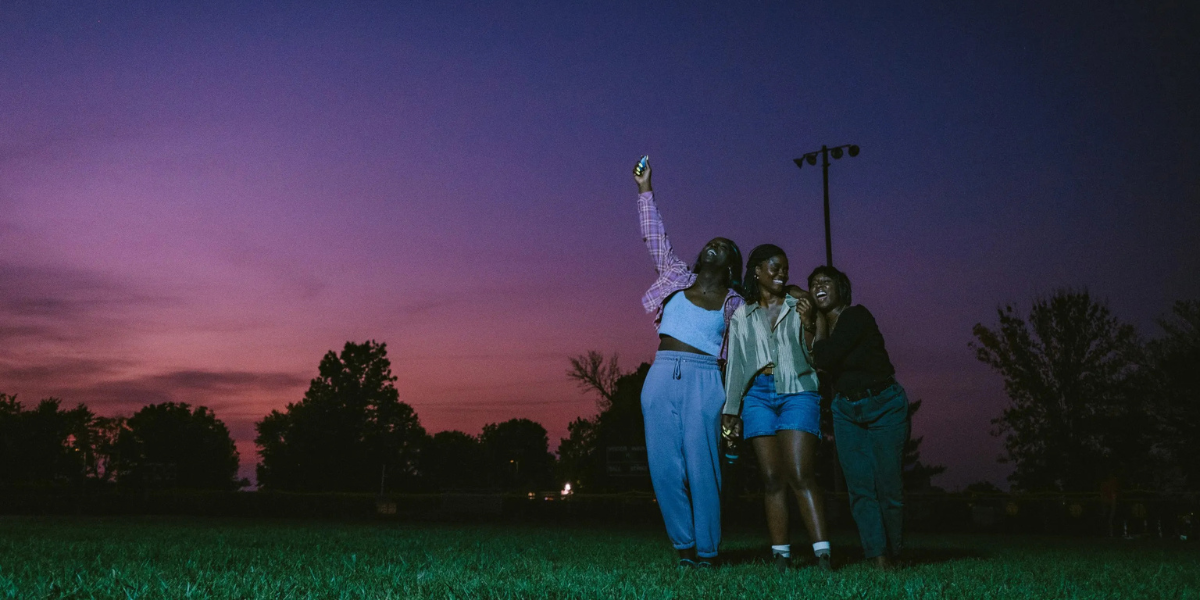
Thankfully, all of these characters exist in Shatara Michelle Ford’s (Test Pattern) sophomore feature, Dreams in Nightmares, a poetic, heartfelt, vibrant road trip story that examines the fabric of a femme friend group navigating their lost ways of life and connecting with each other across Americana. In doing so, it brings lively, textured visibility to the invisibilized relationships and dynamics that go unseen across modern mainstream cinema.
The film follows longtime mid-30s college friends Z (Denée Benton), Lauren (Dezi Bing), and Tasha (Sasha Compère), who are all in a rut. Z, an LA‑based creative writing professor, just got laid off from her job. Her loving partner within her non‑monogamous polycule, Reece (Charlie Barnett), suggests it’s a good time for her to stay in and foster their relationship, but she’s uncertain, weighing whether to go back to school for an MBA or finally write the book she’s been putting off. In Brooklyn, the serious, high-strung Tasha just got laid off too, and she’s fed up with her poet roommate Lauren not paying a share of the rent while galavanting off to unpaid gig work (despite Tasha having told Lauren she could live rent‑free). On top of everything, they can’t seem to get a hold of their friend Kel (Mars Storm Rucker), who’s been AWOL for two months. After Z visits her besties in Brooklyn for a night out, they suspect Kel has gotten back together with their self-centered ex, Sabrina (a scene-stealing Jasmin Savory Brown), and decide to take a road trip across the American Midwest to find them. What starts as a simple road trip to find Kel becomes a reflective odyssey as they confront the struggles and sacrifices that come with pursuit of one’s creative passion as a queer Black artist within contemporary America.
During this summer, I watched Spike Lee’s debut She’s Gotta Have It For the first time. Despite its 80s datedness, the portrait of Nola Darling (Tracy Camilla Johns)’s sexual liberation as an artistic Black woman was a breakthrough for visibility. Ford’s exploration of their Dreams in Nightmares ensemble feels like a stamp on the cultural evolution of Black cinema. It expands it by illustrating the ensemble’s fluid, sexually open worlds. As aforementioned, this is the first time I’ve seen a non‑monogamous Black polycule on film, and it’s done with such loving positivity.
The same sentiment applies to how the film threads Black American history into its opening minutes, with archival footage of Black folks picking cotton — a visual echo of how the trio’s inner desires are now disrupted by late‑stage capitalism. Z and Tasha aren’t necessarily poor; they’ve made it decently well for themselves. But the film interrogates how their past jobs have impeded their passions, personalities, and even relationships.
By the time the trio get onto the open road, Ford creates a naturalistic atmosphere and plays with poetic lyricism, underscoring the rage, pressure, and liberation of marginalized people trying to reclaim their own individualism. There’s an honest, raw aptness to this. In their first stop—a Philly poetry night—the film pauses for a trans poet played by Joss Barton, donning a Statue of Liberty fit, performing a powerful piece about the tribulations of being a doll in her own brimming light and finding true liberation in diverging from the traditionalist American culture, spinning the patriotic verses of “Star Spangled Banner” on its head. On their trip, the trio paves their own updated Green Book, stopping by every Black-owned business they can via Yelp reviews, trying to avoid white spaces they feel especially uncomfortable in. When they arrive in Ohio and visit Sabrina, there’s a hilarious yet effective white woman jump scare.
Ford furthers the themes in a running motif with Z’s comfortability through Lia Ouyang Rusli’s (Sorry, Baby) non-diegetic jazz score, which swells when she’s facing intense frustration at dinner tables. This happens in moments like Sabrina’s very small town white-liberal girlfriend making microaggressions, during a visit with Kel’s Kansas City parents (Regina Taylor and Robert Wisdom) who keep deadnaming and misusing their child’s pronouns, and the trio’s various chagrins. But among her femmes in times of joy and community, the music shifts to an angelic harp, exemplifying free spirit and joy.
Ford embeds nuance in the road trip formula through their way of extracting fabrics of each characters’ respective identity, layering shared history across each stop. The characters all feel so beautifully rendered, and Ford’s character writing adds an immense dimension that makes me feel like I’ve known these people for years and understand their shared existentialist weight.
The essence of communal, familial love radiates across the screen in each frame. Benton, Bing and Compère anchor the film with their gleaming chemistry, literally acting as the driving force and emotional core. I was particularly captivated by Compère as Tasha. Compère imbues Tasha with such a convincing lived-in weight that I can’t help but feel for her character.
The movie runs slightly over two hours, yet it’s one of those films where the runtime doesn’t matter. I wanted to live inside its world with its characters forever. Ultimately, Shatara Michelle Ford’s Dreams in Nightmares is a tender, sincere dedication to every Black queer artist who’s ever felt lost in their own creativity, suffocated by late‑stage capitalism, or erased by an industry that still doesn’t know what to do with them. It’s a celebration of a chosen family, the people who spark joy and are willing to support your full complex, liberated self, even in an unjust country that keeps folks in the margins. It’s a film that believes in us—as the credits feature the words “for all of us”—even when we don’t believe in ourselves.