





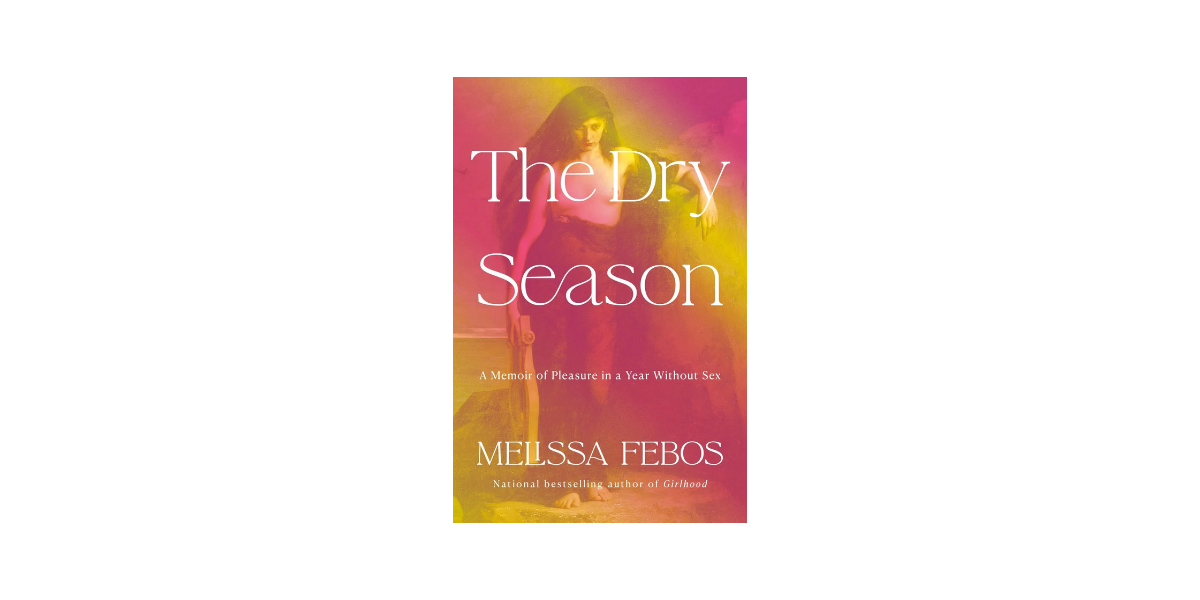
I read Melissa Febos’ latest memoir The Dry Season at the end of one of the biggest transitional years of my life. I’d finished my graduate degree in Ohio and moved across the country to start a new chapter as a high school English teacher in California. The job and the move came with new challenges, like figuring out how to best show up in all the ways my students needed and upholding my values in a completely different regional space. For those first few months, I worried constantly, doubting my ability to be everything I wanted to be and feeling guilty about leaving the Midwest. During that time, I had once again chosen to put my sex and dating life on hold. But as the first few weeks of summer opened up, so did my dating life. I started seeing someone who made me seriously think about the prospect of being in a relationship for the first time in two years. Then I got a notification from my library saying The Dry Season was available for pickup.
The Dry Season chronicles Melissa Febos’ choice to practice celibacy, intentionally abstaining from sex, relationships, and romance after a catastrophic two-year relationship. The three month commitment is meant to serve as the ultimate reset. As Febos describes it, she’d been daisy-chaining her way through committed monogamous relationships nonstop since the age of fifteen. The three month period extended into a year, a time when Febos was able to establish a new relationship to her body, her creativity, and her non-romantic connections.
As the year progressed, Febos finds herself moving towards the stories of women who have historically chosen celibacy as a form of self-ownership and accessing power. One of the many things I love about Febos’ work is her dedication to infusing deep care into her research and bringing it onto the page for her readers. Of the women Febos researched, she writes, “My ancestors were there too, a chorus of chosen teachers: desert mothers, saints, scoundrels, warriors, furies, and artists—their stories spooling back through centuries. Those who took the work of freedom, who understand it as synonymous with love.” These figures stand by Febos, guiding her in tracing back through the elements of her past which colored how she saw romantic relationships and helping her redefine her understanding of what it means to love another person.
A large part of that reflection comes from an examination of how her past jobs as both a sex worker and a server showed up in how she moved through the world. It’s easy to forget how much women and queer people are expected to perform in our daily lives for safety, money, and basic respect. This is especially true in service jobs where paychecks are heavily dictated by tipping. Febos writes, “My ideal server basically ignored us and brought the food. They didn’t have to do anything to ‘earn’ their tip outside of their job description. I wanted to spare them that other kind of work, the kind that had made me so good at seduction.” The unwritten expectations that come with jobs like waiting tables are part of a long list of ways we are expected to live our lives in service to others: customers, strangers, patrons, partners. It’s a message we get in childhood and constantly under capitalism. These experiences manifest in people differently, easily evolving people pleasing and difficulty saying no.
Reading through Febos’ reflections and previous romantic behaviors sent pangs of recognition through me. As a child growing up in Missouri in the early 2000s, I’d made my own observations about how the world would evaluate my success and overall value. The orientation of most of my early girlhood conversations were rooted in questions of my future nuclear family. How many kids did I want? What would I want their names to be? What would my husband be like? The questions about what I wanted out of my life all came with the automatic assumption of a herosexual marriage and a minimum of two children. Though I played into these narratives, I never pictured that future for myself. When I closed my eyes, all I saw was a typewriter and a German Shepard.
This hesitation around wanting to start a family with someone didn’t stop me from pursuing romantic relationships. Once I had come out to myself, I started seeing potential for love everywhere and was crushing constantly (mostly on women who were much older than me). With those crushes came the urge to twist into a version of myself I thought the other person might want. That twisting came with the dramatic highs of validation and depressive lows of feeling unlovable. I spent my days waiting on text messages and nights playing back through every moment of specific interactions wondering how I could have come across hotter, smarter, funnier. Naturally, this approach and mindset around relationships caused a lot of damage, not just to me, but to the people who were trying to take care of me.
Like Febos, I chose to intentionally take sex, dating, and relationships out of the equation. It’s a practice I’ve taken on for different reasons at different points in my life, primarily during times when I felt I needed to fully dedicate my focus to something else: intensive work around my mental health, a creative project, a commitment to becoming a better teacher. The choice to abstain from sex resulted in more time for myself and allowed me to examine the patterns I had developed in relationships. Much of these patterns were tied to a personal obsession with queer perfectionism and struggles around my own self-worth. On the surface, all-consuming crushes and people pleasing may seem like actions which only hurt the doer, but that wasn’t the case with me. I led people on and was often disingenuous. I said I was happy to do things I wasn’t. I lost interest in people overnight. I missed out on important moments for my friends because of my own self-absorption. I never want to do any of that again.
Taking time to be celibate during my first year in California allowed me to build a life which matched my priorities. Febos writes, “The ongoing truth was that I had had more consistent energy for my students than ever before in my teaching career, as I also did for my friends, my family, and my work. Without the funnel of romantic obsession siphoning off large quantities of energy, it is disturbed more generously and evenly among all my relationships. The patterns of my energy and time spent reflected my heart’s investments more accurately than ever.”
We live in a world that heavily prioritizes one type of love and, under the bell jar of that prioritization, it can be hard to feel completely fulfilled without it. Reading The Dry Season reassured me I had built a life with everything I needed: a commitment to taking care of my students, a grounded relationship with my writing, and strong connections to my friends. I like the life I’ve built these past two years. I like having the bandwidth to show up for my students in different ways: coming in hours before school starts to help them with their writing, cheering for them at their events, coaching sports. I like being able to go home to my quiet studio apartment full of books and haunted dolls and bright fabric. I like that I can go to bed early so I can get up at 4 a.m. to write, getting words on the page before most people are awake. And I like that I can spend hours every week with my friends either on the phone or in person.
All of this is not to say that dating, sex, and relationships have no place or value for me. I’ve been on dates with great people (some of whom became my friends), learned a lot, and had fun, mutually enjoyable sex. The breaks I’ve taken from those things have given me the space to find clarity in what I want and show up better for people. I didn’t end up in a relationship with the person I started seeing last June. It didn’t work out and neither have the dates I’ve been on since then. And that feels completely fine. I’d have a beautiful, full life even if I never had another romantic connection. A relationship isn’t something I need; it’s something I’d choose. I know what I’m ready to compromise and what I’m not. After Febos’ year of celibacy, growth, and self-discovery, she met her wife, the brilliant poet Donika Kelly, writing in the book’s acknowledgements, “How lucky I am to have found you. Thank God we didn’t meet until I was ready.” Maybe that’s a type of love I’ll find someday. Maybe it won’t be. Either way, I’m going to keep pushing for the life I want. That’s a pretty spectacular thing.

Comments
Insightful, beautiful, thank you for bringing this to my screen!
Thanks for writing this, it was lovely to read. I’ve been single for 2 years after the ending of my last long term relationship and I do feel like my life is even bigger in this moment, it created so much space for other relationships, spirituality and creativity to flourish :)
more dino https://run-dino.run/
Thank you for this insightful review. I got to hear Melissa Febos and her wife (Danika Kely) speak when they were in Pittsburgh this spring. They were both inspiring. I like you writing. I’m going to look for your other articles. Peace.
Febos is a really talented writer but I thought the book lacked authenticity. It felt more like a research paper than a memoir.