





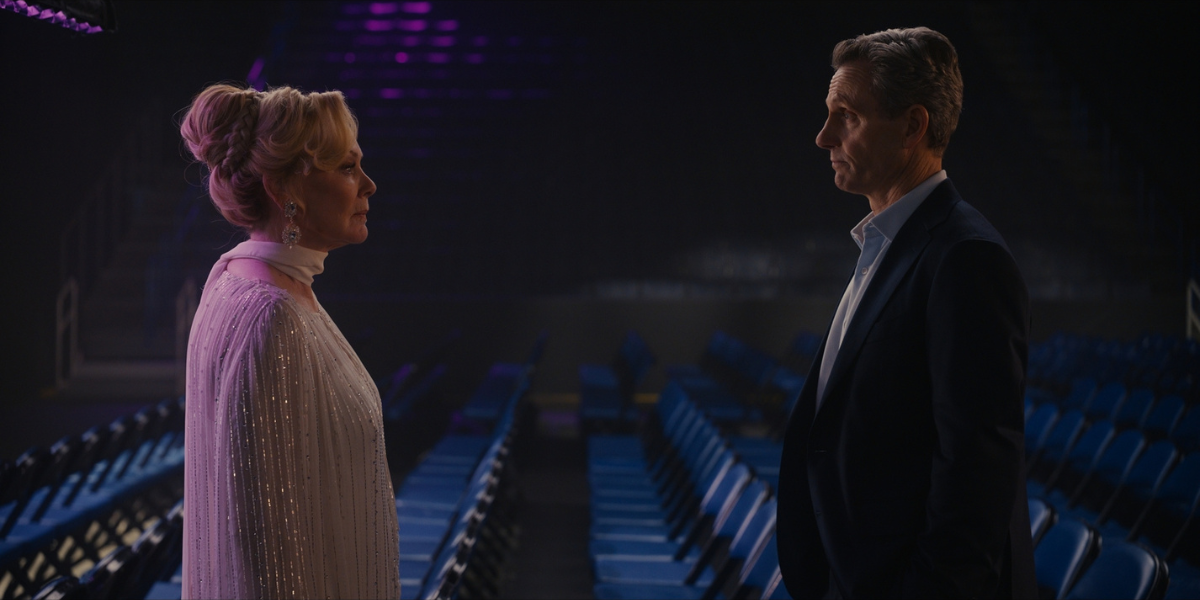
Deborah Vance is not always right about things. In fact, she is quite often wrong about a lot of things, especially when pontificating about the past, the way things used to be. But sometimes, she is extremely right about something regarding changes to the old ways of living, and in this penultimate episode of Hacks, she is very right about this: The QR codification of everything sucks ass.
Yes, a case can be made for contactless ordering options, especially in the age of pandemic-level viruses and the gutting of public health regulations and education. I’m not anti-QR codes in all contexts, but in the context which Deborah laments them in this episode, I wholeheartedly agree. What is the point of scanning a QR code to order room service instead of picking up a hotel room phone to call a human person? No doubt, this switch to QR code ordering allowed hotel management to reduce the size of the room service team. Because the automation of systems like this rarely actually benefits workers, usually only leads to layoffs and increased profit margins for those at the top. And though she makes the point in her signature offensive way, Deborah’s also right that there have been too many shifts away from interfacing with actual humans when it comes to experiences like this. Even in some of my most extroverted friends, I’ve witnessed an increase in sudden fears and anxieties about speaking to strangers, making phone calls, simply interacting with service workers in mundane but meaningful ways.
And what are these customer service shortcuts for? Well, supposedly, convenience. But I am increasingly wanting life to be less convenient, not more. The optimization and streamlining of everything from how our email inboxes are organized to our morning routines to how we order fucking french fries has me staying up past my bedtime reading about the Luddite movement, which I’m realizing I knew very little about before. This season of Hacks has taken some pointed digs at new technologies: Ava was run down by a Waymo, there was an entire episode about why generative AI sucks, and now here we have this seemingly small back-and-forth between Deborah and Ava. Now, Deborah is far from a champion of analog ways of living or divestment from tech; in the same episode, she summons Marty for a booty call that he hops on a private jet to oblige. But this Deborah observation about the pointless “optimization” of room service has stayed with me, because I think it also connects to the broader scope of the episode and its arc.
Bob Lipka is no doubt the type of man who over-optimizes — in his life and in his business. I called him television’s ultimate villain (as in a literal enemy to the art of television) at the top of this season, so I sensed something like the twist of this episode coming. Bob Lipka shows up as Big Bad to reveal he bought out Deborah’s Madison Square Garden show. And he vows to continue sabotaging her career efforts unless she signs an NDA saying she will never disparage him or Late Night ever again.
Deborah is an inconvenience to Bob. Silencing her is another form of optimization; her disparaging remarks bruise his ego and threaten his profit margins (probably not in a significant way, let’s be real, but billionaires like Bob obsess over even the smallest hits to their bottom line). And perhaps signing the NDA would “optimize” Deborah’s life, too, allowing her to continue her comedy career free of Bob’s interference. But it comes at a massive cost.
And so, instead, she chooses inconvenience. She pivots from the record-breaking MSG show to a record-breaking free show in Central Park. Her team pulls off the impossible by putting it all together in just three days. And notice how they’re able to overcome each obstacle to this feat through interpersonal, deeply human connections and conversations. Laurie Metcalf returns in her Emmy-award-winning role as Weed the tour manager (delivering a dependably absurd monologue about why Deborah firing her was actually, eventually, a good thing). And when Jimmy, Kayla, and Randi encounter a gay employee at the New York City Parks and Recreation department (played by Yamaneika Saunders) who adamantly won’t give them the permits they need, they get her to change her mind after realizing she’s a massive fan of Xena and the rewatch podcast Jimmy is producing with Renee O’Connor. Getting the things you’re after by simply TALKING TO PEOPLE! WHAT A CONCEPT!!!!!!
Sure, planning an MSG show was not exactly going to be a walk in the park, but it was in many ways the “easy” route for Deborah to kickoff her career again after a year and a half of being silenced. The Central Park show is the scenic route. It’s also immensely stripped down; gone are the pyrotechnics and other flashy technological aspects of the show. Just Deborah and a mic. The old-school way of doing things is sometimes all you need.
I see this episode as an extension of the AI episode. Creativity and art thrive on inconvenience. To streamline something is to flatten it, and shortcuts usually come at a cost. There is beauty to be found in inconveniences and in embracing the obstacles of living, and this is something I remind myself of often these days as Big Tech tries to convince us from every angle that this latest shortcut, hack, or optimization will somehow change our lives for the better. I’m not a full-on Luddite just yet, but I’m taking small measures to embrace inconvenience, spontaneity, and stripped-down ways of living.
This season has shown Deborah and Ava over and over again that they don’t necessarily need to reach for the shiny new thing in their pursuit of success. Sometimes all you need is a stage and a mic or to simply write what you know (as Ava realizes in her pilot pitching journey). The Central Park show wasn’t Deborah’s initial plan, but sometimes the pivot plan is the better one. And she pulls it off because of the team of people around her, not because of some stunt engineered for virality. The Bob Lipkas of the world will have you believing successful creative careers are determined purely through algorithmic metrics. Watching Deborah and her team succeed by hustling together to creatively overcome these obstacles is the perfect antidote.
Next week is the SERIES FINALE of Hacks! I cannot believe we’re at the end! In the meantime, catch up on all of my coverage of this final season, and tell me in the comments below what you’re hoping to see in the series finale.



Comments
I love your thematic recaps of the season and your take on this episode – it feels connected to the episode earlier this season where Deborah realizes her actual connections to her fans are what made her career special, as well.
Of course loved the whole arc about the MSG show becoming the Central Park show, but a standout scene for me was Deborah asking Marty to come work for her and Marcus at the Diva. Such a satisfying flip of Marty ousting Deborah from the Palmetto in season one. This season has felt like a love letter to the first, with the driveway, the salt and pepper shakers, and this, among other things. So much has changed for the characters and yet the show is so consistent—therein lies its brilliance!
A moment I loved in the previous episode is when Ava is surprised Deborah was serious about them going on vacation—her facial expression says everything about how much that means to her. For the finale, I’m hoping for quiet moments like that, that speak to the depth of Ava and Deborah’s relationship and take it so seriously.
Hacks has been on my list for years and I finally watched it over the last couple of months – have caught up on all your recaps ever and very excited to be caught up in time for the finale!!
.
I don’t think I’d go full Luddite either, but I get the frustration. Every company obsessed with removing human interaction, then wonders why people feel disconnected all the time. @slope 4