





all photos by Noor Aldayeh
The soft tunes of Najat Al Saghira’s song “Bahlam Maak” play as a figure sways behind a curtain, a wooden shower brush in hand. The song fades, as he begins to sing “She’s So High” by Tal Bachman. Occasionally dropping the brush with a loud bang, he peers through and around the curtain to glare at the audience, then continues his singing and dancing.

This is the intergalactic bathhouse of The Ancestor, played by L.A-based comedian, clown, and conflict mediator, E. Zalaan in their show, Syrian Soap. Taking the audience on a dynamic, interactive journey through time and space, this performance invites its viewers to reflect on the complexities of the human experience, what it means to be a living ancestor, and how to channel truth and joy even in the darkest of times. Equal parts hilarious and heartfelt, it is remarkably intimate, cleverly crafted, and self-aware.
Syrian Soap was a featured performance at the performing arts festival The Joy Who Lived, at The Hudson Theater in Los Angeles, which took place from March 31 to April 12. It will also be featured in the Hollywood Fringe Festival in Los Angeles from June 13 to June 20 and the National Queer Theater’s Criminal Queerness Festival in NYC from June 24 to June 27.
Zalaan spoke on their artistry, process, and crafting of this show with Autostraddle. They share how they were guided to comedy during the Syrian Revolution. “I remember being really moved in particular by when Raed Fares, the journalist, was murdered,” they say, “I did this kind of commemoration ceremony for him where I honored him and his legacy, and I asked him, what can I do to continue to honor your life, in my own life? And the answer that I felt I got was, to use my voice to tell the truth.”
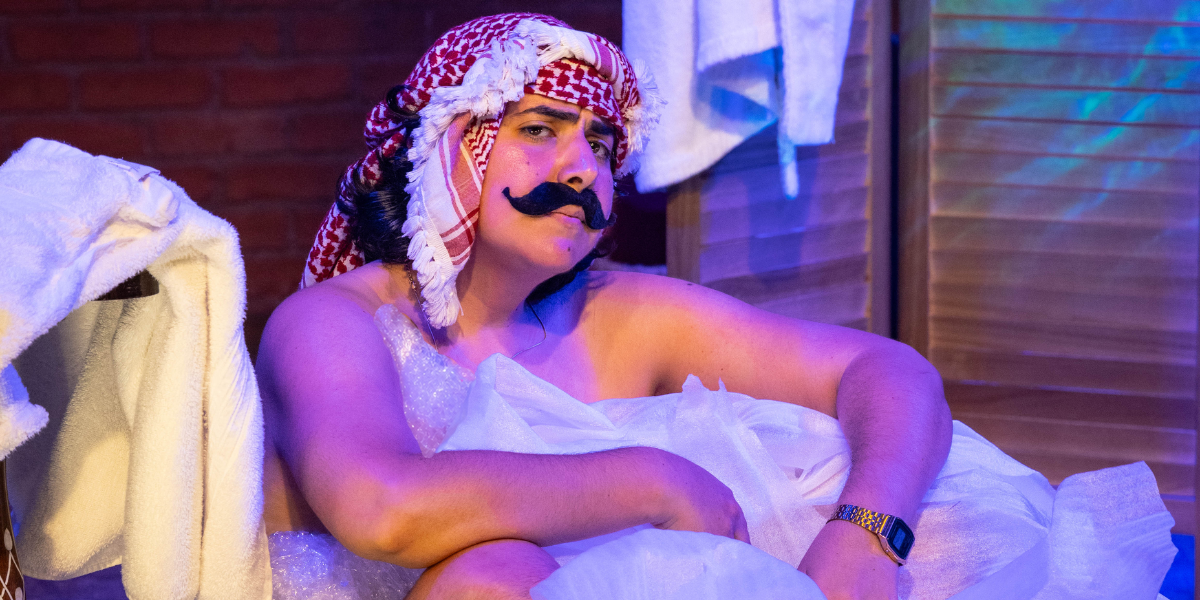
Wrapped in a towel, keffiyeh on his head, bubbles over his chest, Ub-ab (traditional Syrian wooden sandals) on his feet, and sporting a large moustache, The Ancestor is a 2000-year-old encapsulation of a SWANA man. He consistently schmoozes the audience with classic Arabic one liners, “Who is that radiating through the night sky like the Star of Venus?” as he shares tales from his life and handles the questions and asks of his Descendant, who lives in the present-day. A corded telephone hangs on the shower, which rings throughout the show and serves as the communication tool between the characters.
“It is my Descendant again, with a bummer of an existential crisis” the Ancestor says, “look, I don’t know what the future holds. But, I do believe that one day, we will be returned to our lands, and the borders will open, and the prison walls will fall. We will one day feel the sun on our skin, and plant roots in the places we are from… Don’t text him back!!”
Zalaan carefully crafted this character, storyline, and setting through an extensive process of attending classes, (“I love taking workshops as a Gemini,” they say “I’m a perennial workshop taker”), meditation, writing, and collaboration. Utilizing a combination of modern LA clowning, traditional stand-up, and inspiration from Syrian traditions and figures, they transform into different characters and weave through the time and space of the intergalactic bathhouse.
Through classes like the Idiot Workshop, they learned vital principles. “The clown’s job is to reflect back to the audience failure, and this sort of futility of life” they say, “and in that reflection, unite us, and also tell the truth about power.”
The Ancestor and Descendant characters are especially influenced by older Syrian comedians, Duriad Lahham and Naji Jaber. Lahham is known for playing a character named Ghawwar El Toshe, who is, as Zalaan describes, “a clown type character archetype.” “He’s kind of this wise fool,” Zalaan says. “Like, he’s book smart, but keeps getting himself in trouble… he’s aesthetically very much who I’m channeling when I’m playing my Descendent character or self-character in the show…even though the actor who played him broke all our hearts when he didn’t side with the Syrian Revolution.”
Meanwhile, Jaber is known for his macho character Abu Antar, who Zalaan channels to play the Ancestor. “Alpha masculinity, but with a heart of gold,” they say.

The use of the phone as a tool between time was an unintentional reference to an old Ghawwar play. After devising the phone as a communication tool inspired by their childhood in the 90s, they came across a one-act set where Ghawwar drunkenly answers a phone call from his Dad in heaven. They discuss Arab unity, justice, and Palestine. “It gave me goosebumps, and it made me cry, you know?” Zalaan says. “Because I was like, wow, the same shit they were dealing with in the 70s, they are now… not much has changed, if not gotten worse. But also just that on some level, I was doing the exact same play as this legend who had been inspiring me kind of in an indirect way.”
The title of the show itself is a double entendre. It’s inspired by the famous soap of Aleppo, ‘sabun ghar’ or laurel soap, and the Syrian obsession with cleanliness and hamam (bathhouse) culture. Zalaan reflects on an interview they had with their grandma, who shared her experience of going to the hamams, where you’d socialize and get all of the neighborhood tea. It is also a tongue-in-cheek reference to Syrian soap operas and comedies, which are famous all throughout the SWANA region.
Throughout the duration of the show, the Ancestor makes his way through an elaborate self-care routine. We see him pour water (bubble wrap) atop his head out of a dalla al qahwah (coffee pot), lather on soap, put on a face mask, shave his beard and legs. “Our ancestors really want rest. They want rest for themselves, they want rest for us. They want to just stop that toil, the endless cycle of pain and war and suffering” Zalaan says, “that was the first image I had, my ancestor is in a star bath… some kind of Milky Way bath, and he has a star wife, and he keeps getting interrupted, though, by me, because I have bullshit problems.”
They shout out their director and co-deviser, Natasha Mercado for “support with world-building, including the idea for the bathhouse as the mechanism through which the audience ‘plays’ with the ancestor.” Mercado encouraged Zaalan “to find play throughout the show and continuously reconnect to the parts of it that gave me the most joy, which was a challenge, given the heaviness of some of the themes.”
They also mention collaborator Zahra Noorbakhsh for helping find the ancestor character. “How did she help me find it?” they say, “I casually just threw out, you know how your ancestors will sometimes disapprove of your situationships? And she was like, sorry, what? And I was like, oh, that’s not like a normal thing. Like you don’t hear them pissed off at you? She was like, no, describe this… so she helped birth that character, which I just was going to mention in a joke, but she was like, I think this is a character that wants to be born.”
The Ancestor asks audience members what their own descendants are struggling with and provides ancient insight and advice to their problems. One audience member was invited on stage, provided with tea, a muscle massager, and a blanket, and prompted to answer the ringing phone to aid the Ancestor in answering questions from the audience. Attendees brought up topics which ranged from dealing with anxiety, filing their taxes, and parenting struggles.
He cheekily responds to these prompts as well as those of his Descendant, who asks how to navigate failed situationships, getting lost in a solo-hike through the desert, and handling the critiques of family members. A dramatized version of Zalaan, they detail the difficulties of remaining steadfast in their art, and feeling conflicted about continuing comedy as the world is dealing with ongoing atrocities. The Ancestor chides their self-doubt and encourages them to stay true to themself.

He disappears behind the curtain as the Descendant character emerges. They are also clad in Ub-ab, with a shirt that reads “rainbow” in Arabic, a tarboosh (“fez hat”), and two mini ub-ab on their fingers. They carry a briefcase filled with lotion, an olive branch, and a Syrian flag. Running into the audience, they dance the mini ub-ab upon their head to the tunes of Fairouz, then utilize each item in the briefcase to act out physical metaphors, named after each action. A bubble gun is pulled from their belt, which is used against the audience, then in turn, used by an audience member against them. Fatherhood, exile, revolution, friendship, displacement.
The Descendant then asks the audience what to do next. “Keep going! Rest! Regurgitation!” members throw out. “Did I hear stand-up comedy?” they reply, as everyone bursts into laughter. They carry the mic stand over their shoulder, begging to do anything but stand-up, then deliver a witty mini set discussing gender expression and dating.
“Stand-up comedians are the people that can look the hardest things in life in the eye, and somehow alchemize it into laughter,” Zalaan says, “they go to the depths of the spectrum of human existence on both sides.”

Disappearing behind the curtain, they re-emerge dressed as a large Ub-ab, a sassy character whose life story mirrors those living through a dictatorship. The Ub-ab live in a house where they are forced to be silent. They have a younger sister, a mini Ub-ab, who is stolen from them, rumoured to have been pulverized. They join protests against the owners of the house, before they’re forced to flee for decades. When they return from exile, the owners are gone and slippers are in charge, though still pulverizing one another.
“What’s a way to tell the story of the Syrian revolution that doesn’t feel super didactic or pedantic or hitting you over the head with it?” Zalaan says. “Those little shoes felt so alive to me. Like, they have a soul, you know, pun intended… I was like, okay, the wooden shoes, what is their backstory? They’re our working class heroes. What is it like to be a wooden shoe in a house where you have to be quiet? And you aren’t built to be quiet.”

Power and truth remain a constant pillar throughout the performance. Discussing fascism, exile, personal identity, ancestry, and humanity throughout time is no small feat. Zalaan’s performance welcomes its viewers to sit with these realities, to honestly confront, ponder, and digest them. The meticulous use of their body, words, props on set, and active interactions, break down any barriers that the audience might have.
Literally and figuratively peeling off layers as the show goes on, the Ancestor removes their towel, two layers of underwear, and their bubbles — revealing mustaches on their pasties. “I feel really powerful in my body on stage when I’m half naked” Zalaan says, “I don’t know how to describe it, but I think it’s the drag. The drag gives you this aura of strength and silliness that is a weapon that immediately brings people in and it brings a smile to their face.”
Zalaan’s craft is a poignant and necessary example of the vital power that art holds. Every element of this show carries with it a backstory, an inspiration from tradition, an ode to those who have been lost, and those who remain. From the Y2K songs of their childhood, to real-life anecdotes, to the sober realities of the land which they are from, Zalaan embodies the personal as political, and the potent influence of the intimate.
Though of course a comedic piece, Syrian Soap is not making light of or diluting harsh realities. Rather, it confronts these truths head on, and asks the audience “what are you going to do about this? How will you speak truth to power?”
“I want people to leave having felt the full spectrum of the human experience, from grief to joy” they say, “and to have the edges of that horizon expanded, so that they can alchemize the horror of this time into something beautiful and find joy even in the hardest places and circumstances.”
If you are in Los Angeles or New York City in June, be sure to attend this wonderful show. As a queer Syrian myself, I can say that no amount of written praise can truly do this piece justice. Syrian Soap will have you leaving the theater feeling transformed and refreshed, sticking with you for all of the lifetimes to come.


Comments
This sounds like an amazing, moving show. If it could be, say, broadcast on PBS, that would be a dream.
I have felt the disapproval of my ancestors when I have had the temerity to go outside with wet hair, so yes, this is a real thing.
thank you so much for this review! more theater reviews! for those in/near nyc in June, here’s the link for the theater festival this will be at (among other pieces):
https://www.nationalqueertheater.org/2026cqf