





“Is he family?” my friend asked when I pointed out a particular dancer in Hello Dolly!. It took me a moment to understand his meaning. Before I could reply, he continued, “Never mind. I see those highlights. Definitely family.”
The dancer in question was Bert May and the inquiry into his identity added another layer to my fascination with him. I had first noticed him in Guys and Dolls because he was attractive. Then I started noticing just how often he showed up in other movies, frequently with dance solos. It became a quest, a sort of Where’s Waldo search, peering closely at back-up dancers in Golden Age musicals and trying to find Bert May. Back when I had a film blog, I dedicated an entire post to him. His niece found it and, eventually, he found it and kindly commented his appreciation for the tribute.
Bert May had progressively moved up in my mind as I connected with him more and more: first by his face and his talent, then by his presence, and finally by his message. But was he family?
I honestly don’t know if he was queer. A quick internet search suggests he was never married, which is often an indication, but far from conclusive evidence. Nevertheless, the mere possibility of queerness, of a truer connection, made me feel more attached to him than ever.
William J. Mann’s Behind the Screen discusses the burden of proof when it comes to queer historical figures. I am not a historian and I firmly believe no one owes anyone else their queerness or their identity, including public figures. But when it comes to the quest for family, sometimes we can’t help but read between the lines of bachelorhood, put stock in gossip, and revel in the possibility of shared identity.
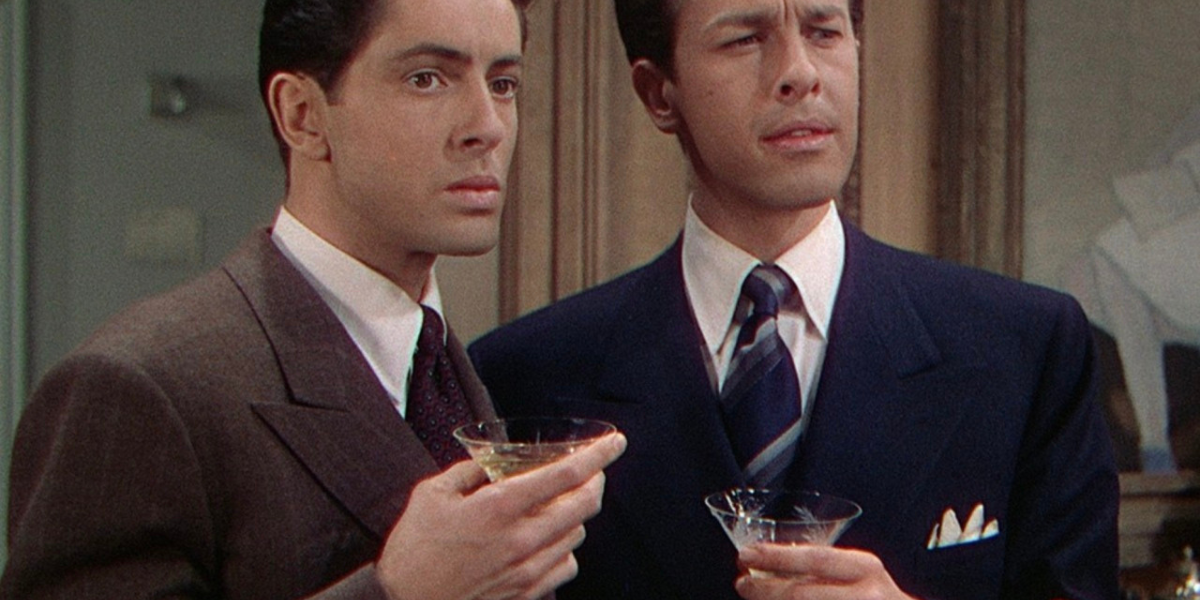
A historian spoke at the beginning of the screening, and he came back up to talk again at the end. “So I assume you all figured out that Brandon and Philip are a couple, right?” Everyone in the theater nodded, except one pair behind me who whispered, “They were?”
I had been looking forward to seeing this movie, in part because of the famed queer subtext. After, I liked to think I would have picked up on it without the prior knowledge. Brandon and Philip stand so close to each other, even when alone in the apartment. The phone is in the bedroom. They’re visiting Brandon’s family in the country together. And, of course, there’s the scene where they each stroke a champagne bottle neck as they talk about the murder in decidedly erotic tones.
Around this same time, I had started reading books about queerness in old movies: queer actors, creators, characters, and subtext. On the surface, behind-the-scenes queerness and the on-screen queerness are two separate things, but I would argue they’re intrinsically connected. And I love that they are.
Rope is queer for many on-screen reasons. But it’s also queer because both of the lead actors, John Dall and Farley Granger, were queer: Dall was gay and Granger bisexual. It’s queer because one of the writers, Arthur Laurents, was queer, and in a relationship with Granger at the time.
It’s loaded with subtext, some more discreet than the rest. It does, unfortunately, feature queer villains who ultimately get their just desserts, a tired trope. But there is something comforting about seeing two men who live together in 1948, who are accepted as a couple by their friends, family, and housekeeper, and who are dimensional and interesting characters (helped, of course, by the performance of the actors). There is something thrilling about seeing all of this in a Hays Code-era movie and recognizing how bold and impressive it was that the film made it past the censors (the story of how they managed it is pretty fantastic, and I highly recommend reading Sick and Dirty by Michael Koresky to get it in more detail).
Under the surface of what is shown onscreen is the knowledge that queer people have always been here. Even when our stories were villainized and condemned, we managed to sneak ourselves in between the cracks of censorship. Yes, the men are murderers and Brandon is particularly twisted in how much his cruelty clearly gets him off. But they also indicate that queer people existed, lived together, had social lives, and were successful (pre-murder plot, they’re clearly enjoying a pretty swanky apartment in New York City). They’re not shunned by their relatives. They don’t hide their relationship. Murder aside, that’s a pretty beautiful thing.
I discovered my bisexuality because of movies (thanks to Gina Lollobrigida, Jean Peters, and Gloria deHaven). And as I grew to understand my asexuality, I recognized that the Hays Code-enforced closed door aspect of old movies had allowed me to relate to the characters and stories better than I would have otherwise.
Watching contemporary media with on-screen sex scenes has made my asexuality increasingly evident. The sex scenes don’t bother me, but they don’t excite me either. I’ve always found the sexual tension, the moments before the door closes, far more appealing than the act itself. A guy I dated before I knew I was ace asked me to describe one of my fantasies, and I went on to depict a scene that culminated in a kiss. “You stopped before it got good,” he complained. “What happens next?” I didn’t know. I didn’t actually care. What happened next wasn’t part of my fantasy.
My fantasies were born from seeing Joel McCrea caress Jean Arthur on the front steps in The More the Merrier or Fernando Lamas kiss Lana Turner’s shoulders in The Merry Widow. The way Cary Grant sits a breath away from Katharine Hepburn in The Philadelphia Story shows a beautiful sort of intimacy that I crave. If I want excitement, I’ll watch movies with actors who have chemistry with every person in the film: Tyrone Power, Alan Ladd, Errol Flynn, Marilyn Monroe, and occasionally Angela Lansbury (no, not as Jessica Fletcher. Watch her in The Harvey Girls and you’ll see what I mean). The tension crackles, but it’s hard to pinpoint why. Who needs to watch sex when you can watch everyone eye-fuck Tyrone Power (and vice versa)? Not me.
There’s a scene in It Should Happen to You where Peter Lawford attempts to seduce Judy Holliday. I adore a good seduction scene. The fact that the attempt fails has never bothered me. On the contrary, in this instance, it enhances the scene because her reaction is deeply relatable. She takes off her shoes to help herself think better (a detail established earlier in the film), and just as he misinterprets the gesture as an invitation, she sits up and says, “I think I’d better be going.”
“Why?” he asks.
“Because I’m not enjoying myself.”
Wouldn’t it be great if her character was a rare example of asexual representation? It was meant to play on Judy Holliday’s type-casting as the dizzy blonde who is far more intelligent than she appears. But as I’ve grown up and watched that scene with a new perspective, I can recognize why it appealed to me so much. She got to experience all of the things I desired and left before the part I didn’t care about.
I had a sheltered childhood. My dad believed (and probably still does) that sex is a necessary evil, so the only movies we were allowed to watch were old Hollywood films and Disney movies. As I grew up, I never missed what the censors (and my dad) wanted to block out. It took watching movies that left the door open to realize why I was so unbothered by the omission and why love scenes in old movies spoke to me. I watch sex scenes now, and I find them interesting, but I can’t relate to any of it. I can’t relate to the need or the desire. I’m happy for the characters enjoying their pleasure, but I don’t fantasize about being in their place. Old movies always gave me exactly what I wanted: romantic stories, gorgeous actors, witty banter, the intimacy of sitting close, soft kisses on the shoulder and the neck, and fingers tangling in hair during an embrace.
My love for queer Hollywood history eventually paved the way for a passion project: a queer historical fantasy set in the Golden Age of Hollywood. When I told my co-author, S.O. Callahan, I’d always wanted to write a Hollywood story, she went all in with me. Now we have two books coming out simultaneously on June 25: When I’m in Your Arms and Together on Parade. Both are queer romances between movie co-stars, with a magical 1934 Hollywood in the background. Shannon added intricate historical details as I peppered in my knowledge of film lore to build our world. I love writing historical fantasy, because it allows me to imagine what could have been. My worlds are (so far) all queernormative so that queer characters can get the soft, low-stakes romances that cishet characters do. These upcoming books are an ode to our queer family of the past, a way to give them a happily ever after and a chance to live openly as their authentic selves.
Was Bert May family? I’ll never know. But I do know Cary Grant and Randolph Scott were, and Spring Byington and Marjorie Main, Edward Everett Horton, William Hayes, Franklin Pangborn, Marlene Dietrich, Greta Garbo, Tallulah Bankhead, Farley Granger, John Dall, Laird Cregar, and Monty Woolley. And those are just some of the confirmed ones. It can feel intrusive to read between the lines of biographies or proclaim rumor as proof, but it’s more than a titillating search for otherness. In fact, it’s the opposite: an urgent need for likeness.
Why is it so comforting to believe Tyrone Power and Burt Lancaster were bi? To read aro-ace identity into Marilyn Monroe’s words? To recognize gender nonconformity in Katharine Hepburn? It isn’t simply the opportunity to brag that I had something in common with these people. It isn’t even simply the idea that we would have had things to talk about. It’s the idea that we have always been here, and members of our family found success, they were glamorous and gorgeous and desired. They made it, despite all of the obstacles. Despite living in a world that didn’t want them to exist, they did: defiantly, boldly, and unforgettably.



Comments
I have no useful commentary or information to add, but I love love love this article. Thank you!
Thank you for this article! I am not a big film person in general, but I can relate to the sense of appreciating the romance more than the sex scenes. I don’t know if this is mostly because I am not into men and just don’t want to see them having sex, or if it says something about me more broadly.
Absolutely adored this article, it made me feel so seen. (Also ace, also obsessed with golden age films, also a huge fan of Michael Koresky.) The third section especially, intertwining a comparison with past and contemporary films to allo and ace desire, was both fascinating and touching. Thank you for your work!