





When we first meet D’Arcy Carden’s Brooke in the new miniseries Five-Star Weekend (based on the 2023 Elin Hilderbrand novel of the same name), she’s trying on a procession of various outfits she ordered online. Nothing is quite right. She looks at the mirror, frustrated about the person looking back. What at first seems like the starting point of a fairly overdone and uninteresting storyline about a middle-aged mother displeased with her aging body instead veers in a different direction entirely as the series and Brooke’s arc unfold. Brooke is not some cliché housewife frowning at wrinkles and a body that is doing bodily things. She’s upset because she doesn’t know who she is and perhaps never has, a lifelong detachment from her desires and self-expression hardening into an exterior she struggles to emerge from. She is queer, she begins to understand in the first couple episodes of the series. But this isn’t necessarily a straightforward story about a repressed gay housewife either. For being a show about rich and conventionally attractive women dealing with relatively low-stakes drama, Five-Star Weekend manages to make the conventional still feel fresh and flavorful, offering a complete and nourishing meal where I expected mere filler-fluff.
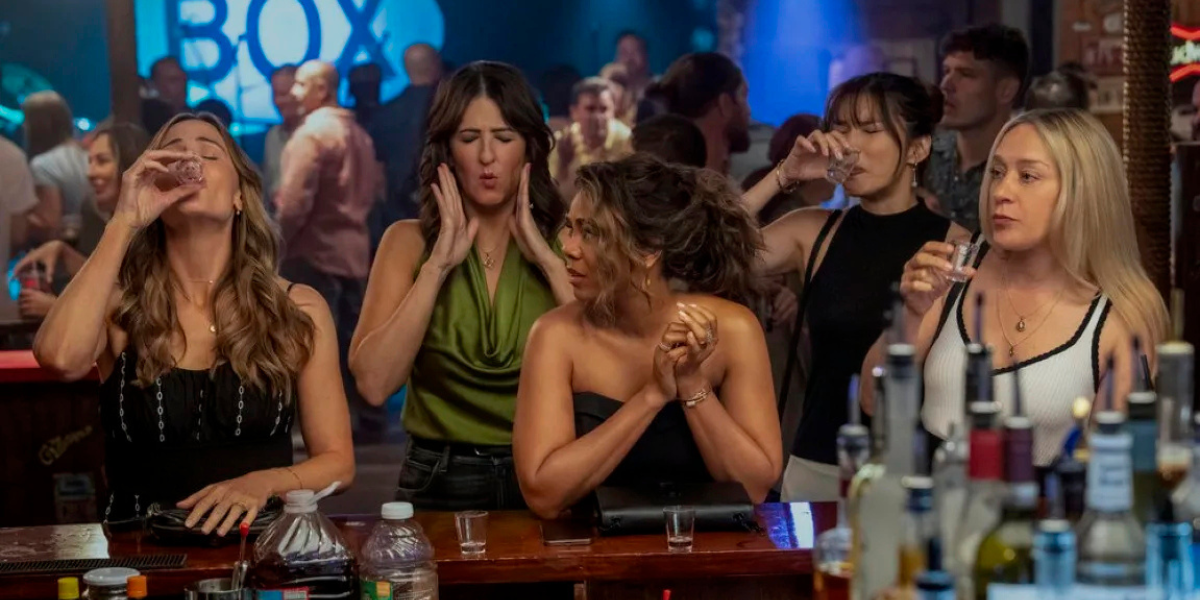
Jennifer Garner, Gemma Chan, Regina Hall, and Chloë Sevigny are here along with Carden as the titular five stars of the show, set on one weekend stretched into eight episodes on the island of Nantucket. Normally assembling a crew of high-profile power-performance actresses for a streaming series set in a wealthy enclave would entail some sort of murder. But Five-Star Weekend is a far cry from a thriller à la Big Little Lies, much too earnest and sweet in comparison. Nor is it a wholly formulaic melodrama without flavor. It surprised me at multiple turns, not in a twisty or revelatory way, but rather because it offers a complex and deep portrayal of adult friendships and lets its characters be messy in ways that feel true-to-life and not just in-service of the plot.
The series is oriented around food content creator Hollis (Garner) and the immediate grieving period following her husband’s tragic death. Six months after his death, she cobbles together a getaway weekend at her vacation home on Nantucket with her “four stars” — four different friends from different stages of her life. Think: bachelorette party but actually more fun because everyone’s middle-aged and therefore less insecure, more willing to be goofy, and far less stressed about who owes who money after a night out. To help her navigate the tumultuous waters of grief, Hollis has her childhood best friend and Nantucket local Tatum (Sevigny); her college best friend, the hotshot and recently canceled sports agent Dru-Ann (Hall); the aforementioned Brooke, who she befriended when they both became mothers; and Gigi (Chan), the most mysterious of the group as she only technically knows Hollis parasocially, connecting with her for her food content. Beyond this core crew, there’s also Hollis’s daughter Caroline (Harlow Jane), who Hollis struggles to connect with despite (or because of) their shared grief. And Judy Greer also reunites with Jennifer Garner as a villain inexplicably named Electra Undergrove. Greer is pitch perfect as a mean mom friend. If anything, she’s under-utilized.
But I’ll also admit too much Electra Undergrove would have pushed Five-Star Weekend into overly soapy melodrama territory, which it again largely avoids. Much media has been made about the power of female friendships, but Five-Star Weekend stands out in just how specific and varied it is in its portrayal of each individual dynamic between Hollis and her friends.
As an adult, I’ve learned every friendship is its own world. Some friendships require more work than others. With some, especially when it comes to family friends or childhood friends, you can just sort of drop in any time, even after long periods of not talking, and it’s like no time has passed at all. You communicate differently with different friends, fight differently with them, too. Five-Star Weekend portrays all of this through Hollis’ friendships with each woman, special and fraught in their own ways. Adult friendships can be challenging, and the series shows a wide range of those challenges, from larger stakes conflicts like lies told in order to protect someone’s feelings to much lower stakes problems like the literal logistics of trying to plan a weekend together when you both live busy lives. No seriously, an entire flashback sequence is dedicated to Hollis and Dru-Ann attempting to schedule a weekend together, and it lands as a solid joke because of how universally relatable it is, even if the actual specifics of it (planning a lavish spa/resort getaway) are less so. Hollis is constantly messing up in her friendships, but then we also see her work through those mistakes and try to mend them. Perhaps I’ve been watching too much Real Housewives lately, but to see friends actually hash things out and apologize meaningfully throughout this series genuinely touched me. Friendships can be messy without devolving into histrionics and ultimatums.
Affairs, secrets, and lies thread through the narrative, sure, but by and large, Five-Star Weekend keeps its dramas relatively grounded and ordinary. This extends to its late-in-life coming out journey for Brooke, which starts with her posing a mere hypothetical about pussy-eating during a game of Never Have I Ever before escalating to an impulsive kiss with Gigi while trying on clothes and then a flirtation with one of the island’s tour guides (played by Roberta Colindrez in a fun A League of Their Own reunion moment for her and Carden).
From the second Brooke posits potentially queer feelings, her friends are supportive, genuinely so. Most coming out stories in film and television fall on one side of the spectrum or the other: The experience is traumatic and full of conflict or wholly joyful and liberating. Five Star Weekend instead portrays what I believe is the most common-in-real-life though least explored-in-art experience of coming out, which sits somewhere between those extremes. Brooke’s realizations about her sexuality are complicated if not conflict-ridden. The kiss with Gigi feels real in that it is awkward but neither euphoric nor devastating. She acts impulsively and doesn’t know exactly how she feels in the moment, and Gigi responds with gentle affirmation, while also calmly ending the interaction before it can escalate into anything more. Not every first gay kiss is some big explosive moment, and Five-Star Weekend allows Brooke to explore quietly but still urgently.
The tension of Brooke’s dalliance with the tour guide is softened by the fact that her husband is an asshole, and I do wonder if it might have been a more interesting story had he not been such a cartoonishly Bad Man. Five-Star Weekend does occasionally opt for for a sweeter, less acidic bite, simplifying some of its storytelling. But it remains complicated and nuanced in enough areas to balance out those softer touches and, again, avoid being mere fluff.
Exploring one’s sexuality is, of course, far different from trying on different clothes, but that opening sequence really does serve as an effective fake out for where I thought Brooke’s storyline might be going and where it ended up. Five-Star Weekend does that bit of sleight of hand in other subplots, too, but I won’t spoil the whole series, and if you’re reading this here on Autostraddle then I’m guessing you care mostly about the queer stuff anyway. But if you saw the trailer and thought Five-Star Weekend was going to be some paint-by-the-numbers romantic drama about the hardships of being wealthy middle-aged women, well, I can assure you there’s more seasoning here than just that.
The series is so focused on the characters’ interpersonal conflicts rather than external factors; even when we do get into the external conflicts, it’s more about how those end up impacting their relationships than actually about what those outside forces are. It’s what makes the characters so relatable and real despite being so immensely privileged. Who can’t relate to being kind of a jerk to a friend during a period of grief? And who can’t relate to loving a friend deeply even at their worst?


Comments
My mom is the biggest Elin Hilderbrand fan and I just read this book so we could watch the show together because we also love Jennifer garner (and Judy greer) from 13 going on 30. Was pleasantly surprised to learn there was a queer character! Even more excited to watch the show now ☺️