





feature image by jjwithers via Getty Images
It’s not an ideal time to visit the sanctuary. Chicago is enduring its coldest winter since 1978. The Thanksgiving snow still hasn’t melted, has been shuffled gray and wet to the edges of sidewalks, ice still deceptively resembling puddles. I’ve forgotten my gloves, so I routinely shift my peppermint tea between hands so each can have a turn in a pocket. After half a decade in Texas, I’ve moved back to the Midwest and realized the body keeps the score but is pretty bad at math; I’ve definitely forgotten just how cold these winters can be. Levi has to endure my complaints the whole walk, despite me being the one who asked him to take me here.


Nestled near the Uptown neighborhood, north of the city center, Montrose Point Bird Sanctuary sits part of a hooked peninsula, adjacent to the Montrose Harbor where a flock of boats roll gently in the marina. Levi is more familiar with this space than I am. An avid birdwatcher and ethnobotanist, he’s the one who first clued me in to the curious history of this place. An official sanctuary since 2001, Montrose Point Bird Sanctuary is special. For whatever reason, despite plenty of other lakefront spots along Chicago, this spot is regularly visited by rare and uncommon migrating birds. Just recently, two snowy owls made headlines as they flew in from the Arctic, potentially signifying an “irruption year” for the breed. According to the Chicago Park District, “over 300 bird species have been recorded” at this strange little offshoot, “making it an internationally recognized area for birding.”
Before and after this recognition, the park has had other identities. From the mid-1950s to mid-1960s, it was a missile site per Project Nike, a project formulated to protect against potential nuclear attacks from Russia. During their lease, the Army planted plentiful honeysuckle, an invasive species to Illinois, to obscure the barracks.
In less official categorizations, it’s also known as a prolific cruising site for gay men.
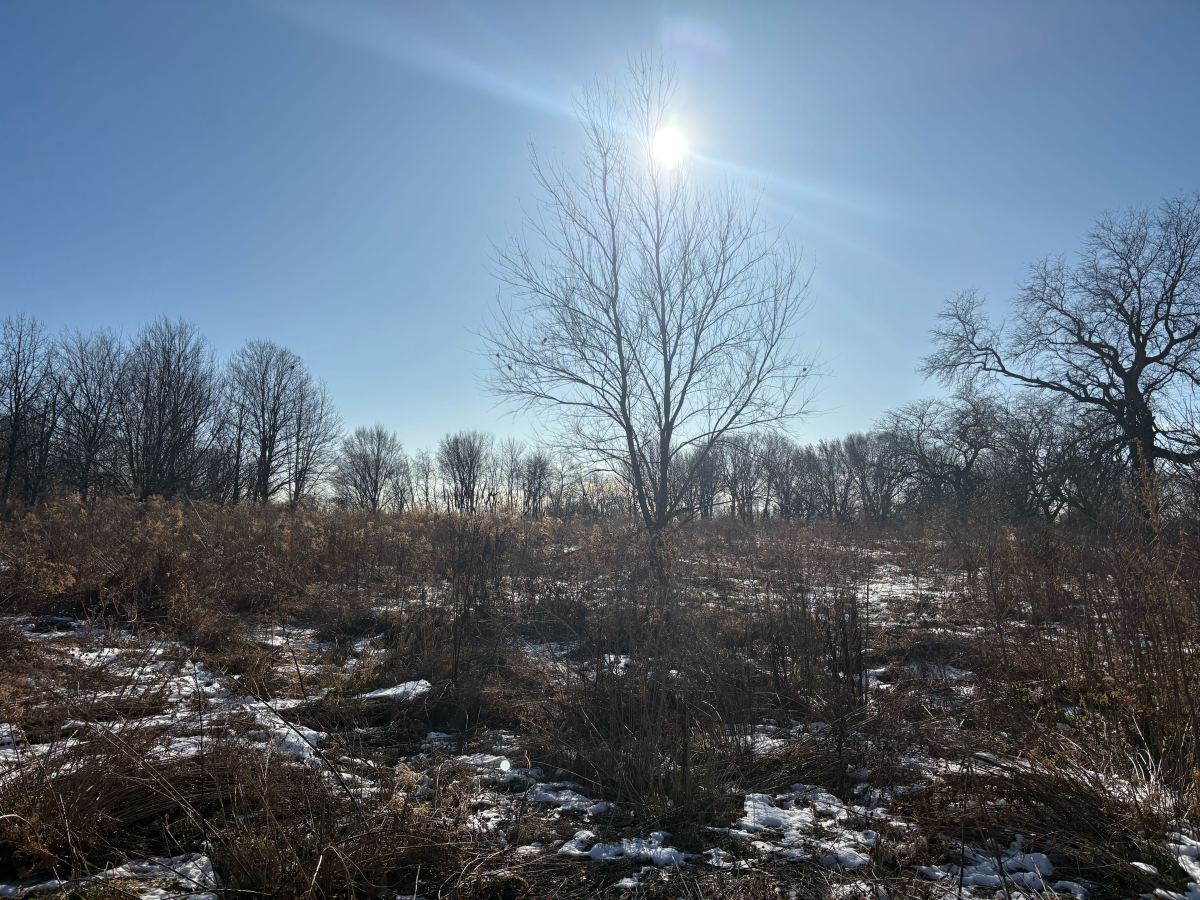
Levi comes here regularly, the iNaturalist app at his ready like a gun in its holster. He gives me this curious history, a happenstance of his intersectional interests (birding and being gay). After the Army fled their lease when the Cold War didn’t heat up as expected, the invasive honeysuckle they left behind kept growing into what is now known as “the Magic Hedge.” It’s christened as magic due to the high volume of birds and bird species that find their migrations landing there. “I like to joke that the magic there is due to all the gay sex,” Levi says. It’s a joke, but I believe him.
Around the same time Montrose Point was beginning its status as a collective third space for birds and gays alike, on another waterfront, scientists were blowing up a long-held belief that same-sex behavior does not occur in the natural world. In the 1970s, husband-and-wife duo George Hunt and Molly Warner were UC Irvine researchers studying the behavior of seagulls on Santa Barbara Island, off the Southern California coast. While George was unable to dedicate his full time to the island’s studies, having been newly hired to teach that semester at the university, Molly stayed behind with a cache of student researchers and plans for George to pop in when possible.
While George was away, Molly’s studies turned up a curious sight: While seagull nests typically render two or three eggs, the field work produced evidence that roughly 10% of the nests held six eggs — an unheard-of feat for one gull to produce. According to Molly, via the Radiolab podcast, “It would be like having septuplets.” Understanding something must be amiss within the birds’ anatomy, George and Molly investigated via (sadly) trapping, euthanizing, and dissecting the bird pairs. In doing so, the at-the-time landmark discovery was made that these were female-female pairs who, in addition to sharing their nests, were also seen engaging in mating rituals (“kissing cloacas,” to put it indelicately). Thus, the infamous lesbian seagulls were discovered.
Stunned by their discovery, George and Molly spent years collecting data. Finally, in 1977, their research was published in Science under the title “Female-Female Pairing in Western Gulls, Larus Occidentalis in Southern California.” With any other research, this may have stayed within the scientific world, but in the political unrest of the late 70s, it caused a media frenzy. As Lulu Miller explains in her You’re Wrong About interview with Sarah Marshall: “Because in documenting these islands full of homosexual gulls, George and Molly hadn’t just challenged a central belief of science. They had clumsily detonated that centuries-old justification that people were still using to try to keep homosexuality a crime.”
As queer people, we’re not unaware of the consistent lobs thrown our way from bigots that proclaim queerness “isn’t natural.” Despite ample proof of same-sex behavior present in the natural world, the idea persists that something has gone awry either by choice or environment, but certainly not through any true biological process. According to Miller, this idea originates with Thomas Aquinas, a Catholic saint from the 1200s who ardently tried to reconcile philosophy with the Catholic faith. An avid reader of Aristotle, whose “eudaimonia” was the belief that in order to live the best human life, one must live to their highest purpose, Aquinas surmised this to mean the “purpose” of human life was to create more human life. Ergo, same-sex relationships were an affront to God and the divine purpose he has assigned us.
Such a belief, despite religious roots, persisted scientifically. Without scientific studies or records observing this behavior in the wild, it was easy for opponents like the infamous pie-faced orange-monger Anita Bryant to proclaim “Not even barnyard animals do the disgusting things that homosexuals do.” With George and Molly’s seagull study, it was clear that was a grossly incorrect assessment of the world around us. As Miller explains, the writer Bruce Bagemihl confronted scientists regarding their potential observations of same-sex behavior for his book Biological Exuberance: Animal Homosexuality and Natural Diversity. According to Bagemihl, dozens of scientists admitted to witnessing same-sex behavior across species and regions but declined to include such observations in their research either due to their own biases or resistance from the greater scientific world. Essentially: Animals have been naturally gay for a very long time, but we have been the ones too afraid to admit it.
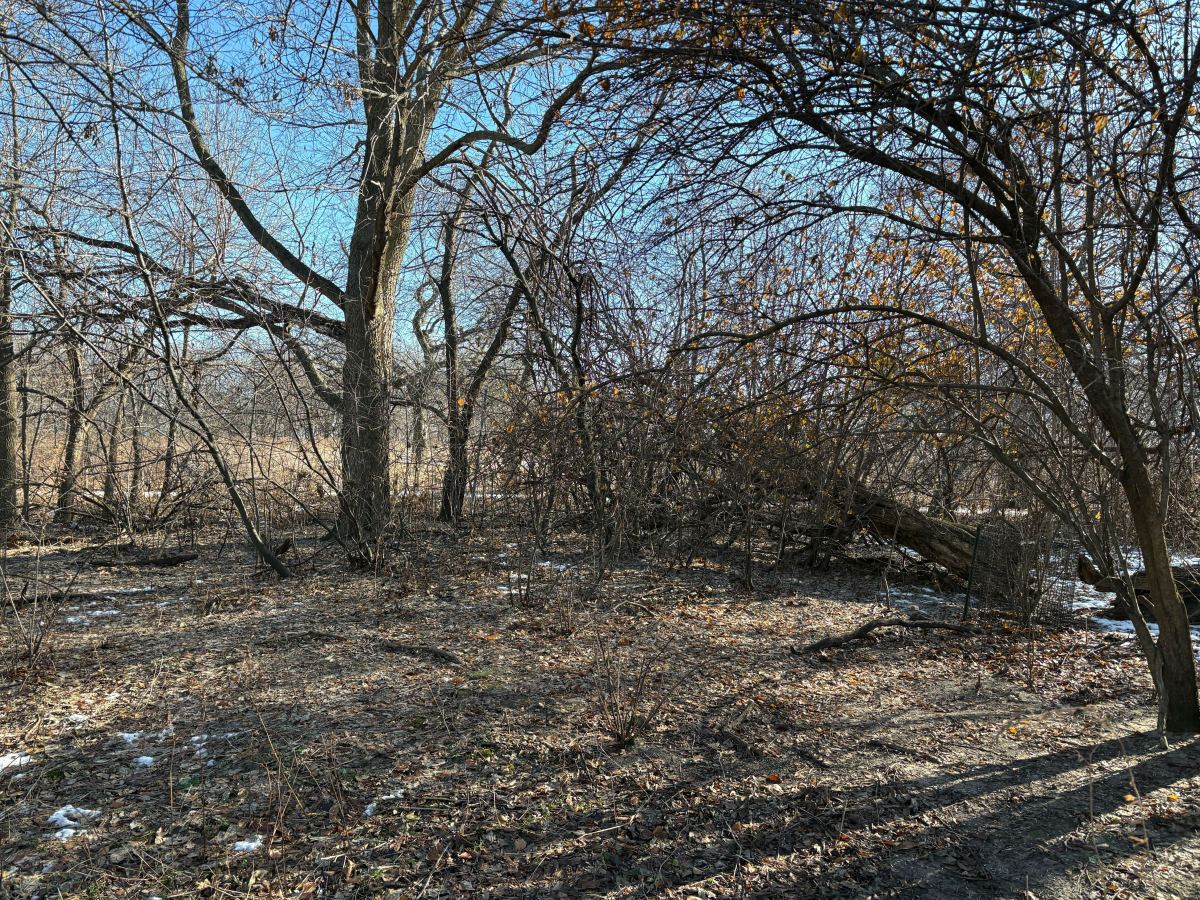
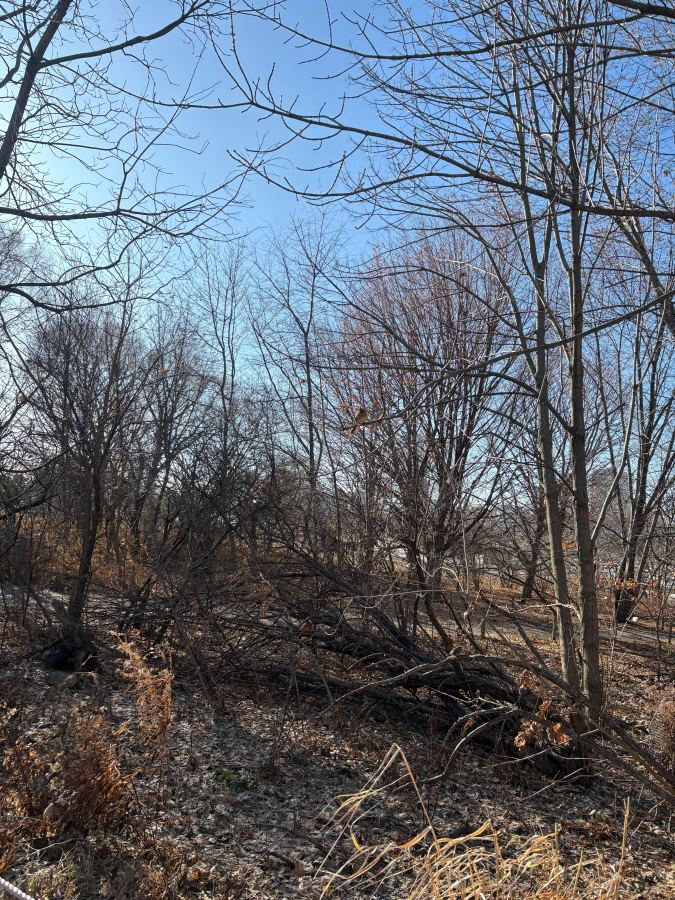
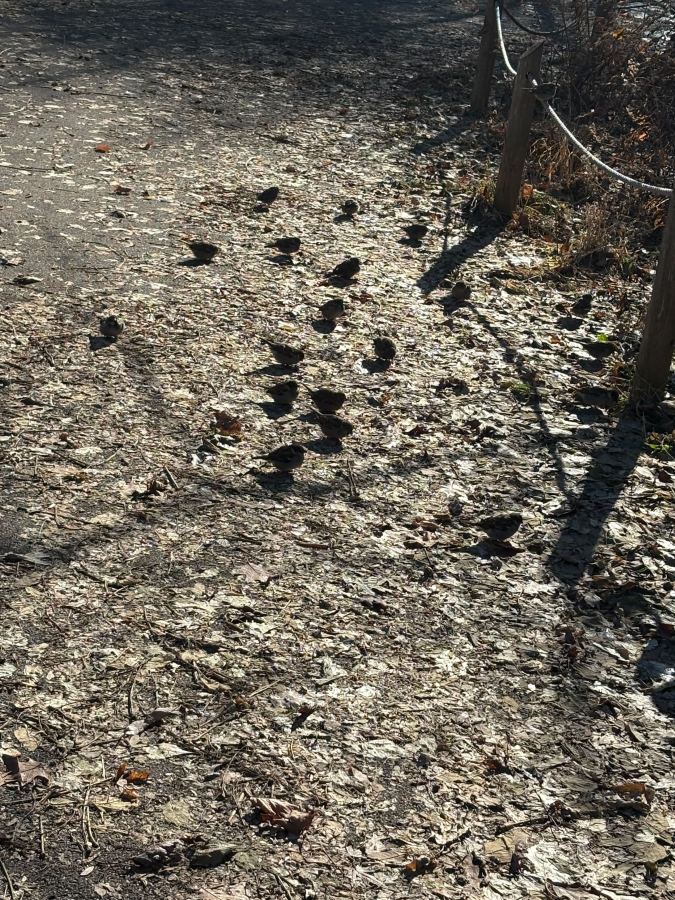
All of this is in my mind at Montrose Point. It’s early December, so I can only imagine what I could be witnessing here at any other point in the year — even still, the magnitude of the place pulses. Identified for me by Levi (as I would be so ignorant as to just say “lots of birds” without him) were black-capped chickadees, house sparrows, and Northern cardinals. Not just individuals, but whole flocks pecking at the ice and gravel, fluttering into trees and through bushes as round, tiny bullets. Even without their lush green springtime foliage, the branches of plants are so closely cloistered I can hardly parse the other side of the trail from them. It’s easy to conceive of this as a utopia of privacy. Prey animals and queer people alike historically revel in locales that promise anonymity, of a space where neither names nor affiliations matter as much as the body and the spirit.
While lesbian cruising doesn’t have as prolific a history, I’m familiar with this feeling. Before I moved here to Chicago, I was in Austin, Texas: a home where the foliage rarely had to fear a winter’s decimation. When I was there, I would attend underground parties for lesbians — word-of-mouth invite only, tape over phone cameras required. It wasn’t because the nature of the parties were lascivious — not all of them, at least — it was in order to protect the people. The world is not kind to queer folks. And in many ways, it isn’t kind to birds either: Human industry never has the little guy in mind. It is a means of consumption and capitalization that leaves animals and people in the dust.
George and Molly’s work with the gulls led to personal consequences (nasty letters mailed to their door and pulled funding from the National Science Foundation), but professional victories across the field: Radiolab’s episode on the gulls features John Megahan, Eliot Schrefer, and Christine Wilkinson, who are are just a few of the many scientists who have studied and/or observed same-sex behavior across several species. Even despite many rabblerousing conservatives, it is a truth universally acknowledged that some animals must be in want of a wife or a husband, regardless of their own sex (and especially in the case of bonobos, often multiples of each).
Lately I’ve been consumed with narratives of the natural homosexual animal. In fall of last year, I became enamored of Queer Nature, a poetry anthology featuring nature poems by queer poets. I am feasting on books about animals and connecting their behaviors to my own poetry, trying to explain these truths through my advantageous and self-indulgent metaphors. I’ve spent hours and days stringing stanzas together that poke at these inevitabilities; my manuscript (which, at this point, may never be a book, with how perfect I must make it, but that’s another essay) is awash in deer and horses and gulls and my girlfriend and other women who have crossed my path in these ways. I don’t even realize why I’m obsessed with this, until I hear one of the podcasts explain it.
Sarah Marshall, in conversation with Lulu Miller, says: “[I]f you have to convince people of your humanity, then you will never convince them of your humanity, because if they need to be convinced… They should just know that already. But on the other hand, maybe the point of this is that it’s not for them, it’s for you and it’s for you. People who for whatever reason, needed to be told they were good for society.”

There is a loneliness in being queer. No matter how enveloped into your community I am, and no matter how many queer friends I have, I am still haunted by the reality of hatred. It’s been said in so many places where queerness is discussed, but it’s true: I don’t get to live my life the same way as others. When wanting to mention my girlfriend or hold her hand in public or even just wear some article of clothing that could indicate my sexuality, I do have to consider a rolodex of environmental factors: where I am, who could be watching, what are those who would dislike it capable of doing in their reaction. Despite the overall acceptance of people in my own circles, there is a shame in me when having to bring it up. And I feel shame for that shame, but it’s there. So perhaps being able to point to bonobos or gulls is not just about proving to others that I am useful, that I am allowed to be who I am, but about proving it just as much to myself.
But even further still, while yes, there is a biological imperative towards same-sex behavior in the animal kingdom — who cares? There should not have to be a use or a purpose to my life that others can observe for me to have that life. To live it.
On the walk, I trip. I spill peppermint tea all over my jacket, and it freezes to the fabric. I am still allowed to exist, despite proving I have bad balance, despite getting my coat dirty. I could hate myself for it, be embarrassed, whittle myself down to nothing for the mistake — I don’t. In a past version of myself, I would have. Being queer nowadays for me has that same impulse. I will never do it perfectly. By doing it, I will always be a little lonely. I will never convince everyone I am natural, or if I can convince them I am natural, I will never convince them I am useful.
But it’s December in Chicago. The lake sprawls past my sight. The Sears Tower is a flag stuck in the earth. All around me are chickadees, burping their light breath around my feet, angling their bauble heads in trees to get a better understanding of the rust-colored puff that is me walking near them. I get too close and, like a mushroom cloud, they bloom up and away, still singing. In the farther sky, lake gulls hug the air with their gulping squalls. In my heart, I thank them. They’re not doing it for me, but that doesn’t matter, nothing does. And for that, I am also grateful.


Comments
a) this was lovely
b) this reminded me of the delightful habit of heterosexual males comparing themselves to male lions to suggest power or prowess, despite the fact that lions are rather matriarchal, have a habit of exiling males who aren’t useful enough, and female lions occasionally grow manes and mount other female lions (a fact they would likely find emasculating)
loved editing this!
Montrose was the spot that first got me into birding and, five years later, it still holds the same magic and I love being able to bring new queer folks into the lovely world of birding here <3 thank you for spotlighting my favorite place in Chicago!