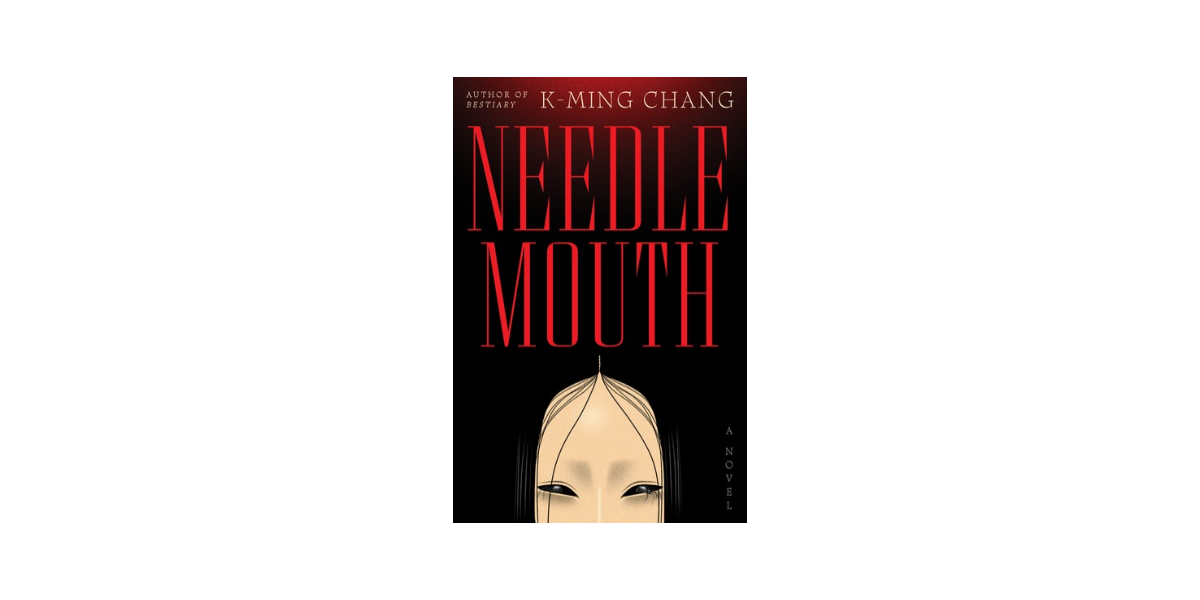
Needlemouth by K-Ming Chang opens with a girl forgetting.
That girl is Cindy. Unable to recall large portions of her life, most notably memories of her own mother, Cindy goes to spend the summer at the home of her dead grandmother with her two cousins, Mandy and Yangyang. Strange things start occurring in and around the house. Birds die, their decomposing bodies littering the streets. Blood stains walls and doorframes. And each morning, Cindy wakes up to find mysterious objects in her mouth: a poisonous berry, cat hair, buttons from her Ama’s nightgown.
While these details are terrifying in their vividness, they aren’t the force that makes the beginning of Needlemouth scary. The real horror lies in the generations of patriarchal violence stacked on top of these girls. They are born into a debt of unworthiness, told their only value lies in what they can give to men and to their future children. Their lives do not belong to them. It’s a truth that has been passed down from mother to daughter, a seemingly inescapable systematic trap.
The baton of the story moves between all three of the cousins’ perspectives, highlighting the ways each of them handle their imposed reality. In many ways, Cindy has the easiest and most tragic path laid before her. Since she cannot remember enough about her life and mother to want more, it makes it easier to accept her fate living in the shadow of men. To her, the forgetting becomes a kind of mercy. Like Cindy, Yangyang starts the novel passive in the face of her precarved destiny. Unlike her cousin, Yangyang and recalls everything about her life. Instead of forgetting pieces of her life, she dissociates from it believing herself to be separate from the world she is forced to inhabit. In many ways, she’s right.
My personal favorite of the cousins is Mandy, the only one of the three girls whose story begins with her ready to fight. She possesses the kind of queer bitch energy you get from being punched by life too many times. Readers are first introduced to her through her diary entries where she recounts the story of a boy who followed her into a bathroom stall trying to touch her without her consent:
When he withdrew his finger, there was shit on the tip of it. He walked out, a little bewildered, and to this day I don’t know if he washed his hand or wiped it or whatever. After that, I told Cindy and Yangyang, and we laughed and called him Shit Finger. We laughed and laughed about it. Cindy thought it was gross and rolled on the floor laughing. But I laughed out of relief. I still do. I was glad that it was my first time, because I thought there was no way for him to brag about this to his friends, because then he would have to admit to touching my shit. He would be more humiliated than me. That’s all I really live for, avoiding humiliation. I imagine telling everyone before he can tell anyone: He put it up my asshole and got covered in my SHIT!!! How everyone would laugh at him.
After that, Mandy realizes there’s power to be had in both disgust and meanness. She fantasizes about covering herself in shit, eating shit, becoming shit. To be disgusting is to be undesirable, and that’s the closest she can imagine herself to freedom.
Cindy’s forgetting. Yangyang’s dissociation. Mindy’s anger. These are different responses to grief. It is the collective force of their grief that brings Needlemouth to them. Part vampire, part hungry ghost, Needlemouth is born from Buddhist folklore. The story goes as follows: A woman dies and is forgotten by her descents. Her spirit suffers, unattended and uncared for. She hungers to be remembered, her body bloating and her mouth shrinking to the size of a needle tip. Needlemouth is the vampiric form of this ghost, an actual needle flitting in and out of her mouth like a mosquito proboscis looking for blood.
Once summoned, Needlemouth makes two demands of the girls. The first is that they adopt her as their mother. The second is that they go back in time and kill her father. Naturally, the girls protest. Needlemouth has given them a mission they are destined to fail. They cannot go back in time. They cannot take back history. But they have to try.
As the girls struggle to fulfill Needlemouth’s requests, they begin to braid together, moving from individual to collective. While they each have their own chapters, the experience of Needlemouth has brought them to each other in a way no other type of violence has. They become the unit they should have been all along. It’s the only way they are going to survive.
When I say “survive,” I’m not referring to surviving Needlemouth herself. Yes, Needlemouth does haunt and terrorize them. She kidnaps Mandy and Yangyang’s mothers, holding them hostage inside a television. She takes all three girls into the demon realm. She forces Cindy into her body, carrying her in her stomach like an unborn baby. She buries Mandy in shit (be careful what you wish for). But Needlemouth herself was never what these girls needed to be afraid of. It’s the world that made her.
So often when we think about haunted houses or ghosts we think about the private and the individual. It’s the same way we look at domestic violence. Something unfolding behind closed doors. Terrible things are happening, but they are unfortunate specific circumstances, not structures which need to be questioned. Women are told to accept, accept, accept. They give up themselves to husbands who dim their light. Men they are unable to ever be free from, trapped by money, society, children. So many women are forced to let their lives wither down to nothing and end up telling their daughters to do the same. To be a good girl is to suffer endlessly. As Chang writes: “You can either be good, or you can live.”
Needlemouth and the girls she haunts turn away from that patriarchal construction of goodness. They embrace evil and ugliness and rage. Needlemouth helps the girls disavow every story they’ve been told about what their life is supposed to look like. She shows them that rage is the fiercest kind of love there is. It’s the kind of love that demands, that fights for better.
To me, that rage is the queerest element of the novel, even more so than the fact that all of the girls are lesbians (though of course their rage and lesbianism are intertwined). Their rage gives them a power none of the women around them possess. They are prepared to kill men. They are choosing to end their bloodline. They are going to break away from the structures that have sought to trap every woman in their lineage. They are going to live a life no one has ever modeled for them. They are going to be free.
Closing the novel left me at the intersection of hope and heartbreak. I want to live in a world full of Needlemouths. A world where rageful girls are granted unimaginable powers, where the life of one girl matters more than anything else in the universe. Last week, I taught my high schoolers about Anita Hill and Christine Blasey Ford. How both of them told their stories with the hopes it would be enough to stop more terrible men from gaining access to the most powerful judicial seats in the country. It wasn’t. Clarence Thomas and Brett Kavanaugh went forward with their confirmations. There are millions of stories just like theirs. Later in the day, one of my students came up to talk to me about the day’s lesson. They only had one question. “Why didn’t it matter?” I do my best to explain, to bring them closer to an impossible understanding. To tell them despite everything those stories do matter. That they matter more than anything. That night, I stare at my ceiling and think of Needlemouth.
As painful as the student’s question was, it gave me the same hope Needlemouth did. We can look at everything that’s happening and know it’s unacceptable. We need to be angry. It’s that anger that drives change. I have a life I never could have imagined growing up. I’m an out lesbian who is choosing to end my own bloodline, a decision I’ve been told makes me deeply selfish. I’ve built my own kind of family out of art and friendships and community. When I picture my legacy, I see my work, my friends, the hundreds of students I’ll teach over the course of my career. My life is possible because thousands of queer people before me demanded it.
At one point in the novel, Needlemouth is given the space to provide her own testimony, telling the story of watching mother suffer in a marriage she cannot bring herself to escape. All Needlemouth wants is for her mother to be free, to leave her father behind, and have them start a new life together without men at the center. Witnessing her mother, she thinks: “Go. Leave this house. Your life is the light. Run into it.”
While the novel is full of showstopping lines, it’s these words which echo in my head the most. I read them and make a promise to myself. I will continue to build myself a beautiful life. I will continue to be angry. I will use that anger to push for better, for the world I know my students deserve. And on the hard days I will close my eyes and picture Needlemouth, watching us all from the dark.