





Queer people have joked that “the straights are not okay” for years now, but 2026 may just be a landmark year for the “Heteropessimist Novel.” One of the biggest books of the year, Yesteryear, does technically follow a cynical tradwife influencer named Natalie Heller Mills, who finds herself thrust back in time to the 19th century American West, but, first and foremost, Caro Claire Burke’s smash hit is a novel about the absolutely dire prospects for all women who have bought into conservative gender roles. Much of the book isn’t spent in depictions of frontier hardship, but instead in the soul crushing malaise and degradation that comes with trying to play housewife and mother for a family that will always place more value on underachieving men. One of the most salient critiques I’ve seen of Yesteryear is that Natalie (and maybe by some extension Burke herself) have such a bleak and cynical opinion of womanhood that it borders on self-directed misogyny. It’s an attitude that’s not all that divorced from the perpetual victim complex that assails TERF ideology. A belief that to experience true womanhood is to suffer an unending marathon of pain and humiliation and that this is an immutable, unchangeable truth. Anyone who even dares to believe otherwise is either delusional or complicit in the cruel violations to come.
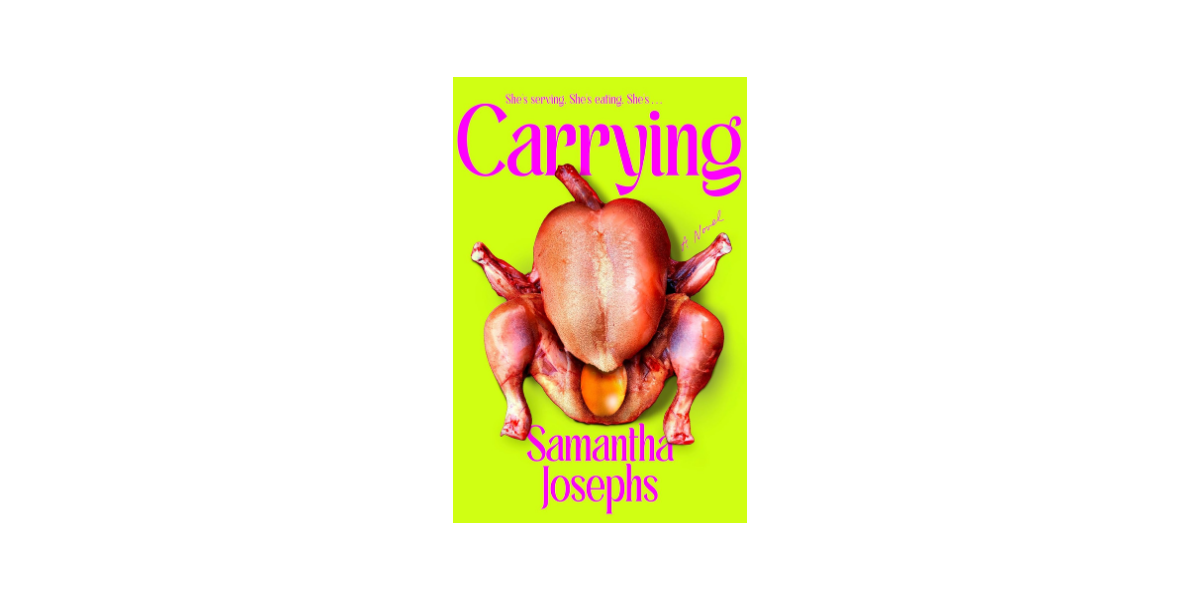
It’s in this context that I find Samantha Josephs’s debut literary horror novel, Carrying, so fascinating. Unlike Natalie Heller Mills, Josephs’s protagonist, Martha, wasn’t born into the supposed trap of heterosexual womanhood—no, she fought for it with tooth and nail. After suffering years of heartbreaks and hate crimes, Martha, much to her best friend (and gynecologist) Roger’s continued protestations, abandoned every bit of her life as an out trans woman in favor of settling into heterosexual domestic bliss with her loving, ignorant husband, Leon, and new stepdaughter, Enid. She has a gaggle of other middle aged mom friends, schedules her days around school commutes and pilates classes, and loves nothing more than cooking elaborate family dinners. To Martha, housewifery is a hard-won fantasy, even if it’s founded on a massive lie of omission, one that she’s desperate to maintain. It’s not that Leon is a bigot; by all accounts, he’s an upper-class milquetoast California liberal, but he is absolutely desperate for the one thing Martha can never give him: a baby.
Her only plan is to buy time with faked miscarriages until she can claim she’s experiencing early onset menopause. Even still, Martha knows that this wouldn’t be the end of her worries. She may not think of herself as a particularly jealous woman, but she lives in perpetual fear of an “Imaginary Fertile Woman” who one day may fill in the womb sized gap in Leon’s life. It doesn’t help that she’s even seen this happen to the cis women in her life. One of her best mom friends, Christine, recently divorced her husband after he knocked up another woman over fifteen years his junior. Leon has never given Martha any reason to doubt his loyalty, but the secret that forms the foundation of their marriage bed will always threaten the future of her fantasy.
Martha’s paranoia is only compounded by a mysterious illness that has taken over her body, racked her head with debilitating migraines, and turns every food and drink into inedible slop in her mouth. The only cure, according to a mostly queer support group Martha discovers via TikTok, is eating rancid meat, which her tastebuds now consider an incredible delicacy. To Martha’s surprise, this actually helps. Her symptoms disappear so long as she maintains a steady habit of dumpster diving behind local grocery stores for discarded chicken and pork. And then, one day, inexplicably, Martha discovers she’s pregnant.
It’s no secret that Carrying is ultimately a body horror novel and, while Samantha Josephs writes plenty of stomach-churning, fluid-drenched, and flesh-rending sequences, Martha’s surprise pregnancy itself is never treated as monstrous. Arduous and maybe a little gross at times, but never malignant. Martha is never vilified for wanting womanhood or for yearning deep down to experience the impossible dream of childbirth that so many cisgender women take for granted. There’s a world where a lesser writer might have written Carrying as a “careful what you wish for” style fable that sees its trans protagonist subjected to some condescending “welcome-to-womanhood” punishment from some cosmic force, but Josephs rightfully sidesteps this interpretation without sanitizing the more discomforting aspects of her narrative.
Likewise, Martha may be a deeply flawed and, at times, abrasive character, but this mostly comes from her willingness to toss away a community that’s a core part of herself in favor of living out a cisgender dream life that is unable and even unwilling to accept her as she is. Martha is a compulsive liar and a schemer and she is more than willing to go to extreme lengths to hide the truth of her transness from Leon and his family. Her pregnancy, and the mysterious debilitating illness that accompanies it, only truly spiral into the horrific as her queer support systems dwindle and her husband begins to see her more as an incubator for his future progeny than a wife.
As a work of body horror itself, Carrying may not push the envelope as intensely as some of its contemporaries. While there are undoubtedly some delightfully gross moments throughout, nothing is quite as intense as other recent trans body horror works such as Andrew Joseph White’s violent and bleak You Weren’t Meant to Be Human or the gnarliest moments of Allison Rumfitt’s Brainwyrms. Instead, Martha’s ordeal is far more gradual, her body coming apart at the seams the longer she avoids (or is denied access to) her rancid panacea. While I’m sure there are plenty of cis readers who will find themselves squirming through Carrying’s increasingly wild third act, as a trans reader, I found Martha’s plight painful and familiar. Martha may be an incredibly vain woman who is more than happy to lash out at those who threaten her extreme attempt at woodworking, but I can empathize with the almost feral need to defend a body you’ve fought so hard to make right. Trans body horror has, understandably, exploded as a subgenre over the last decade, and I can think of few things more horrific than having the hardest years of transition forcibly undone against your will. Martha isn’t exactly detransitioned, but as her body bloats, cracks, and comes apart, the harder it is to forget the parts about herself that she long buried.
At its core, Carrying may be just as skeptical about the patriarchal expectations and injustices of mainstream heterosexuality as Yesteryear or its peers, but Samantha Josephs makes one thing abundantly clear: Women don’t need to feel this way. Womanhood is not a curse, and neither is motherhood. The real horrors are, and always will be, those who seek to strip women, cis or trans, of their humanity, who refuse to listen with empathy, and who are more than willing to look past the suffering unfolding in front of them so they can get what they want.




Comments
Just to add: in the review it sounds a bit like living stealth means living a cis gender life and/or living a lie, while that’s not generally the case. I haven’t read the book so the protagonist may well be a liar in other respects, but just to clarify that trans people (fictional or otherwise) obviously don’t owe anyone a disclosure of their gender identity.