





It’s not officially spooky season, to be sure, but if you’re gay and kinda haunted, isn’t it always? The beginning of this year surely pummeled me, and I think many of us are in that same boat. It’s spring now, thank goodness, but there’s still something in the air, call it ghosts, call it the miasma of the world creeping upon us, and what better thing to seek refuge in (and support) than queer books and their authors? In that spirit (ha), I’ve put together a list of books that might serve the urge of a little haunt, and to push our brains outside of our own experiences. Books that ask questions like: Is any of this really happening? What is possible, in this great big world of ours? And, of course, how do we survive each other?
Hemlock by Melissa Faliveno

I first read this book on recommendation from our very own Kayla Kumari Upadhyaya, wherein she told me to boot anything I needed off my TBR pile to make room for it. Even if she wasn’t one of my nearest and dearest, I trust her taste implicitly, and so I made room. And I’m so grateful I did. Faliveno’s style, simple, propelling, guides us to the Northwoods of Wisconsin, wherein we follow Sam, who already in her appearance blurs the lines of gender, as she undergoes (or doesn’t?) a transformation that is not only bodily, but something else. We follow as Sam slips further back into a dependency on alcohol, and as stranger and stranger occurrences, and visitors, pull her deeper into the woods, and into the haunted core of her familial inheritance. Whether that’s for better or worse, though, is for you to decide.
Voice Like a Hyacinth by Mallory Pearson

In Pearson’s sophomore novel, queer friendship takes a starring role, despite the horrors. Set at an art institution in what amounts to be the middle of functional nowhere, we follow five obsessive, deeply connected friends in the last year of their competitive painting program, wherein only one of them can truly succeed. The stakes for their young lives have never been higher, and thus only one thing can bring them to the heights they need to go: a touch of the occult, and a spell with deep consequences. This is dark academia at its most tender, and the language itself is lyrical and layered, much like its own kind of painting.
Whidbey by T Kira Madden

Whidbey has gotten some great press lately, and I can’t express enough how utterly deserved it is. T Kira has done something singular with this book, which in itself has no “real” ghosts but that is undeniably haunted. In this case, the three women that make up this novel have their lives deeply impacted by one man, a serial predator, Calvin Boyer, who is both boogeyman and beloved. It’s a testament to the way trauma carries through our lives, that the truth is always more complicated than it seems, and that, in the end, we all make our own choices, whether or not we are guided to them or not. While this book deals with intense themes, psychic pain, and much more, I can recommend it without hesitation.
The Fact of A Body by Alex Marzano-Lesnevich
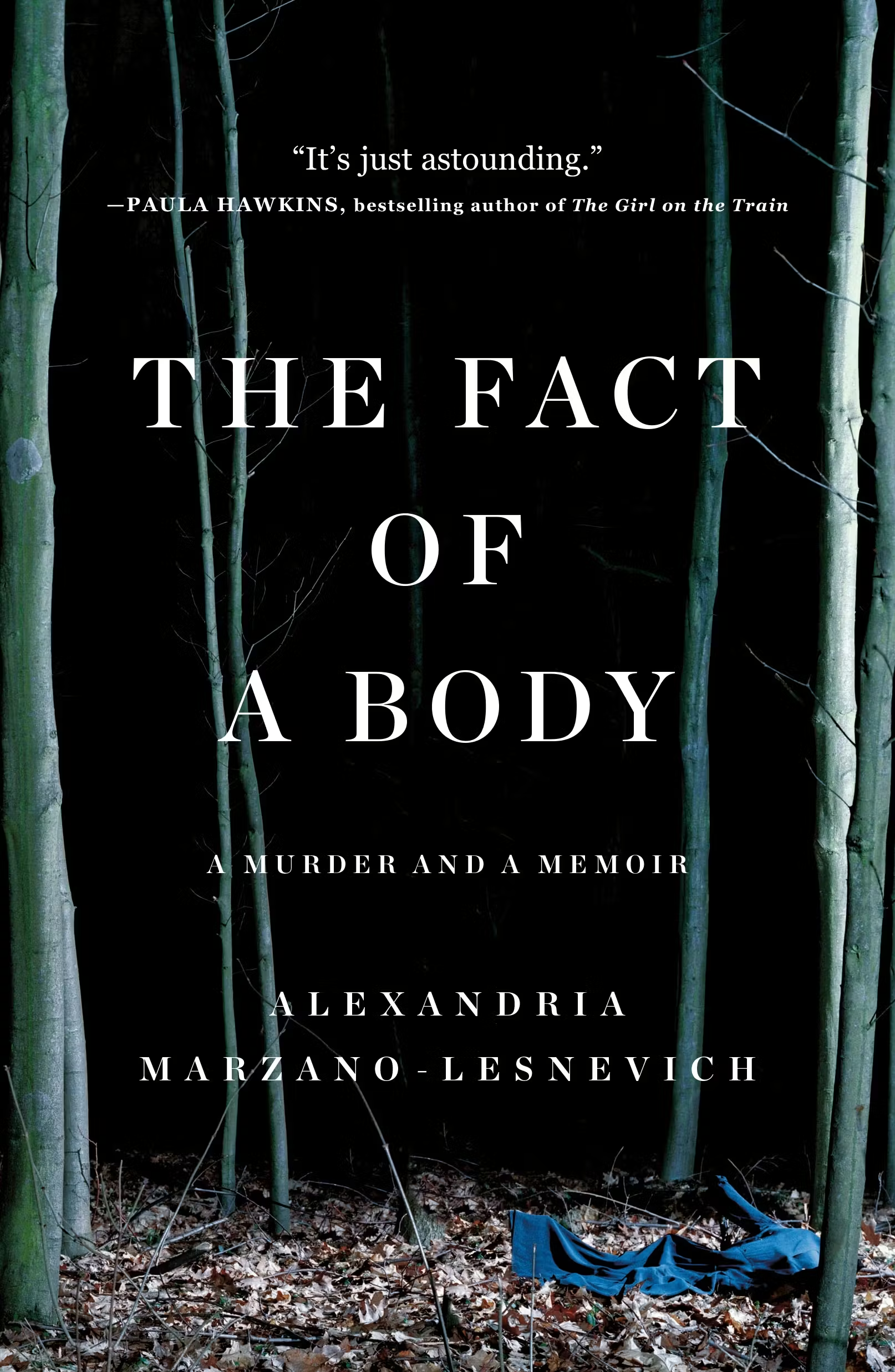
Alex Marzano-Lesnevich’s Lambda Literary Award winning memoir is thoughtfully rendered and thoughtfully researched, which is what makes it an easy choice for being the only nonfiction entry on this list. Part true crime, reenactment, and intellectual thriller, this book takes the reader to Louisiana, to a large, decaying house that once housed Revolutionary War officers, and to the past of a man most would consider without the rights to one. It deals with many similar themes to Whidbey, but through a different prism, and one can learn not only about our (possibly always) decaying justice system, but also how the past, and history, are their own kind of looming specter, and how one might process it when it comes bumping through the night.
A Good Happy Girl by Marissa Higgins

This debut by Marissa Higgins is another novel where there are no actual spirits, but where those things that have been inflicted upon us become their own kind of bodily haunting. In this work, we meet Helen, an attorney who livestreams her feet in the bathroom stall of her law office during work hours with a minor (or major) dependency on cold medicine and committed lesbian couples. It is through the eyes of her complicated character that we meet the wives, who she hopes will “mother her meanly,” while she lives a life around the fact that her parents are in prison for a horrible act of neglect she cannot fully interact with. Helen is, despite the novel’s almost detached voice, deeply haunted, and capable of more care than she allows herself to enact, or even receive. This novel explores many questions, but one of the most poignant is: by suffering, do we earn something?
Private Rites by Julia Armfield

Julia Armfield’s second novel is haunted by many things: the rain, the looming presence of one’s father, and the kind of rituals that only come into play in the darkest of nights. Without revealing too much, I can say that this book follows three sisters, whose shared father, an architect, has stood the test of the climate crisis ravaging the rest of the world. A speculative retelling of King Lear, this deeply queer book questions the price of survival and the binding nature of family through almost quiet, everyday minutiae, though things are not normal, nor will they ever be again. The novel’s last act pulls the rug (or raft) out from under us, to compelling and successful results.
Briefly, a Delicious Life by Nell Stevens

Perhaps the least frightening entry on this list, Briefly, A Delicious Life is still narrated by a teenage ghost haunting a hilltop monastery in Mallorca. Blanca, who dies in 1473, falls deeply and after-life alteringly in love with writer George Sand when she comes to visit Blanca’s village, live in the monastery, and work on her next novel. Oh, and accompanying her are her two children and Frederic Chopin. Yes, that very Chopin. Briefly is a historical novel I can get behind. It explores the unconventional nature of gender and sexuality that both adult artists exhibit, as well as giving us a tender, funny view of the mundanity of life after death, and what awaits us in the aftermath of tragedy, even if it isn’t the thing we expected.
Open Throat by Henry Hoke

I’m all for strange narration, and if a teenage ghost wasn’t enough to convince you of that, then perhaps a mountain lion will be. I read Open Throat in 2023, when it first came out and, immediately upon finishing, texted my friend Felix something to the tune of: “I just read a novella about a queer mountain lion that deals with things like CLIMATE CHANGE, the pressing glut of societal expectations, and um, gender?” Suffice it to say, we both loved it. Our lion is thoughtful, insightful, unerringly kind, vulnerable, HAUNTED, and strange — they are the perfect narrator, and exploration, of these trying times. There might even be a proper ghost or two… you’ll have to tell me.
Our Share of the Night by Mariana Enríquez

If Mariana Enríquez has one fan, it’s me. If Mariana Enriquez has no fans, I’m dead. And so on. The political reality is always present in Enriquez’s work and is both specter and phantasm and real, lived reality. And perhaps nothing in her oeuvre represents this better than her epic Our Share of the Night. Spanning decades from London to the “brutal years of Argentina’s military dictatorship, this novel focuses on a family with a deep occult lineage and has a plethora of queer themes (and episodes) to choose from. It’s very much horror and very much supernatural, but is rendered so beautifully even the horror-averse will be compelled. It is a bit of a long read, with its paperback version coming in at around six hundred pages, but the commitment is wholly worth it.


Comments
Also my spooky sapphic short story collection Lavender Speculation!
Been listening to the audiobook of The Fact of a Body because of this list, and it’s genuinely one of the best things I’ve ever read I think. So thanks for the rec!