





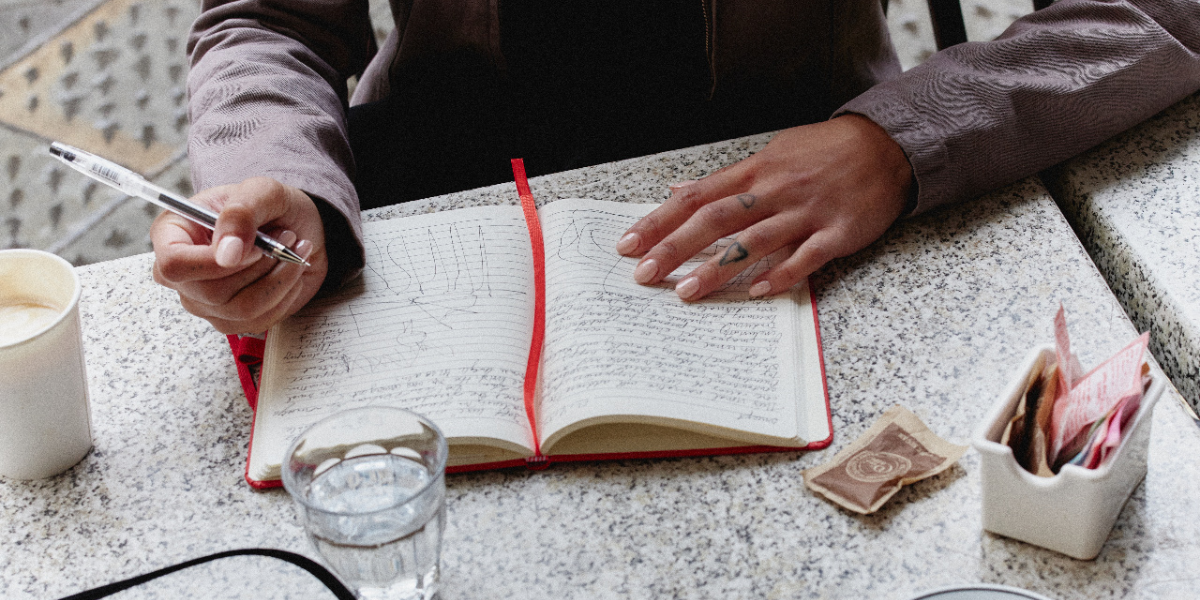
On my first date with my girlfriend Sarah, we met up for coffee at 7 a.m., a stunningly unsexy time of day. My attraction to her was undeniable. But as I watched her beautiful tanned face and tattooed hands move across the table, I still had a hard time mentally categorizing what I felt as desire.
Growing up evangelical in the South, straight people were all I saw—in media and in my real life. I had no mental model for what love, sex, or relationships looked like outside of one man, one woman. Even as I started dating as a queer person at 30, I was alarmed at the way my brain slid into those old grooves. I worried I was permanently broken.
What I needed was a strategic retraining exercise, a counter-operation to combat decades of comphet programming. In the same way exposure to straight media had shaped my understanding of what was possible, perhaps its opposite—a concentrated intake of queer media—could undo those old beliefs.
I needed help imagining something new. Enter: Pinterest.
To talk about Pinterest is to talk about desire. The platform is inherently aspirational. Unlike Instagram, where we portray our lives as we want others to see them, on Pinterest, we imagine our lives as we’d like them to be. There is no hiding the longing.
In fundamentalist religion, desire was a dangerous thing. When there is only one permissible dream for a woman, any desire can only ever be too much. I was 19 years old when my college sweetheart first brought up marriage. Briefly, I resisted. I tried to imagine other options: moving to a new city alone, starting my first job, living with my best friends, meeting new people and new versions of myself. But those dreams were fuzzy. The only future I could picture clearly was the one that I’d been presented with my whole life. I chose the most legible option—which seemed, at the time, to be the only one.
When I got engaged at 21, I went directly to Pinterest. The year was 2014, so I’m sure you can perfectly picture my board: flower crowns, rustic outdoor venue, taco truck at the reception. After the wedding, my new spouse and I moved into a small, dark apartment in Texas. I created another Pinterest board for our first home together, collecting images of sunny rooms filled with plants that wouldn’t survive and recipes I’d never make, trying hard to convince myself this was what I desired.
Seven years later, my then-spouse told me they wanted to explore their gender identity. We were still in the church and both wrestling with deeply internalized transphobia. The first thing we did was start a shared Pinterest board. When reality felt too dangerous, Pinterest was a sandbox in which possible lives could be constructed and tested out—a safe, secret place for those desires to unfold.
As I watched her pins appear, I know now, I was watching her come into focus for herself. The marriage ended, but that experience gave me the permission I needed to look directly at my own desires for the first time.
I knew exactly where to start.
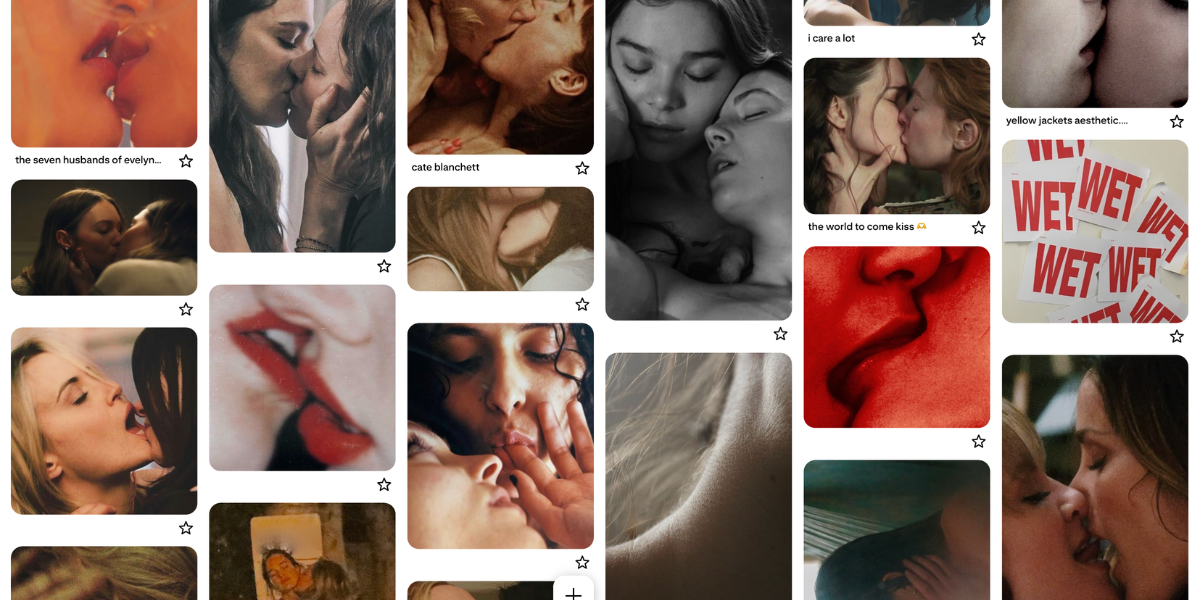
I named my private Pinterest board SAPPHIC. There, I began collecting hundreds of images of women kissing, queer love, and sapphic desire—a stark contrast to planning my wedding there as an evangelical teen. I scoured the internet for photos, art, poems, and music about the love between women. I found myself searching the same terms I had when I was 11 years old on our family’s desktop computer: Computah, show me two girls kissing.
Pinterest’s algorithm is pretty great these days, especially once you go into settings and click “Turn off all AI content.” Soon, it was serving me a constant stream of sapphic media: Villanelle with a knife to Eve’s throat, the orange jumpsuits of Piper and Alex, Mila Kunis and Zoe Saldana in the library. It gave me Sappho, photobooth strips, fingers in flowers, fingers in mouths, nipples, oysters, peaches, Greek goddesses, and Jodie Comer with a mouthful of whipped cream.
In the privacy of that board, I found a space to dream about the life I wanted. It was intoxicating to imagine a world beyond the binaries I’d always felt beholden to.
I loved this secret world, but I cringed at the thought of anyone seeing it. Sarah, in particular. I was already self-conscious about my lack of queer dating experience. Imagine her finding this Helga Pataki-ass shrine in my digital closet? Cops would be called. I’d never hear from her again.
More than that, I felt ashamed this counter-programming was even necessary. My late-in-life imposter syndrome kicked into overdrive, telling me the same story it always did: If this were true about you, it wouldn’t be so hard for you to believe.
When I think about why it took me so long to notice my queer desire, I think about possibility models. Growing up, there were no (out) queer couples in my community. Even once I came out, I didn’t have many up-close examples of queerness. I couldn’t imagine what I couldn’t see.
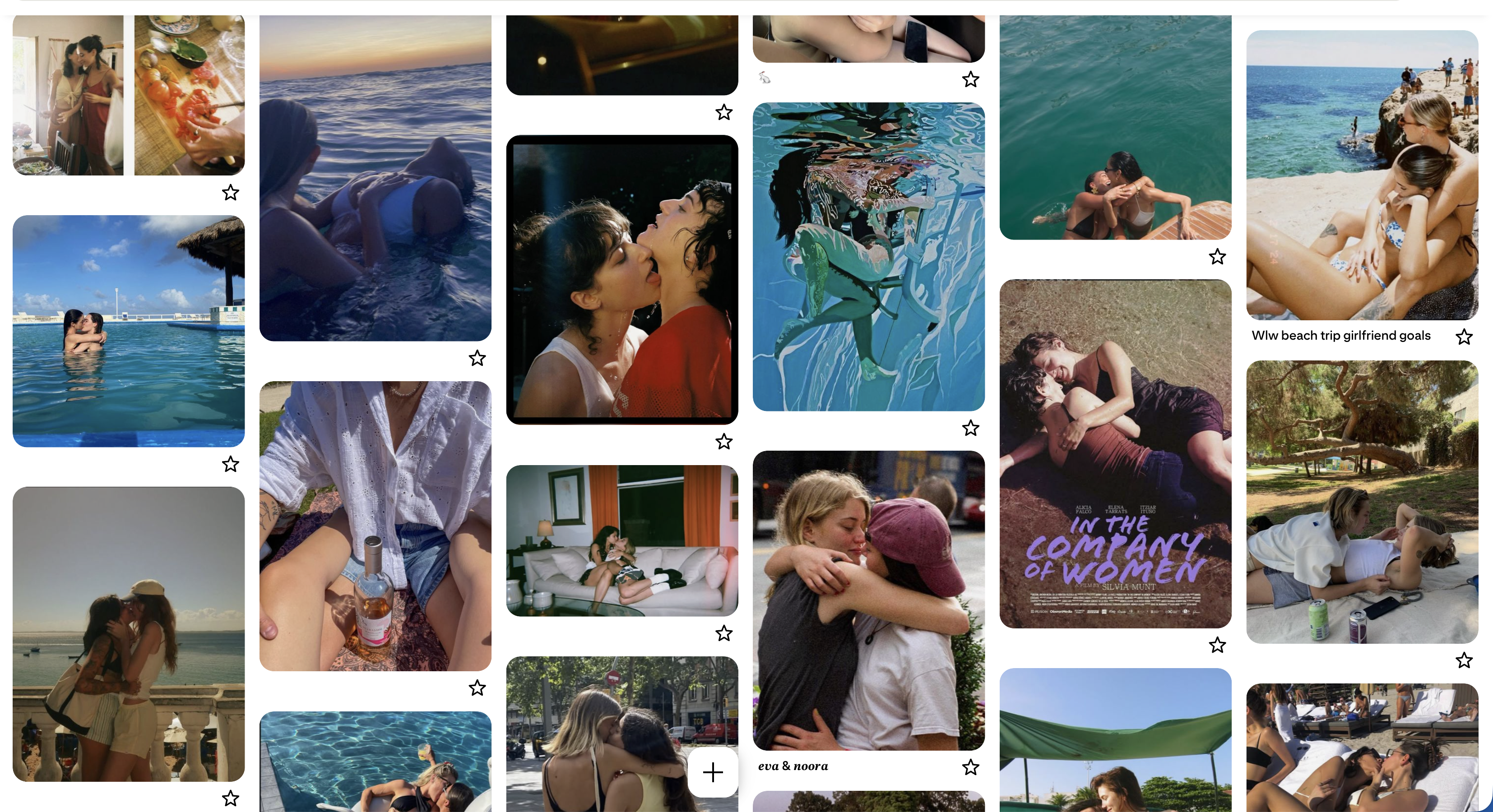
The Pinterest photos I loved most were not of celebrities; they were of anonymous couples doing ordinary things. Slicing tomatoes in the kitchen, laying on a picnic blanket, crossing the street with arms slung around shoulders and waists—shows of casual affection that made something inside me shimmer.
There’s one image that appears on my board multiple times. (Other than the sex scene from Carol, I mean.) The photo shows two women in bed, asleep. Their bodies are close together under a downy white comforter, one of their arms tucked intimately around the other’s waist. I subconsciously hit “save” every time I saw it. Something about it spoke to me for reasons I couldn’t articulate.
For the entire first year of being out, I noticed how jealous I felt when I saw gay women in the wild—even though I, myself, was also dating women. It was a strange kind of envy, an intense heart-breaking, engulfing yearning I couldn’t quite place, as if they existed in a world I was still waiting to be admitted to.
In the photo, I can tell the two women are younger than I am now. In this way, the Pinterest board was not only an imagined future, but also a form of time-travel, recreating the youth and adolescence I didn’t have. My coming-out process has involved grieving the milestones I missed. The secret sleepover kisses I missed out on. The high school friend I never realized I was in love with. The college hookups that didn’t happen. Ultimately, my sorrow was about the way I’d been robbed of imagination and how small that had made my life for so long.
Pinterest softened the sting of that loss. When I opened up my SAPPHIC board, it glowed like a treasure chest. The lives that were kept from me. The desire I’d never let myself feel. The kaleidoscopic world of queerness I’d been shut out of for so long.
When the pastor in my head hissed fake or abomination or aberration, I could look to this proof and remember: Real.
Looking back at that photo now, the soft golden glow of the lamp, the sweet abandon on their faces, I see that what appealed to me was the intimacy of complete surrender. A world where that kind of love is utterly, miraculously normal.
Queerness felt like such an impossible gift, one that had arrived late and unexpectedly. I still couldn’t believe my luck. Every time I opened my Pinterest board, I felt an illicit thrill. It was the same heat I felt in my belly when I would see those lesbian couples in the wild: a spark of possibility, a burst of recognition, an oh we’re allowed to want that? We’re allowed to have it? The idea still shocks me.
In the church, desires were demonized. Only by surrendering them would we be saved. But queerness seemed to say: It is your desire that will save you.
Over the course of a year, my Pinterest board grew, from dozens to hundreds of pins. Outside of my digital vision board, my life was changing, too. I was making up for lost time: reading queer books, listening to queer music, watching every queer TV show or movie I could find. I learned from queer theorists and activists. I joined my city’s LGBTQ+ writers group. I showed up to queer shows, readings, and dance parties all over town. I met new queer friends, who introduced me to their friends, who introduced me to theirs (a real-life algorithm!). The more vibrant and alive and gay my life became, the quieter my doubt got. Eventually, it disappeared entirely.
Cultivating a queer aesthetic, with the dreamy close-up photos of lips and tongues, is not the same thing as building a queer life. But it did help me believe one was possible.
I’d been embarrassed I needed something as silly as a Pinterest board to help me believe my own queerness. I’d been frustrated I couldn’t shed those old bad beliefs the moment I toggled “women” on Hinge. Now, when I think of those early days of pinning images to my SAPPHIC board, the judgment and self-criticism is gone. Instead, I feel a deep tenderness toward the girl who chose to fight her way past decades of indoctrination to finally arrive here, where she’s always belonged. How lucky am I, to get to feel all of this for the first time? To finally fully embrace my desires, when that once seemed inconceivable?
I still add something to my Pinterest board almost every day. Now, though, it’s less of a vision board and something more akin to an altar. My daily life looks a lot like the Pinterest board I imagined back then. I am surrounded by a beloved queer community, in the South and beyond. My world is filled with queer art and art-making. Every night, I fall asleep under a downy white comforter, limbs tangled with the girl I love: intimacy that feels utterly, miraculously normal.
Pinterest became a portal into the life I longed for. As one of the images I pinned, stills from the movie The World To Come, says: “It’s a good thing to remember that our imaginations / can always be cultivated.”
Comments
What a great and reflective article. Pinterest is such an interesting space to explore identity and interests. You’ve worded this so beautifully. Thanks for sharing.
“In the church, desires were demonized. Only by surrendering them would we be saved. But queerness seemed to say: It is your desire that will save you.” — my favorite line, though this is an essay of great lines. Thoroughly enjoyed!