





Did You Like This?
Independent queer media needs your support to survive. Become a member now so we can make more gay stuff like this.

Cameron
Cameron has written 76 articles for us.
Independent queer media needs your support to survive. Become a member now so we can make more gay stuff like this.
Cameron has written 76 articles for us.


Comments
I was just wondering how I can communicate my “they” pronouns to my Spanish speaking coworkers. Ello? Ell@ pronounced with an -ow? For gendered adjectives I’ve been kind of mumbling the last bit or giving up and using the feminine
Hi there!
Gabby did an interesting article about it here: https://www.autostraddle.com/whats-the-story-behind-latinxs-320117/
It is Latin-American-centered, but I see lots of queers in Spain that adopted the same system: removing the end word -o or -a and replacing it by a “post-op” -x, that is usually pronounced “e”, as shown by this Argentinean girl:
https://www.lagacetasalta.com.ar/nota/106300/actualidad/ellos-ellas-elles-mira-como-explica-esta-nena-lenguaje-inclusivo.html
Or in Spain, I see people alternatively using the -x ending and an -e ending, as can be seen if you look around on this website (CW: BDSM and porn are mentioned, but not shown):
https://elenaurkopostop.com/bio/
Oh well, I am so enthusiastic about what this language modifications that I used an Argentinean example when talking about Spain :D
Hope you still get the drift!
Also, to wrap it up: you can introduce yourself as “ellx” or “elle”, pronounced “elle”.
My first language, Finnish, is also pretty awesome for non-binary folks. No gendered nouns or pronouns. The singular third-person pronoun (“hän”) is gender-neutral.
Damn, that’s the dream. Wish more languages were like that…
Finnish is awesome! My native language is Spanish and I went to Finland as an exchange student. The gender neutrality is genius! It is very hard to speak neutrally about someone or yourself in Spanish due to our verbs, adjetives, nouns, and almost everything being gendered. You end up sounding like a narrator when talking about anyone.
My language (igbo) doesn’t have gendered pronouns either! Every singular pronoun is “ọ” and to indicate more than one person, it’s “fa” or “ha” depending on dialect.
We have words for man and woman, and mother and father, but we just have a general “sibling”. My mom didn’t understand singular they pronouns when I explained it to her in English, but she did when I explained it in igbo.
Japanese didn’t historically have gendered third person pronoun, but they were adopted to align with European languages. However, using a pronoun is pretty rare, so it’s easy to speak in the third person without gendering someone. In the first person though, pronouns are gendered.
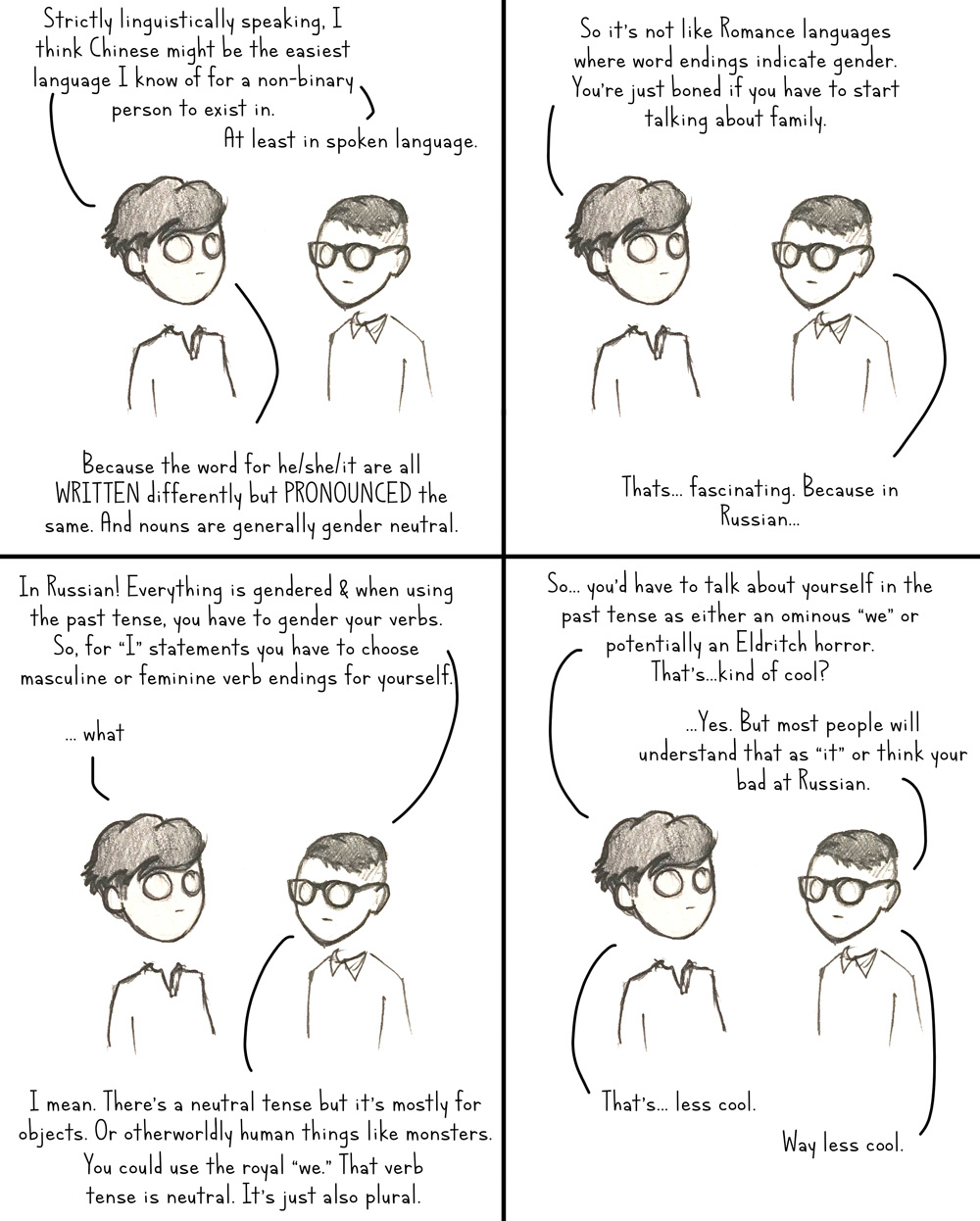
Chinese is similar (maybe the same?? Idk Japanese)! I mean, as with a lot of languages there are intrinsically patriarchal roots. The root for “he” is the character for “human” and (possibly because of western influence, a character emerged to specify gender for the third person) the character for “she” has a different root meaning “female” which SUGGESTS that men are human and women are other. Which! Cool, The West.
Japanese is a super gendered language though. It’s mostly not in pronouns (which, like you say, can almost always be avoided–and even first person pronouns have relatively neutral options), but masculine/feminine language patterns are still pretty strong in casual speech.
Things like the politeness level used, intonation, and vocabulary choice all play a role. You can aim for the relatively neutral end of your assigned gender without a problem, but if you try to mix it up beyond that, people definitely notice and will either think it’s weird or (if you don’t come off as a native speaker) assume you’re doing it on accident and correct you.
This is also a thing in Chinese. If you mean to be polite, you’re adding gendered general titles for strangers (mister, miss, etc), or you’re adding gendered (& aged & maternal/paternal sometimes) relations for family (& family friends). Regarding professions, titles tend to be pretty neutral and you refer to professionals as (last name)(title). Doctor is just doctor, teacher is just teacher, manager is just manager, etc.
But on a super casual conversational basis, no one’s really freaking out over singular third person pronouns because THEY ARE ALL THE SAME SOUND and no verb conjugations (ever). So you can point and say to your pal, “(singular pronoun) is cute” without assuming someone’s gender but also asserting that you are talking about one particular person & not a whole group of people. Which is nice in that extremely limited & particular way. Whereas English is in a grammatical struggle with singular “they” existing with a pluralized verb conjugation (which is NOT an excuse to not use someone’s pronouns. Our language is failing its speakers & folks are TRYING, dammit).
In Chinese, he/she were the same characters (他) until someone decided we need gendered ones because of translation difficulties (people can only translate ‘she’ as ‘that woman’). The character for ‘she’ (她) looks just like the ‘he’ (他) one but with a ‘woman’ (女) on the side (the character has always existed but was not used as ‘she’ until the 20th century). However, people generally won’t bat an eye if you use ‘他’ (which is now more associated with ‘he’) for everything. I personally don’t use ‘she’ in my writing because it is just not necessary.
Funny how Chinese is an analytic language and English is going from synthetic to analytic but the latter affected the former to become less analytic. Sort of.
(note: Analytic languages don’t really have inflections. Synthetic languages do.)
hungarian is also very gender neutral (same roots as finnish), ő is the universal singular pronoun there! and you can say ‘my partner’ instead of girlfriend/boyfriend in a totally normal way, without the whole “you mean your business partner or your lover and does that mean same sex lover?” confusion that we have in english
Thanks for sharing, everyone who speaks something besides/in addition to English!
I take this applies to both Madrin and Cantonese? I am not sure about Persian, but friends have told me Hebrew is a very gendered language. A sentice may translate to english as The pizza that Sandy had was a cheese pizza, where pizza and cheese would be the female pronoun variant of the word. People have been working to come up with gender neutral variants, but it’s not easy.
Yup, Hebrew is super gendered down to the way you conjugate your own verbs. Some folks (Americans and Israeli) are working on coming up with alternatives, which is interesting in itself.
These have been really interesting comments to read!
Arabic is a tricky one too because as well as male and female singular pronouns the language has pronouns for a group of men (or a mixed group) and a group of women. The dual form of verbs also comes in two gendered variations. I’m not a native speaker so I don’t know if a gender neutral alternative has appeared but it doesn’t seem like you’d be able to use a third person singular.
YES Turkish also has no gender in grammar. It’s so nice. Culturally, things are very gendered though, like addressing people with gendered nouns (grandad, auntie, lady, older sister, older brother, uncle etc). But some terms of address, like hoca (teacher) aren’t gendered.
The Chinese written pronouns have always been gender neutral until the 20th century under European influence. There are different written pronouns for people, deity, objects, and animals. Then the Europeans came and a female person written pronoun was invented. It doesn’t need to be used, and isn’t always. Nobody gets offended if you use the people pronoun for them.
Oh that’s interesting! I’m aware of the European influence that lead to the creation of 她. It makes perfect sense to me to just use 他.
In the circles that I’m in, everyone has stressed using 他 & 她 (and 它, 祂, & 牠) accurately. My family uses 她 in texts and all of the Chinese classes I’ve taken make a point to differentiate 他 and 她. People correct me ALL THE TIME, so I figured it was just ingrained in the language at this point.
It could be a regional difference, or the rigidity of trying to teach ‘proper’ Chinese, or the fact that I’m automatically ‘othered’ (I’m mixed/ born & raised in the US) so people are quick to assume my Chinese needs ‘correcting’.
loveeee this comment thread!! *swoon gif*
Hmm, somebody whose ASL (American Sign Language) is better than mine please check me on this, but I don’t believe ASL pronouns are gendered. You sign a noun in a particular space to establish the reference, and then you just point to that space, or move towards or away from it if needed.
I came down to say the same – ASL doesn’t have gendered pronouns either. There are gendered nouns though – you typically just move the location for the sign.
I’m seeing a girl who’s Filipina and she speaks Tagalog, which is the main language of the Phillipines (though they have many dialects). She told me that in Tagalog there is no such thing as gendered pronouns – they use the same word for everyone. So it’s like both a singular and plural they, except from in this context “she” and “he” don’t exist.
I remember when I studied French back at elementary school and we were introduced to gendered nouns. I was like WTF is this madness?!?! It took me a long time to appreciate the beauty and musicality of the French language but I’m still a bit baffled especially when it comes to their numbers. It’s all well and good…until you get to 69. Then it just goes off the rails and gets all weird and mathematical and I still have PTSD thinking back to my French lessons in school when it comes to numbers.
I was much happier when I had to learn Turkish and found out that their nouns are neutral – o is for male, female and it. Yay. Mandarin is also fun in that you don’t have to conjugate verbs – everything is the same in the past, present and future tense. The writing system however….yikes.