





It goes without saying that this bleak Trump 2.0 time has been cruel for trans adults and youth across America, from journalists spreading misinformation in the New York Times to many evil politicians, including the deteriorating Cheeto in Chief, wanting to ban trans youth from receiving care and from social experiences like sports.
Amy K. Jenkins’ intimate dual compilation portrait, Adam’s Apple, about her trans son Adam Sieswerda, feels like a powerful response to the Trump era’s inaccurate views of trans kids. The doc, which premiered at SXSW 2026, is a raw and vulnerable, decade-sprawling tale about a rural northeastern family’s evolution as the eldest child embarks on a transition journey.
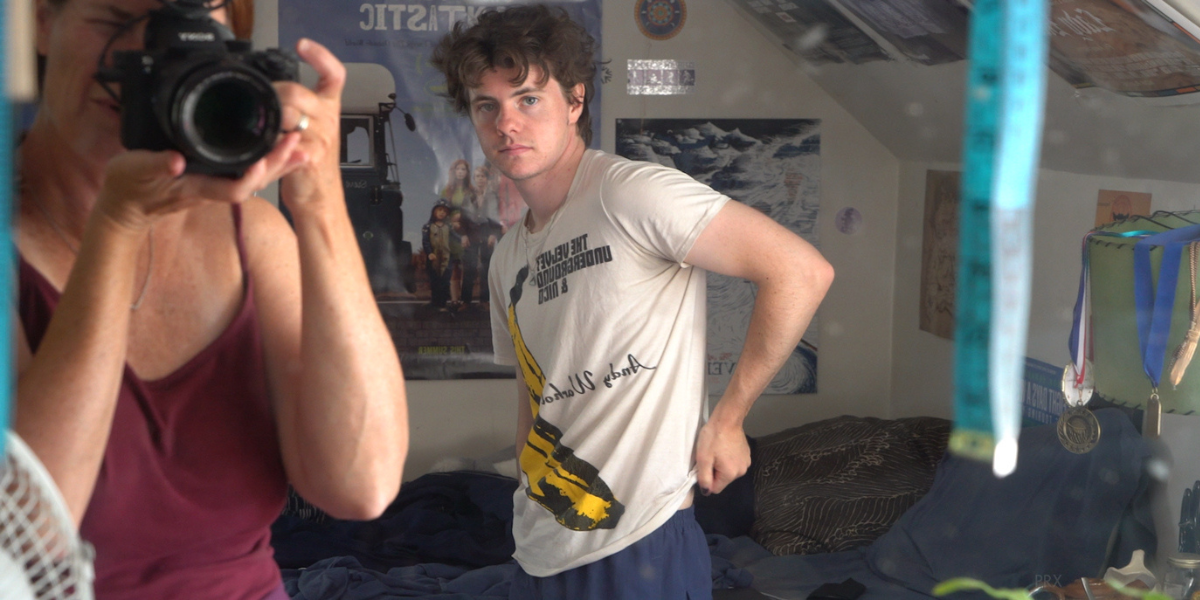
The film is a joint effort between the New Hampshire-based mother and son. It’s compiled from the footage from Jenkins’ handheld home videos and Adam’s iPhone. At the doc’s outset, a fourteen-year-old Adam comes across his fifth-grade notebook, where he wrote: “I would like to be in a movie.” Jenkins responds, “Okay let’s make a movie together, and you get veto power.”
Jenkins’ footage depicts Adam’s aversion to being perceived as a girl from a young age. He despises his birth name, dreams of being a MALE musician, and presents as a boy. One snapshot sees him in a Superman costume, saying: “I don’t want to be a girl, because it’s embarrassing.” There’s such a precious moment where he thought he was a late bloomer, waiting for his Adam’s apple to appear and voice to drop. He experiences depression as a teenager, fearing how the guy friends he exclusively hangs out with will perceive him and the singer/songwriter who doesn’t want to sing his vocals until his voice drops. As he enters puberty, he is advised by his physician to begin testosterone treatment so he can finally experience himself.
For his 15th birthday, his mom and dad, John, go with him to take his inaugural T-shot. John grieves that he is losing a daughter and gaining a son, which Adam rightfully takes offense to. The boy receives gender-affirming care throughout high school, and the film focuses on his growing development as a teen coming to his own and his mom traversing these grounds.
Adam’s Apple skillfully weaves together past and present to trace Adam’s early development, capturing the struggles he faces before receiving gender-affirming care and the anxieties that emerge from both within himself and from clashing ideologies that strain family dynamics. The film has the feel of a kaleidoscopic vintage compilation, moving through time with intimate snapshots of Adam’s life. What makes the portrait so compelling is Adam’s emotional self-assurance. He’s a sharp, emotionally intelligent kid — open, honest, and confident in his identity, yet still unmistakably a teenager. He expresses himself with a vividness and candor that feels distinctly reflective of Gen Z. The documentary also finds a striking balance of perspective between Adam and his mother, the filmmaker Amy Jenkins.
Amy is a constant source of loving support and care and, even in her missteps, there’s a patient effort to understand. Throughout the footage across the decades from his infancy to entering college, the film is a warm love letter to her son. Her narration about the teen shenanigans Adam gets into and reaction to that rebellious and angsty behavior is especially entertaining. My favorite moments are when she openly contemplates, in real time, whether she’s coddling him too much, unsure how to put her foot down after he gets his way with lengthy sleepovers — especially after being caught with beer. It’s not just about navigating life with a trans teen son; it’s about navigating life with a teenager, period.
While Amy offers unwavering support, there’s a lot of hesitancy from her husband John. Watching the strain in Adam’s relationship with his father evolve over time is harrowing but builds toward meaningful understanding. The doc captures John struggling with the fear that he has “lost” a daughter, but is welcoming to Adam. As the film progresses, most of their conflicts end up feeling less about Adam’s transition and more about the usual chaos of raising a teenager. A moment where John and Amy discuss what to do after Adam totals his car captures this shift perfectly.
Because this is a white rural family that ultimately chooses to accept and support their son’s growth every step of the way — even throwing him a top-surgery celebration dubbed the “No More Boobies Party” — Adam’s Apple becomes a meaningful entry point for audiences who may be resistant to, or simply unfamiliar with, gender-affirming care. Seeing the gradual growth his family takes over the years — guided by love and effort — was deeply moving.
Adam’s Apple becomes, at its core, a story about the work of accepting your child’s identity and the ways that effort can eventually flourish. It’s heartwarming to follow Adam’s coming-of-age journey as he learns to live fully as himself during such a transformative period of adolescence. Granted, I wish Jenkins had inquired her son about his film and music intake as his room becomes cluttered with movie posters like Call Me By Your Name and Captain Fantastic, which I do think also help inform your identity as a person too. Share that Letterboxd, Adam!
The experience is made even more engaging by Jenkin’s pristine, nature-filled imagery, presented through a kaleidoscopic visual style. It demonstrates how normal being a trans kid should be. By the end, you feel confident this family will be okay and this young man still will be maturing well into adulthood — as long as he’s happy, as every trans kid deserves to be.


Comments
Thanks for this great review, have added the film to my watchlist
This sounds like a really important and moving film. It’s great that there are resources like AI Photo Editing that can help preserve and share these kinds of stories.
Nice article! I recently enhanced some shots with the free HDR photo enhancer, the difference was night and day.